

Market Summary
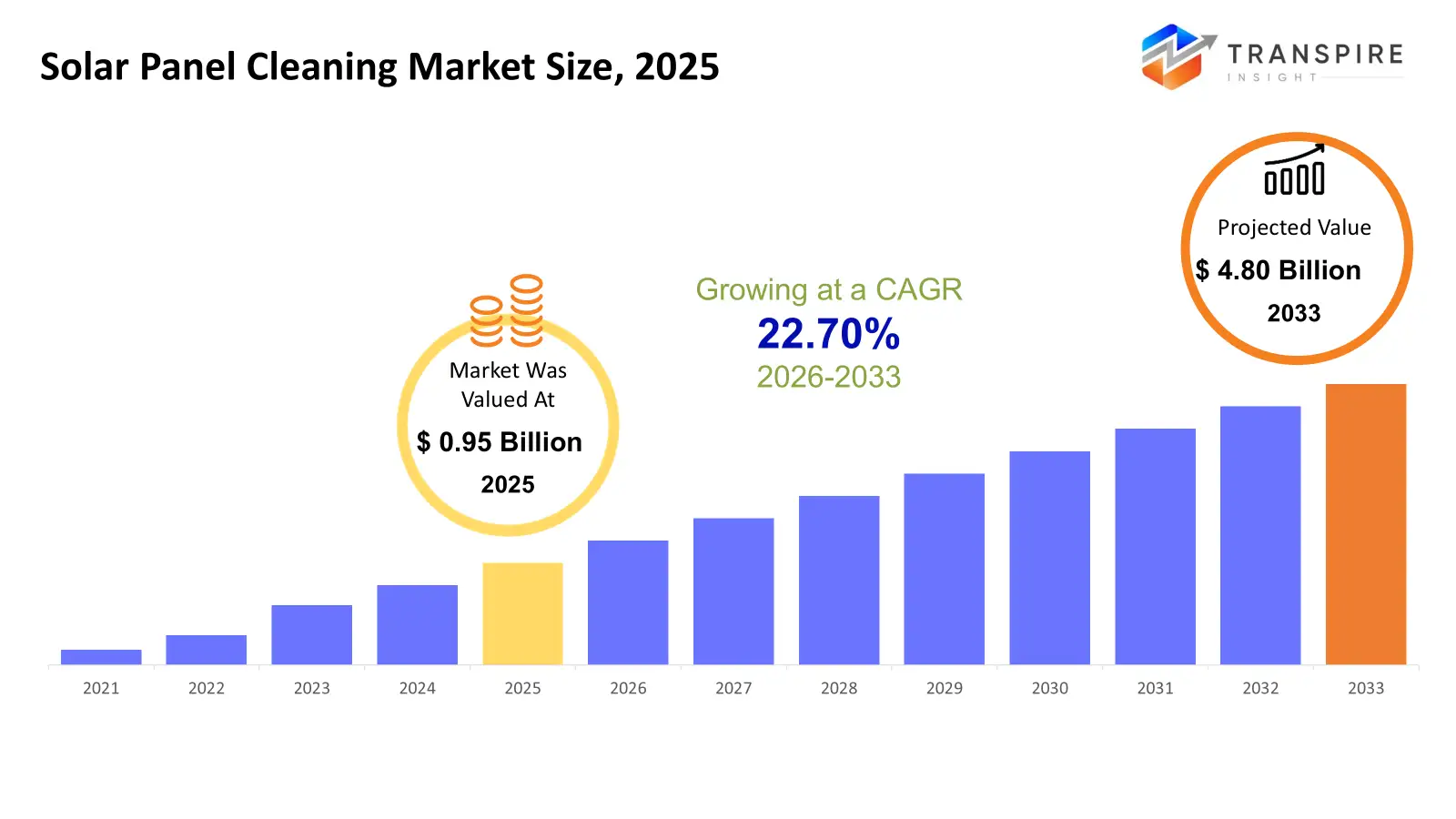
The global Solar Panel Cleaning market size was valued at USD 0.95 billion in 2025 and is projected to reach USD 4.80 billion by 2033, growing at a CAGR of 22.70% from 2026 to 2033. Out here, more solar panels mean more grime buildup, slowing things down. When the dust settles, power drops off fast. Cleaning steps in because dirty glass just does not cut it anymore. Panels work best when clear, so keeping them that way matters now more than ever.
Market Size & Forecast
- 2025 Market Size: USD 0.95 Billion
- 2033 Projected Market Size: USD 4.80 Billion
- CAGR (2026-2033): 22.70%
- North America: Largest Market in 2026
- Asia Pacific: Fastest Growing Market
To learn more about this report,  Download Free Sample Report
Key Market Trends Analysis
- The North American market share is estimated to be approximately 30% in 2026. Fueled by growing solar setups across the region, North America sees a rise in automated cleaning methods that reduce workforce demands. While panels spread wider, machines take over upkeep, slashing effort, shifting routines. With sunlight harnessed more each year, maintenance evolves beyond manual reach. Equipment rolls in where people once walked, quietly changing how sites stay clear.
- Fresh pressure to meet rules pushes cleaner energy setups in American homes, stores, and schools, many now turning to smart machines that wash panels using less water. Machines roll over rooftops where people once climbed, saving time while staying within legal lines drawn by officials watching closely. Even vast solar farms out west trade mops for robotics, cutting waste as droughts tighten their grip on supply. Rules shape choices, yes - but so does speed, since faster cleaning means more power hour after hour.
- Sun-powered setups across the Asia Pacific are expanding fast, mainly through massive solar fields. Because of this, machines that clean panels without harming nature are becoming more common. New tech spreads quickly here, helping these green methods take root. Growth pushes change, yet habits shift only when tools improve. Cleaner energy needs cleaner upkeep. This region shows how closely they link
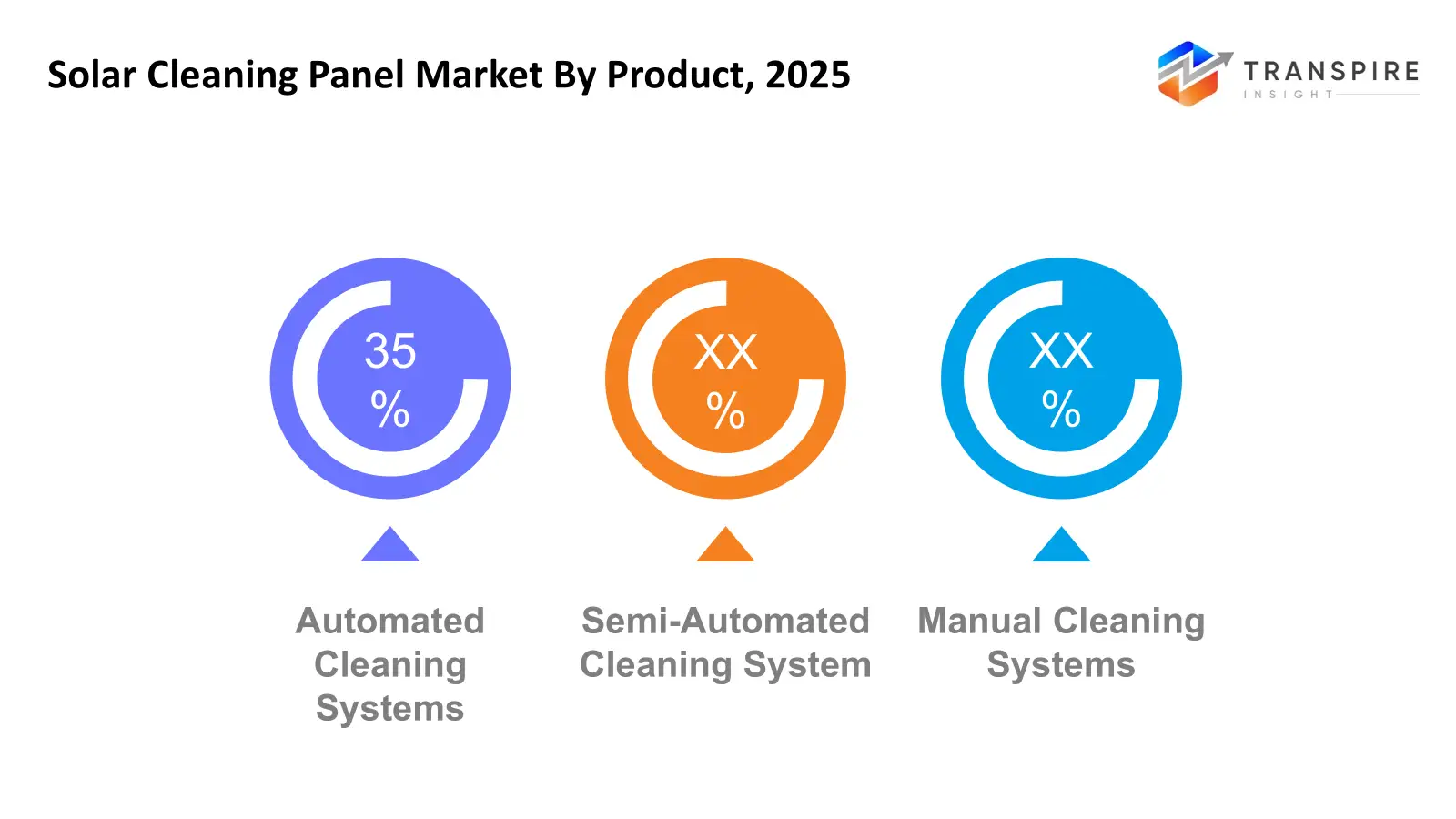
- Automated Cleaning Systems share approximately 37% in 2026. Robotic cleaners are becoming more common because they cut down on manpower needs. These systems handle big solar farms without slowing things down. Efficiency jumps when machines take over repetitive tasks. Labor costs drop as automation steps in. Large sites benefit most from consistent performance. Savings add up over time thanks to fewer workers needed. Machines work steadily where human crews might struggle.
- Water is saved when dry methods replace washing. Arid spots lean into no-water options more each year. Less runoff happens because cleaning skips liquids. Dirt lifts without droplets in these systems. Pressure or heat does the work instead of flow. Eco strain drops where water stays in pipes. Some places push this shift harder than others. Drought awareness drives change slowly but steadily. Machines adapt to run without soaking steps. Results stay clean even with zero splash.
- Robots that clean are getting smarter these days. Because of new tech like internet links and self-running systems, they work faster. Fewer breaks happen during chores now. Machines handle more tasks without stopping. Efficiency goes up when robots take over. Downtime drops because updates allow constant operation. Factories and offices notice the difference quickly.
- From sunrise to sunset, big solar fields need clean panels just right; too much dust cuts power fast. These vast spaces push demand because machines that scrub glass without fuss work best here. Efficiency matters most when acres of mirrors stretch far beyond sight. Keeping them clear means more juice flows steadily through the wires below.
Now more than ever, keeping solar panels clean matters because sunlight powers everything. When grime builds up dust, leaves, and bird mess it blocks rays, slowing down electricity flow. Efficiency dips without attention, so upkeep turns into a must across homes, businesses, rooftops, and fields. As a result, the solar panel cleaning market is gaining strong momentum, driven by demand for solutions that work well, last long, and are gentle on surfaces. Growing reliance on sun-driven systems pushes this need further each year.
Fresh tech changes are shifting how cleaning gets done. Robots now handle much of it, slipping between solar panels without stopping power flow. Efficiency pulls interest; fewer workers are needed, too. Though small sites still wipe panels by hand, bigger ones lean on clever machines that clean smarter. Growth rides on these updates, slowly replacing old ways across wide fields.
Water-saving habits shape how products sell today. Old ways soaked up too much liquid, filled buckets with harsh stuff. Now machines scrub smarter, leaving less behind. Cleaner results come without the waste, thanks to clever updates. Ideas spread fast when they work better and tread lightly. Progress hums along, fed by practical upgrades instead of big promises.
Not just about shine - keeping panels clean helps guard the money already spent on solar setups. With more and larger solar fields popping up, those running them want ways to stretch how long equipment lasts, avoid stoppages, and keep power flowing steadily. New ideas keep arriving, while a sharper eye on doing things right shapes what comes next for this space.
Solar Panel Cleaning Market Segmentation
By Product
- Automated Cleaning Systems
Sweeping across wide fields of panels, machines take charge where humans once spent hours under the sun. These robotic cleaners move on their own, guided by sensors instead of schedules. Without needing constant oversight, they keep surfaces clear using programmed routines. Where dust piles up fast, mechanical arms and small vehicles step in reliably. Labor shrinks dramatically when automation handles daily grime removal tasks.
- Manual Cleaning Systems
Some people clean smaller home solar panels by hand using basic tools. These systems rely on simple brushes that need human effort. Not every setup requires machines; many choose manual methods for their size. Physical scrubbing helps remove dirt when automated options are not needed. Effort goes directly into maintenance without extra equipment.
- Semi-Automated Cleaning Systems
A mix of machines and people handles cleaning in mid-sized setups. These systems rely on equipment that works with close human watch. The operation moves faster than fully hand-driven methods. Yet judgment still comes from staff on site. Automation takes care of repetitive tasks. Oversight ensures precision where needed most.
To learn more about this report, Download Free Sample Report
By Cleaning Method
- Water-Based Cleaning
Starting with water, this approach cleans by mixing in cleaning agents or skipping them entirely. From a different angle, it tackles grime through soaking and scrubbing actions. Sometimes, plain water does the job just fine on its own. Other times, added cleaners boost the outcome slightly. This way has been around for ages, passed down through everyday practice. It remains common because results show up clearly when done right.
- Waterless
Picking up dust without a drop of liqui that’s how it works. Brushes go over surfaces first, followed by tools that push away grime with air. Microfiber cloths come into play later, lifting particles quietly. Nothing gets wet during the process. No plumbing needed at any point. Machines stay safe, floors stay dry. Efficiency shows up in less waste overall.
- Chemical Cleaning
A splash of soap, then a slow lift of grime. Dirt gives way when foam spreads across the surface. Detergent works where wiping fails. Grubby corners loosen under thick bubbles. Debris slips off once soaked long enough.
By Component
- Cleaning Equipment
A machine hums while scrubbing floors on its own. Brushes spin fast, attached to rolling units that move without help. Tools powered by motors handle dust and grime in tight corners.
- Detergent & Cleaning Fluids
Frothy liquids splash into sinks, tackling grime through mixtures stirred with care. These blends slip into rinse cycles, breaking down mess without harsh effort.
- Monitoring & Control System
From tiny sensors to smart gadgets, these tools keep automated cleaning on track. Not just watching - adjusting through feedback loops built into control hubs. When dirt levels shift, responses follow without delay. Performance stays steady because systems talk to each other constantly. Even minor hiccups get corrected before they grow. Automation runs more smoothly when data flows freely between parts.
By End-Users
- Residential Installation
Roof tops at houses often hold solar panels that need compact ways to stay clean. Some homes rely on simple tools because space is tight up there. Cleaning these setups does not demand heavy equipment. Instead, light gear works better when access is tricky. Most household systems respond well to basic care routines.
- Commercial Installations
Medium-scale solar setups in offices, schools, and business complexes.
- Utility-Scale Solar Farms
A single dust particle can dim a sun-fed grid’s output. Machines roll across open fields of glass, wiping away what nature drops. Sunlight hits panels only when maintenance keeps pace with windblown grit. Efficiency lives in motion, brushes spinning, arms sweeping, silence between storms.
Regional Insights
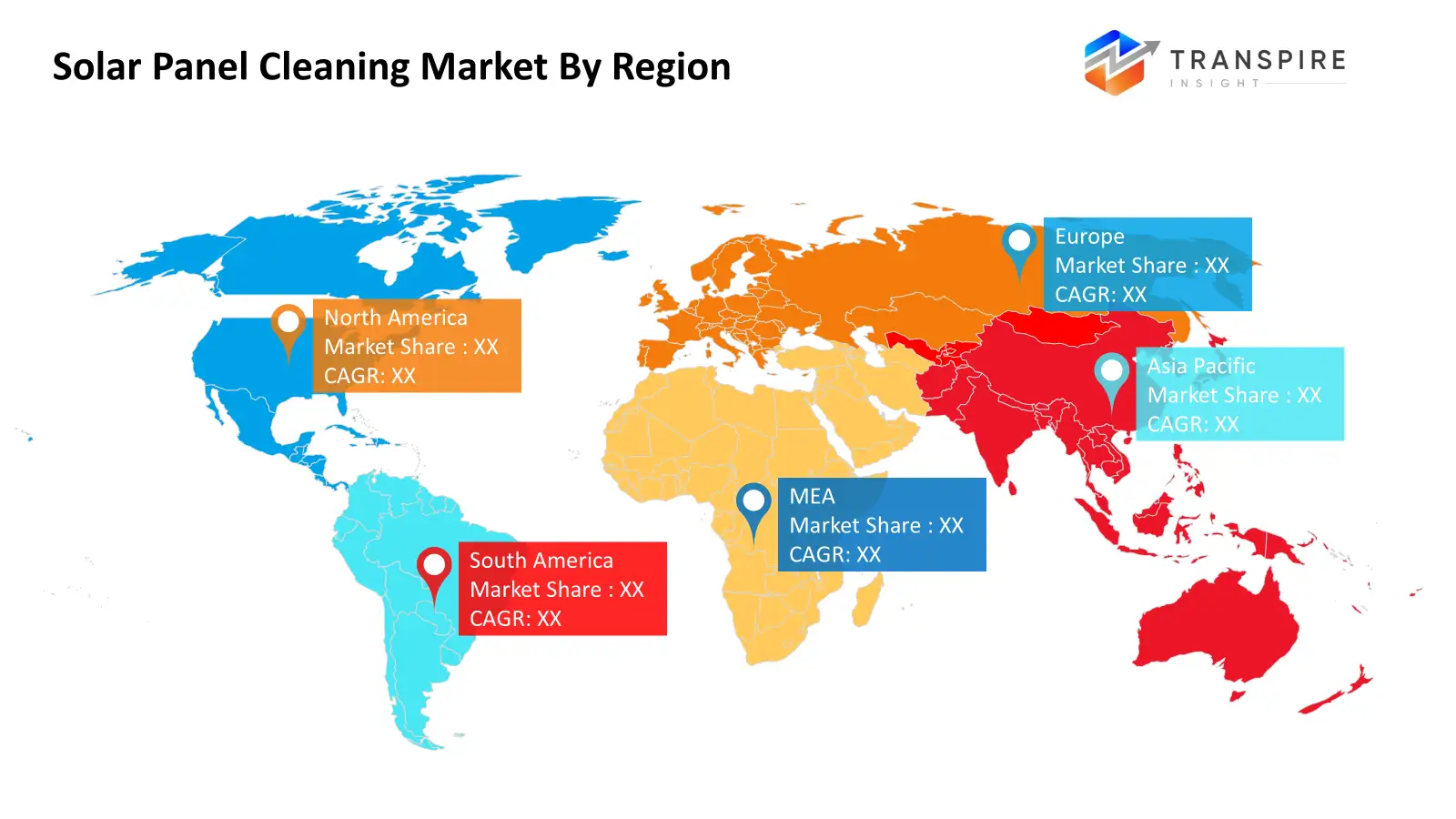
Solar power keeps spreading across North America, pushing more interest in clean panels. Growing numbers of solar farms pop up, needing regular upkeep that skips heavy labor. Machines designed to wash panels move into focus, fitting large sites and tight rooftops alike. Government programs help lower costs, making green energy choices easier for many. As sunlight gets turned into electricity on a larger scale, keeping surfaces clear becomes routine work.
Fueled by tight rules across Europe around clean power and planet-safe practices, smarter ways to wash solar panels are catching on. Because big solar fields need every drop of sun they can get, upgrades that save water while staying green push demand higher. Cleaner tech spreads faster.
It leads worldwide because solar power grows fast there, especially where nations such as China, India, and Japan push forward. Big solar farms rise alongside more panels on city rooftops. This mix pulls in need. Alongside come smart tools, like machines that clean without much water. Now look elsewhere: places across the Middle East and Africa begin adding lots too, their pace picking up steadily.
To learn more about this report, Download Free Sample Report
Recent Development News
- November 27, 2025 – Freyr Energy launched India’s first intelligent self-cleaning solar systems in Uttar Pradesh.
(Source:https://freyrenergy.com/news/self-cleaning-solar-system-uttar-pradesh/)
- April 24, 2025 – Chemitek Solar launched a new generation antistatic solution for solar panels.
|
Report Metrics |
Details |
|
Market size value in 2025 |
USD 0.95 Billion |
|
Market size value in 2026 |
USD 1.15 Billion |
|
Revenue forecast in 2033 |
USD 4.80 Billion |
|
Growth rate |
CAGR of 22.70% from 2026 to 2033 |
|
Base year |
2025 |
|
Historical data |
2021 – 2024 |
|
Forecast period |
2026 – 2033 |
|
Report coverage |
Revenue forecast, competitive landscape, growth factors, and trends |
|
Regional scope |
North America; Europe; Asia Pacific; Latin America; Middle East & Africa |
|
Country scope |
United States; Canada; Mexico; United Kingdom; Germany; France; Italy; Spain; Denmark; Sweden; Norway; China; Japan; India; Australia; South Korea; Thailand; Brazil; Argentina; South Africa; Saudi Arabia; United Arab Emirates |
|
Key company profiled |
Ecoppia, Kärcher, SolarCleano, SunBrush mobil, Serbot AG, Aegeus Technologies, Nomadd Desert Solar Solutions, Boson Robotics, Heliotex, AX System, Clean Solar Solutions, Indisolar Products Private Limited, Sharp Corporation, Saint‑Gobain Surface Conditioning, Premier Solar Cleaning, Solar Service Professionals |
|
Customization scope |
Free report customization (country, regional & segment scope). Avail customized purchase options to meet your exact research needs. |
|
Report Segmentation |
By Product (Automated Cleaning Systems, Manual Cleaning Systems, Semi-Automated Cleaning Systems), By Cleaning Method (Water-Based Cleaning, Waterless, Chemical Cleaning), By Component (Robots, Detergent & Cleaning Fluids, Monitoring & Control System), By End-Users (Residential Installation, Commercial Installation, Utility-Scale Solar Farms), |
Key Solar Panel Cleaning Company Insights
Solar panels at big plants often need cleaning, something Ecoppia tackles using robots instead of people. Its machines run without water, cutting environmental impact while boosting power production. Rather than relying on manual labor, these devices work steadily across vast fields under harsh conditions. Performance stays high even after months outdoors thanks to the durable engineering behind each unit. Around the world, plant managers choose this method when routine upkeep becomes too heavy a burden. Innovation drives updates, yet simplicity remains core to how every system functions day after day.
Key Solar Panel Cleaning Companies:
- Ecoppia
- Kärcher
- SolarCleano
- SunBrush mobil
- Serbot AG
- Aegeus Technologies
- Nomadd Desert Solar Solutions
- Boson Robotics
- Heliotex
- AX System
- Clean Solar Solutions
- Indisolar Products Private Limited
- Sharp Corporation
- Saint‑Gobain Surface Conditioning
- Premier Solar Cleaning
- Solar Service Professionals
Global Solar Panel Cleaning Market Report Segmentation
By Product
- Automated Cleaning Systems
- Manual Cleaning Systems
- Semi-Automated Cleaning Systems
By Cleaning Method
- Water-Based Cleaning
- Waterless
- Chemical Cleaning
By Component
- Robots
- Detergent & Cleaning Fluids
- Monitoring & Control System
By End-Users
- Residential Installation
- Commercial Installation
- Utility-Scale Solar Farms
Regional Outlook
- North America
- United States
- Canada
- Mexico
- Europe
- Germany
- United Kingdom
- France
- Spain
- Italy
- Rest of Europe
- Asia Pacific
- Japan
- China
- Australia & New Zealand
- South Korea
- India
- Rest of Asia Pacific
- South America
- Brazil
- Argentina
- Rest of South America
- Middle East & Africa
- Saudi Arabia
- United Arab Emirates
- South Africa
- Rest of the Middle East & Africa
Frequently Asked Questions
Find quick answers to common questions.
The approximate Solar Panel Cleaning Market size for the market will be USD 4.80 billion in 2033.
Key segments for the Solar Panel Cleaning Market are By Product (Automated Cleaning Systems, Manual Cleaning Systems, Semi-Automated Cleaning Systems), By Cleaning Method (Water-Based Cleaning, Waterless, Chemical Cleaning), By Component (Robots, Detergent & Cleaning Fluids, Monitoring & Control System), By End-Users (Residential Installation, Commercial Installation, Utility-Scale Solar Farms).
Major Solar Panel Cleaning Market players are Ecoppia, Kärcher, SolarCleano, and SunBrush mobil,.
The North America region is leading the Solar Panel Cleaning Market.
The Solar Panel Cleaning Market CAGR is 22.70%.
- Ecoppia
- Kärcher
- SolarCleano
- SunBrush mobil
- Serbot AG
- Aegeus Technologies
- Nomadd Desert Solar Solutions
- Boson Robotics
- Heliotex
- AX System
- Clean Solar Solutions
- Indisolar Products Private Limited
- Sharp Corporation
- Saint‑Gobain Surface Conditioning
- Premier Solar Cleaning
- Solar Service Professionals
Recently Published Reports
-
Apr 2026
Active Power Filter Market
Active Power Filter Market Size, Share & Analysis Report By Type (Shunt Active Power Filters, Series Active Power Filter, Hybrid Active Power Filter), By Application (Harmonics Mitigation, Reactive Power Compensation, Voltage Regulation, Power Factor Correction), By Phase (Single Phase, Three Phase), By End-User Industry (Manufacturing, Healthcare, Commercial, Automotive, Oil and Gas, Others), and Geography (North America, Europe, Asia-Pacific, Middle East and Africa, South and Central America), 2021 - 2031
-
Apr 2026
Electrical Transformer Market
Electrical Transformer Market Size, Share & Analysis Report By Core (Closed, Shell, and Berry), By Insulation (Gas, Oil, Solid, Air, and Other), By Phase (Single, and Three), By Rating (100 MVA to 500 MVA, 501 MVA to 800 MVA, and 801 MVA to 1200 MVA), and Geography (North America, Europe, Asia-Pacific, Middle East and Africa, South and Central America), 2021 – 2031
-
Apr 2026
Hydraulic Piston Pumps Market
Hydraulic Piston Pumps Market Size, Share & Analysis Report By Type (Axial Piston Pumps, Radial Piston Pumps), By Operating Pressure (Low Pressure, Medium Pressure, High Pressure), By Application (Construction, Mining, Agriculture, Automotive, Oil & Gas, Industrial Machinery, Others), By End-User (OEMs, Aftermarket), and Geography (North America, Europe, Asia-Pacific, Middle East and Africa, South and Central America), 2021 – 2031
-
Apr 2026
Laboratory Gas Generators Market
Laboratory Gas Generators Market Size, Share & Analysis Report By Product (Nitrogen Gas Generator, Hydrogen Gas Generator, Zero Air Gas Generator, Purge Gas Generator, TOC Gas Generators, Others), By Application (Gas Chromatography, Liquid Chromatography-mass Spectrometry (LC-MS), Gas Analyzers, Others), By End-user (Life Science, Chemical & Petrochemical, Food & Beverage, Others), and Geography (North America, Europe, Asia-Pacific, Middle East and Africa, South and Central America), 2021 – 2031