

United States Chronic Lower Back Pain Treatment Market Size & Forecast:
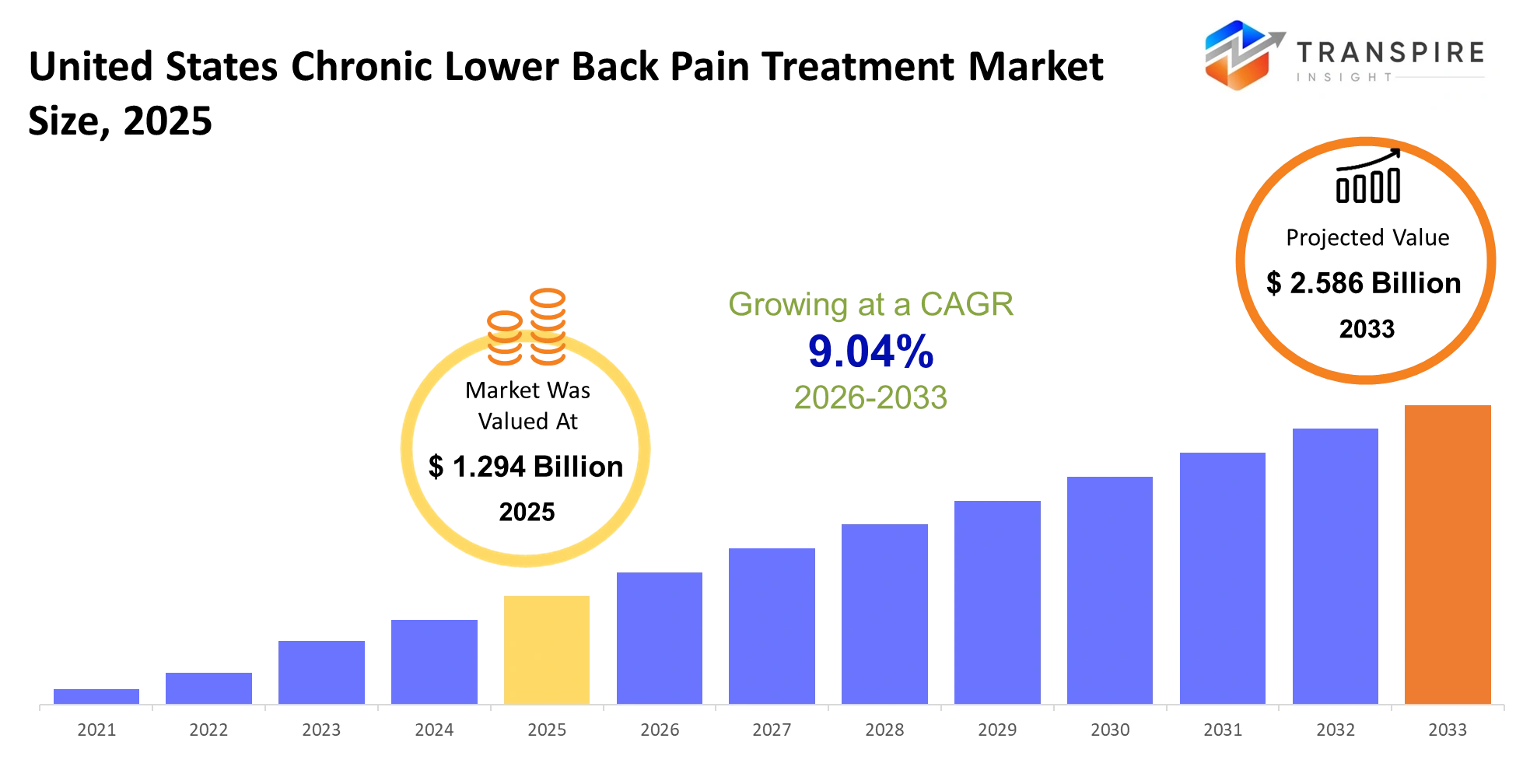
- United States Chronic Lower Back Pain Treatment Market Size 2025: USD 1.294 Billion
- United States Chronic Lower Back Pain Treatment Market Size 2033: USD 2.586 Billion
- United States Chronic Lower Back Pain Treatment Market CAGR: 9.04%
- United States Chronic Lower Back Pain Treatment Market Segments: By Treatment Type (Medication Therapy, Physical Therapy, Surgical Treatment, Chiropractic Care, Neurostimulation Therapy, Others), By Drug Type (NSAIDs, Opioids, Muscle Relaxants, Antidepressants, Corticosteroids, Others), By End User (Hospitals, Pain Management Clinics, Rehabilitation Centers, Ambulatory Surgical Centers, Others), By Application (Degenerative Disc Disease, Herniated Disc, Spinal Stenosis, Sciatica, Others).
To learn more about this report,  Download Free Sample Report
United States Chronic Lower Back Pain Treatment Market Summary:
The United States Chronic Lower Back Pain Treatment Market size is estimated at USD 1.294 Billion in 2025 and is anticipated to reach USD 2.586 Billion by 2033, growing at a CAGR of 9.04% from 2026 to 2033. The United States Chronic Lower Back Pain Treatment market kind a revolves around helping patients manage persistent spinal discomfort that basically keeps them from moving well , slows work output, worsens sleep quality, and gradually erodes long term physical capability. In real life it isn’t just one single thing it sort of spreads across pain medications, physical rehabilitation, minimally invasive procedures, spinal cord stimulation hardware, regenerative therapies, and even digital rehabilitation platforms that get used by hospitals, pain clinics, orthopedic centers, and outpatient care providers.
Over the last five years, the market has been drifting away from opioid-heavy pain control toward a more combined approaches mix , plus device-assisted therapies. That shift really gathered momentum after stricter opioid prescribing rules and tighter payer checking made clinicians lean into non-drug treatment pathways. Also the COVID-19 pandemic somehow nudged buying patterns by boosting tele-rehabilitation and remote musculoskeletal support, so chronic pain management became easier to reach beyond the traditional hospital setting
Right now, the growth seems linked to an aging population, desk bound work habits, and employer expectations aimed at lowering disability related productivity losses. As healthcare systems start emphasizing longer range functional recovery instead of fast symptom suppression, providers are routing more resources into personalized, tech-enabled care models , which in turn raises both procedure volumes and recurring treatment income.
Key Market Insights
- In 2025, the Southern United States basically dominated the United States Chronic Lower Back Pain Treatment Market with almost 38% market share, mostly because obesity rates are higher there and the populations are aging faster… or something like that.
- The Western region is projected to grow the quickest through 2032, helped by quick uptake of digital musculoskeletal care platforms, which people seem to trust more over time.
- Urban healthcare networks in California, Texas, and Florida keep expanding outpatient pain clinics, plus minimally invasive spine treatment centers are showing up more often as well.
- Medicare reimbursement support for interventional pain procedures also seemed to strengthen regional market penetration across high volume healthcare systems, so adoption becomes less hesitant.
- Minimally invasive treatment procedures accounted for over 34% of the United States Chronic Lower Back Pain Treatment Market share in 2025, largely due to quicker recovery times.
- Pharmacological therapies stayed in the second spot, backed by big prescription volumes and the ongoing need for chronic pain management, again and again.
- Spinal cord stimulation devices are expected to be the fastest-growing segment from 2026 to 2032, with double digit revenue growth predictions.
- Regenerative medicine therapies—like platelet-rich plasma injections—picked up momentum among orthopedic and sports medicine providers, since many patients ask for non-surgical options.
- Digital therapeutics and AI-enabled rehabilitation platforms are also starting to appear as major growth drivers within the musculoskeletal treatment industry size forecast, even though the rollout is still uneven.
- Degenerative disc disease treatment led the application side, holding nearly 31% revenue share in 2025, mainly because age-related spinal degeneration cases keep climbing.
- Post-surgical chronic pain management is forecast to grow the fastest through 2032, since revision surgeries keep increasing across the country, step by step.
What are the Key Drivers, Restraints, and Opportunities in the United States Chronic Lower Back Pain Treatment Market?
The strongest growth driver in the United States Chronic Lower Back Pain Treatment Market is basically the healthcare system’s drift away from long term opioid dependence toward interventional plus technology enabled pain management, uh and all that. This move really took off after stricter opioid prescribing guidelines , and also litigation costs kept climbing, so providers and payers ended up having to rethink chronic pain protocols. Hospitals and specialty clinics then started expanding spinal cord stimulation, minimally invasive procedures and even digital rehabilitation programs that try to show measurable functional outcomes. As insurers reimburse more non opioid therapies with fewer long run complication risks, treatment volumes keep edging up and recurring care revenues also keep rising, especially in outpatient settings.
Meanwhile, the market’s biggest structural hurdle is inconsistent reimbursement coverage for advanced therapies, like regenerative medicine and neuromodulation devices. A lot of insurers still treat newer treatments as elective or not sufficiently validated , so patients get stuck with higher out of pocket costs. Fixing this is not fast either, because reimbursement frameworks rely on long term clinical evidence, policy revisions and multi year payer negotiations. So adoption stays slower among middle income patients, and device manufacturers plus specialty treatment providers see delayed revenue realization.
A major future opportunity is AI-driven musculoskeletal care platforms that are also integrated with remote patient monitoring, kind of a full circle setup. Healthcare systems and employers are investing in digital spine care programs which combine wearable sensors, predictive analytics, and virtual physical therapy, so the care feels more continuous and less episodic.
What Has the Impact of Artificial Intelligence Been on the United States Chronic Lower Back Pain Treatment Market?
Artificial intelligence and advanced digital technologies are kinda reshaping the United States Chronic Lower Back Pain Treatment Market , mainly by boosting diagnosis accuracy, kind of automating patient monitoring, and generally improving how long-term therapy gets managed. AI-enabled imaging platforms help radiologists as well as spine specialists spot disc degeneration, nerve compression, and musculoskeletal abnormalities quicker than the older manual review method, it feels more direct and less time consuming. In practice, hospitals and orthopedic centers are also rolling out machine learning algorithms meant to foresee chronic pain trends and flag patients who might be at high risk for opioid dependency or possible post-surgical complications.
Then there are digital musculoskeletal platforms , which blend wearable sensors, motion tracking, and virtual rehabilitation tools. They do a lot more than “remind” people, they automate therapy adherence monitoring and tailor treatment intensity in near real time. A few providers say they see fewer dropout cases from physical therapy , plus rehabilitation timelines get shorter after using AI-assisted remote care systems. Predictive analytics meanwhile lets clinics fine-tune scheduling, cut down on unnecessary imaging procedures, and use interventional pain specialists more efficiently, which supports lower operating costs and also raises overall treatment throughput, without so much chaos.
On another note, spinal cord stimulation manufacturers are increasingly leaning on AI-driven programming software, to optimize neurostimulation patterns based on patient response data. This kinda makes pain relief feel more even, and could reduce the amount of follow up visits needed, just to make little adjustments. But also, AI adoption has its boundaries, mostly because patient data is kind of split up across separate systems and the integration varies a lot, even between one hospital network and the next. That situation caps model accuracy and slows down the large-scale rollout of advanced digital pain management platforms, even when everyone wants it to move faster.
Key Market Trends
- Since 2021, hospitals kinda dialed down opioid-first chronic pain programs, at the same time stricter prescribing rules pushed up the demand for interventional spine procedures and more non-pharmacological therapy options.
- Outpatient pain clinics expanded pretty hard between 2022 and 2025 , because insurers leaned toward cheaper ambulatory care versus inpatient spinal interventions, like it was the default choice.
- Medtronic and Boston Scientific also put more money into AI enabled spinal cord stimulation systems, with adaptive neurostimulation features after 2023 , sort of building around that “smart feedback” idea.
- Tele-rehabilitation picked up speed nearly 40% since the pandemic as healthcare systems folded virtual physical therapy into chronic musculoskeletal care pathways , and it stayed that way.
- Employers started shifting to preventive musculoskeletal health programs after remote work setups made people more sedentary, which tied into rising lower back pain claims starting around 2020.
- Regenerative medicine clinics kept growing their use of platelet-rich plasma and stem-cell based therapies, even though reimbursement was inconsistent , so broader nationwide adoption was kinda throttled through 2025.
- Health systems leaned more on wearable motion tracking devices after 2022 to track rehab participation and reduce repeat visits to specialists for chronic pain patients , rather than just relying on follow-ups.
- Private equity money into specialty spine and pain management clinics rose a lot since 2021, which then drove consolidation across those fractured regional networks for care.
- Medicare reimbursement updates nudged minimally invasive lumbar decompression procedures forward , so adoption grew among older patients across outpatient care facilities.
- By 2024, digital musculoskeletal platforms rolled in predictive analytics plus patient monitoring tools, which helped clinicians reduce therapy drop-out rates and support better long-term functional results.
United States Chronic Lower Back Pain Treatment Market Segmentation
By Treatment Type
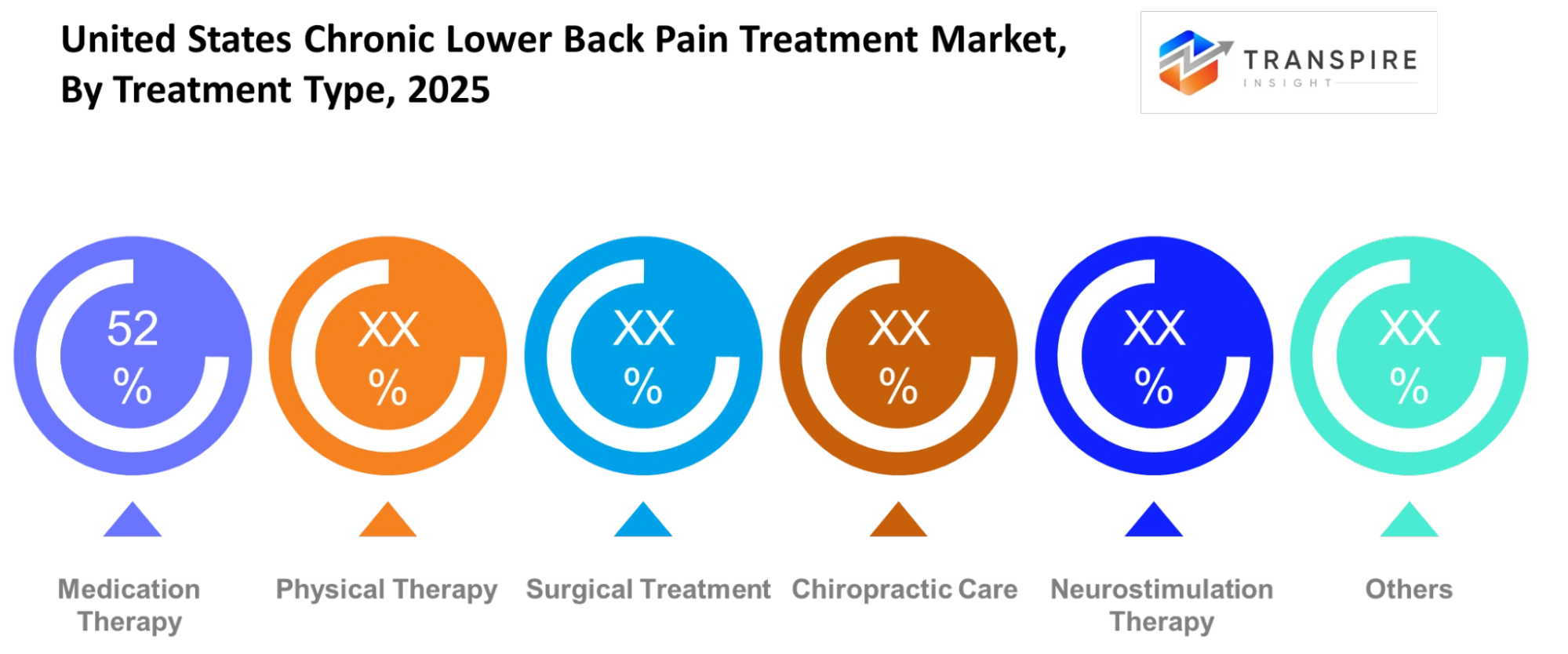
Medication therapy still seems to stay at the front of the pack in the treatment type segmentation, mostly because many healthcare providers keep leaning on pharmacological pain control as sort of the first step for chronic low back pain management. Physical therapy follows not far behind, thanks to broader insurance coverage and this growing inclination toward non invasive recovery routes . Surgical treatment, meanwhile , sits with a smaller but pretty steady slice , since spinal fusion and decompression procedures are still kind of unavoidable for especially severe structural disorders. Neurostimulation therapy and chiropractic care are also gaining momentum, with clinicians looking for options beyond opioid heavy treatment protocols , which is where the interest is moving.
At the same time, demand for spinal cord stimulation systems keeps rising, driven by better long term pain management outcomes as well as stronger reimbursement support for minimally invasive interventions. Looking ahead , growth is expected to tilt toward combined care models, mixing rehabilitation, digital monitoring and targeted interventional procedures in one go. Manufacturers are putting serious money into wearable rehabilitation systems and AI assisted therapy optimization tools, while investors keep focusing on outpatient musculoskeletal care platforms , attracted by recurring treatment related revenue potential.
To learn more about this report, Download Free Sample Report
By Drug Type
NSAIDs basically dominate the drug type segment, mostly because physicians widely prescribe anti-inflammatory medications for ongoing pain management, and also for better mobility. Muscle relaxants plus corticosteroids still hold up, especially during acute flare-ups and when spine issues are tied to inflammation . Opioids, which were once a major revenue driver, now see declining prescription volumes due to more strict federal prescribing rules and the added litigation exposure connected to addiction concerns . Antidepressants are also getting more common for neuropathic pain, in part because healthcare providers more and more understand how chronic pain links to mental health disorders.
Right now the growth trajectory favors safer, lower-dependency drug categories that match payer preferences and the long-term adherence goals, more than “volume chasing” alone. Pharmaceutical companies keep expanding their research on non-opioid formulations and combination therapies, aimed at lowering adverse effects while still improving functional recovery rates. In the future, competition within this segment will probably be decided by clinical outcome proof, reimbursement placement, and how well patients stay on therapy over time, not only by prescription volume .
By End-User
Hospitals still look like the main end-user group , mostly because big healthcare systems can bundle advanced imaging , multidisciplinary spine expertise, and get patients to surgical specialists all inside one treatment network. Pain management clinics have been growing very fast lately, over the last five years, in part because more patients are trying minimally invasive procedures in settings that are not really inpatient hospitals. Rehabilitation centers keep building momentum too , since physical recovery programs now tend to matter more within chronic pain care pathways, not just as a “later step”. Ambulatory surgical centers are also showing up as one of the quickest categories, driven by lower procedure costs, shorter patient stays, and better insurer reimbursement economics.
Overall demand is moving toward more decentralized outpatient care setups that can lower total treatment expenses while still keeping procedures efficient. On top of that, technology adoption inside these environments is accelerating, especially with AI-driven rehabilitation tracking plus remote patient monitoring systems. Investors, and operators as well, are responding by scaling specialty pain clinics and outpatient spine treatment networks across dense urban markets.
By Application
Degenerative disc disease comes up as the leading application segment, sort of because aging populations keep expanding , and sedentary habits keep going, which then pushes long term spinal deterioration higher across the United States. Treatments for herniated disc and sciatica still take up a lot of procedure volumes, mainly from more workplace musculoskeletal strain and obesity related spinal complications that don’t really give much slack. Spinal stenosis demand is rising steadily, especially for older patients who are often asking for minimally invasive decompression procedures, not the more traditional surgery path. In the clinics, the focus is also drifting toward earlier detection and a longer functional management plan, rather than only fast symptom control. And honestly that is becoming the main vibe, like a theme you keep hearing, over and over.Providers are increasingly leaning on imaging analytics, motion tracking rehabilitation systems, and therapy plans that are personalized, so treatment precision improves for chronic spinal conditions.
Looking ahead, application growth should likely concentrate on preventive musculoskeletal care plus remote rehabilitation management platforms, ones that aim to lower disability claims and reduce repeat interventions over time. Device manufacturers, and rehabilitation technology firms as well, are positioning pretty aggressively here, since healthcare systems are prioritizing recovery outcomes you can actually measure and cost efficient chronic pain management approaches.
What are the Key Use Cases Driving the United States Chronic Lower Back Pain Treatment Market?
Degenerative disc disease is still basically the main reason behind treatment demand, I mean aging populations keep growing and a lot of people work in sedentary setups, so chronic spinal pain keeps climbing. Hospitals and pain management clinics then rack up the biggest procedure counts via medication therapy , physical rehabilitation, and those minimally invasive spinal interventions that are fairly common now.
After surgery rehab is also moving fast , plus workplace musculoskeletal injury management keeps getting more attention across rehab centers and ambulatory surgical facilities. In logistics , manufacturing, and even healthcare, employers are funding chronic pain programs more often , mainly to cut absenteeism, reduce disability claims, and limit those long term productivity losses tied to spinal disorders.
Newer things are showing up too , like AI-guided remote rehabilitation and wearable motion tracking systems that are meant for home based recovery checkups. Personalized neurostimulation therapies, and regenerative medicine treatments as well, look promising for the long haul, since specialty clinics want options beyond opioid dependent pain management or invasive spinal surgery, or at least they hope for alternatives.
|
Report Metrics |
Details |
|
Market size value in 2025 |
USD 1.294 Billion |
|
Market size value in 2026 |
USD 1.411 Billion |
|
Revenue forecast in 2033 |
USD 2.586 Billion |
|
Growth rate |
CAGR of 9.04% from 2026 to 2033 |
|
Base year |
2025 |
|
Historical data |
2021 - 2024 |
|
Forecast period |
2026 - 2033 |
|
Report coverage |
Revenue forecast, competitive landscape, growth factors, and trends |
|
Geographic scope |
United States of America |
|
Key company profiled |
Pfizer, Johnson & Johnson, Medtronic, Abbott Laboratories, Boston Scientific, Stryker, Zimmer Biomet, Eli Lilly, Teva Pharmaceuticals, Endo Pharmaceuticals, Nevro, Omron Healthcare, SpineThera, Bausch Health, Sanofi. |
|
Customization scope |
Free report customization (country, regional & segment scope). Avail customized purchase options to meet your exact research needs. |
|
Report Segmentation |
By Treatment Type (Medication Therapy, Physical Therapy, Surgical Treatment, Chiropractic Care, Neurostimulation Therapy, Others), By Drug Type (NSAIDs, Opioids, Muscle Relaxants, Antidepressants, Corticosteroids, Others), By End User (Hospitals, Pain Management Clinics, Rehabilitation Centers, Ambulatory Surgical Centers, Others), By Application (Degenerative Disc Disease, Herniated Disc, Spinal Stenosis, Sciatica, Others). |
Which Regions are Driving the United States Chronic Lower Back Pain Treatment Market Growth?
The North East part of the United States tends to lead the chronic lower back pain treatment market,mostly because there’s a heavy clustering of advanced hospital networks, and frankly a lot of specialists are close by. Also strong reimbursement structures from private insurers and Medicare expansion help make spinal cord stimulation, and then different interventional pain procedures, show up more often in day to day practice. A lot of the academic medical centers in states like New York, and Massachusetts add momentum too by pushing clinical innovation in neuromodulation and regenerative spine therapies. And because the region is quick to take on new tools, hospitals often blend AI-supported imaging with digital rehabilitation systems into what feels like the normal care pathway. You end up with a fairly mature healthcare environment, including well established outpatient spine clinics,which helps keep procedure volumes steady and keeps high-value treatment utilization from dropping off.
In comparison the Midwest looks more like a steady, structured contributor. That’s largely linked to big employer sponsored healthcare systems, plus solid occupational injury management programs. Manufacturing and logistics bring in continuous demand for chronic pain care,especially when repetitive strain and workplace spinal injuries are involved. Here adoption feels more practical, leaning toward cost efficient outpatient procedures and conservative treatment pathways, not so much rapid technology experimentation like you might see elsewhere. Regional hospital networks also hold long-term arrangements with device suppliers, so procurement cycles for pain management equipment stay predictable. That kind of predictability, in turn, supports a gradual but consistent revenue stream across pharmaceutical providers and rehabilitation service organizations.
Western United States is showing the quickest growth momentum, it seems kinda driven by a fast expansion of outpatient surgical centers and digital musculoskeletal care platforms, you know. In places like California and Washington tele-rehabilitation adoption has sped up after recent workforce mobility trends and also because of tech-sector healthcare investments. Venture capital funding has kept backing AI enabled pain management startups, they fold in wearable sensors and predictive therapy analytics, sort of in a smooth package. Meanwhile infrastructure upgrades in ambulatory care networks have made it easier to access minimally invasive spinal procedures across a lot of urban and suburban areas. Overall this signals real entry opportunities for device manufacturers and digital health firms aiming at scalable, subscription based chronic pain treatment solutions all the way through 2033.
Who are the Key Players in the United States Chronic Lower Back Pain Treatment Market and How Do They Compete?
Competition in the United States chronic lower back pain treatment market stays pretty moderately consolidated in the advanced device areas, but it’s still kind of all over the place when you look at outpatient clinics and pharmaceutical therapies. Big medical technology companies go after neurostimulation performance, imaging integration, and also that payer reimbursement alignment, while smaller pain clinics lean into service speed and these localized care models. In the end, competitive advantage is looking more and more like it depends on clinical outcomes data plus digital therapy integration , and that’s where the real stickiness comes from.
Medtronic concentrates on spinal cord stimulation systems with adaptive pulse tech, adjusting therapy based on patient feedback data, which helps improve long-term device retention over time. Abbott sets itself apart with Bluetooth-enabled neuromodulation platforms so clinicians can make remote adjustments, and that can reduce follow up visits. Boston Scientific pushes forward through minimally invasive spine solutions and it also uses targeted acquisitions of pain management startups, which then strengthens its outpatient procedure footprint across ambulatory surgical centers in several major U.S. states.
Pfizer really leans into non-opioid pharmacological pipelines aimed at neuropathic pain mechanisms, and it uses the whole clinical trial depth thing to nudge payers toward acceptance and help with formulary placement, sort of. Meanwhile Johnson & Johnson mixes its orthopedic device background with rehabilitation technologies, and it keeps expanding via partnerships with spine care networks as well as outpatient surgical facilities that are more integrated than before. Both of them, in a way, sharpen their positioning by stitching together drug-device treatment pathways and by rolling out evidence-based chronic pain management programs across hospital systems and those employer sponsored healthcare contracts.
Company List
- Pfizer
- Johnson & Johnson
- Medtronic
- Abbott Laboratories
- Boston Scientific
- Stryker
- Zimmer Biomet
- Eli Lilly
- Teva Pharmaceuticals
- Endo Pharmaceuticals
- Nevro
- Omron Healthcare
- SpineThera
- Bausch Health
- Sanofi
Recent Development News
In May 2026, Medtronic to Acquire SPR Therapeutics for $650 Million: Medical technology company Medtronic announced plans to acquire SPR Therapeutics to strengthen its chronic pain treatment portfolio. The acquisition expands Medtronic’s non-opioid neurostimulation offerings aimed at chronic lower back pain and related conditions in the U.S. market. The deal reflects increasing investment in minimally invasive pain management technologies.
Source: https://www.reuters.com
In January 2026, Boston Scientific Highlights Long-Term Spinal Cord Stimulation Data at NANS 2026: Boston Scientific presented new long-term clinical outcomes at the North American Neuromodulation Society (NANS) 2026 meeting. The studies demonstrated sustained effectiveness of spinal cord stimulation therapies for chronic pain, including chronic lower back pain management, reinforcing the company’s expansion in neuromodulation treatments.
Source: https://news.bostonscientific.com
What Strategic Insights Define the Future of the United States Chronic Lower Back Pain Treatment Market?
The United States chronic lower back pain treatment market is kinda moving, structurally, toward more integrated technology-led care ecosystems that blend interventional procedures, digital rehabilitation, and data-driven pain management too. This change is pushed by payer pressure to cut down long-term disability costs, and also by provider demand for outcomes that are actually measurable functionally, not just symptom based treatment alone. Over the next 5 to 7 years, value creation should concentrate in outpatient neuromodulation, AI-enabled rehabilitation platforms, and minimally invasive spine interventions that shorten recovery cycles and reduce how much patients depend on hospitals.
There’s also a hidden risk though, reimbursement fragmentation for advanced digital therapeutics and regenerative procedures, which could end up slowing adoption even with strong clinical validation. If payer policies don’t standardize coverage, then innovation uptake might stay uneven across states and different patient groups, and that could limit scalable revenue realization for the technology providers, overall.
At the same time, an emerging opportunity is the convergence of wearable motion analytics with closed-loop spinal cord stimulation systems, these are already being piloted in a few select U.S. academic hospitals. By combining them you get real-time therapy adjustment based on patient mobility data, which sounds straightforward but is pretty powerful. Market participants should prioritize payer-aligned clinical evidence generation and also build partnerships with outpatient surgical networks, to speed up reimbursement acceptance and help scale across decentralized care environments.
United States Chronic Lower Back Pain Treatment Market Report Segmentation
By Treatment Type
- Medication Therapy
- Physical Therapy
- Surgical Treatment
- Chiropractic Care
- Neurostimulation Therapy
- Others
By Drug Type
- NSAIDs
- Opioids
- Muscle Relaxants
- Antidepressants
- Corticosteroids
- Others
By End User
- Hospitals
- Pain Management Clinics
- Rehabilitation Centers
- Ambulatory Surgical Centers
- Others
By Application
- Degenerative Disc Disease
- Herniated Disc
- Spinal Stenosis
- Sciatica
- Others
Frequently Asked Questions
Find quick answers to common questions.
The approximate United States Chronic Lower Back Pain Treatment Market size for the market will be USD 2.586 Billion in 2033.
The key segments of the United States Chronic Lower Back Pain Treatment Market are By Treatment Type (Medication Therapy, Physical Therapy, Surgical Treatment, Chiropractic Care, Neurostimulation Therapy, Others), By Drug Type (NSAIDs, Opioids, Muscle Relaxants, Antidepressants, Corticosteroids, Others), By End User (Hospitals, Pain Management Clinics, Rehabilitation Centers, Ambulatory Surgical Centers, Others), By Application (Degenerative Disc Disease, Herniated Disc, Spinal Stenosis, Sciatica, Others).
Major players in the United States Chronic Lower Back Pain Treatment Market are Pfizer, Johnson & Johnson, Medtronic, Abbott Laboratories, Boston Scientific, Stryker, Zimmer Biomet, Eli Lilly, Teva Pharmaceuticals, Endo Pharmaceuticals, Nevro, Omron Healthcare, SpineThera, Bausch Health, Sanofi.
The current market size of the United States Chronic Lower Back Pain Treatment Market is USD 1.294 Billion in 2025.
The United States Chronic Lower Back Pain Treatment Market CAGR is 9.04%.
- Pfizer
- Johnson & Johnson
- Medtronic
- Abbott Laboratories
- Boston Scientific
- Stryker
- Zimmer Biomet
- Eli Lilly
- Teva Pharmaceuticals
- Endo Pharmaceuticals
- Nevro
- Omron Healthcare
- SpineThera
- Bausch Health
- Sanofi
Recently Published Reports
-
May 2026
Biosimilars Market
Biosimilars Market By Product Type (Monoclonal Antibodies, Recombinant Hormones, Erythropoietin, G-CSF, Others), By Indication (Oncology, Autoimmune Diseases, Blood Disorders, Diabetes, Others), By Manufacturing Type (In-House Manufacturing, Contract Manufacturing), By Distribution Channel (Hospital Pharmacies, Retail Pharmacies, Online Pharmacies), By Industry Analysis, Size, Share, Growth, Trends, and Forecasts 2021-2033
-
Apr 2026
Gastrointestinal Endoscopy Market
Gastrointestinal Endoscopy Market By Type (Rigid Gastrointestinal Endoscope, Flexible Gastrointestinal Endoscopes, Disposable Gastrointestinal Endoscope), By Procedure Type (Colonoscopy, Gastroscopy, Duodenoscopy, Enteroscopy, Flexible Sigmoidoscopy, Others), By Application (Diagnosis, Treatment), By End-Users (Hospitals, Ambulatory Surgical Centers, Specialty Clinics, Laboratories, Others), By Industry Analysis, Size, Share, Growth, Trends, and Forecasts 2021-2033
-
Apr 2026
Rare Inherited Metabolic Disorder Drug Market
Rare Inherited Metabolic Disorder Drug Market By Drug Class (Enzyme Replacement Drugs, Gene Therapy Drugs, Substrate Reduction Drugs, Small Module Drugs, Protein Drugs), By Route of Administration(Parenteral, Oral, Intrathecal), By Clinical Development (Marketed Drugs, Late Stage Clinical Phase III, Early Stage Clinical Phase I-II, Preclinical Candidates), By Indication (Lysosomal Storage Disorders, Urea Cycle Disorders, Amino Acid Metabolic Disorders, organic Acidemias, Peroximal Disorders), By Industry Analysis, Size, Share, Growth, Trends, and Forecasts 2021-2033
-
Jan 2026
Pharmaceutical Cleanroom Technology Market
Pharmaceutical Cleanroom Technology Market By Product (Equipment, Consumables, Services); By Cleanroom Type (Standard Cleanrooms, Modular Cleanrooms); By End Use (Pharmaceutical Companies, Biotechnology Companies), By Industry Analysis, Size, Share, Growth, Trends, and Forecasts 2021-2033