
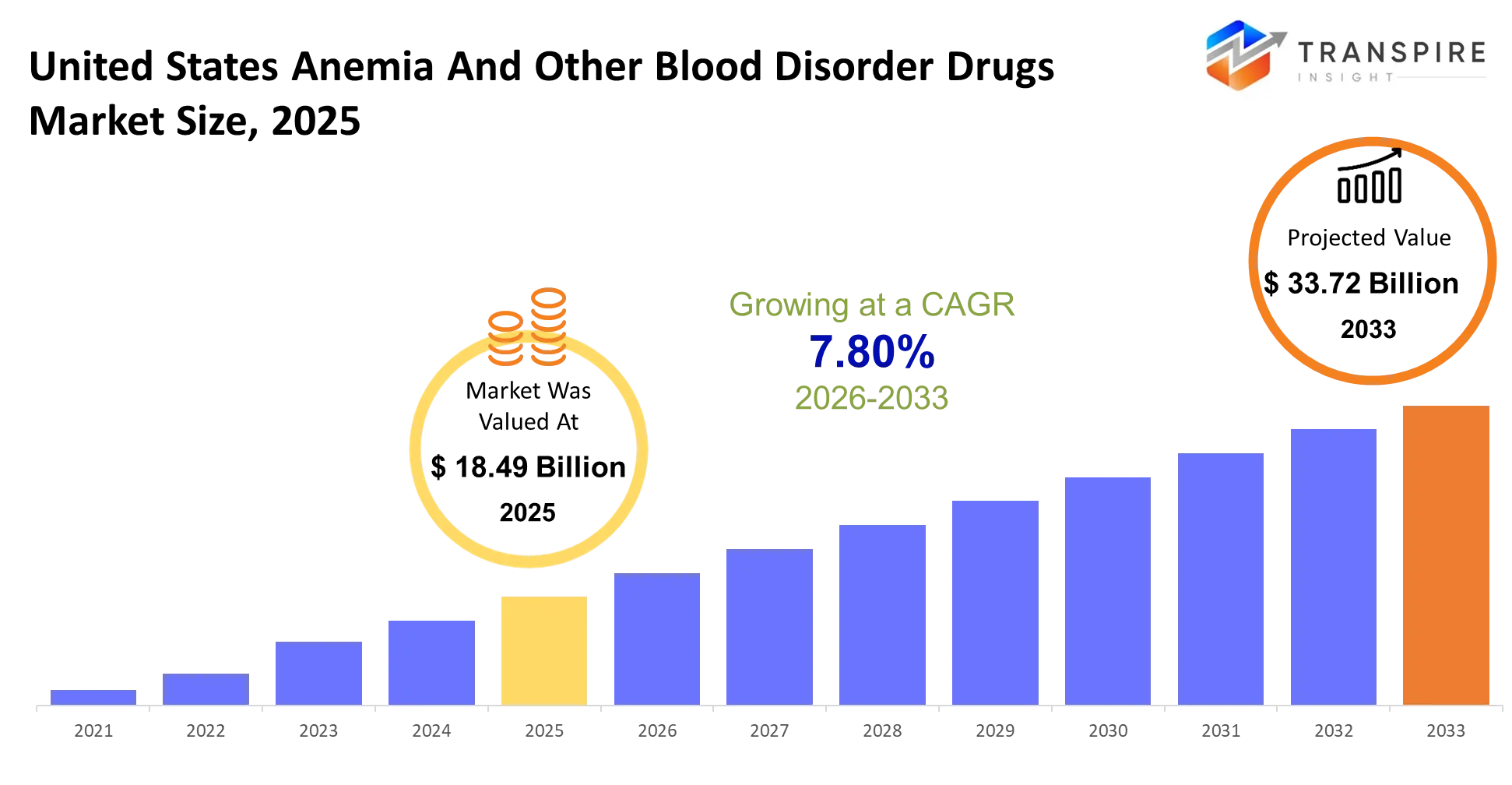
United States Anemia And Other Blood Disorder Drugs Market Size & Forecast:
- United States Anemia And Other Blood Disorder Drugs Market Size 2025: USD 18.49 Billion
- United States Anemia And Other Blood Disorder Drugs Market Size 2033: USD 33.72 Billion
- United States Anemia And Other Blood Disorder Drugs Market CAGR: 7.80%
- United States Anemia And Other Blood Disorder Drugs Market Segments: By Drug Type (Erythropoiesis-stimulating Agents, Iron Supplements, Monoclonal Antibodies, Gene Therapies, Immunosuppressants, Others); By Disorder Type (Iron Deficiency Anemia, Sickle Cell Disease, Thalassemia, Hemophilia, Aplastic Anemia, Others); By Distribution Channel (Hospital Pharmacies, Retail Pharmacies, Online Pharmacies, Others); By End User (Hospitals, Specialty Clinics, Home Care Settings, Others)
To learn more about this report,  Download Free Sample Report
United States Anemia And Other Blood Disorder Drugs Market Summary
The United States Anemia And Other Blood Disorder Drugs Market was valued at USD 18.49 Billion in 2025. It is forecast to reach USD 33.72 Billion by 2033. That is a CAGR of 7.80% over the period.
The United States Anemia and other blood disorder drugs market supports clinical management of conditions that mess with oxygen transport and clotting, including chronic kidney disease related anemia, hemophilia, sickle cell disease and thalassemia. In day to day practice, these therapies cut down the need for repeated transfusions, help steady hemoglobin levels, and let patients go through surgery or long term dialysis with fewer complications.
Over the last 3 to 5 years, the market seems to have shifted structurally away from usual transfusion and iron supplementation, and more toward biologics, like erythropoiesis-stimulating agents, and also gene-based therapies. This really kind of signals disease modification more than just symptom control, you know. One solid trigger was the COVID-19 period , which stressed the blood donation networks and made hospitals lean on outpatient routes and self-administered treatment pathways instead. That disruption then basically accelerated the rollout of long-acting injectables and other advanced therapies, so revenue started leaning more heavily toward high-value specialty drugs, while reliance on episodic hospital care went down a bit.
Key Market Insights
- The United States Anemia And Other Blood Disorder Drugs Market is basically helped along by the expanding uptake of biologics, cell therapies, and precision hematology care models across specialty care networks, a lot of clinics are leaning in now.
- More advanced treatments for sickle cell disease and hemophilia are changing the overall industry size story, because pharmaceutical companies are pushing curative program pipelines harder and harder, you can see the shift.
- Also, regulatory backing for orphan drugs sped up approvals from 2021 to 2025, and that kind of thing strengthens market share chances for rare blood disorder medicines, sooner than many expected.
- In the Northeast region, the United States Anemia And Other Blood Disorder Drugs Market dominates, with roughly 34% share in 2025, largely due to advanced hematology centers and their patient volumes.
- Meanwhile, biologics along with erythropoiesis-stimulating agents remained the leading product segment, with close to 38% of revenue share in 2025 across anemia treatment uses.
- Iron deficiency anemia drugs stayed pretty much the second biggest segment , mainly because they’re used a lot in chronic kidney disease and oncology supportive care places where doctors prefer dependable options.
- Gene therapies look set to be the quickest growing segment from 2026 to 2030 after big regulatory approvals for sickle cell disease treatment innovations , kind of a turnaround moment for the market.
- Oral iron therapies keep getting solid uptake thanks to cost efficiency , though premium biologics end up driving stronger revenue growth across specialty drug channels , you know the usual trend.
- Chronic kidney disease - associated anemia contributed close to 31% of the United States Anemia And Other Blood Disorder Drugs Market share in 2025 .
- Hospitals and specialty hematology clinics led the way with more than 52% share in 2025 , because complex biologics often need carefully monitored administration and ongoing follow up care after initiation .
What are the Key Drivers, Restraints, and Opportunities in the United States Anemia And Other Blood Disorder Drugs Market?
The primary driver speeding up the United States Anemia and Other Blood Disorder Drugs Market is the quick movement toward gene based and biologic therapies for long term hematologic disorders. That move really picked up after the approvals for more advanced treatments related to sickle cell disease and hemophilia, with orphan drug incentives kicking in and also faster regulatory review pathways in play. Pharmaceutical firms then started leaning harder into specialty hematology pipelines, well because these high value therapies seem to deliver much higher revenue per patient than the older approaches, like iron supplementation, or transfusion support. And on the provider side, hospitals plus specialty clinics are likewise focusing on long acting options that can cut down readmissions and also reduce transfusion dependence, so overall adoption has improved across larger healthcare systems.
Still, the largest restraint in the market is the expensive price tag and operational overhead tied to advanced blood disorder therapies. Gene therapies usually call for specialized treatment centers, cold chain logistics, and extended patient follow up, which puts up structural obstacles that you can’t sort out overnight. On top of that, reimbursement discussions with insurers keep pushing access further out, especially when therapies are priced at the multimillion dollar level. So even with strong clinical interest, commercial uptake stays slow and revenue growth gets held back.
A major opportunity is showing up kinda quietly through outpatient hematology infrastructure and that personalized medicine platform thing. Healthcare networks across the United States are expanding infusion centers, along with precision diagnostics, to help with earlier action in sickle cell disease and rare anemia cases. There are companies pushing CRISPR based therapies and AI assisted diagnostic tools, so they’re set up to gain because precision treatment models start becoming commercially scalable.
What Has the Impact of Artificial Intelligence Been on the United States Anemia And Other Blood Disorder Drugs Market?
Artificial intelligence and advanced digital technologies are reshaping the United States Anemia and Other Blood Disorder Drugs Market, kind of by improving diagnostic precision, treatment planning , and clinical workflow efficiency all at once. Hospitals and specialty hematology centers are now increasingly using AI-driven analytics platforms to automate patient risk stratification for sickle cell disease, thalassemia, and even chemotherapy-induced anemia. Machine learning models can comb through electronic health records, genetic profiles ,and laboratory trends, to catch early-stage complications before severe symptoms show up. As a result, diagnosis timelines have been shortened, and patient monitoring feels more consistent across large healthcare systems.
On the development side drug makers are also, kind of leaning into predictive algorithms during clinical trials to fine tune patient recruitment and anticipate how well the treatments might work. AI supported trial design reduces protocol amendments , and it tends to improve enrollment efficiency so development costs can drop and regulatory submission timelines can move faster. In everyday commercial practice digital adherence platforms, and remote monitoring tools let physicians observe hemoglobin shifts plus transfusion schedules in real time which supports treatment continuity and cuts down on preventable hospital stays.Some healthcare providers even mention operational efficiency gains, including lower readmission rates and quicker treatment adjustments.
Still, AI adoption has a major snag because hematology datasets remain fragmented across hospitals, laboratories ,and specialty clinics. With limited interoperability and inconsistent patient data quality, model accuracy can suffer, and large-scale rollout of predictive clinical systems becomes slower than it should be.
Key Market Trends
- Since 2022, hospitals have started to rely less on everyday transfusions by leaning into longer acting biologics , and sort of more targeted therapies for chronic anemia handling, in a way that felt pretty systematic but not always identical everywhere.
- Vertex Pharmaceuticals and CRISPR Therapeutics kicked the competitive pace up after gene-editing approvals changed the outlook for sickle cell care during 2023 , and again through 2024.
- Medicare reimbursement reforms pushed specialty clinics toward outpatient infusion styles , which in turn reduced how much inpatient care depended on transfusions across major hematology networks since 2021.
- After FDA fast track programs squeezed the review timelines for rare blood disorder treatments , pharmaceutical manufacturers ramped up their orphan drug pipeline investments, a lot more than before.
- AI-assisted diagnostics really picked up momentum after 2022, because healthcare systems used predictive analytics to spot anemia complications earlier, before emergency hospitalization somehow had to happen.
- Intravenous iron therapy became more common across oncology centers , since clinicians wanted quicker hemoglobin stabilization during chemotherapy treatment cycles, especially when schedules were tight.
- Since 2020, blood supply shortages have made providers prioritize remedies that reduce how often transfusions are needed, mainly for sickle cell disease and thalassemia care.
- Biosimilar competition increased pricing pressure on erythropoiesis-stimulating agents, so companies tried to stand out with longer dosing intervals, and also with patient support programs.
- Between 2023 and 2025, specialty pharmacies broadened distribution partnerships, which improved access nationally to self administered hematology therapies and home monitoring tools.
- Clinical trial sponsors started using decentralized recruitment platforms more often after 2021, which lowered enrollment delays for rare anemia and hemophilia study protocols, even when sites were farther apart.
United States Anemia And Other Blood Disorder Drugs Market Segmentation
By Drug Type:
Erythropoiesis-stimulating agents are taking up a pretty important spot in the United States Anemia And Other Blood Disorder Drugs Market , mainly because treatment demand keeps climbing among patients dealing with chronic kidney disease and cancer-related anemia. Hospitals and specialty centers often suggest these therapies so they can help kick-start red blood cell production, and at the same time lower transfusion dependency. Iron supplements also keep things steady in demand , since iron deficiency shows up a lot across different age groups.
Monoclonal antibodies along with gene therapies are starting to get, more attention too, mostly because the advanced treatment options are becoming more widely available inside the healthcare system. Gene therapies, in particular, help sustain long term control for inherited blood disorders, while immunosuppressants still remain important for aplastic anemia care. Other medication categories keep backing supportive care, plus add-on combination therapies, and this allows physicians to tune the whole treatment program based on how severe the disease is , and on how the patient responds overall.
By Disorder Type:
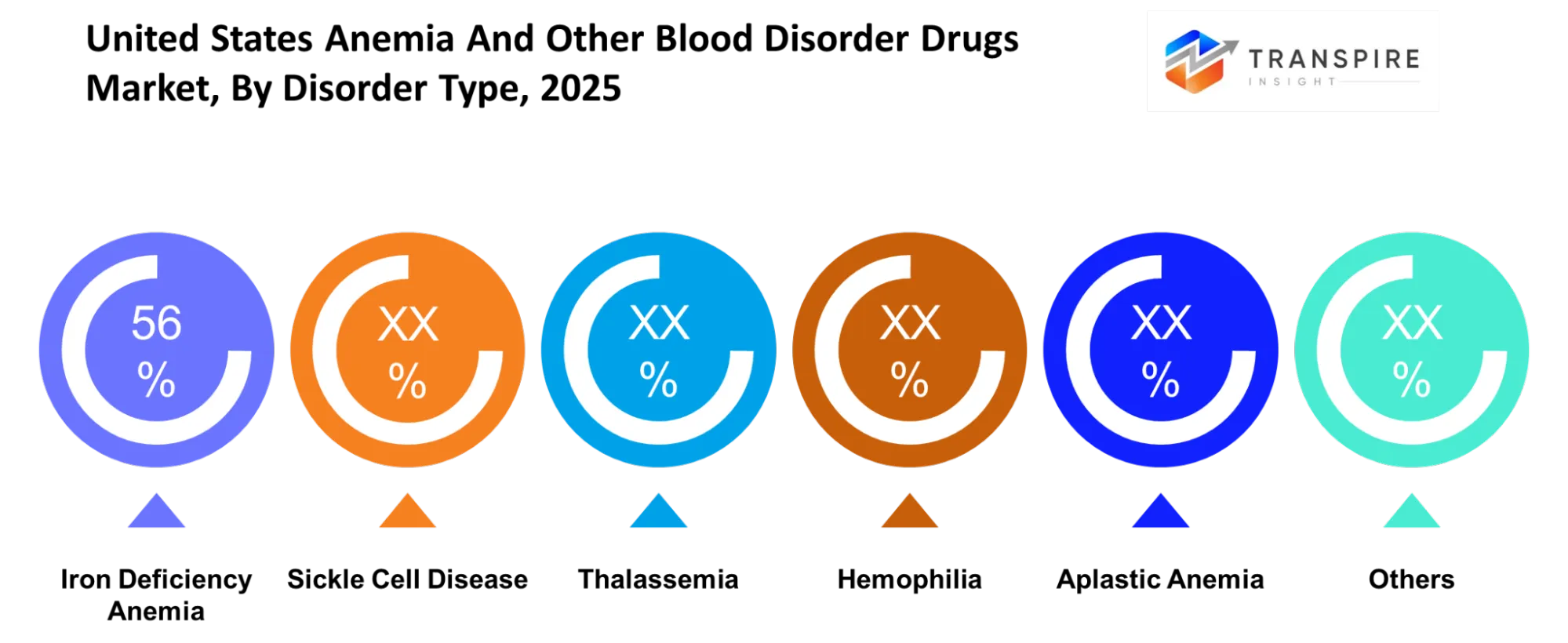
Iron deficiency anemia makes up a pretty big share of the United States Anemia and Other Blood Disorder Drugs Market, mainly because nutritional shortfalls, pregnancy-linked issues, and long term illnesses keep going up, so more patients are showing up. Doctors and other healthcare providers are leaning into earlier detection and quicker care, which in turn is helping prescriptions rise for iron based treatments, plus those supportive medicines you see in hospitals and outpatient clinics.
At the same time, sickle cell disease and thalassemia care demand is growing too, partly from higher public awareness and steady progress in specialty drug development. Hemophilia treatment keeps moving forward with longer-lasting therapies , and this makes life easier for patients, while also dialing down the number of times they have to visit the hospital. Meanwhile, aplastic anemia and several other rare blood disorders need more specialized treatment plans, and that’s nudging pharmaceutical companies to put money into focused drugs, and research programs across the United States healthcare ecosystem.
To learn more about this report, Download Free Sample Report
By Distribution Channel:
Hospital pharmacies count for quite a notable part of the United States Anemia and Other Blood Disorder Drugs Market, simply because many severe blood disorder treatments need physician oversight and very controlled dispensing settings. In practice hospitals manage advanced therapies, emergency care , and injectable medications, so the demand stays steady through institutional buying programs. There are also specialty treatment initiatives that keep hospital pharmacy involvement high across different urban zones and regional healthcare centers.
At the same time, retail pharmacies keep widening access to prescription medicines for long term anemia management and supportive treatments. Online pharmacies are also growing, largely because people want convenient medicine delivery and they like the ability to compare prices more easily. Digital healthcare platforms are further smoothing the process, helping patients refill their prescriptions faster and with less friction. Meanwhile, other pathways like specialty distributors add fuel to market growth by supporting therapies for rare diseases and by handling temperature sensitive biologic products properly.
By End User:
Hospitals still stay as the leading end user segment in the United States Anemia And Other Blood Disorder Drugs Market because lots of complex blood disorders really need continuous oversight, laboratory work, and advice from a specialist, in practice this is hard to shift elsewhere. Big healthcare institutions are ramping up spending on newer treatment technologies and patient management platforms which in turn helps demand keep rising for newer drugs and biologic treatments, used both in urgent, and longer term care setups too.
At the same time, specialty clinics are taking on more weight, since dedicated treatment centers can offer more tailored guidance for sickle cell disease, thalassemia, and hemophilia. Home care is growing as well, because an increasing number of patients want support outside the traditional hospital surroundings. With advances in self administration therapies, plus remote monitoring services, people can handle chronic blood disorders with a bit more ease, and fewer trips to healthcare facilities.
What are the Key Use Cases Driving the United States Anemia And Other Blood Disorder Drugs Market?
The largest use case in the United States Anemia and Other Blood Disorder Drugs Market stay tied to chronic kidney disease–related anemia management, sort of the main routine. Dialysis centers, and hospital nephrology departments rely heavily on erythropoiesis stimulating agents, plus intravenous iron therapies because these options cut transfusion dependence and help keep long term patient care costs more stable.
Secondary applications are growing fast, especially across oncology and inherited blood disorder care. Cancer centers often use anemia drugs to handle chemotherapy induced hemoglobin loss, but then specialty hematology clinics are also moving toward advanced biologics for people with sickle cell disease and hemophilia. They tend to need continuous monitoring, and targeted therapy administration.
Newer use cases are also showing up around gene editing therapies and more personalized hematology treatment platforms. Academic medical centers and biotechnology backed treatment networks are testing CRISPR based therapies and AI guided diagnostics to spot high risk patients earlier, and then route individualized treatment pathways. The idea is to bring down hospitalization frequency over the forecast period, even if the rollout timing is a little uneven in practice.
|
Report Metrics |
Details |
|
Market size value in 2025 |
USD 18.49 Billion |
|
Market size value in 2026 |
USD 19.93 Billion |
|
Revenue forecast in 2033 |
USD 33.72 Billion |
|
Growth rate |
CAGR of 7.80% from 2026 to 2033 |
|
Base year |
2025 |
|
Historical data |
2021 - 2024 |
|
Forecast period |
2026 - 2033 |
|
Report coverage |
Revenue forecast, competitive landscape, growth factors, and trends |
|
Geographic scope |
United States of America |
|
Key company profiled |
Pfizer, Novartis, Bristol Myers Squibb, Roche, Takeda Pharmaceutical, Sanofi, CSL Behring, Amgen, Bluebird Bio, Vertex Pharmaceuticals, Agios Pharmaceuticals, Novo Nordisk, Bayer, AstraZeneca, Eli Lilly |
|
Customization scope |
Free report customization (country, regional & segment scope). Avail customized purchase options to meet your exact research needs. |
|
Report Segmentation |
By Drug Type (Erythropoiesis-stimulating Agents, Iron Supplements, Monoclonal Antibodies, Gene Therapies, Immunosuppressants, Others); By Disorder Type (Iron Deficiency Anemia, Sickle Cell Disease, Thalassemia, Hemophilia, Aplastic Anemia, Others); By Distribution Channel (Hospital Pharmacies, Retail Pharmacies, Online Pharmacies, Others); By End User (Hospitals, Specialty Clinics, Home Care Settings, Others) |
Which Regions are Driving the United States Anemia And Other Blood Disorder Drugs Market Growth?
The Northeast region kinda leads the United States Anemia and Other Blood Disorder Drugs Market, mostly because it sort of stacks together advanced academic hospitals, solid insurance coverage, and clustered hematology research infrastructure. States like Massachusetts , New York and Pennsylvania have big specialty treatment centers that manage high volumes of rare blood disorder cases, and also run quite a lot of clinical trials. On top of that the region gets a push from early uptake of gene therapies and biologics since there is better reimbursement alignment between private insurers and large healthcare systems. Altogether this whole ecosystem helps speed up commercialization of newer therapies, and it also gives pharmaceutical companies more direct access to specialized patient communities, plus research partnerships that are easy to grow.
Meanwhile the Midwest stays a steady contributor to market revenue because it has a wide hospital network, well integrated healthcare systems, and fairly consistent chronic disease management programs. Compared with the Northeast, this area leans less on having therapy concentration at the highest cutting edge and more on reliable use of anemia drugs across dialysis centers and oncology clinics. Big health providers in Illinois, Ohio, and Minnesota keep investing in long-range outpatient treatment infrastructure that supports fairly predictable demand for erythropoiesis-stimulating agents and iron therapies. Because operations are stable, the Midwest turns into a solid revenue foundation for manufacturers, they often want steady prescription volumes rather than just premium specialty concentration.
The Southern United States is kinda emerging as the fastest-growing region, thanks to more sickle cell disease treatment access and also higher investment in specialty hematology services. States like Texas, Georgia, and Florida have increased funding for rare disease programs while hospital systems keep expanding outpatient infusion and transfusion centers, like it’s a priority or something. Growth seemed to really accelerate after newer gene based therapies got regulatory approvals, and that kind of nudged providers into modernizing treatment pathways and diagnostic capabilities too, even if it takes time. For the 2026 to 2033 stretch, this whole regional expansion is expected to open up major opportunities for biotechnology firms, specialty pharmacies, and investors who are focused on scalable hematology treatment infrastructure, especially those who want dependable growth.
Who are the Key Players in the United States Anemia And Other Blood Disorder Drugs Market and How Do They Compete?
The United States Anemia and Other Blood Disorder Drugs Market kind of operates in a moderately consolidated, competitive space, where big pharmaceutical companies basically run most of the known anemia therapies, but biotechnology firms disrupt the whole picture with gene-editing methods and precision hematology ideas. Lately, competition feels more about how durable the treatment is, whether payers will actually reimburse it, and how quickly it can cut down long-term transfusion dependence… not just about “what the price is.” The established players defend their share by extending specialty portfolios and locking in payer agreements, while the newer entrants tend to push curative approaches aimed at sickle cell disease and other rare inherited blood disorders. Firms that have strong biologics manufacturing skills and solid clinical trial networks get a commercial edge, since the regulatory approval routes for hematology therapies are still complex and they require a lot of capital
Pfizer competes using a large scale hematology setup plus diversified oncology support products that help keep hospital prescribing relationships in place. The company kind of differentiates itself with a broad reimbursement footprint, plus an integrated specialty distribution network across the United States, which feels pretty important. Novartis leans hard into targeted hematology innovation and it also puts money into advanced cell and gene therapy capabilities to strengthen its rare disease pipeline. Overall, the whole strategy sort of centers on high value therapies, backed by precision diagnostics and supported by long term specialty care partnerships .
Bluebird Bio kinda separates itself with gene therapies made for transfusion dependent blood disorders, so it lands in that narrow space of curative development. They keep pushing forward via specialized treatment center partnerships that help with administering those intricate therapies, and yeah, there’s the whole part about long term patient monitoring too. Meanwhile Vertex Pharmaceuticals is going hard, using CRISPR based collaborations meant to turn out next generation sickle cell therapies for real commercial use. That tech forward way of doing things gives them a competitive advantage in the top tier treatment lanes, where clinical results and lower lifetime care costs strongly steer adoption choices.
Company List
- Pfizer
- Novartis
- Bristol Myers Squibb
- Roche
- Takeda Pharmaceutical
- Sanofi
- CSL Behring
- Amgen
- Bluebird Bio
- Vertex Pharmaceuticals
- Agios Pharmaceuticals
- Novo Nordisk
- Bayer
- AstraZeneca
- Eli Lilly
Recent Development News
In December 2025, Agios Pharmaceuticals launched AQVESME following expanded U.S. FDA approval for treating anemia in adults with alpha- or beta-thalassemia, strengthening the company’s rare blood disorder portfolio and expanding treatment options in the U.S. market.
Source https://www.reuters.com/
In January 2024, Takeda Pharmaceutical Company entered a worldwide licensing and collaboration agreement with Protagonist Therapeutics for rusfertide, a late-stage rare hematology drug candidate, with the partnership supporting co-development and commercialization efforts in blood disorder treatment markets including the United States.
Source https://www.takeda.com/
What Strategic Insights Define the Future of the United States Anemia And Other Blood Disorder Drugs Market?
In the next 5 to 7 years, the United States Anemia and Other Blood Disorder Drugs Market is expected to drift , more or less, toward treatment models that feel more tailored and maybe even curative, with things powered by gene editing, precision diagnostics, and long-acting biologics. Over time, revenue growth will move away from high volume supportive therapies, and slide toward premium specialty treatments instead , the goal being to lower lifetime transfusion dependence while also cutting down hospital use.In turn, this transition will likely bolster biotechnology firms, along with specialized treatment networks, inside the wider hematology ecosystem.
One sort of hidden risk is the growing concentration of advanced therapy manufacturing capacity among only a few suppliers and treatment centers. If reimbursement disputes show up, or if production delays, or regulatory quality concerns emerge, patient access could slow down a lot, even if clinical demand stays strong. So you end up with an operational vulnerability that is not fully captured in today’s growth projections.
An emerging opportunity also shows up via AI-supported hematology diagnostics that get integrated into outpatient care networks, especially across underserved Southern states where sickle cell disease prevalence is higher. Companies trying to enter this space should put partnerships first with regional hospital systems and specialty infusion centers, because localized treatment infrastructure will become a real competitive differentiator as advanced therapies scale commercially.
United States Anemia And Other Blood Disorder Drugs Market Report Segmentation
By Drug Type
- Erythropoiesis-stimulating Agents
- Iron Supplements
- Monoclonal Antibodies
- Gene Therapies
- Immunosuppressants
By Disorder Type
- Iron Deficiency Anemia
- Sickle Cell Disease
- Thalassemia
- Hemophilia
- Aplastic Anemia
By Distribution Channel
- Hospital Pharmacies
- Retail Pharmacies
- Online Pharmacies
By End User
- Hospitals
- Specialty Clinics
- Home Care Settings
Frequently Asked Questions
Find quick answers to common questions.
The United States Anemia And Other Blood Disorder Drugs Market size is USD 33.72 Billion in 2033.
Key segments for the United States Anemia And Other Blood Disorder Drugs Market are By Drug Type (Erythropoiesis-stimulating Agents, Iron Supplements, Monoclonal Antibodies, Gene Therapies, Immunosuppressants, Others); By Disorder Type (Iron Deficiency Anemia, Sickle Cell Disease, Thalassemia, Hemophilia, Aplastic Anemia, Others); By Distribution Channel (Hospital Pharmacies, Retail Pharmacies, Online Pharmacies, Others); By End User (Hospitals, Specialty Clinics, Home Care Settings, Others).
Major United States Anemia And Other Blood Disorder Drugs Market players are Pfizer, Novartis, Bristol Myers Squibb, Roche, Takeda Pharmaceutical, Sanofi, CSL Behring, Amgen, Bluebird Bio, Vertex Pharmaceuticals, Agios Pharmaceuticals, Novo Nordisk, Bayer, AstraZeneca, Eli Lilly.
The United States Anemia And Other Blood Disorder Drugs Market size is USD 18.49 Billion in 2025.
The United States Anemia And Other Blood Disorder Drugs Market CAGR is 7.80% from 2026 to 2033.
- Pfizer
- Novartis
- Bristol Myers Squibb
- Roche
- Takeda Pharmaceutical
- Sanofi
- CSL Behring
- Amgen
- Bluebird Bio
- Vertex Pharmaceuticals
- Agios Pharmaceuticals
- Novo Nordisk
- Bayer
- AstraZeneca
- Eli Lilly
Recently Published Reports
-
May 2026
Biosimilars Market
Biosimilars Market By Product Type (Monoclonal Antibodies, Recombinant Hormones, Erythropoietin, G-CSF, Others), By Indication (Oncology, Autoimmune Diseases, Blood Disorders, Diabetes, Others), By Manufacturing Type (In-House Manufacturing, Contract Manufacturing), By Distribution Channel (Hospital Pharmacies, Retail Pharmacies, Online Pharmacies), By Industry Analysis, Size, Share, Growth, Trends, and Forecasts 2021-2033
-
Apr 2026
Gastrointestinal Endoscopy Market
Gastrointestinal Endoscopy Market By Type (Rigid Gastrointestinal Endoscope, Flexible Gastrointestinal Endoscopes, Disposable Gastrointestinal Endoscope), By Procedure Type (Colonoscopy, Gastroscopy, Duodenoscopy, Enteroscopy, Flexible Sigmoidoscopy, Others), By Application (Diagnosis, Treatment), By End-Users (Hospitals, Ambulatory Surgical Centers, Specialty Clinics, Laboratories, Others), By Industry Analysis, Size, Share, Growth, Trends, and Forecasts 2021-2033
-
Apr 2026
Rare Inherited Metabolic Disorder Drug Market
Rare Inherited Metabolic Disorder Drug Market By Drug Class (Enzyme Replacement Drugs, Gene Therapy Drugs, Substrate Reduction Drugs, Small Module Drugs, Protein Drugs), By Route of Administration(Parenteral, Oral, Intrathecal), By Clinical Development (Marketed Drugs, Late Stage Clinical Phase III, Early Stage Clinical Phase I-II, Preclinical Candidates), By Indication (Lysosomal Storage Disorders, Urea Cycle Disorders, Amino Acid Metabolic Disorders, organic Acidemias, Peroximal Disorders), By Industry Analysis, Size, Share, Growth, Trends, and Forecasts 2021-2033
-
Jan 2026
Pharmaceutical Cleanroom Technology Market
Pharmaceutical Cleanroom Technology Market By Product (Equipment, Consumables, Services); By Cleanroom Type (Standard Cleanrooms, Modular Cleanrooms); By End Use (Pharmaceutical Companies, Biotechnology Companies), By Industry Analysis, Size, Share, Growth, Trends, and Forecasts 2021-2033