
South Korea Touch Screen Display Market Size & Forecast:
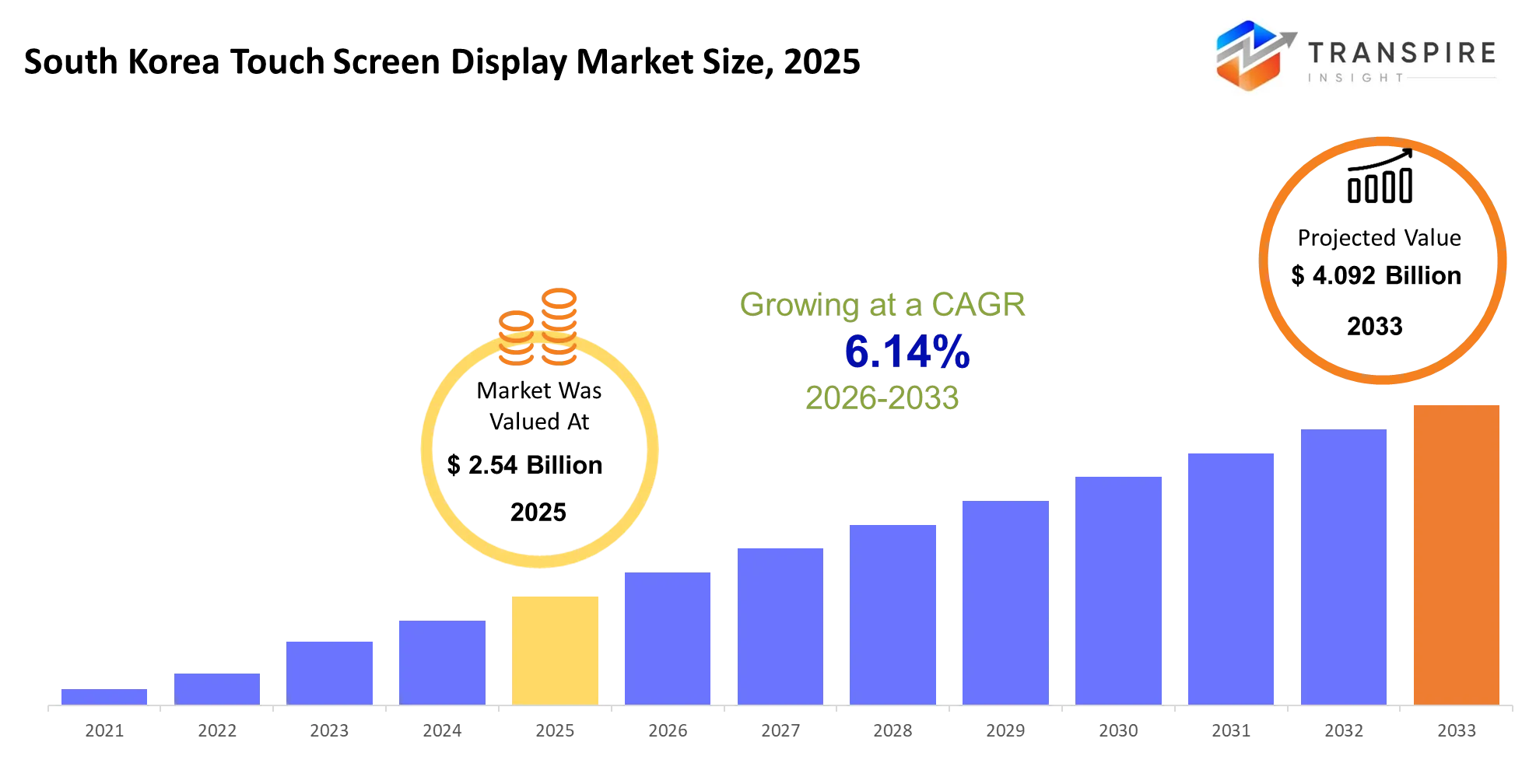
- South Korea Touch Screen Display Market Size 2025: USD 2.54 Billion
- South Korea Touch Screen Display Market Size 2033: USD 4.092 Billion
- South Korea Touch Screen Display Market CAGR: 6.14%
- South Korea Touch Screen Display Market Segments: By Technology (Capacitive Touch Screens, Resistive Touch Screens, Infrared Touch Screens, Surface Acoustic Wave Touch Screens, Others); By Application (Smartphones, Tablets, Automotive Displays, Industrial Displays, Retail Kiosks, Others); By Display Type (LCD Touch Displays, OLED Touch Displays, Flexible Touch Displays, Others); By End User (Consumer Electronics Companies, Automotive OEMs, Retail Sector, Others); By Screen Size (Small-sized Displays, Medium-sized Displays, Large-sized Displays, Others)
To learn more about this report,  Download Free Sample Report
South Korea Touch Screen Display Market Summary
The South Korea Touch Screen Display Market was valued at USD 2.54 Billion in 2025. It is forecast to reach USD 4.092 Billion by 2033. That is a CAGR of6.14% over the period.
In South Korea, touch screen displays kind of act as the main human–machine interface across industrial control panels, maritime navigation systems, automotive infotainment units, and factory automation terminals. In practice, they let operators manage intricate processes in real time, so people can lean less on manual controls and also get better precision in those high pressure settings like ship bridges, smart factories, and logistics hubs.
Over the last 3–5 years , you can really see the market moving away from resistive and the more basic single layer capacitive panels toward more advanced multi touch setups, plus tougher OLED and TFT-LCD options that are built alongside industrial IoT systems. Another structural turn was the push to AI enabled, and edge connected display modules , these help with real time diagnostics and predictive control.
The COVID-19 driven supply chain disruption basically made everyone speed up local sourcing approaches and it also encouraged manufacturers to spread production across more suppliers. So, this mix of automation demand and supply chain resilience has boosted adoption in maritime electronics, semiconductor fabs, and smart infrastructure deployments, and it tends to show up as stronger integration revenue for display manufacturers too.
Key Market Insights
- South Korea Touch Screen Display Market seems to show solid integration, especially across automotive and semiconductor manufacturing systems, with more advanced HMI being adopted lately.
- Industrial automation is sitting at about 32% share in 2025, basically fueled by smart factory expansion across South Korea.
- Meanwhile display module upgrades, moving from LCD to OLED-based touch systems, reportedly boosted energy efficiency by nearly 18% since 2022, kinda impressive.
- Smart mobility applications— like EV dashboards— are still the fastest moving segment through the 2033 forecast period.
- Also, the market benefits from rising requirements in maritime navigation, plus digital bridge systems, which are growing in South Korea shipbuilding hubs.
- In healthcare, the medical devices segment holds a notable portion, because digitized diagnostic interfaces are becoming standard in hospital-grade equipment.
- For end use, consumer electronics stays the biggest category, contributing more than 40% of the demand share in 2025.
- On the supply side, BOE Technology and LG Display keep expanding high-resolution flexible panels, to strengthen industrial HMI competitiveness.
- Strategic partnerships too, such as between Samsung Display and automation firms, are speeding up AI integrated touch interface deployment.
- Finally, demand for ruggedized touch panels in rough industrial settings keeps increasing, and that’s pushing premium product pricing trends upward.
What are the Key Drivers, Restraints, and Opportunities in the South Korea Touch Screen Display Market?
The South Korea Touch Screen Display Market is mainly pushed by the fast growth of industrial automation in semiconductor fabs, automotive assembly lines , and shipbuilding facilities. This whole move seems like it was sparked by Industry 4.0 setups, because plant operators need real-time interactive control interfaces to run those complicated high data systems. So as factories and maritime control rooms shifted toward digital command, the appetite for high durability multi-touch screens went up a lot, and that basically strengthened OEM earnings, plus those longer service agreements too.
One big break though is the high cost plus technical complexity of OLED panels and industrial-grade touch modules. They need precision manufacturing, a dependable supply of rare materials, and also very strict calibration rules. As a result, it becomes harder for smaller and mid-tier companies to scale up, which slows adoption in price sensitive industrial areas. It also leaves the market a bit dependent on a handful of major suppliers like LG Display and Samsung Display, and that, in turn, limits how flexible competition can be.
On the opportunity side, there is an emerging chance in AI-assisted edge displays, especially for predictive maintenance and smart control surroundings. For instance, shipbuilders around Busan are now testing connected bridge systems where touch panels process sensor information locally to cut down on lag. That kind of approach can open up fresh revenue routes for maritime digital transformation, and even for autonomous vessel development across the forecast period.
What Has the Impact of Artificial Intelligence Been on the South Korea Touch Screen Display Market?
Artificial intelligence is kinda reshaping touch screen display ecosystems across South Korea, turning them into intelligent control interfaces , not just static input panels. In industrial automation , AI algorithms get embedded into display-linked control setups to help optimize production line monitoring, and to make fault detection happen faster, in real time. In maritime conditions these smart interfaces back up scrubber performance systems and exhaust gas cleaning technology by pulling together sensor inputs into interactive dashboards for operators, so they can actually act on what they see.
Predictive maintenance is also a big application area now. Machine learning models analyze touch-enabled system data streams to anticipate equipment wear or degradation, for semiconductor fabs and ship engines alike. This approach cuts down unplanned downtime and makes operational planning more accurate, at least in most cases. In modern ship control rooms, AI-assisted displays improve navigation efficiency by processing environmental inputs along with fuel performance data. That tends to deliver measurable benefits in fuel optimization, plus smoother compliance reporting too.
Still, adoption has a snag, mostly because data quality can be inconsistent, especially offshore. Limited connectivity at sea lowers the reliability of real-time AI models, which then limits full deployment of predictive systems. Also, integration costs can be high, and that slows adoption for mid-tier maritime operators, so penetration across the sector doesn’t really become uniform.
Key Market Trends
- Between 2022 and 2025, Touch screen displays kinda shifted from resistive tech into OLED based industrial interfaces, across several manufacturing hubs, and yeah it’s been pretty noticeable.
- Industrial automation adoption climbed, and that pushed smart HMI deployments up by almost 30% within South Korean semiconductor facilities.
- In the automotive space, EV dashboards started to integrate multi touch setups, which helped expand the in vehicle display footprint by more than 25% since 2023.
- Maritime navigation systems also moved forward, with AI assisted touch control bridges being rolled out in major Korean shipyards such as Busan.
- LG Display and Samsung Display boosted flexible OLED production capacity by a double digit percentage in 2025, and the ramp looks sustained.
- Consumer electronics still lead overall, contributing over 40% , but the industrial segment is the one evolving fastest, no doubt.
- Medical imaging gear increasingly depends on high resolution capacitive touch displays for diagnostic precision workflows.
- After 2022, supply chain localization reduced reliance on imported display components by about 15%, which is pretty huge for procurement teams.
- BOE Technology grew its industrial grade panel shipments, aiming at Korean OEM integration partnerships and similar deals.
- Smart factory rollout programs during 2024–2025 significantly increased demand for ruggedized touch interfaces, so the market’s getting a bit louder.
South Korea Touch Screen Display Market Segmentation
By Technology
Capacitive touch screens hold the dominant position, mostly because they are built into a lot of smartphones , automotive infotainment systems and industrial control panels. The high sensitivity, multi-touch ability , and the overall durability during heavy day-to-day use make capacitive setups the choice that a lot of consumer electronics makers keep returning to. Resistive touch screens still keep a smaller but steady share , mainly in places where costs must be tightly managed, like certain industrial settings and older equipment. There, glove compatibility plus pressure-based input is still actually useful. Infrared touch screens meanwhile stay more niche, especially in big-format displays like kiosks and public information systems, because scalability ends up mattering more than ultra-fine precision density.
Capacitive technology keeps expanding, driven by the demand for high-resolution interactive interfaces in smart factories and connected vehicles. Resistive systems are slowly losing ground as OEMs move toward alternatives with better accuracy, even if in industrial environments the replacement cycles can keep a baseline demand alive. Infrared options also get a boost from retail digitalization, particularly for large kiosks and signage-type installations. Surface acoustic wave and a few other advanced methods are starting to pick up traction early in specialized medical and military-grade systems. Over the forecast period, capacitive and hybrid sensor-integrated solutions will probably set the pace for where manufacturers and investors put their money and attention.
By Application
Smartphones, kind of represent the dominant application segment because of the really high production volumes and those continuous refresh cycles you keep seeing in South Korea’s consumer electronics ecosystem. Also, the strong integration of OLED-based touch modules, plus more advanced haptic feedback systems kind of helps lock in the sustained demand coming from major OEMs. Then, automotive displays land as the second key segment, mainly pushed by rapid EV adoption and the cockpit digitalization trend that’s rising across domestic manufacturers. Industrial displays still keep good relevance too, mostly from smart factory expansion and automation-driven control interfaces that keep getting adopted.
Smartphones also keep moving forward, especially with foldable and flexible display integration, which in turn boosts the demand for component level innovation. Automotive use cases, are growing faster than traditional electronics, since in-vehicle digitization keeps increasing and there’s also a regulatory focus on driver assistance systems. Industrial applications are supported by the semiconductor manufacturing expansion and the robotics deployment within production facilities. Retail kiosks are getting broader uptake across urban infrastructure and logistics hubs, while other domains like healthcare and aviation offer more niche but still high value demand. Looking across the forecast period, automotive and industrial applications will outpace traditional consumer electronics in growth intensity, kind of overall.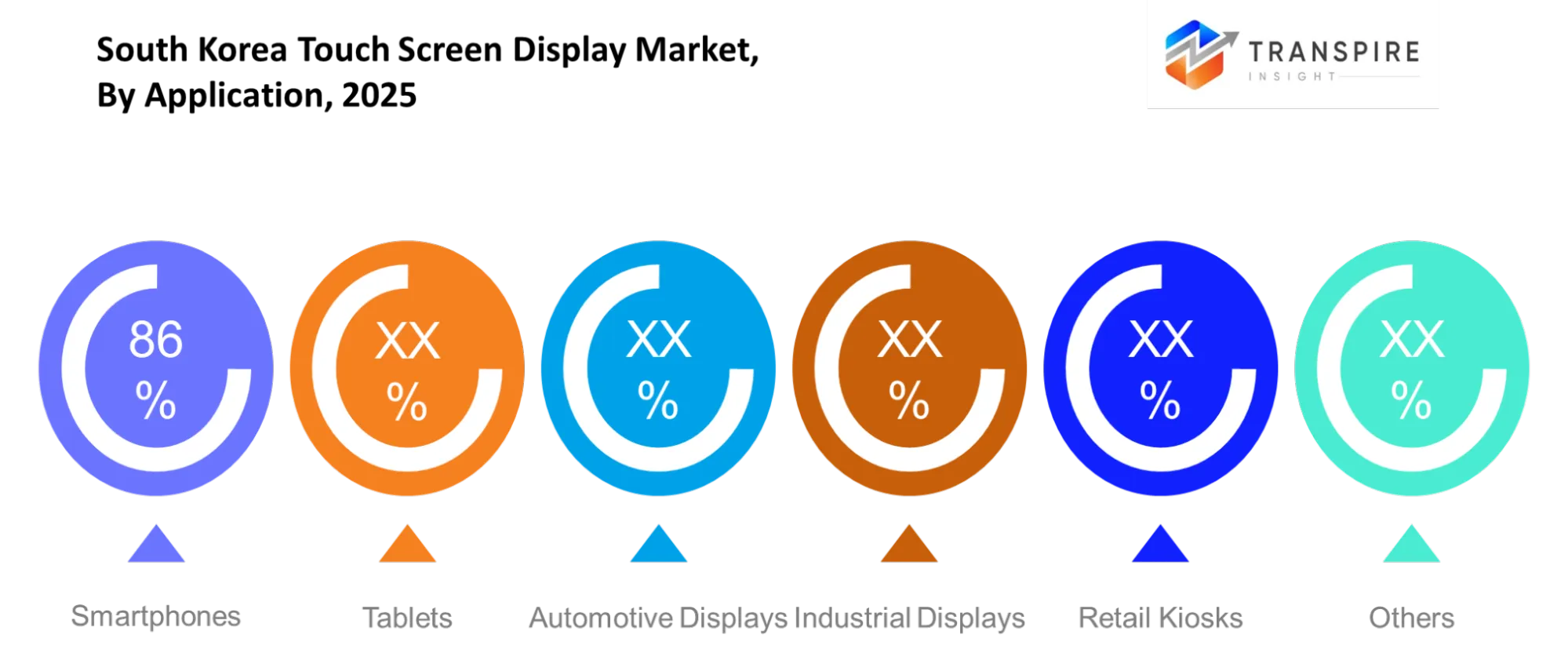
To learn more about this report, Download Free Sample Report
By Display Type
LCD touch displays basically keep the biggest installed base, mostly because they had the historical lead, they are cost efficient, and because so many industrial and commercial systems already adopted them. OLED touch displays are now picking up real momentum, for a couple of clear reasons like stronger contrast, better energy efficiency, and the way they get built into premium smartphones and those automotive dashboards. Flexible touch displays are also showing high growth, driven by foldable devices, and honestly by what feels like the next generation curved interfaces in mobility plus wearables.
That said, LCD systems still stay relevant in cost conscious and large volume industrial deployments, even if the replacement pressure is starting to increase, a bit. OLED adoption keeps moving faster thanks to improvements in thin film transistor technology and also South Korea’s strong leadership in display manufacturing ecosystems. Flexible panels are expanding through cooperation between OEMs and panel manufacturers, targeting foldable smartphones and more advanced cockpit layouts. The other display technologies mostly stay niche, they get used in specialized military, medical, and experimental applications only. Over time, OLED and flexible systems are expected to reshape premium interface design standards across multiple industries, in a pretty direct way.
By End User
Consumer electronics firms are basically running the demand scene, mostly because they crank out so many smartphones, tablets, and wearable devices, and all of that needs very refined touch integration. Automotive OEMs are still the second most important group here, they’re getting pulled forward by electrification, and also cockpit digitalization across both local and overseas vehicle lines. Then there’s the retail side, it’s moving ahead too, via self service kiosks plus interactive signage setups in city commercial zones, where people just walk up and expect it to work.
In a nutshell, consumer electronics keep their strong lead, mainly due to ongoing product cycles and the quick pace of improvements in display performance. Automotive demand is also speeding up quicker than most areas, driven by EV adoption, and regulatory support for advanced driver interfaces. Retail keeps expanding at a steady rate as digital transformation pushes higher expectations for customer engagement. Industrial manufacturers add fairly reliable demand through factory automation systems and machine control interfaces. Other spaces—like healthcare and logistics—are showing newer openings, where high reliability touch systems help boost day to day operational efficiency. Over the forecast span, automotive and industrial users should take more share as consumer electronics become more mature.
By Screen Size
Small-sized displays hold the biggest share, mostly because smartphones, tablets, and those compact industrial interfaces are everywhere. Manufacturing output efficiency is high and mass-market reach is strong, so the demand stays steady across the consumer electronics ecosystem. Medium-sized displays basically sit in the middle, powered by automotive dashboards, retail kiosks, and industrial control panels, where you do need a decent amount of interface space, not too much, not too little.
Small displays keep pulling ahead, largely from ongoing smartphone innovation and the way devices get integrated with high-resolution touch layers. Medium-sized systems are also moving up at a steady pace, especially with the spread of EV cockpit displays and interactive retail setups. Large-sized displays are showing up as a premium-ish category for control rooms, smart factories, and public infrastructure networks. This adoption gets a boost, from rising demand for centralized monitoring interfaces in industrial settings. Then there are the specialized sizes, which handle more niche uses, like aviation and defense systems. Through the forecast window, medium and large displays will take on even more strategic weight, since many industries are shifting toward centralized digital control architectures.
What are the Key Use Cases Driving the South Korea Touch Screen Display Market?
In South Korea, the main situation where touch screen displays are used is mostly around industrial automation control systems. Here, operators deal with robotics, semiconductor fabrication lines, and shipbuilding workflows, using centralized interactive panels, kind of day to day. As you might expect, this is where the strongest demand comes from, because real time precision matters a lot, and the whole system needs to be tightly stitched together.
As a second tier, you also see touch displays in automotive entertainment layouts and healthcare diagnostic interfaces. For example, car makers slip these touch screens into EV dashboards along with navigation, and in hospitals they show up for imaging, patient monitoring, plus digital diagnostics that connect into hospital networks.
More recently, newer roles are appearing, like smart maritime bridge systems and AI assisted factory control rooms. In these settings, teams mix touch interaction with predictive analytics and sensor fusion, so you can push toward semi autonomous operational control, both for ship navigation, and for industrial environments.
|
Report Metrics |
Details |
|
Market size value in 2025 |
USD 2.54 Billion |
|
Market size value in 2026 |
USD 2.696 Billion |
|
Revenue forecast in 2033 |
USD 4.092 Billion |
|
Growth rate |
CAGR of6.14% from 2026 to 2033 |
|
Base year |
2025 |
|
Historical data |
2021 - 2024 |
|
Forecast period |
2026 - 2033 |
|
Report coverage |
Revenue forecast, competitive landscape, growth factors, and trends |
|
Regional scope |
South Korea |
|
Key company profiled |
Samsung Display, LG Display, BOE Technology, AUO Corporation, Innolux, Sharp Corporation, Sony, Japan Display Inc., TPK Holding, Elo Touch Solutions, 3M, HannStar Display, Wintek Corporation, Panasonic, Corning |
|
Customization scope |
Free report customization (country, regional & segment scope). Avail customized purchase options to meet your exact research needs. |
|
Report Segmentation |
By Technology (Capacitive Touch Screens, Resistive Touch Screens, Infrared Touch Screens, Surface Acoustic Wave Touch Screens, Others); By Application (Smartphones, Tablets, Automotive Displays, Industrial Displays, Retail Kiosks, Others); By Display Type (LCD Touch Displays, OLED Touch Displays, Flexible Touch Displays, Others); By End User (Consumer Electronics Companies, Automotive OEMs, Retail Sector, Others); By Screen Size (Small-sized Displays, Medium-sized Displays, Large-sized Displays, Others) |
Which Regions are Driving the South Korea Touch Screen Display Market Growth?
South Korea’s coastal industrial hubs, especially Busan and Ulsan, kind of stand out as the main region for touch screen display adoption, mainly because their maritime and shipbuilding ecosystems are pretty strong. You can actually see that major shipbuilders, and also logistics operators around there, keep generating a steady need for more capable navigation and control interfaces. On top of that, government-backed smart port initiatives help push out digital infrastructure, a lot. So, overall, this environment keeps supporting continuous integration of ruggedized, high-performance display systems.
Meanwhile, the Seoul metropolitan area works like a stable secondary hub, and it’s powered by electronics manufacturing, automotive R&D, plus medical device innovation. Compared with coastal areas, its demand is not as choppy, more anchored in consumer electronics and enterprise systems. Also, strong investment from global OEMs helps keep upgrade cycles for display technologies consistent. In practice, it becomes a dependable revenue contributor, not really a zone that depends on volatility driven growth.
And the fastest-growing spot is Gyeonggi Province, where the main drivers are semiconductor expansion and smart factory investments. More recently, infrastructure upgrades in chip fabrication plants have basically pushed demand toward high-precision touch interfaces. With automation increasing in production environments, adoption of AI-integrated display systems gets even more momentum. Looking at 2026–2033, this region is expected to turn into a major growth engine for industrial-grade touch technologies.
Who are the Key Players in the South Korea Touch Screen Display Market and How Do They Compete?
Competition in the South Korea touch screen display market is sort of moderately consolidated, i mean its not totally fragmented, but a few big manufacturers pretty much steer the high end OLED and industrial grade panel production. In practice, leadership in technology, vertical integration and manufacturing scale tend to take over the whole competitive picture. The usual story is incumbents try to hold onto share with advanced display upgrades, while smaller firms often go after more specific industrial and specialty use cases, more like an odd corner of the market instead of the whole thing.
Samsung Display is leading, mainly via advanced OLED touch integration aimed at automotive plus consumer electronics. They also lean hard on deep links across semiconductor and device ecosystems, so costs and performance stay on their side. LG Display meanwhile leans into large format industrial panels and automotive displays, they stand out with higher durability and energy efficient OLED approaches for smart factory setups, which is a bit of a differentiator there.
BOE Technology keeps competing aggressively on scale and cost efficiency, and it keeps pushing partnerships with Korean OEMs to lift industrial touchscreen adoption. AUO Corporation emphasizes high resolution industrial displays for medical and manufacturing needs, they lean on niche engineering know-how rather than trying to be everything. TPK Holding focuses on touch sensor modules and component level innovation, which helps device manufacturers get more integration flexibility. Corning supports the chain with advanced glass substrates that boost durability and scratch resistance, especially where harsh conditions hit hard in industrial environments.
Overall, strategic expansion is increasingly pulled by partnerships with automotive OEMs, smart factory integrators, and even maritime system developers, not just straightforward product launches.
Company List
- Samsung Display
- LG Display
- BOE Technology
- AUO Corporation
- Innolux
- Sharp Corporation
- Sony
- Japan Display Inc.
- TPK Holding
- Elo Touch Solutions
- 3M
- HannStar Display
- Wintek Corporation
- Panasonic
- Corning
Recent Development News
"In April 2026, LG Display announced an investment of OLED display infrastructure expansion worth approximately $745 million. The project strengthens advanced OLED production capacity in South Korea and improves supply readiness for next-generation touch-enabled commercial and automotive displays.https://www.reuters.com
"In December 2025, Samsung Display unveiled next-generation foldable OLED technology integrated into the Galaxy Z Trifold launch ecosystem. The 10-inch Dynamic AMOLED foldable display enhanced multi-touch responsiveness and durability for high-end mobile touch applications.https://www.techradar.com
"In May 2026, Samsung Display showcased advanced Sensor OLED and Flex Chroma Pixel technologies at SID Display Week 2026. The new panels integrate touch, biometric sensing, and ultra-high brightness performance, expanding industrial and automotive touch screen use cases.https://www.androidcentral.com
What Strategic Insights Define the Future of the South Korea Touch Screen Display Market?
The South Korea Touch Screen Display Market is slowly but definitely shifting, in a kind of structured way, toward more clever AI built-in industrial interfaces that are tucked into manufacturing, automotive, and maritime systems. Most of the growth now looks less like “buy a panel, ship it, repeat” and more like the display hardware and the real-time data processing pieces basically being treated as one together. There’s also a quiet risk ,in other words not always visible at first, tied to the supply chain leaning heavily on advanced OLED materials and a pretty narrow set of suppliers, that situation can cause pricing volatility and production slow downs.
At the same time there is a new opening, especially in autonomous ship navigation, plus AI assisted smart factory control rooms where touch interfaces become mission-critical decision surfaces. In the next 5–7 years, whoever wins will likely need vertical integration with AI software ecosystems, rather than focusing only on the screens. Companies in this space should consider modular, ruggedized display architectures that allow predictive analytics to plug in cleanly. That approach can help lock in longer enterprise contracts and also reduce reliance on hardware-only income streams.
South Korea Touch Screen Display Market Report Segmentation
By Technology
- Capacitive Touch Screens
- Resistive Touch Screens
- Infrared Touch Screens
- Surface Acoustic Wave Touch Screens
- Others
By Application
- Smartphones
- Tablets
- Automotive Displays
- Industrial Displays
- Retail Kiosks
- Others
By Display Type
- LCD Touch Displays
- OLED Touch Displays
- Flexible Touch Displays
- Others
By End User
- Consumer Electronics Companies
- Automotive OEMs
- Retail Sector
- Industrial Manufacturers
- Others
By Screen Size
- Small-sized Displays
- Medium-sized Displays
- Large-sized Displays
- Others
Frequently Asked Questions
Find quick answers to common questions.
The Expected South Korea Touch Screen Display Market size for the Market will be USD 4.092 Billion in 2033.
Key segments for the South Korea Touch Screen Display Market are By Technology (Capacitive Touch Screens, Resistive Touch Screens, Infrared Touch Screens, Surface Acoustic Wave Touch Screens, Others); By Application (Smartphones, Tablets, Automotive Displays, Industrial Displays, Retail Kiosks, Others); By Display Type (LCD Touch Displays, OLED Touch Displays, Flexible Touch Displays, Others); By End User (Consumer Electronics Companies, Automotive OEMs, Retail Sector, Others); By Screen Size (Small-sized Displays, Medium-sized Displays, Large-sized Displays, Others).
Major South Korea Touch Screen Display Market Players are Samsung Display, LG Display, BOE Technology, AUO Corporation, Innolux, Sharp Corporation, Sony, Japan Display Inc., TPK Holding, Elo Touch Solutions, 3M, HannStar Display, Wintek Corporation, Panasonic, Corning.
The Current South Korea Touch Screen Display Market size is USD 2.54 Billion in 2025.
The South Korea Touch Screen Display Market CAGR is 6.14% from 2026 to 2033.
- Samsung Display
- LG Display
- BOE Technology
- AUO Corporation
- Innolux
- Sharp Corporation
- Sony
- Japan Display Inc.
- TPK Holding
- Elo Touch Solutions
- 3M
- HannStar Display
- Wintek Corporation
- Panasonic
- Corning
Recently Published Reports
-
Apr 2026
Fiber Optic Faceplates Market
Fiber Optic Faceplates Market Size, Share & Analysis Report By Type (< 300 mm2, 300-350 mm2, and > 350 mm2, By Application (Night Vision, Holographic Imaging, Medical, and Others), and Geography (North America, Europe, Asia-Pacific, Middle East and Africa, South and Central America), 2021 - 2031
-
Apr 2026
High Temperature Superconductors Market
High Temperature Superconductors Market Size, Share & Analysis Report By Type (1G HTS, and 2G HTS), By Application (Power Cable, Fault Current Limiter, and Transformer), and Geography (North America, Europe, Asia-Pacific, Middle East and Africa, South and Central America), 2021 - 2031
-
Apr 2026
Industrial Plugs and Socket Market
Industrial Plugs and Socket Market Size, Share & Analysis Report By Type (Industrial Plugs, Industrial Sockets), By Current (Up to 32 A, 32 to 125 A, Above 125 A), By Protection (Dustproof and Splash Proof, Waterproof, Explosion Proof), By End User (Heavy Industries, Oil and Gas, Chemicals and Pharmaceuticals, Power Generation, Others), and Geography (North America, Europe, Asia-Pacific, Middle East and Africa, South and Central America), 2021 - 2031
-
Apr 2026
InGaAs Avalanche Photodiodes Market
InGaAs Avalanche Photodiodes Market Size, Share & Analysis Report By Type (1100 - 1700 nm, and 1000 - 1600 nm), By Application (Missile Warning System, Muzzle Flash Detection, Wafer Defect Inspection, Laser Rangefinders, and Others), and Geography (North America, Europe, Asia-Pacific, Middle East and Africa, South and Central America), 2021 - 2031