
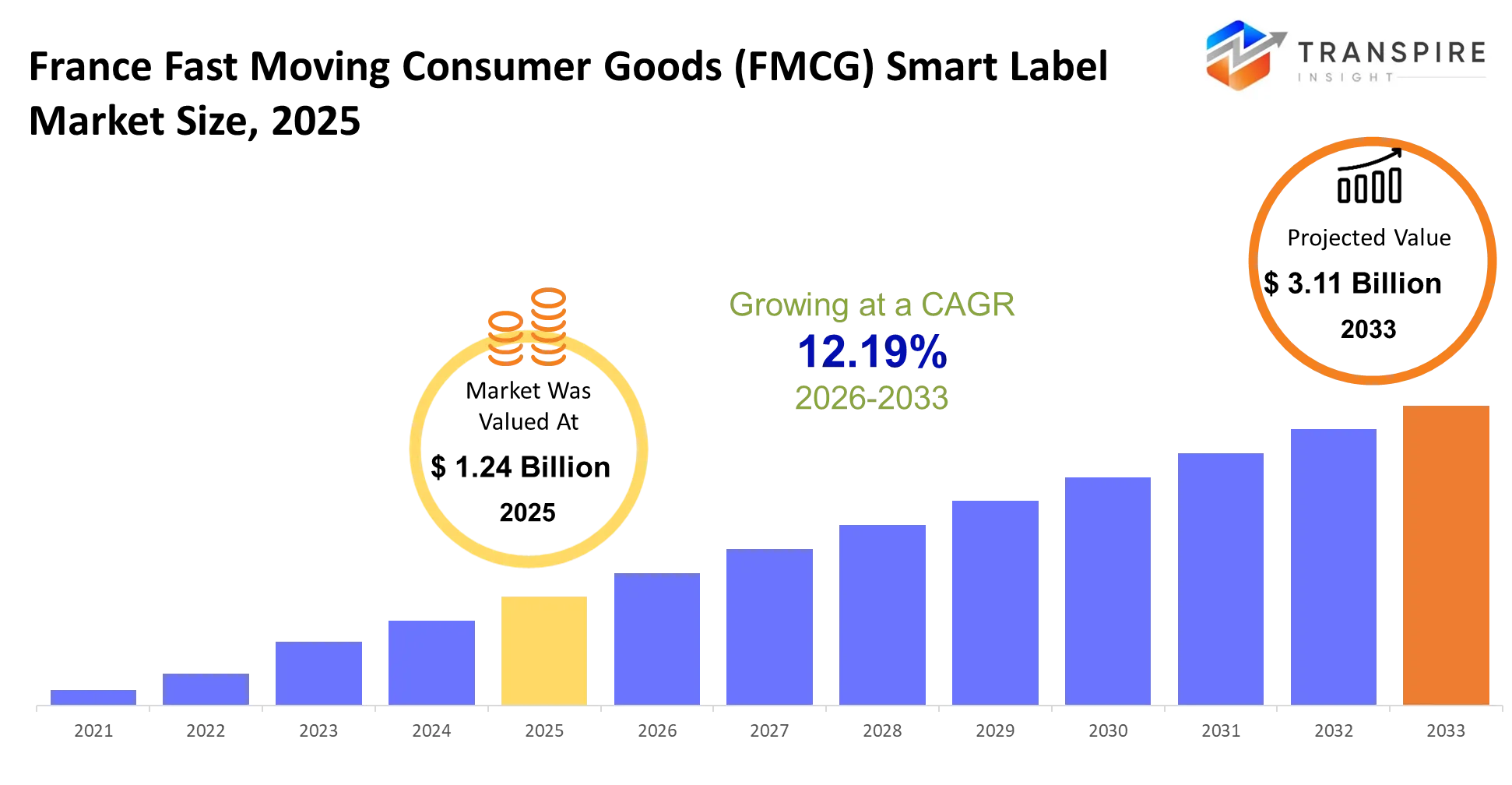
France Fast Moving Consumer Goods (FMCG) Smart Label Market Size & Forecast:
- France Fast Moving Consumer Goods (FMCG) Smart Label Market Size 2025: USD 1.24 Billion
- France Fast Moving Consumer Goods (FMCG) Smart Label Market Size 2033: USD 3.11 Billion
- France Fast Moving Consumer Goods (FMCG) Smart Label Market CAGR: 12.19%
- France Fast Moving Consumer Goods (FMCG) Smart Label Market Segments: By Type (RFID Labels, NFC Labels, QR Code Labels, Others); By Application (Product Tracking, Anti-counterfeiting, Inventory Management, Marketing, Others); By End-User (Retailers, FMCG Brands, Logistics, Others); By Component (Hardware, Software, Services, Others)
To learn more about this report,  Download Free Sample Report
France Fast Moving Consumer Goods (FMCG) Smart Label Market Summary
The France Fast Moving Consumer Goods (FMCG) Smart Label Market was valued at USD 5.02 billion in 2025. It is forecast to reach USD 3.11 Billion by 2033. That is a CAGR of 12.19% over the period.
In practice smart labels across France’s FMCG ecosystem work like a kind of digital identity layer on the most normal everyday products, supporting retailers, manufacturers and logistics operators to follow freshness, authenticity, and movement through supply chains that are a bit too compressed to be managed by sight alone. They also fix a durable, sort of stubborn operational pain point. The visibility is fragmented between production lines, distribution hubs, and retail shelves, where product rotation happens fast enough that manual checking turns into a steady source of small mistakes.
Over the last 3–5 years the market has shifted, not just “more tech”, but more fundamentally. It moved away from basic barcode dependency toward RFID-enabled plus sensor-integrated labeling systems, which allow capture of real time data at the product level. A major trigger, speeding up adoption was the EU’s tightening food traceability and sustainability disclosure rules. Those changes basically pushed FMCG brands to digitize packaging intelligence, so they can stay compliant and also lower recall risk . Meanwhile, pandemic-era disruptions in the supply chain uncovered inventory blind spots , and that pushed retailers to invest in automated tracking ecosystems, even when budgets were tight.
So now this mix of regulatory pressure and logistics instability has reshaped procurement priorities. Smart labels are no longer viewed as a nice optional upgrade, but as a compliance-linked infrastructure investment that has to be there.
Key Market Insights
- France's FMCG smart label market is getting more and more pushed by EU traceability compliance rules, impacting over 60% of the packaged goods supply chains in 2025.
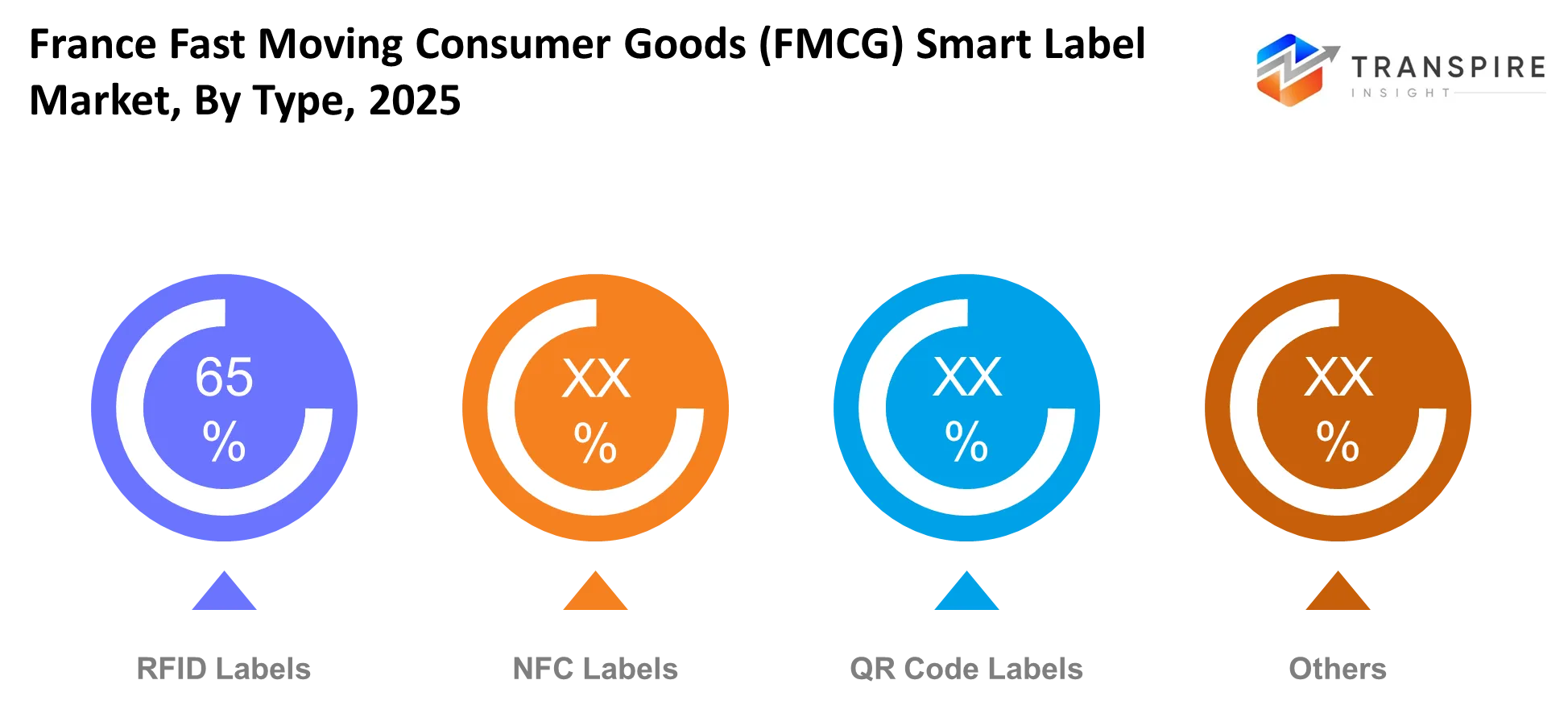
- RFID based labeling pretty much leads the France FMCG smart label market , with almost 48% share, mainly because of stronger real-time stockkeeping visibility.
- Sensor enabled smart labels are the fastest growing slice through 2033, thanks to cold-chain monitoring needs inside food and beverage logistics.
- Retail distribution still seems the most dominant application with roughly 52% share, since supermarkets move toward automated shelf tracking systems, kind of everywhere.
- E-commerce logistics is the one growing quicker these days as well, because demand keeps rising for end-to-end parcel visibility in France’s FMCG smart label market.
- Big FMCG manufacturers take around 55% of end-user share, and they use smart labels for recall prevention plus anti-counterfeit verification setups.
- Small to mid size brands are adopting faster, supported by falling RFID tag costs , and also SaaS driven tracking platforms.
- Avery Dennison and Zebra Technologies are leading the innovation path, via RFID hardware expansion and cloud connected labeling ecosystems.
- Strategic partnerships between packaging companies and software providers are speeding up AI powered traceability solutions across France supply chains.
- In the competition, advantage is increasingly defined by integration ability, combining labeling hardware, analytics platforms, and regulatory reporting tools all together, without too much friction.
What are the Key Drivers, Restraints, and Opportunities in the France Fast Moving Consumer Goods (FMCG) Smart Label Market?
The main driver in France’s FMCG smart label market is mostly regulatory- pushed traceability enforcement all over the EU, especially more strict paperwork around product origin, safety, and sustainability evidence. In practice, these rules basically shoved FMCG producers to put digital identifiers right onto the packaging, and that turned what was compliance work into a kind of structured revenue path for labeling technology suppliers. So adoption is strongest in food, beverage, and personal care, because recall exposure and audit frequency are usually high there.
One big restraint is the integration headache between old packaging lines and newer RFID or sensor-driven labeling setups. A lot of mid-tier manufacturers still run fragmented production infrastructure, so they cannot really support real-time data capture without costly retrofitting. That turns into a steady adoption lag, particularly for firms working on thin margins, which slows down how fast smart labeling moves through the entire FMCG value chain.
An emerging opportunity looks like AI-enabled smart packaging analytics. where consumption signals and logistics movements, in real time, can be monetized for demand predictions and adaptive inventory control. There are already pilot runs in French retail networks, linking smart label readings to predictive restocking systems, and the outcome is better shelf availability, and less spoilage. This blend, of packaging intelligence with retail analytics, is expected to open up a fresh data-driven revenue layer that sits beyond classic labeling use cases.
What Has the Impact of Artificial Intelligence Been on the France Fast Moving Consumer Goods (FMCG) Smart Label Market?
Artificial intelligence is kinda reshaping the France FMCG smart label ecosystem, by turning packaging from passive identity tools into active data nodes inside digital supply chains. In day to day logistics, AI powered systems now automate inventory scanning and tracking, by interpreting RFID plus sensor information in real time, which cuts down on manual warehouse verification work , and boosts stock accuracy across fast moving FMCG ranges.
Machine learning models are used more and more for predictive analytics, specifically to forecast product demand, shelf-life deterioration, and distribution bottlenecks. They look at earlier movement patterns together with current label data to improve replenishment timing , and to limit overstock or stockout situations. In cold-chain FMCG logistics, predictive monitoring helps with temperature compliance, it also lowers spoilage risk by flagging unusual signals before product quality is affected too much.
Operationally, many companies say they get better inventory precision and faster recall execution, thanks to AI based traceability mapping across distribution networks. Still, the uptake is held back by partial data standardization across packaging formats, plus uneven connectivity in downstream retail spaces, and that combination makes models less accurate once they’re in the wild. Also, high integration expenses for connecting AI platforms with older labeling infrastructure slows the rollout for mid-sized FMCG players.
Key Market Trends
- RFID migration sped up quite sharply after 2023 as French FMCG companies started dropping static barcode only tracking set ups, especially across the high volume product lines, you know.
- In 2024, EU sustainability reporting requirements basically nudged manufacturers to place traceable digital identifiers into more than 70% of packaged goods.
- Also, cold-chain monitoring took off faster, because food exporters began rolling out sensor enabled labels for temperature sensitive logistics, and compliance with that side of rules.
- Then in 2025 retail automation grew quickly, with supermarkets putting shelf level RFID readers in place to cut down on the manual inventory checks, kind of reducing those repeated counts.
- AI enabled demand forecasting showed up around 2025 too, tying smart label signals to predictive restocking routines across FMCG networks.
- Packaging vendors moved toward an integrated service style, mixing hardware with analytics and compliance reporting platforms, instead of selling pieces separately.
- On top of that, anti counterfeit use cases multiplied in premium FMCG segments, especially cosmetics and organic food in France.
- Cloud based label management platforms gained momentum as SMEs looked for scalable alternatives to pricey on premise tracking systems.
- And finally, cross border logistics providers adopted smart labels to keep traceability more consistent across the various EU regulatory jurisdictions.
France Fast Moving Consumer Goods (FMCG) Smart Label Market Segmentation
By Type
RFID labels are in a leading position in the France FMCG smart label market, simply because they can enable real time product level tracing across retail and logistics nets. The high adoption across supermarkets and big FMCG distributors keeps the momentum strong, and it is backed by scalable systems for automatic reading plus inventory synchronization . NFC labels come next as a solid secondary segment, mostly used in premium packaging and consumer engagement scenarios, where phone based interaction is actually required. QR code labels still see widespread use, mostly due to low deployment cost and the straightforward way they integrate with packaging lines already running . Other variants, like hybrid sensing and electronic shelf labels, stay more niche , because standardization is not really consistent.
RFID growth is pushed by regulatory traceability needs and the appetite for automated warehouse workflows , since that helps reduce manual scanning mistakes. NFC adoption tends to rise alongside brand-led marketing moves, where physical items are linked to digital experiences, particularly in cosmetics and premium food segments. QR codes work well for cost mindful FMCG producers who want fast compliance, without needing major infrastructure upgrades. During the forecast period, RFID should keep expanding, as interoperability keeps improving, and NFC is expected to grow deeper in premium areas. QR codes will stay relevant as a basic technology, but the innovation attention will drift toward hybrid smart labeling setups, mixing several data capture methods .
By Application
Product tracking kind of dominates the France FMCG Smart Label Market, mainly because EU traceability rules are strict and teams really need end-to-end visibility across supply chains that move fast. In practice, high-volume food and beverage distribution leans on continuous tracking to lower recall exposure and also to keep logistics accuracy in a better place. Inventory management sits in the second spot, and it’s supported by retail automation and the ongoing desire for real-time stock visibility across both warehouses , and store shelves. Anti-counterfeiting use cases are growing steadily too, especially for premium FMCG lines and organic product categories. Marketing applications stay smaller, but they’re still dependable, driven by interactive packaging approaches and consumer engagement type campaigns.
The growth behind product tracking is mostly compliance obligations plus the rising complexity of cross-border FMCG distribution networks. Inventory management expands as retailers digitize and as automated replenishment systems get adopted in big supermarket chains. Anti-counterfeiting demand increases due to brand safeguarding needs in higher-value goods, notably cosmetics and specialty foods. Marketing uses tend to grow alongside NFC and QR integrations, where the packaging links up with digital ecosystems.Over the forecast period, product tracking and inventory management should keep leading adoption, while anti-counterfeiting will turn into a critical add-on, like a value-added layer, for premium FMCG brands.
To learn more about this report, Download Free Sample Report
By End-User
In the France FMCG Smart Label Market, retailers hold the leading position because they have direct hold over shelf level inventory, and they also have this strong need for real-time product visibility, like not later but right now. Big supermarket chains and hypermarkets deploy smart labeling systems to cut down shrinkage and also to make replenishment run more smoothly and efficiently. FMCG brands sit in the second-largest segment, because manufacturers are integrating labeling solutions, to stay compliant and to enhance supply chain traceability, you know the whole audit trail thing. Logistics providers are a rapidly expanding group, mainly with distribution optimization on one side, and cold chain monitoring expectations on the other. Other users include e-commerce platforms and third party distributors where adoption is still emerging, but it’s also fragmented.
Retailer growth is helped by automation of store operations and by growing pressure to improve inventory precision in fast turnover environments. FMCG brand adoption is bolstered by regulatory traceability obligations, and by overall risk reduction during recall management. Logistics expansion is connected with cross-border distribution complexity, plus demand for temperature controlled monitoring systems that stay consistent. In time, retailers will likely stay dominant due to those very practical operational gains, while logistics providers should accelerate too as supply chains become more digitally integrated, kind of naturally. FMCG brands will also invest more in integrated labeling ecosystems, to connect production, compliance, and distribution systems, in one coordinated approach.
By Component
In the France FMCG Smart Label Market, hardware holds the dominant position, mostly because RFID tags, scanner units, and embedded sensing devices are being put in place across retail , and logistics networks. Software comes next, not far behind , since the appetite is growing for analytics platforms that can turn the label data into actionable supply chain guidance. Services are also climbing , largely due to system integration work, cloud deployment tasks, and ongoing maintenance needs across big rollouts. Meanwhile, other pieces—like data infrastructure layers—stay rather niche, though they’re getting more important as everything becomes more interlinked.
Hardware growth is being pulled forward by the large-scale use of RFID plus sensor enabled packaging through FMCG supply chains. Software is expanding alongside the move toward predictive analytics , better inventory optimization, and compliance reporting systems. On the services side, companies need integration support so they can connect older packaging setups with newer digital platforms, and that keeps demand steady. Over the forecast period, software and services should gain more share as the value gradually shifts away from purely physical labeling toward data driven intelligence systems, so vendors are pushed to craft end to end solution ecosystems, not just sell standalone hardware.
What are the Key Use Cases Driving the France Fast Moving Consumer Goods (FMCG) Smart Label Market?
The main use case in the France FMCG smart label market is more or less end-to-end product traceability across the retail supply chain, like from factory to shelf and back again in a way. Big FMCG producers lean on smart labels to follow goods all the way from manufacturing to retail placement, while also making sure they stay aligned with EU safety rules and speeding up recall response times. This use case mostly wins, because it cuts down both financial exposure and brand reputation damage, especially in those high-volume consumer segments where one incident can spread fast.
Secondary applications are now sort of broadening, especially in cold chain logistics and omnichannel retail fulfillment, you know the usual two lanes at once. Food distributors and e-commerce sellers use smart labels to watch temperature conditions and inventory movement almost in real time, and this is happening a lot in dairy, meat, and ready-to-eat categories. The momentum is growing among logistics providers and large supermarket chains that want tighter oversight on perishable products, not just rough estimates.
Newer use cases that are starting to appear include AI-linked consumption analytics and dynamic pricing optimization, though the rollout is still uneven. Retailers are testing smart labels that can pass real time consumption signals into demand forecasting systems, which then supports adaptive restocking and waste reduction plays. In the longer run, these capabilities may also drift into personalized retail moments, and even into automated inventory ecosystems across France’s FMCG sector.
|
Report Metrics |
Details |
|
Market size value in 2025 |
USD 1.24 Billion |
|
Market size value in 2026 |
USD 1.39 Billion |
|
Revenue forecast in 2033 |
USD 3.11 Billion |
|
Growth rate |
CAGR of 12.19% from 2026 to 2033 |
|
Base year |
2025 |
|
Historical data |
2021 - 2024 |
|
Forecast period |
2026 - 2033 |
|
Report coverage |
Revenue forecast, competitive landscape, growth factors, and trends |
|
Regional scope |
France |
|
Key company profiled |
Avery Dennison, Zebra Technologies, Checkpoint Systems, SATO, Honeywell, NXP, Impinj, Smartrac, Thinfilm, CCL Industries, Alien Technology, Identiv, HID Global, Brady, Toshiba Tec |
|
Customization scope |
Free report customization (country, regional & segment scope). Avail customized purchase options to meet your exact research needs. |
|
Report Segmentation |
By Type (RFID Labels, NFC Labels, QR Code Labels, Others); By Application (Product Tracking, Anti-counterfeiting, Inventory Management, Marketing, Others); By End-User (Retailers, FMCG Brands, Logistics, Others); By Component (Hardware, Software, Services, Others) |
Which Regions are Driving the France Fast Moving Consumer Goods (FMCG) Smart Label Market Growth?
Île-de-France remains the dominant region, mostly because it bundles FMCG headquarters, retail decision centers, and digital supply chain operators all together. A lot of national retailers, plus packaging technology buyers, are based in Paris, so adoption of smart labeling standards tends to start earlier, across procurement cycles, in a pretty direct way. The area also has clear regulatory enforcement visibility, where EU traceability requirements get put into practice quickly, by centralized compliance teams. Then there’s the tight network of logistics software providers and packaging innovators, which keeps pushing the whole leadership narrative forward, by making pilot-to-scale deployment models feel almost routine.
Hauts-de-France is a different kind of story, more like a logistics and distribution powerhouse than a true decision hub. Its advantage comes from really high freight throughput along the Calais and Dunkirk corridors, where FMCG imports and exports rely on consistent scanning and inventory synchronization. In contrast to Île-de-France, growth here is driven by operational necessity, rather than “innovation leadership”, because retailers lean on supply chain dependability more than on experimentation. Plus, the region has a steady industrial base, and it faces frequent cross-border trade dynamics with Belgium and the Netherlands, which keeps it contributing steadily to smart label deployment volumes.
Auvergne-Rhône-Alpes is starting to look like the fastest-growing region, largely due to modernization in food processing, and cold-chain manufacturing clusters near Lyon and Grenoble. There have been recent investments in automated logistics parks and temperature-controlled distribution, and that creates demand for sensor-enabled labeling systems, pretty fast. This transition is still fairly recent, pushed by regional agro-industrial upgrading and export-focused production expansion. For investors and technology providers, this region signals a transition
Who are the Key Players in the France Fast Moving Consumer Goods (FMCG) Smart Label Market and How Do They Compete?
The France FMCG smart label market is kind of moderately consolidated, where global labeling and RFID technology providers mingle with semiconductor and IoT specialists. The competition feels driven mostly by how well they integrate tech, not price by itself, since FMCG clients want end-to-end traceability setups that merge hardware, data platforms, and compliance reporting. Incumbents are defending their turf too, by expanding ecosystem partnerships, while semiconductor firms and IoT innovators disrupt the older packaging-focused style, pushing more data-centric solutions, and honestly it shows.
Avery Dennison competes with big scale RFID label manufacturing plus cloud based item-level tracking platforms, so FMCG brands can roll out standardized traceability across several product lines. Zebra Technologies leans on industrial grade scanning infrastructure and software integration, and it differentiates via enterprise logistics automation tools, especially for retail warehouses and distribution centers. Checkpoint Systems leans into anti-theft and retail intelligence labeling, then expands through partnerships with European supermarket chains to tighten in-store inventory visibility.
NXP Semiconductors and Impinj compete on RFID chip innovation, basically supplying the core hardware level that supports strong tag readability and better data accuracy in crowded retail areas. Their approach centers on miniaturization and energy efficient chip design which improves scalability for FMCG packaging, and that keeps getting emphasized. Across the ecosystem, companies are forming cross layer partnerships more often, combining chipmakers, label producers and analytics platforms, to secure longer term enterprise contracts.
Company List
- Avery Dennison
- Zebra Technologies
- Checkpoint Systems
- SATO
- Honeywell
- NXP Semiconductors
- Impinj
- Smartrac
- Thinfilm
- CCL Industries
- Alien Technology
- Identiv
- HID Global
- Brady Corporation
- Toshiba Tec Corporation
Recent Development News
In September 2025, Avery Dennison entered an expanded strategic partnership with Wiliot. The collaboration scaled ambient IoT-enabled smart label solutions to improve real-time item-level visibility across global retail and FMCG supply chains, strengthening connected product intelligence used by European retailers.https://rfid.averydennison.com
In January 2025, Avery Dennison expanded RFID adoption in grocery retail with Kroger collaboration. The initiative deployed item-level RFID inventory automation across grocery operations, improving stock visibility, reducing shrinkage, and enhancing real-time replenishment systems that influence European FMCG rollout strategies.https://rfid.averydennison.com
What Strategic Insights Define the Future of the France Fast Moving Consumer Goods (FMCG) Smart Label Market?
The France FMCG smart label market is moving, structurally, toward fully integrated, data-driven packaging ecosystems where labeling becomes more like a real-time intelligence layer for retail and logistics optimization, not just a label. This shift is being pulled by a sort of convergence between EU compliance enforcement and retailer demand for more granular inventory sight, pushing firms toward platform-based traceability systems instead of standalone labeling solutions. A less obvious risk is technology dependency concentration, where a small cluster of RFID chip and software providers could end up creating supply bottlenecks or even pricing pressure across the whole ecosystem if consolidation speeds up.
At the same time, there is also a big emerging opportunity in AI-linked smart packaging analytics, connecting product-level data with dynamic demand forecasting and automated replenishment routines in large retail networks. Market participants should put emphasis on ecosystem partnerships that bundle hardware, data infrastructure,and analytics capabilities together rather than competing with isolated labeling technologies. Value creation is basically shifting toward end-to-end traceability platforms, where the whole chain matters.
France Fast Moving Consumer Goods (FMCG) Smart Label Market Report Segmentation
By Type
- RFID Labels
- NFC Labels
- QR Code Labels
- Others
By Application
- Product Tracking
- Anti-counterfeiting
- Inventory Management
- Marketing
- Others
By End-User
- Retailers
- FMCG Brands
- Logistics
- Others
By Component
- Hardware
- Software
- Services
- Others
Frequently Asked Questions
Find quick answers to common questions.
The expected France Fast Moving Consumer Goods (FMCG) Smart Label Market size for the market will be USD 3.11 Billion in 2033.
Key segments for the France Fast Moving Consumer Goods (FMCG) Smart Label Market are By Type (RFID Labels, NFC Labels, QR Code Labels, Others); By Application (Product Tracking, Anti-counterfeiting, Inventory Management, Marketing, Others); By End-User (Retailers, FMCG Brands, Logistics, Others); By Component (Hardware, Software, Services, Others).
Major France Fast Moving Consumer Goods (FMCG) Smart Label Market players are Avery Dennison, Zebra Technologies, Checkpoint Systems, SATO, Honeywell, NXP, Impinj, Smartrac, Thinfilm, CCL Industries, Alien Technology, Identiv, HID Global, Brady, Toshiba Tec.
The France Fast Moving Consumer Goods (FMCG) Smart Label Market size is USD 1.24 Billion in 2025.
The France Fast Moving Consumer Goods (FMCG) Smart Label Market CAGR is 12.19% from 2026 to 2033.
- Avery Dennison
- Zebra Technologies
- Checkpoint Systems
- SATO
- Honeywell
- NXP Semiconductors
- Impinj
- Smartrac
- Thinfilm
- CCL Industries
- Alien Technology
- Identiv
- HID Global
- Brady Corporation
- Toshiba Tec Corporation
Recently Published Reports
-
Apr 2026
Bottled Water Market
Bottled Water Market Size, Share & Analysis Report By Product Type (Still Bottled Water, Carbonated Bottled Water, Functional Bottled Water, and Others), By Packaging (PET, Cans, and Others), By Sales Channel (Supermarkets/Hypermarkets, Convenience Stores/Drug Stores, Grocery Stores/Club Stores, Foodservice, and Others) and Geography (North America, Europe, Asia-Pacific, Middle East and Africa, South and Central America), 2021 - 2032
-
Apr 2026
Color Cosmetic Packaging Market
Color Cosmetic Packaging Market Size, Share & Analysis Report By Application (Mascara Packaging, Liquid Packaging, and Liquid Face), By Type (Tubes & Bottles, Pens & Markers, Compacts & Containers, and Droppers & Pumps), and Geography (North America, Europe, Asia-Pacific, Middle East and Africa, South and Central America), 2021 - 2031
-
Apr 2026
External Microphone For Camera Market
External Microphone For Camera Market Size, Share & Analysis Report By Type (Shotgun Microphone, Lavalier Microphone, and Others), By Application (Digital Camera, Professional Video Camera, and Others), and Geography (North America, Europe, Asia-Pacific, Middle East and Africa, South and Central America), 2021 - 2031
-
Apr 2026
Foot Orthotic Insoles Market
Foot Orthotic Insoles Market Size, Share & Analysis Report By Type (Pre-fabricated, and Custom-made), By Material (Thermoplastic, Composite Carbon Fiber, and Others), By Distribution Channel (Drug Stores, Hospitals & Clinics, and Others), and Geography (North America, Europe, Asia-Pacific, Middle East and Africa, South and Central America), 2021 - 2031