

Europe Smart Label Market Size & Forecast:
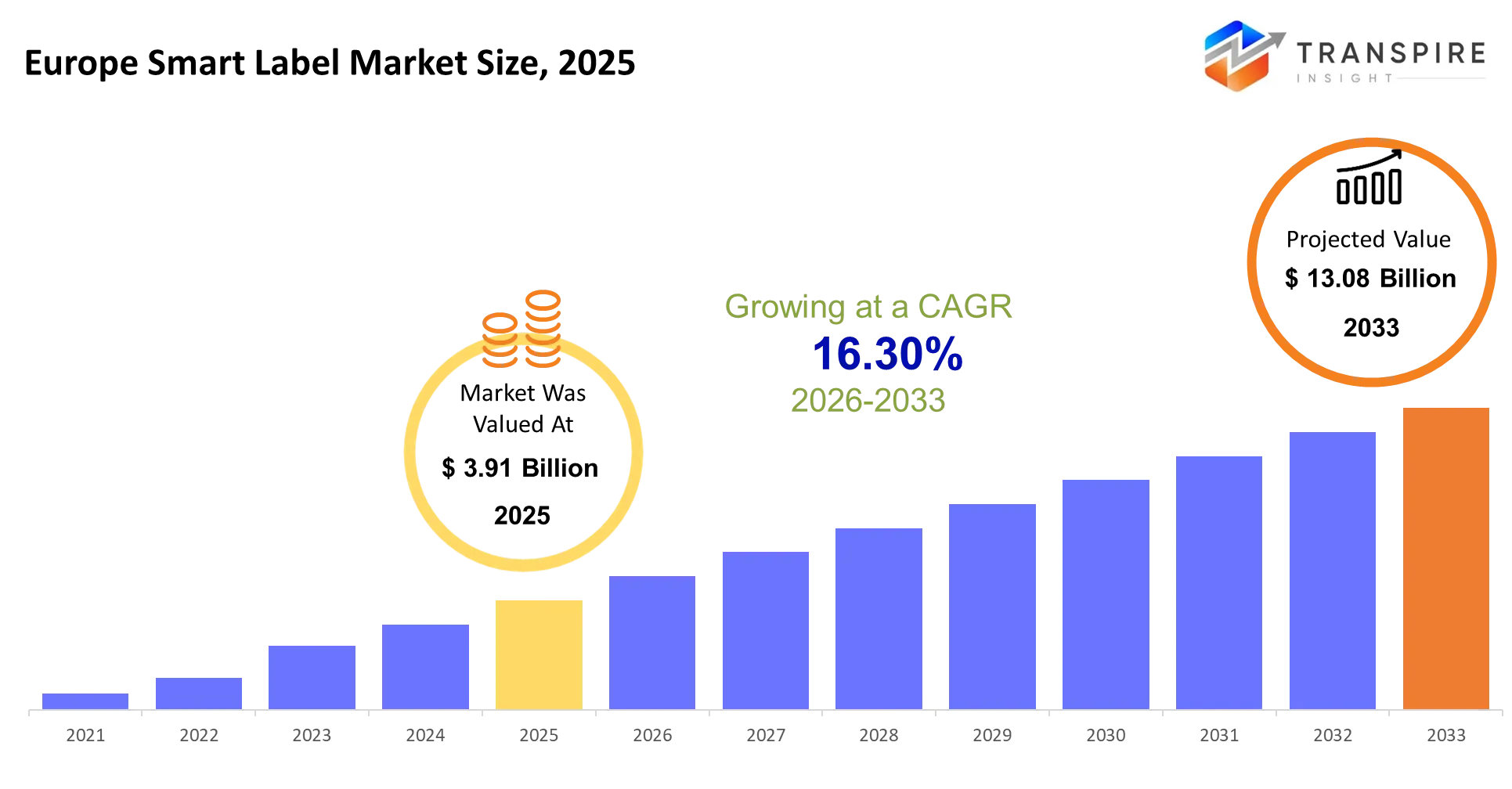
- Europe Smart Label Market Size 2025: USD 3.91 Billion
- Europe Smart Label Market Size 2033: USD 13.08 Billion
- Europe Smart Label Market CAGR: 16.30%
- Europe Smart Label Market Segments: By Type (RFID Labels, NFC Labels, QR Labels, Others); By Application (Inventory Tracking, Anti-counterfeiting, Marketing, Others); By End-User (Retail, Logistics, Healthcare, Others); By Component (Hardware, Software, Services, Others)
To learn more about this report,  Download Free Sample Report
Europe Smart Label Market Summary
The Europe Smart Label Market was valued at USD 3.91 Billion 2025. It is forecast to reach USD 13.08 Billion by 2033. That is a CAGR of 16.30% over the period.
The smart labels used in European markets provide a solution to practical supply chain problems because they transform physical items into trackable assets that generate data throughout the entire supply chain process. Retailers and logistics providers and healthcare operators use RFID and NFC and sensor-enabled labels to track goods and authenticate products and monitor temperature conditions in real time. The system provides three main benefits because it helps businesses reduce stock losses and increase replenishment accuracy and achieve compliance with European safety regulations and traceability requirements.
The market has moved away from barcode-based identification systems during the last three to five years. The product serialization requirements and upcoming digital product passport requirements established by EU regulatory frameworks created a mandatory requirement for item-level traceability which functions as a fundamental structural change. Supply chain disruptions during the COVID-19 pandemic and its aftermath revealed visibility shortcomings which drove companies to invest in automated tracking systems.
Changes in regulatory requirements combined with operational risk have transformed how organizations allocate their budgets. Organizations consider smart labeling technology to be essential for their core operational needs which drives them to implement their technology partnerships through large-scale deployments.
Key Market Insights
- The Europe Smart Label Market in 2025 will see Western Europe exceed 45% market share because of European Union traceability requirements and its high-quality retail systems.
- The manufacturing sector in Eastern Europe will experience rapid growth until 2032 because the region develops its export supply chains to meet European Union compliance requirements.
- The second biggest market segment will experience growth because premium products need authentication and consumer engagement solutions which became available after 2024.
- Retailers are moving away from barcode systems to implement real-time inventory tracking systems which will lead to Battery-free IoT labelRFID labels achieving over 50% market share in 2025.
- NFC labels rank as the second most popular label type in the market. The fastest-growing market segment will experience rapid growth from 2026 to 2032 because of inexpensive ambient tracking technology developments.
- Retailers use item-level visibility systems which account for almost 40% of their inventory tracking needs to decrease shrinkage and enhance stock precision.
- The pharmaceutical and luxury goods markets experience the most rapid growth for anti-counterfeiting solutions because EU serialization rules become more stringent since 2023.
- The market for retail space uses omnichannel fulfillment and automated checkout systems which provide Europe with the most automated solutions according to retail market data that shows over 35% market share.
- The healthcare sector will experience the highest growth rate because of its need to comply with regulations which requires temperature-sensitive products and controlled products to have traceability systems.
- Pragmatic Semiconductor differentiates with flexible NFC chip technology, supporting cost-efficient smart label integration for mass-market adoption.
What are the Key Drivers, Restraints, and Opportunities in the Europe Smart Label Market?
The European Union traceability regulations which implement Digital Product Passport requirements and establish more stringent pharmaceutical serialization standards, serve as the primary factor driving market expansion. The regulations define item-level identification requirements together with lifecycle data tracking obligations, which result in direct market growth for RFID and NFC-enabled labels used in retail healthcare and electronics. Companies now invest in smart labeling not as an efficiency upgrade but as a compliance necessity, which shifts spending from optional pilots to large-scale deployments. The regulatory requirement has resulted in larger contracts which demand extended technology usage periods.
The most significant constraint exists because technology standards and data systems throughout the value chain remain divided into separate components. The existence of multiple proprietary platforms together with different frequency standards creates interoperability problems which prevent label providers from connecting with software systems and end users. The existing infrastructure requires smaller companies to pay for integration, which creates financial problems, making it hard for them to expand into international markets. The network effects which could drive market growth exist but proceed at an uneven rate because adoption remains restricted.
A major opportunity is emerging through the integration of battery-free IoT labels, particularly via ambient IoT platforms developed by companies like Wiliot. The solutions enable users to perform continuous tracking operations without needing to do maintenance work, which creates new business opportunities within low-profit systems for tracking high-volume products. The upcoming energy-efficient technologies will achieve widespread adoption because European Union sustainability policies and decreasing costs will drive their market expansion.
What Has the Impact of Artificial Intelligence Been on the Europe Smart Label Market?
Supply chains throughout Europe are now using artificial intelligence to transform smart labeling from its original function as a basic identification tool into advanced automated decision-making systems. The AI-powered platforms process information which they receive from RFID and sensor-based labels to perform automated inventory reconciliation and shrinkage detection and compliance tracking tasks within retail and logistics networks. The company Avery Dennison uses cloud-based analytics to implement automatic replenishment systems while detecting anomalies without requiring manual audits. The process results in decreased work requirements which help businesses maintain stock precision during their distribution operations which handle large volumes of products.
The predictive capabilities of machine learning models have become more advanced because they now use historical label data and current signal information to make predictions. AI technology in cold chain logistics enables operators to predict temperature fluctuations and spoilage threats before they happen which helps them decide whether to change shipment routes or alter storage conditions. Retailers use predictive analytics to enhance their shelf stock management and demand prediction systems which helps them achieve better product turnover and lower excess stock. The applications create tangible improvements because they increase product availability on store shelves and decrease waste throughout all categories of perishable items.
Organizations continue to experience obstacles in adopting new systems because existing legacy systems create problems with their data management and integration processes. The majority of organizations face difficulties when they attempt to connect label data with their current enterprise systems because this hampers their ability to extract complete AI insights from their data.
Key Market Trends
- Since 2022, large European retailers have moved from pilot RFID programs to full-scale deployment with companies like Avery Dennison who provide item-level inventory visibility through their technology which operates in thousands of retail locations.
- EU regulatory pressure since 2023 has accelerated adoption of traceability solutions which now require pharmaceuticals and food products to use serialized systems that verify their labeling.
- Between 2024 and 2026 supply chain disruptions forced logistics providers to implement smart labels that offered real-time tracking capabilities while they stopped using manual barcode systems and changed to automated sensor-enabled technologies.
- NFC-enabled smart labels have moved beyond niche marketing use cases toward authentication and consumer engagement with luxury and cosmetics brands integrating smartphone-based verification features since 2024.
- The funding activities of Wiliot collaborations have reached an increased point of intensity which connects to the development of IoT solutions that operate without batteries and use smart labeling systems.
- The technology standards for different systems have become more disjointed since 2023 which leads to difficulties with system compatibility that affect purchasing decisions and create barriers to technology adoption in small and mid-sized businesses.
- EU circular economy laws which introduced sustainability mandates in 2024 have created a need for digital product passports which now drive apparel and electronics manufacturers to implement advanced smart labeling systems.
- The business environment since 2025 has made software platforms essential for companies because they need data analytics and system integration capabilities instead of using just label hardware.
- Companies in Eastern European markets have increased their business activities since 2025 because manufacturing relocation and export-based compliance requirements force them to meet international standards.
Europe Smart Label Market Segmentation
By Type:
The largest market share of RFID labels results from their widespread use in both retail and logistics sectors which need direct tracking and automated systems. RFID technology enables large retailers and warehouse operators to scan multiple products at once because it does not require direct sight access to items. The market share of NFC labels has increased although it remains smaller than before since customers use it for product verification and smartphone interactions. QR labels maintain their popularity because they are affordable and simple to implement yet their technical capabilities prevent them from meeting more complex requirements.
The use of RFID labels has increased because supply chains undergo digital transformation and businesses seek better inventory management. NFC technology develops through its ability to create connections between brands and consumers. QR labels remain important for businesses that work with limited budgets but upcoming advanced technologies will likely replace them. During the forecast period enterprises will increasingly adopt RFID technology while NFC will become more popular in high-end product markets. Product developers and investors should prioritize hybrid solutions that combine identification, interaction, and data capture capabilities.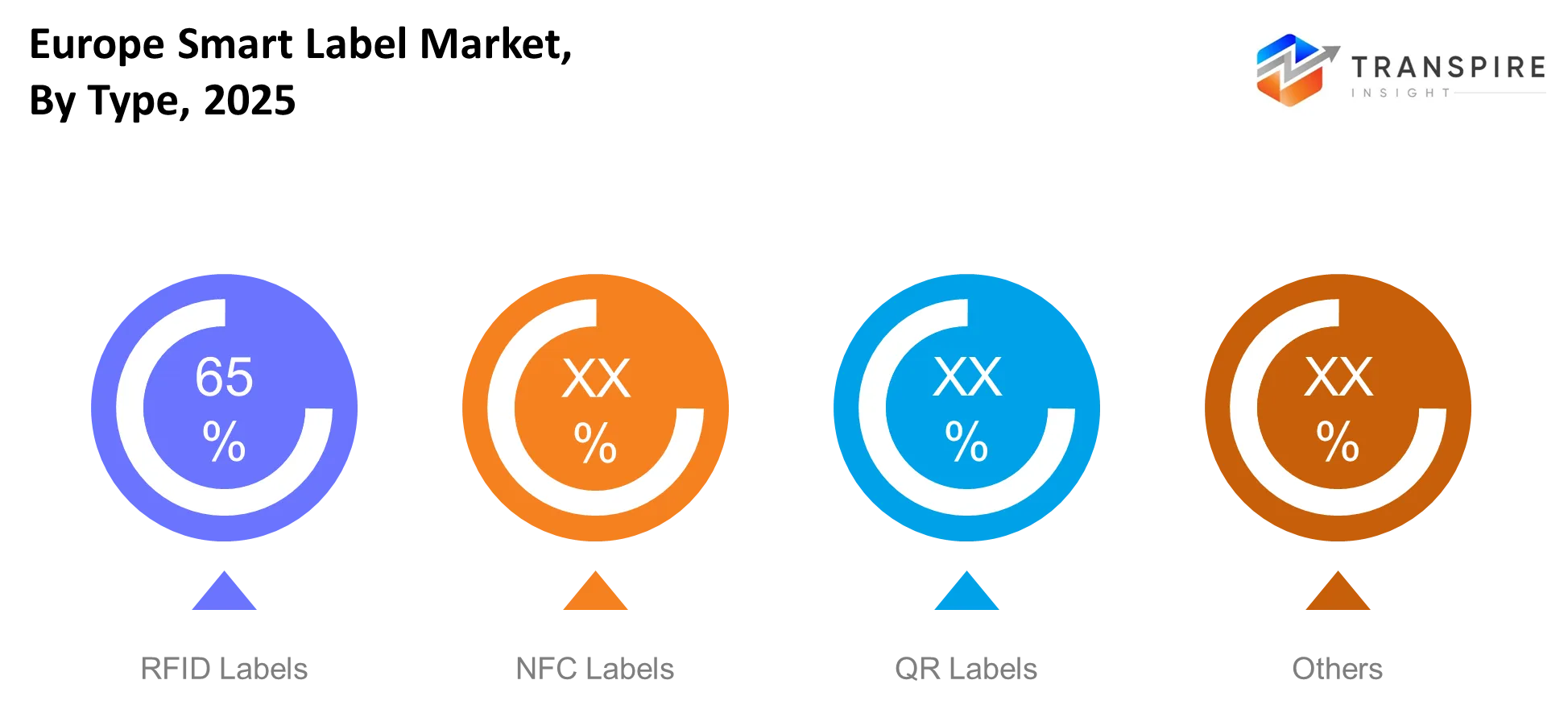
To learn more about this report, Download Free Sample Report
By Application:
Inventory tracking represents the dominant application, supported by widespread deployment across retail and logistics operations. The system needs to automate checkout processes, so the organization needs to reduce stock discrepancies and enhance replenishment cycles. Anti-counterfeiting follows as a critical application in pharmaceuticals, luxury goods, and electronics, where product authenticity directly impacts brand value and regulatory compliance. Marketing applications are growing steadily, particularly through interactive labels that enhance customer engagement.
The leading position of inventory tracking exists because its expenses return clear profit measurements. Anti-counterfeiting grows through stricter regulations and rising counterfeit risks across cross-border trade. Marketing applications expand as brands seek differentiated customer experiences through digital touchpoints. Future growth will likely see convergence between these applications, with multi-functional labels delivering tracking, authentication, and engagement within a single solution.
By End-User:
The retail segment leads the market because businesses require efficient inventory management systems to handle their high-volume operations. Retail giants allocate substantial resources toward smart labeling technology to enhance their inventory control systems and combat product loss. Logistics serves as a vital business operation because supply chains now require comprehensive tracking capabilities for their entire operations. The healthcare industry occupies a smaller market share but experiences rapid expansion because of its need to follow strict regulatory standards and track valuable medical items.
Retail expansion depends on businesses implementing automated systems and multiple customer service methods. The logistics industry expands its operations through e-commerce growth and international business activities which need unified tracking systems. The healthcare system needs faster services because it has to meet both compliance requirements and protect patient safety. Health care will take a bigger market share because advanced labeling systems will become crucial for meeting regulatory standards and maintaining supply chain visibility.
By Component:
Hardware dominates the component segment, as physical labels, chips, and readers form the foundation of all smart labeling systems. The segment experiences growth through investments in RFID inlays and NFC chips which are used in large-scale deployments. Software functions as a vital component because it delivers data analytics and tracking platforms and enterprise system integration. The organization provides services through system integration and maintenance and consulting services.
The volume expansion of hardware products drives their market growth while software products gain value through their ability to support data-driven decision-making. Organizations need service expertise because they must handle the implementation and operation of sophisticated labeling systems. The software market will grow over the forecast period because companies will use analytics and platform features to differentiate their products. Market participants should concentrate on product packages that merge dependable hardware with expandable software solutions.
What are the Key Use Cases Driving the Europe Smart Label Market?
Smart labels create their primary application in retail and fast-moving consumer goods because they provide businesses with contemporary inventory data and help them stop inventory theft. European retailers use RFID-enabled labels because these systems help them track inventory more precisely and complete customer payments automatically while reducing product losses. The application creates maximum demand because it delivers benefits which increase operational efficiency and profit margins for businesses which operate at large scale.
The strict requirements for traceability and safety standards drive the expansion of pharmaceutical and food logistics operations. Smart labels track temperature-controlled shipments while authenticating products in controlled supply chain environments. Healthcare organizations and cold chain distributors are adopting these solutions to meet EU safety requirements while decreasing operational waste.
New use cases are emerging through circular economy initiatives and digital product passport systems. Apparel and electronics sectors are adopting smart label technology to monitor product life cycles and recycling operations. The applications which currently exist in this space are in their initial development stage, yet they match future EU sustainability regulations, which will result in substantial commercial expansion.
|
Report Metrics |
Details |
|
Market size value in 2025 |
USD 3.91 Billion |
|
Market size value in 2026 |
USD 4.546 Billion |
|
Revenue forecast in 2033 |
USD 13.08 Billion |
|
Growth rate |
CAGR of 16.30% from 2026 to 2033 |
|
Base year |
2025 |
|
Historical data |
2021 - 2024 |
|
Forecast period |
2026 - 2033 |
|
Report coverage |
Revenue forecast, competitive landscape, growth factors, and trends |
|
Regional scope |
Europe (Germany, United Kingdom, France, Italy, Spain, Rest of Europe) |
|
Key company profiled |
Avery Dennison, Zebra Technologies, Checkpoint Systems, SATO, Honeywell, NXP, Impinj, Smartrac, Thinfilm, CCL Industries, Alien Technology, Identiv, HID Global, Brady, Toshiba Tec |
|
Customization scope |
Free report customization (country, regional & segment scope). Avail customized purchase options to meet your exact research needs. |
|
Report Segmentation |
By Type (RFID Labels, NFC Labels, QR Labels, Others); By Application (Inventory Tracking, Anti-counterfeiting, Marketing, Others); By End-User (Retail, Logistics, Healthcare, Others); By Component (Hardware, Software, Services, Others) |
Which Regions are Driving the Europe Smart Label Market Growth?
The smart label market in Western Europe operates through strict regulations which developed digital tracking systems from their early implementation. Countries such as Germany France and the Netherlands benefit from their advanced retail network which connects manufacturers with logistics companies and technology providers. The region develops its circular economy policies while making products transparent to all sectors which include food and pharmaceutical and apparel markets. The industry maintains its power through an established network of RFID manufacturers and software vendors and regulatory-focused clients who require exceptional labeling systems.
Northern Europe delivers steady results because its organized processes and sustainable practices drive its operations instead of its market size. The Swedish and Danish markets require smart labels for recycling and lifecycle tracking because their environmental goals extend over extended periods. The region demonstrates increased adoption compared to Western Europe through its uniform implementation methods which decrease market fragmentation. The government and private sector organizations work together to develop labeling technologies which create stable revenue streams through their predictable implementation process.
Eastern Europe has become the fastest expanding area because of its swift industrial upgrades and its growing adherence to European Union rules. Countries like Poland and Romania use supply chain digitization to improve their export capabilities while fulfilling international compliance standards. Multinational companies established manufacturing operations in the area because they needed common labeling requirements which created momentum for industry changes. Technology providers and investors have discovered a market entry opportunity which defines the growth of this industry.
Who are the Key Players in the Europe Smart Label Market and How Do They Compete?
The Europe smart label market displays moderate consolidation at its topmost level whereas new market entrants who use software technology to compete against existing players create active market competition. Large materials and RFID manufacturers continue to defend share through scale and established customer networks while smaller technology firms push disruption through IoT integration and data analytics. The primary basis of competition has shifted from cost efficiency toward technology differentiation which enables real-time data capture together with interoperability and sustainability compliance throughout supply chains.
Avery Dennison maintains its market position through ongoing development of RFID and connected product solutions which provide complete systems that merge hardware with cloud-based data services. The company uses strategic investments and partnerships to expand its business which includes its partnership with Wiliot for enhancing ambient IoT solutions. CCL Industries uses growth-driven operational efficiency and its various label product lines to establish market presence while acquiring European companies to expand its business operations and incorporate smart labeling into its standard product offerings.
Checkpoint Systems provides retail-focused RFID solutions which establish its market position through complete system integration with clothing and product tracking solutions. Pragmatic Semiconductor develops ultra-thin flexible NFC chips which decrease production costs to facilitate widespread market adoption while the company establishes partnerships with label manufacturers to implement its technology in scalable smart label solutions.
Company List
- Avery Dennison
- Zebra Technologies
- Checkpoint Systems
- SATO
- Honeywell
- NXP
- Impinj
- Smartrac
- Thinfilm
- CCL Industries
- Alien Technology
- Identiv
- HID Global
- Brady
- Toshiba Tec
Recent Development News
“In April 2026, Avery Dennison announced a $75 million investment in Wiliot. This strategic funding strengthens their partnership to scale ambient IoT and smart label capabilities for real-time supply chain intelligence and connected product ecosystems.https://www.averydennison.com
“In February 2026, Avery Dennison launched its AD IdentiFresh™ RFID inlay series. The solution enhances real-time inventory visibility in fresh food supply chains, improving waste reduction and operational efficiency across European retail environments.https://www.averydennison.com
What Strategic Insights Define the Future of the Europe Smart Label Market?
The Europe smart label market is now shifting to integrated data-rich labeling systems which better serve supply chain needs than compliance requirements through their ability to track supply chain processes and assess environmental impacts and monitor customer interactions. The market expansion depends on how well different systems work together instead of requiring separate label development. The industry faces a hidden danger through market fragmentation because various standards and exclusive technologies will prevent smaller companies from participating while larger companies build control over essential data systems. The joint development of smart labels with digital product passports which will comply with upcoming EU sustainability rules will create major new market opportunities for the textiles and electronics industries. Companies that commit to these frameworks at an early stage will gain first-mover benefits. All market players should direct their resources toward establishing open-standard systems which will create cross-business data-sharing partnerships that allow them to become ecosystem facilitators instead of supplying individual components.
Europe Smart Label Market Report Segmentation
By Type
- RFID Labels
- NFC Labels
- QR Labels
- Others
By Application
- Inventory Tracking
- Anti-counterfeiting
- Marketing
- Others
By End-User
- Retail
- Logistics
- Healthcare
- Others
By Component
- Hardware
- Software
- Services
- Others
Frequently Asked Questions
Find quick answers to common questions.
The Europe Smart Label Market size is USD 13.08 Billion in 2033.
Key Segments for the Europe Smart Label Market are By Type (RFID Labels, NFC Labels, QR Labels, Others); By Application (Inventory Tracking, Anti-counterfeiting, Marketing, Others); By End-User (Retail, Logistics, Healthcare, Others); By Component (Hardware, Software, Services, Others).
Major Europe Smart Label Market Players are Avery Dennison, Zebra Technologies, Checkpoint Systems, SATO, Honeywell, NXP, Impinj, Smartrac, Thinfilm, CCL Industries, Alien Technology, Identiv, HID Global, Brady, Toshiba Tec.
The current Europe Smart Label Market size is USD 3.91 Billion in 2025.
The Europe Smart Label Market CAGR is 16.30% from 2026 to 2033.
- Avery Dennison
- Zebra Technologies
- Checkpoint Systems
- SATO
- Honeywell
- NXP
- Impinj
- Smartrac
- Thinfilm
- CCL Industries
- Alien Technology
- Identiv
- HID Global
- Brady
- Toshiba Tec
Recently Published Reports
-
Apr 2026
Fiber Optic Faceplates Market
Fiber Optic Faceplates Market Size, Share & Analysis Report By Type (< 300 mm2, 300-350 mm2, and > 350 mm2, By Application (Night Vision, Holographic Imaging, Medical, and Others), and Geography (North America, Europe, Asia-Pacific, Middle East and Africa, South and Central America), 2021 - 2031
-
Apr 2026
High Temperature Superconductors Market
High Temperature Superconductors Market Size, Share & Analysis Report By Type (1G HTS, and 2G HTS), By Application (Power Cable, Fault Current Limiter, and Transformer), and Geography (North America, Europe, Asia-Pacific, Middle East and Africa, South and Central America), 2021 - 2031
-
Apr 2026
Industrial Plugs and Socket Market
Industrial Plugs and Socket Market Size, Share & Analysis Report By Type (Industrial Plugs, Industrial Sockets), By Current (Up to 32 A, 32 to 125 A, Above 125 A), By Protection (Dustproof and Splash Proof, Waterproof, Explosion Proof), By End User (Heavy Industries, Oil and Gas, Chemicals and Pharmaceuticals, Power Generation, Others), and Geography (North America, Europe, Asia-Pacific, Middle East and Africa, South and Central America), 2021 - 2031
-
Apr 2026
InGaAs Avalanche Photodiodes Market
InGaAs Avalanche Photodiodes Market Size, Share & Analysis Report By Type (1100 - 1700 nm, and 1000 - 1600 nm), By Application (Missile Warning System, Muzzle Flash Detection, Wafer Defect Inspection, Laser Rangefinders, and Others), and Geography (North America, Europe, Asia-Pacific, Middle East and Africa, South and Central America), 2021 - 2031