
Asia Pacific Logistics Automation Market Size & Forecast:
- Asia Pacific Logistics Automation Market Size 2033: USD 44119.3 Million
- Asia Pacific Logistics Automation Market CAGR: 17.40%
- Asia Pacific Logistics Automation Market Segments: By Component (Hardware, Software, Services, Robotics, AI Systems, Others); By Application (Warehouse Automation, Transportation, Sorting, Packaging, Inventory Mgmt, Others); By End-User (E-commerce, Retail, Manufacturing, Automotive, Healthcare, Others); By Deployment (On-premises, Cloud, Hybrid, Digital Platforms, SaaS, Others)
To learn more about this report,  Download Free Sample Report
Asia Pacific Logistics Automation Market Summary
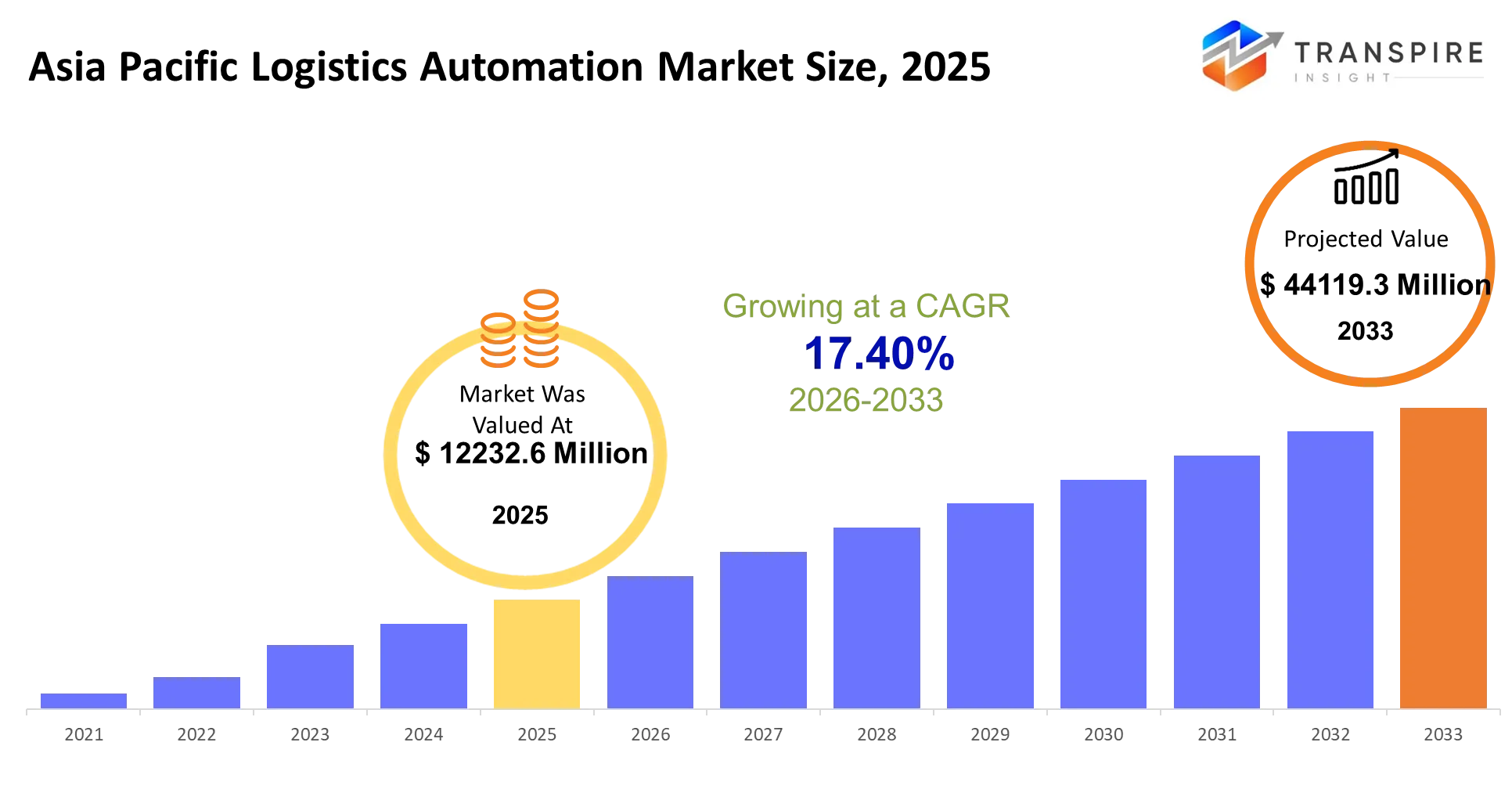
The Asia Pacific Logistics Automation Market was valued at USD 12232.6 Million in 2025. It is forecast to reach USD 44119.3 Million by 2033. That is a CAGR of 17.40% over the period.
The Asia Pacific logistics automation market enables businesses to implement robotics systems and automated storage and retrieval systems and conveyor sorting systems and warehouse management software which efficiently transfers goods between ports and warehouses and distribution networks. The market has evolved during the past five years from using individual mechanical systems to employing complete software-based automation systems which enable robots and IoT sensors and AI orchestration platforms to work together as one system. The supply chain disruptions and worker shortages caused by COVID-19 pandemic brought about this change which revealed the limitations of manual operations used in warehousing and port facilities throughout the entire region.
The companies established resilience as their main focus while developing systems to enhance operational efficiency which resulted in their adoption of scalable automation solutions that decrease their need for unstable workforce resources while enhancing their inventory tracking capabilities. The e-commerce and manufacturing and logistics industries maintain their constant use of automation because companies now treat it as an essential part of their business operations instead of an equipment investment.
Key Market Insights
- China controls the Asia Pacific Logistics Automation Market because it will hold 38 to 42 percent of market share in 2025 through its extensive development of e-commerce fulfillment centers.
- Japan and South Korea experience high automation levels because their workforce shortage drives organizations to adopt advanced robotics in their logistics processes.
- India experiences its fastest growth between 2025 and 2030 because businesses implement warehouse digital solutions and 3PL providers expand their operations.
- Warehouse Automation Systems lead the market because they control approximately 45 percent of the Asia Pacific Logistics Automation Market in 2025.
- Automated Storage and Retrieval Systems (ASRS) serve as the second largest market segment which companies use in their high-density fulfillment centers.
- Robotics-based picking systems represent the fastest-growing segment through 2030 because AI technology enables more accurate picking operations.
- E-commerce fulfillment dominates the market with about 50 percent market share because customers expect same-day delivery and businesses process large order volumes.
- Port and freight automation stands as the most rapidly expanding application because smart port modernization projects are being implemented throughout the Asia-Pacific region.
- The Asia Pacific Logistics Automation Market shows its highest end-use demand from retail and e-commerce companies, which control almost 48 percent of the market.
- The manufacturing and automotive logistics sectors now use automation technology to enhance their supply chain resilience while decreasing operational interruptions.
What are the Key Drivers, Restraints, and Opportunities in the Asia Pacific Logistics Automation Market?
The main factor driving growth for the company results from two elements which include the rapid development of e-commerce fulfillment networks and the ongoing labor shortages that affect major economies including China Japan and South Korea. The transition to automated systems for supply chain management first gained traction during the COVID-19 pandemic when organizations discovered that manual inventory processes and sorting methods caused their supply chains to operate inefficiently. The logistics industry responded to these problems by increasing its spending on robotic systems and AI-based warehouse management solutions and automated storage systems. Businesses need to invest more money in complete automation systems because these systems deliver substantial improvements in operational efficiency while decreasing delivery expenses which enables their revenues to grow more quickly.
Warehouse systems face their biggest obstacle because organizations must pay high initial costs to implement new systems while dealing with the difficulties of making their existing systems work together with their outdated warehouse equipment. Southeast Asian mid-sized logistics companies continue to operate their business using disjointed IT systems which do not support the implementation of modern automation technologies. The existing structural framework prevents organizations from implementing widespread usage because it causes delayed deployment times and limits their ability to expand using non-tier-1 logistics centers which face extended return on investment periods.
India and Vietnam present a major opportunity for the development of smart port automation projects. The combination of AI-powered cargo handling systems and 5G port logistics networks has reached a mature stage which enables shipping companies to coordinate with inland distribution through real-time information sharing. As port modernization becomes a national infrastructure priority automation vendors can explore new revenue streams through their modernization efforts.
What Has the Impact of Artificial Intelligence Been on the Asia Pacific Logistics Automation Market?
The Asia Pacific Logistics Automation Market experiences transformation through artificial intelligence together with advanced digital systems which introduce intelligence to warehouse operations, port facilities, and maritime logistics activities. Artificial intelligence now enables continuous monitoring of scrubber performance systems through its marine emission control technologies which analyze exhaust gas cleaning data to automatically track compliance with IMO sulfur emission standards. Digital control systems now operate as the primary system for shipping operators because they use real-time operating parameter adjustments to protect regulatory compliance while reducing fuel penalties.
Machine learning models now enable better predictive abilities through their application across logistics networks. The systems in warehouse and fleet environments use vibration, temperature, and usage pattern data to predict equipment failures which results in a 20 to 30 percent reduction of unplanned downtime in automated facilities. Emissions forecasting tools enable better voyage planning because they model fuel consumption patterns based on various load and weather scenarios which help fleet operators achieve better fuel efficiency and reduced operational expenses.
The operational improvements result in measurable benefits which include better asset uptime and more accurate compliance reporting and lower maintenance costs for integrated logistics systems. The process of adoption faces a major barrier because of two main issues, which are the poor quality of maritime data that exists in the real world and the restricted satellite connection which occurs during maritime travel. The Asia Pacific Logistics Automation Market faces reduced model accuracy because of operational gaps which prevent complete advanced artificial intelligence system deployment across its fragmented shipping routes.
Key Market Trends
- E-commerce growth from 2020 to 2025 forced Chinese and Indian warehouses to adopt AI robotic systems for their sorting operations.
- Japanese logistics companies started using autonomous mobile robots because their existing conveyor systems needed more flexibility to handle their increased operational needs which began after 2022.
- The smart port projects established in Singapore and China after 2021 brought IoT cargo tracking systems into operation because shipping delays showed how badly container visibility systems needed improvement.
- Daifuku started using modular automation systems because they needed to replace their fixed infrastructure with flexible systems to operate their high-density fulfillment centers in 2023.
- Southeast Asian logistics centers started using cloud-based warehouse management systems because they needed to stop using their uncoordinated on-premise inventory management systems after 2022.
- The 3PL sector in India started increasing its automation spending after supply chain disruptions in 2021 because it wanted to establish real-time tracking systems and AI-powered demand forecasting equipment.
- The usage of robotics in warehouses increased rapidly after 2020, which resulted in APAC high-volume distribution centers decreasing their need for human workers by up to 35%.
- Siemens and Honeywell developed their AI logistics systems because they wanted to improve warehouse management through predictive optimization instead of traditional emergency response methods in 2023.
- Geopolitical supply chain diversification after 2022 created new automation opportunities for cross-border logistics which drove manufacturers to move their operations to Southeast Asia.
Asia Pacific Logistics Automation Market Segmentation
By Component :
The system requires physical hardware components which include sensors and conveyor belts and scanning units and machines that facilitate faster and error-free movement of goods. The system uses software to manage control systems which track goods movement and operate facilities in actual time. The services provide support for installation and system upkeep and system upgrades which extend through all office locations.
Robotics and artificial intelligence systems boost operational capacity through their speedy and precise performance in warehouse work and decision-making processes. Robotics handles work which includes lifting and picking and sorting tasks while artificial intelligence systems provide support for predicting and planning routes and managing demand. The extra tools provide operational flexibility because they complete missing operational requirements and they enhance the ability of systems to work together.
By Application :
Warehouse automation systems help facilities by improving their storage operations and order processing systems and internal movement of goods while decreasing the need for human workers. The transportation system enables goods to move between various places while offering enhanced tracking capabilities and better operational coordination. The sorting systems enable fast goods separation according to their size and type and destination which leads to better operational performance.
Packaging materials enable faster and more consistent delivery preparation of products while inventory management systems enable stock monitoring which helps prevent stock shortages and excess inventory situations. The other applications provide support for specific operational functions which enhance the complete logistics process while improving the performance of the entire system.
By End-User :
E-commerce users implement automation solutions to achieve faster order processing and precise package delivery and their capability to manage large order volumes. Retail operations implement automated systems to enhance their management of store supply chains and distribution centers. Manufacturing industries depend on automated solutions to control their production processes and material transportation and warehouse operations which enable them to maintain nonstop production.
Automotive users depend on automation systems to manage their inventory of parts and their assembly operations. Healthcare applications establish secure storage areas to ensure safe handling of medical supplies and equipment while enabling immediate access to these resources. Other end-users implement automation systems that deliver specific operational advantages which enhance their speed and precision and trustworthiness.
By Deployment :
Through on-premises deployment organizations can completely control their facility systems which include their automation systems. Cloud deployment enables remote access, real-time data handling, and flexible scaling of logistics operations. Hybrid models combine both approaches to balance control and flexibility based on operational needs.
Digital platforms help unify logistics processes under one system, improving visibility and coordination across activities. Software as a Service solutions decrease the requirement for substantial infrastructure expenditures while providing automated system access through subscription plans which simplify operational system upgrades and management activities.
What are the Key Use Cases Driving the Asia Pacific Logistics Automation Market?
The Asia Pacific Logistics Automation Market currently experiences its primary growth through warehouse fulfillment automation which employs robotic technology and automated storage systems and AI-based sorting systems to handle large volumes of e-commerce and retail customer orders. This application generates the strongest demand because rising same-day delivery expectations and labor constraints in China, Japan, and India require faster, error-free inventory handling and scalable throughput.
The market for automated systems now shows two new growth areas which include port cargo handling automation and cold-chain logistics optimization. Singapore and China port operators now utilize automated cranes and IoT-based container tracking systems to achieve faster unloading times. Pharmaceutical and food distributors use temperature-controlled automated warehouses to protect product quality during long-distance supply chain operations.
The development of AI-powered fleet management systems and autonomous yard management technology systems now enables multimodal logistics operations in major distribution centers. The 3PL providers and maritime-linked logistics operators require these systems to achieve better operational coordination between their shipping operations and their rail and road networks because supply chain uncertainties are increasing.
|
Report Metrics |
Details |
|
Market size value in 2025 |
USD 12232.6 Million |
|
Market size value in 2026 |
USD 14349.1 Million |
|
Revenue forecast in 2033 |
USD 44119.3 Million |
|
Growth rate |
CAGR of 17.40% from 2026 to 2033 |
|
Base year |
2025 |
|
Historical data |
2021 - 2024 |
|
Forecast period |
2026 - 2033 |
|
Report coverage |
Revenue forecast, competitive landscape, growth factors, and trends |
|
Regional scope |
India, China, Japan, and Australia |
|
Key company profiled |
Daifuku, Dematic, Honeywell, SSI Schaefer, Vanderlande, TGW Logistics, Murata Machinery, Toyota Industries, KNAPP, Swisslog, ABB, Siemens, KION Group, Amazon Robotics, Zebra Technologies |
|
Customization scope |
Free report customization (country, regional & segment scope). Avail customized purchase options to meet your exact research needs. |
|
Report Segmentation |
By Component (Hardware, Software, Services, Robotics, AI Systems, Others); By Application (Warehouse Automation, Transportation, Sorting, Packaging, Inventory Mgmt, Others); By End-User (E-commerce, Retail, Manufacturing, Automotive, Healthcare, Others); By Deployment (On-premises, Cloud, Hybrid, Digital Platforms, SaaS, Others) |
Which Regions are Driving the Asia Pacific Logistics Automation Market Growth?
China holds the leading position in the Asia Pacific Logistics Automation Market because of its extensive port facilities and its concentrated production capability and its government-supported digital logistics initiatives. The development of smart ports in Shanghai and Shenzhen through substantial financial backing has resulted in the complete incorporation of artificial intelligence systems for cargo operations and automated container monitoring. The country’s extensive e-commerce ecosystem further reinforces demand for high-speed warehouse automation. The ecosystem operates through local robotics manufacturers together with advanced 5G connectivity which enables various logistics nodes to operate without interruption. The combination of these elements produces an automated system which maintains ongoing control of all operational processes throughout the area.
Japan functions as a stable contributor to the market because of its precise logistics needs and her long-term capacity planning needs industrial growth. Growth in the country occurs through automated system advancements which improve current infrastructure during supply chain operations for automotive and electronics products. The country needs to adopt robotics systems for warehouse and port operations because its workforce is getting older, although businesses still invest in technology at a slow pace. Japanese companies provide automation services to global markets because their operational procedures follow consistent regulations while they maintain high performance requirements which produce steady revenue for their business.
India becomes the fastest-growing area because its national programs have modernized logistics infrastructure through measures like port digitization and industrial corridor development. E-commerce penetration has grown rapidly while 3PL companies have expanded their operations which has increased the speed of warehouse automation implementation since 2022. The new multimodal logistics hubs and smart port programs in Gujarat and Maharashtra create new ways to improve supply chain operations. The 2026 to 2033 period will deliver substantial business growth opportunities to investors and market newcomers because of India's rapid development during this time frame which allows for cost-effective scalability through automated solutions.
Who are the Key Players in the Asia Pacific Logistics Automation Market and How Do They Compete?
The Asia Pacific logistics automation market experiences moderate consolidation because global automation firms control major integration projects while local businesses concentrate on developing specific warehouse systems.The market operates based on three fundamental elements which include complete system integration and software compatibility and dependable service delivery but not on the pricing of individual hardware components. Existing companies maintain their market share through their established systems while new companies use robotics-as-a-service and adaptable operational methods to compete in the mid-level logistics market.
Daifuku and KION Group and Toyota Industries compete through their automated systems and their ability to handle materials. Daifuku develops modular warehouse solutions and scalable AS/RS systems while building its presence in India and Southeast Asia through major e-commerce distribution contracts. KION Group uses its automation products to create complete intralogistics systems which it sells to high-density distribution centers located in China and Japan. Toyota Industries uses forklift automation systems and hybrid manual-automated equipment to create operational advantages for manufacturing supply chains.
ABB Siemens and Honeywell compete in the market through their automation solutions which are driven by software. ABB uses robotics systems to enhance operational efficiency and picking accuracy in warehouse and port environments. Siemens uses digital twin technology to improve logistics processes. Honeywell uses its warehouse execution systems to enhance inventory tracking and process management across its extensive distribution networks.
Company List
- Daifuku
- Dematic
- Honeywell
- SSI Schaefer
- Vanderlande
- TGW Logistics
- Murata Machinery
- Toyota Industries
- KNAPP
- Swisslog
- ABB
- Siemens
- KION Group
- Amazon Robotics
- Zebra Technologies
Recent Development News
In April 2026, FORTNA announced a strategic partnership with Jacobi Robotics. The partnership between FORTNA and Jacobi Robotics will implement Jacobi's OmniPalletizer system into FORTNA's existing automation systems to provide AI-based mixed-case palletizing solutions which will decrease manual work in high-capacity distribution centers while enhancing operational efficiency throughout Asia Pacific distribution networks.
Source https://www.fortna.com/
In April 2026, AGIBOT announced a strategic partnership with Cerebrotech Inc. The partnership will develop robotics and embodied AI systems for use in Philippine logistics and corporate operations which will help Southeast Asian warehouses and distribution networks to adopt automated systems.Source https://www.prnewswire.com/
What Strategic Insights Define the Future of the Asia Pacific Logistics Automation Market?
The Asia Pacific Logistics Automation Market is moving toward its future state which will establish its complete logistics operations through automated solutions that businesses will run using software-based systems which will operate without any need for their physical machinery. The next five to seven years will see this transition because of ongoing worker shortages and increasing demands for e-commerce delivery capacity and better connection between ports and warehouses and multiple transport systems. Automation will develop into a united digital platform which combines all warehouse functions instead of existing as independent system enhancements thereby driving solution providers toward their platform-based sales models.
The risk of dependency on a limited number of international automation providers and software systems creates dangerous concentration points which threaten essential logistics functions. Any interruption to these systems or their ability to work together will result in longer implementation times and higher costs for operators who need to switch between systems.
Smart port-to-inland automation corridors are emerging as new business opportunities which specifically develop through government initiatives that connect port digitization with industrial freight corridors throughout India and Southeast Asia. Market participants should prioritize modular, interoperable systems that can scale across these connected logistics zones to capture long-term contract value and early ecosystem lock-in.
Asia Pacific Logistics Automation Market Report Segmentation
By Component
- Hardware
- Software
- Services
- Robotics
- AI Systems
By Application
- Warehouse Automation
- Transportation
- Sorting
- Packaging
- Inventory Mgmt
By End-User
- E-commerce
- Retail
- Manufacturing
- Automotive
- Healthcare
By Deployment
- On-premises
- Cloud
- Hybrid
- Digital Platforms
- SaaS
Frequently Asked Questions
Find quick answers to common questions.
The Asia Pacific Logistics Automation Market size is USD 44119.3 Million in 2033.
Key segments for the Asia Pacific Logistics Automation Market are By Component (Hardware, Software, Services, Robotics, AI Systems, Others); By Application (Warehouse Automation, Transportation, Sorting, Packaging, Inventory Mgmt, Others); By End-User (E-commerce, Retail, Manufacturing, Automotive, Healthcare, Others); By Deployment (On-premises, Cloud, Hybrid, Digital Platforms, SaaS, Others).
Major Asia Pacific Logistics Automation Market players are Daifuku, Dematic, Honeywell, SSI Schaefer, Vanderlande, TGW Logistics, Murata Machinery, Toyota Industries, KNAPP, Swisslog, ABB, Siemens, KION Group, Amazon Robotics, Zebra Technologies.
The Asia Pacific Logistics Automation Market size is USD 12232.6 Million in 2025.
The Asia Pacific Logistics Automation Market CAGR is 17.40% from 2026 to 2033.
- Daifuku
- Dematic
- Honeywell
- SSI Schaefer
- Vanderlande
- TGW Logistics
- Murata Machinery
- Toyota Industries
- KNAPP
- Swisslog
- ABB
- Siemens
- KION Group
- Amazon Robotics
- Zebra Technologies
Recently Published Reports
-
Apr 2026
Fiber Optic Faceplates Market
Fiber Optic Faceplates Market Size, Share & Analysis Report By Type (< 300 mm2, 300-350 mm2, and > 350 mm2, By Application (Night Vision, Holographic Imaging, Medical, and Others), and Geography (North America, Europe, Asia-Pacific, Middle East and Africa, South and Central America), 2021 - 2031
-
Apr 2026
High Temperature Superconductors Market
High Temperature Superconductors Market Size, Share & Analysis Report By Type (1G HTS, and 2G HTS), By Application (Power Cable, Fault Current Limiter, and Transformer), and Geography (North America, Europe, Asia-Pacific, Middle East and Africa, South and Central America), 2021 - 2031
-
Apr 2026
Industrial Plugs and Socket Market
Industrial Plugs and Socket Market Size, Share & Analysis Report By Type (Industrial Plugs, Industrial Sockets), By Current (Up to 32 A, 32 to 125 A, Above 125 A), By Protection (Dustproof and Splash Proof, Waterproof, Explosion Proof), By End User (Heavy Industries, Oil and Gas, Chemicals and Pharmaceuticals, Power Generation, Others), and Geography (North America, Europe, Asia-Pacific, Middle East and Africa, South and Central America), 2021 - 2031
-
Apr 2026
InGaAs Avalanche Photodiodes Market
InGaAs Avalanche Photodiodes Market Size, Share & Analysis Report By Type (1100 - 1700 nm, and 1000 - 1600 nm), By Application (Missile Warning System, Muzzle Flash Detection, Wafer Defect Inspection, Laser Rangefinders, and Others), and Geography (North America, Europe, Asia-Pacific, Middle East and Africa, South and Central America), 2021 - 2031