

Europe Chilled Beam System Market Size & Forecast:
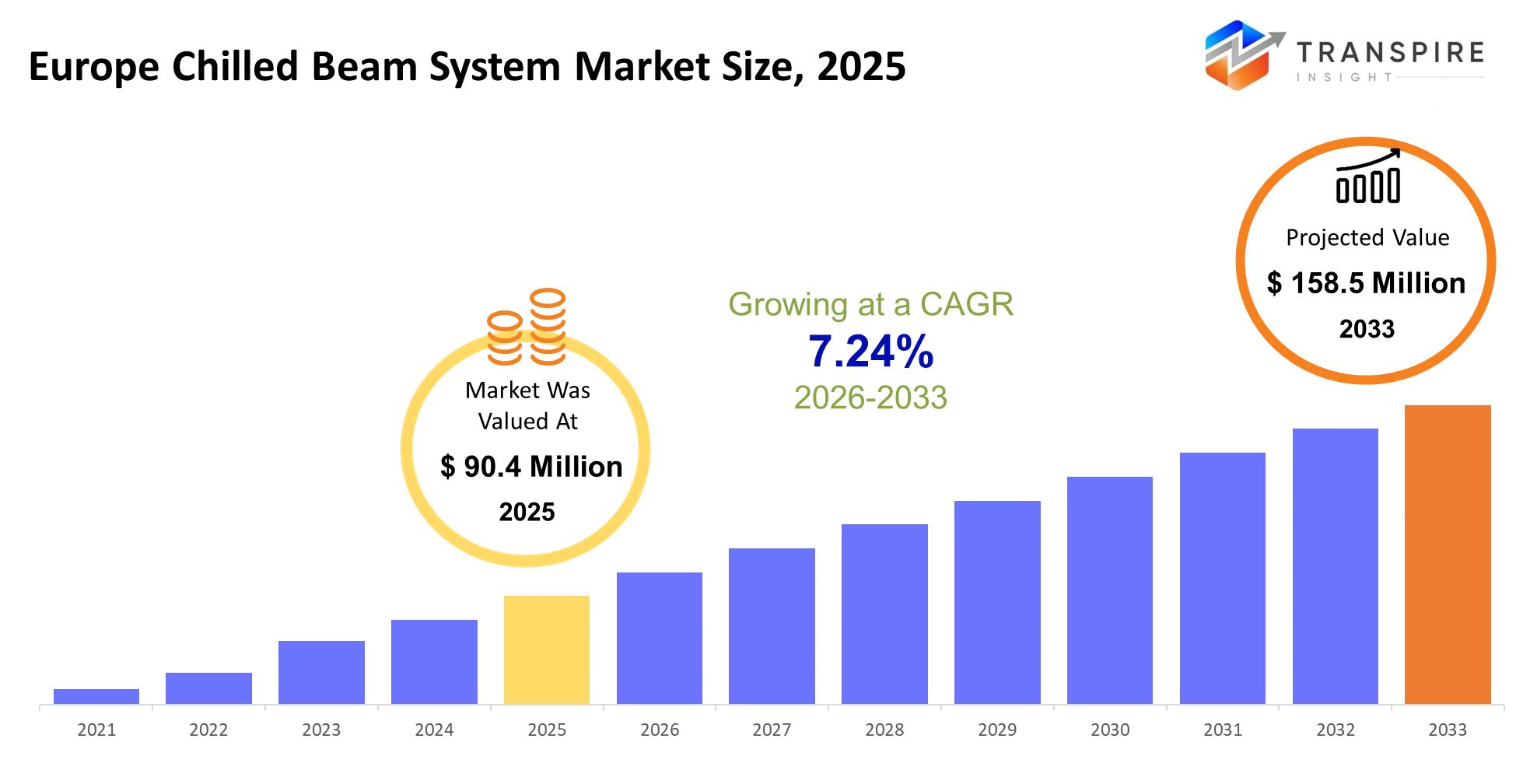
- Europe Chilled Beam System Market Size 2025: USD 90.4 Million
- Europe Chilled Beam System Market Size 2033: USD 158.5 Million
- Europe Chilled Beam System Market CAGR: 7.24%
- Europe Chilled Beam System Market Segments: By Type (Active Chilled Beam, Passive Chilled Beam, Multi-service Beam, Others); By Application (Commercial Buildings, Offices, Healthcare Facilities, Educational Institutions, Hospitality, Others); By End-User (Construction Companies, Facility Managers, Real Estate Developers, Government, Industrial Firms, Others); By Installation (New Installations, Retrofit, Others).
To learn more about this report,  Download Free Sample Report
Europe Chilled Beam System Market Summary
The Europe Chilled Beam System Market was valued at USD 90.4 Million in 2025. It is forecast to reach USD 158.5 Million by 2033. That is a CAGR of 7.24% over the period.
Chilled beam systems provide an effective solution for building systems because they deliver cooling and ventilation services without needing to use significant amounts of air that is recirculated. These systems operate in offices and hospitals and universities to create constant indoor temperature conditions while reducing energy consumption and noise production. The system provides essential benefits for commercial areas because it helps to maintain tenant comfort and air quality while minimizing their operational costs.
The European building design system has undergone a structural change during the last three to five years because of a movement that supports low-carbon building design. The latest energy performance standards required developers to switch from traditional HVAC systems that depend on air to water-based systems that use less energy. The main factor that triggered this process occurred when construction companies began to enforce building emissions standards, which required compliance for project approval and funding. The new rule brought about increased use of chilled beam systems in construction projects and high-end retrofits, which resulted in revenue growth because these systems became necessary for compliance, not optional system enhancements.
Key Market Insights
- In 2025 Northern and Western Europe will control more than 48% of the market because they enforce strict energy regulations and possess established environmentally sustainable construction systems.
- The Eastern European region will experience its most rapid growth until 2030 because construction activities increase and European Union infrastructure improvement projects receive financial support.
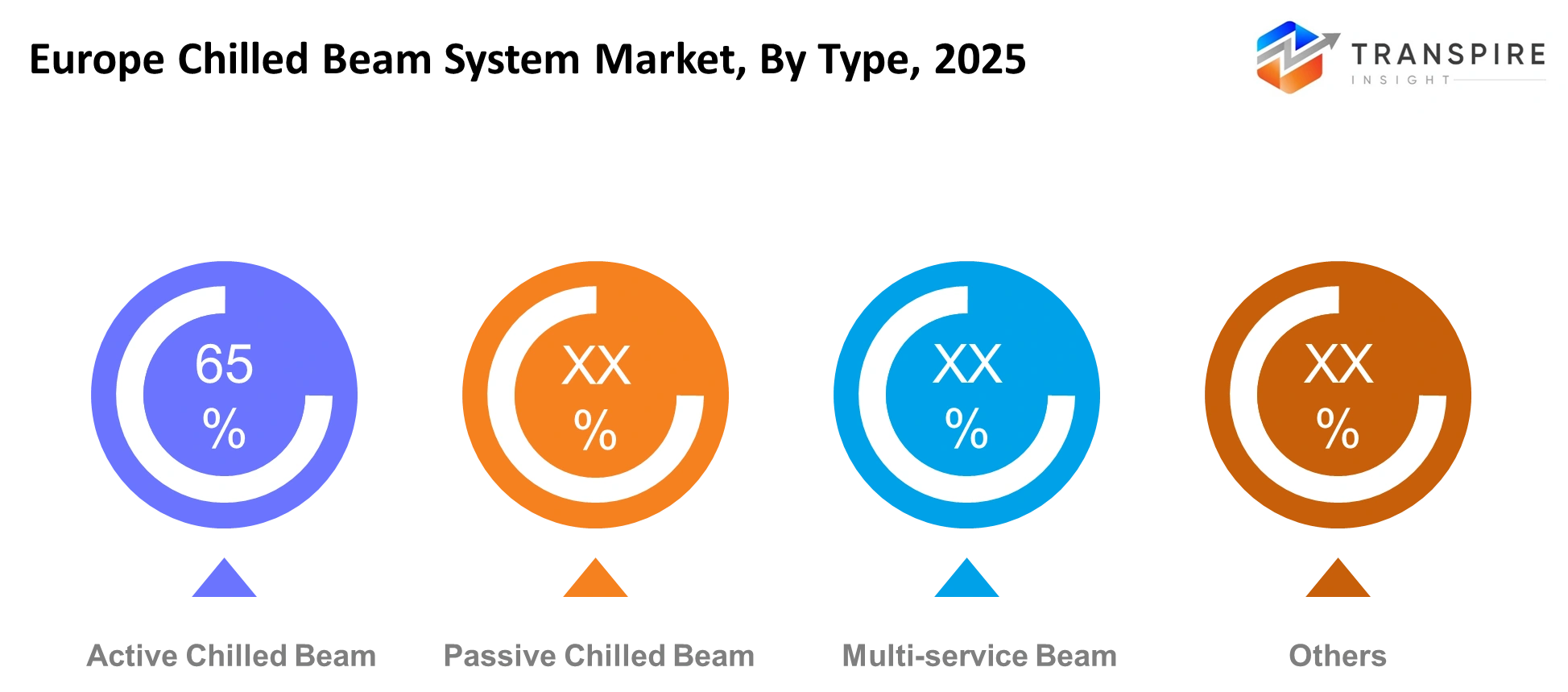
- The Europe Chilled Beam System Market is dominated by active chilled beam systems which control almost 60% of the market through their advanced cooling performance and airflow management capabilities.
- The market for passive chilled beams holds the second biggest market share because they are used in specific situations which require low energy consumption in buildings.
- The demand for integrated lighting systems with acoustic solutions and HVAC systems will make multi-service chilled beams become the fastest-growing segment of the market from 2026 until 2026.
- Developers of commercial office buildings will achieve the most market success in 2025 because they focus on creating energy-efficient buildings which provide maximum comfort to their occupants.
- The healthcare sector is developing into the most rapidly expanding field because it needs to meet strict indoor air quality standards and control infection spread.
- Real estate developers create the most demand with their 45% market share because chilled beams increase property worth and help buildings achieve green certification.
- Government and institutional buyers are expanding rapidly, supported by public funding and regulatory mandates for low-carbon building systems.
- European companies operating in the Chilled Beam System Market are forming new partnerships while creating digital systems and entering new markets to build their competitive advantage for the future.
What are the Key Drivers, Restraints, and Opportunities in the Europe Chilled Beam System Market?
The main reason why chilled beam technology is gaining acceptance in Europe stems from the implementation of more rigorous building energy regulations that European countries have established. The revised Energy Performance of Buildings standards together with their new policies compelled developers to reduce operational carbon emissions while adopting water-based cooling systems that operate with decreased fan energy requirements. The regulatory requirement triggered an upsurge in demand for commercial construction projects because compliance with these regulations served as the foundation for project approval and determination of asset worth. The industry adopted chilled beam systems as standard practice for large office and institutional projects which generated consistent revenue growth for the company.
The market expansion path toward wider adoption face its biggest obstacle because high retrofit complexity remains unresolved. The existing buildings lack necessary features such as ceiling space and pipe layout together with insulation materials which make it impossible to implement chilled beam systems at an affordable expense. The building design barrier occupies a permanent space because it relies on established architectural patterns that existed before the current technology developments emerged. The result is delayed adoption across a large portion of Europe’s aging building stock which slows overall market growth despite strong demand in new construction.
The emerging opportunity for chilled beam systems exists through modular and prefabricated construction because these systems allow pre-integration into building design elements. The factory assembly method enables accurate component installation while decreasing the need for manual work in construction areas. The adoption of modular construction by Northern European countries will create opportunities for manufacturers to increase system deployment speed while developing new business opportunities.
What Has the Impact of Artificial Intelligence Been on the Europe Chilled Beam System Market?
Real-time monitoring systems of digital control systems maintain energy efficiency while operational performance of chilled beam systems. AI-based algorithms in building management systems allocate cooling requirements to different building areas, which decreases the need for human work while maintaining stable indoor temperature levels. Facility teams use Internet of Things sensors to track temperature and humidity and occupancy levels, which enables systems to automatically adjust their operations instead of operating on predetermined time patterns. The system achieves its energy-saving goals through automated processes which enable buildings to meet European energy performance requirements.
The use of machine learning models has become more widespread because they provide accurate predictions for maintenance requirements while enhancing system performance. The predictive analytics technology identifies the initial signs of coil contamination and valve breakdowns and flow problems, which leads to fewer unexpected breakdowns and longer equipment lifespan. Operators experience energy reductions between 10 and 20 percent after they implement AI-driven optimization instead of using their previous fixed control systems. Engineers use digital twins to perform system performance tests, which help them improve system operations before actual working conditions create problems.
The primary challenge with AI platform implementation into existing HVAC systems remains because of its expensive nature and complicated process. The lack of sufficient sensors and high-quality data in currently operating buildings prevents accurate model training, which hinders implementation despite evident energy efficiency improvements.
Key Market Trends
- The demand for green certification which began in 2020 drove commercial buildings to adopt chilled beam systems which reached 58% market share by 2025.
- European regulators established stricter energy performance requirements after 2021, which forced developers to change from air-based HVAC systems to water-based solutions that minimize fan energy use.
- After COVID-19, people started to demand systems that enhance indoor air quality because chilled beams protect offices and hospitals from air contamination through their ability to minimize air recirculation.
- From 2023 until 2026, manufacturers began to implement smart controls and sensors into chilled beams, which enabled their products to function with digital building management systems.
- The market for passive chilled beams started to expand after 2024 because buyers preferred energy-efficient solutions, which made this design category the most rapidly expanding segment although it currently holds a smaller market share.
- The high initial expenses and complex systems of retrofit projects have made older buildings difficult to adopt since 2022, which has caused suppliers to concentrate their efforts on new construction projects.
- Investors in properties from 2025 onward started to assess HVAC systems based on their carbon emissions and energy efficiency, instead of evaluating them based on their installation costs.
- The last five years have seen aluminum become the top material choice because it offers both environmental sustainability through recyclability and superior thermal performance, leading organizations to procure materials based on sustainability needs.
- Chilled beams became more popular in healthcare and educational facilities after 2024 because institutional building designs needed to focus on creating environments with low noise and consistent thermal conditions.
Europe Chilled Beam System Market Segmentation
By Type:
Active chilled beam systems control the major market share because they provide effective cooling and work well with contemporary HVAC systems. Large commercial spaces maintain high demand because their need for accurate temperature management and energy efficiency drives their purchasing choices. Passive chilled beams occupy a smaller share because their restricted cooling capacity limits their application to particular climate conditions and building design elements. Multi-service beams attract interest from high-end projects which combine lighting and air distribution and acoustic functions into a single product, but their initial cost restricts their full market potential.
Active systems see market expansion because of increasing energy regulations and growing demand for buildings that produce low carbon emissions. Passive systems grow slowly, supported by niche applications in mild climates and retrofit projects. Multi-service beams expand through high-end developments that prioritize space optimization and design flexibility. Future demand points toward integrated systems that combine efficiency with multifunctionality, which pushes product developers to create hybrid solutions and investors to concentrate on high-end construction markets.
To learn more about this report, Download Free Sample Report
By Application:
Commercial buildings maintain the highest market share because their extensive spaces and centralized cooling requirements make them perfect candidates for chilled beam systems. The office market comes next because workers need both comfort and energy-saving climate control solutions. Healthcare facilities maintain steady adoption due to strict indoor air quality requirements, whereas educational institutions and hospitality segments contribute moderate shares which arise from their renovation cycles and sustainability targets.
The growth patterns of different applications show distinct differences. The demand for office space increases when buildings receive green building certifications and when workplace wellness programs become popular. The healthcare sector expands through infrastructure improvements and infection control systems which require low-airflow system installation. The hospitality industry needs premium hotel development because silent facilities and comfortable spaces create additional worth. The upcoming trend predicts increased adoption of healthcare and education systems which will lead manufacturers to design products that meet hygiene requirements and sound control needs and adaptable usage needs while investors observe institutional building development schedules.
By End-User:
Construction companies and real estate developers control the market share because they participate directly in building projects and choose which systems to install. Government bodies hold a significant position through public infrastructure projects that emphasize energy efficiency and sustainability. Facility managers have the power to decide which systems to retrofit or maintain while industrial firms represent a minor portion because their operations only work in industrial environments.
Different users have different factors that drive their growth. Real estate developers choose chilled beams because these systems increase their property values and help them achieve green certification standards. Government demand increases because of upcoming regulatory requirements and climate change objectives. Facility managers choose systems that help them decrease operational expenses while achieving better energy results throughout system operation. The future will bring enhanced partnerships between developers and technology providers which will help both sectors develop their construction projects while public sector spending generates consistent market demand which will lead suppliers to develop products that meet regulatory requirements and operational efficiency across all stages of product life.
By Installation:
The market is currently dominated by new installations which enable easier installation of chilled beam systems within contemporary building designs. Architects and engineers select these systems for their initial design work because the systems allow them to create sustainable construction projects and work with different building materials. Existing building systems create additional difficulties which lead to increased expenses that make retrofit installations less common. The other types of installation work exist as specific installation projects that contact their respective installation teams.
The expansion of new installations occurs because urban areas develop and building codes establish stricter requirements for energy-efficient construction. The demand for retrofitting services increases at a gradual pace because developed areas need infrastructure upgrades due to their aging systems. The process of retrofitting existing buildings faces obstacles because of high expenses and complex technical requirements which make new construction projects more favorable. The market for retrofit solutions will experience continuous growth because technological progress and decreasing installation obstacles lead manufacturers to create flexible systems while investors track remodeling processes in established business sectors.
What are the Key Use Cases Driving the Europe Chilled Beam System Market?
The strongest demand for office buildings arises because organizations need chilled beam systems to comply with European energy performance regulations and indoor comfort standards. The systems enable large corporate campuses and urban office towers to achieve energy reduction goals while they maintain their required temperature conditions. The combination of silent system operation and better air circulation results in increased work efficiency, which drives commercial properties to implement this technology.
The healthcare and education fields demonstrate increased technology usage because hospitals and universities replace their current systems with greener solutions that fulfill their sustainability and air quality standards. The healthcare and education sectors prefer chilled beams because they produce minimal sound and airflow which enables them to create controlled spaces. Green building certifications and public sector funding empower institutions to install green building solutions at an increasing pace.
The two emerging applications of data centers and mixed-use smart buildings present significant potential for future growth. Chilled beam systems help developers achieve energy-efficient cooling for their hybrid building projects because they enable chilled beam systems to become part of their building designs. The combination of heightened carbon emission control regulations with rising smart infrastructure needs has created multiple new business opportunities.
|
Report Metrics |
Details |
|
Market size value in 2025 |
USD 90.4 Million |
|
Market size value in 2026 |
USD 97.2 Million |
|
Revenue forecast in 2033 |
USD 158.5 Million |
|
Growth rate |
CAGR of 7.24% from 2026 to 2033 |
|
Base year |
2025 |
|
Historical data |
2021 - 2024 |
|
Forecast period |
2026 - 2033 |
|
Report coverage |
Revenue forecast, competitive landscape, growth factors, and trends |
|
Regional scope |
Europe (Germany, United Kingdom, France, Italy, Spain, Rest of Europe) |
|
Key company profiled |
Halton, TROX, Swegon, Lindab, FläktGroup, Systemair, Caverion, Carrier, Daikin, Johnson Controls, Siemens, Schneider Electric, Zehnder, Airflow Developments, Titus. |
|
Customization scope |
Free report customization (country, regional & segment scope). Avail customized purchase options to meet your exact research needs. |
|
Report Segmentation |
By Type (Active Chilled Beam, Passive Chilled Beam, Multi-service Beam, Others); By Application (Commercial Buildings, Offices, Healthcare Facilities, Educational Institutions, Hospitality, Others); By End-User (Construction Companies, Facility Managers, Real Estate Developers, Government, Industrial Firms, Others); By Installation (New Installations, Retrofit, Others). |
Which Regions are Driving the Europe Chilled Beam System Market Growth?
European regulations require strict energy efficiency standards, which require building performance regulations to be enforced, which keeps the market operating at its current level. The regulations push developers to select low-energy HVAC systems because this requirement enables the installation of chilled beam systems throughout their projects. The construction industry functions through established operational methods and advanced technical resources, which create an efficient system for integrating various components. The three groups of policymakers, architects, and technology providers work together for their mutual benefit, which leads to continuous development and ongoing demand for their products.
The North American market maintains steady growth because investors continue to fund both commercial real estate and institutional infrastructure projects. The market expansion proceeds through corporate sustainability initiatives while companies assess their expenses throughout their product lifecycle instead of relying on government regulations. Building owners choose energy-efficient retrofits because these upgrades lower their operational costs while helping them achieve their corporate environmental objectives. The organization maintains stable operations through its established system of facility managers and service providers, which operates from office spaces to healthcare facilities and educational institutions.
The Asia-Pacific region experiences the fastest growth rate because of its rapid development of urban areas and its extensive building construction activities. The government recently introduced new programs that support green building initiatives and energy-saving practices, which have resulted in increased use of innovative cooling systems. The development of commercial centers and smart city initiatives enables businesses to implement chilled beam technology in their operations. The upcoming growth period between 2026 and 2033 displays significant potential for new market players and investors, who will focus on building projects in high-density urban areas while meeting developing sustainability requirements.
Who are the Key Players in the Europe Chilled Beam System Market and How Do They Compete?
European competition for the chilled beam system market maintains a moderate level of fragmentation because multiple engineering companies and HVAC specialists compete through project-based contracts. The current manufacturers maintain their market position through established partnerships with architects and contractors, while smaller companies enter the market through their specialized design or retrofit knowledge. Organizations make their decisions based on technology performance and system integration, which becomes crucial for projects needing energy efficiency standards and control of indoor climate conditions. The ability to provide services becomes essential since customers appreciate the combination of design assistance and installation help along with maintenance support for the entire product lifecycle.
Halton Group develops cutting-edge technology through its active chilled beam systems, which provide excellent performance and advanced airflow management and minimal noise emissions. TROX GmbH establishes its market position through its extensive engineering capabilities and ability to create personalized air distribution systems for large commercial spaces. Swegon Group AB develops market advantage through its complete systems, which integrate chilled beams with intelligent controls and energy tracking systems, making them more attractive for environmentally certified projects.
FläktGroup delivers extensive solutions for major projects while providing a wide range of products that meet both construction and renovation requirements. Lindab Group uses its modular design capabilities and extensive distribution network to efficiently meet the needs of mid-sized commercial projects. The expansion strategies of these companies involve developing partnerships with construction firms and implementing digital system connections and expanding their operations into Eastern European markets that experience increasing construction activity.
Company List
- Halton
- TROX
- Swegon
- Lindab
- FläktGroup
- Systemair
- Caverion
- Carrier
- Daikin
- Johnson Controls
- Siemens
- Schneider Electric
- Zehnder
- Airflow Developments
- Titus
Recent Development News
“In April 2026, Halton Group launched an updated variable air volume chilled beam solution (Rex REW) to replace earlier models. The upgrade improves demand-controlled ventilation and energy efficiency in office environments, strengthening the company’s position in smart HVAC integration.
Source: https://www.halton.com
“In January 2026, Swegon Group AB expanded its sustainability program through industry partnerships focused on circular HVAC systems and reduced material use. This initiative supports chilled beam adoption by aligning products with evolving European energy and carbon regulations.
Source: https://blog.swegon.com
What Strategic Insights Define the Future of the Europe Chilled Beam System Market?
The Europe chilled beam system market is moving toward tightly integrated, low-energy building ecosystems which operate through digital building management systems and accomplish carbon reduction goals. The system performance assessment of HVAC systems will shift from evaluating their individual efficiency to assessing their performance with intelligent control systems and occupancy detection systems and energy consumption monitoring systems. The market now supports vendors who provide complete climate control systems instead of specific climate control system elements.
The dangerous threat becomes less apparent because advanced variable refrigerant flow systems and hybrid cooling technologies create new competition through their simpler installation process for retrofitting applications. If these alternatives reduce cost and complexity faster than chilled beam innovation, adoption rates may slow in renovation-heavy markets. The construction industry now presents a new opportunity for prefabricated and modular construction because standardized chilled beam systems can now be integrated into factory-built buildings.Market participants should invest in modular, plug-and-play designs with strong digital compatibility to secure relevance in both new construction and retrofit projects.
Europe Chilled Beam System Market Report Segmentation
By Type
- Active Chilled Beam
- Passive Chilled Beam
- Multi-service Beam
- Others
By Application
- Commercial Buildings
- Offices
- Healthcare Facilities
- Educational Institutions
- Hospitality
- Others
By End-User
- Construction Companies
- Facility Managers
- Real Estate Developers
- Government
- Industrial Firms
- Others
By Installation
- New Installations
- Retrofit
- Others
Frequently Asked Questions
Find quick answers to common questions.
The Europe Chilled Beam System Market size is USD 158.5 Million in 2033.
Key segments for the Europe Chilled Beam System Market are By Type (Active Chilled Beam, Passive Chilled Beam, Multi-service Beam, Others); By Application (Commercial Buildings, Offices, Healthcare Facilities, Educational Institutions, Hospitality, Others); By End-User (Construction Companies, Facility Managers, Real Estate Developers, Government, Industrial Firms, Others); By Installation (New Installations, Retrofit, Others).
Major Europe Chilled Beam System Market players are Halton, TROX, Swegon, Lindab, FläktGroup, Systemair, Caverion, Carrier, Daikin, Johnson Controls, Siemens, Schneider Electric, Zehnder, Airflow Developments, Titus.
The Europe Chilled Beam System Market size is USD 90.4 Million in 2025.
The Europe Chilled Beam System Market CAGR is 7.24% from 2026 to 2033.
- Halton
- TROX
- Swegon
- Lindab
- FläktGroup
- Systemair
- Caverion
- Carrier
- Daikin
- Johnson Controls
- Siemens
- Schneider Electric
- Zehnder
- Airflow Developments
- Titus
Recently Published Reports
-
Apr 2026
Fiber Optic Faceplates Market
Fiber Optic Faceplates Market Size, Share & Analysis Report By Type (< 300 mm2, 300-350 mm2, and > 350 mm2, By Application (Night Vision, Holographic Imaging, Medical, and Others), and Geography (North America, Europe, Asia-Pacific, Middle East and Africa, South and Central America), 2021 - 2031
-
Apr 2026
High Temperature Superconductors Market
High Temperature Superconductors Market Size, Share & Analysis Report By Type (1G HTS, and 2G HTS), By Application (Power Cable, Fault Current Limiter, and Transformer), and Geography (North America, Europe, Asia-Pacific, Middle East and Africa, South and Central America), 2021 - 2031
-
Apr 2026
Industrial Plugs and Socket Market
Industrial Plugs and Socket Market Size, Share & Analysis Report By Type (Industrial Plugs, Industrial Sockets), By Current (Up to 32 A, 32 to 125 A, Above 125 A), By Protection (Dustproof and Splash Proof, Waterproof, Explosion Proof), By End User (Heavy Industries, Oil and Gas, Chemicals and Pharmaceuticals, Power Generation, Others), and Geography (North America, Europe, Asia-Pacific, Middle East and Africa, South and Central America), 2021 - 2031
-
Apr 2026
InGaAs Avalanche Photodiodes Market
InGaAs Avalanche Photodiodes Market Size, Share & Analysis Report By Type (1100 - 1700 nm, and 1000 - 1600 nm), By Application (Missile Warning System, Muzzle Flash Detection, Wafer Defect Inspection, Laser Rangefinders, and Others), and Geography (North America, Europe, Asia-Pacific, Middle East and Africa, South and Central America), 2021 - 2031