

North America Residential Real Estate Market Size & Forecast:
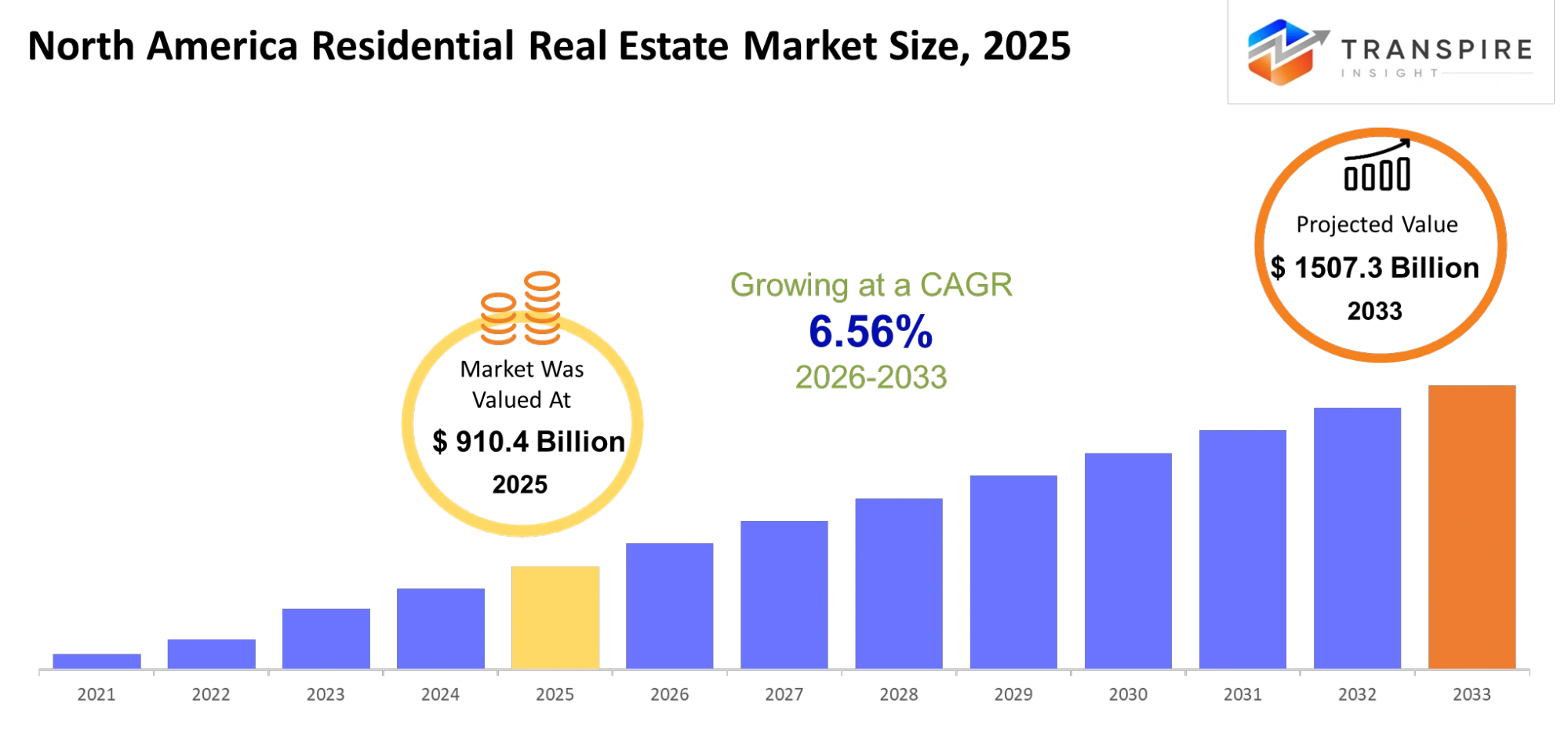
- North America Residential Real Estate Market Size 2025: USD 910.4 Billion
- North America Residential Real Estate Market Size 2033: USD 1507.3 Billion
- North America Residential Real Estate Market CAGR: 6.56%
- North America Residential Real Estate Market Segments: By Property Type (Apartments, Villas, Condominiums), By Transaction Type (Sales, Rental), By End-User (Individuals, Investors).
To learn more about this report,  Download Free Sample Report
North America Residential Real Estate Market Summary:
The North America Residential Real Estate Market size is estimated at USD 910.4 Billion in 2025 and is anticipated to reach USD 1507.3 Billion by 2033, growing at a CAGR of 6.56% from 2026 to 2033. The residential real estate market in North America which includes Canada the United States and Mexico operates as part of the larger property and housing sector which experiences changes because of buyer behavior and digital technology advancements. The demand for residential properties will shift to include flexible living spaces and energy-efficient homes which people want to live in suburban areas and secondary cities because they work remotely. Virtual tours and AI-based pricing tools and simplified online closing processes will continue to drive technological changes in real estate transactions. The development priorities will experience changes because of new regulatory frameworks which include zoning changes and environmental sustainability requirements while cross-border investment trends will shift because economic conditions and demographic needs throughout the area change.
Key Market Trends & Insights:
- North America's residential real estate market in Canada, the United States, and Mexico will see ongoing shifts in buyer preferences, driving growing interest in functional living.
- The evolution of technology will bring new ways of executing real estate transactions. Technology will be used for all aspects of real estate transactions, from discovery to closing. This will reduce the need for real estate agents or intermediaries.
- Predictive analytics will be used to offer sellers advice on their listings. Technology will allow real estate agents to develop two distinct business models based on their growing use of technology. This will result in a new competitive environment in the housing market.
- The sustainable development standards will create more significant effects on building construction and property renovation activities. Buyers will increasingly search for properties which include sustainable features that comprise energy-efficient materials and solar power usage and decreased electricity expenses.
- The financial sector will experience changes which will occur due to economic conditions and fluctuations in interest rates.
North America Residential Real Estate Market Segmentation
By Property Type
Apartments- The best type of houses for people living in an urban area is still apartments because of their design, which satisfies the needs of people living in an urban area where there is a lack of space. The type of building for people who buy or rent will depend on the availability of amenities such as co-working space, fitness space, and security. Young professionals and small families will require buildings that provide them with space for residential use. People will start to prefer vertical communities because these developments provide affordable housing for contemporary living needs.
Villas- The demand for villas will continue because buyers prefer homes that provide them with private outdoor areas and customized interior space. High-income individuals who want to escape from densely populated urban centers will drive greater demand for villas. The design of villas will feature customized elements together with outdoor spaces that residents can use privately and smart home systems and sustainable building materials and environmentally friendly technologies to develop luxurious villas that satisfy both environmental standards and resident comfort.
Condominiums- Condominiums will provide a residential option that exists between apartments and standalone homes which will attract buyers who desire property ownership but need to minimize their upkeep work. The main attractions of the property will include its shared facilities and its professional services and its safe residential areas. Upcoming projects will focus on building social environments which combine recreational areas with health-related spaces. The association management system should operate with transparent processes which residents can easily understand while all residents should have access to fixed maintenance expense information.
To learn more about this report, Download Free Sample Report
By Transaction Type
Sales- Digital platforms together with data-driven decision-making tools will keep transforming property sales operations. Buyers will demand transparent pricing systems which deliver faster documentation results through efficient online systems. Sellers will depend more on specific advertising methods together with virtual product displays to access bigger customer networks. The sales segment will also show changing buyer behavior patterns through its use of adaptable payment methods and fresh financing solutions which help attract first-time consumers.
Rental- The rental segment will gain importance as mobility increases and long-term ownership becomes less accessible for some groups. Tenants will choose housing options that provide them with flexible rental agreements and short lease periods plus complete residential facilities. Landlords will respond by offering furnished units together with digital systems which enable them to manage rental properties. Remote work growth will shape rental demand patterns as tenants look for living spaces which offer affordable rent and good connectivity plus high residential standards.
By End-User
Individuals- Individual buyers will shape their demand through their lifestyle choices which they have built from their work and family needs and personal health requirements. Many people will search for homes which provide them with capabilities to work from home while they meet their family needs and maintain their personal health. The ability to access educational institutions and medical facilities and essential daily needs remains vital for people. The period of time will lead people to give more value to permanent benefits and energy-efficient solutions and superior neighborhood conditions which developers will use to create their residential projects.
Investors- Investors will shift their investment strategy toward residential properties which require them to establish their return goals while managing risks and creating diverse investment portfolios. They will explore both short-term rental opportunities and long-term leasing strategies depending on market conditions. Data analytics will help identify locations and property types which can generate profitable results. Institutional investors will also show growing interest leading to more structured and professionally managed residential investment models.
Regional Insights
The housing market in Canada will undergo continuous changes because of rising affordability challenges and newly established migration patterns. The primary demand will support major cities, but smaller urban areas will become more popular for buyers who want affordable housing and improved quality of life. The construction industry will experience changes because government policies which aim to stabilize prices and expand supply will dictate their building practices. Homebuyers will prefer energy-efficient houses, while developers will create projects which meet sustainability requirements and upcoming demographic changes.
The United States residential market operates according to regional patterns, which show that southern and midwestern territories attract more interest because they offer lower housing costs. Suburban and exurban areas will continue to attract people because of remote and hybrid work arrangements. Digital platforms will improve property transaction efficiency by providing faster and clearer process management. The development patterns of both expanding and existing metropolitan areas will be transformed through new zoning and land use regulations which will promote mixed housing development across their regions.
The demand for residential properties in Mexico will increase. This will be in terms of both local and foreign investors. The demand will be in the coastal towns and other places of interest. This will be in terms of people looking to buy second homes and rental properties. The major cities will continue to grow in terms of infrastructure development. Developers will develop modern product packages that include security features, but they will also create affordable housing solutions that meet the needs of multiple income groups.
The North American market will experience changing cross-border investment patterns that will depend on changes in currency value and shifts in economic feelings. Buyers will look for opportunities in other countries because they want to improve their lifestyle and achieve their financial goals. Governments will implement policy changes to control foreign ownership rights while safeguarding local residents from high housing costs. The housing market will experience demographic changes through an increase in older people, while first-time buyers will create demand for different types of housing that will increase throughout the entire region.
Recent Development News
Recent developments in Canada highlight a strong policy-driven approach to housing stability. Authorities are focusing on affordability while encouraging new construction, though projections suggest housing starts may slow over the next few years. At the same time, rental markets are expected to ease slightly as vacancy levels improve. Industry discussions are also emphasizing modular construction and faster approvals to address supply gaps and adapt to changing buyer expectations.
In the United States, recent policy discussions have centered on reducing regulatory barriers to boost housing availability. A new federal initiative aims to simplify construction approvals and lower development costs, reflecting concerns about affordability pressures. Meanwhile, international investors continue to play a visible role in transactions, often relying on cash purchases and long-term strategies. Legislative proposals targeting large institutional buyers are also under debate, signaling a shift in market structure.
|
Report Metrics |
Details |
|
Market size value in 2025 |
USD 910.4 Billion |
|
Market size value in 2026 |
USD 965.9 Billion |
|
Revenue forecast in 2033 |
USD 1507.3 Billion |
|
Growth rate |
CAGR of 6.56% from 2026 to 2033 |
|
Base year |
2025 |
|
Historical data |
2021 – 2024 |
|
Forecast period |
2026 – 2033 |
|
Report coverage |
Revenue forecast, competitive landscape, growth factors, and trends |
|
Regional scope |
North America (Canada, The United States, and Mexico) |
|
Key company profiled |
Zillow Group Inc., Redfin Corporation, Realtor.com (Move Inc.), Keller Williams Realty Inc., RE/MAX Holdings Inc., Compass Inc., Coldwell Banker Real Estate LLC, Century 21 Real Estate LLC, Douglas Elliman Inc., Sotheby’s International Realty, Opendoor Technologies Inc., Offerpad Solutions Inc., Realogy Holdings Corp., Brookfield Residential Properties, Lennar Corporation. |
|
Customization scope |
Free report customization (country, regional & segment scope). Avail customized purchase options to meet your exact research needs. |
|
Report Segmentation |
By Property Type (Apartments, Villas, Condominiums), By Transaction Type (Sales, Rental), By End-User (Individuals, Investors). |
Key North America Residential Real Estate Market Company Insights
The residential real estate market in North America will see its main companies from Canada and the United States and Mexico enter competition by implementing technology and creating local business methods and developing unique service offerings. The digital home-search systems will become stronger through the efforts of Zillow and Redfin, while Lennar Corporation and D.R. Horton will develop housing solutions that their customers need. Brookfield Residential in Canada will focus on building projects that involve community input, while Mexican companies will grow their urban development work. The ability to make decisions based on data and complete transactions quickly and match products with changing customer needs will determine competitive advantage.
Company List
- Zillow Group Inc.
- Redfin Corporation
- Realtor.com (Move Inc.)
- Keller Williams Realty Inc.
- RE/MAX Holdings Inc.
- Compass Inc.
- Coldwell Banker Real Estate LLC
- Century 21 Real Estate LLC
- Douglas Elliman Inc.
- Sotheby’s International Realty
- Opendoor Technologies Inc.
- Offerpad Solutions Inc.
- Realogy Holdings Corp.
- Brookfield Residential Properties
- Lennar Corporation.
North America Residential Real Estate Market Report Segmentation
By Property Type
- Apartments
- Villas
- Condominiums
By Transaction Type
- Sales
- Rental
By End-User
- Individuals
- Investors
Frequently Asked Questions
Find quick answers to common questions.
The approximate North America Residential Real Estate Market size for the market will be USD 1507.3 Billion in 2033.
Key segments for the North America Residential Real Estate Market By Property Type (Apartments, Villas, Condominiums), By Transaction Type (Sales, Rental), By End-User (Individuals, Investors).
Major players in the North America Residential Real Estate Market are Zillow Group Inc., Redfin Corporation, Realtor.com (Move Inc.), Keller Williams Realty Inc., RE/MAX Holdings Inc., Compass Inc., Coldwell Banker Real Estate LLC, Century 21 Real Estate LLC, Douglas Elliman Inc., Sotheby’s International Realty, Opendoor Technologies Inc., Offerpad Solutions Inc., Realogy Holdings Corp., Brookfield Residential Properties, Lennar Corporation.
The North America Residential Real Estate Market size is USD 910.4 Billion in 2025.
Ans: The North America Residential Real Estate Market CAGR is 6.56%.
- Zillow Group Inc.
- Redfin Corporation
- Realtor.com (Move Inc.)
- Keller Williams Realty Inc.
- RE/MAX Holdings Inc.
- Compass Inc.
- Coldwell Banker Real Estate LLC
- Century 21 Real Estate LLC
- Douglas Elliman Inc.
- Sotheby’s International Realty
- Opendoor Technologies Inc.
- Offerpad Solutions Inc.
- Realogy Holdings Corp.
- Brookfield Residential Properties
- Lennar Corporation.
Recently Published Reports
-
Apr 2026
Handling and Lifting Equipment Market
Handling and Lifting Equipment Market Size, Share & Analysis Report By Product (Cranes and Hoists, Forklifts, Conveyor Systems, Aerial Work Platforms, Others), By Application (E-Commerce, Automotive and Railway, Food and Beverages, Aviation, Others), and Geography (North America, Europe, Asia-Pacific, Middle East and Africa, South and Central America), 2021 - 2031
-
Apr 2026
HVAC Equipment Market
HVAC Equipment Market Size, Share & Analysis Report By Heating Equipment Type (Boilers and Furnaces, Heat Pumps, and Unitary Heaters), By Ventilation Equipment (Air Handling Units, Humidifiers and Dehumidifiers, Air Filters, and Fan Coiling Units), By Air Conditioning Equipment (Unitary Air Conditioners, Room Air Conditioners, Packaged Terminal Air Conditioners, and Chillers), By End User (Commercial, Residential, Industrial, and others), and Geography (North America, Europe, Asia-Pacific, Middle East and Africa, South and Central America), 2021 – 2031
-
Apr 2026
Refrigeration Valves Market
Refrigeration Valves Market Size, Share & Analysis Report By Type (Solenoid Valves, Expansion Valves, Check Valves, Service Valves, Others), By Application (Commercial Refrigeration, Industrial Refrigeration, Transport Refrigeration, Residential Refrigeration, Air Conditioning Systems), By End User (Food and Beverage Industry, Pharmaceutical Industry, HVAC Industry, Chemical Industry, Others), and Geography (North America, Europe, Asia-Pacific, Middle East and Africa, South and Central America), 2021 – 2031
-
Apr 2026
E-Commerce Packaging Materials Market
E-Commerce Packaging Materials Market By Material Type (Corrugated Boxes, Paper & Paperboard, Foam & Cushioning Materials, Plastic Packaging, Flexible Packaging, Protective Packaging, Others), By Product(Primary Packaging, Secondary Packaging, Tertiary Packaging), By Packaging Function (Protective Packaging, Branding & Presentation Packaging, Transit & Logistic Packaging, Sustainable Packaging, Tamper Evidence Packaging), By End-User (Retail & Consumer Goods, Electronic Appliances, Food & Beverages, Healthcare & Pharmaceutical, Fashion & Apparel, Home & Furnishing, Others); By Industry Analysis, Size, Share, Growth, Trends, and Forecasts 2021-2033