

North America Pre-Engineered Buildings Market Size & Forecast:
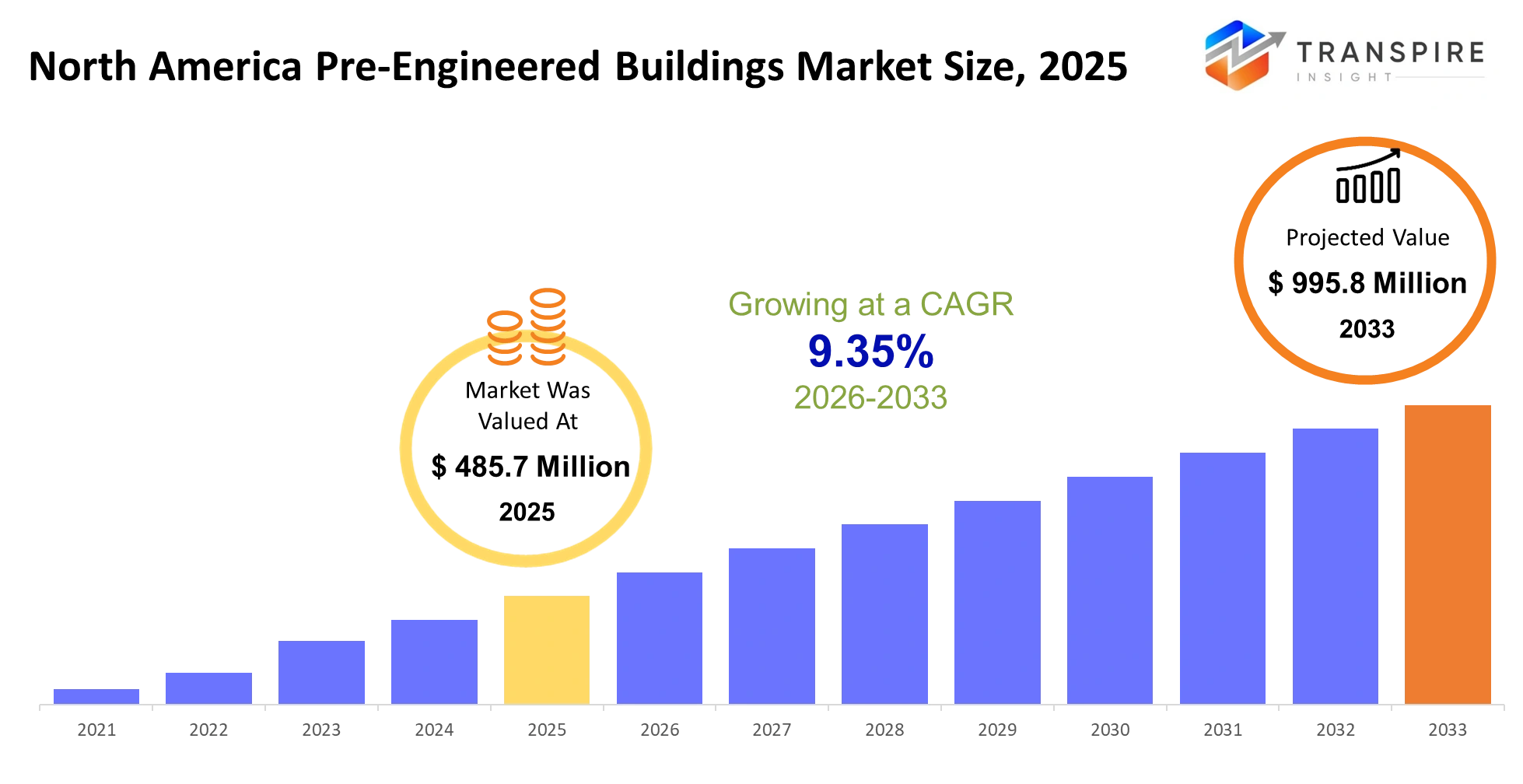
- North America Pre-Engineered Buildings Market Size 2025: USD 485.7 Million
- North America Pre-Engineered Buildings Market Size 2033: USD 995.8 Million
- North America Pre-Engineered Buildings Market CAGR: 9.35%
- North America Pre-Engineered Buildings Market Segments: By Type (Steel Buildings, Modular, Portable, Hybrid, Custom, Prefab, Industrial); By Application (Industrial, Commercial, Warehouses, Infrastructure, Retail, Aviation, Agriculture); By Component (Frames, Panels, Roofs, Walls, Doors, Windows, Insulation); By End-User (Construction Firms, Govt, Industrial, Warehousing, Retail, Logistics, Infrastructure); By Distribution (Direct, Contractors, Dealers, OEM, Export, Online, Wholesale).
To learn more about this report,  Download Free Sample Report
North America Pre-Engineered Buildings Market Summary:
The North America Pre-Engineered Buildings Market size is estimated at USD 485.7 Million in 2025 and is anticipated to reach USD 995.8 Million by 2033, growing at a CAGR of 9.35% from 2026 to 2033.
The construction sector of North America Pre-Engineered Buildings Market experiences design evolution because clients now demand shorter project completion times and steel structures which can adapt to different requirements. The present situation shows a transition toward digital planning methods which use coordinated systems and modular production techniques because consumer needs and building regulations and environmental sustainability requirements have changed.
Companies in the industry use advanced digital modeling and better material tracking systems and new compliance systems which have developed because of different regional regulations. Clients increasingly expect customized layouts, reduced construction timelines, and energy conscious designs, which drive companies to develop new execution processes while anticipating upcoming market needs for their commercial and industrial sectors.
What Has the Impact of Artificial Intelligence Been on the North America Pre-Engineered Buildings Market?
The North America Pre-Engineered Building Market experiences rapid changes because artificial intelligence modifies all aspects of business operations from data analysis to demand estimation and operational efficiency improvement. The combination of artificial intelligence with North America Pre-Engineered Building Market operations enables businesses to conduct market research and access real-time data while using predictive models. Stakeholders can use advanced machine learning models which analyze construction industry data and customer choice patterns and economic trends to develop precise demand predictions. The North America Pre-Engineered Buildings Market benefits from artificial intelligence because its strategies for planning infrastructure projects deliver better results and decrease project risks.
The North America Pre-Engineered Building Market benefits from AI analytics, which enable significant gains in production efficiency and intelligent automation. Machine learning powered automatic design systems enable rapid building component customization, which decreases engineering time while preserving accuracy.
AI-powered systems in manufacturing optimize fabrication workflows, which decreases resource usage and improves product quality. Smart automation systems in supply chain management enable businesses to manage their inventory effectively while forecasting disruptions and reducing their operational expenses. The advancements strengthen the competitive advantage of companies that operate in the North America Pre-Engineered Buildings Market.
AI is driving innovation while enabling personalized solutions which help North American Pre-Engineered Buildings Market companies develop customized products that fulfill changing customer needs. AI technologies provide building solutions which offer improved performance and reduced operating expenses through their intelligent design simulations and predictive maintenance capabilities. The North American Pre-Engineered Buildings Market will experience increased AI adoption as market trends support efficient and sustainable practices which will create permanent growth prospects and establish new industry benchmarks.
Key Market Trends & Insights:
- The United States controls more than 75% of the North America Pre-Engineered Buildings Market because its industrial and commercial construction sectors require pre-engineered buildings.
- Canada shows the fastest growth among regions because its infrastructure development and sustainable building projects will drive a compound annual growth rate that exceeds 7% until 2030.
- The market for pre-engineered buildings operates mostly through steel-based buildings which will capture approximately 68% of the market share in 2025 because of their strength and affordability.
- The second largest market category belongs to hybrid structures which commercial users adopt because they provide both design adaptability and shorter building durations.
- The market for modular pre-engineered systems will experience its highest growth rate because of rising interest in prefabrication and advanced construction methods until 2030.
- Industrial applications dominate the market with more than 55% share because warehouse expansion and logistics growth and manufacturing facility development drive these industrial applications.
- The application segment for commercial infrastructure grows the fastest because retail spaces and offices and institutional buildings create more demand for these spaces.
- The industrial sector dominates the North America Pre-Engineered Buildings Market because it holds a 52% market share which e-commerce and supply chain growth support.
- The infrastructure and institutional sector grows the fastest among end-user categories because government funding and urban development projects create growth opportunities.
- The North America Pre-Engineered Buildings Market gets dominated by key players Nucor Corporation and BlueScope Steel and Kirby Building Systems and Zamil Steel and Butler Manufacturing.
North America Pre-Engineered Buildings Market Segmentation
By Type :
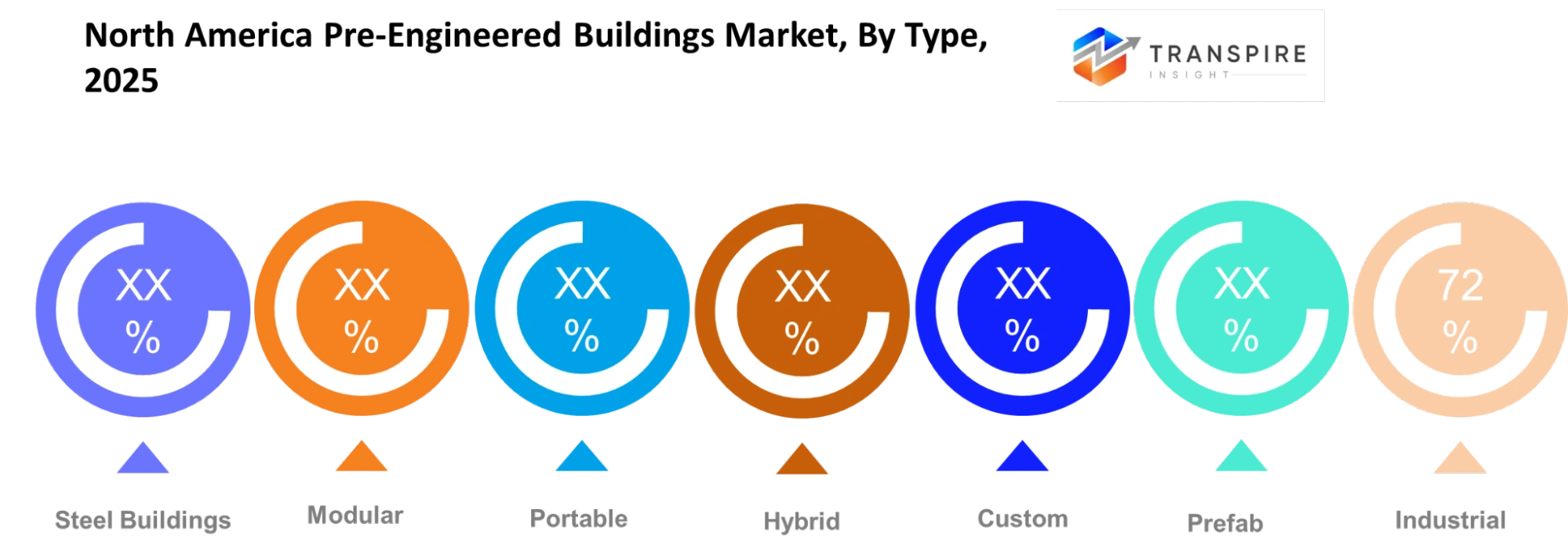
Steel buildings maintain high market demand because of their exceptional durability and extended lifespan and their straightforward process for future expansion. The use of modular and prefab structures enables construction teams to complete their work at construction sites with increased efficiency and decreased need for workers. Construction activities can use portable and hybrid systems which provide adaptable solutions for their temporary and semi-permanent work sites.
Industrial structures provide manufacturing and processing areas with equipment that can handle extreme operational demands. Custom designs support project-specific needs in large infrastructure work. The use of prefabricated systems enables manufacturers to produce products under factory conditions which they can then install at various locations. The overall demand for building construction services in North America follows three main factors which include construction costs and project completion time and requirements for adaptable design solutions.
To learn more about this report, Download Free Sample Report
By Application :
The industrial sector experiences continuous demand because factories and their production facilities expand throughout their operations. The commercial sector includes offices which provide support to service buildings. The warehouse industry maintains its strength because logistics demand continues to increase. Infrastructure projects use pre-engineered systems which provide both fast construction times and strong building durability. The retail market supports the rapid establishment of new stores throughout urban areas.
Aviation structures provide support for hangars and maintenance units which need open areas with no obstructions. Agricultural activities require storage barns and farm buildings. The application segment receives advantages from construction time reductions and material consumption management. The demand for goods rises because North America needs to expand its logistics and transportation systems together with its storage facilities.
By Component :
Building structures depend on frames to create essential load-bearing strength that serves as their primary structural framework. The panels create building closure systems which enable fast construction through their assembly process. Roof systems provide two essential functions which protect buildings from weather and maintain their structural integrity. Walls create building divisions while they also control indoor temperature through their thermal control capabilities. The function of doors and windows in buildings consists of two main purposes which provide building access and enable air circulation through the structure.
Insulation helps buildings achieve better energy performance while it assists in maintaining indoor temperatures. The construction process requires all components because they enable speedier building assembly when compared to traditional construction methods. The production of standardized components enables businesses to maintain budget control while decreasing production waste. The segment experiences growth because industrial and commercial sectors require building structures that offer energy efficiency and long-lasting durability.
By End-User :
Construction firms use pre-engineered buildings to complete projects more quickly while needing fewer workers. Government projects use these structures for public facilities and infrastructure expansion. Industrial users adopt them for manufacturing units and production sites requiring scalable layouts.
Warehousing and logistics users depend on large clear-span structures for storage and distribution centers. Retail users apply them for quick store setup. Infrastructure development projects use these systems for transport and utility facilities. The overall demand increases because construction projects require faster delivery times and builders seek more economical construction methods.
By Distribution :
Direct distribution supports large-scale buyers who need customized supply solutions from manufacturers. The contractors handle both on-site integration work and all project activities. Dealers function as regional supply chain partners who expedite product distribution to their markets. OEM channels deliver complete system components which builders use to develop construction-based solutions.
Export channels enable international markets to access standardized building systems through their export capabilities. The online channels provide both product visibility and procurement access to customers. Wholesale distribution enables contractors and dealers to receive their bulk supplies. The different channels establish two benefits which include quicker material delivery and better access to pre-engineered building solutions that serve various project requirements throughout North America.
What are the Main Challenges for the North America Pre-Engineered Buildings Market Growth?
The North America Pre-Engineered Buildings Market faces several technical and operational challenges that limit its growth potential. Design standardization, while cost-effective, often restricts customization for complex projects, creating performance limitations in specialized applications. The supply chain experiences instability and cost unpredictability because raw material prices, particularly steel, keep changing. North America Pre-Engineered Buildings Market challenges create operational delays which impede project progress and limit capacity for large infrastructure projects that need precise engineering work and flexible construction methods.
The North America Pre-Engineered Buildings Market faces challenges from manufacturing and commercialization barriers which block its development. Production processes require high capital investment in advanced fabrication technologies, which increases entry barriers for smaller players. Project approvals face difficulties because different regions establish their own building codes and environmental standards which require companies to meet various regulatory requirements. The North America Pre-Engineered Buildings Market faces market restrictions which combine with increasing labor and logistics expenses to create pricing pressures that reduce profitability and delay product launch activities.
The process of adopting new technologies creates major difficulties which limit business growth. The existing knowledge about pre-engineered solutions has not reached all industries despite their demonstrated effectiveness. The absence of trained experts who can operate advanced design tools and automated systems stops business development. The North America Pre-Engineered Buildings Market faces growth challenges because of infrastructure deficiencies and insufficient funding for new construction areas in underdeveloped parts of North America.
The construction industry faces higher dangers because of increased competition from both traditional building methods and new modular construction systems. Price-sensitive clients often prefer traditional methods but the market requires businesses to keep developing new technologies. The North America Pre-Engineered Buildings Market study shows two challenges which need resolution because they cause ongoing problems with technology adoption.
Regional Insights
The North America pre-engineered buildings market will experience steady expansion because construction periods shorter than expected and construction expenses lower than traditional methods drive market growth. The market will experience increasing demand from industrial and commercial sectors which require construction work to be completed rapidly and to be adaptable for future needs. The region will experience growth in logistics and warehousing and infrastructure projects because steel structures provide better durability and customization options.
The United States will lead demand with strong investments in warehouses data centers and manufacturing facilities. Canada will follow with growth supported by infrastructure upgrades and energy projects. Mexico will experience increasing adoption because industrial growth and cross-border trade activities will create a continuous need for effective building solutions.
The North America pre-engineered buildings market will experience growth because construction projects now require sustainable building methods which use controlled factory production to decrease material waste while enhancing product quality. The increasing costs of land and labor will drive builders toward using pre-engineered solutions because these methods enable them to finish projects faster while maintaining structural integrity which helps the market remain stable over time.
Urban development and industrial development will show their growth patterns through Regional Insights which study areas that have major transportation routes and port facilities. The design process will be affected by climate factors because people increasingly seek energy-saving insulation materials and buildings that can withstand various weather conditions. The government infrastructure modernization program will create business opportunities in important regional markets throughout the entire country.
Recent Development News
In April 2026, Owens Corning announced an amended agreement with Praana Group for the sale of its glass reinforcements business. The divestiture is expected to support capital reallocation toward core construction and building solutions segments, including engineered building systems in North America.
Source: https://www.businesswire.com/
In March 2026, Nucor Corporation continued expansion of its steel solutions portfolio supporting non-residential construction and pre-engineered metal building systems. The company increased focus on value-added steel products to meet rising demand for warehouses and industrial infrastructure across North America.
Source: https://nucor.com/
|
Report Metrics |
Details |
|
Market size value in 2025 |
USD 485.7 Million |
|
Market size value in 2026 |
USD 532.5 Million |
|
Revenue forecast in 2033 |
USD 995.8 Million |
|
Growth rate |
CAGR of 9.35% from 2026 to 2033 |
|
Base year |
2025 |
|
Historical data |
2021 - 2024 |
|
Forecast period |
2026 - 2033 |
|
Report coverage |
Revenue forecast, competitive landscape, growth factors, and trends |
|
Regional scope |
North America (Canada, The United States, and Mexico) |
|
Key company profiled |
Kirby Building Systems, BlueScope Steel, Nucor Buildings, Zamil Steel, Butler Manufacturing, Lindab, Everest Industries, PEB Steel, Interarch, Tata BlueScope, Tiger Steel, Astron Buildings, Varco Pruden, Armstrong Steel, Metallic Building. |
|
Customization scope |
Free report customization (country, regional & segment scope). Avail customized purchase options to meet your exact research needs. |
|
Report Segmentation |
By Type (Steel Buildings, Modular, Portable, Hybrid, Custom, Prefab, Industrial); By Application (Industrial, Commercial, Warehouses, Infrastructure, Retail, Aviation, Agriculture); By Component (Frames, Panels, Roofs, Walls, Doors, Windows, Insulation); By End-User (Construction Firms, Govt, Industrial, Warehousing, Retail, Logistics, Infrastructure); By Distribution (Direct, Contractors, Dealers, OEM, Export, Online, Wholesale). |
How Can New Companies Establish a Strong Foothold in the North America Pre-Engineered Buildings Market?
New entrants aiming to succeed in the North America Pre-Engineered Buildings Market must begin with focused niche targeting and clear value differentiation. Companies should focus on high-growth markets which include logistics warehouses and healthcare infrastructure and smart city projects that require fast construction work instead of trying to compete in all market segments.
Emerging companies can solve their cost overruns and long construction time problems by developing products which match important industry trends that include sustainable materials and energy-efficient designs. The North America Pre-Engineered Buildings Market provides better market entry opportunities through this approach which helps organizations establish their market presence.
The North America Pre-Engineered Buildings Market requires companies to pursue innovation and technology adoption as essential strategies for developing competitive advantages. Startups that use AI-driven design tools together with digital twins and predictive analytics can achieve better structural performance while decreasing their engineering requirements.
Companies such as Katerra which operated before its restructuring showed how integrated digital platforms could improve the efficiency of prefabrication and project delivery processes. Veev introduces innovative modular construction techniques which enable faster building processes and personalized solutions to the market through its new building systems.
The North America Pre-Engineered Buildings Market experiences increased growth through strategic partnerships and ecosystem collaborations. New companies can expand their operational capabilities through partnerships with material suppliers and EPC contractors and technology providers.
The industry can achieve better execution results through organizations that invest in smart automation together with workforce training programs which address existing skill deficiencies. Emerging players in the North America Pre-Engineered Buildings Market can establish a strong market position through their specialized expertise and technological innovations and strategic partnerships.
Key North America Pre-Engineered Buildings Market Company Insights
The North America Pre-Engineered Buildings Market will experience steady growth because people want affordable building methods which enable construction work to be completed faster. The market will grow because these products are being used more frequently in industrial spaces and commercial buildings and storage facilities. Steel structures will become the most popular choice because they offer better durability and design options which enable users to create specific designs for different application needs.
The pre-engineered building market will experience growth because logistics and warehousing and manufacturing operations expand their facilities. The combined effects of urban development and infrastructure investment will create a stronger demand for products. Energy-efficient construction methods together with material waste reduction methods will enable builders who create sustainable buildings to complete their projects efficiently while maintaining their quality standards. The construction industry experiences cost estimation challenges because of unpredictable fluctuations in raw material prices which particularly affect steel costs,
Manufacturers and contractors face cost unpredictability because raw material prices, especially steel, fluctuate. Smaller construction segments face limited understanding about pre-engineered buildings which results in decreased adoption rates. The design restrictions of complex architectural projects will limit their use to premium applications because organizations must follow government regulations and local building codes.
The market will continue to experience intense competition because both established steel structure manufacturers and local companies operate in the industry. Companies will use product innovation and strategic partnerships together with manufacturing capacity expansion to build their market presence. The combination of pricing strategies with project customization will determine project success while after-sales service and installation support will affect customer choice.
Company List
- Kirby Building Systems
- BlueScope Steel
- Nucor Buildings
- Zamil Steel
- Butler Manufacturing
- Lindab
- Everest Industries
- PEB Steel
- Interarch
- Tata BlueScope
- Tiger Steel
- Astron Buildings
- Varco Pruden
- Armstrong Steel
- Metallic Building
What are the Key Use-Cases Driving the Growth of North America Pre-Engineered Buildings Market?
The North America Pre-Engineered Buildings Market is experiencing growth because industrial and logistics sectors require its solutions to deliver fast results while saving operational expenses. The warehousing and distribution centers function as primary applications because e-commerce businesses require storage facilities that can grow with their needs. Pre-engineered buildings enable faster project completion and reduced material waste while providing organizations with the ability to extend their operations, which makes these buildings perfect for contemporary supply chain systems. The growing demand for pre-engineered buildings leads to increasing market expansion in North America.
The North America Pre-Engineered Buildings Market experiences growth from the manufacturing and automotive industries because companies are investing more in their production facilities and assembly plants. Companies prefer these structures for their durability, large clear spans, and ability to support heavy machinery. The healthcare sector has emerged as a major application area for temporary hospitals and diagnostic centers and emergency response units because these facilities require both fast deployment and dependable structural integrity.
The North America Pre-Engineered Buildings Market experiences expansion through commercial and infrastructure development projects. Pre-engineered solutions have gained popularity in retail outlets and office spaces and institutional buildings because these solutions offer design flexibility and shorter construction times.
The adoption of smart buildings and sustainable construction practices creates new possibilities for innovation through their emerging trend. The North America Pre-Engineered Buildings Market shows sustainable growth because diverse use cases enable organizations to achieve their primary goals of improved scalability and operational efficiency.
North America Pre-Engineered Buildings Market Report Segmentation
By Type
- Steel Buildings
- Modular
- Portable
- Hybrid
- Custom
- Prefab
- Industrial
By Application
- Industrial
- Commercial
- Warehouses
- Infrastructure
- Retail
- Aviation
- Agriculture
By Component
- Frames
- Panels
- Roofs
- Walls
- Doors
- Windows
- Insulation
By End-User
- Construction Firms
- Govt
- Industrial
- Warehousing
- Retail
- Logistics
- Infrastructure
By Distribution
- Direct
- Contractors
- Dealers
- OEM
- Export
- Online
- Wholesale
Frequently Asked Questions
Find quick answers to common questions.
The approximate North America Pre-Engineered Buildings Market size for the market will be USD 995.8 Million in 2033.
Key segments for the North America Pre-Engineered Buildings Market are By Type (Steel Buildings, Modular, Portable, Hybrid, Custom, Prefab, Industrial); By Application (Industrial, Commercial, Warehouses, Infrastructure, Retail, Aviation, Agriculture); By Component (Frames, Panels, Roofs, Walls, Doors, Windows, Insulation); By End-User (Construction Firms, Govt, Industrial, Warehousing, Retail, Logistics, Infrastructure); By Distribution (Direct, Contractors, Dealers, OEM, Export, Online, Wholesale).
Major North America Pre-Engineered Buildings Market players are Kirby Building Systems, BlueScope Steel, Nucor Buildings, Zamil Steel, Butler Manufacturing, Lindab, Everest Industries, PEB Steel, Interarch, Tata BlueScope, Tiger Steel, Astron Buildings, Varco Pruden, Armstrong Steel, Metallic Building.
The North America Pre-Engineered Buildings Market size is USD 485.7 Million in 2025.
The North America Pre-Engineered Buildings Market CAGR is 9.35%.
- Kirby Building Systems
- BlueScope Steel
- Nucor Buildings
- Zamil Steel
- Butler Manufacturing
- Lindab
- Everest Industries
- PEB Steel
- Interarch
- Tata BlueScope
- Tiger Steel
- Astron Buildings
- Varco Pruden
- Armstrong Steel
- Metallic Building
Recently Published Reports
-
Dec 2024
Handling and Lifting Equipment Market
Handling and Lifting Equipment Market Size, Share & Analysis Report By Product (Cranes and Hoists, Forklifts, Conveyor Systems, Aerial Work Platforms, Others), By Application (E-Commerce, Automotive and Railway, Food and Beverages, Aviation, Others), and Geography (North America, Europe, Asia-Pacific, Middle East and Africa, South and Central America), 2021 - 2031
-
Feb 2025
HVAC Equipment Market
HVAC Equipment Market Size, Share & Analysis Report By Heating Equipment Type (Boilers and Furnaces, Heat Pumps, and Unitary Heaters), By Ventilation Equipment (Air Handling Units, Humidifiers and Dehumidifiers, Air Filters, and Fan Coiling Units), By Air Conditioning Equipment (Unitary Air Conditioners, Room Air Conditioners, Packaged Terminal Air Conditioners, and Chillers), By End User (Commercial, Residential, Industrial, and others), and Geography (North America, Europe, Asia-Pacific, Middle East and Africa, South and Central America), 2021 – 2031
-
Feb 2025
Refrigeration Valves Market
Refrigeration Valves Market Size, Share & Analysis Report By Type (Solenoid Valves, Expansion Valves, Check Valves, Service Valves, Others), By Application (Commercial Refrigeration, Industrial Refrigeration, Transport Refrigeration, Residential Refrigeration, Air Conditioning Systems), By End User (Food and Beverage Industry, Pharmaceutical Industry, HVAC Industry, Chemical Industry, Others), and Geography (North America, Europe, Asia-Pacific, Middle East and Africa, South and Central America), 2021 – 2031
-
Dec 2025
E-Commerce Packaging Materials Market
E-Commerce Packaging Materials Market By Material Type (Corrugated Boxes, Paper & Paperboard, Foam & Cushioning Materials, Plastic Packaging, Flexible Packaging, Protective Packaging, Others), By Product(Primary Packaging, Secondary Packaging, Tertiary Packaging), By Packaging Function (Protective Packaging, Branding & Presentation Packaging, Transit & Logistic Packaging, Sustainable Packaging, Tamper Evidence Packaging), By End-User (Retail & Consumer Goods, Electronic Appliances, Food & Beverages, Healthcare & Pharmaceutical, Fashion & Apparel, Home & Furnishing, Others); By Industry Analysis, Size, Share, Growth, Trends, and Forecasts 2021-2033