
North America High-Tech Logistics Market Size & Forecast:
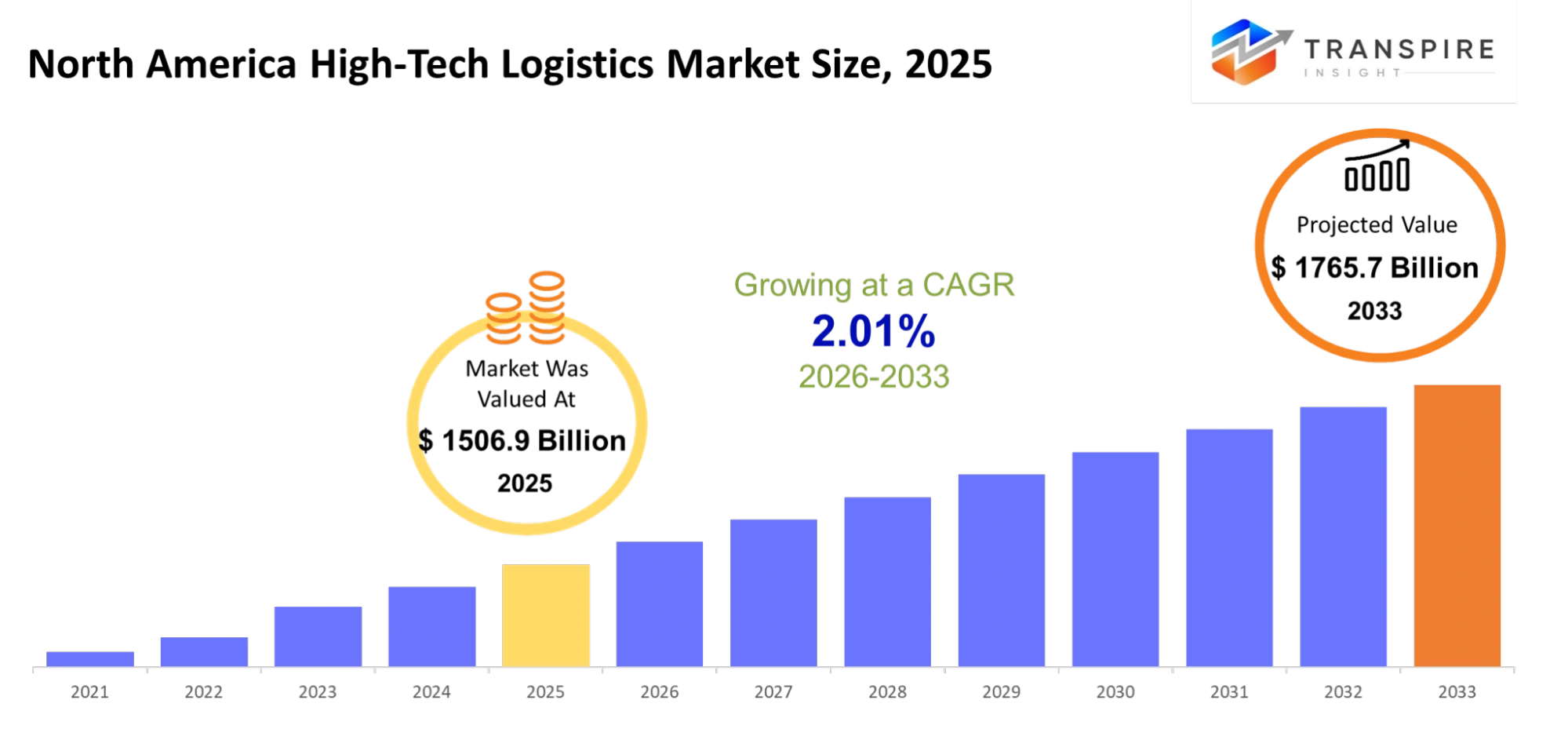
- North America High-Tech Logistics Market Size 2025: USD 1506.9 Billion
- North America High-Tech Logistics Market Size 2033: USD 1765.7 Billion
- North America High-Tech Logistics Market CAGR: 2.01%
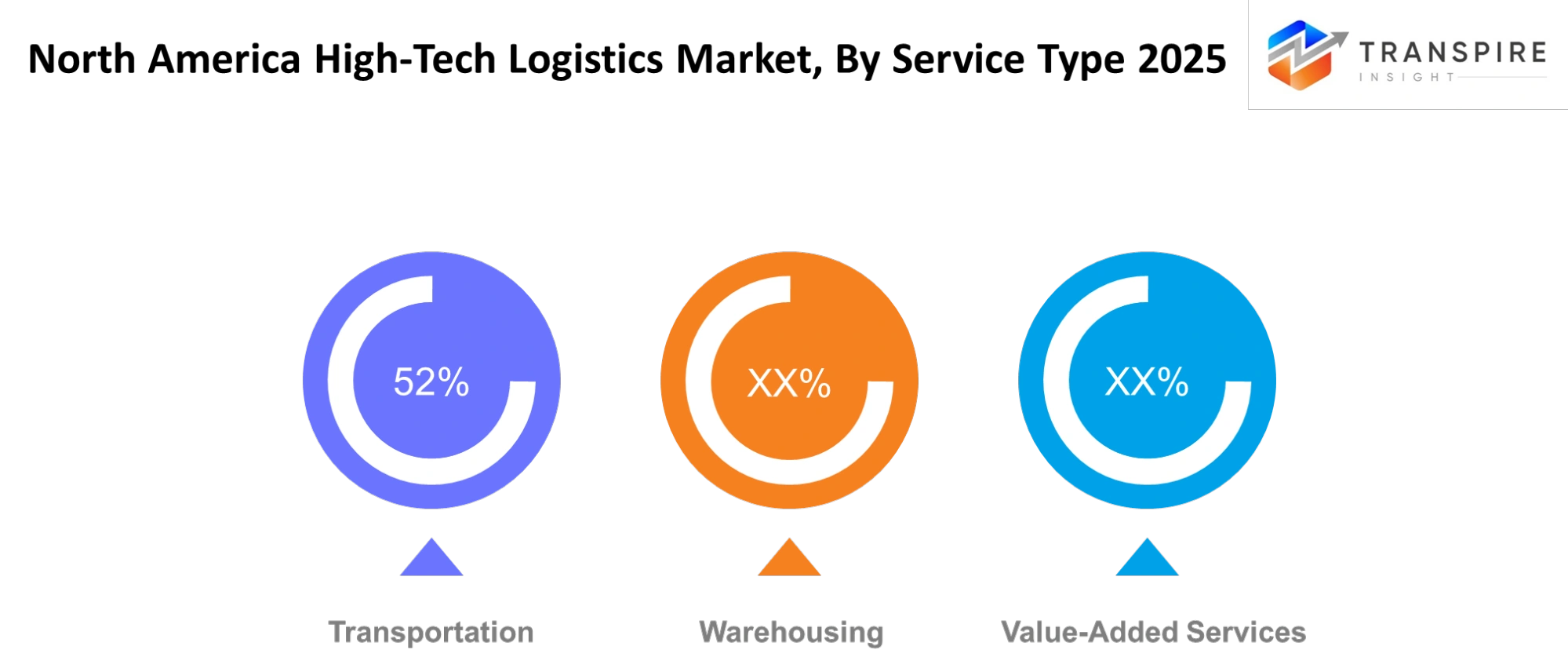
- North America High-Tech Logistics Market Segments: By Service Type (Transportation, Warehousing, Value-Added Services), By Mode (Road, Air, Sea), By End-User (Electronics, Semiconductor, IT Hardware).
To learn more about this report,  Download Free Sample Report
North America High-Tech Logistics Market Summary:
The North America High-Tech Logistics Market size is estimated at USD 1506.9 Billion in 2025 and is anticipated to reach USD 1765.7 Billion by 2033, growing at a CAGR of 2.01% from 2026 to 2033.
The high-tech logistics market in North America which includes Canada and the United States and Mexico will reach its peak when advanced supply chain engineering meets the rapid growth of digital commerce. Warehousing and transportation systems will adopt predictive analytics and autonomous handling and connected infrastructure to achieve better speed and accuracy results. Consumers will demand tighter delivery windows and full transparency which will require operators to develop new methods for fulfilling their needs. The operational standards of organizations will change due to increased regulatory scrutiny on cross-border data transfers and emissions. The market will transition to data-driven logistics systems that provide high responsiveness and accurate results and maintain system durability while delivering services to customers as robotics and IoT integration and AI-based planning technologies become more advanced.
Key Market Trends & Insights:
The high-tech logistics market of North America which includes Canada and the United States and Mexico will experience a continuous transformation towards hyper-automation technology in its fulfillment centers. The combination of robotics and automated sorting systems together with AI-based inventory planning will create new operational standards for speed. Business organizations will create systems that require less manual work while achieving better accuracy which will enable them to handle changing order patterns during online shopping spikes.
Logistics networks will be designed based on consumer demand which increasingly requires same-day and next-day delivery options. Companies will create new last-mile delivery methods which combine micro-warehousing systems with urban distribution centers. Competitive logistics companies will develop their service offerings through delivery customization which allows customers to choose their preferred delivery times and track their orders in real time.
Companies will implement sustainable solutions for transportation and energy-efficient buildings because environmental sustainability issues need increasing governmental and business attention. Organizations will start using electric vehicle fleets together with route optimization software and carbon tracking solutions. Environmental regulations will become mandatory requirements which organizations must follow because both government officials and customers demand organizations to demonstrate their environmental impact.
Cross-border logistics operations will see enhanced digital efficiency through advanced customs technologies and data-sharing systems. Trade policies and regional agreements will determine the most efficient methods for goods movement between different countries. Stakeholders will gain access to enhanced visibility platforms which enable them to foresee operational interruptions while maintaining effective coordination throughout intricate supply chain systems.
North America High-Tech Logistics Market Segmentation
By Service Type
Transportation- The transportation services sector will adopt real-time tracking systems together with AI-powered route optimization and automatic fleet control systems to enhance the speed of transporting valuable cargo. Companies will prioritize secure handling and temperature-controlled transit where required, while digital platforms will enhance coordination between carriers, shippers, and end-users.
Warehousing- Warehousing will transform into highly automated environments which use robotics together with smart shelf technology and predictive inventory management systems. Facilities will shift closer to urban demand centers which enable them to complete orders more rapidly. Advanced data systems will optimize storage patterns and reduce errors while enabling smooth integration with order management systems which increase operational visibility.
Value-Added Services- Value-added services will expand beyond traditional packaging and labeling to include customization, product configuration, reverse logistics, and refurbishment. Service providers will offer tailored solutions to meet specific industry needs which enhance overall customer experience. The services enable businesses to operate their complex supply chains with greater adaptability and speed of response.
To learn more about this report, Download Free Sample Report
By Mode
Road- The system will continue to maintain its dominant position due to its flexibility in operation and ability to access remote delivery points. The integration of telematics systems routing software and electric vehicles will enhance its operation and environmental friendliness. This system will be vital in offering insights to the logistics operators who need to make deliveries and at the same time ensure cost-effectiveness and commitment to service.
Air- This system will be widely accepted in the handling of high-value products in industries such as the electronics and semiconductor sectors.The introduction of improved cargo tracking systems and faster customs clearance processes will enhance its operation capabilities. The system will continue to attract customers due to its ability to deliver essential goods while ensuring its reliability in operation despite its high service costs.
Sea- The system will continue to operate bulk goods movements and long-haul routes with superior efficiencies in handling hardware goods movements in large quantities. The system will also be improved through digital platforms and more efficient facilities in handling its operations. The system will continue to attract customers due to its cost advantage to those requiring long transit times and container tracking capabilities.
By End-User
Electronics- The electronics segment needs logistics systems that respond quickly because its products have short life cycles and their demand patterns change frequently. The process requires secure handling. Our system needs to deliver products quickly while providing customers with current delivery information. Logistics providers will use flexible warehousing and distribution systems to manage their inventory needs during peak seasons and different times of the year.
Semiconductor- The semiconductor industry requires logistics operations that require accurate tracking and environmental control, as well as complete adherence to regulatory requirements. The transportation process requires special packaging materials and continuous monitoring to protect sensitive components. The implementation of advanced tracking systems together with special risk management systems will strengthen supply chains which will protect critical operations that depend on timely deliveries.
IT Hardware- IT hardware logistics will focus on the safe transportation of bulky and high-value equipment. Inventory control processes and delivery time management systems need to operate at maximum efficiency. Providers will enhance their services through installation support and reverse logistics, and refurbishment services which will help businesses handle product lifecycles.
Regional Insights
The high-tech logistics market of North America which includes Canada, the United States and Mexico will show a strong connection between its advanced infrastructure and digital systems. The United States will become the main country for implementing automation into its fulfillment networks while Canada will use automated trade routes to enhance operational efficiency. Mexico will become a stronger manufacturing center because its logistics operations will connect to international supply networks.
The United States plans to fund smart warehouse projects, autonomous transport research and development and AI-driven supply chain management systems. Canada will develop sustainable logistics solutions which will include environmentally friendly transportation methods and energy-efficient building systems. Mexico will establish modern logistics facilities and improve trade route connections to northern markets due to increasing demand for nearshoring services.
Digital customs systems, together with shared data platforms, will create a more efficient process for cross-border cooperation. International trade agreements will create a smoother process for transporting goods, which will result in fewer delays and better forecasting ability. Logistics providers will develop advanced visibility solutions to help them manage operational risks while ensuring shipment consistency across various legal systems in three countries.
The urbanization of the population and the change in consumer behavior imply that the population within the region will demand faster delivery services and accessible distribution facilities. There will be more investments in the major cities in the region in the form of micro-fulfillment facilities and last-mile innovations. The region will develop better logistical systems that will ensure it is able to cope with disruptions and provide uninterrupted services of high quality to various business industries.
Recent Development News
Automation and AI Redefining Logistics Operations-The current situation in the United States shows that multiple industries are implementing automated systems and advanced logistics technologies. Businesses use AI-based workflows together with robotic systems to decrease their need for human workers while increasing their operational efficiency. FedEx plans to use AI technology throughout its main business operations to establish a new approach which relies on data for its logistics activities.
Expansion of High-Tech Warehousing for Data Infrastructure- Canada is experiencing increased funding for dedicated logistics centers which provide support to cutting-edge industries that include data storage facilities. Businesses are developing distribution centers which are capable of managing delicate materials and intricate operational systems. DHL has expanded its operations throughout North America because logistics companies need to develop digital services which support their growing cargo operations.
|
Report Metrics |
Details |
|
Market size value in 2025 |
USD 1506.9 Billion |
|
Market size value in 2026 |
USD 1535.8 Billion |
|
Revenue forecast in 2033 |
USD 1765.7 Billion |
|
Growth rate |
CAGR of 2.01% from 2026 to 2033 |
|
Base year |
2025 |
|
Historical data |
2021 – 2024 |
|
Forecast period |
2026 – 2033 |
|
Report coverage |
Revenue forecast, competitive landscape, growth factors, and trends |
|
Regional scope |
North America (Canada, The United States, and Mexico) |
|
Key company profiled |
DHL Supply Chain, FedEx Corporation, United Parcel Service Inc. (UPS), DB Schenker, Kuehne+Nagel International AG, XPO Logistics Inc., Ryder System Inc., Expeditors International of Washington Inc., C.H. Robinson Worldwide Inc., Nippon Express Co. Ltd., CEVA Logistics, DSV A/S, Panalpina (DSV), Hellmann Worldwide Logistics, Geodis SA. |
|
Customization scope |
Free report customization (country, regional & segment scope). Avail customized purchase options to meet your exact research needs. |
|
Report Segmentation |
By Service Type (Transportation, Warehousing, Value-Added Services), By Mode (Road, Air, Sea), By End-User (Electronics, Semiconductor, IT Hardware). |
Key North America High-Tech Logistics Market Company Insights
The market in North America, including countries such as Canada, the United States, and Mexico, is expected to include high-tech logistics providers that offer services in the form of integrated digital ecosystems. These are essentially the integration of various technologies such as automation, analytics, and visibility tools. The major players in the market are expected to invest in smart warehouses and AI-based planning and optimization. The competitive landscape is expected to include customization, technology adoption, and the ability to provide consistent and secure services.
Company List
- DHL Supply Chain
- FedEx Corporation
- United Parcel Service Inc. (UPS)
- DB Schenker
- Kuehne+Nagel International AG
- XPO Logistics Inc.
- Ryder System Inc.
- Expeditors International of Washington Inc.
- C.H. Robinson Worldwide Inc.
- Nippon Express Co. Ltd.
- CEVA Logistics
- DSV A/S
- Panalpina (DSV)
- Hellmann Worldwide Logistics
- Geodis SA.
North America High-Tech Logistics Market Report Segmentation
By Service Type
- Transportation
- Warehousing
- Value-Added Services
By Mode
- Road
- Air
- Sea
By End-User
- Electronics
- Semiconductor
- IT Hardware
Frequently Asked Questions
Find quick answers to common questions.
The approximate North America High-Tech Logistics Market size for the market will be USD 1765.7 Billion in 2033.
Key segments for the North America High-Tech Logistics Market By Service Type (Transportation, Warehousing, Value-Added Services), By Mode (Road, Air, Sea), By End-User (Electronics, Semiconductor, IT Hardware).
Major players in the North America High-Tech Logistics Market are DHL Supply Chain, FedEx Corporation, United Parcel Service Inc. (UPS), DB Schenker, Kuehne+Nagel International AG, XPO Logistics Inc., Ryder System Inc., Expeditors International of Washington Inc., C.H. Robinson Worldwide Inc., Nippon Express Co. Ltd., CEVA Logistics, DSV A/S, Panalpina (DSV), Hellmann Worldwide Logistics, Geodis SA.
The North America High-Tech Logistics Market size is USD 1506.9 Billion in 2025.
The North America High-Tech Logistics Market CAGR is 2.01%.
- DHL Supply Chain,
- FedEx Corporation,
- United Parcel Service Inc. (UPS),
- DB Schenker,
- Kuehne+Nagel International AG,
- XPO Logistics Inc.,
- Ryder System Inc.,
- Expeditors International of Washington Inc.,
- C.H. Robinson Worldwide Inc.,
- Nippon Express Co. Ltd.,
- CEVA Logistics,
- DSV A/S,
- Panalpina (DSV),
- Hellmann Worldwide Logistics,
- Geodis SA.
Recently Published Reports
-
Apr 2026
ATV & UTV Market
ATV & UTV Market Size, Share & Analysis Report By Type (ATV, and UTV), By Variants (Less Than 400 CC, 400 CC To 800 CC, and More Than 800 CC), and Geography (North America, Europe, Asia-Pacific, Middle East and Africa, South and Central America), 2021 - 2031
-
Apr 2026
Automotive Central Gateway Module Market
Automotive Central Gateway Module Market Size, Share & Analysis Report By Type (Ethernet Central Gateway Module, CAN Central Gateway Module, LIN Central Gateway Module, and FlexRay), By Application (Powertrain Control, Body Control, Infotainment System, Advanced Driver Assistance Systems (ADAS), and Others), By End User (Passenger Vehicles, and Commercial Vehicles), and Geography (North America, Europe, Asia-Pacific, Middle East and Africa, South and Central America), 2021 - 2031
-
Apr 2026
Automotive Engine Oil Filter Market
Automotive Engine Oil Filter Market Size, Share & Analysis Report By Filter Type (Fuel Filter, Engine Oil Filter, Hydraulic Oil Filter, and Others), By Filter Media (Cellulose, Synthetic, and Micro), By Sales Channel (OEMs, and Aftermarket), By Vehicle Type (Passenger Cars, Light Commercial Vehicles, Heavy Duty Trucks, Buses and Coaches, and Off-road Vehicles), and Geography (North America, Europe, Asia-Pacific, Middle East and Africa, South and Central America), 2021 - 2031
-
Apr 2026
Automotive Parts Aluminium Die Casting Market
Automotive Parts Aluminium Die Casting Market Size, Share & Analysis Report By Production Process (Pressure Die Casting, Vacuum Die Casting, Squeeze Die Casting, Gravity Die Casting), By Application (Body Parts, Engine Parts, Transmission Parts, Battery And Related Components, Other Application Types), and Geography (North America, Europe, Asia-Pacific, Middle East and Africa, South and Central America), 2021 - 2031
Our Clients