
United Kingdom Security Fogging Systems Market Size & Forecast:
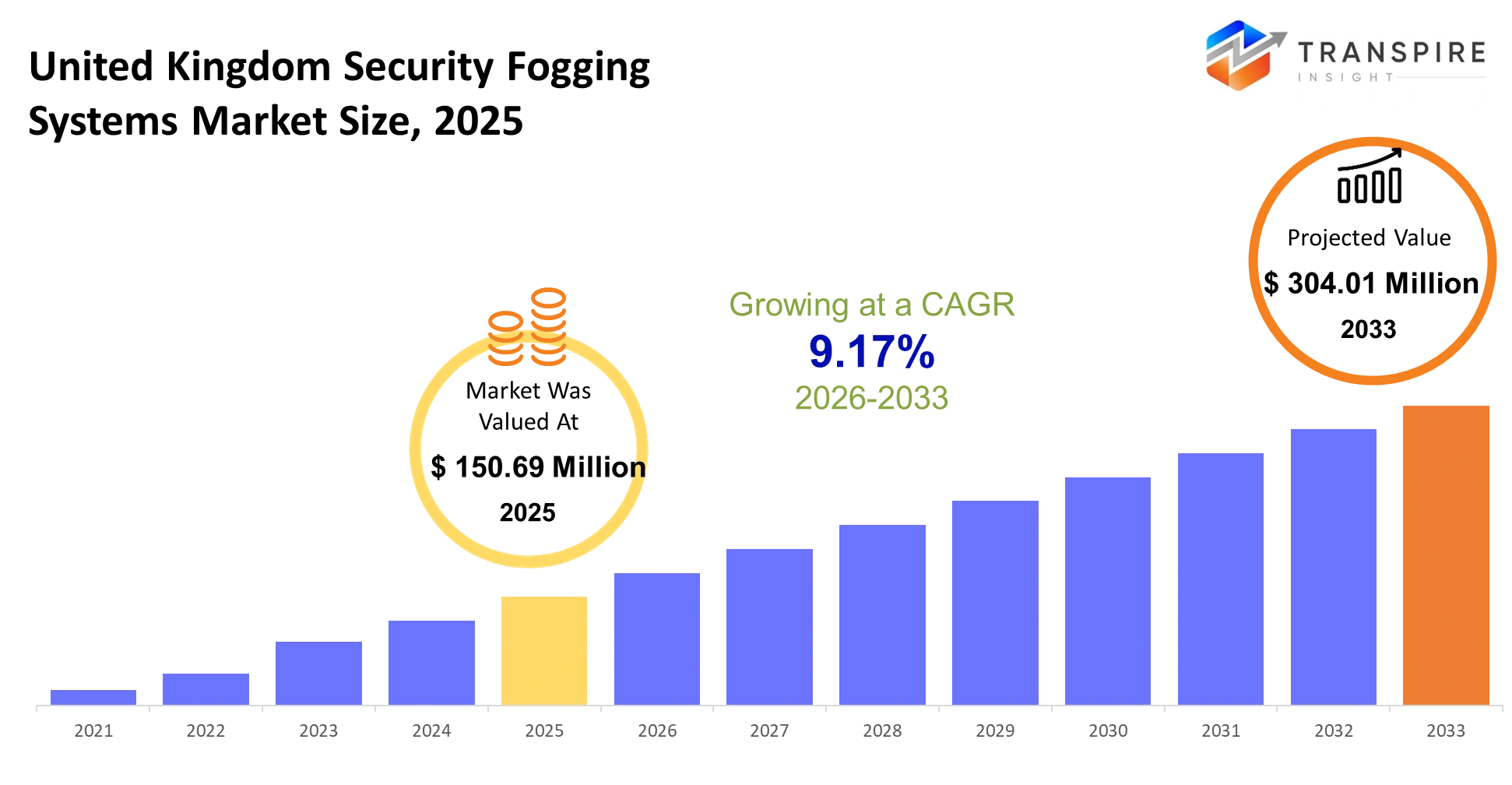
- United Kingdom Security Fogging Systems Market Size 2025: USD 150.69 Million
- United Kingdom Security Fogging Systems Market Size 2033: USD 304.01 Million
- United Kingdom Security Fogging Systems Market CAGR: 9.17%
- United Kingdom Security Fogging Systems Market Segments: By Product Type (Portable Fogging Systems, Fixed Fogging Systems, Automatic Fogging Systems, Others); By Technology (Thermal Fogging, ULV Fogging, Dry Fogging, Electrostatic Fogging, Others); By Application (Commercial Security, Residential Security, Warehouses, Banking & Financial Security, Others); By End User (Retail Stores, Banks, Warehouses, Residential Users, Government Facilities, Others)
To learn more about this report,  Download Free Sample Report
United Kingdom Security Fogging Systems Market Summary
The United Kingdom Security Fogging Systems Market was valued at USD 150.69 Million in 2025. It is forecast to reach USD 304.01 Million by 2033. That is a CAGR of 9.17% over the period.
The United Kingdom security fogging systems market does a real job in those high risk commercial settings where a break in turns into immediate inventory loss, within minutes. Retail chains, warehouses, pharmacies, banks, and logistics sites use these systems to flood an intruder area with dense fog during unauthorized entry. It scrambles sight lines and makes would-be thieves drop the attempt before police or security teams reach the premises. The tech has moved away from standalone deterrent devices to something more like an integrated security layer, tied in with AI enabled alarms, CCTV analytics, and remote monitoring platforms.
In the last five years, organized retail crime plus warehouse theft that connects with e-commerce distribution networks has shifted what buyers care about. Companies now pay less attention to post incident investigation and more to immediate loss prevention. On top of that, Brexit related supply chain disruption, and the inflationary pressure—both helped speed up adoption, since inventory values went up and the financial damage from a theft event became harder to absorb. That situation is pushing insurers and facility operators to back layered security spending, so there is steadier recurring demand for system upgrades, maintenance agreements, and integrated installations across commercial and industrial sites.
Key Market Insights
- The United Kingdom Security Fogging Systems Market is quietly benefiting from more and more deployments, across retail chains, big warehouses, banks, and pharmaceutical storage sites that deal with high-value inventory.
- AI-linked fogging systems picked up major ground after 2021, because companies started linking intrusion alarms with CCTV analytics and also remote supervision platforms.
- England is leading the United Kingdom Security Fogging Systems Market, taking close to 68% market share in 2025, mainly due to dense commercial infrastructure ,and organized retail activity that keeps scaling.
- Within the product lineup, condensed security fogging systems are leading with around 54% share in 2025, since they create rapid visibility disruption and they usually mean lower maintenance overhead.
- Hybrid integrated fogging systems are still number two, as commercial operators often favor coordinated alarm, surveillance, and access-control security setups ,together.
- Smart IoT-enabled fogging systems are expected to be the fastest-growing segment from 2026 to 2031, driven by predictive threat detection abilities that feel more proactive than before.
- When it comes to use cases, retail security applications are leading with nearly 41% market share in 2025 , because organized theft incidents keep impacting supermarkets, luxury retailers, and electronics stores alike.
- Warehouse and logistics applications show the quickest growth trajectory through 2031, since e-commerce fulfillment centers hold more valuable inventory, and their dispatch cycles are tighter.
- Commercial enterprises are the top end-user segment , with more than 48% share, supported by stricter insurance compliance rules and stronger asset protection requirements.
- Meanwhile, pharmaceutical and healthcare facilities are becoming a rapidly expanding end-user category, due to theft risks involving controlled medicines and medical equipment that can be hard to replace.
What are the Key Drivers, Restraints, and Opportunities in the United Kingdom Security Fogging Systems Market?
The most powerful driver pushing the United Kingdom Security Fogging Systems Market forward is this clear jump in organized commercial theft, especially aimed at retail chains, pharmacies, and e-commerce warehouses. The change got stronger after 2020 when inflation and supply chain disruption raised the worth of inventory pretty quickly across consumer electronics, luxury goods and pharmaceutical products. Companies noticed that standard CCTV cameras can record the incident, yes, but they don’t actually stop it in real time. So that idea basically shifted investment toward active loss-prevention technologies, the kind that can stop a problem within seconds. When insurers began tightening their risk evaluation rules for high value storage locations, a lot of operators went for security fogging systems as a way to reduce claim exposure and also shrinkage in stock, which then helps support higher installation revenue and longer running service agreements.
Even so, the main structural snag still sits with the expensive integration work, specifically when trying to retrofit older commercial buildings. Many locations in the United Kingdom still run separate alarm and surveillance setups, and those don’t always work smoothly with automated fogging activation. To make it fit, wiring upgrades, control adjustments, and remote monitoring network changes are often needed, and that can mean downtime for operations, plus specialist installation teams. This tends to slow adoption among mid-sized retailers and independent warehouses, mostly outside the biggest urban centers, which in turn reduces market reach and also delays the return of recurring maintenance revenue.
A really big future opportunity seems to be forming through smart logistics infrastructure tied to automated warehousing, and it’s getting more visible every month. Large fulfillment operators are increasingly rolling out AI-driven surveillance along with cloud based threat sensing platforms, then those setups can kick on fogging systems automatically if there is an unauthorized entry attempt. Meanwhile, distribution hubs around the Midlands and Northern England are starting to look like especially strong growth areas, since logistics developers are investing in high security automated storage environments that get designed from day one around integrated protection systems.
What Has the Impact of Artificial Intelligence Been on the United Kingdom Security Fogging Systems Market?
Artificial intelligence and advanced digital technologies are quietly reshaping the United Kingdom Security Fogging Systems Market , by turning what used to be conventional intrusion deterrent devices into smarter automated security platforms, kinda like a watchful guardian. Today’s fogging systems more and more include AI-driven video analytics and motion detection software, plus cloud-connected alarm networks that can flag suspicious behavior before a physical break-in happens. For example, retail chains and warehouse operators are increasingly adopting automated control routines that push fog deployment within seconds after unauthorized movement is detected , which cuts down the need for manual involvement and makes responses more consistent across many sites at once.
Meanwhile machine learning is also sharpening predictive maintenance features. Operators can review sensor data coming from fog generators, battery units, and pressure systems, to spot performance oddities before actual failures show up. In practice, this helps decrease unplanned downtime and trims emergency servicing expenses. Some integrated commercial security setups even report maintenance efficiency gains around 15% to 20% from remote diagnostics and automated fault detection. And the AI monitoring platforms often enable compliance tracking too, because they log activation events, alarm histories, and operational readiness in real time , no delays.
Still , AI adoption has its limits. Integration costs can be high, and there’s fragmented legacy infrastructure across older commercial buildings. A lot of facilities run outdated alarm and surveillance systems that do not easily support real time data synchronization, so wider rollout of intelligent fogging technologies gets slowed, sometimes quite a lot.
Key Market Trends
- Since 2022, more than 60% of new commercial fogging deployments have somehow integrated directly with cloud-based CCTV and alarm management platforms, which is kind of a shift people notice.
- Retailers were also seen replacing passive surveillance arrangements after organized theft incidents started pushing inventory shrinkage expenses up, especially across electronics, luxury goods, and pharmacy chains.
- AI-enabled video analytics really took off after 2021, and it made fogging systems kick in within seconds once suspicious behavioral pattern detection flags appeared.
- Manufacturers like Density Global and UR Fog moved product development toward wireless compact units, for the smaller urban retail spaces where “space” is always kind of tight.
- Insurance providers tightened commercial risk checks between 2021 and 2025, so businesses felt encouraged to adopt layered active loss-prevention technologies instead of relying on surveillance-only setups.
- Warehouse operators in the Midlands then increased their spend on integrated fogging systems as e-commerce fulfillment centers handled higher-value rapid-dispatch inventory, you know how that goes.
- After 2023, remote diagnostics adoption expanded steadily too, and that helped facility operators cut down on emergency maintenance visits while improving uptime consistency.
- Competitive behavior changed a lot as security integrators partnered with smart building automation providers, delivering centralized multi-site threat management platforms across locations.
United Kingdom Security Fogging Systems Market Segmentation
By Product Type:
Portable fogging systems give temporary, kinda flexible security coverage across retail spaces, storage areas, and smaller commercial units. Demand went up when businesses started looking for a mobile security approach that can move between locations without all the big installation work. The compact size and setup that feels faster continue to back wider use at independent facilities, even when teams are limited.
Fixed fogging systems are still common in warehouses, banks, and larger commercial buildings, where long term protection really needs to stay in place. With stable installation, plus a direct tie in with alarm systems, response can be quicker when an intrusion attempt happens. Automatic fogging systems got even more acceptance after operators leaned toward integrated security networks , especially those with remote monitoring and AI enabled activation options.
By Technology:
Thermal fogging tech is still used steadily in bigger industrial areas, where quick fog dispersion matters for immediate visibility disruption. High density fog output supports broad area coverage, particularly in warehouse and logistics settings that manage valuable inventory. Operational reliability keeps feeding the demand from commercial security providers.
ULV fogging and dry fogging also spread across retail and financial environments, since lower residue levels mean less cleanup after activation. Electrostatic fogging systems got a lot more attention too, mainly because distribution improves and indoor coverage becomes more efficient. Ongoing gains in sensor integration and wireless controls keep shaping how security equipment is bought across commercial sectors.
By Application:
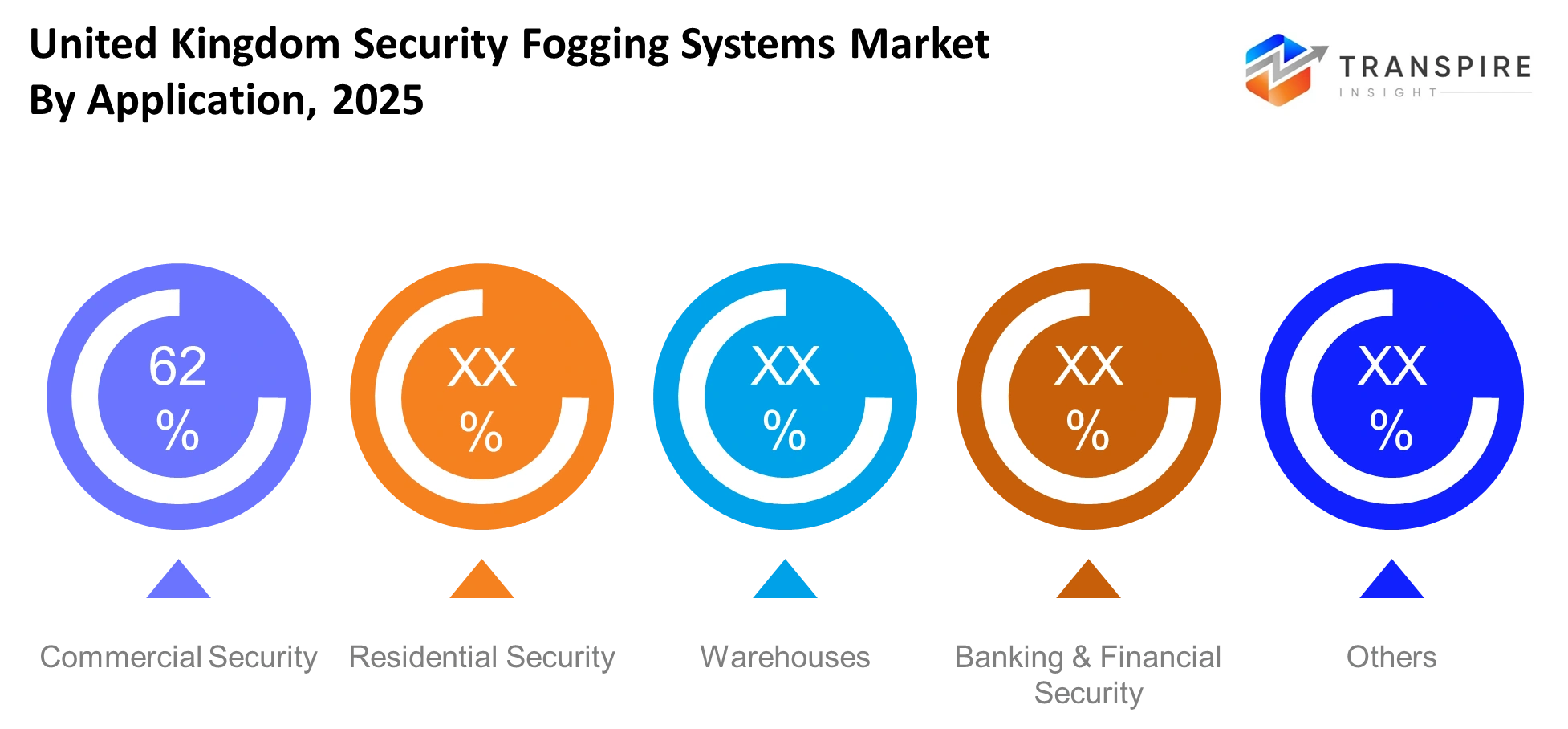
Commercial security applications now seem to hold a really major position, partly because organized theft incidents went up and started adding pressure on retailers and logistics operators, to strengthen those active protection systems. Security fogging technology actually works together with CCTV monitoring, alarm verification, and access control systems, so that intrusion attempts are stopped before inventory loss becomes too severe.
Warehouse security and banking security uses keep expanding too, mainly since companies store more high-value products and confidential assets inside centralized facilities. Residential security adoption also moved gradually upward, especially around premium housing developments and gated properties that want layered intrusion prevention. There is also faster emergency response capability which supports wider application growth across different property categories , not just one.
To learn more about this report, Download Free Sample Report
By End User:
Retail stores are still one of the leading end-user segments, because repeated theft incidents hit electronics, luxury products and pharmaceutical goods pretty hard. Big retail chains keep upgrading from passive surveillance systems toward active deterrent technologies, in a way that interrupts criminal activity right after unauthorized entry happens. Multi-site retail operators also like the centralized monitoring capabilities, because it makes oversight easier.
Banks and warehouse operators keep investing strongly too, since financial assets and inventory losses become direct operational costs. Government facilities and residential users are adopting fogging systems more and more as public infrastructure and private properties demand higher security standards. Security integration with smart building systems will keep influencing future purchasing behavior across end-user categories, in a slow but steady way.
What are the Key Use Cases Driving the United Kingdom Security Fogging Systems Market?
Retail security still counts as the biggest use case in the United Kingdom Security Fogging Systems Market, mainly because organized theft keeps hitting electronics stores, luxury retailers , pharmacies, and supermarkets, well, you know the drill. Security fogging systems deliver an instant visibility disruption when an intrusion attempt starts, and that helps a company shelter high-value stock before the law enforcement teams finally arrive on the commercial site.
Warehouse and banking applications have picked up real momentum too, since logistics providers and financial institutions are putting more weight on real-time loss prevention. In e-commerce fulfillment centers, the fogging systems are often paired with AI-enabled surveillance networks, so that the quick-dispatch inventory stays protected. Banking operators also install automated fogging units inside ATM zones, vault spaces, and cash-handling rooms, aiming to lower robbery exposure and general risk.
Newer options are showing up in data centers, healthcare storage facilities, and smart commercial buildings that link into centralized security platforms. Pharmaceutical distributors, for their part, increasingly trial fogging solutions to safeguard temperature-sensitive medical supplies and controlled substances. There also seems to be upside in premium residential developments where owners want more advanced intrusion prevention systems tied to remote monitoring technology.
|
Report Metrics |
Details |
|
Market size value in 2025 |
USD 150.69 Million |
|
Market size value in 2026 |
USD 164.51 Million |
|
Revenue forecast in 2033 |
USD 304.01 Million |
|
Growth rate |
CAGR of 9.17% from 2026 to 2033 |
|
Base year |
2025 |
|
Historical data |
2021 - 2024 |
|
Forecast period |
2026 - 2033 |
|
Report coverage |
Revenue forecast, competitive landscape, growth factors, and trends |
|
Regional scope |
Middle East and Africa (Saudi Arabia, United Arab Emirates, South Africa, Rest of Middle East and Africa) |
|
Key company profiled |
Density Global, UR Fog, Sentinel SFG, Concept Smoke Screen, Protect Fog Cannon, Smokecloak, ZeroVision, Securitas Technology, Verisure, Honeywell, Johnson Controls, Axis Communications, Hikvision, Bosch Security Systems, Dahua Technology |
|
Customization scope |
Free report customization (country, regional & segment scope). Avail customized purchase options to meet your exact research needs. |
|
Report Segmentation |
By Product Type (Portable Fogging Systems, Fixed Fogging Systems, Automatic Fogging Systems, Others); By Technology (Thermal Fogging, ULV Fogging, Dry Fogging, Electrostatic Fogging, Others); By Application (Commercial Security, Residential Security, Warehouses, Banking & Financial Security, Others); By End User (Retail Stores, Banks, Warehouses, Residential Users, Government Facilities, Others) |
Which Regions are Driving the United Kingdom Security Fogging Systems Market Growth?
England still, kind of, leads the United Kingdom Security Fogging Systems Market, mainly because of its heavy concentration of big retail chains, financial institutions, logistics hubs, and also commercial property networks. Places like London, Birmingham, and Manchester keep putting money into integrated commercial security infrastructure right after organized retail crime incidents pick up across city areas. On top of that, firm insurance compliance rules plus advanced surveillance integration help push broader uptake of automated fogging systems for warehouses and banking facilities. Meanwhile, a fairly mature ecosystem of security integrators, monitoring providers, and installation contractors keeps getting tighter, which basically reinforces England’s market position.
Scotland, for its part, brings in steady revenue from ongoing spend by industrial sites, financial services, and regional distribution networks. Compared with England, the market momentum in Scotland leans less on dense retail presence and more on long-term infrastructure shielding, plus targeted commercial property security upgrades. Companies around Glasgow and Edinburgh continue adopting layered security approaches, especially as commercial operators prioritize uninterrupted operations and asset protection. With stable economic activity and gradual modernization of commercial buildings going on, demand for security fogging technologies stays fairly consistent across the region.
Northern England represents the fastest-growing regional market as logistics expansion and warehouse construction accelerated after major e-commerce investments between 2021 and 2025. Distribution corridors across Leeds, Liverpool, and Newcastle experienced rising deployment of AI-enabled fogging systems linked with centralized security platforms. Commercial operators increasingly prioritize rapid intrusion prevention because higher-value inventory moves through automated fulfillment centers with shorter delivery cycles. This growth trend creates strong opportunities for technology providers, installation firms, and remote monitoring companies seeking expansion between 2026 and 2033.
Who are the Key Players in the United Kingdom Security Fogging Systems Market and How Do They Compete?
In the United Kingdom Security Fogging Systems Market, the competitive landscape stays kind of moderately fragmented, with international manufacturers still up against specialized regional security integrators. A lot of the fight seems to land more on technology integration, remote monitoring capability and after-sales support , not just the price of the equipment. The established players keep defending their market share via long-term commercial contracts , especially with retailers, warehouses, and financial institutions. Meanwhile, newer entrants tend to lean on AI-enabled automation and wireless installation flexibility. Basically, buyers now look for suppliers who can stitch fogging systems together with surveillance analytics, access control, and centralized alarm management platforms.
UR Fog leans hard into compact dry fog technology for rapid deployment, mainly inside retail stores and other commercial facilities where installation space is limited, kind of tight. They differentiate with low-residue fog generation and compatibility with third-party alarm systems that are widely used across the United Kingdom. Their growth push is increasingly aimed at logistics warehouses and multi-site retail operators that need centralized monitoring. Density Global competes by offering customized security solutions for high-risk commercial settings, where exposure of inventory stays high. Strong installation help and tailored system configuration, that combination, lets the company land contracts across banking facilities and industrial storage operations.
Concept Smoke Screen is all about immediate visual disruption, like right away, plus quick activation speed when someone tries to get in. The company keeps a competitive edge via dense fog output and solid partnerships with commercial alarm providers, especially across urban retail networks. Ajax Systems keeps pushing forward by building smart wireless security ecosystems that blend fogging units with AI supported sensors and mobile controlled monitoring applications. With this tech driven method in place, it draws smaller commercial operators who want less installation complexity and security upgrades that scale more easily.
Company List
- Density Global
- UR Fog
- Sentinel SFG
- Concept Smoke Screen
- Protect Fog Cannon
- Smokecloak
- ZeroVision
- Securitas Technology
- Verisure
- Honeywell
- Johnson Controls
- Axis Communications
- Hikvision
- Bosch Security Systems
- Dahua Technology
Recent Development News
In April 2026, Smoke Screen launched its “Ajax Ready” Sentinel security fog generators. The company announced that the new systems come with pre-installed Ajax Jeweller relays for faster wireless integration with intruder alarm platforms widely used across UK commercial security installations. Source https://www.smoke-screen.com/
In March 2026, Smoke Screen launched the Sentinel Go battery-powered security fog generator. The new off-grid fogging solution was introduced for construction sites, storage containers, and remote facilities where conventional wired installations are impractical.
Source https://www.smoke-screen.com/
What Strategic Insights Define the Future of the United Kingdom Security Fogging Systems Market?
The United Kingdom Security Fogging Systems Market is moving, kind of toward fully integrated autonomous security ecosystems, where fogging systems function as part of AI-driven threat response networks, not really as lone deterrent devices. Over the next five to seven years adoption will increasingly rely on how well security providers connect fogging systems with predictive surveillance analytics remote access control and centralized building management platforms. Commercial property modernization, plus automated warehouse expansion will keep driving this shift forward, even if it feels slower at first
There is also a less obvious risk, the growing dependence on integrated digital infrastructure. As more fogging systems hook into cloud-based monitoring networks, cybersecurity weak points and system interoperability failures could throw a wrench into deployment across older commercial facilities that still run a more fragmented security architecture. In practice, this may slow adoption among mid-sized operators who have tight technology budgets or simply lack internal IT capacity
On the opportunity side, a strong emerging opening is showing up in data centers and pharmaceutical distribution hubs, where valuable assets need immediate intrusion disruption without stressing or harming sensitive equipment. New entrants should really focus on partnerships with smart building integrators and cybersecurity providers, so they can build long-term differentiation that goes beyond hardware manufacturing alone, because integrations tend to stick around longer than components
United Kingdom Security Fogging Systems Market Report Segmentation
By Product Type
- Portable Fogging Systems
- Fixed Fogging Systems
- Automatic Fogging Systems
By Technology
- Thermal Fogging
- ULV Fogging
- Dry Fogging
- Electrostatic Fogging
By Application
- Commercial Security
- Residential Security
- Warehouses
- Banking & Financial Security
By End User
- Retail Stores
- Banks
- Warehouses
- Residential Users
- Government Facilities
Frequently Asked Questions
Find quick answers to common questions.
The United Kingdom Security Fogging Systems Market size is USD 304.01 Million in 2033.
Key segments for the United Kingdom Security Fogging Systems Market are By Product Type (Portable Fogging Systems, Fixed Fogging Systems, Automatic Fogging Systems, Others); By Technology (Thermal Fogging, ULV Fogging, Dry Fogging, Electrostatic Fogging, Others); By Application (Commercial Security, Residential Security, Warehouses, Banking & Financial Security, Others); By End User (Retail Stores, Banks, Warehouses, Residential Users, Government Facilities, Others).
Major United Kingdom Security Fogging Systems Market players are Density Global, UR Fog, Sentinel SFG, Concept Smoke Screen, Protect Fog Cannon, Smokecloak, ZeroVision, Securitas Technology, Verisure, Honeywell, Johnson Controls, Axis Communications, Hikvision, Bosch Security Systems, Dahua Technology.
The United Kingdom Security Fogging Systems Market size is USD 150.69 Million in 2025.
The United Kingdom Security Fogging Systems Market CAGR is 9.17% from 2026 to 2033.
- Density Global
- UR Fog
- Sentinel SFG
- Concept Smoke Screen
- Protect Fog Cannon
- Smokecloak
- ZeroVision
- Securitas Technology
- Verisure
- Honeywell
- Johnson Controls
- Axis Communications
- Hikvision
- Bosch Security Systems
- Dahua Technology
Recently Published Reports
-
Apr 2026
3D Optical Profiler Market
3D Optical Profiler Market Size, Share & Analysis Report By Type (Desktop 3D Optical Profiler, and Portable 3D Optical Profiler), By Technology (Confocal Technology, and White Light Interference), By End-Use Industry (Manufacturing, Research Institutions, Automotive, Aerospace and Defense, Medical Devices, and Other), and Geography (North America, Europe, Asia-Pacific, Middle East and Africa, South and Central America), 2021 - 2031
-
Apr 2026
Depth Sensor Market
Depth Sensor Market Size, Share & Analysis Report By Type (Infrared Depth Sensors, Time-of-Flight (ToF) Sensors, Stereo Vision Sensors, Structured Light Sensors, Ultrasonic Depth Sensors), By Application (Automotive, Robotics, Gaming, Consumer Electronics, Industrial Automation, Healthcare, Security & Surveillance, Others), By End Users (Automotive Manufacturers, Consumer Electronics Companies, Healthcare Providers, Industrial Companies, Security Agencies, Gaming Companies, Robotics Companies, Others), and Geography (North America, Europe, Asia-Pacific, Middle East and Africa, South and Central America), 2021 – 2031
-
Apr 2026
Digital Manufacturing Market
Digital Manufacturing Market Size, Share & Analysis Report By Component (Hardware, Software, and Services), By Technology (Robotics, 3D Printing, Internet of Things (IoT), and Others), By Application (Automotive and Transportation, Aerospace and Defense, Consumer Electronics, Industrial Machinery, and Others), By Process Type (Computer-Based Designing, Computer-Based Simulation, Computer 3D Visualization, Analytics, and Others), and Geography (North America, Europe, Asia-Pacific, Middle East and Africa, South and Central America), 2021 – 2031
-
Apr 2026
Digital Visa Services Market
Digital Visa Services Market Size, Share & Analysis Report By Type (Individual Travelers, Group Travelers), By Application (Tourism, Business Travel, Others), and Geography (North America, Europe, Asia-Pacific, Middle East and Africa, South and Central America), 2021 – 2031