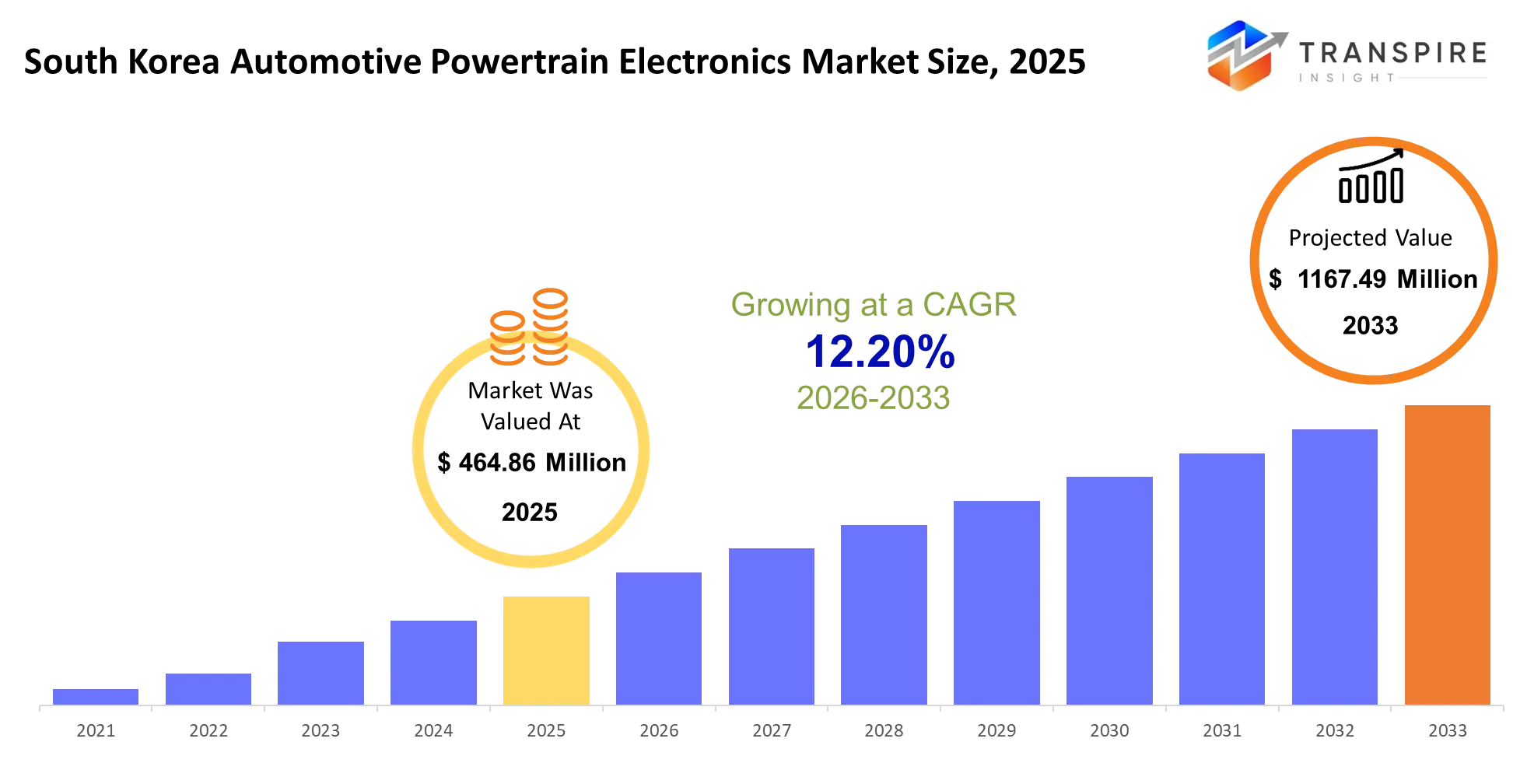
South Korea Automotive Powertrain Electronics Market Size & Forecast:
- South Korea Automotive Powertrain Electronics Market Size 2025: USD 464.86 Million
- South Korea Automotive Powertrain Electronics Market Size 2033: USD 1167.49 Million
- South Korea Automotive Powertrain Electronics Market CAGR: 12.20%
- South Korea Automotive Powertrain Electronics Market Segments: By Component (Engine Control Units, Transmission Control Units, Power Modules, Sensors, Inverters, Others); By Vehicle Type (Passenger Cars, Commercial Vehicles, Electric Vehicles, Hybrid Vehicles, Others); By Technology (Powertrain Control Systems, Electrified Powertrains, Battery Management Systems, AI-enabled Powertrain Systems, Others); By Application (Engine Management, Transmission Management, Energy Efficiency Optimization, Emission Control, Others); By End User (OEMs, Aftermarket Suppliers, Fleet Operators, Others)
To learn more about this report,  Download Free Sample Report
South Korea Automotive Powertrain Electronics Market Summary
The South Korea Automotive Powertrain Electronics Market was valued at USD 464.86 Million in 2025. It is forecast to reach USD 1167.49 Million by 2033. That is a CAGR of 12.20%over the period.
In practice, automotive powertrain electronics in South Korea kinda ensure that vehicles turn fuel or electrical energy into regulated motion with precision, efficiency and compliance. In other words these systems handle things like engine control units, battery management, transmission control, and power distribution so modern vehicles can meet tighter emissions rules, while still holding good performance. They really function as a kind of decision layer between the mechanical parts and software driven vehicle intelligence, and in doing so they directly shape fuel economy and the overall feel during driving, drivability.
Over the last 3–5 years, the market has moved in a more structural way from mechanically dominated control setups to software defined and semiconductor heavy architectures. The push toward electrification in South Korea’s automotive ecosystem, together with stronger emissions standards , made this transition happen faster. One big trigger was a global semiconductor supply disruption , it made the dependency risks obvious and pushed OEMs to localize and also redesign parts of the power electronics supply chain. Because of that manufacturers now place more emphasis on integrated control modules and higher efficiency electronic designs, which speeds up adoption and also changes where revenue flows go , toward advanced components and system integration services .
Key Market Insights
- The South Korea Automotive Powertrain Electronics Market is showing a pretty clear shift toward EV powertrain control systems , mostly pushed by the national electrification roadmap and the usual OEM investment cycles that come in waves.
- Market size growth seems tied to stronger integration of ECUs alongside battery management systems across both passenger and commercial vehicle platforms.
- The fastest-growing regional cluster is still Ulsan and Gyeonggi, and it looks supported by Hyundai Motor Group’s supply chain concentration plus their R&D hubs.
- Meanwhile the Seoul metropolitan region holds around 42% market share in 2025, because there’s so much going on there—dense OEM presence, Tier-1 suppliers, and a semiconductor ecosystem that kind of “feeds” the whole supply chain.
- In terms of vehicle type, Battery Electric Vehicles are leading adoption with more than 38% share, mainly due to EV output ramp-ups and regulatory emission limits.
- Hybrid powertrain systems stay second-largest as OEMs try to balance the move between ICE and full electrification , without rushing too hard into one direction.
- For products, Battery Management Systems are the quickest mover segment, expanding fast during the 2025–2033 forecast window.
- When you look at applications, passenger vehicles take the largest share, near 55%, driven by strong EV penetration and consumer adoption behavior.
- Commercial vehicle electrification is also starting to look like a high-growth lane, supported by logistics fleet modernization and procurement upgrades.
- Key players like Robert Bosch GmbH, Continental AG, Denso Corporation, ZF Friedrichshafen AG, Aptiv PLC, and Hyundai Mobis are working to improve their position through ECU innovation and EV platform collaborations.
- Overall, competitive advantage is becoming less about hardware alone and more about software integration, semiconductor localization, and these strategic partnerships with EV manufacturers , even when the timelines don’t match neatly.
What are the Key Drivers, Restraints, and Opportunities in the South Korea Automotive Powertrain Electronics Market?
The main driver in the South Korea Automotive Powertrain Electronics Market is basically the fast electrification of vehicles , which is backed by government emission rules and also OEMs EV production targets. Because of this, automakers have been pushed to swap mechanical control systems for electronic power management units , so demand keeps climbing for things like ECUs, inverters , and more sophisticated battery control modules. In practice, revenue growth really tracks with the increased electronic content per car , especially for electric and hybrid platforms , since almost every drivetrain function is electronically ruled and monitored.
Still, one big drag is the heavy reliance on advanced semiconductor imports and those pretty tangled chip supply chains. Powertrain electronics need high-performance microcontrollers and power semiconductors, and these parts are still pretty exposed to global supply swings. That kind of structural exposure makes it harder to scale production quickly and it also raises costs for OEMs , which then slows the wider electrification push across mid-tier vehicle types. It additionally makes it tougher for smaller suppliers to compete well, because the R&D needs and fabrication costs can be enormous.
On the other hand, there is a growing opportunity around localized semiconductor , and power module production in South Korea. With government-supported investment in local chip fabrication and EV component ecosystems, conditions are becoming more supportive for vertically integrated powertrain electronics making. For instance , partnerships involving Hyundai Group suppliers together with semiconductor players are helping speed up next-generation silicon carbide powered power module development, and those modules can meaningfully lift energy efficiency while also improving thermal behavior in EV drivetrain systems .
What Has the Impact of Artificial Intelligence Been on the South Korea Automotive Powertrain Electronics Market?
Artificial intelligence is kind of reshaping the South Korea Automotive Powertrain Electronics Market, more like by allowing adaptive control systems that keep tuning how vehicle energy gets split up. In newer EV platforms, AI based powertrain controllers can change torque delivery, battery load balancing, and thermal management all at once, basically in real time. This tends to push up the overall system efficiency. As a result, energy losses drop and the driving range can improve, and you do not really need a hardware redesign each time.
At the same time machine learning models are being used more often for predictive maintenance of power electronics. They spot early symptoms of inverter wear, battery imbalance, or even thermal stress. OEMs and Tier 1 suppliers pull in sensor data, then forecast component trouble before it becomes a bigger failure, this helps keep vehicles running longer and it also lowers warranty expenses. For electric fleets, AI driven optimization has shown clear reductions in energy use by shifting power distribution based on how the vehicle is actually driven, plus terrain related conditions.
Still, AI adoption in powertrain electronics is not perfect. One issue is that real world driving data can be inconsistent, and the overall integration process is pretty complex across multi supplier architectures. Sensor calibration can vary a bit, and standardization is limited across different ECU platforms, which makes it harder for the models to stay accurate in edge conditions. Also, real time AI processing needs substantial computation, so system costs go up, and that slows down rollout in mass market vehicle segments.
Key Market Trends
- The South Korea Automotive Powertrain Electronics Market has been shifting in a way that feels more software, less hardware, like the ECUs are no longer the whole story, since 2023.
- Also, a more integrated software-defined vehicle control architecture is becoming the norm and it shows up quicker than people expected.
- In 2025, EV penetration passed 30% of new vehicle production, which basically pushed adoption even faster for advanced powertrain electronics modules.
- Then there are the semiconductor localization efforts, which increased domestic sourcing of automotive-grade chips by almost 18% from 2023 to 2025.
- At the same time, battery management system adoption jumped noticeably, mainly because OEMs got better at EV range optimization and thermal safety requirements, you know, the usual but more strict now.
- Hyundai Mobis also kept expanding investment in EV platform electronics, which strengthened how the control modules get integrated across Hyundai Group.
- Earlier, supply chain disruptions from 2021–2023 forced ECU redesigns anyway, especially for multi-vendor chip compatibility and it wasn't just a minor change.
- On the technology side, Continental AG and Bosch raised R&D spending for silicon carbide-based inverter technologies, aiming for higher efficiency in EV drivetrains.
- Meanwhile hybrid demand looked steadier, around 25% share, sort of like transitional powertrain technology across the South Korean market.
- Another effect is vehicle software integration complexity. It got higher, so OEMs leaned into partnerships with Tier-1 electronics suppliers, because doing it alone is messy.
- And the fastest shift, at least in practice, seems to be in commercial EV fleets, where electronics adoption improved fleet efficiency by roughly 15–20% operationally.
South Korea Automotive Powertrain Electronics Market Segmentation
By Component
Engine Control Units kinda hold the leading position overall , mainly because theyre rolled out in lots of internal combustion, hybrid, and even newer hybridized vehicle setups. The market share stays solid because ECUs kind of work as the central processing hub that handles combustion timing , fuel injection , and also emission calibration across most passenger vehicle types. Transmission Control Units stay in a strong secondary role too, especially as automated systems and dual-clutch setups keep showing up in more mid to premium cars. The growth story is basically pushed by people wanting more seamless gear shifts, plus better efficiency tweaks, since fuel economy rules keep getting tighter.
Power Modules look like they're getting extra relevance fast as electrification keeps increasing the semiconductor intensity inside drivetrain systems. Sensors keep expanding at a steady pace, since real time data gathering helps with torque management and thermal regulation across both ICE and EV platforms. Inverters are seeing quick growth as electric mobility keeps rising, and as conversion efficiency keeps improving. Other segments are still kinda fragmented , but they also include those emerging integrated control units. Through the forecast window, power modules and inverters will likely become more structurally important , because electrified architectures replace mechanical dependence , and that nudges suppliers toward higher efficiency semiconductor design and more integrated powertrain platforms.
By Vehicle Type
Passenger cars kind of dominate the segment, mostly because production volumes stay high and OEM teams keep rolling out advanced electronics across things like infotainment, efficiency, and emissions control systems . The market share looks steady too, since people still want fuel efficiency, and also those connected driving experiences, so it keeps influencing what OEM design teams prioritize. For commercial vehicles, they hold a pretty stable place, backed by logistics expansion and the regulatory pressure that keeps building on fleet emissions.The whole growth reasoning feels tied to reducing operating expenses, and also to mandatory compliance upgrades across freight and transit operators, which is just continuous.
Electric vehicles are the fastest growing group, mostly due to government incentives plus the expansion of charging infrastructure that makes adoption move faster. Hybrid vehicles still matter in the transition, because they balance performance with fuel efficiency, especially in places where full electrification is kind of gradual. “Others” is usually specialty mobility platforms, with limited uptake but that’s slowly evolving.Over the forecast period, EVs will reshape how component demand is structured, since they increase semiconductor content per vehicle and they shift investment toward high-voltage power electronics, plus integrated battery systems.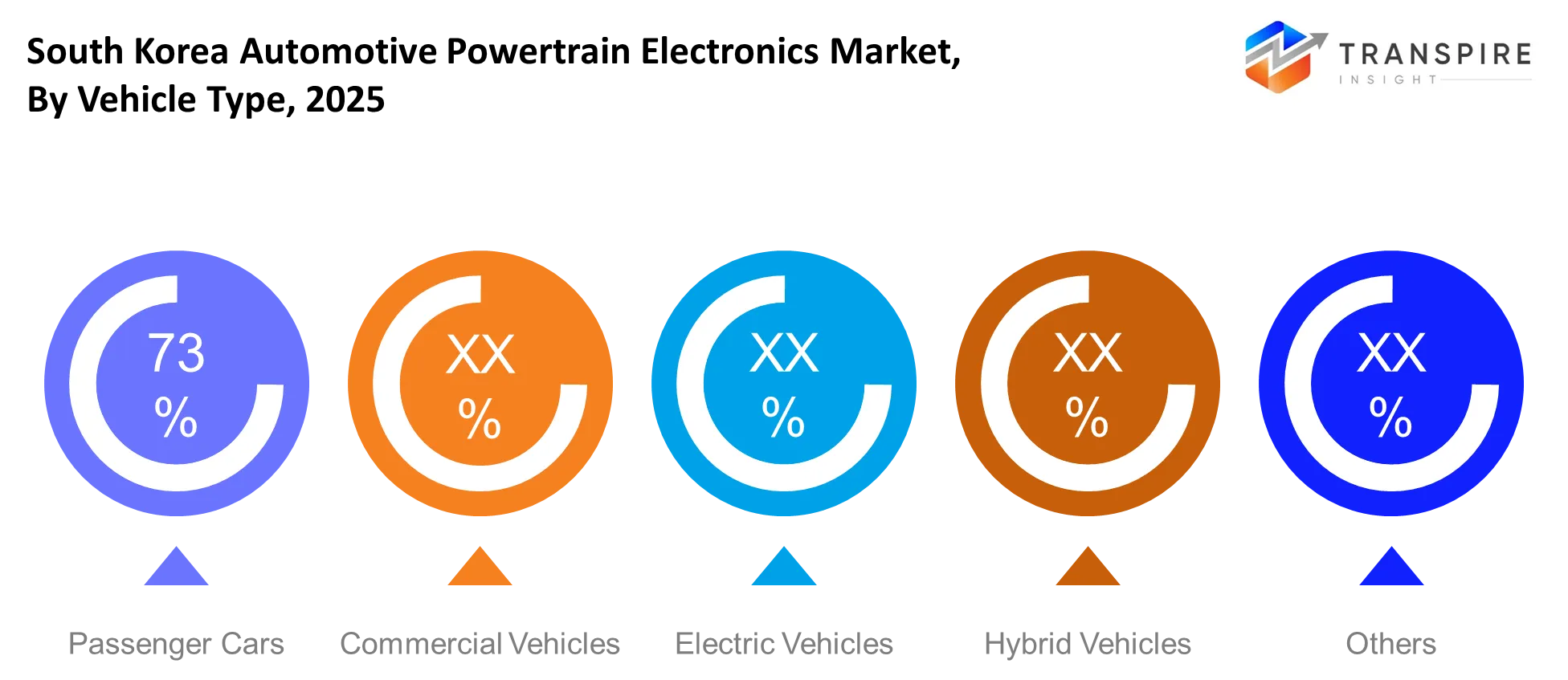
To learn more about this report, Download Free Sample Report
By Technology
Powertrain Control Systems sort of hold a pretty dominant position, mainly because they are foundational for handling engine and transmission work across both traditional and hybrid vehicles. The market share is still strong too, mostly since these systems give needed coordination between the mechanical parts and the electronic side. Electrified Powertrains, however, are the ones that feel like they are growing faster, since EV setups tend to lean hard on high-voltage energy distribution and tight motor control integration. A lot of the growth rationale also comes from electrification policies , and from OEMs moving toward modular EV platform designs.
Battery Management Systems are accelerating as well, because energy storage safety, efficiency, and lifecycle optimization have become core to EV output. Then there’s AI enabled Powertrain Systems, which show up as a more advanced category that focuses on adaptive energy optimization and predictive diagnostics. Other options exist too, for example legacy hybrid coordination systems, which slowly lose relevance as time goes on. During the forecast period, electrified powertrains plus battery management systems will basically reset the technology ranking, while AI integration will keep nudging control systems toward more autonomous energy decision frameworks over time.
By Application
Engine Management kinda holds a leading position, mainly because it plays a critical part in optimizing combustion efficiency, emission compliance, and that overall performance stability across ICE and hybrid platforms. Market share stays high too because almost every vehicle needs ongoing engine calibration, plus the control logic running the right way. Transmission Management keeps a solid role, backed by automation momentum and efficiency improvements in gear shifting systems. The growth logic behind all this is pretty straightforward, people want a smoother driving feel, plus better fuel economy gains.
Energy Efficiency Optimization is emerging as a fast-growing application, and it’s mostly pushed by electrification, along with stricter regulatory efficiency benchmarks. Emission Control still keeps real importance, simply because compliance rules apply in both domestic and export markets. Other related areas include auxiliary system coordination with limited, but still steady adoption. Over the forecast period, Energy Efficiency Optimization is likely to get the highest strategic importance—OEMs are prioritizing range extension and carbon reduction, so the system design shifts toward integrated, software-driven power management.
By End User
OEMs kinda dominate the segment , mostly because they do direct integration of powertrain electronics right into vehicle manufacturing and the whole platform development rhythm. The market share stays pretty high , since OEMs get to steer the system architecture choices and also decide which supplier gets picked for the core drivetrain components. Aftermarket Suppliers still have a smaller but steady standing, they tend to focus on replacement modules and also those performance upgrades. The growth logic is mostly tied to vehicle parc expansion and the fact that electronic component replacements are happening more often these days.
Fleet Operators are becoming a more noticeable group , especially as logistics and mobility companies keep pushing predictive maintenance and fuel efficiency fine tuning. Then you have others too, like niche industrial users and testing teams, with demand that’s limited but pretty specialized. Through the forecast period OEM dominance should continue , but fleet operators will probably get more strategic weight as data-driven vehicle management systems move into the center of day to day operational efficiency and lifecycle cost reduction.
What are the Key Use Cases Driving the South Korea Automotive Powertrain Electronics Market?
In the South Korea Automotive Powertrain Electronics Market the main use case looks like real-time engine plus motor control in electric and hybrid cars, where the electronics kinda handle torque , manage energy flow and push efficiency improvements. This specific use case ends up pulling the most demand because EV production keeps scaling fast and emission rules are getting stricter, so companies basically need responsive control hardware right now.
Then there are the secondary use cases , like transmission control systems together with regenerative braking coordination. You see these a lot in passenger vehicles and light commercial vehicles, especially those used by logistics teams and city mobility fleets. The upside is pretty clear: fuel efficiency goes up and mechanical parts tend to wear less over time .
On the emerging side, people are talking about AI enabled energy optimization and connected drivetrain diagnostics. These help with predictive tweaks in how power is distributed and they also flag faults early. Right now this area is gaining traction, since OEMs are rolling out vehicle software platforms alongside cloud based analytics, to support more stable long term performance and reliability.
|
Report Metrics |
Details |
|
Market size value in 2025 |
USD 464.86 Million |
|
Market size value in 2026 |
USD 521.56 Million |
|
Revenue forecast in 2033 |
USD 1167.49 Million |
|
Growth rate |
CAGR of 12.20% from 2026 to 2033 |
|
Base year |
2025 |
|
Historical data |
2021 - 2024 |
|
Forecast period |
2026 - 2033 |
|
Report coverage |
Revenue forecast, competitive landscape, growth factors, and trends |
|
Regional scope |
South Korea |
|
Key company profiled |
Hyundai Mobis, Bosch, Continental AG, Denso, Hitachi Astemo, Valeo, ZF Friedrichshafen, Mitsubishi Electric, Magna International, Aptiv, Lear Corporation, Infineon Technologies, NXP Semiconductors, Renesas Electronics, BorgWarner |
|
Customization scope |
Free report customization (country, regional & segment scope). Avail customized purchase options to meet your exact research needs. |
|
Report Segmentation |
By Component (Engine Control Units, Transmission Control Units, Power Modules, Sensors, Inverters, Others); By Vehicle Type (Passenger Cars, Commercial Vehicles, Electric Vehicles, Hybrid Vehicles, Others); By Technology (Powertrain Control Systems, Electrified Powertrains, Battery Management Systems, AI-enabled Powertrain Systems, Others); By Application (Engine Management, Transmission Management, Energy Efficiency Optimization, Emission Control, Others); By End User (OEMs, Aftermarket Suppliers, Fleet Operators, Others) |
Which Regions are Driving the South Korea Automotive Powertrain Electronics Market Growth?
Seoul plus the whole surrounding Gyeonggi area pretty much dominates the South Korea Automotive Powertrain Electronics Market, mainly because there are so many OEM headquarters around, along with semiconductor design firms, and a solid set of Tier 1 suppliers. In a practical sense, this place has an advantage from the way R&D centers and the vehicle software development hubs connect directly, so ECU innovation feels faster and the system validation cycles end up shorter. On top of that, national regulators are headquartered in Seoul, and their oversight is strong, which pushes early compliance for emissions rules and EV requirements, before things get late.
Then you have Busan and the Ulsan industrial belt, which act like the second big contributor. Their engine is mostly large scale vehicle manufacturing plus export oriented production. It is different from Seoul’s more design minded ecosystem, because here the whole foundation is high volume assembly work, and the logistics are helped by port based efficiency. The demand side is kind of stable too, since automakers keep running long term investment cycles, betting on steady export pulls toward Europe and North America. Also, those integrated manufacturing compounds make it easier to deploy standardized powertrain electronics across mass produced vehicle platforms, and that usually keeps revenue contributions steadier even when global demand shifts.
Meanwhile the fastest growing momentum seems to be building in the Daegu–Gwangju corridor. EV focused industrial restructuring has sped up there over the last few years, and government supported electrification programs along with localized EV component clusters have basically turned the region into a new kind of production base for power electronics as well as battery systems. Recent infrastructure upgrades and supplier incentives have also pulled in mid tier electronics manufacturers looking for cost efficient expansion. This move, in other words, suggests a decentralization trend, creating fresh entry points for investors aiming to scale EV supply chain integration from 2026 to 2033.
Who are the Key Players in the South Korea Automotive Powertrain Electronics Market and How Do They Compete?
Competition in the South Korea Automotive Powertrain Electronics Market is kind of moderately consolidated, where global Tier-1 suppliers and semiconductor firms are going head to head, but also with those pretty strong domestic OEM-linked ecosystems. The main way they compete is still technological differentiation, and like specifically, ECU integration, better power efficiency, and EV platform compatibility. Most of the established players defend their standing via deep OEM partnerships, but semiconductor-led newcomers are throwing curveballs too, because they are moving away from a hardware-first mindset, and instead they push software-defined abilities directly into powertrain systems.
Hyundai Mobis, for example, gets a noticeable edge from its close relationship with Hyundai Motor Group platform work, and it leans into modular EV power electronics and next-generation drivetrain control units. That kind of ecosystem fit helps them run faster vehicle-to-component co-development cycles, compared with suppliers who are not as tightly connected. Robert Bosch GmbH stays competitive with advanced software-driven ECU platforms, and it also invests a lot in silicon carbide based inverter technologies to push energy efficiency in electrified drivetrains. Denso Corporation meanwhile differentiates through very high-reliability hybrid system electronics, plus strong know-how in thermal management, especially when applications run high-load.
Continental AG puts its focus on scalable architecture platforms, the ones that support cross vehicle compatibility, which helps it hold ground in multi-OEM supply chains. Aptiv PLC, on the other hand, is expanding through software-defined vehicle architecture partnerships, and the theme there is centralized computing instead of so many distributed ECUs, it lowers overall system complexity, and it makes upgrades feel more flexible over time.
Company List
- Hyundai Mobis
- Robert Bosch GmbH
- Continental AG
- Denso Corporation
- Hitachi Astemo
- Valeo
- ZF Friedrichshafen AG
- Mitsubishi Electric
- Magna International
- Aptiv PLC
- Lear Corporation
- Infineon Technologies
- NXP Semiconductors
- Renesas Electronics Corporation
- BorgWarner Inc.
Recent Development News
In September 2025, Hyundai Mobis entered a large-scale collaboration with over 20 companies including semiconductor and foundry partners to build a localized automotive semiconductor ecosystem in South Korea. The initiative focuses on strengthening supply security for powertrain electronics and accelerating ECU and controller innovation for EV platforms. This move is expected to reduce dependency on imported automotive chips and improve integration speed across drivetrain systems.https://www.mobis.com
In January 2026, Sonatus partnered with Bosch, NXP, and Renesas at CES 2026 to demonstrate AI-enabled software-defined vehicle technologies for powertrain and vehicle system optimization. The collaboration highlights real-time diagnostic and edge AI control capabilities aimed at improving ECU performance and reducing development cycles for next-generation vehicles. This strengthens the shift toward software-defined powertrain electronics architecture in global and South Korean markets.https://en.wikipedia.org/wiki/Sonatus
In January 2026, Hyundai Motor Group expanded its AI robotics and electrified powertrain integration strategy showcased at CES 2026, focusing on next-generation EV platforms and high-efficiency drivetrain systems. The initiative emphasizes tighter integration between powertrain electronics and AI-based vehicle control systems to improve energy optimization and platform scalability. This development supports the broader transition toward centralized vehicle computing architectures in South Korea’s automotive sector.https://www.hyundai.com
What Strategic Insights Define the Future of the South Korea Automotive Powertrain Electronics Market?
The South Korea Automotive Powertrain Electronics Market is kinda shifting toward more centralized , software-defined electrification platforms where the hardware gets more or less standardized and a lot of the value slowly moves to control algorithms and semiconductor efficiency. This kind of change is pulled along by EV penetration speeding up and OEM consolidation around integrated vehicle architectures, so the electronic control systems become less fragmented.
There is also a less obvious risk, like semiconductor dependency concentration, meaning the whole ecosystem can end up relying on a small set of advanced chip suppliers, and that could cause production scalability bottlenecks , and even slow the innovation cadence. In practice even small disruptions in chip fabrication cycles might mess with EV drivetrain rollout timelines , more than people expect.
At the same time, there is an emerging opening around developing silicon carbide and gallium nitride based power modules, and doing that within more localized supply chains. That approach can lift thermal efficiency and cut energy losses in EV systems quite a lot. Market participants that move early to align with domestic semiconductor collaboration ecosystems in South Korea may end up with a more structural advantage. A main strategic recommendation is to invest in cross-layer integration capabilities that blend software control systems together with next generation power electronics hardware, instead of treating them separately.
South Korea Automotive Powertrain Electronics Market Report Segmentation
By Component
- Engine Control Units
- Transmission Control Units
- Power Modules
- Sensors
- Inverters
- Others
By Vehicle Type
- Passenger Cars
- Commercial Vehicles
- Electric Vehicles
- Hybrid Vehicles
- Others
By Technology
- Powertrain Control Systems
- Electrified Powertrains
- Battery Management Systems
- AI-enabled Powertrain Systems
- Others
By Application
- Engine Management
- Transmission Management
- Energy Efficiency Optimization
- Emission Control
- Others
By End User
- OEMs
- Aftermarket Suppliers
- Fleet Operators
- Others
Frequently Asked Questions
Find quick answers to common questions.
The Estimated South Korea Automotive Powertrain Electronics Market size for the market will be USD 1167.49 Million in 2033.
Key Segments for the South Korea Automotive Powertrain Electronics Market are By Component (Engine Control Units, Transmission Control Units, Power Modules, Sensors, Inverters, Others); By Vehicle Type (Passenger Cars, Commercial Vehicles, Electric Vehicles, Hybrid Vehicles, Others); By Technology (Powertrain Control Systems, Electrified Powertrains, Battery Management Systems, AI-enabled Powertrain Systems, Others); By Application (Engine Management, Transmission Management, Energy Efficiency Optimization, Emission Control, Others); By End User (OEMs, Aftermarket Suppliers, Fleet Operators, Others).
Major South Korea Automotive Powertrain Electronics Market Players are Hyundai Mobis, Bosch, Continental AG, Denso, Hitachi Astemo, Valeo, ZF Friedrichshafen, Mitsubishi Electric, Magna International, Aptiv, Lear Corporation, Infineon Technologies, NXP Semiconductors, Renesas Electronics, BorgWarner.
The Current South Korea Automotive Powertrain Electronics Market size is USD 464.86 Million in 2025.
The South Korea Automotive Powertrain Electronics Market CAGR is 12.20% from 2026 to 2033.
- Hyundai Mobis
- Robert Bosch GmbH
- Continental AG
- Denso Corporation
- Hitachi Astemo
- Valeo
- ZF Friedrichshafen AG
- Mitsubishi Electric
- Magna International
- Aptiv PLC
- Lear Corporation
- Infineon Technologies
- NXP Semiconductors
- Renesas Electronics Corporation
- BorgWarner Inc.
Recently Published Reports
-
Apr 2026
ATV & UTV Market
ATV & UTV Market Size, Share & Analysis Report By Type (ATV, and UTV), By Variants (Less Than 400 CC, 400 CC To 800 CC, and More Than 800 CC), and Geography (North America, Europe, Asia-Pacific, Middle East and Africa, South and Central America), 2021 - 2031
-
Apr 2026
Automotive Central Gateway Module Market
Automotive Central Gateway Module Market Size, Share & Analysis Report By Type (Ethernet Central Gateway Module, CAN Central Gateway Module, LIN Central Gateway Module, and FlexRay), By Application (Powertrain Control, Body Control, Infotainment System, Advanced Driver Assistance Systems (ADAS), and Others), By End User (Passenger Vehicles, and Commercial Vehicles), and Geography (North America, Europe, Asia-Pacific, Middle East and Africa, South and Central America), 2021 - 2031
-
Apr 2026
Automotive Engine Oil Filter Market
Automotive Engine Oil Filter Market Size, Share & Analysis Report By Filter Type (Fuel Filter, Engine Oil Filter, Hydraulic Oil Filter, and Others), By Filter Media (Cellulose, Synthetic, and Micro), By Sales Channel (OEMs, and Aftermarket), By Vehicle Type (Passenger Cars, Light Commercial Vehicles, Heavy Duty Trucks, Buses and Coaches, and Off-road Vehicles), and Geography (North America, Europe, Asia-Pacific, Middle East and Africa, South and Central America), 2021 - 2031
-
Apr 2026
Automotive Parts Aluminium Die Casting Market
Automotive Parts Aluminium Die Casting Market Size, Share & Analysis Report By Production Process (Pressure Die Casting, Vacuum Die Casting, Squeeze Die Casting, Gravity Die Casting), By Application (Body Parts, Engine Parts, Transmission Parts, Battery And Related Components, Other Application Types), and Geography (North America, Europe, Asia-Pacific, Middle East and Africa, South and Central America), 2021 - 2031
Our Clients