
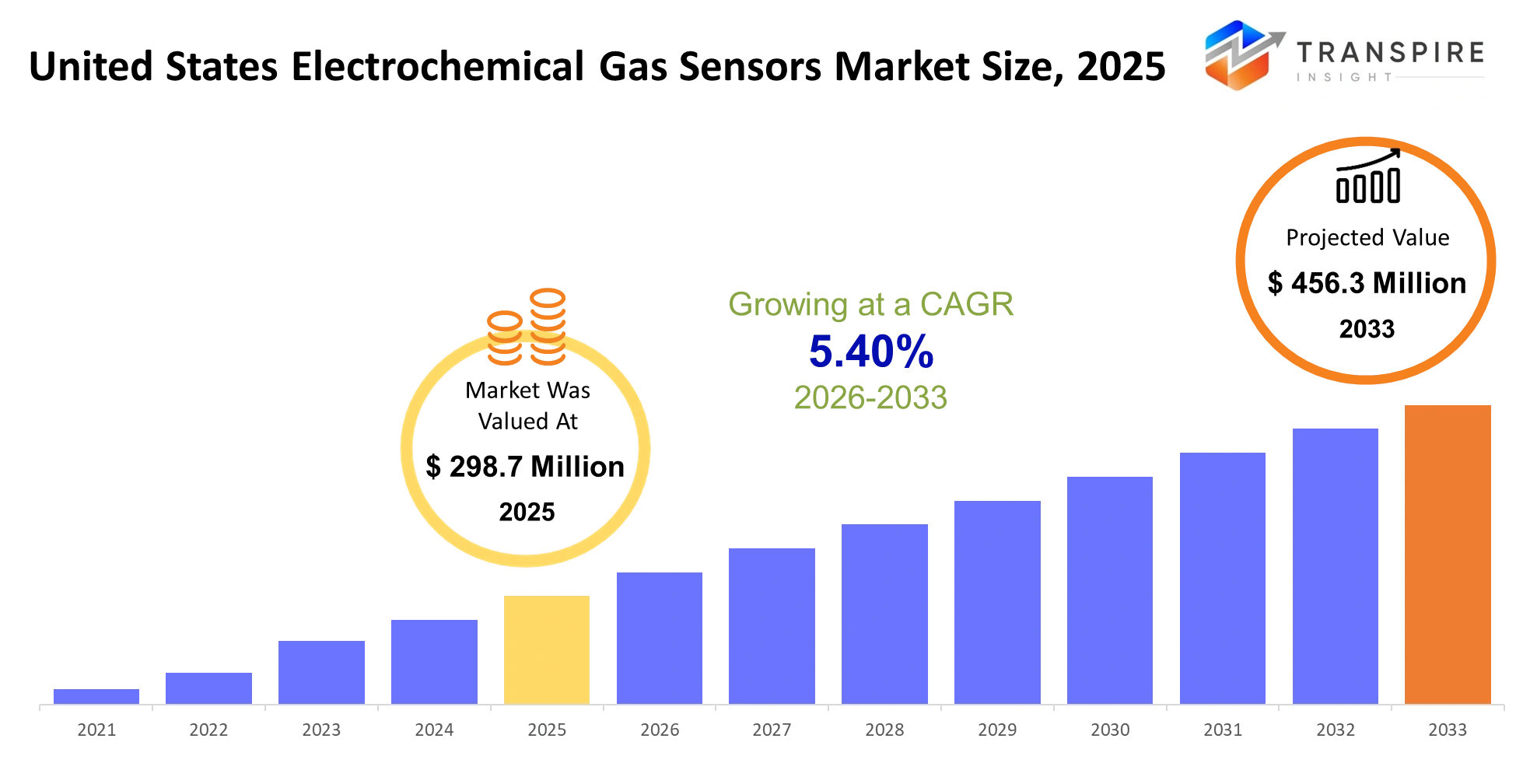
United States Electrochemical Gas Sensors Market Size & Forecast:
- United States Electrochemical Gas Sensors Market Size 2025: USD 298.7 Million
- United States Electrochemical Gas Sensors Market Size 2033: USD 456.3 Million
- United States Electrochemical Gas Sensors Market CAGR: 5.40%
- United States Electrochemical Gas Sensors Market Segments: By Gas Type (Oxygen Sensors, Carbon Monoxide Sensors, Hydrogen Sulfide Sensors, Ammonia Sensors, Nitrogen Oxide Sensors, Others); By Technology (Electrochemical Sensors, Solid-state Sensors, MEMS Sensors, Infrared Sensors, Others); By Application (Industrial Safety, Environmental Monitoring, Healthcare, Automotive, Oil & Gas, Others); By End User (Manufacturing Industry, Healthcare Sector, Energy Sector, Government Agencies, Others).
To learn more about this report,  Download Free Sample Report
United States Electrochemical Gas Sensors Market Summary
The United States Electrochemical Gas Sensors Market was valued at USD 298.7 Million in 2025. It is forecast to reach USD 456.3 Million by 2033. That is a CAGR of 5.40% over the period.
The United States electrochemical gas sensors market sort of plays a critical part in spotting toxic as well as combustible gases in places like oil refineries, chemical plants , wastewater facilities, and shipboard systems, where even tiny leaks can snowball into operational shutdowns or real safety incidents. Lately the whole market has been moving away from simple standalone analog detectors, toward networked electrochemical sensors that get folded into industrial IoT platforms , so companies can keep a constant watch and lean into predictive maintenance.
One of the biggest catalysts behind this change has been the stricter OSHA and EPA enforcement on workplace exposure limits, plus more attention on safety after industrial leakage events and port-side hazardous material situations.At the same time, supply chain disruptions kinda showed how risky it is when manual inspections get delayed, so plant operators are slowly leaning more on automated sensing solutions, even if it’s not always simple. Because of that, purchasing is moving toward connected higher value sensor ecosystems not just swapping old units out , and that in turn reshapes revenue patterns toward ongoing monitoring services and more tightly integrated safety infrastructure.
Key Market Insights
- The Midwest region kind of dominated the United States Electrochemical Gas Sensors Market, with about 34% market share in 2025 , mostly because manufacturing stays strong and chemical processing keeps running hot.
- Meanwhile the Southern United States is expected to become the fastest growing regional market through 2032 , pushed by more investment in oil, gas, and even semiconductors.
- Portable electrochemical gas sensors took roughly 46% of the overall industry share in 2025, since worker safety compliance keeps getting stricter across industrial sites.
- For applications, carbon monoxide detection led the way with nearly 31% market share in 2025, mainly due to how widely it’s used in industrial safety surveillance systems.
- And toxic gas monitoring applications are emerging pretty quickly too, as healthcare laboratories , along with pharmaceutical facilities, tighten up workplace air quality requirements.
- In the United States electrochemical gas sensing industry, industrial manufacturing sort of leads the end user landscape, holding about 38% revenue share in 2025 and yes that sounds like the most significant part right now.
- Meanwhile, healthcare and medical diagnostics seems to be the fastest mover, mainly because electrochemical biosensors are being used more and more for respiratory surveillance and patient monitoring setups.
- Also, as hydrogen fuel infrastructure keeps expanding, there’s a newer kind of demand bubbling up for advanced electrochemical gas detection tools across transportation plus energy arenas.
- On top of that, the way semiconductor manufacturing is growing across the United States is pulling more demand toward very delicate electrochemical gas sensors, like for sensing toxic plus flammable gases, pretty directly.
- Also last but not least, tighter OSHA compliance duties are steering industrial operators toward real time gas detection setups, with automatic alarms and analytics. That honestly makes the whole workflow feel more watched over and, less reactive, than it used to be.
What are the Key Drivers, Restraints, and Opportunities in the United States Electrochemical Gas Sensors Market?
The main driver pushing the United States Electrochemical Gas Sensors Market forward is the ongoing tightening of industrial workplace safety rules, across oil and gas , chemicals, mining , and semiconductor manufacturing. With updated Occupational Safety and Health Administration compliance requirements, plus tougher Environmental Protection Agency emission tracking regulations , industrial operators have had to use continuous gas detection tools instead of doing periodic manual checks. And that change has basically boosted purchases of fixed as well as portable electrochemical gas sensors, especially for carbon monoxide, hydrogen sulfide, and ammonia detection. Also, the fast expansion of semiconductor fabrication sites in places like Texas and Arizona has made this even stronger, because these facilities need very sensitive, real time toxic gas monitoring tools to keep safety standards on track and production flowing.
The biggest brake though still looks like sensor calibration drift along with a limited working lifespan in rough industrial settings. Electrochemical gas sensors slowly fade in sensitivity after exposure to high humidity, temperature swings or corrosive gases , which then lifts both replacement rates and overall upkeep costs. This is sort of structural, since it comes from the electrochemical reaction process itself, not really from some short-term supply chain hiccup or a pricing situation. A lot of mid sized companies end up postponing bigger rollouts because keeping sensor accuracy across large industrial networks means higher operational expenditure, period .
A big opportunity is showing up because hydrogen infrastructure is expanding across the United States. Federal funding, that backs hydrogen production hubs as well as fuel-cell transportation networks, is starting to create real demand for more advanced hydrogen leak detection systems. Electrochemical sensors, with ultra-low concentration sensing ability, are getting rolled into hydrogen storage sites, refueling stations, and clean energy projects more and more, especially in California and also around the Gulf Coast area.
What Has the Impact of Artificial Intelligence Been on the United States Electrochemical Gas Sensors Market?
Artificial intelligence, plus advanced digital technologies, is really shifting how gas detection and emission monitoring get handled across industrial and energy operations in the United States. A lot of manufacturers are now baking in AI driven analytics into electrochemical sensing platforms, to automate the hazardous gas watch, ventilation adjustments, and compliance paperwork in refineries , semiconductor sites, and chemical processing plants. In practice, these “smart” monitoring setups keep reading the sensors continuously, then sort of self adjust airflow systems or kick off shutdown protocols when the gas levels show up as abnormal. This kind of automation takes the pressure off manual inspections, and it also tends to speed up response times when leaks happen.
On top of that, machine learning models are making predictive maintenance better inside exhaust gas cleaning tech and broader industrial safety infrastructure. Operators are leaning on past sensor logs, humidity behaviors, and temperature swings to anticipate calibration drift, as well as component deterioration before it turns into a real failure. Some industrial facilities have already mentioned less unplanned downtime and better overall equipment utilization after installing predictive monitoring platforms that connect into electrochemical sensing networks. AI supported calibration management has also helped cut down on false alarms, and it makes regulatory compliance feel more consistent across multiple locations, even when the operations aren’t exactly identical.
Despite these wins, the integration costs still remain a big limitation, like it or not. Many legacy industrial plants continue running fragmented control architectures that cannot, in practice, really flex to cloud-connected analytics platforms or real-time AI processing. Also the field data quality stays uneven, which quietly drags model accuracy down, especially when things get rough with fluctuating gas mixtures and extreme temperatures, where the operating environment is just not so friendly .
Key Market Trends
- In 2023, semiconductor makers in Arizona and Texas bumped up use of ultra-sensitive toxic gas sensors, for cleanroom safety rules. It was like a gradual push though, not sudden , and you can see it more clearly after 2023.
- Industrial buyers meanwhile moved away from standalone detectors, and toward cloud-connected monitoring platforms. That shift helped with centralized compliance records across several sites, in particular since 2021 , when plants started consolidating reporting workflows.
- Hydrogen pilot efforts also sped things up. Electrochemical leak detection systems started getting more attention after federal clean energy funding grew through 2022 and 2023, and that momentum just kept going.
- Bigger names like Honeywell International and MSA Safety increased spending on AI-assisted calibration, plus predictive maintenance software, after 2024. The phrasing may sound technical, but it basically means fewer surprises during operations.
- Portable gas detection equipment got stronger traction among utility contractors too. That happened as remote worker safety protocols got stricter, following the post-pandemic operational reshuffling, not long ago , but definitely noticeable.
- Electrochemical sensor producers also tried to reduce how much they relied on Asian component sourcing between 2022 and 2025. So they expanded North American assembly work instead, which helped the supply chain feel steadier.
- Environmental monitoring agencies increasingly traded periodic manual inspections for continuous emissions tracking systems. The goal is tighter enforcement on industrial air quality, especially after 2023.
- Multi-gas sensing platforms became a more common procurement choice. Operators wanted lower installation costs, plus simpler upkeep routines, and honestly less downtime , if you look at the buying notes.
- In healthcare, facilities increased adoption of compact electrochemical biosensors. Respiratory monitoring investments grew across hospitals and diagnostic labs since 2021 , and that naturally pulled demand forward.
- Finally, sensor manufacturers started building low-power wireless communication modules directly into safety setups. That extended battery life and cut maintenance interruptions across industrial sites, which is usually the point in the first place, right.
United States Electrochemical Gas Sensors Market Segmentation
By Gas Type:
Oxygen sensors kinda hold a steady position in the United States Electrochemical Gas Sensors Market, mainly because they’re getting used more and more in medical equipment, confined space monitoring , and industrial safety setups. Carbon monoxide sensors keep picking up steam from residential safety systems, warehouses, and automotive exhaust monitoring, you know, the usual places where this gas shows up. Hydrogen sulfide sensors get a lot of mileage in wastewater treatment plants and oil refining operations where toxic gas exposure is still a big issue. Ammonia sensors back refrigeration facilities and fertilizer production lines as well, where leak detection still matters for everyday operational safety.
Nitrogen oxide sensors are seeing stronger adoption in emission control systems and environmental testing programs too, since tighter air quality regulations keep affecting how industries operate. Plus other sensor types, like chlorine sensors and sulfur dioxide sensors are also being rolled out more in chemical processing and public utility services. On top of that, growing industrial automation and workplace safety standards continue to nudge steady expansion across several gas sensing categories throughout the market.
By Technology:
Electrochemical sensors still kind of lead the pack in the United States Electrochemical Gas Sensors Market, mainly due to strong sensitivity , low power draw and that overall cost efficiency that everyone likes. Industrial sites, medical facilities, and environmental monitoring setups keep choosing these sensors for dependable gas detection in both regulated and risky conditions . You get reliable output plus a compact build, so they work well for both portable units and fixed monitoring systems, at scale.
Meanwhile, solid-state sensors are getting more attention, mostly because they last longer and they tolerate rough environments better. MEMS sensors are also expanding fast, since compact electronics and wearable monitoring gear really need smaller sensing parts with high precision. Infrared sensors continue to hold steady in uses where you need non-contact detection and consistent operation over time. Beyond that, other sensing approaches are gradually coming in too, because manufacturers are aiming to speed up response time and cut down maintenance needs.
By Application:
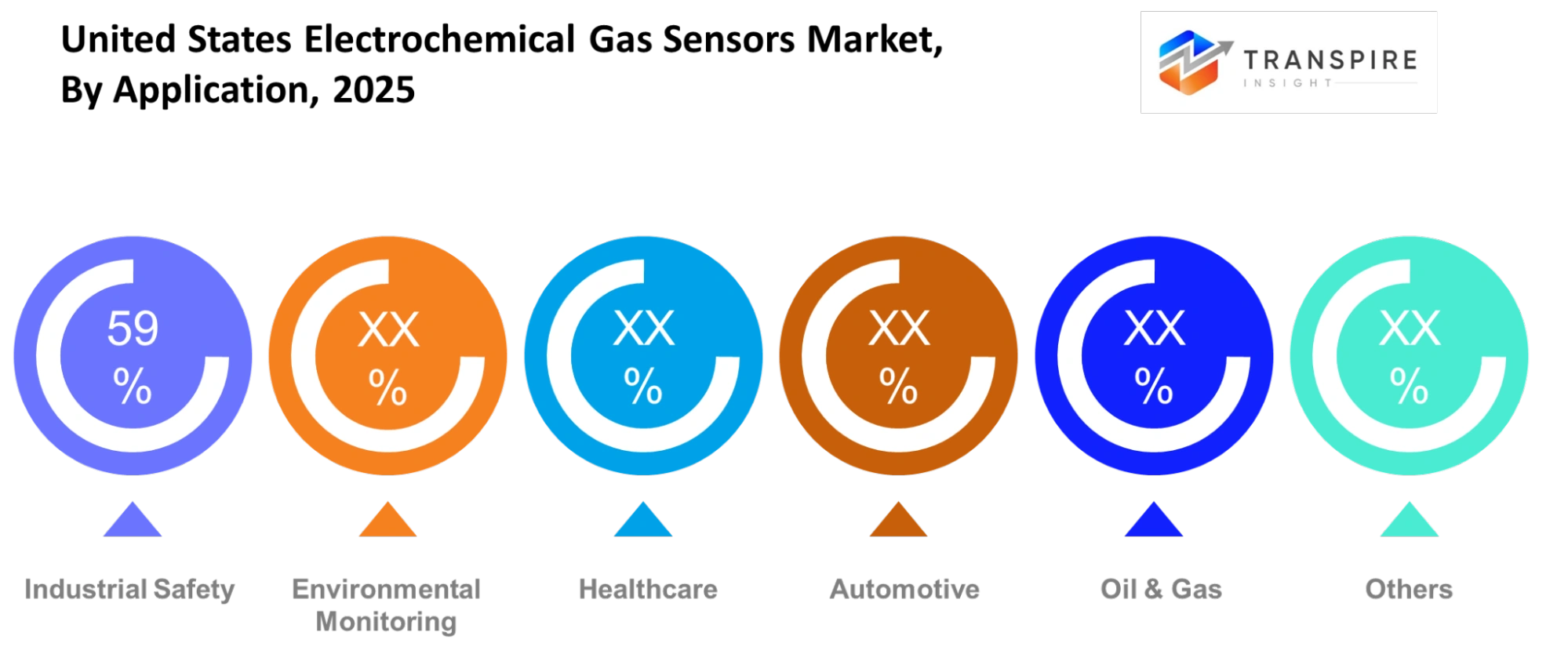
Industrial safety still feels like one of the most solid application domains in the United States Electrochemical Gas Sensors Market, because manufacturing plants, mining operations, and chemical processing units all keep needing ongoing toxic gas surveillance. At the same time environmental monitoring is getting more momentum too, with government bodies and industrial managers leaning into emission tracking plus day to day workplace air quality management. There’s also this growing awareness around employee wellbeing which keeps strengthening demand
Healthcare use cases continue to broaden, since hospitals and diagnostic centers want reliable oxygen and anesthesia gas monitoring setups. Automotive, meanwhile, is moving forward as demand rises for emission control tech and cabin air quality checks. Oil and gas operators also keep leaning on gas detection systems, especially for leak finding and worker protection. Beyond that, smart building deployments and fire detection arrangements are opening up extra growth avenues across the whole market, kinda like side streets that still matter.
To learn more about this report, Download Free Sample Report
By End User:
Manufacturing industries show up as a big end-user group in the United States Electrochemical Gas Sensors Market, sort of, because production sites need constant supervision of hazardous gases to keep worker safety up and keep day-to-day operations efficient, too. At the same time growing industrial automation and tighter occupational safety rules keep pushing companies to add more sophisticated sensing solutions inside factories and processing facilities.
Meanwhile the healthcare space is also moving ahead steadily. This happens as more providers adopt respiratory monitoring systems, ventilators, and even medical gas analyzers. In parallel the energy segment still has strong demand, since power plants, renewable energy stations, and fuel storage operations need reliable gas watch systems so safety stays intact. On top of that, government bodies keep putting money into environmental surveillance and emergency response frameworks, all to raise public safety and support regulatory compliance across both city zones and industrial corridors.
What are the Key Use Cases Driving the United States Electrochemical Gas Sensors Market?
So, industrial safety monitoring still ends up being the main use case for electrochemical gas sensors, especially across oil refineries, chemical plants, mining sites, and semiconductor fabrication units. In practice these places keep pushing for continuous sensing of carbon monoxide, hydrogen sulfide, and ammonia. That’s what they point to for OSHA workplace exposure limits, and also so the whole operation doesn’t trip into shutdowns, or at least avoid that kind of surprise event.
Meanwhile, healthcare and wastewater treatment are growing more quickly than before. Hospitals are rolling out compact biosensors for breathing related monitoring, and municipal treatment facilities are tightening up toxic gas surveillance. Also, food processing plants and cold storage operators are investing more in ammonia leak detection, to lower worker hazard exposure, and yes to dodge regulatory penalties that come with the territory.
Then there are emerging applications, like around hydrogen fuel infrastructure, and even battery manufacturing facilities. Hydrogen production hubs, refueling stations, and electric vehicle battery plants now tend to need ultra-sensitive leak detection, something that can catch trace gas concentrations before ignition risks pop up, or before contamination starts spreading.
|
Report Metrics |
Details |
|
Market size value in 2025 |
USD 298.7 Million |
|
Market size value in 2026 |
USD 315.8 Million |
|
Revenue forecast in 2033 |
USD 456.3 Million |
|
Growth rate |
CAGR of 5.40% from 2026 to 2033 |
|
Base year |
2025 |
|
Historical data |
2021 - 2024 |
|
Forecast period |
2026 - 2033 |
|
Report coverage |
Revenue forecast, competitive landscape, growth factors, and trends |
|
Geographic scope |
United States of America |
|
Key company profiled |
Honeywell, Figaro Engineering, Membrapor, Alphasense, Dräger, City Technology, ABB, Bosch Sensortec, Siemens, Aeroqual, Senseair, Dynament, Industrial Scientific, MSA Safety, SGX Sensortech. |
|
Customization scope |
Free report customization (country, regional & segment scope). Avail customized purchase options to meet your exact research needs. |
|
Report Segmentation |
By Gas Type (Oxygen Sensors, Carbon Monoxide Sensors, Hydrogen Sulfide Sensors, Ammonia Sensors, Nitrogen Oxide Sensors, Others); By Technology (Electrochemical Sensors, Solid-state Sensors, MEMS Sensors, Infrared Sensors, Others); By Application (Industrial Safety, Environmental Monitoring, Healthcare, Automotive, Oil & Gas, Others); By End User (Manufacturing Industry, Healthcare Sector, Energy Sector, Government Agencies, Others). |
Which Regions are Driving the United States Electrochemical Gas Sensors Market Growth?
The Midwest still feels like the leading regional market for electrochemical gas sensors in the United States, mainly because there’s a dense concentration of chemical manufacturing, metal processing and industrial automation stuff all in one place. States like Ohio, Illinois and Michigan keep pretty strict occupational safety rules, so they end up needing continuous toxic gas monitoring across big industrial plants. On top of that the area has a mature supplier ecosystem that basically covers sensor manufacturers, industrial automation providers and even engineering service companies, who can handle large scale deployments without too much trouble. Also, the region has had long standing investments in factory modernization, plus predictive maintenance systems, which keeps pushing the uptake of connected gas detection technologies along the manufacturing corridors.
The Western United States is the second biggest regional contributor, but the growth path isn’t the same. It tends to be driven more by technology refreshes and environmental compliance rather than heavy manufacturing volume alone. Places like California Oregon and Washington have some of the strictest air quality and workplace exposure regulations in the country, so demand stays steady for advanced monitoring solutions in healthcare, biotechnology, and semiconductor areas. There’s also strong venture capital momentum and clean technology funding, which helps innovation in compact wireless sensing platforms. Overall this region gives more consistent market revenue because industrial operators keep upgrading their environmental monitoring systems to match changing state level compliance requirements.
The Southern United States is sort of coming up as the fastest growing region, mainly because there is rapid expansion in energy infrastructure , semiconductor fabrication and hydrogen production projects. Texas as well as Louisiana have been seeing big investments in LNG facilities , petrochemical plants and clean hydrogen hubs since 2023 and that has pushed up the need for real time toxic and combustible gas monitoring systems. On top of that, federal incentives that are linked to domestic semiconductor manufacturing have helped speed up the construction of high specification fabrication facilities across the whole area. So yeah, this whole growth pattern is creating solid prospects for sensor manufacturers, software providers, and industrial safety companies that are aiming for long term expansion between 2026 and 2033.
Who are the Key Players in the United States Electrochemical Gas Sensors Market and How Do They Compete?
The United States Electrochemical Gas Sensors Market is still kinda moderately consolidated , with just a small cluster of industrial safety and sensing technology companies that ends up controlling a lot of the big, large scale deployments. Honestly, competition is shifting more and more toward sensor accuracy, wireless integration, predictive analytics, and how efficiently teams can handle long term maintenance, instead of plain hardware pricing. Bigger manufacturers are holding on to share by adding AI driven diagnostics plus cloud connectivity into gas monitoring platforms, while smaller entrants tend to concentrate on narrow needs like hydrogen leak detection or wearable safety device solutions. In sectors such as semiconductor fabrication , energy infrastructure , and healthcare, buyers are now more focused on calibration stability, regulatory certification, and software interoperability when they pick a supplier.
Honeywell International keeps showing up by building an integrated industrial safety ecosystem , so it blends electrochemical sensing hardware with centralized monitoring software and automated compliance reporting. The strength here is mainly the long standing relationships with refinery, aerospace, and chemical processing operators, especially those running large multi site programs. Honeywell has also pushed the connected worker platform forward to improve predictive maintenance and remote monitoring services, which makes it easier for customers to manage fleets without as much manual effort. MSA Safety, on the other hand, differentiates itself with rugged portable detection devices aimed at mining, firefighting, and oilfield situations, where sensor durability really determines worker safety outcomes. MSA keeps broadening its footprint via partnerships with industrial distributors , plus it invests in cloud based fleet management platforms too.
Dräger really puts a lot of emphasis on healthcare, and also dangerous industrial places, by shipping very sensitive multi gas detection systems, and they follow strict certification in both medical and industrial areas. The main pull is precision monitoring for hospitals , pharmaceutical laboratories and those confined workspaces where even small amounts of toxic gas detection really matters. Amphenol Corporation goes a different route, they push sensor miniaturization, plus custom integration work for semiconductor manufacturing, and for advanced electronics use cases. Lately they’ve also grown their North American production footprint, so supply chain slowdowns happen less, and it helps domestic semiconductor investment programs along.
Company List
- Honeywell
- Figaro Engineering
- Membrapor
- Alphasense
- Dräger
- City Technology
- ABB
- Bosch Sensortec
- Siemens
- Aeroqual
- Senseair
- Dynament
- Industrial Scientific
- MSA Safety
- SGX Sensortech
Recent Development News
In August 2025, Advent Technologies Holdings entered a partnership with a global semiconductor and wireless technology company. The agreement focused on developing electrochemical gas sensors using Advent’s Ion Pair membrane technology for air-quality monitoring, food safety, and medical breath-analysis applications, supporting innovation in next-generation gas sensing solutions.
Source: https://www.nasdaq.com/
In January 2026, Teledyne Technologies announced acquisition of DD-Scientific. The deal expanded Teledyne’s electrochemical gas sensor portfolio with lead-free sensing technology for industrial safety, healthcare, and environmental monitoring applications, strengthening its position in the United States electrochemical gas sensors market.
Source: https://www.teledyne.com/
What Strategic Insights Define the Future of the United States Electrochemical Gas Sensors Market?
The United States Electrochemical Gas Sensors Market is kinda moving, not just in a straight line, toward more intelligent, networked sensing ecosystems that sit side by side with industrial automation and predictive safety platforms. Over the next five to seven years, the pull will shift more and more away from standalone gas detection hardware, and toward software-linked monitoring setups that can do real-time analytics, push automated compliance reports, and enable remote diagnostics too. A lot of this shift is being nudged by semiconductor manufacturing expansion, hydrogen infrastructure rollout, and tighter workplace exposure monitoring rules across industrial plants.
There’s also an underrecognized risk that folks seem to gloss over, which is the growing reliance on specialized raw materials and microelectronic components used for sensor fabrication. When supply gets concentrated among a relatively small set of component suppliers, manufacturers can end up facing pricing volatility and nasty production bottlenecks during geopolitical disruptions or semiconductor shortages, even if their demand forecasts look fine. At the same time, hydrogen transportation and storage infrastructure is becoming a real, emerging opportunity since ultra-sensitive leak detection demands are getting baked into new federal clean energy projects, like it’s part of the baseline requirements.
Market participants should probably double down on partnerships with industrial software providers and put money into AI-enabled calibration management systems. That way they can build steadier long-term service revenue and keep customers, even when hardware sales alone start to slow down, or get more competitive.
United States Electrochemical Gas Sensors Market Report Segmentation
By Gas Type
- Oxygen Sensors
- Carbon Monoxide Sensors
- Hydrogen Sulfide Sensors
- Ammonia Sensors
- Nitrogen Oxide Sensors
By Technology
- Electrochemical Sensors
- Solid-state Sensors
- MEMS Sensors
- Infrared Sensors
By Application
- Industrial Safety
- Environmental Monitoring
- Healthcare
- Automotive
- Oil & Gas
By End User
- Manufacturing Industry
- Healthcare Sector
- Energy Sector
- Government Agencies
Frequently Asked Questions
Find quick answers to common questions.
The United States Electrochemical Gas Sensors Market size is USD 456.3 Million in 2033.
Key segments for the United States Electrochemical Gas Sensors Market are By Gas Type (Oxygen Sensors, Carbon Monoxide Sensors, Hydrogen Sulfide Sensors, Ammonia Sensors, Nitrogen Oxide Sensors, Others); By Technology (Electrochemical Sensors, Solid-state Sensors, MEMS Sensors, Infrared Sensors, Others); By Application (Industrial Safety, Environmental Monitoring, Healthcare, Automotive, Oil & Gas, Others); By End User (Manufacturing Industry, Healthcare Sector, Energy Sector, Government Agencies, Others).
Major United States Electrochemical Gas Sensors Market players are Honeywell, Figaro Engineering, Membrapor, Alphasense, Dräger, City Technology, ABB, Bosch Sensortec, Siemens, Aeroqual, Senseair, Dynament, Industrial Scientific, MSA Safety, SGX Sensortech.
The United States Electrochemical Gas Sensors Market size is USD 298.7 Million in 2025.
The United States Electrochemical Gas Sensors Market CAGR is 5.40% from 2026 to 2033.
- Honeywell
- Figaro Engineering
- Membrapor
- Alphasense
- Dräger
- City Technology
- ABB
- Bosch Sensortec
- Siemens
- Aeroqual
- Senseair
- Dynament
- Industrial Scientific
- MSA Safety
- SGX Sensortech
Recently Published Reports
-
Apr 2026
Fiber Optic Faceplates Market
Fiber Optic Faceplates Market Size, Share & Analysis Report By Type (< 300 mm2, 300-350 mm2, and > 350 mm2, By Application (Night Vision, Holographic Imaging, Medical, and Others), and Geography (North America, Europe, Asia-Pacific, Middle East and Africa, South and Central America), 2021 - 2031
-
Apr 2026
High Temperature Superconductors Market
High Temperature Superconductors Market Size, Share & Analysis Report By Type (1G HTS, and 2G HTS), By Application (Power Cable, Fault Current Limiter, and Transformer), and Geography (North America, Europe, Asia-Pacific, Middle East and Africa, South and Central America), 2021 - 2031
-
Apr 2026
Industrial Plugs and Socket Market
Industrial Plugs and Socket Market Size, Share & Analysis Report By Type (Industrial Plugs, Industrial Sockets), By Current (Up to 32 A, 32 to 125 A, Above 125 A), By Protection (Dustproof and Splash Proof, Waterproof, Explosion Proof), By End User (Heavy Industries, Oil and Gas, Chemicals and Pharmaceuticals, Power Generation, Others), and Geography (North America, Europe, Asia-Pacific, Middle East and Africa, South and Central America), 2021 - 2031
-
Apr 2026
InGaAs Avalanche Photodiodes Market
InGaAs Avalanche Photodiodes Market Size, Share & Analysis Report By Type (1100 - 1700 nm, and 1000 - 1600 nm), By Application (Missile Warning System, Muzzle Flash Detection, Wafer Defect Inspection, Laser Rangefinders, and Others), and Geography (North America, Europe, Asia-Pacific, Middle East and Africa, South and Central America), 2021 - 2031