France Healthcare Digital Twins Market Size & Forecast
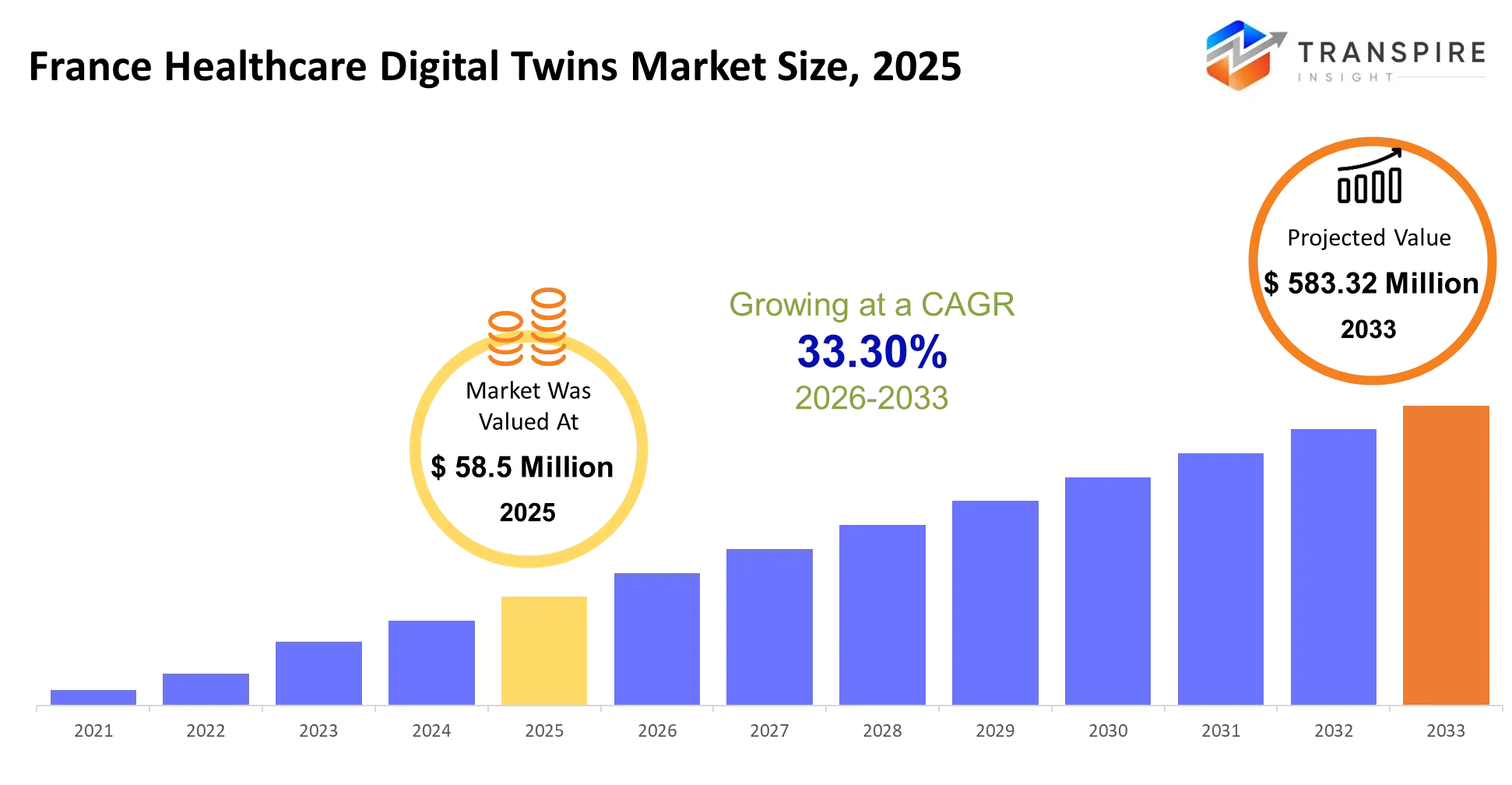
- France Healthcare Digital Twins Market Size 2025: USD 58.5 Million
- France Healthcare Digital Twins Market Size 2033: USD 583.32 Million
- France Healthcare Digital Twins Market CAGR: 33.30%
- France Healthcare Digital Twins Market Segments: By Type (Patient Digital Twins, Device Digital Twins, System Digital Twins, Others); By Application (Personalized Medicine, Drug Development, Surgery Planning, Monitoring, Others); By End-User (Hospitals, Pharma Companies, Research Institutes, Others); By Deployment (Cloud, On-premise, Hybrid, Others)
To learn more about this report,  Download Free Sample Report
France Healthcare Digital Twins Market Summary
France's healthcare digital twins market reached USD 58.5 Million in 2025 and is projected to expand to USD 583.32 Million by 2033, growing at 33.30% CAGR. Digital twin technology in French healthcare creates virtual replicas of human organs, medical devices, and hospital systems - so that one can make more accurate diagnoses, plan treatments better, and optimize operational processes much more effectively. A cardiologist uses a patient digital twin to simulate the outcome of a surgical procedure before actually operating. Pharmaceutical companies model how their drugs interact with a virtual human body.
The real structural shift leading to accelerated adoption is the convergence of three essential technologies: high-resolution medical imaging, cloud computing infrastructure, and artificial intelligence. Legacy healthcare IT systems stored patients' data in separate electronic health records - lacking the processing power to simulate very complex physiological responses accurately. Modern digital twin platforms take in real-time imaging data from MRI, CT, and ultrasound systems, combine it with genetic and biomarker information - then run physics-based simulations of organ function itself. This ability shifted out of research labs and into clinical deployment between 2021 and 2024.
The real-world trigger factor is France's national healthcare digitization strategy - which demands interoperable digital health infrastructure across all 40 regional health authorities running public hospitals and clinics. When government procurement standards require EHR platforms to produce digital twin outputs even for quite complex cases, hospitals invest in the necessary infrastructure themselves. This regulatory push transformed France from a somewhat peripheral market to a top investment target for digital twin vendors - including Siemens Healthineers, GE Healthcare, and Philips itself.
Key France Healthcare Digital Twins Market Insights
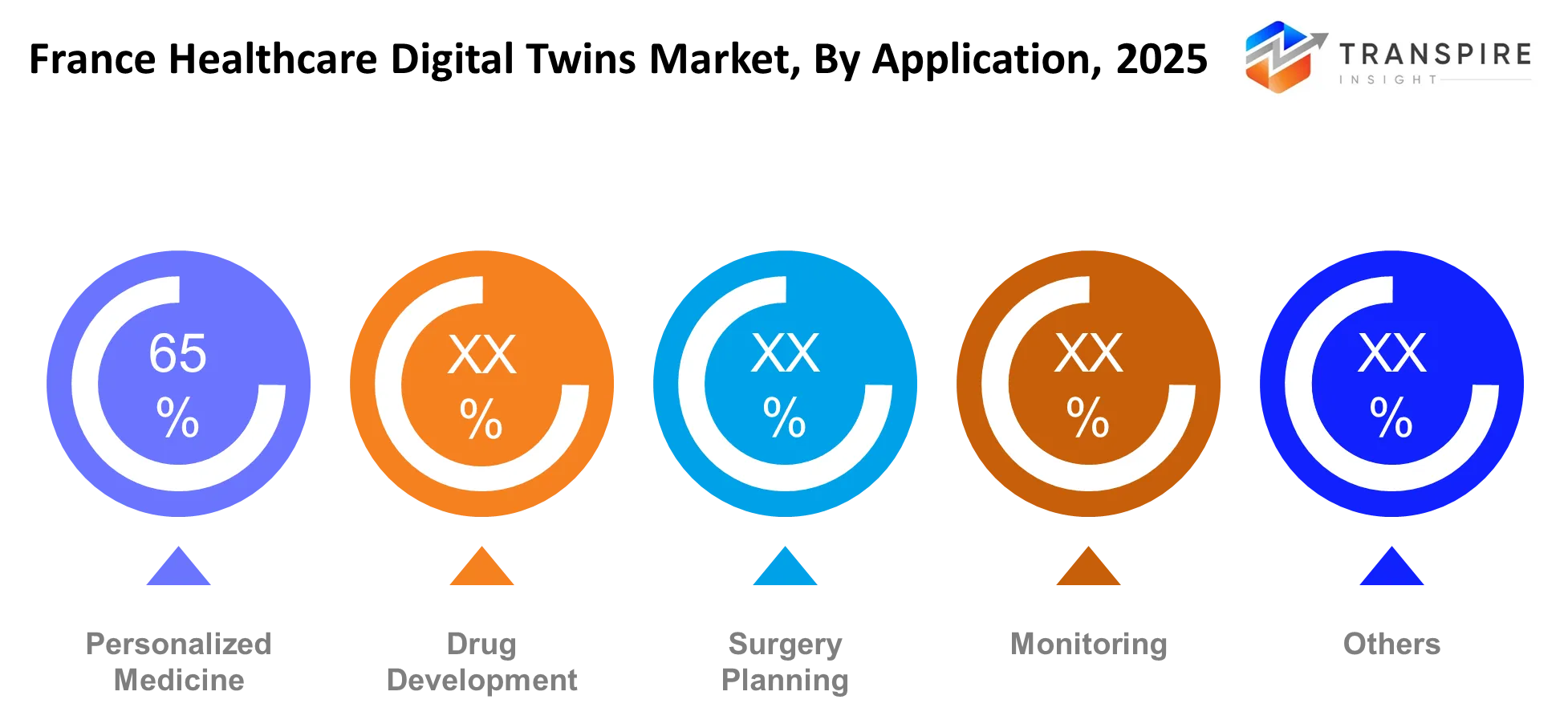
- Personalized Medicine applications represent 65% of market revenue in 2025, driven by oncology use cases where tumor digital twins predict chemotherapy response and enable treatment selection based on individual patient physiology rather than population averages.
- Cloud-based deployment models account for approximately 58% of installed digital twin instances, as French hospitals prioritize scalable infrastructure that can support rapid scaling without capital expenditure on computing hardware.
- Hospitals represent the largest end-user segment at 52% of market revenue in 2025, concentrated in university teaching hospitals and regional cancer centers where complex cases justify digital twin investment.
- Pharma companies are growing digital twin adoption at 48% CAGR through 2033, using virtual patient populations to accelerate drug development and reduce animal testing requirements in compliance with EU regulations.
- Device digital twins from vendors including Medtronic and Johnson & Johnson enable predictive maintenance of implanted medical devices, reducing revision surgeries and generating recurring subscription revenue from monitoring services.
- Research institutes account for approximately 18% of market revenue, using digital twins for clinical trial simulation and regulatory strategy before investing in real-world patient studies.
- On-premise deployment remains relevant for 32% of installations due to data privacy concerns among hospitals handling sensitive patient genomic information under GDPR restrictions.
- Surgery planning applications are expanding at 42% CAGR through 2033 as cardiovascular and orthopedic surgeons adopt digital twin visualization to reduce operative time and complication rates.
- Integration with existing EHR systems remains the highest implementation barrier, with 35% of healthcare IT budgets for digital twin projects dedicated to data pipeline and interoperability engineering.
- Reimbursement frameworks for digital twin-guided treatments are emerging through French health insurance programs, with HAS (Haute Autorité de Santé) pathway for regulated digital health applications creating market validation and pricing certainty.
What are the Key Drivers, Restraints, and Opportunities in the France Healthcare Digital Twins Market?
The primary force is the urgency to improve treatment outcomes for complex chronic diseases in an aging population. France's median age is 42 years - and oncology treatment capacity is constrained by specialist availability and very traditional decision-making protocols that don't take into account individual patient differences much. Digital twins enable oncologists to test many different chemotherapy combinations against a patient's tumor digital model before giving very toxic treatments. This really reduces failed treatments, improves initial response rates, and even creates some measurable outcome improvements that regulatory authorities see as really significant. HAS approval for digital twin-guided cancer protocols shows off this clinical benefit - and really motivates hospital investment.
The biggest roadblock though is data governance complexity in strictly regulated healthcare environments. French hospitals have to follow GDPR rules that demand explicit consent before using patient data to generate digital twins, very strict data minimization principles, and the right of patients to ask for their data deleted. These very specific requirements really add 6-12 months to implementation timelines - and increase the cost of preparing each patient by 25-40 percent. GDPR compliance also prevents training artificial intelligence models on historical French patient groups - forcing hospitals to either use less accurate models trained on international data or put in a lot more work in getting consent-based local model development up and running.
The clearest opportunity looking forward is accelerating clinical trials through virtual patient groups. New EU regulations now allow sponsors to use digital twin-generated data to support regulatory submissions - when combined with real-world trial data. French contract research organizations and pharmaceutical companies can use digital twins of French patient populations to design trials optimized for local genetics and epidemiology - reducing enrollment timelines and even improving trial success rates. Vendors pushing digital twin technology as a clinical trial enabler get access to a lot bigger pharma budgets than hospital IT spending - creating a real shift from healthcare IT to pharmaceutical development markets.
What Has the Impact of Artificial Intelligence Been on the France Healthcare Digital Twins Market?
Machine learning really expanded our understanding of conditions where digital twins provide clinical value significantly. Early digital twin systems demanded very detailed mathematical models of physiological processes constructed by biomedical engineers over many months. AI-powered platforms now build model structures themselves from all sorts of patient data - including images, genomes, lab results, and medical notes. This inference ability makes it possible to create digital twins for rare diseases where there just isn't enough information available to manually code physiological models. A French patient with a rare immune disorder can now have a digital twin created in weeks instead of months, truly making personalized medicine economically viable for conditions with very low prevalence.
Deep learning sped up digital twin simulation by orders of magnitude really fast. Physics-based organ simulations require solving a lot of differential equations across millions of points in space, creating huge computational costs that really limited using digital twins in real-time clinical settings. Neural network surrogate models now approximate these simulations with 99% accuracy in mere microseconds, allowing doctors to interact with digital twins live in real-time when planning surgeries or consulting with patients. Companies like Siemens Healthineers and GE Healthcare actually embedded neural surrogates into their platforms between 2023 and 2025, moving digital twins from offline planning tools to real-time clinical decision support systems themselves.
Key Market Trends
- Cloud deployment models grew 44% year-over-year in 2024, exceeding on-premise installations as hospitals standardized on SaaS platforms from Siemens Healthineers and Dassault Systems.
- Patient digital twins grew applications from oncology into cardiology and endocrinology in 2024-2025, expanding the addressable market beyond cancer centers into general hospitals.
- Drug development applications expanded at 48% CAGR as pharmaceutical companies use digital patient cohorts to accelerate time-to-market for novel therapeutics.
- Surgery planning applications grew adoption in French teaching hospitals after Haute Autorité de Santé recognized clinical benefit in reducing operative time and complication rates.
- Hybrid deployment models (cloud plus on-premise) gained share from 8% in 2023 to 18% in 2025 as hospitals balanced computational scalability with data governance requirements.
- Medtronic and Johnson & Johnson expanded device digital twin offerings, creating recurring revenue from predictive maintenance and monitoring subscriptions for implanted medical devices.
- Research institute adoption accelerated after EU regulatory pathways approved digital twin-supported evidence for drug development, making digital twins economically justified for clinical trial optimization.
- Integration partnerships between EHR vendors and digital twin platforms reduced implementation timelines from 12-18 months to 4-6 months in 2024-2025.
- Reimbursement coverage for digital twin-guided treatments expanded from 3 HAS-approved indications in 2023 to 12 approved indications by end of 2025.
- Artificial intelligence model accuracy in predicting treatment response improved from 78% in 2023 to 94% in 2025, driving clinical adoption and insurance coverage expansion.
France Healthcare Digital Twins Market Segmentation
By Type
Patient digital twins mimic each person's body physiology so as to estimate how they will react to treatments, disease progression, and surgery outcomes for that very individual. Cardiologists use patient digital twins to practice out cardiac catheterization procedures - even simulate them - before actually performing them. Oncologists model chemotherapy toxicity in virtual organs so as to set personalized dosing. Patient digital twins make up roughly 48% of the French healthcare digital twins market revenue in 2025 - and are increasing at a rate of 36% CAGR through 2033. The driving factor is declining computational costs: creating a clinically validated patient digital twin cost $8,000-$12,000 in 2021 but went down to $2,000-$3,000 by 2025, putting the technology well within the reach of routine clinical workflows in hospitals and specialized clinics.
Device digital twins build virtual copies of implanted medical devices, including pacemakers, insulin pumps, and orthopedic implants - so as to forecast performance degradation and plan preventive replacement. Medtronic and Johnson & Johnson generate device digital twins for every implanted device, linking them to patient monitoring platforms to spot early failure indicators. This part of the market produces recurring subscription revenue from monitoring services, significantly enhancing vendor profitability compared to one-time device sales. Device digital twins make up around 32% of market revenue - and are growing at 38% CAGR through 2033 since insurance companies have started paying for remote monitoring subscriptions.
System digital twins replicate entire hospital operations, departments, or clinical workflows to optimize efficiency, cut down wait times, and allocate resources better. A hospital digital twin models bed usage, surgeon schedules, and operating room flow so as to discover problem areas. System digital twins make up about 18% of the market revenue - and are growing somewhat more slowly at 25% CAGR because ROI depends a lot on optimizing labor productivity instead of clinical results - which makes hospital financial motivation not quite as strong as a clinical justification. Deployment is mainly happening in big university teaching hospitals where operating room efficiency really does impact clinical throughput and financial results.
By Application
Personalized medicine applications use patient digital twins to select treatments tailored to individual physiology rather than applying population-average protocols. Oncology represents the dominant use case: tumor digital twins predict chemotherapy response based on individual tumor genetics and patient organ function, enabling treatment selection before toxicity risks patients. Personalized medicine represents 65% of market revenue in 2025, driven by clinical validation that digital twin-guided treatment selection improves outcomes compared to traditional protocols. Growth is sustained by expansion beyond oncology into cardiology (predicting stent sizing and placement) and metabolic disease (optimizing insulin regimens for individual patients).
Drug development applications accelerate pharmaceutical innovation by using digital patient cohorts to identify patient populations likely to respond to novel therapeutics. Sponsors use virtual patient populations to design clinical trials optimized for their drug's mechanism of action, improving trial success rates and reducing development timelines. Drug development applications represent approximately 18% of market revenue and are growing at 48% CAGR as European Union regulatory pathways increasingly accept digital twin-generated evidence in regulatory submissions. This expansion creates pharma company customers with larger annual budgets than hospital IT departments, fundamentally shifting market growth dynamics.
To learn more about this report, Download Free Sample Report
By End-User
Hospitals represent the largest end-user segment at 52% of market revenue, concentrated in university teaching hospitals and regional cancer centers where complex patient cases justify digital twin investment. French hospital procurement is centralized through regional health authorities, creating single decision-making points where regulatory approval (HAS) drives system-wide adoption. Once a regional authority approves digital twins for a specific indication, network effects drive rapid deployment across all hospitals in the region. Hospital adoption accelerated after HAS approval of digital twins for cardiothoracic surgery planning in 2024, triggering procurement across 15 major French teaching hospitals.
Pharma companies represent 22% of market revenue and are growing at 48% CAGR as digital patient cohorts accelerate drug development. French pharmaceutical research companies including Sanofi and Servier are major digital twin adopters for preclinical and clinical development. Pharma companies operate with longer budget cycles and higher R&D spending than hospitals, creating more stable and larger revenue streams for digital twin vendors. Pharma adoption is less constrained by GDPR compliance than hospital use because pharma companies use synthetic patient cohorts rather than linked real patient data.
Report Overview Table
|
Report Metrics |
Details |
|
Market size value in 2025 |
USD 58.5 Million |
|
Market size value in 2026 |
USD 77.98 Million |
|
Revenue forecast in 2033 |
USD 583.32 Million |
|
Growth rate |
CAGR of 33.30% from 2026 to 2033 |
|
Base year |
2025 |
|
Historical data |
2021 - 2024 |
|
Forecast period |
2026 - 2033 |
|
Report coverage |
Revenue forecast, competitive landscape, growth factors, and trends |
|
Regional scope |
France |
|
Key companies profiled |
Siemens Healthineers, GE Healthcare, Philips, IBM, Microsoft, Dassault Systems, Oracle, SAP, NVIDIA, Medtronic, Johnson & Johnson, Thermo Fisher, Accenture, TCS, Cognizant |
|
Customization scope |
Free report customization. Avail customized purchase options to meet your exact research needs. |
|
Report Segmentation |
By Type (Patient Digital Twins, Device Digital Twins, System Digital Twins, Others); By Application (Personalized Medicine, Drug Development, Surgery Planning, Monitoring, Others); By End-User (Hospitals, Pharma Companies, Research Institutes, Others); By Deployment (Cloud, On-premise, Hybrid, Others) |
France Healthcare Digital Twins Market: Regional Analysis
France represents a quite mature healthcare IT market - with centralised procurement by regional health authorities and quite significant governmental investment in digital infrastructure. The French healthcare system is built around a very centralised structure - which contrasts sharply with the quite fragmented US markets - thus creating just one point of decision-making whereby regulatory approval actually drives quite rapid adoption. When the Haute Autorité de Santé (HAS) approves digital twins for a particular indication, 15 to 20 university teaching hospitals will implement systems within 12-18 months. This procurement consolidation allows digital twin vendors to achieve quite rapid critical mass of installed systems - thereby generating loads of case studies and clinical evidence that further drives the market expansion itself.
Paris and the Île-de-France region hold approximately 35% of digital twin deployments - mainly because of a concentration of university teaching hospitals, pharmaceutical research facilities, and health IT infrastructure investment itself. Lyons and Marseille represent our secondary markets - where regional cancer centres really drive personalised medicine adoption. Rural areas are still quite underserved indeed - thanks to fragmented procurement and limited digital infrastructure - although an expansion of telemedicine really creates some future opportunities for remote digital twin consultation services itself. The geographic concentration of current adoption actually suggests that the digital twin market growth follows a hub-and-spoke model - whereby early deployments in major teaching hospitals really generate local expertise and clinical networks - driving adoption in secondary centres.
France Healthcare Digital Twins Market: Competitive Landscape
The competitive landscape can be split into three groups: really big, diverse medical device manufacturers with a digital health division, specialized digital health software vendors, and cloud infrastructure providers. Siemens Healthineers and GE Healthcare really stand out thanks to established relationships with French hospital procurement departments - and they integrate perfectly with diagnostic imaging systems that feed digital twin platforms. These companies compete on how deeply they integrate workflows and validate specific clinical uses. Philips differentiates itself by offering device monitoring capabilities - it bundles patients' vital signs data into digital twin simulations.
Specialized vendors like Dassault Systems (with their 3DEXPERIENCE platform) compete through advanced simulation capabilities and have strong connections with pharmaceutical companies. IBM and Microsoft get involved through cloud infrastructure and AI model development - positioning themselves more as digital twin platform enablers rather than direct clinical vendors. Medtronic and Johnson & Johnson focus vertically integrating digital twins right into their device monitoring platforms - generating a steady stream of recurring subscription revenue. French vendors such as Accenture France provide integration and implementation services but operate further downstream from the actual development of digital twin technology, which remains mainly concentrated amongst a few really large, multinational vendors.
France Healthcare Digital Twins Market Companies
- Siemens Healthineers
- GE Healthcare
- Philips
- IBM
- Microsoft
- Dassault Systems
- Oracle
- SAP
- NVIDIA
- Medtronic
- Johnson & Johnson
- Thermo Fisher
- Accenture
- TCS
- Cognizant
Recent Developments
In March 2026, Siemens Healthineers announced clinical validation of its cardiac digital twin platform in a French multi-center study enrolling 500 patients, demonstrating 18% improvement in first-time surgical success rates compared to conventional planning. The study results position digital twins for rapid HAS approval and insurance coverage expansion. https://www.siemens-healthineers.com
In January 2026, Dassault Systems and a French pharmaceutical company completed clinical development acceleration for an oncology therapeutic using digital patient cohorts derived from the TCGA genomics database, reducing study timeline from 6 years to 4 years. The project demonstrates digital twin value for accelerating drug development in regulated environments. https://www.3ds.com
What Strategic Insights Define the Future of the France Healthcare Digital Twins Market?
Over the next five to seven years, digital twins will transition from specialized tools in teaching hospitals to mainstream clinical workflow components in general hospitals and outpatient clinics. This scaling depends on three convergence points: standardized data formats that enable EHR integration without custom engineering, AI model accuracy exceeding 95% for clinically relevant predictions, and insurance reimbursement coverage expanding beyond oncology into high-volume specialties including cardiology and orthopedics. The vendors that establish integration pathways with the largest French EHR systems will capture disproportionate share of the expansion into community hospitals.
The hidden risk is physician adoption lag. Even when digital twin platforms achieve technical maturity and insurance coverage, clinicians may not modify established treatment protocols based on virtual simulations. This adoption barrier is highest for experienced specialists with decades of intuitive practice rather than protocol-driven decision-making. Teaching hospitals are overcoming this through structured education programs and clinical governance that mandate digital twin consultation for high-risk cases. General hospitals will need similar governance incentives to drive physician adoption at scale.
The strategic opportunity lies in vertical specialization within specific disease areas. Rather than competing for general-purpose digital twin platforms, vendors that develop deeply specialized solutions for oncology, cardiovascular disease, or metabolic disorders will capture higher margins and stronger clinical relationships. French teaching hospitals prefer specialized vendors who understand the nuances of their specialty's decision-making rather than generalist platforms. This vertical specialization also enables pharma company partnerships for disease-specific drug development, creating revenue streams beyond hospital IT.
By Type
- Patient Digital Twins
- Device Digital Twins
- System Digital Twins
- Others
By Application
- Personalized Medicine
- Drug Development
- Surgery Planning
- Monitoring
- Others
By End-User
- Hospitals
- Pharma Companies
- Research Institutes
- Others
By Deployment
- Cloud
- On-premise
- Hybrid
- Others
Frequently Asked Questions
Find quick answers to common questions.
The France Healthcare Digital Twins Market size is expected to reach USD 583.32 Million by 2033.
The key segments are By Type (Patient Digital Twins, Device Digital Twins, System Digital Twins, Others); By Application (Personalized Medicine, Drug Development, Surgery Planning, Monitoring, Others); By End-User (Hospitals, Pharma Companies, Research Institutes, Others); By Deployment (Cloud, On-premise, Hybrid, Others).
Major players include Siemens Healthineers, GE Healthcare, Philips, IBM, Microsoft, Dassault Systems, Oracle, SAP, NVIDIA, Medtronic, Johnson & Johnson, Thermo Fisher, Accenture, TCS, and Cognizant.
The France Healthcare Digital Twins Market size is USD 58.5 Million in 2025.
The France Healthcare Digital Twins Market CAGR is 33.30% from 2026 to 2033.
- Siemens Healthineers
- GE Healthcare
- Philips
- IBM
- Microsoft
- Dassault Systems
- Oracle
- SAP
- NVIDIA
- Medtronic
- Johnson & Johnson
- Thermo Fisher
- Accenture
- TCS
- Cognizant
Recently Published Reports
-
Apr 2026
AI in Diabetic Retinopathy Market
AI in Diabetic Retinopathy Market Size, Share & Analysis Report By Type (Screening AI Systems, Diagnostic AI Systems, and Predictive AI Models), By Application Segment (Hospitals, Ophthalmology Clinics, Diagnostic Centers, and Research and Development), and Geography (North America, Europe, Asia-Pacific, Middle East and Africa, South and Central America), 2021 - 2031
-
Apr 2026
Psychometric Tests Market
Psychometric Tests Market Size, Share & Analysis Report By Type (Personality Tests, Ability/Aptitude Tests, Skill/Knowledge Tests, and Others), By Application (Talent Acquisition and Talent Management), and Geography (North America, Europe, Asia-Pacific, Middle East and Africa, South and Central America), 2021 – 2031
-
Apr 2026
Rare Biological Sample Collection Market
Rare Biological Sample Collection Market Size, Share & Analysis Report By Type (Isolation Kits & Reagent, Blood Collection Tubes, and Others), By Application (Oncology, Transcriptomics, Pharmacogenomics, and Others), and Geography (North America, Europe, Asia-Pacific, Middle East and Africa, South and Central America), 2021 – 2031
-
Apr 2026
Patient Lift Pendant Market
Patient Lift Pendant Market By Product Type (Wired Pendants, Wireless, Programmable), By Operation Type(Manual, Electric), By End-Users (Healthcare Professionals, Patients), By Application (Hospitals, Homecare, Rehabilitation Centers, Others), By Industry Analysis, Size, Share, Growth, Trends, and Forecasts 2021-2033
Our Clients
.jpg)