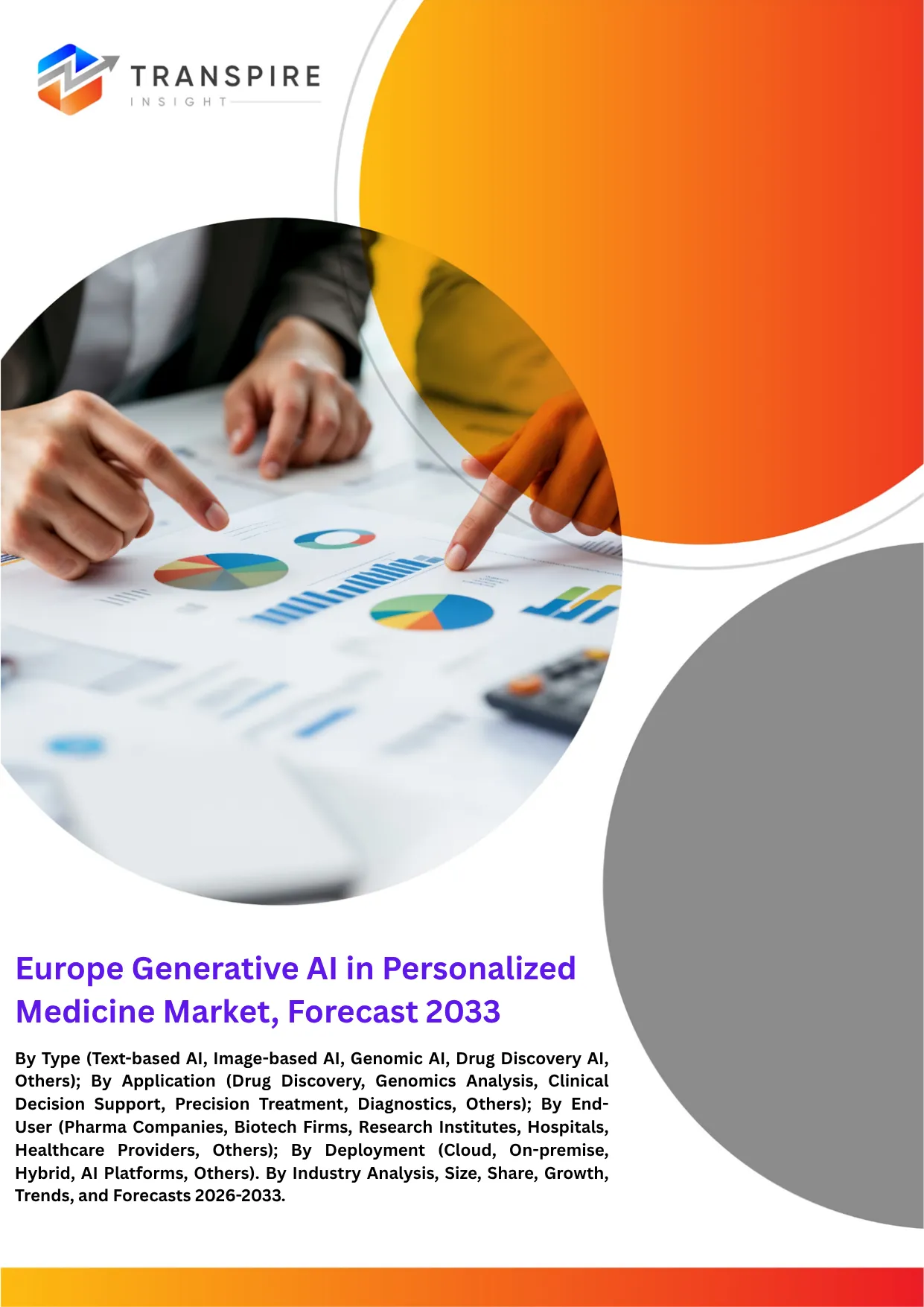
Europe Generative AI in Personalized Medicine Market Size & Forecast:
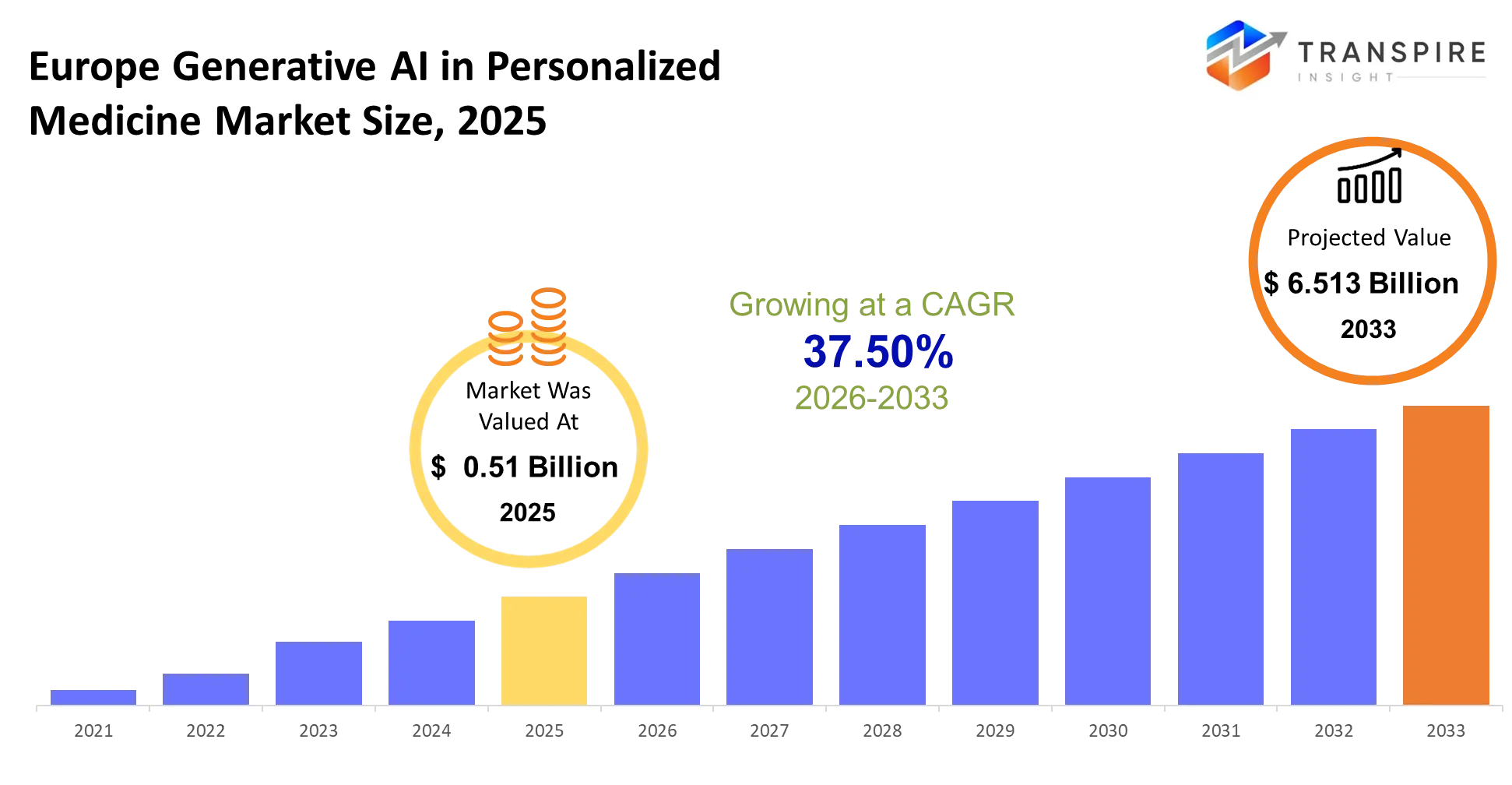
- Europe Generative AI in Personalized Medicine Market Size 2025: USD 0.51 Billion
- Europe Generative AI in Personalized Medicine Market Size 2033: USD 6.513 Billion
- Europe Generative AI in Personalized Medicine Market CAGR: 37.50%
- Europe Generative AI in Personalized Medicine Market Segments: By Type (Text-based AI, Image-based AI, Genomic AI, Drug Discovery AI, Others); By Application (Drug Discovery, Genomics Analysis, Clinical Decision Support, Precision Treatment, Diagnostics, Others); By End-User (Pharma Companies, Biotech Firms, Research Institutes, Hospitals, Healthcare Providers, Others); By Deployment (Cloud, On-premise, Hybrid, AI Platforms, Others)
To learn more about this report,  Download Free Sample Report
Europe Generative AI in Personalized Medicine Market Summary:
The Europe Generative AI in Personalized Medicine Market size is estimated at USD 0.51 Billion in 2025 and is anticipated to reach USD 6.513 Billion by 2033, growing at a CAGR of 37.50% from 2026 to 2033. The European generative AI market for personalized medicine operates at the boundary between healthcare and advanced computing systems which use data-driven methodologies to create customized medical treatments for individual patients. The system will use genomic sequencing information together with clinical records and continuous health monitoring data to create customized health solutions. European patients will demand treatments that match their biological characteristics while doctors will depend on systems that process complex data sets more efficiently than conventional approaches. The technology will continue to advance through ongoing research which uses various European datasets to create models that enhance accuracy for different population groups. The establishment of more stringent data protection regulations together with ethical standards will determine how organizations develop and implement their solutions. The process of establishing user trust depends on maintaining a balance between new innovations and existing regulations because users want both transparent information and exact details.
What Has the Impact of Artificial Intelligence Been on the Europe Generative AI in Personalized Medicine Market?
The European generative A1 market for personalized medicine has experienced a fast transformation because artificial intelligence now enables medical professionals to convert data into usable clinical information at an unprecedented speed. European generative AI systems used in the personalized medicine market will enable efficient market research through their ability to analyze extensive genomic data and clinical trial information and patient medical histories with accurate results. The system will enhance predictive analytics which enables stakeholders to forecast treatment requirements and discover new medicinal developments and optimize their research activities. The evolution of artificial intelligence systems in the European generative AI market for personalized medicine will result in decision-making processes that depend on concrete evidence which will help reduce uncertainty throughout the entire healthcare innovation process.
The Europe generative AI market for personalized medicine will achieve its operational goals through the implementation of smart automation systems and machine learning models which will improve efficiency in drug discovery and development processes. The combination of AI-powered simulations and automated data processing systems will enable organizations to conduct experiments more quickly while decreasing their need for human data processing and diagnostic work. AI systems will optimize supply chain operations through their ability to predict demand for personalized treatments which will result in decreased waste and reduced operational expenses. The advancements will enable organizations in the European generative A1 market for personalized medicine to deliver quicker responses to individual patient requirements.
In addition to efficiency, the use of artificial intelligence in personalized medicine in the Europe market of Generative AI has the potential to deliver unprecedented levels of customization and competitive advantage. The integration of multi-dimensional data for patients will enable personalized treatment routes for improved results and satisfaction, resulting in a significant change in how services are delivered.
Key Market Trends & Insights:
- The Europe generative AI in personalized medicine market in Western Europe is dominant with over 45% market share in 2025 due to robust healthcare facilities and AI penetration.
- The Northern Europe region will experience the highest growth, and this is due to investments made in digital health solutions.
- AI software platforms will account for over 50% of the market share in 2025 due to increased use of predictive analytics and clinical decision support systems.
- Data services and analysis solutions follow, accounting for the second-highest revenue share, which is crucial for interpreting the genome and patient data integration.
- Drug discovery tools enabled by generative AI are estimated to be the fastest-growing applications, likely to increase exponentially between 2026-2030 on account of increased investments in R&D.
- Oncology applications lead the way with nearly 40% market share due to the role played by AI in designing personalized treatment options for cancers.
- Identification of rare diseases represents the fastest-growing application, mainly attributed to the growing demand for personalized treatment options for patients suffering from rare diseases.
- Pharmaceutical companies are anticipated to lead the Europe generative AI in personalized medicine market with over 55% share attributable to AI applications.
Europe Generative AI in Personalized Medicine Market Segmentation
By Type
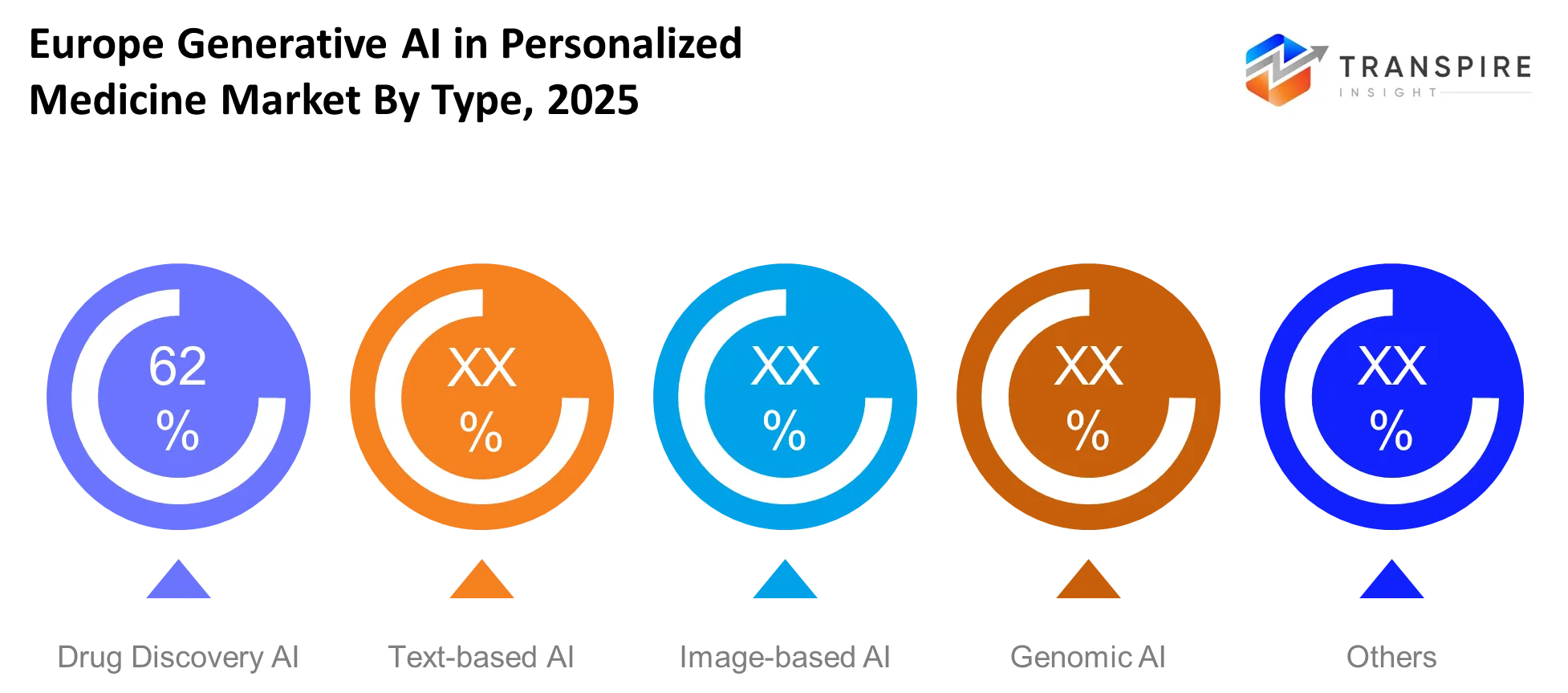
The text-based AI will be concentrated on interpretation of clinical notes, patient history, and literature, so that the information provided is enough for making decisions. The image-based AI will improve medical imagery by making diagnosis easier, quicker, and more precise via scans and other means. The genomic AI will work to analyze complicated genome data to find the correlations between specific gene structures and diseases or treatments.
All three types will operate on a different level of personalization to build an efficient system. The implementation of technology will largely depend on having well-structured data and its seamless integration into existing health systems. The constant improvement of the model training process will allow increasing precision regardless of the patient. The market demands will evolve towards using all three types simultaneously.
To learn more about this report, Download Free Sample Report
By Application
The drug development process is likely to be greatly helped by the speedy determination of the potentiality of compounds in the process of drug discovery, thus saving much time in the early stages of research. Analysis of genomics would allow for a greater understanding of genetic diversity, which would help formulate targeted treatments.
Diagnostics would benefit from early detection and accurate categorization of diseases, which can be done effectively through the use of superior algorithms. Other possible applications would include monitoring patients and determining their risks. Increased demand will result from the desire to obtain more favorable outcomes while minimizing uncertainties.
By End-User
The pharmaceutical organizations will employ such sophisticated technology systems that will enable them to develop improved drug discovery pipelines, as well as cut down research times. The biotechnology firms will employ these tools to come up with innovations in their processes of genetic testing and targeted therapy solutions. The research institutions will also adopt these tools in their research work and clinical trials.
This will help the healthcare organizations to offer better and more efficient health care services to their clients through the personalization of medical treatments. Other players who will take part in the adoption of these tools will be specialized laboratories and diagnostic facilities.
By Deployment
Cloud deployment would give scalability and easy access to better computer facilities for hospitals. On-premises deployment would give better control of patients' personal information and enable compliance with stringent rules and regulations. Hybrids of cloud and on-premises deployment would have both advantages, that is, flexibility and security in equal measures. This AI system will create a comprehensive platform for developing and deploying the applications.
In the future, new methods can come about for deploying because technology will evolve and bring new demands from customers. Organizations would consider factors such as costs, data protection, and business processes when selecting a suitable deployment technique. Improvements in IT infrastructures would help integrate these technologies into health care institutions.
What are the Main Challenges for the Europe Generative AI in Personalized Medicine Market Growth?
The Europe generative AI in personalized medicine market faces technical and operational difficulties that prevent systems from achieving their full capacity and operating at uniform efficiency. AI models face difficulties in rendering accurate clinical results because healthcare data exists in disorganized and incomplete forms. The process becomes more difficult because hospitals need to link their current systems with new technologies which extends the time required for implementation. The European generative AI in personalized medicine market faces implementation challenges because of data standardization problems and platform interoperability restrictions which make it difficult to achieve smooth operational flow.
The Europe generative AI in personalized medicine market faces hurdles from manufacturing and commercialization barriers because European countries have established strict regulatory requirements. The requirements for data protection and medical compliance force companies to spend additional resources which results in extended timeframes for product development. Companies must dedicate significant resources to validation and testing and certification activities which results in delayed time to market for their products. The market restrictions create financial challenges for smaller businesses which need to develop new products in the Europe generative AI in personalized medicine market.
The issue of adoption is one that poses significant challenges, considering that the healthcare providers may not necessarily have the necessary resources and trained personnel to facilitate effective use of such advanced technology. The other hindrance to adoption is the limited budget for the technology, as well as varying degrees of digital maturity in different regions, thus limiting market penetration. The reluctance of doctors to change their ways of doing things can further pose a challenge in adopting the new technology.
Regional Insights
The process of algorithm improvement will result in better decision-making capabilities for both diagnosis and therapy selection processes. The rising requirement for precise medical treatment will drive healthcare organizations to implement these systems. The design and integration of systems will be shaped by data privacy regulations. The future market stability and trust relationships will depend on strong partnerships between technology vendors and medical facilities.
Different patient care activities and research research processes will require specific contributions from each type of resource. Improvement of system adoption will occur when healthcare systems achieve better integration among their various components. The use of these technologies together will lead to better operational performance. The ongoing research efforts will enhance system accuracy for various clinical situations and different types of medical data.
Healthcare providers will aim to deliver more personalized care with improved patient outcomes. Laboratories and diagnostic centers will become additional users who need to extend their operational capabilities. The groups will work together to create better innovative solutions. The adoption process will depend on two factors: the state of existing infrastructure and the requirements set by regulatory bodies.
Western European countries will establish leadership because they possess advanced healthcare systems and they started using new technologies. Germany, France, and the United Kingdom will allocate funds for healthcare solutions which use data to drive their operations. The government will support research and development through policy initiatives and funding programs.
Northern Europe will demonstrate rapid development because of its established digital health systems and its regulatory framework which supports innovation. The Southern and Eastern regions will experience gradual adoption growth as their infrastructure develops and investment progresses. Different adoption speeds will create distinct growth patterns across different regions. International partnerships will help create a wider market for development.
Recent Development News
In April 2026, Boehringer Ingelheim launched an artificial intelligence research center. The initiative will strengthen AI-driven drug development capabilities and streamline clinical trial processes in Europe.
In March 2026, Insilico Medicine announced a global licensing and research collaboration with Eli Lilly. The deal, valued up to $2.75 billion, will advance AI-driven drug candidates for commercialization.
|
Report Metrics |
Details |
|
Market size value in 2025 |
USD 0.51 Billion |
|
Market size value in 2026 |
USD 0.701 Billion |
|
Revenue forecast in 2033 |
USD 6.513 Billion |
|
Growth rate |
CAGR of 37.50% from 2026 to 2033 |
|
Base year |
2025 |
|
Historical data |
2021 - 2024 |
|
Forecast period |
2026 - 2033 |
|
Report coverage |
Revenue forecast, competitive landscape, growth factors, and trends |
|
Regional scope |
Europe (Germany, United Kingdom, France, Italy, Spain, Rest of Europe) |
|
Key company profiled |
OpenAI, Google, Microsoft, IBM, NVIDIA, Tempus, Insilico Medicine, Recursion Pharma, BenevolentAI, DeepMind, BioNTech, Roche, Novartis, AstraZeneca, Illumina |
|
Customization scope |
Free report customization (country, regional & segment scope). Avail customized purchase options to meet your exact research needs. |
|
Report Segmentation |
By Type (Text-based AI, Image-based AI, Genomic AI, Drug Discovery AI, Others); By Application (Drug Discovery, Genomics Analysis, Clinical Decision Support, Precision Treatment, Diagnostics, Others); By End-User (Pharma Companies, Biotech Firms, Research Institutes, Hospitals, Healthcare Providers, Others); By Deployment (Cloud, On-premise, Hybrid, AI Platforms, Others) |
How Can New Companies Establish a Strong Foothold in the Europe Generative AI in Personalized Medicine Market?
To gain an early position in the Europe generative AI in personalized medicine market, new entrants should focus on areas that have high barriers to entry due to complex data. Concentration on areas such as diagnosis of rare diseases and optimizing therapies for better outcomes will enable organizations to establish a niche in the Europe generative AI in personalized medicine market. The trend of precision and measurable benefits is in line with the current market dynamics, and startups with a tool that helps in integrating data from the entire healthcare system would find an opportunity in this sector.
The development and deployment of innovative solutions will form a key element for success, especially through the use of advanced machine learning algorithms that offer explainability. Differentiation in terms of technology to gain clinical trust and regulatory acceptance is important. In addition, alliances with hospitals, research institutions, and pharmaceutical companies will help in establishing credibility in this market. New organizations such as Owkin and BenevolentAI provide a good illustration of how to do this.
For the sustainability of their operations, it is imperative for the start-ups to allocate their resources on the development of a scalable infrastructure and cloud-based systems that can provide continuous learning from patient data. The solution for the lack of workforce can be attained by introducing an easy-to-use interface with automation tools. With appropriate alignment and compliance, the barriers of entry can be lowered.
Key Europe Generative AI in Personalized Medicine Market Company Insights
The Europe generative AI market for personalized medicine will create a specialized area where advanced data models will enable personalized treatment solutions based on clinical and genetic data. The growth of the market will depend on three factors which include the precision of the product and its ability to connect with other systems and its compliance with regulatory standards in various healthcare settings. The need for precise medical care will determine which developments the organization will pursue.
The medical field will move towards treatment methods that rely on data analysis combined with advanced technological systems. The implementation process will follow ethical standards together with data protection regulations that differ between countries. The technology providers will enhance their products to achieve better performance and greater acceptance by medical professionals. Organizations need to establish trust between their parties and create transparent systems while demonstrating their ability to produce measurable patient results.
The field of diagnostics will gain advantages from both early disease detection and enhanced capabilities to identify different types of medical conditions. The other applications will develop monitoring systems which focus on preventive health maintenance. The combination of different applications will enable organizations to operate their workflows in a more efficient manner. The healthcare industry will adopt data-driven solutions because organizations increasingly depend on evidence-based information.
Healthcare organizations will use data to make informed choices which will lead to better patient care. Diagnostic laboratories and various other users will increase their capacity to offer services. The process of innovation will benefit from active collaboration among all involved parties. The process of adoption will depend on two main factors which include the state of infrastructure systems and the adherence to regulatory requirements.
The different methods of deployment will change as technology progresses and organizations need different solutions. Organizations need to select operational models that match their financial requirements and performance targets. The process of integrating new technology with current systems will continue to hold significant value. Organizations will choose their deployment methods because these choices will affect their operational efficiency and their ability to use the system over time.
Company List
- OpenAI
- Microsoft
- IBM
- NVIDIA
- Tempus
- Insilico Medicine
- Recursion Pharma
- BenevolentAI
- DeepMind
- BioNTech
- Roche
- Novartis
- AstraZeneca
- Illumina
What are the Key Use-Cases Driving the Growth of the Europe Generative AI in Personalized Medicine Market?
The Europe generative AI in personalized medicine market is experiencing an upsurge owing to the successful application of use-cases that help to enhance both the quality of care provided and its efficiency. For instance, one of the most useful applications of this technology is drug discovery, which involves the use of machine learning models to mine biological datasets in order to find the most promising molecules. By doing so, it becomes possible to speed up drug development and reduce the costs of innovation.
A further example of a use-case that is boosting growth within the Europe generative AI in personalized medicine market is clinical decision support, which helps to improve both the precision and efficiency of medical diagnostics and treatment planning. Moreover, thanks to the advances made in genomics analysis, it is now possible to tailor the treatment to the unique traits of each patient. Finally, the diagnostics market itself is evolving due to the introduction of innovations based on the application of generative AI technologies.
In addition to its primary applications in the healthcare industry, the enterprise-grade integration of AI in Europe generative AI in personalized medicine market has opened up new avenues for development. Companies in the pharmaceutical sector are leveraging simulations powered by AI to streamline their clinical trials process, while digital health service providers are incorporating personalized insights into their patient engagement journey.
Europe Generative AI in Personalized Medicine Market Report Segmentation
By Type
- Text-based AI
- Image-based AI
- Genomic AI
- Drug Discovery AI
- Others
By Application
- Drug Discovery
- Genomics Analysis
- Clinical Decision Support
- Precision Treatment
- Diagnostics
- Others
By End-User
- Pharma Companies
- Biotech Firms
- Research Institutes
- Hospitals
- Healthcare Providers
- Others
By Deployment
- Cloud
- On-premise
- Hybrid
- AI Platforms
- Others
Frequently Asked Questions
Find quick answers to common questions.
The approximate Europe Generative AI in Personalized Medicine Market size for the market will be USD 6.513 Billion in 2033.
Key segments for the Europe Generative AI in Personalized Medicine Market are By Type (Text-based AI, Image-based AI, Genomic AI, Drug Discovery AI, Others); By Application (Drug Discovery, Genomics Analysis, Clinical Decision Support, Precision Treatment, Diagnostics, Others); By End-User (Pharma Companies, Biotech Firms, Research Institutes, Hospitals, Healthcare Providers, Others); By Deployment (Cloud, On-premise, Hybrid, AI Platforms, Others).
Major Europe Generative AI in Personalized Medicine Market players are OpenAI, Google, Microsoft, IBM, NVIDIA, Tempus, Insilico Medicine, Recursion Pharma, BenevolentAI, DeepMind, BioNTech, Roche, Novartis, AstraZeneca, Illumina.
The Europe Generative AI in Personalized Medicine Market size is USD 0.51 Billion in 2025.
The Europe Generative AI in Personalized Medicine Market CAGR is 37.50%.
- OpenAI
- Microsoft
- IBM
- NVIDIA
- Tempus
- Insilico Medicine
- Recursion Pharma
- BenevolentAI
- DeepMind
- BioNTech
- Roche
- Novartis
- AstraZeneca
- Illumina
Recently Published Reports
-
Apr 2026
AI in Diabetic Retinopathy Market
AI in Diabetic Retinopathy Market Size, Share & Analysis Report By Type (Screening AI Systems, Diagnostic AI Systems, and Predictive AI Models), By Application Segment (Hospitals, Ophthalmology Clinics, Diagnostic Centers, and Research and Development), and Geography (North America, Europe, Asia-Pacific, Middle East and Africa, South and Central America), 2021 - 2031
-
Apr 2026
Psychometric Tests Market
Psychometric Tests Market Size, Share & Analysis Report By Type (Personality Tests, Ability/Aptitude Tests, Skill/Knowledge Tests, and Others), By Application (Talent Acquisition and Talent Management), and Geography (North America, Europe, Asia-Pacific, Middle East and Africa, South and Central America), 2021 – 2031
-
Apr 2026
Rare Biological Sample Collection Market
Rare Biological Sample Collection Market Size, Share & Analysis Report By Type (Isolation Kits & Reagent, Blood Collection Tubes, and Others), By Application (Oncology, Transcriptomics, Pharmacogenomics, and Others), and Geography (North America, Europe, Asia-Pacific, Middle East and Africa, South and Central America), 2021 – 2031
-
Apr 2026
Patient Lift Pendant Market
Patient Lift Pendant Market By Product Type (Wired Pendants, Wireless, Programmable), By Operation Type(Manual, Electric), By End-Users (Healthcare Professionals, Patients), By Application (Hospitals, Homecare, Rehabilitation Centers, Others), By Industry Analysis, Size, Share, Growth, Trends, and Forecasts 2021-2033
Our Clients
.jpg)