Japan Healthcare Digital Twins Market Size & Forecast:
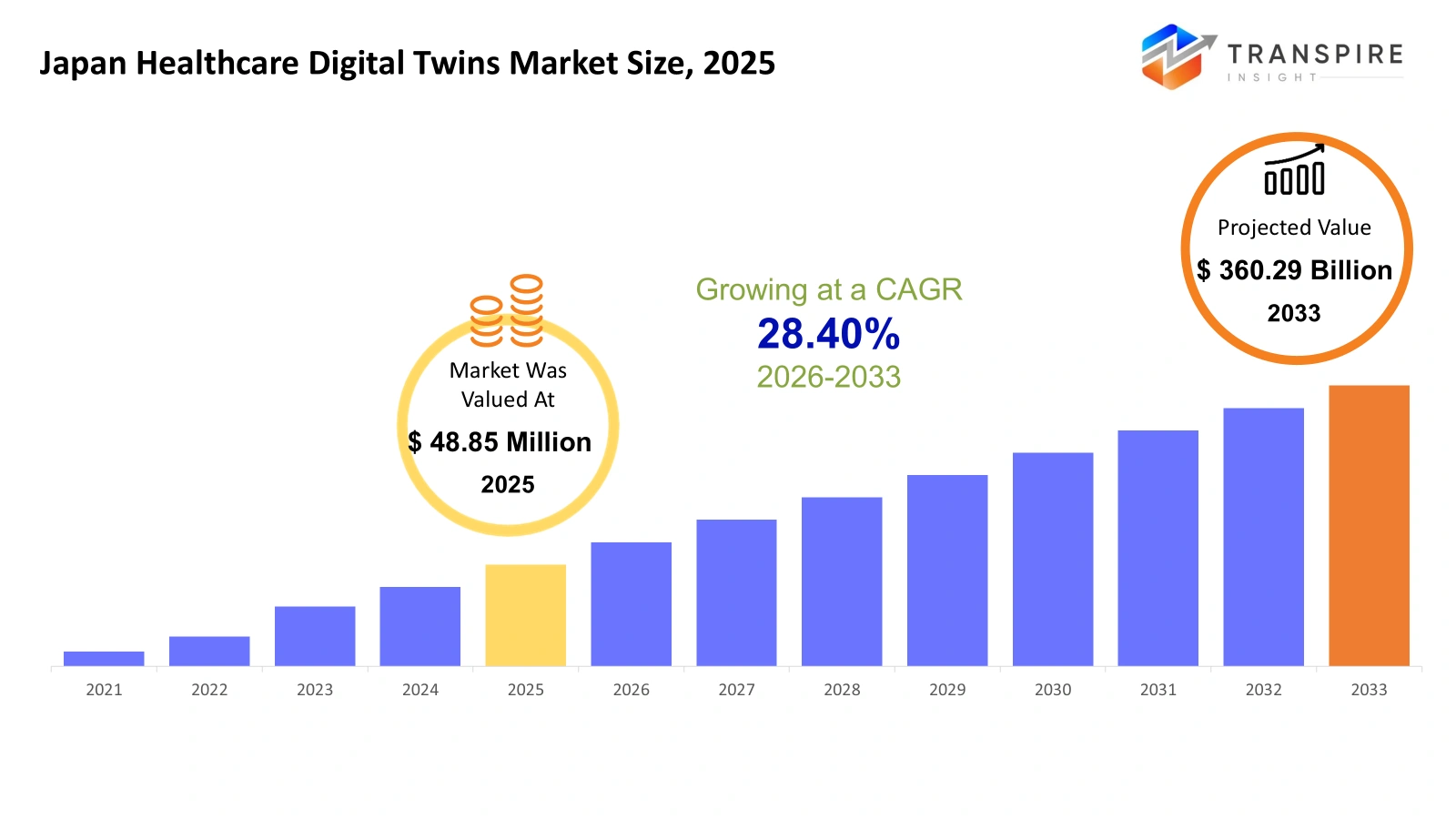
- Japan Healthcare Digital Twins Market Size 2025: USD 48.85 Million
- Japan Healthcare Digital Twins Market Size 2033: USD 360.29 Million
- Japan Healthcare Digital Twins Market CAGR: 28.40%
- Japan Healthcare Digital Twins Market Segments:By Component (Software, Hardware, Services), By Application (Personalized Medicine, Hospital Operations Management, Drug Discovery), By End User (Hospitals, Research Institutes, Pharmaceutical Companies).
To learn more about this report,  Download Free Sample Report
Japan Healthcare Digital Twins Market Summary:
The Japan Healthcare Digital Twins Market size is estimated at USD 48.85 Million in 2025 and is anticipated to reach USD 360.29 Million by 2033, growing at a CAGR of 28.40% from 2026 to 2033. The Japan Healthcare Digital Twins Market is experiencing rapid expansion as hospitals and research institutions implement advanced digital simulations to improve patient treatment methods. Healthcare providers use virtual patient replicas to forecast treatment outcomes and develop customised treatment plans while improving operational performance. The market experiences growth because organisations are increasing their funding for artificial intelligence and Internet of Things and data analytics solutions. The Japanese healthcare system establishes itself as a leader in digital health technology through its commitment to precision medicine, thereby enhancing patient safety and treatment outcomes.
Key Market Trends & Insights:
- The usage of personalised medicine is increasing among healthcare providers throughout Japan. Digital twins enable Japanese healthcare providers to develop individualised patient models which support the creation of precise treatment strategies and enhance their ability to forecast how patients will react to treatment.
- The combination of artificial intelligence together with Internet of Things devices enables medical professionals to track their patients' vital signs in real time, which creates digital twin systems that predict future medical results and determine optimal treatment methods.
- Digital twins enable hospitals to identify upcoming medical dangers, which helps them maintain patient safety while establishing better methods for early diagnosis, which leads to improved outcomes throughout patient treatment.
- Digital twins create virtual hospital environments which enable administrators to test different operational methods while assessing their financial impact and patient care efficiency.
- The development of digital health systems in Japan receives funding from both government programmes and private organisations, which creates strong digital twin platforms that enable rapid progress in healthcare delivery systems across the country.
- Digital twin systems enable researchers to conduct virtual experiments with new drugs and treatment methods, which helps them decrease research expenses while achieving faster results in finding effective medical solutions.
Japan Healthcare Digital Twins Market Segmentation
By Component
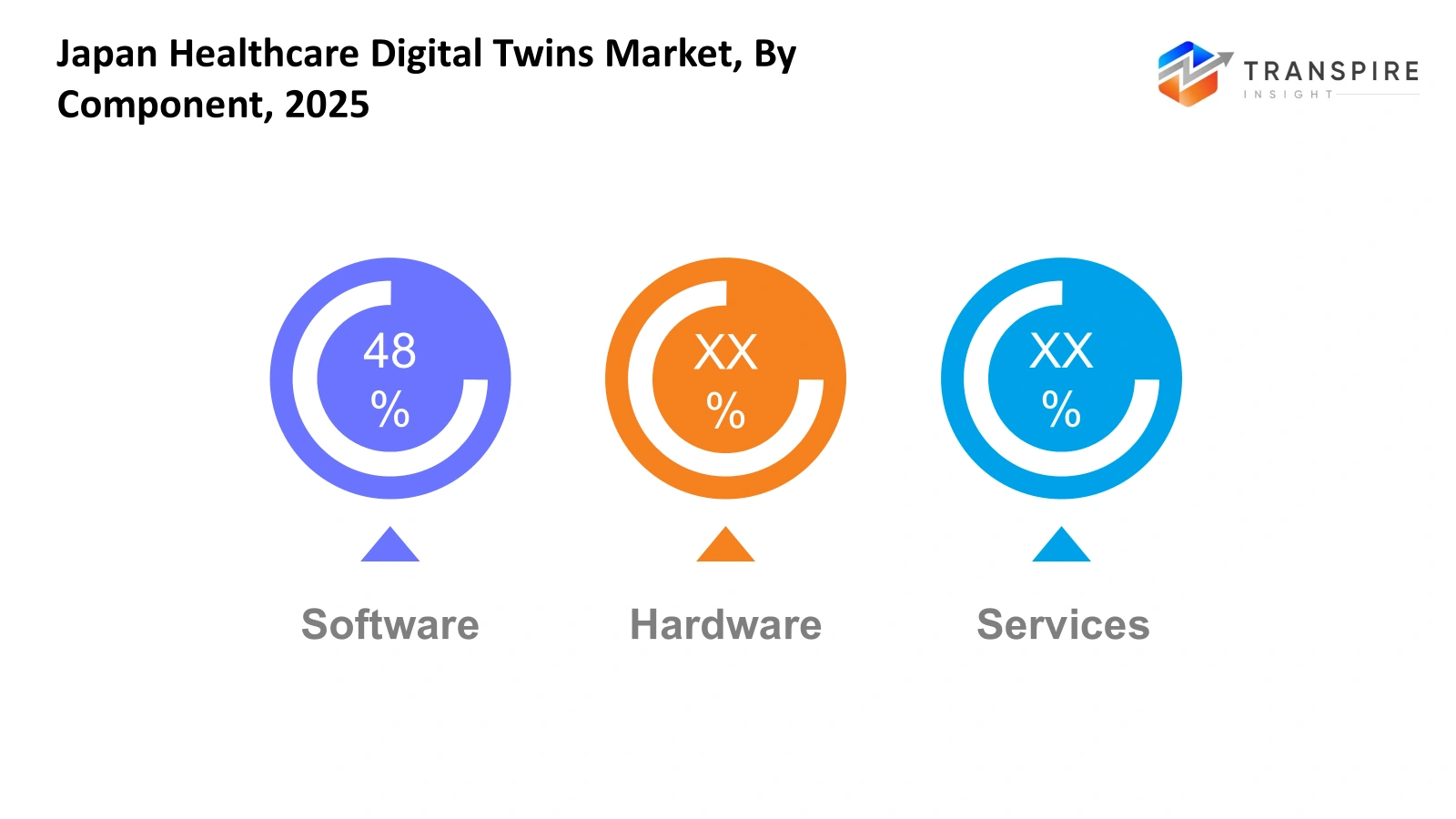
- Software: The Digital twin software functions as the essential framework for simulations which create precise representations of patient body functions and hospital workflows and treatment results. Clinicians use advanced analytics and AI-powered interfaces to understand complex data patterns, which lead to better decision-making and response prediction, thus making software essential for Japan to expand its healthcare digital twin implementation.
- Hardware: The hardware system comprises IoT devices and sensors and monitoring tools which gather immediate patient and operational information. These tools create precise digital twin models which maintain real-time responsiveness while providing healthcare predictions and operational efficiency.
- Services: The services include consulting work and system integration and maintenance services and data management activities. Experts help healthcare organisations implement digital twins by providing solution development and workflow optimisation support. The services create an effective digital twin adoption process which delivers maximum organisational benefits while building trust in digital twin technology throughout the healthcare system of Japan.
To learn more about this report, Download Free Sample Report
By Application
- Personalized Medicine: Digital twins enable doctors to develop specific patient models which predict treatment results and customise medical procedures. The method establishes more precise treatment outcomes which decrease medical risks while improving patient treatment results and establishing Japan's path toward precision medicine and personalised medical approaches.
- Hospital Operations Management: Digital twins enable hospitals to create simulation models which display their operational workflows along with resource distribution patterns and patient movement pathways. The system enables administrators to maintain high patient care standards while they plan and run their hospital operations through its ability to improve operational effectiveness, decrease expenses and enhance service delivery.
- Drug Discovery: Digital twins serve as modelling tools which pharmaceutical researchers use to study human responses during their drug development process. Virtual simulations reduce the need for extensive clinical trials, which decrease expenses while increasing success rates to enable faster innovation in Japan's pharmaceutical sector.
By End User
- Hospitals: The hospitals use digital twins technology to monitor patients better and to organise their operations, which results in better patient treatment results. The hospitals use real-time data together with predictive models to deliver secure and effective medical services while they enhance their internal processes and resource management.
- Research Institutes: Research organisations use digital twins to conduct virtual studies, simulate clinical scenarios, and analyse disease progression. The process enables Japanese researchers to fast-track new innovations while decreasing their testing expenses and acquiring precise scientific data which supports Japan's position as the foremost nation in medical research.
- Pharmaceutical Companies: Pharmaceutical companies use digital twin technology to test drugs and predict their effectiveness and assess their potential risks. The digital human body model enables them to increase research and development productivity while decreasing product failures and speeding up the introduction of new medical treatments into the Japanese healthcare market.
Country Insights
Japan has become a leading country for healthcare digital twin implementation through its advanced technological systems and commitment to precision medicine. Digital twin technology has begun to gain traction in hospitals and research organisations because it enables them to create simulations of patient physiology and use them for treatment planning and operational efficiency improvements. The digital health innovation push from government programmes, together with rising funding for AI, IoT and big data analytics technologies, creates market expansion opportunities. The country's ageing population creates increased demand for healthcare solutions that leverage predictive capabilities to detect medical issues and create customised treatment plans. Pharmaceutical companies use digital twin technology to improve their drug discovery and clinical trial processes, resulting in shorter development times and lower costs. The partnership between technology companies and medical research institutions creates an environment which promotes testing new ideas through innovative approaches to healthcare solutions. Japan's healthcare digital twin market is expected to experience continuous growth, which creates multiple chances for stakeholders to enhance patient treatment while improving healthcare system efficiency.
Recent Development News
AI Accelerates Digital Twin Usage in Japanese Healthcare.
Japan SIP Program Hosts Digital Twin‑Focused Sessions.
|
Report Metrics |
Details |
|
Market size value in 2025 |
USD 48.85 Million |
|
Market size value in 2026 |
USD 62.63 Million |
|
Revenue forecast in 2033 |
USD 360.29 Million |
|
Growth rate |
CAGR of 28.40% from 2026 to 2033 |
|
Base year |
2025 |
|
Historical data |
2021 – 2024 |
|
Forecast period |
2026 – 2033 |
|
Report coverage |
Revenue forecast, competitive landscape, growth factors, and trends |
|
Country scope |
Japan |
|
Key company profiled |
Siemens Healthineers, IBM Corporation, Microsoft Corporation, GE Healthcare, Philips Healthcare, Oracle Corporation, Dassault Systèmes, NVIDIA Corporation, SAP SE, Cisco Systems Inc., Amazon Web Services, Accenture PLC, Bentley Systems, ANSYS Inc., Verto Analytics. |
|
Customization scope |
Free report customization (country, regional & segment scope). Avail customized purchase options to meet your exact research needs. |
|
Report Segmentation |
By Component (Software, Hardware, Services), By Application (Personalized Medicine, Hospital Operations Management, Drug Discovery), By End User (Hospitals, Research Institutes, Pharmaceutical Companies). |
Key Japan Healthcare Digital Twins Company Insights
The primary Japanese healthcare digital twins market companies are implementing innovative development methods and forming strategic partnership agreements to enhance their market presence. The companies are making substantial investments in artificial intelligence systems. Internet of Things technologies and sophisticated data analysis methods to achieve precise medical patient modelling and operational efficiency results. The company establishes partnerships with hospitals and research institutes and pharmaceutical companies to develop personalised medicine solutions and drug development solutions. These companies use their technological abilities and their understanding of the medical field to create solutions that help Japanese digital healthcare systems grow while improving patient health results through more accurate and efficient medical solutions.
Company List
- Siemens Healthineers
- IBM Corporation
- Microsoft Corporation
- GE Healthcare
- Philips Healthcare
- Oracle Corporation
- Dassault Systèmes
- NVIDIA Corporation
- SAP SE
- Cisco Systems Inc.
- Amazon Web Services
- Accenture PLC
- Bentley Systems
- ANSYS Inc.
- Verto Analytics.
Japan Healthcare Digital Twins Market Report Segmentation
By Component
- Software
- Hardware
- Services
By Application
- Personalized Medicine
- Hospital Operations Management
- Drug Discovery
By End User
- Hospitals
- Research Institutes
- Pharmaceutical Companies.
Frequently Asked Questions
Find quick answers to common questions.
The Approximate Japan Healthcare Digital Twins Market size for the Market will be USD 360.29 Million in 2033.
The key Segments of the Japan Healthcare Digital Twins Market are By Component (Software, Hardware, Services), By Application (Personalized Medicine, Hospital Operations Management, Drug Discovery), By End User (Hospitals, Research Institutes, Pharmaceutical Companies).
Major Players in the Japan Healthcare Digital Twins Market are Siemens Healthineers, IBM Corporation, Microsoft Corporation, GE Healthcare, Philips Healthcare, Oracle Corporation, Dassault Systèmes, NVIDIA Corporation, SAP SE, Cisco Systems Inc., Amazon Web Services, Accenture PLC, Bentley Systems, ANSYS Inc., Verto Analytics.
The Current Market size of the Japan Healthcare Digital Twins Market is USD 48.85 Million in 2025.
The Japan Healthcare Digital Twins Market CAGR is 28.40%.
- Siemens Healthineers
- IBM Corporation
- Microsoft Corporation
- GE Healthcare
- Philips Healthcare
- Oracle Corporation
- Dassault Systèmes
- NVIDIA Corporation
- SAP SE
- Cisco Systems Inc.
- Amazon Web Services
- Accenture PLC
- Bentley Systems
- ANSYS Inc.
- Verto Analytics.
Recently Published Reports
-
Apr 2026
AI in Diabetic Retinopathy Market
AI in Diabetic Retinopathy Market Size, Share & Analysis Report By Type (Screening AI Systems, Diagnostic AI Systems, and Predictive AI Models), By Application Segment (Hospitals, Ophthalmology Clinics, Diagnostic Centers, and Research and Development), and Geography (North America, Europe, Asia-Pacific, Middle East and Africa, South and Central America), 2021 - 2031
-
Apr 2026
Psychometric Tests Market
Psychometric Tests Market Size, Share & Analysis Report By Type (Personality Tests, Ability/Aptitude Tests, Skill/Knowledge Tests, and Others), By Application (Talent Acquisition and Talent Management), and Geography (North America, Europe, Asia-Pacific, Middle East and Africa, South and Central America), 2021 – 2031
-
Apr 2026
Rare Biological Sample Collection Market
Rare Biological Sample Collection Market Size, Share & Analysis Report By Type (Isolation Kits & Reagent, Blood Collection Tubes, and Others), By Application (Oncology, Transcriptomics, Pharmacogenomics, and Others), and Geography (North America, Europe, Asia-Pacific, Middle East and Africa, South and Central America), 2021 – 2031
-
Apr 2026
Patient Lift Pendant Market
Patient Lift Pendant Market By Product Type (Wired Pendants, Wireless, Programmable), By Operation Type(Manual, Electric), By End-Users (Healthcare Professionals, Patients), By Application (Hospitals, Homecare, Rehabilitation Centers, Others), By Industry Analysis, Size, Share, Growth, Trends, and Forecasts 2021-2033
Our Clients
.jpg)