
South Korea Sodium-Ion Battery Market Size & Forecast:
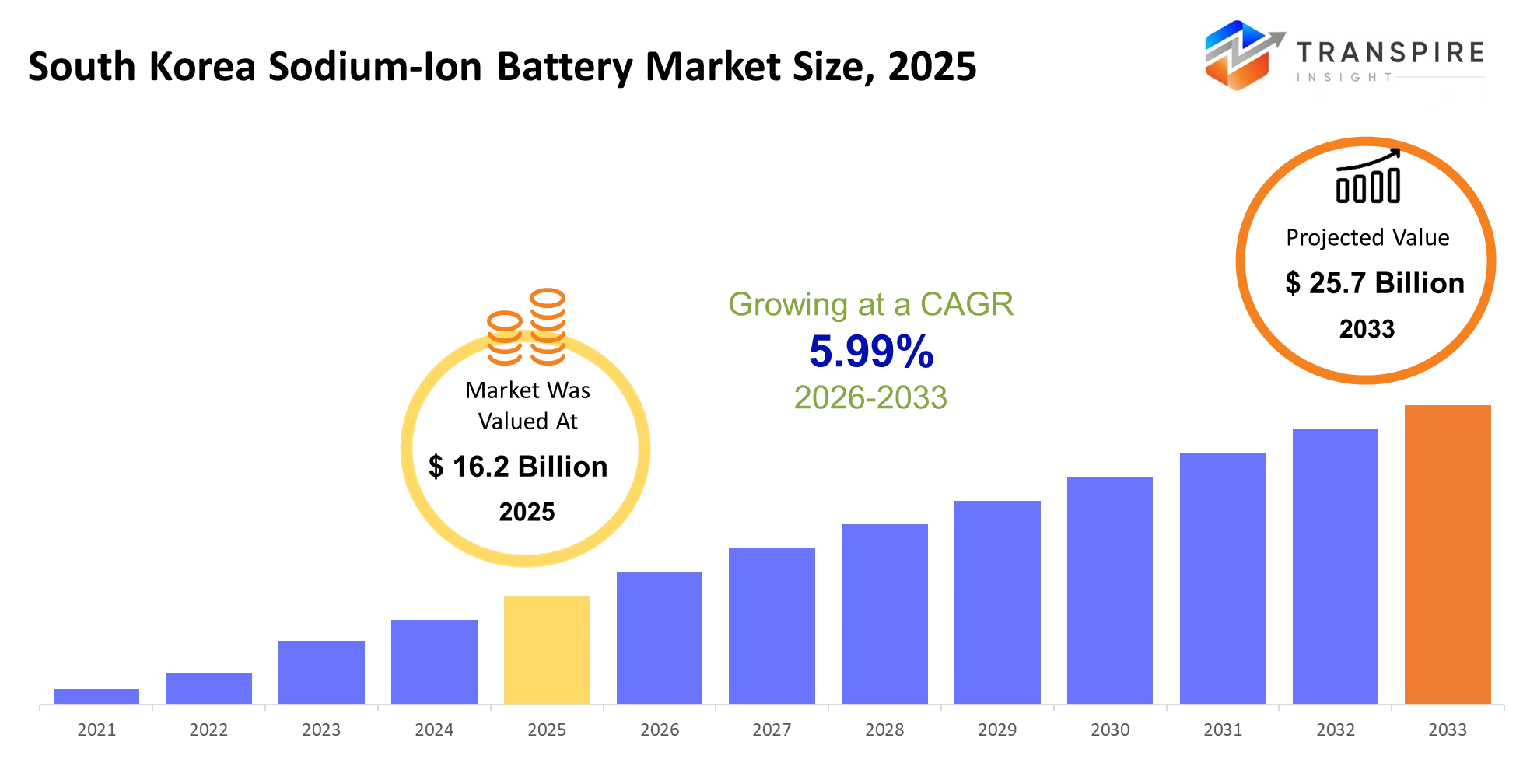
- South Korea Sodium-Ion Battery Market Size 2025: USD 16.2 Billion
- South Korea Sodium-Ion Battery Market Size 2033: USD 25.7 Billion
- South Korea Sodium-Ion Battery Market CAGR: 5.99%
- South Korea Sodium-Ion Battery Market Segments: By Service Type (Transportation Services, Warehousing Services, Cold Chain Logistics, Inventory Management, Last-mile Delivery, Others); By Mode of Transport (Road Transport, Rail Transport, Air Freight, Sea Freight, Others); By Application (Food & Beverage Logistics, Personal Care Logistics, Household Product Logistics, E-commerce FMCG Logistics, Others); By End User (Retail Chains, FMCG Manufacturers, E-commerce Companies, Others).
To learn more about this report,  Download Free Sample Report
South Korea Sodium-Ion Battery Market Summary
The South Korea Sodium-Ion Battery Market was valued at USD 16.2 Billion in 2025. It is forecast to reach USD 25.7 Billion by 2033. That is a CAGR of 5.99% over the period.
In practice, South Korea’s sodium-ion battery market kind of backs stationary energy storage setups, backup power for industrial facilities, and those auxiliary roles at ports plus shipbuilding yards, where cost stability, safety, and long cycle life start to matter more than pure energy density. Over the last three to five years , the sector seems to have moved from lab validation into early commercial rollouts for grid storage and maritime electrification, and you can notice procurement strategies in utilities and shipyards getting wider, not just lithium-ion only dependence.
This shift has been pushed along by lithium and nickel price volatility, plus supply chain hiccups and a growing worry about critical mineral concentration risks during 2022–2024. Since sodium-ion chemistries lean on abundant feedstocks and lower-cost inputs, they reduce import exposure and make lifecycle economics feel a bit more predictable for large scale storage, so utilities, ports, and shipbuilders are now more willing to scale deployments and turn pilot efforts into orders that are actually procurement-backed.
Key Market Insights
- Gyeonggi Province kind of dominates the South Korea Sodium-Ion Battery Market, with something like a 35–40% share. This is mainly because of the dense battery R&D and also those manufacturing clusters, kinda packed together.
- Meanwhile Ulsan and Busan seem to be the quickest movers from 2024–2030, pushed by port electrification efforts and maritime storage deployment projects, even when budgets fluctuate a bit.
- The Chungcheong region shows steady growth, backed by big scale energy storage pilot installations and the steady industrial pull.
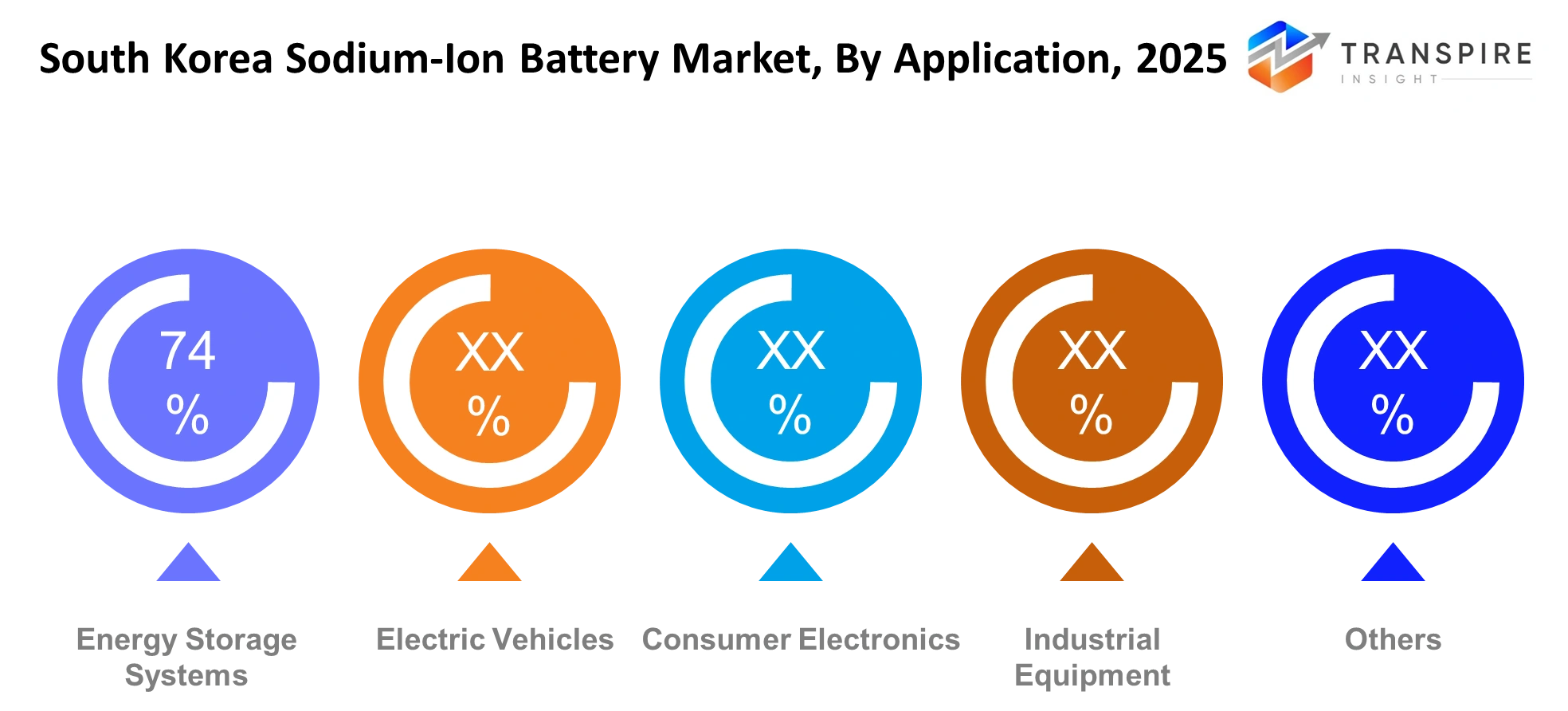
- Stationary energy storage systems are leading the South Korea Sodium-Ion Battery Market with over 45% share in 2025, largely due to grid stabilization needs.
- And then, grid-scale energy storage is even more prominent at around 48% share, driven by renewable integration and those peak load balancing requirements.
- Port electrification plus hybrid maritime setups are kind of the quickest-to-arrive application lane in South Korea, lately.
- Industrial power continuity systems keep a kind of reliable pull on demand across manufacturing-centric corridors.
- The utilities side stays at the front as the leading end-user, with close to a 50% slice in the South Korea Sodium-Ion Battery Market, overall.
- Ports and shipping operators are showing the quickest growth as end-users, mostly because electrification rules are getting stricter.
- And industrial facilities, say semiconductor plants and similar production sites, bring a steady floor demand for backup energy systems.
What are the Key Drivers, Restraints, and Opportunities in the South Korea Sodium-Ion Battery Market?
The main growth driver is kinda a structural push to cut back dependence on imported lithium and nickel, after repeated price volatility across 2022 to 2024. Because of that, utilities, shipbuilders, and industrial operators have been looking at sodium-ion systems for grid storage and backup uses, where the lifecycle cost stability matters most. In other words procurement teams are choosing predictable operating expenditure, over the highest possible energy density, and so adoption is turning into early commercial agreements, especially for large-scale storage deployments linked to renewable integration.
Still, the biggest constraint is basically lower energy density versus the more advanced lithium-ion chemistries, and that makes sodium-ion less attractive for compact mobility applications. This is not really a “we can just tweak the factory” issue, it’s a structural technical gap sitting inside the material chemistry itself. So it cannot be fixed quickly by incremental process improvements, not even with better manufacturing tricks. As a consequence, uptake is mostly limited to stationary use cases and situations where weight sensitivity is lower, which ends up delaying broader revenue expansion in higher-value mobility segments
After that, the next growth phase is starting to show up via port electrification and maritime auxiliary power systems in Busan and Ulsan. In South Korea there is piloting of hybrid vessel electrification, and these projects become a sort of testing ground for sodium-ion in harsh operational conditions. That’s where suppliers can validate performance at scale, and then potentially unlock longer-term procurement contracts too, with less uncertainty later on.
What Has the Impact of Artificial Intelligence Been on the South Korea Sodium-Ion Battery Market?
AI plus advanced digital technologies are getting plugged in more and more into South Korea’s sodium-ion battery and marine energy storage environment, especially around port microgrids, on vessel auxiliary power setups, and for emissions compliance platforms. A lot of operators are rolling out AI automation that helps streamline scrubber performance systems, and the exhaust gas cleaning tech, so they can tweak operating parameters on the fly, and keep automated fleet compliance logs in step with the ever tightening maritime emission requirements. There are also machine learning models in the mix for predictive maintenance of battery packs and those onboard energy storage units, they spot slow degradation signals, then they help steer charging cycles in a way that extends service life, and keeps performance steadier when marine conditions get noisy or unstable.
When you look at port settings specifically, AI based energy management tools can forecast emissions intensity and handle load distribution across sodium-ion storage assets, which boosts uptime, cuts down surprise downtime, and delivers double digit improvements in maintenance efficiency and fuel optimization. Still, uptake is not seamless, since there just isn’t enough high quality operational data for sodium-ion chemistries, and connectivity can be pretty inconsistent at sea, that means real time model training is limited and remote diagnostics get harder. On top of that, the costs to integrate with older shipboard control systems are high, so broad deployment moves slow even though commercial interest keeps climbing.
Key Market Trends
- South Korean utilities kinda shifted their procurement strategies after the 2023 lithium price spikes, and suddenly you see more sodium-ion pilot deployments cropping up across the grid scale storage projects.
- Gyeonggi-based manufacturers also pushed harder on sodium-ion R&D facilities between 2024 and 2026, like moving from lab validation to early commercial prototypes, not fully ready but closer than before.
- Then the shipbuilders in Busan started putting sodium-ion auxiliary systems in place after 2024, especially after emissions compliance upgrades got tighter and maritime fuel efficiency requirements got more strict, you know.
- Meanwhile, Reliance-linked sodium-ion technology partnerships began to speed up after 2023, which helped with localized pilot production and it also lowered the overall import dependency risk.
- In 2025 energy storage buyers started diversifying contracts more often, so they weren’t stuck with lithium only exposure, and some of them allocated around 15–20% toward sodium-based systems.
- AI-enabled battery management systems improved lifecycle performance forecasting after 2024, which in turn boosted operational reliability for grid storage deployments too.
- Port electrification projects in Ulsan really scaled after 2025, creating stronger demand for sodium-ion storage in hybrid shore power infrastructure.
- And around 2023 to 2026, manufacturing cost gaps narrowed, because cathode material innovation reduced sodium-ion production expenses by double digit percentages, so the economics got less lopsided over time.
South Korea Sodium-Ion Battery Market Segmentation
By Service Type :
Transportation services kinda help move sodium-ion battery module kits from production plants into industrial and utility areas. Since around 2023, people have been leaning more toward safer handling protocols, because energy storage shipments have been growing. So the logistics operators basically keep attention on controlled movement, lower damage frequency, and quicker turnaround times along the domestic supply routes, even when schedules get messy.
Also, warehousing and inventory management feel more serious now. Manufacturers hold extra buffer stocks for grid-linked and port energy projects, which means more careful staging. For 2024, more structured storage systems plus tracking tools should lift traceability and cut down on dispatch delays, a bit like “less waiting, more visibility.” And last-mile delivery services are increasingly tailored for industrial installations that need precise scheduling and on-site integration help, not just drop-off.
By Mode of Transport :
Road transport still looks like the main way of distributing sodium-ion battery shipments inside South Korea, mostly because routing is flexible and regional connections are quicker. Use has gone up since 2022, as local manufacturing clusters spread out, so there’s less dependence on long-haul alternatives and overall delivery efficiency for industrial customers tends to be better.
Sea freight backs bulk movement of battery components for export focused manufacturing. Rail transport is being used bit by bit for heavier industrial corridors. Air freight is more constrained due to cost and safety rules, but it does support urgent prototype movements when timing matters most. Starting in 2024, multimodal logistics planning has improved supply reliability across the production hubs, with fewer surprises during handoffs.
By Application :
Industrial uses tied to energy storage systems sort of dominate sodium-ion battery deployment, not so much the consumer logistics buckets. Starting around 2023, grid storage and industrial backup setups have been the big push, mainly in manufacturing areas that need steady and low-cost energy support for never-ending operations.
E-commerce and FMCG logistics, honestly, benefit in a more indirect way because warehouses get calmer on the energy front, powered by these sodium-ion systems. From 2024 onward, when they get wired into smart storage facilities, downtime risk goes down. Beyond that, industrial infrastructure and utility-scale energy balancing still keep expanding, especially while South Korea is prioritizing cost-effective and dependable energy storage rollout.
To learn more about this report, Download Free Sample Report
By End User :
Retail chains run sodium-ion battery systems to keep power flowing, even inside storage and distribution locations where interruptions are a real hassle. FMCG producers fold in these systems so production stays continuous, plus it helps with energy cost management. E-commerce groups place sodium-ion storage in fulfillment centers. Other end users are logistics operators and industrial plants that basically require reliable backup power systems.
End-user uptake is climbing, mostly because operational reliability is becoming more important across the supply chain. FMCG and e-commerce are leading the deployment, mostly due to high swings in energy demand. At the same time, spending on energy storage infrastructure is helping with tighter cost control, reducing outage exposure, and enabling scalable operations across the growing distribution network in South Korea.
What are the Key Use Cases Driving the South Korea Sodium-Ion Battery Market?
Honestly grid scale energy storage is still the main thing pushing the South Korea Sodium-Ion Battery Market forward, utilities keep rolling out these setups to smooth out grids that are heavy on renewables, and to handle peak load electricity. The pull is strongest in places where cost predictability and long cycle life beat compact size, especially large stationary installations tied to industrial power networks.
Then there’s secondary adoption, it’s quietly moving forward in industrial backup systems, plus port side energy infrastructure. Semiconductor plants and manufacturing sites are leaning on sodium ion storage to sidestep production stoppages, while logistics hubs use it so power stays steady during high throughput operations. Utilities and FMCG-linked distribution centers are the real end users that are driving this next bit of expansion.
Looking ahead there are also emerging use cases like shore power systems for electrified ports and auxiliary power for hybrid maritime operations. Some pilots in Busan and Ulsan are testing sodium-ion integration aimed at vessel support systems and emissions-compliant port electrification, so it feels early stage but the interest is clearly increasing beyond the straight stationary applications.
|
Report Metrics |
Details |
|
Market size value in 2025 |
USD 16.2 Billion |
|
Market size value in 2026 |
USD 17.1 Billion |
|
Revenue forecast in 2033 |
USD 25.7 Billion |
|
Growth rate |
CAGR of 5.99% from 2026 to 2033 |
|
Base year |
2025 |
|
Historical data |
2021 - 2024 |
|
Forecast period |
2026 - 2033 |
|
Report coverage |
Revenue forecast, competitive landscape, growth factors, and trends |
|
Country scope |
South Korea |
|
Key company profiled |
CATL, Faradion, Natron Energy, HiNa Battery, Altris, Tiamat Energy, Reliance New Energy, BYD, Panasonic, LG Energy Solution, Samsung SDI, SK On, Contemporary Amperex Technology, BASF, Northvolt. |
|
Customization scope |
Free report customization (country, regional & segment scope). Avail customized purchase options to meet your exact research needs. |
|
Report Segmentation |
By Service Type (Transportation Services, Warehousing Services, Cold Chain Logistics, Inventory Management, Last-mile Delivery, Others); By Mode of Transport (Road Transport, Rail Transport, Air Freight, Sea Freight, Others); By Application (Food & Beverage Logistics, Personal Care Logistics, Household Product Logistics, E-commerce FMCG Logistics, Others); By End User (Retail Chains, FMCG Manufacturers, E-commerce Companies, Others). |
Which Regions are Driving the South Korea Sodium-Ion Battery Market Growth?
Gyeonggi Province kinda takes the lead in the South Korea Sodium-Ion Battery Market,mostly because there are so many battery companies packed together, plus R&D institutes and energy storage integration facilities that are already in place. With policy backing aimed at domestic energy security it’s been easier to push large scale pilot activities, across industrial parks ,and also utility linked storage programs. There’s also close coordination between research universities and private manufacturers, so commercialization sort of moves faster. On top of that, the electronics and semiconductor scene is already well developed, which makes the need for dependable reserve power solutions feel pretty steady.
Chungcheong region brings in more steady revenue, and it leans on a balanced industrial setup, more like manufacturing continuity, instead of that aggressive innovation led expansion. While Gyeonggi feels more technology intensive, Chungcheong growth is powered by steady spending from mid-sized industrial operators who just want dependable storage for factories and logistics centers. Regulatory rollouts are more gradual too, so adoption happens on a predictable rhythm, not in sudden demand spikes. That steadiness is why the area becomes an important kind of baseline contributor, for long term revenue, in the sodium ion battery field.
Busan and Ulsan show the fastest growth, and it seems tied to port modernization programs, along with maritime electrification efforts that started after 2024. New emission control rules and shore power infrastructure upgrades have boosted interest in alternative storage systems for harbor operations. Shipbuilding firms and port authorities are actively trying sodium ion setups in auxiliary use and grid support roles. This shift is happening quickly, so it opens strong entry chances for tech providers and investors focused on maritime energy transition projects
Who are the Key Players in the South Korea Sodium-Ion Battery Market and How Do They Compete?
Competition in the South Korea sodium-ion battery market is still kinda in the early commercialization phase, and the overall setup looks moderately fragmented… like nobody has the whole picture yet. Big lithium-ion players keep most of the R&D horsepower, and meanwhile smaller materials specialists plus startup teams are testing weirdly different cathode and electrolyte concepts. What really pushes competition is not so much chasing raw volume, but rather getting to cost parity with lithium systems, boosting energy density, and proving they can scale pilot lines into real commercial manufacturing. On top of that, firms are racing on supply chain self-sufficiency, meaning less dependence on imported critical minerals, and also on how fast they can move from lab validation into industrial deployment for grid and maritime uses.
LG Energy Solution is putting the weight on tech innovation, by basically adapting their existing lithium-ion production lines to build sodium-ion prototypes, which should cut the transition cost and speed up the commercialization schedule. Samsung SDI leans harder into high-performance materials research, especially aiming for better thermal stability so the cells make more sense for stationary storage. SK On tries to squeeze costs by tightening supply chain integration and working with domestic chemical suppliers, so they can lock in stable sodium feedstock access and not get stuck later.
POSCO Future M uses its materials strength to work on sodium-based cathode precursors, which puts it more in the upstream role rather than chasing cell manufacturing directly. Hyundai Motor Company, on the other hand, is exploring more niche opportunities, like auxiliary power systems for industrial mobility platforms, and they’re partnering with battery developers for limited pilot runs. Overall, these companies tend to grow through partnerships with utilities and shipbuilding-connected energy projects, and that helps them strengthen their presence in these early maritime and grid storage ecosystems, even if it’s still a bit messy and evolving.
Company List
- CATL
- Faradion
- Natron Energy
- HiNa Battery
- Altris
- Tiamat Energy
- Reliance New Energy
- BYD, Panasonic
- LG Energy Solution
- Samsung SDI
- SK On
- Contemporary Amperex Technology
- BASF
- Northvolt
Recent Development News
In April 2026, CATL entered a major sodium-ion battery supply partnership with Beijing HyperStrong Technology. The three-year 60 GWh agreement demonstrated large-scale commercial readiness for sodium-ion batteries, prompting heightened competitive and investment activity across Asian battery markets, including South Korea.
Source: https://www.reuters.com/
In April 2025, CATL launched its new sodium-ion battery brand, expanding commercialization efforts for next-generation battery technology. The launch intensified competitive pressure on South Korean battery manufacturers pursuing alternatives to lithium-ion batteries and accelerated global investment interest in sodium-ion battery development.
Source: https://www.reuters.com/
What Strategic Insights Define the Future of the South Korea Sodium-Ion Battery Market?
The South Korea Sodium-Ion Battery Market is kind of moving into a cost-optimization tier inside stationary and maritime energy systems, where buying decisions increasingly care about supply chain steadiness and expected lifetime economics rather than chasing peak energy density. This change is being pushed by ongoing fluctuations in lithium-linked material markets, plus growing pressure on utilities and port operators to keep long-term operating spending steady, not just “optimize” for a quarter or two.
There’s also a more quiet risk, like how fast new lithium solid-state and high-manganese chemistries are progressing. If they get cheaper or better sooner than people model, they may shrink the cost–performance gap faster than expected, and that could slow sodium-ion scaling beyond those pilot-to-commercial steps. In other words, substitution pressure could funnel demand only toward the most cost-sensitive uses, so the revenue base stays narrower, and diversification gets weaker.
On the opportunity side, port electrification rules around Busan and Ulsan are starting to matter, because shore power upgrades are creating early demand for hybrid storage integration. This “small” segment is becoming a more formal procurement lane rather than just experimental rollouts. Players should probably form early partnerships with port authorities and grid operators, to lock in longer term framework agreements before standards finish settling and competitive entry barriers get higher.
South Korea Sodium-Ion Battery Market Report Segmentation
By Service Type
- Transportation Services
- Warehousing Services
- Cold Chain Logistics
- Inventory Management
- Last-mile Delivery
By Mode of Transport
- Road Transport
- Rail Transport
- Air Freight
- Sea Freight
By Application
- Food & Beverage Logistics
- Personal Care Logistics
- Household Product Logistics
- E-commerce FMCG Logistics
By End User
- Retail Chains
- FMCG Manufacturers
- E-commerce Companies
Frequently Asked Questions
Find quick answers to common questions.
The South Korea Sodium-Ion Battery Market size is USD 25.7 Billion in 2033.
Key segments for the South Korea Sodium-Ion Battery Market are By Service Type (Transportation Services, Warehousing Services, Cold Chain Logistics, Inventory Management, Last-mile Delivery, Others); By Mode of Transport (Road Transport, Rail Transport, Air Freight, Sea Freight, Others); By Application (Food & Beverage Logistics, Personal Care Logistics, Household Product Logistics, E-commerce FMCG Logistics, Others); By End User (Retail Chains, FMCG Manufacturers, E-commerce Companies, Others).
Major South Korea Sodium-Ion Battery Market players are CATL, Faradion, Natron Energy, HiNa Battery, Altris, Tiamat Energy, Reliance New Energy, BYD, Panasonic, LG Energy Solution, Samsung SDI, SK On, Contemporary Amperex Technology, BASF, Northvolt.
The South Korea Sodium-Ion Battery Market size is USD 16.2 Billion in 2025.
The South Korea Sodium-Ion Battery Market CAGR is 5.99% from 2026 to 2033.
- CATL
- Faradion
- Natron Energy
- HiNa Battery
- Altris
- Tiamat Energy
- Reliance New Energy
- BYD, Panasonic
- LG Energy Solution
- Samsung SDI
- SK On
- Contemporary Amperex Technology
- BASF
- Northvolt
Recently Published Reports
-
Apr 2026
Active Power Filter Market
Active Power Filter Market Size, Share & Analysis Report By Type (Shunt Active Power Filters, Series Active Power Filter, Hybrid Active Power Filter), By Application (Harmonics Mitigation, Reactive Power Compensation, Voltage Regulation, Power Factor Correction), By Phase (Single Phase, Three Phase), By End-User Industry (Manufacturing, Healthcare, Commercial, Automotive, Oil and Gas, Others), and Geography (North America, Europe, Asia-Pacific, Middle East and Africa, South and Central America), 2021 - 2031
-
Apr 2026
Electrical Transformer Market
Electrical Transformer Market Size, Share & Analysis Report By Core (Closed, Shell, and Berry), By Insulation (Gas, Oil, Solid, Air, and Other), By Phase (Single, and Three), By Rating (100 MVA to 500 MVA, 501 MVA to 800 MVA, and 801 MVA to 1200 MVA), and Geography (North America, Europe, Asia-Pacific, Middle East and Africa, South and Central America), 2021 – 2031
-
Apr 2026
Hydraulic Piston Pumps Market
Hydraulic Piston Pumps Market Size, Share & Analysis Report By Type (Axial Piston Pumps, Radial Piston Pumps), By Operating Pressure (Low Pressure, Medium Pressure, High Pressure), By Application (Construction, Mining, Agriculture, Automotive, Oil & Gas, Industrial Machinery, Others), By End-User (OEMs, Aftermarket), and Geography (North America, Europe, Asia-Pacific, Middle East and Africa, South and Central America), 2021 – 2031
-
Apr 2026
Laboratory Gas Generators Market
Laboratory Gas Generators Market Size, Share & Analysis Report By Product (Nitrogen Gas Generator, Hydrogen Gas Generator, Zero Air Gas Generator, Purge Gas Generator, TOC Gas Generators, Others), By Application (Gas Chromatography, Liquid Chromatography-mass Spectrometry (LC-MS), Gas Analyzers, Others), By End-user (Life Science, Chemical & Petrochemical, Food & Beverage, Others), and Geography (North America, Europe, Asia-Pacific, Middle East and Africa, South and Central America), 2021 – 2031