

France Transportation Management System Market Size & Forecast:
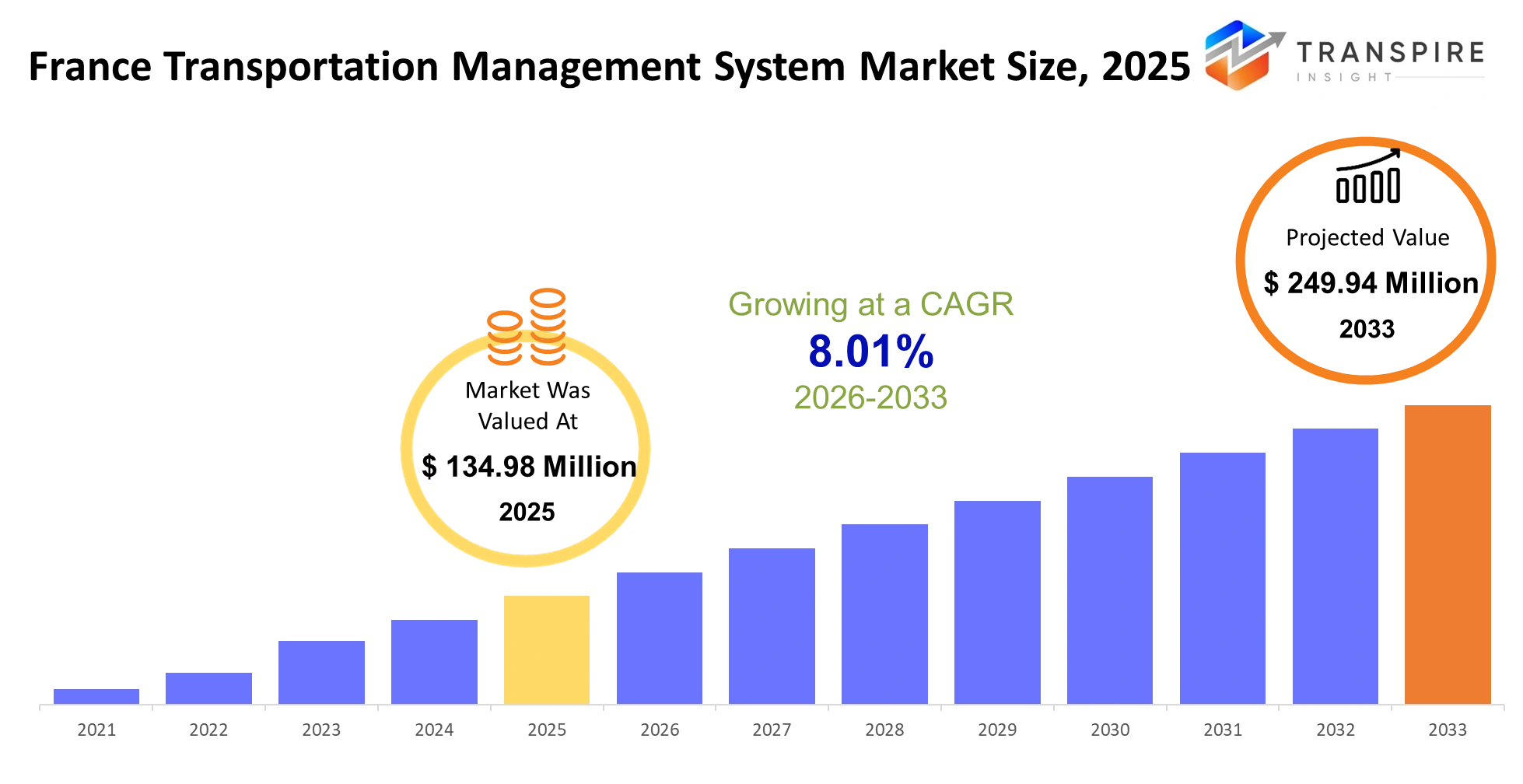
- France Transportation Management System Market Size 2025: USD 134.98 Million
- France Transportation Management System Market Size 2033: USD 249.94 Million
- France Transportation Management System Market CAGR: 8.01%
- France Transportation Management System Market Segments: By Type (Planning Systems, Execution Systems, Analytics & Reporting, Others); By Application (Freight Management, Route Optimization, Fleet Management, Shipment Tracking, Others); By End-User (Logistics Companies, Retailers, Manufacturers, E-commerce Companies, Others); By Deployment (Cloud, On-premise, Hybrid, Others).
To learn more about this report,  Download Free Sample Report
France Transportation Management System Market Summary
The France Transportation Management System Market was valued at USD 134.98 Million in 2025. It is forecast to reach USD 249.94 Million by 2033. That is a CAGR of 8.01% over the period.
The France Transportation Management System Market enables manufacturers and retailers and logistics providers and distributors to control freight movement with enhanced speed and tracking abilities and reduced transportation expenses. Transportation management platforms are now widely used to optimize route planning and automate carrier selection and track shipments in real time and reduce fuel and labor inefficiencies throughout domestic and cross-border supply chains. The market has evolved during the last five years because businesses now prefer cloud-based AI-powered logistics orchestration platforms which work with warehouse systems and ERP software and predictive analytics engines instead of basic transport scheduling tools.
The identification of operational weaknesses in fragmented freight networks resulted from supply chain disruptions which occurred in Europe between 2020 and 2022 because of post-pandemic disruptions and port congestion. French enterprises responded by investing in digital freight visibility and automation technologies to improve resilience and delivery predictability. The current transition process increases software revenue which produces ongoing earnings for businesses while it drives mid-sized logistics companies to adopt SaaS services and develop intelligent transportation systems throughout France.
Key Market Insights
- The France Transportation Management System Market experienced its first cloud migration peak during 2025 after more than 60% of new transportation management solutions used SaaS-based platforms for deployment.
- Northern France maintained nearly 38% regional market share because of its logistics infrastructure and industrial freight corridors and its location close to major European trade routes.
- The Southern France region developed into the most rapidly expanding e-commerce hub because of its growing e-commerce warehousing and cross-border transportation operations which began to expand in 2023.
- Freight route optimization software sustained its market lead in the France Transportation Management System Market because rising fuel costs created new demands for enhanced fleet operations and accurate delivery times.
- Enterprises adopted real-time shipment visibility platforms because retailers needed both predictive ETAs and live freight tracking to manage their omnichannel distribution networks.
- AI-powered transportation analytics became the fastest-growing technology segment after logistics providers adopted automated load planning and carrier performance intelligence systems.
- The retail and e-commerce sector acquired over 34% of market share because delivery services needed to handle last-mile operations while using advanced methods to fulfill same-day orders.
- French industrial companies adopted manufacturing logistics solutions at the fastest rate because they implemented digital systems to manage their inbound raw material transport and outbound distribution operations.
- Third-party logistics providers strengthened their leadership position because European supply chain disruptions increased demand for centralized transportation orchestration capabilities.
What are the Key Drivers, Restraints, and Opportunities in the France Transportation Management System Market?
The European freight sector experiences fast digital transformation because European supply chains become disrupted after 2020, which now serves as the main factor driving growth in the French transportation management system market. The combination of rising transportation expenses and delivery hold-ups plus fluctuating fuel costs compelled logistics firms and manufacturing companies to adopt automated transportation intelligence systems instead of manual planning methods. French companies use cloud-based TMS solutions to improve their route selection process and enhance carrier efficiency while tracking their freight operations throughout the distribution process. The operational change brings advantages through improved delivery performance and reduced transportation costs which lead to increased software usage and higher subscription-based revenue streams.
The most significant restraint remains the complexity of integrating transportation management platforms with legacy ERP systems, warehouse infrastructure, and fragmented carrier networks. Many medium-sized logistics operators still depend on outdated operational architectures that require expensive customization and long deployment cycles. Multiple supply chain functions face implementation challenges because digital transformation needs data standardization and workforce retraining and interoperability upgrades. The result is delayed purchasing decisions and slower enterprise-wide deployment.
AI-driven autonomous logistics orchestration and multimodal transportation analytics create a major opportunity. France is expanding its investment in smart logistics corridors and connected freight ecosystems which will develop throughout the Paris and Marseille and Lyon regions.
What Has the Impact of Artificial Intelligence Been on the France Transportation Management System Market?
The implementation of artificial intelligence has created major changes in transportation management systems throughout France by enhancing the precision of freight planning processes and providing complete visibility of shipments and enabling automated logistics operations. The current transportation systems utilize artificial intelligence algorithms to perform automated route optimization and carrier selection and delivery scheduling by using real-time data on traffic patterns and fuel usage and weather interruptions and warehouse loading capacity. The logistics industry now uses intelligent control towers which allow operators to monitor their fleet activities in real time while creating new transportation routes whenever they experience unexpected delays or operational disruptions.
Machine learning models are improving the ability to forecast outcomes in freight networks through their analysis capabilities. Transportation analytics engines have the ability to predict delivery bottlenecks while identifying routes for high-risk carriers and forecasting maintenance requirements of fleet vehicles before they experience operational breakdowns. The French logistics providers achieved fuel consumption and empty-mile frequency decreases after they adopted AI-based load optimization systems according to their reported results. Retailers use predictive transportation visibility tools to enhance their ability to deliver products on time while synchronizing inventory management for omnichannel fulfillment.
The implementation of advanced digital technologies which include IoT-enabled telematics and cloud freight marketplaces and real-time shipment dashboards has improved both operational efficiency and regulatory compliance procedures. The high costs required for system integration together with the inconsistent data quality present in fragmented logistics networks create obstacles for organizations that want to implement AI technology. The predictive analytics models face accuracy issues because many transportation operators fail to connect their carrier and warehouse and shipment data sources which subsequently obstructs their ability to implement predictive analytics throughout their organization.
Key Market Trends
- French logistics operators since 2022 have transitioned from using on-premise transport software to adopting cloud-native TMS platforms which provide them with better scalability and remote operational control.
- Retailers expanded their real-time shipment visibility investments because European delivery disruptions showed them the weaknesses which existed in their fragmented transportation coordination systems.
- The adoption of AI-powered route optimization tools surged between 2023 and 2025 as freight operators needed to address fuel price fluctuations which required them to decrease their transportation inefficiencies.
- To accommodate increasing cross-border trade activities between Western and Central Europe third-party logistics providers implemented multimodal freight management systems at an accelerated pace.
- Major e-commerce distributors adopted predictive ETA analytics as standard practice because they required enhanced delivery precision and superior customer fulfillment results.
- Logistics software vendors developed transportation platform integration with warehouse automation systems to build complete supply chain execution environments.
- French manufacturers implemented transportation analytics dashboards to track real-time carrier performance and freight costs and carbon emissions.
- Transportation operators raised their cybersecurity budget which resulted from increased ransomware attacks and supply chain data breaches that began after 2021.
- TMS vendors established strategic partnerships with telematics providers to create expanded capabilities for connected fleet intelligence and real-time shipment monitoring systems.
- Mid-sized enterprises increasingly adopted subscription-based transportation software models because implementation costs declined significantly after widespread SaaS platform expansion.
- French logistics operators since 2022 have transitioned from on-premise transport software to cloud-native TMS platforms.
France Transportation Management System Market Segmentation
By Type
Transportation Management System Planning systems stand as the primary solution used by French businesses to create their freight schedules through carrier distribution optimization and shipment efficiency reduction. The systems enable logistics providers and manufacturers to manage their European supply chains which require cost efficiency and delivery accuracy control. Digital platforms with centralized planning capabilities now drive organizations to adopt these systems because they enhance their forecasting abilities while enabling multimodal transport network coordination.
The research period will see planning systems develop into AI-powered decision systems which will modify transport routes based on real-time demand information and current traffic data and existing capacity limits. The execution systems play a crucial role in maintaining operational efficiency because they handle all aspects of real-time shipment tracking and dispatch management and carrier communication during high-volume logistics operations. The industry experiences growth because shipment processes become more complicated while businesses demand faster delivery times which will continue to expand through the development of intelligent transportation control towers that connect planning with execution processes in a single operational system.
By Application
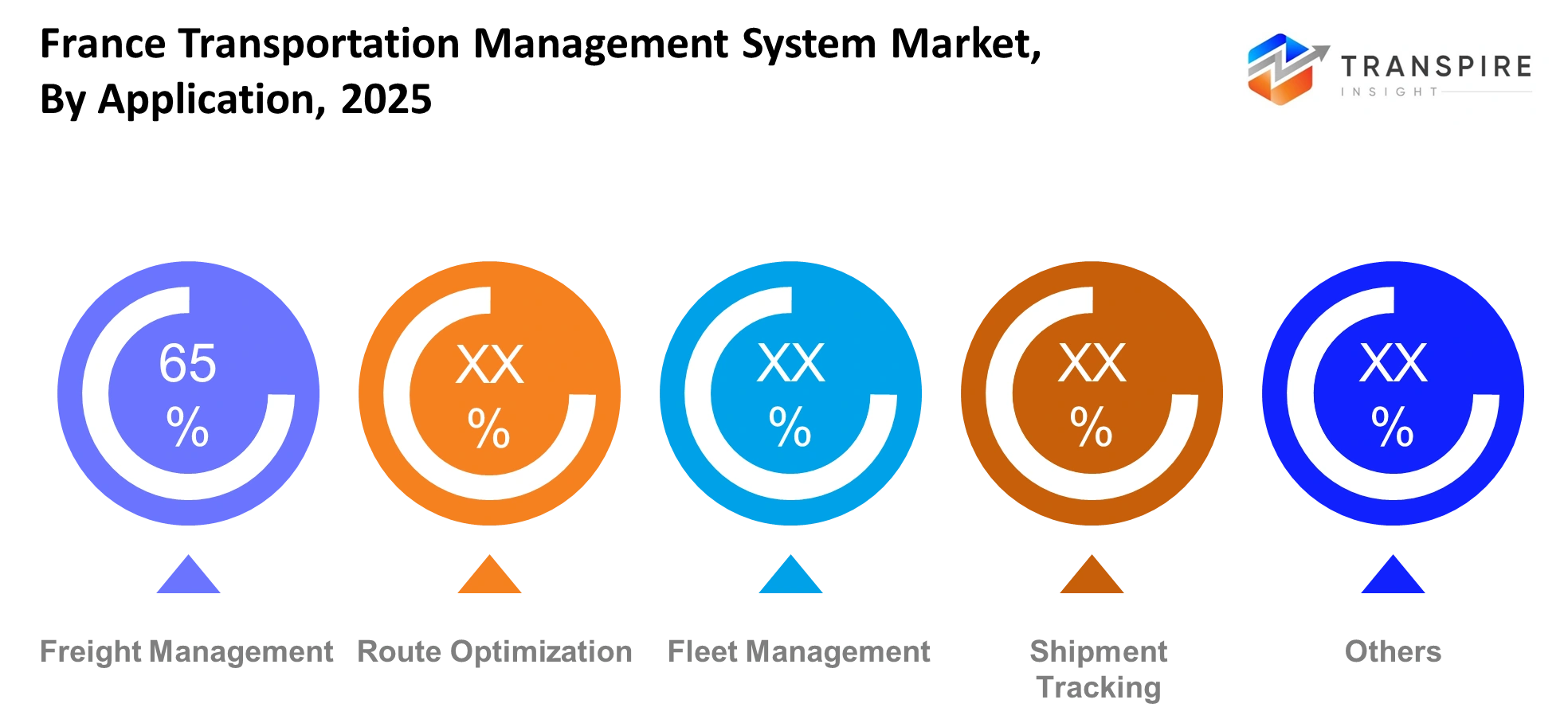
The application market shows its highest demand for freight management systems because transportation companies need unified platforms to manage their shipment operations and choose carriers and determine costs. The industry shows strong system adoption because retail businesses and manufacturing companies and third-party logistics providers experience higher freight volumes which create direct operational efficiency benefits that boost their profits. Businesses now implement digital freight management platforms to automate their coordination processes while achieving better results in European supply chain operations across borders.
The use of route optimization and fleet management applications is increasing because of higher fuel prices and the need for better vehicle resource management and delivery operations. The systems assist logistics companies in decreasing empty travel distances while they achieve better scheduling precision and improved total fleet effectiveness. AI-based routing tools will bring future growth because they create flexible transport systems which adjust according to current traffic and weather and demand changes.
To learn more about this report, Download Free Sample Report
By End-User
The primary user group of logistics companies controls all their business operations because transportation management functions as their essential method of achieving operational efficiency and delivering services. The companies utilize TMS platforms for two main purposes which include controlling their carrier networks and optimizing their freight operations across multiple clients at large scale. Supply chain complexity is increasing which creates a demand for businesses to establish real-time tracking systems that work throughout their disconnected logistical operations.
The upcoming forecast period will see logistics providers enhance their implementation of AI-based transportation orchestration systems which will enable them to achieve better automated processes while decreasing their operational expenses. Fast delivery requirements and omnichannel fulfillment needs and real-time shipment tracking needs create a significant demand which retailers need to fulfill. The need for delivery speed and order tracking information drives customers to prefer these services.
By Deployment
The Transportation Management System Market in France shows Cloud deployment as its leading method because businesses need to achieve better scalability, complete projects in shorter timeframes, and reduce their initial costs for infrastructure resources. Logistics operators increasingly shift toward SaaS-based transportation platforms that support real-time visibility, AI-driven optimization, and seamless integration with ERP and warehouse systems. Organizations require strong system adoption because they must operate multiple freight networks which include both domestic and international supply routes while keeping their business operations flexible.
Cloud systems will gain more strength during the forecast period because transportation software ecosystems will require more data processing power and automated functions. The increasing adoption of predictive analytics together with real-time coordination tools will establish cloud computing as the leading technology among mid-sized businesses which are pursuing fast digital transformation. The market is moving toward fully connected logistics platforms where transportation planning, execution, and analytics operate within unified cloud environments.
What are the Key Use Cases Driving the France Transportation Management System Market?
The transportation management system market in France sees its most common application through freight route optimization which retail e-commerce and third-party logistics companies use to operate their businesses. Companies use transportation management platforms to decrease empty vehicle operations while they automate their process of assigning carriers and their system for scheduling deliveries through their high-volume distribution networks. The application experiences its highest demand because French retailers and logistics providers must deal with increasing fuel prices and reduced delivery times and growing requirements for service dependability throughout their domestic and European shipping routes.
The manufacturing and industrial logistics sectors currently experience rapid development of their adjacent applications. Transportation orchestration tools increasingly find usage in automotive aerospace and consumer goods manufacturing because these tools help businesses synchronize their inbound material shipments with their outbound distribution operations. Food and beverage distributors are also adopting real-time freight visibility systems to manage temperature-sensitive deliveries and maintain compliance with European traceability regulations.
AI-based predictive transportation control towers and carbon emissions optimization platforms represent new applications for development. Large organizations now start to connect their transportation analytics systems with their sustainability reporting frameworks because they want to track freight emissions while enhancing their ESG compliance. Companies that operate near major French ports and cross-border trade hubs are showing growing interest in autonomous shipment planning systems and multimodal freight coordination tools.
|
Report Metrics |
Details |
|
Market size value in 2025 |
USD 134.98 Million |
|
Market size value in 2026 |
USD 145.79 Million |
|
Revenue forecast in 2033 |
USD 249.94 Million |
|
Growth rate |
CAGR of 8.01% from 2026 to 2033 |
|
Base year |
2025 |
|
Historical data |
2021 - 2024 |
|
Forecast period |
2026 - 2033 |
|
Report coverage |
Revenue forecast, competitive landscape, growth factors, and trends |
|
Regional scope |
France |
|
Key company profiled |
Caterpillar Inc., Cummins Inc., Rolls-Royce Holdings plc, Wärtsilä Corporation, MAN Energy Solutions SE, Mitsubishi Heavy Industries Ltd., General Electric Company, Yanmar Holdings Co. Ltd., Volvo Penta AB, Deutz AG, Perkins Engines Company Ltd., Kirloskar Oil Engines Ltd., Hyundai Heavy Industries Co. Ltd., Kohler Co., Scania AB. |
|
Customization scope |
Free report customization (country, regional & segment scope). Avail customized purchase options to meet your exact research needs. |
|
Report Segmentation |
By Type (Planning Systems, Execution Systems, Analytics & Reporting, Others); By Application (Freight Management, Route Optimization, Fleet Management, Shipment Tracking, Others); By End-User (Logistics Companies, Retailers, Manufacturers, E-commerce Companies, Others); By Deployment (Cloud, On-premise, Hybrid, Others). |
Which Regions are Driving the France Transportation Management System Market Growth?
The Northern France market holds the top position in regional markets because it contains the nation's most extensive logistics networks and industrial areas and freight transportation facilities. The area possesses direct transportation links that connect to Belgium and Germany and the Netherlands and the United Kingdom through its extensive system of roads and railways and ports. The main logistics centers located in Paris and Lille and Le Havre continue to draw funding for both warehouse automation systems and advanced freight management technologies. The government actively supports digital supply chain updates and cross-border trade improvements which help the region maintain its position as a leading economic center.
Western and Central France represent the second-largest contributor to market revenue but the growth pattern differs from the northern corridor. This region benefits from a stable manufacturing base and consistent industrial freight demand and long-term transportation modernization projects which operate without depending on high-volume international trade activities. Transportation management software becomes more popular among automotive suppliers and food processing companies and regional distributors because it helps them achieve better operational efficiency and manage freight expenses. Established manufacturing ecosystems generate reliable requirements for companies that need to manage logistics operations through integrated planning and multiple transportation methods.
The e-commerce infrastructure development together with Mediterranean trade operations and port modernization projects in Marseille and Toulouse have made Southern France the fastest growing region. The logistics sector in the region has undergone rapid digitization because companies installed new transportation visibility systems which enable them to track freight movements across borders into Southern Europe and North Africa.
Who are the Key Players in the France Transportation Management System Market and How Do They Compete?
The France Transportation Management System Market maintains its competition at a moderate level of market consolidation because international enterprise software companies and dedicated logistics technology firms both compete in the market. The competition now depends on two elements which include technology capabilities and integration levels instead of using pricing as the only competitive factor. The established vendors use AI-powered transportation analytics and cloud-based deployment solutions and complete supply chain system integration to protect their current market share. The specialized logistics software companies achieve market success through their rapid deployment capabilities and their customized freight management solutions which meet the needs of medium-sized businesses.
SAP creates its unique market position through complete system connections between its transportation management solution and ERP systems and warehouse functions and its business network partnerships. The company extended its logistics network through AI-based freight planning and digital cloud solutions which the company developed to serve the needs of French businesses that operate in regulated industries. Oracle competes with its predictive logistics intelligence and built-in analytics tools which customers can access through Oracle Fusion Cloud Transportation Management. The company uses autonomous transportation planning together with AI-based operational optimization to support its international supply chain operations.
Blue Yonder enhances its market position through its ability to deliver instant supply chain insights and its transportation management systems which focus on retail operations. Manhattan Associates establishes its market identity through its ability to provide combined transportation execution and warehouse management capabilities within a single logistics solution. Descartes Systems Group develops its solutions for European cross-border trade by creating systems that enable freight visibility through multiple modes of transportation and automatic customs compliance and direct connections to carriers.
Company List
- SAP
- Oracle
- IBM
- Blue Yonder
- Manhattan Associates
- Descartes Systems Group
- Trimble
- MercuryGate
- Infor
- C.H. Robinson
- E2open
- Transporeon
- 3Gtms
- Oracle Transportation Management
- Kuebix
Recent Development News
In April 2026, SAP was recognized as a Leader in the 2026 Gartner Magic Quadrant for Transportation Management Systems. The recognition strengthened SAP’s competitive position in AI-enabled transportation planning and integrated logistics execution.
Source Link: https://news.sap.com
In February 2026, SAP launched SAP Logistics Management as a SaaS-native logistics platform for localized and satellite transportation operations. The launch expanded cloud-based freight coordination and real-time carrier collaboration capabilities for growing logistics networks.
Source Link: https://news.sap.com
What Strategic Insights Define the Future of the France Transportation Management System Market?
The France Transportation Management System Market is evolving toward AI-powered logistics systems which use cloud-based platforms for complete freight tracking and warehouse operations and transportation routing and predictive analytics functions. The European market development is driven by ongoing supply chain problems and increasing delivery standards and need for effective international freight handling across European countries. The market will see transportation software providers who build multimodal logistics systems for enterprise ERP systems gain more market share during the next five to seven years. Businesses face hidden dangers because they increasingly rely on a small group of worldwide cloud and enterprise software companies.
Mid-sized logistics companies will face higher costs because of market concentration which will also restrict their ability to operate. European sustainability reporting requirements create new business opportunities for companies developing carbon emissions analytics and AI-driven autonomous freight coordination solutions. Companies entering the market should prioritize interoperable, API-driven transportation platforms that integrate seamlessly with warehouse systems, telematics infrastructure, and cross-border customs networks to remain competitive in the evolving French logistics ecosystem.
France Transportation Management System Market Report Segmentation
By Type
- Planning Systems
- Execution Systems
- Analytics & Reporting
- Others
By Application
- Freight Management
- Route Optimization
- Fleet Management
- Shipment Tracking
- Others
By End-User
- Logistics Companies
- Retailers
- Manufacturers
- E-commerce Companies
- Others
By Deployment
- Cloud
- On-premise
- Hybrid
- Others
Frequently Asked Questions
Find quick answers to common questions.
The confirmed 2033 market size figure in USD 249.94 Million.
Key segments for the France Transportation Management System Market are By Type (Planning Systems, Execution Systems, Analytics & Reporting, Others); By Application (Freight Management, Route Optimization, Fleet Management, Shipment Tracking, Others); By End-User (Logistics Companies, Retailers, Manufacturers, E-commerce Companies, Others); By Deployment (Cloud, On-premise, Hybrid, Others).
Major France Transportation Management System Market players are SAP, Oracle, IBM, Blue Yonder, Manhattan Associates, Descartes Systems, Trimble, MercuryGate, Infor, C.H. Robinson, E2open, Transporeon, 3Gtms, Oracle Transportation, Kuebix.
The France Transportation Management System Market size is USD 134.98 Million in 2025.
The France Transportation Management System Market CAGR is 8.01% from 2026 to 2033.
- SAP
- Oracle
- IBM
- Blue Yonder
- Manhattan Associates
- Descartes Systems Group
- Trimble
- MercuryGate
- Infor
- C.H. Robinson
- E2open
- Transporeon
- 3Gtms
- Oracle Transportation Management
- Kuebix
Recently Published Reports
-
Apr 2026
3D Optical Profiler Market
3D Optical Profiler Market Size, Share & Analysis Report By Type (Desktop 3D Optical Profiler, and Portable 3D Optical Profiler), By Technology (Confocal Technology, and White Light Interference), By End-Use Industry (Manufacturing, Research Institutions, Automotive, Aerospace and Defense, Medical Devices, and Other), and Geography (North America, Europe, Asia-Pacific, Middle East and Africa, South and Central America), 2021 - 2031
-
Apr 2026
Depth Sensor Market
Depth Sensor Market Size, Share & Analysis Report By Type (Infrared Depth Sensors, Time-of-Flight (ToF) Sensors, Stereo Vision Sensors, Structured Light Sensors, Ultrasonic Depth Sensors), By Application (Automotive, Robotics, Gaming, Consumer Electronics, Industrial Automation, Healthcare, Security & Surveillance, Others), By End Users (Automotive Manufacturers, Consumer Electronics Companies, Healthcare Providers, Industrial Companies, Security Agencies, Gaming Companies, Robotics Companies, Others), and Geography (North America, Europe, Asia-Pacific, Middle East and Africa, South and Central America), 2021 – 2031
-
Apr 2026
Digital Manufacturing Market
Digital Manufacturing Market Size, Share & Analysis Report By Component (Hardware, Software, and Services), By Technology (Robotics, 3D Printing, Internet of Things (IoT), and Others), By Application (Automotive and Transportation, Aerospace and Defense, Consumer Electronics, Industrial Machinery, and Others), By Process Type (Computer-Based Designing, Computer-Based Simulation, Computer 3D Visualization, Analytics, and Others), and Geography (North America, Europe, Asia-Pacific, Middle East and Africa, South and Central America), 2021 – 2031
-
Apr 2026
Digital Visa Services Market
Digital Visa Services Market Size, Share & Analysis Report By Type (Individual Travelers, Group Travelers), By Application (Tourism, Business Travel, Others), and Geography (North America, Europe, Asia-Pacific, Middle East and Africa, South and Central America), 2021 – 2031