
Europe Intelligent Transportation System Market Size & Forecast:
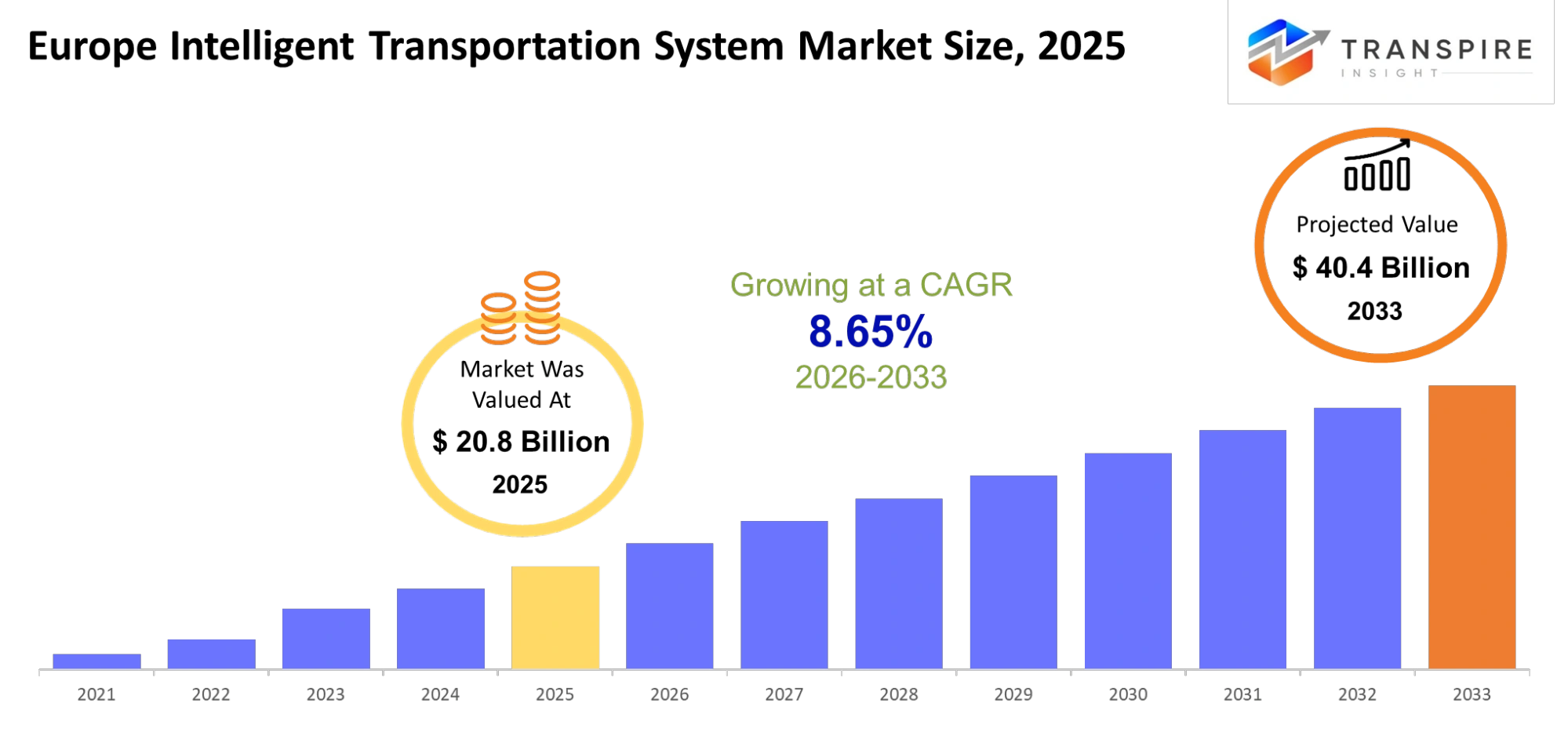
- Europe Intelligent Transportation System Market Size 2025: USD 20.8 Billion
- Europe Intelligent Transportation System Market Size 2033: USD 40.4 Billion
- Europe Intelligent Transportation System Market CAGR: 8.65%
- Europe Intelligent Transportation System Market Segments: By Type (Traffic Management, Fleet Management, Parking Management, Ticketing Systems, Surveillance Systems, Others); By Application (Roadways, Railways, Aviation, Maritime, Urban Mobility, Others); By End-User (Government, Transport Authorities, Logistics, Smart Cities, Enterprises, Others); By Component (Hardware, Software, Services, Sensors, Communication Systems, Others)
To learn more about this report,  Download Free Sample Report
Europe Intelligent Transportation System Market Summary:
The Europe Intelligent Transportation System Market size is estimated at USD 20.8 Billion in 2025 and is anticipated to reach USD 40.4 Billion by 2033, growing at a CAGR of 8.65% from 2026 to 2033. europe intelligent transportation system market sits within the broader mobility technology industry and will continue to reshape how cities handle movement, safety, and congestion. What defines its current state is a shift in commuter expectations, where real-time updates, seamless ticketing, and predictable travel will be seen as basic necessities rather than added benefits. Public authorities across Europe will tighten regulations around emissions and road safety, pushing digital traffic control and smart infrastructure into everyday use. At the same time, advances in vehicle connectivity, edge computing, and data exchange will deepen coordination between roads, vehicles, and control centers, gradually turning transport networks into responsive, data-driven ecosystems.
What Has the Impact of Artificial Intelligence Been on the Europe Intelligent Transportation System Market?
Artificial intelligence is rapidly transforming the europe intelligent transportation system market by reshaping how data is captured, analyzed, and translated into real-time mobility decisions. AI in europe intelligent transportation system market operations will strengthen market research capabilities through advanced data modeling, enabling authorities and private players to interpret traffic patterns, commuter behavior, and infrastructure performance with far greater accuracy. Machine learning algorithms will continuously refine demand forecasting, allowing transport networks to anticipate congestion, optimize route planning, and align services with shifting urban mobility trends.
Artificial intelligence in europe intelligent transportation system market frameworks will also elevate operational efficiency through smart automation and predictive analytics. AI-driven systems will streamline traffic signal control, reduce idle times, and enhance incident detection, directly lowering operational costs and improving service reliability. In supply chain and logistics integration, intelligent routing and automated fleet coordination will minimize fuel consumption and delivery delays, supporting cost reduction and sustainability goals. These advancements will position the europe intelligent transportation system market as a data-centric ecosystem where innovation, personalization, and adaptive infrastructure create a measurable competitive edge for stakeholders navigating complex urban transport demands.
Key Market Trends & Insights:
- The europe intelligent transportation system market is witnessing increased adoption of AI in traffic optimization, improving congestion control and reducing travel time by up to 25%.
- Smart automation and machine learning are enabling predictive analytics, enhancing real-time decision-making and boosting operational efficiency across transport networks.
- Growing demand for connected vehicles and V2X communication is strengthening the europe intelligent transportation system market ecosystem with advanced data-sharing capabilities.
- Sustainability regulations are accelerating deployment of smart mobility solutions, reducing emissions and supporting green transport initiatives across major European cities.
- Western Europe dominates the europe intelligent transportation system market, holding nearly 45% market share in 2025 due to advanced infrastructure and early technology adoption.
- Eastern Europe is the fastest-growing region, expected to expand at over 10% CAGR during the forecast period with increasing smart city investments.
- Traffic management systems dominate with over 35% share, driven by demand for congestion reduction and urban mobility control.
- Advanced traveler information systems rank as the second-largest segment, supported by rising real-time data usage.
- Smart ticketing solutions are the fastest-growing segment through 2030, fueled by digital payment integration trends.
- Urban traffic management leads with approximately 40% share, reflecting high demand for efficient city transport systems.
- Autonomous vehicle integration is the fastest-growing application, driven by innovation in AI and connected mobility technologies.
- Government and public sector agencies dominate with over 50% share, investing heavily in infrastructure modernization.
- Logistics and fleet operators are rapidly growing end-users, leveraging predictive analytics for route optimization and cost efficiency.
Europe Intelligent Transportation System Market Segmentation
By Type:
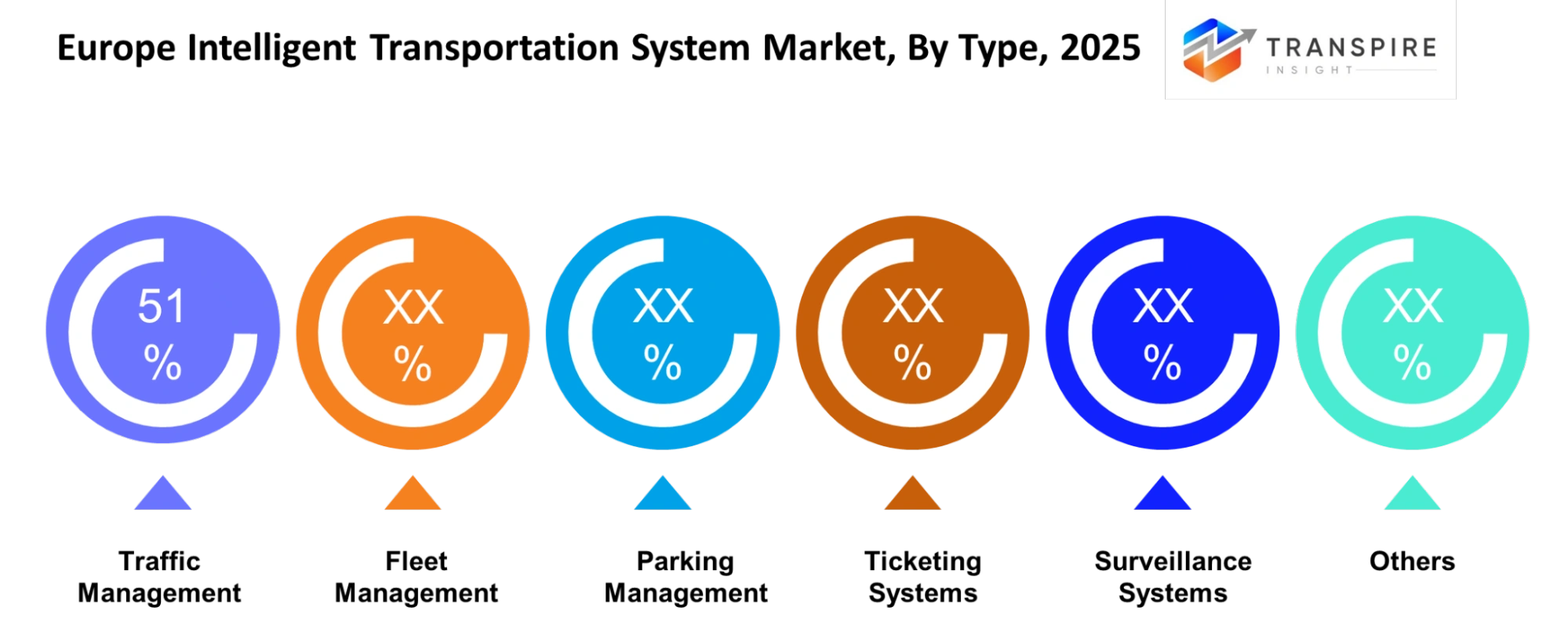
Traffic management will remain central as cities aim to reduce congestion and improve road efficiency through real-time monitoring systems. Fleet management will gain attention as logistics providers will rely on tracking tools to improve delivery timelines and reduce fuel usage. Parking management will address urban space challenges by guiding vehicles toward available spots and lowering idle time. Ticketing systems will move toward digital formats, making public transport access smoother and more convenient for daily users.
Surveillance systems will support safety by using cameras and data analysis to detect violations and manage incidents quickly. Other solutions will include integrated platforms that connect multiple services into a single operational system. Each type will work together to create a more coordinated transport structure. Continuous upgrades in digital tools will strengthen performance and user satisfaction across these categories.
To learn more about this report, Download Free Sample Report
By Application :
Roadways will dominate due to high vehicle usage and the need for efficient traffic flow in growing urban areas. Railways will adopt smart scheduling and monitoring tools to improve punctuality and passenger experience. Aviation will use advanced systems to manage air traffic and reduce delays at busy airports. Maritime applications will focus on port management and vessel tracking to ensure smooth cargo movement.
Urban mobility will expand with integrated transport solutions that connect buses, metros, and shared services into one system. Other applications will include niche areas where smart transport solutions will enhance operational control. Demand across these applications will continue to rise as cities aim for better connectivity. Technology adoption will support faster and safer movement across all transport modes.
By End-User :
Government bodies will lead investments as public infrastructure development will remain a priority for economic growth. Transport authorities will manage daily operations by adopting systems that improve service reliability and reduce delays. Logistics companies will use smart tools to optimize routes and cut operational costs. Smart cities will integrate transport systems into broader digital frameworks to improve urban living standards.
Enterprises will adopt these systems to support employee mobility and business operations. Other end-users will include smaller organizations seeking efficient transport solutions. Each group will contribute to the overall demand by focusing on efficiency and cost control. Long-term planning will ensure better coordination between public and private stakeholders.
By Component :
Hardware will include physical devices such as cameras, control units, and display systems that support transport operations. Software will play a key role in data processing, analytics, and system integration for better decision-making. Services will cover maintenance, consulting, and system upgrades to ensure smooth functioning over time. Sensors will collect real-time data from vehicles and infrastructure to improve monitoring accuracy.
Communication systems will enable data exchange between different components, supporting real-time coordination across networks. Other components will include emerging technologies that enhance system capabilities. Each element will work together to build a connected and responsive transport environment. Ongoing innovation will improve efficiency, safety, and overall system performance.
What are the Main Challenges for the Europe Intelligent Transportation System Market Growth?
Technical and operational complexity remains one of the most critical challenges in europe intelligent transportation system market expansion. Integrating legacy infrastructure with modern digital platforms often creates performance gaps and interoperability issues, slowing system deployment. Data accuracy, cybersecurity risks, and real-time processing limitations further add to operational strain, especially in high-density urban environments. These challenges in europe intelligent transportation system market systems can restrict scalability and reduce the efficiency gains expected from smart transport solutions.
Manufacturing and commercialization barriers also influence the pace of europe intelligent transportation system market growth. High development costs, strict regulatory compliance requirements, and lengthy approval processes delay the rollout of advanced technologies. Vendors must meet region-specific standards, which increases production complexity and limits rapid expansion across multiple countries. Cost pressures and uncertain return on investment often discourage smaller players from entering the europe intelligent transportation system market, creating a barrier to innovation.
Adoption challenges continue to affect overall market penetration, particularly in regions with limited digital infrastructure. Many cities face funding gaps and lack the skilled workforce needed to implement and manage advanced systems. Resistance to change and slow policy execution further delay adoption, adding to the market limitations. Competition from alternative mobility solutions and evolving technology standards will also create future risks, shaping the long-term direction of europe intelligent transportation system market development.
Regional Insights
Western Europe will lead due to strong digital infrastructure, early adoption of smart mobility solutions, and consistent public investment in transport modernization. Countries such as Germany, France, and the Netherlands will focus on integrated traffic systems, reducing congestion and improving road safety. Advanced policy frameworks will support long-term deployment and system upgrades.
Northern Europe will show steady progress with emphasis on sustainability and clean mobility. Sweden and Denmark will invest in intelligent traffic control and connected transport networks. High urban planning standards will support efficient system use and better commuter experience. Stable funding and innovation-driven policies will strengthen regional adoption.
Eastern Europe will emerge as a fast-growing area with increasing smart city initiatives and infrastructure development. Poland and Hungary will expand digital transport systems to improve connectivity and reduce operational gaps. Government support and foreign investment will drive gradual adoption. Development pace will vary based on economic and technical readiness across countries.
Recent Development News
In April 2026, Hitachi Rail announced acquisition of Clever Devices. The deal will expand digital mobility capabilities and strengthen intelligent transport solutions across global transit systems.https://www.hitachi.com
In April 2026, Tracsis announced acquisition of Vesputi GmbH. The acquisition will enhance data-driven transport analytics and support expansion of smart mobility services in Europe.https://www.londonstockexchange.com
|
Report Metrics |
Details |
|
Market size value in 2025 |
USD 20.8 Billion |
|
Market size value in 2026 |
USD 22.6 Billion |
|
Revenue forecast in 2033 |
USD 40.4 Billion |
|
Growth rate |
CAGR of 8.65% from 2026 to 2033 |
|
Base year |
2025 |
|
Historical data |
2021 - 2024 |
|
Forecast period |
2026 - 2033 |
|
Report coverage |
Revenue forecast, competitive landscape, growth factors, and trends |
|
Regional scope |
Europe (Germany, United Kingdom, France, Italy, Spain, Rest of Europe) |
|
Key company profiled |
Siemens, Thales, Kapsch TrafficCom, Cubic Corporation, Garmin, TomTom, Bosch, IBM, Cisco, Hitachi, NEC, Alstom, Indra Sistemas, Huawei, Schneider Electric |
|
Customization scope |
Free report customization (country, regional & segment scope). Avail customized purchase options to meet your exact research needs. |
|
Report Segmentation |
By Type (Traffic Management, Fleet Management, Parking Management, Ticketing Systems, Surveillance Systems, Others); By Application (Roadways, Railways, Aviation, Maritime, Urban Mobility, Others); By End-User (Government, Transport Authorities, Logistics, Smart Cities, Enterprises, Others); By Component (Hardware, Software, Services, Sensors, Communication Systems, Others) |
How Can New Companies Establish a Strong Foothold in the Europe Intelligent Transportation System Market?
New entrants can build a strong position in the europe intelligent transportation system market by focusing on niche problem areas where large vendors often move slowly. Targeting segments such as last-mile delivery optimization, urban congestion analytics, or smart parking will allow startups to deliver specialized solutions with faster deployment cycles. Innovation strategies built around AI-driven predictive analytics and real-time data platforms will help address pressing urban mobility challenges. By aligning offerings with current industry trends such as sustainability and connected mobility, companies can tap into steady market growth opportunities.
Partnerships will play a decisive role in scaling within the europe intelligent transportation system market. Collaborating with municipal authorities, transport agencies, and infrastructure providers will open access to pilot projects and long-term contracts. Technology differentiation through cloud-based platforms, IoT-enabled sensors, and edge computing will help new players stand out in a competitive environment. Solving sector-specific issues, such as reducing delivery delays in logistics or improving passenger flow in smart cities, will strengthen credibility and customer retention.
Emerging players already demonstrate how focused innovation can create impact in the europe intelligent transportation system market. For instance, startups like Vianova are using data analytics to improve urban traffic planning, while Padam Mobility is enhancing flexible public transport systems. These examples highlight that combining targeted solutions with strong partnerships and scalable technology will help new companies establish a lasting foothold.
Key Europe Intelligent Transportation System Market Company Insights
Competition will remain intense as established firms and emerging players will focus on advanced digital solutions and service expansion. Companies will invest in artificial intelligence, real-time analytics, and connected infrastructure to strengthen positioning. Continuous product upgrades and system integration will help maintain strong market presence across multiple regions.
Strategic partnerships and acquisitions will play a key role in gaining competitive advantage and expanding capabilities. Firms will collaborate with government bodies and transport authorities to secure long-term projects. Focus on cost efficiency, innovation, and scalable platforms will support differentiation. Market participants will aim to improve performance, reliability, and user experience through ongoing technological improvements.
Company List
- Siemens
- Thales
- Kapsch TrafficCom
- Cubic Corporation
- Garmin
- TomTom
- Bosch
- IBM
- Cisco
- Hitachi
- NEC
- Alstom
- Indra Sistemas
- Huawei
- Schneider Electric
What are the Key Use-Cases Driving the Growth of the Europe Intelligent Transportation System Market?
The europe intelligent transportation system market is gaining momentum through practical use-cases that directly address urban congestion and road safety challenges. Intelligent traffic management systems are widely deployed to monitor vehicle flow, adjust signal timings, and reduce travel delays in major cities. These solutions use real-time data and predictive analytics to improve decision-making, leading to measurable reductions in congestion and emissions. As cities aim for smarter mobility, such applications are accelerating adoption across both public and private sectors.
Another key use-case driving the europe intelligent transportation system market is smart public transport integration. Digital ticketing, passenger information systems, and route optimization tools are enhancing commuter experience and operational efficiency. Transport agencies are leveraging connected platforms to manage fleets, track vehicles, and improve service reliability. This shift is not only increasing user satisfaction but also supporting higher ridership levels, contributing to steady market expansion.
Logistics and fleet management applications are also shaping the europe intelligent transportation system market by improving supply chain efficiency. Companies are using AI-driven route planning and vehicle tracking to reduce delivery times and fuel costs. In parallel, smart parking and urban mobility platforms are helping cities manage space constraints and reduce idle traffic. These diverse use-cases highlight strong innovation potential and will support long-term scalability across multiple industries.
Europe Intelligent Transportation System Market Report Segmentation
By Type
- Traffic Management
- Fleet Management
- Parking Management
- Ticketing Systems
- Surveillance Systems
- Others
By Application
- Roadways
- Railways
- Aviation
- Maritime
- Urban Mobility
- Others
By End-User
- Government
- Transport Authorities
- Logistics
- Smart Cities
- Enterprises
- Others
By Component
- Hardware
- Software
- Services
- Sensors
- Communication Systems
- Others
Frequently Asked Questions
Find quick answers to common questions.
The approximate Europe Intelligent Transportation System Market size for the market will be USD 40.4 Billion in 2033.
Key segments for the Europe Intelligent Transportation System Market are By Type (Traffic Management, Fleet Management, Parking Management, Ticketing Systems, Surveillance Systems, Others); By Application (Roadways, Railways, Aviation, Maritime, Urban Mobility, Others); By End-User (Government, Transport Authorities, Logistics, Smart Cities, Enterprises, Others); By Component (Hardware, Software, Services, Sensors, Communication Systems, Others).
Major Europe Intelligent Transportation System Market players are Siemens, Thales, Kapsch TrafficCom, Cubic Corporation, Garmin, TomTom, Bosch, IBM, Cisco, Hitachi, NEC, Alstom, Indra Sistemas, Huawei, Schneider Electric.
The Europe Intelligent Transportation System Market size is USD 20.8 Billion in 2025.
The Europe Intelligent Transportation System Market CAGR is 8.65%.
- Siemens
- Thales
- Kapsch TrafficCom
- Cubic Corporation
- Garmin
- TomTom
- Bosch
- IBM
- Cisco
- Hitachi
- NEC
- Alstom
- Indra Sistemas
- Huawei
- Schneider Electric
Recently Published Reports
-
Apr 2026
ATV & UTV Market
ATV & UTV Market Size, Share & Analysis Report By Type (ATV, and UTV), By Variants (Less Than 400 CC, 400 CC To 800 CC, and More Than 800 CC), and Geography (North America, Europe, Asia-Pacific, Middle East and Africa, South and Central America), 2021 - 2031
-
Apr 2026
Automotive Central Gateway Module Market
Automotive Central Gateway Module Market Size, Share & Analysis Report By Type (Ethernet Central Gateway Module, CAN Central Gateway Module, LIN Central Gateway Module, and FlexRay), By Application (Powertrain Control, Body Control, Infotainment System, Advanced Driver Assistance Systems (ADAS), and Others), By End User (Passenger Vehicles, and Commercial Vehicles), and Geography (North America, Europe, Asia-Pacific, Middle East and Africa, South and Central America), 2021 - 2031
-
Apr 2026
Automotive Engine Oil Filter Market
Automotive Engine Oil Filter Market Size, Share & Analysis Report By Filter Type (Fuel Filter, Engine Oil Filter, Hydraulic Oil Filter, and Others), By Filter Media (Cellulose, Synthetic, and Micro), By Sales Channel (OEMs, and Aftermarket), By Vehicle Type (Passenger Cars, Light Commercial Vehicles, Heavy Duty Trucks, Buses and Coaches, and Off-road Vehicles), and Geography (North America, Europe, Asia-Pacific, Middle East and Africa, South and Central America), 2021 - 2031
-
Apr 2026
Automotive Parts Aluminium Die Casting Market
Automotive Parts Aluminium Die Casting Market Size, Share & Analysis Report By Production Process (Pressure Die Casting, Vacuum Die Casting, Squeeze Die Casting, Gravity Die Casting), By Application (Body Parts, Engine Parts, Transmission Parts, Battery And Related Components, Other Application Types), and Geography (North America, Europe, Asia-Pacific, Middle East and Africa, South and Central America), 2021 - 2031
Our Clients