Market Summary
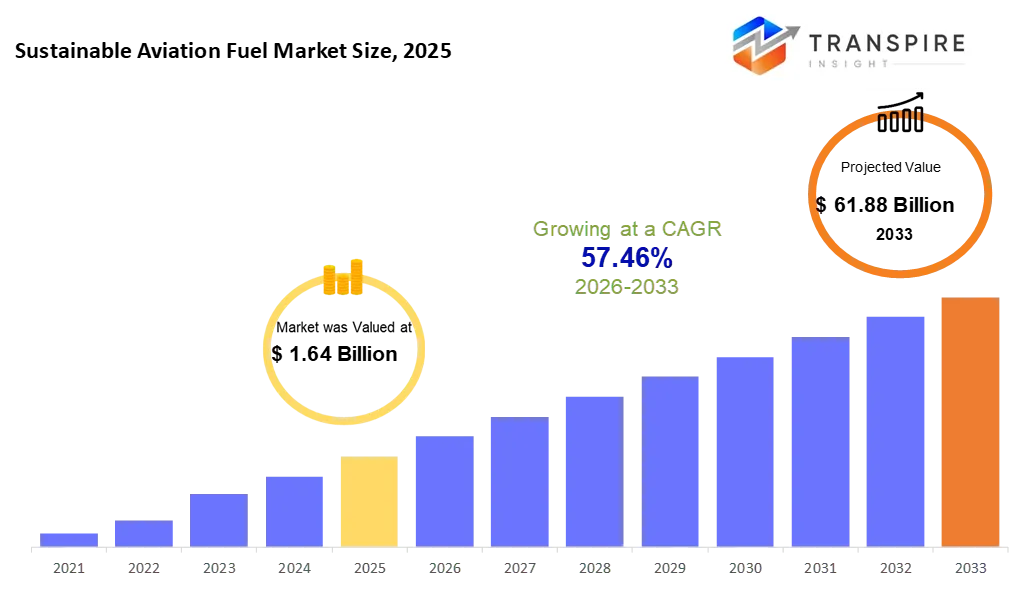
The global Sustainable Aviation Fuel market size was valued at USD 1.64 billion in 2025 and is projected to reach USD 61.88 billion by 2033, growing at a CAGR of 57.46% from 2026 to 2033. Growth in the sustainable aviation fuel market is driven by rising pressure to cut aviation carbon emissions and meet global climate commitments. Airlines are increasingly adopting SAF blends to comply with regulatory mandates and voluntary net-zero targets. Advancements in conversion technologies and expanding feedstock availability, along with government incentives and airline–fuel producer partnerships, are accelerating commercial-scale deployment.
Market Size & Forecast
- 2025 Market Size: USD 1.64 Billion
- 2033 Projected Market Size: USD 61.88 Billion
- CAGR (2026-2033): 57.46%
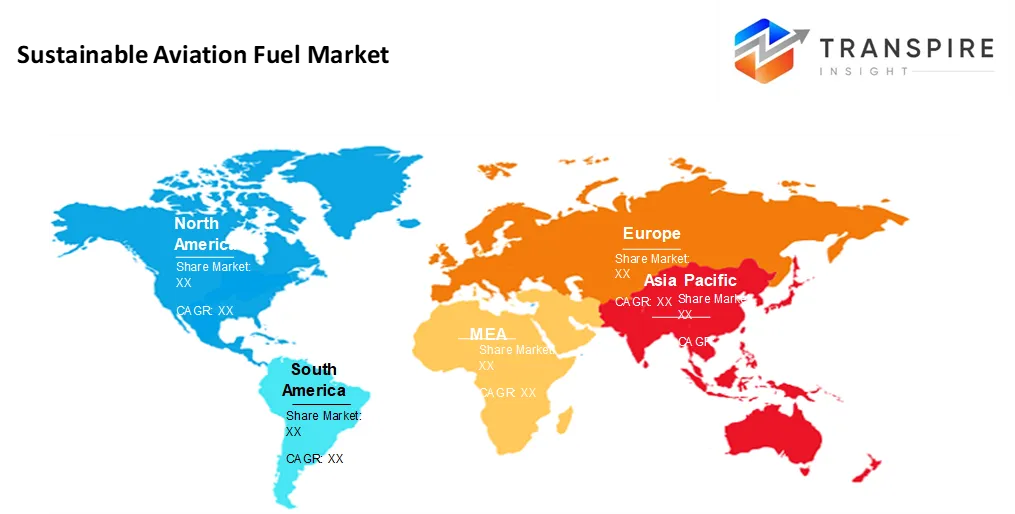
- North America: Largest Market in 2026
- Asia Pacific: Fastest Growing Market
To learn more about this report,  Download Free Sample Report
Key Market Trends Analysis
- North America market share estimated to be approximately 47% in 2026. Fueled by firm promises from carriers, plus backing from officials, the region pushes ahead. The infrastructure already in place gives it an edge. Progress rolls forward because support runs deep. Momentum builds where effort meets readiness.
- Fueled by government rules on biofuels, the United States holds the top spot among countries. Plants that make HEFA-SPK fuel are already active there. Major airlines work closely with these operations. Size-wise, no other nation matches its scale in this field.
- Out of nowhere, Asia Pacific surges ahead as demand for cleaner flight fuels climbs. Rising passenger numbers light a spark under change across major hubs. Projects aiming at sustainable fuel gain ground fast in China, then Japan, followed by Australia. Airlines there push harder into greener operations, shifting momentum quietly but steadily.
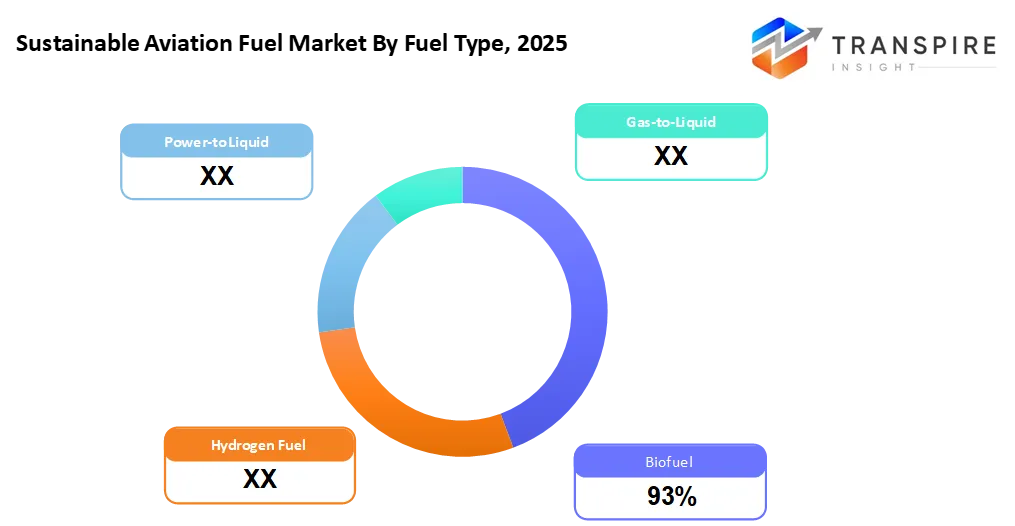
- Biofuel shares approximately 95% in 2026. Biofuels work straight out of the gate with today’s aircraft engines. No redesign needed. Because they fit right into current systems, adoption happens faster. Their edge lies in slashing carbon output over their entire life cycle. That drop matters when measuring environmental impact.
- Starting strong, HEFA-SPK leads the pack among SAF methods. Its edge comes from being already rolled out at scale. Costs stay low thanks to established processes. They have e been quick to jump on board. Success like this did not come overnight; it built up steadily.
- Fuel needs for long-distance travel make fixed-wing planes the top users of sustainable aviation fuel. Their role in moving people and goods worldwide drives this high consumption rate.
- Fueled by rules, climate goals, and airlines, SAF gains ground on commercial flights. While promises matter, real change rides with each jet that takes off using cleaner fuel.
A surge in demand for greener flight options pushes the rise of Sustainable Aviation Fuel. From old kitchen grease to algae and farm leftovers, raw materials are changing how fuel gets made. Instead of relying on fossil sources, producers now turn to crops, fats, and biological waste. These inputs go through methods like HEFA-SPK or Fischer-Tropsch to become usable power for planes. Another route, turning alcohol into fuel, opens more doors across both civilian and defense fleets. Because these fuels work in today’s engines, switching becomes simpler without costly upgrades. Growth continues as pressure mounts to cut down soot and fumes from air travel. While challenges remain, progress moves steadily under real-world conditions.
Commercial flights use most of the world's jet fuel, making them the main force behind SAF demand. As rules tighten on emissions, airlines turn to sustainable alternatives not just to comply but also to honor their own climate goals. Programs such as CORSia push further adoption across global routes. Among the options available now, bio-based fuels lead the way. These include HEFA-SPK types made from used cooking grease and animal fat. Their edge comes from existing supply chains, lower costs compared to newer options, and measurable cuts in carbon output over time.
Now coming into focus, machines shape how much sustainable fuel can be made at a lower expense. Because it has been around longer, HEFA-SPK runs ahead of others in use. On the edges, methods like ATJ-SPK, FT-SPK, and ones using heat-driven breakdown gain ground slowly. Fuel output grows faster since test programs get more money, refineries blend new materials, and cooperation forms across companies, carriers, and officials.
On top of things, North America, along with Europe, moves ahead in adopting sustainable aviation fuel thanks to policy backing, financial nudges from governments, and airlines stepping up, especially in the United States, where demand hits its highest. Not far behind, the Asia Pacific races forward on growing flight numbers plus green goals set by countries like China, Japan, and Australia. Elsewhere, chances pop up when making more fuel from non-traditional sources, pushing usage into freight flights, short-hop routes, and private jets, while also funneling resources into studying future types of clean jet fuels.
Sustainable Aviation Fuel Market Segmentation
By Fuel Type
- Fuel
Fuel made from living stuff runs most of today’s sustainable aviation supply. It works straight away with current planes. It cuts emissions well. Ready now, not someday. Fits without engine changes.
- Hydrogen Fuel
Starting fresh, hydrogen fuel powers new kinds of flight without releasing pollution. Some test planes already run on it, showing what might come next. A few forward-looking models are trying this out before others follow. This path opens different ways to move through the sky cleanly.
- Power-to-Liquid Fuel
Fuel made from air and water, powered by clean energy, is stepping into the spotlight. This liquid form of stored sunlight runs engines without fossil fumes. Renewables drive the process, turning electrons into droplets that can burn later. A quiet shift grows behind labs refining these sky-sourced liquids. Time reveals its role in cutting carbon deep within heavy transport. Not magic, just molecules remade with wind and sun.
- Gas-to-Liquid
Turning natural gas into airplane fuel happens in places where gas is plentiful. This process fills a small but specific role in energy markets. Instead of burning it directly, some nations transform the resource through chemical methods. The result works like regular aviation fuel yet comes from a different source. Such projects tend to appear where pipelines and reserves already exist.
To learn more about this report, Download Free Sample Report
By Technology
- HEFA-SPK
Most airlines now rely on HEFA-SPK for sustainable fuel. This method stands out because it works at scale today. Its real-world readiness sets it apart from newer options. Equipment and supply chains already support it widely.
- FT-SPK
From wood or trash, gas forms first. That gas turns into a liquid fuel for planes through Fischer-Tropsch chemistry. This kerosene-like result burns clean. The method skips crude oil entirely. Heat and pressure remake molecules step by step. Final product fits existing engines without changes.
- HFS-SIP
Fermentation turns sugars into fuel, processed later to match jet standards. This route builds on farm-grown syrup instead of crude oil.
- ATJ-SPK
- From fermented alcohol, ATJ-SPK makes renewable jet fuel. Though still in trial phases, more programs are beginning to test it. One step at a time, this method turns farm-based liquids into aircraft energy.
By Aircraft Type
- Fixed Wings
Fuel-thirsty machines that stay aloft on steady wings dominate SAF use simply because they burn so much during long-haul flights across continents, carrying passengers or freight.
- Rotocraft
A few helicopters try rotocraft designs, though most stay close to testing phases. Not many choose this path -interest pops up now and then, mostly in specialty cases.
- Others
Flying machines beyond regular planes, some tiny, some unique, are testing cleaner fuel options. Drones take flight with new energy ideas. Unmanned vehicles help check how green power works in practice.
By Platform
- Commercial Aviation
- Because of strict rules plus goals to cut emissions, commercial aviation pushes forward on sustainable fuel use. Still, pressure from laws shapes how fast changes happen across the industry. Goals tied to lowering carbon footprints steer decisions more than before. Rules don’t just suggest change, they demand it. Even so, movement grows steady under these demands.
- Regional Transport Aircraft
Out on shorter routes, regional planes are starting to fly more often using sustainable fuels. These smaller aircraft see increasing fuel changes aimed at cutting emissions locally. Step by step, airlines swap standard options for greener ones across brief trips. Fuel shifts here support wider efforts without waiting for long-distance fixes.
- Military Aviation
Flying military planes saw quick changes, thanks to national efforts aiming at long-term goals. Choices made in defense planning pushed new approaches forward early on.
- Business & General Aviation
Some now run on cleaner fuel, though it is still rare. More companies are slowly beginning to try these greener options instead of waiting. Private jets see a quiet rise in this shift, not fast, not loud, just steady. A few owners swap old methods simply because change feels possible today.
- Unmanned Aerial Vehicles
Flying robots take part in small-scale trials, often just test runs. Sometimes seen at demos, rarely elsewhere.
Regional Insights
Right now, North America leads in SAF demand because airlines there aim high on green goals, get help from public funding, plus already have plants ready to go. At the front stands the United States, home to several sites making fuel via HEFA-SPK and ATJ-SPK methods. Behind it, Canada follows with steady growth across both passenger flights and freight routes. Over in Europe, nations like Germany, France, and the United Kingdom push ahead fast thanks to strict rules from Brussels, climate promises, and close work between carriers and suppliers. Elsewhere on that continent, countries such as Spain, Italy, and the Netherlands move more slowly but build momentum using trial runs alongside new local refineries.
Across the Asia Pacific, demand for sustainable aviation fuel is climbing fast as flights increase and concern about emissions spreads. Not just airlines but also national plans push forward in countries like China, Japan, and Australia, where trials and support measures take shape. Elsewhere, places such as South Korea, India, and Thailand see slow movement fueled by outside supplies, carrier efforts, and early homegrown attempts. Growth hangs on better access to raw materials, stronger networks for transport, and processing factors now drawing more funds. Progress speeds up where groundwork strengthens.
Brazil and Mexico lead Latin America's shift toward sustainable aviation fuel, thanks to joint efforts and new facilities coming online. Elsewhere in the region, nations like Argentina, Chile, and Colombia inch forward with slow but steady uptake. Over in the Middle East and Africa, early momentum builds as Saudi Arabia, the United Arab Emirates, and Turkey integrate cleaner fuels into state and private flights. Countries such as South Africa, Egypt, and Morocco follow behind, nudged ahead by green power plans and carriers aiming for lower emissions.
To learn more about this report, Download Free Sample Report
Recent Development News
- November 20, 2025 – Spring GDS launched a new sustainable aviation fuel.
- October 23, 2025 – Neste extends partnership with United Airlines to bring sustainable aviation fuel to three major United States airports.
- July 9, 2025 – ORLEN launched sales of new aviation fuel.
|
Report Metrics |
Details |
|
Market size value in 2025 |
USD 1.64 Billion |
|
Market size value in 2026 |
USD 2.58 Billion |
|
Revenue forecast in 2033 |
USD 61.88 Billion |
|
Growth rate |
CAGR of 57.46% from 2026 to 2033 |
|
Base year |
2025 |
|
Historical data |
2021 – 2024 |
|
Forecast period |
2026 – 2033 |
|
Report coverage |
Revenue forecast, competitive landscape, growth factors, and trends |
|
Regional scope |
North America; Europe; Asia Pacific; Latin America; Middle East & Africa |
|
Country scope |
United States; Canada; Mexico; United Kingdom; Germany; France; Italy; Spain; Denmark; Sweden; Norway; China; Japan; India; Australia; South Korea; Thailand; Brazil; Argentina; South Africa; Saudi Arabia; United Arab Emirates |
|
Key company profiled |
Aemetis Inc., Avfuel, Fulcrum BioEnergy, Gevo, Total Energies Aviation, LanzaTech, Neste, Preem AB, Sansol, SkyNRG, World Energy, Velocys, BP Global, Exxon Mobil Corporation, Renewable Energy Group, Phillips 66, Honeywell, and Advanced Biofuel. |
|
Customization scope |
Free report customization (country, regional & segment scope). Avail customized purchase options to meet your exact research needs. |
|
Report Segmentation |
By Fuel Type (Biofuel, Hydrogen Fuel, Power to Liquid Fuel, Gas-to-Liquid) By Technology(HEFA-SPK, FT-SPK, HFS-SIP, ATJ-SPK) By Aircraft Type (Fixed Wings, Rotocraft, Others) By Platform (Commercial, Regional Transport Aircraft, Military Aviation, Business & General Aviation, Unmanned Aerial Vehicles) |
Key Sustainable Aviation Fuel Company Insights
Neste Finnish firm, turns used cooking oil into clean plane fuel, no engine tweaks needed. Suppliers ship leftovers. Neste transforms them. Airlines fly farther with less carbon. Big names like KLM and Finnair now run part of their fleets on this stuff. Long deals lock in a steady supply, flight after flight. No magic, just chemistry refined over the years. Factories hum nonstop, scaling output while cutting CO₂ footprints. Team-ups with airports and oil giants help spread the fuel fast. Drop-in means plug-and-play for today’s jets, zero redesigns. Behind it all, science focused squarely on slashing emissions from takeoff to landing. Not tomorrow. Not someday. Now. That relentless push defines who runs ahead in green aviation. Guess who leads that race?
Key Sustainable Aviation Fuel Companies:
- Aemetis Inc.
- Avfuel
- Fulcrum BioEnergy
- Gevo
- Total Energies Aviation
- LanzaTech
- Neste
- Preem AB
- Sansol
- SkyNRG
- World Energy
- Velocys
- BP Global
- Exxon Mobil Corporation
- Renewable Energy Group
- Phillips 66
- Honeywell
- Advanced Biofuel.
Global Sustainable Aviation Fuel Market Report Segmentation
By Fuel Type
- Biofuel
- Hydrogen Fuel
- Power to Liquid Fuel
- Gas-to-Liquid
By Technology
- HEFA-SPK
- FT-SPK
- HFS-SIP
- ATJ-SPK
By Aircraft Type
- Fixed Wings
- Rotocraft
- Others
By Platform
- Commercial
- Regional Transport Aircraft
- Military Aviation
- Business & General Aviation
- Unmanned Aerial Vehicles
Regional Outlook
- North America
- United States
- Canada
- Europe
- Germany
- United Kingdom
- France
- Spain
- Italy
- Rest of Europe
- Asia Pacific
- Japan
- China
- Australia & New Zealand
- South Korea
- India
- Rest of Asia Pacific
- Latin America
- Brazil
- Mexico
- Rest of Latin America
- Middle East & Africa
- GCC
- South Africa
- Rest of the Middle East & Africa
Frequently Asked Questions
Find quick answers to common questions.
The approximate Sustainable Aviation Fuel Market size for the market will be USD 61.88 billion in 2033.
Key segments for the Sustainable Aviation Fuel Market are By Fuel Type (Biofuel, Hydrogen Fuel, Power to Liquid Fuel, Gas-to-Liquid), By Technology(HEFA-SPK, FT-SPK, HFS-SIP, ATJ-SPK), By Aircraft Type (Fixed Wings, Rotocraft, Others), By Platform (Commercial, Regional Transport Aircraft, Military Aviation, Business & General Aviation, Unmanned Aerial Vehicles).
Major Sustainable Aviation Fuel Market players are Neste, Aemetis Inc., Avfuel, Fulcrum BioEnergy, and Gevo.
The North America region is leading the Sustainable Aviation Fuel Market
The Sustainable Aviation Fuel Market is 57.46%.
- Aemetis Inc.
- Avfuel
- Fulcrum BioEnergy
- Gevo
- Total Energies Aviation
- LanzaTech
- Neste
- Preem AB
- Sansol
- SkyNRG
- World Energy
- Velocys
- BP Global
- Exxon Mobil Corporation
- Renewable Energy Group
- Phillips 66
- Honeywell
- Advanced Biofuel.
Recently Published Reports
-
Apr 2026
Aerospace Fluoropolymers Market
Aerospace Fluoropolymers Market Size, Share & Analysis Report By Type (PTFE, FEP, PFA, ETFE, and Others), By Application (Electrical Insulation, Seals & Gaskets, Coatings, and Others), By End User (Commercial Aviation, Military Aviation, General Aviation, and Others), and Geography (North America, Europe, Asia-Pacific, Middle East and Africa, South and Central America), 2021 - 2031
-
Apr 2026
Airborne SATCOM System Market
Airborne SATCOM System Market Size, Share & Analysis Report By Type (SATCOM Terminals, Transceivers, Airborne Radio, Modems and Routers, SATCOM Radomes, and Other), By Application (Government and Defense and Commercial), and Geography (North America, Europe, Asia-Pacific, Middle East and Africa, South and Central America), 2021 – 2031
-
Apr 2026
Ship Leasing Market
Ship Leasing Market Size, Share & Analysis Report By Vessel Type (Container Ships, Bulk Carriers, Tankers, and Specialized Vessels), By Lease Duration (Short-Term Lease (Less than 1 year), Medium-Term Lease (1-5 years), and Long-Term Lease (More than 5 years)), By Lease Type (Bareboat Charter, Time Charter, Financial Lease, and Others), By End-User Industry (Oil and Gas, Manufacturing and Industrial, Automotive, Agriculture and Food, Retail and Consumer Goods, and Others), and Geography (North America, Europe, Asia-Pacific, Middle East and Africa, South and Central America), 2021 – 2031
-
Apr 2026
Thread Rolling Dies Market
Thread Rolling Dies Market Size, Share & Analysis Report By Type (Flat Thread Rolling Dies, Circular (Cylindrical) Dies, Tangential Thread Rolling Dies, Planetary Thread Rolling Dies, and Other Types), By Material Type (High-Speed Steel (HSS), Carbide, Tool Steel, Alloy Steel, and Other Specialized Alloys), By Distribution Channel (Direct Sales, Distributors and Dealers, and Online Platforms), By Application (Automotive Industry, Aerospace and Defense, Construction and Infrastructure, Industrial Machinery, Electronics and Electrical Components, Medical Devices, and Fastener Production), and Geography (North America, Europe, Asia-Pacific, Middle East and Africa, South and Central America), 2021 – 2031
Our Clients