
Feb 17, 2026
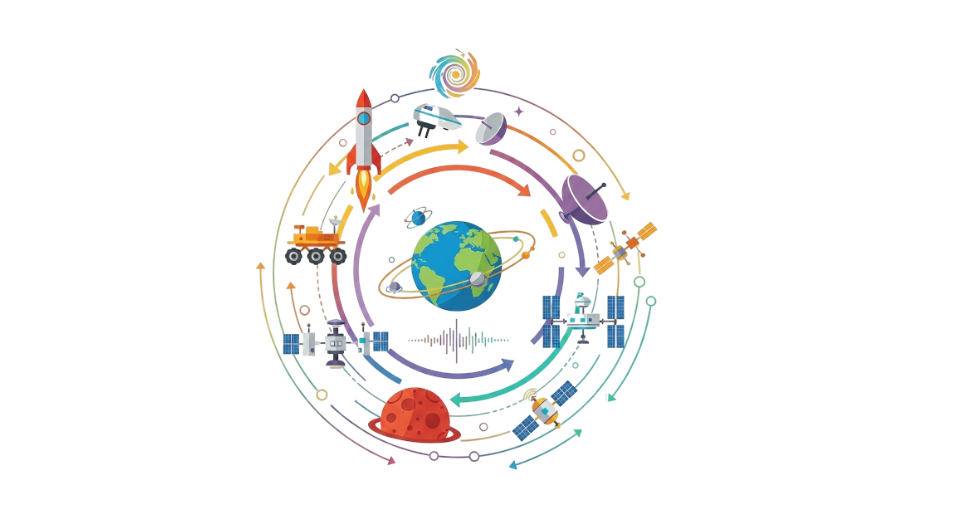
The report “Space Technology Market By Technology (Satellite Technology, Launch Vehicle Technology, Space Robotics and Automation, Space Propulsion Systems, Space Communication Systems, Space Navigation and Positioning Systems, Space-Based Observation and Imaging), By Platform (Satellites, Launch Vehicles, Space Probes, Space Station, Rovers and Landers, Ground Support Equipment), By Application (Communication, Earth Observation and Remote Sensing, Navigation and Positioning, Space Exploration, Scientific Research, Space Tourism, Defense and Security) and By End-Use Industry (Government and Military, Commercial Enterprises, Research and Academic Institutions)” is expected to reach USD 1200.00 billion by 2033, registering a CAGR of 8.60% from 2026 to 2033, according to a new report by Transpire Insight.
The space technology market is presently undergoing a structural shift due to the rise in commercialization, technological development, and expanding application areas in the field of communication, navigation, earth observation, and defense. The market, which was earlier driven by government-led programs, is now being shaped by the rise in investments by private companies in satellite constellations, reusable launch vehicles, and next-generation propulsion systems. This trend is helping to make space more accessible while also allowing for cost optimization and rapid deployment across various mission types. The rising need for high-speed global connectivity and real-time data acquisition is also contributing to the growth of the market. Satellite communication systems are increasingly being used for broadband connectivity in rural and underserved areas, and earth observation systems are being used for climate observation, disaster response, and infrastructure development. The development of miniaturization and automation is also helping to facilitate the use of small satellites, which are allowing for the achievement of operational flexibility and economic efficiency.
The market is also being driven by growing defense expenditures and the need for national security, in which space resources are playing a pivotal role in surveillance, navigation, and secure communication. Governments are now focusing on robust space infrastructure, which is promoting joint efforts with private players to accelerate technological development and minimize risks associated with operations. In addition, advancements in propulsion technology, artificial intelligence, and ground infrastructure are further improving the capabilities of space missions and data processing. As the trend of commercial engagement continues to accelerate along with government investments, the space technology market is also expected to witness innovation, diversified revenue streams, and increased global engagement in both mature and developing space economies.
The Satellite Technology segment is projected to witness the highest CAGR in the Space Technology during the forecast period.
According to Transpire Insight, Satellite technology remains the leading technology in the technology category because of its widespread use in communication, navigation, and observation functions. The use of large-scale satellite constellations has greatly improved connectivity and data access globally, allowing various sectors to incorporate satellite services into their daily operations. Advances in satellite payload optimization, processing, and longevity are improving the return on investment for satellite operators, which is fueling further investment in satellite development and launch initiatives.
In addition, the growing use of satellite-enabled infrastructure for climate observation, agricultural monitoring, and defense surveillance is also solidifying long-term demand. Governments and organizations are focusing on developing robust and scalable satellite networks to meet growing data demand and connectivity needs. The development of low earth orbit satellite constellations has also improved communication reliability and lowered latency, further solidifying the strategic value of satellite technology in the overall space sector.
The Satellites segment is projected to witness the highest CAGR in the Space Technology during the forecast period.
Satellites are the most prominent platform segment because of their multi-functional nature in various applications such as communication, earth observation, and navigation. The trend of miniaturization and modularity has greatly impacted the production time and launch costs of satellites, making it feasible for both government and private organizations to increase their satellite fleet. This development has increased the flexibility of deployment and enabled fast upgrades of technology, further intensifying the dominance of the platform segment in the market.
Moreover, the growing need for real-time data and connectivity is creating a constant demand for satellite launches, especially in the broadband and remote sensing segments. There is a growing trend among commercial players to use constellation deployment models to provide global coverage and redundancy. With advancements in satellite technology through improved analytics and extended satellite life, the platform segment is expected to continue its growth trajectory with support from commercial applications and government initiatives.
The Communication segment is projected to witness the highest CAGR in the Space Technology during the forecast period.
According to Transpire Insight, Communication continues to be the leading application area in the space technology market, driven by the growing consumption of data worldwide and the need for constant connectivity. Satellite communication systems are proving to be a crucial enabler in closing the digital divide, especially in areas that are far-flung and difficult to reach. The development of high-throughput satellites and low earth orbit satellite systems is having a major impact on the bandwidth capacity, which is fueling the growth of satellite broadband.
In addition, the convergence of satellite communication systems with the aviation, maritime, and military domains is opening up new avenues of applications and fortifying revenue streams. Governments and corporations are investing in robust communication systems that provide continuity and security for data transfer. As the pace of digital transformation continues to gain momentum worldwide, satellite communication systems are likely to remain at the forefront of market development.
The Government and Military segment is projected to witness the highest CAGR in the Space Technology during the forecast period.
The government and military remain the major end-users in this market, and this trend is expected to continue due to the continuous investment in national security, space exploration, and communication infrastructure. Continuous investment in the development of advanced technologies such as surveillance satellites, navigation systems, and communication platforms is made possible by the long-term funding commitments of governments and military organizations.
The importance of space-based resources in military operations ensures that demand and technological development in this end-user segment remain consistent. Moreover, the current geopolitical scenario and the growing emphasis on space security are encouraging governments to enhance their autonomous space capabilities. Partnerships with commercial space companies are making it possible to achieve innovation cycles and cost-effective deployment models. As governments continue to realize the importance of space as a operational domain, the demand from the government and military end-user segment is expected to continue to influence the investment patterns in the space technology market.
The North America region is projected to witness the highest CAGR in the Space Technology during the forecast period.
North America is the most prominent regional market due to its sophisticated space infrastructure, active involvement of the private sector, and significant government investment. The region has an established ecosystem that combines satellite manufacturing, launch capabilities, and data analysis. The innovation in reusable launch systems and satellite technology is paving the way for rapid deployment and enhancing the region’s competitive edge in the global space industry.
The presence of prominent commercial space players and significant defense spending also helps the region to be at the forefront of technological advancements. Joint programs between government bodies and the private sector are accelerating research and development activities. With growing requirements for satellite communication, earth observation, and defense-related services, North America is expected to retain its dominant position through innovation and large-scale investment in next-generation space technology.
Key Players
The top 15 players in the Space Technology market include SpaceX, The Boeing Company, Lockheed Martin Corporation, Airbus SE, Northrop Grumman Corporation, Blue Origin LLC, Rocket Lab USA Inc, Arianespace, Maxar Technologies, Thales Group, General Dynamics Corporation, Honeywell International Inc., China Aerospace Science and Technology Corporation, SES S.A., and Hindustan Aeronautics Limited.
Drop us an email at:
Call us on:
+91 7666513636

 inquiry@transpireinsight.com
 APAC:+91 7666513636
 Address





