

Europe Cloud Logistics Market Size & Forecast:
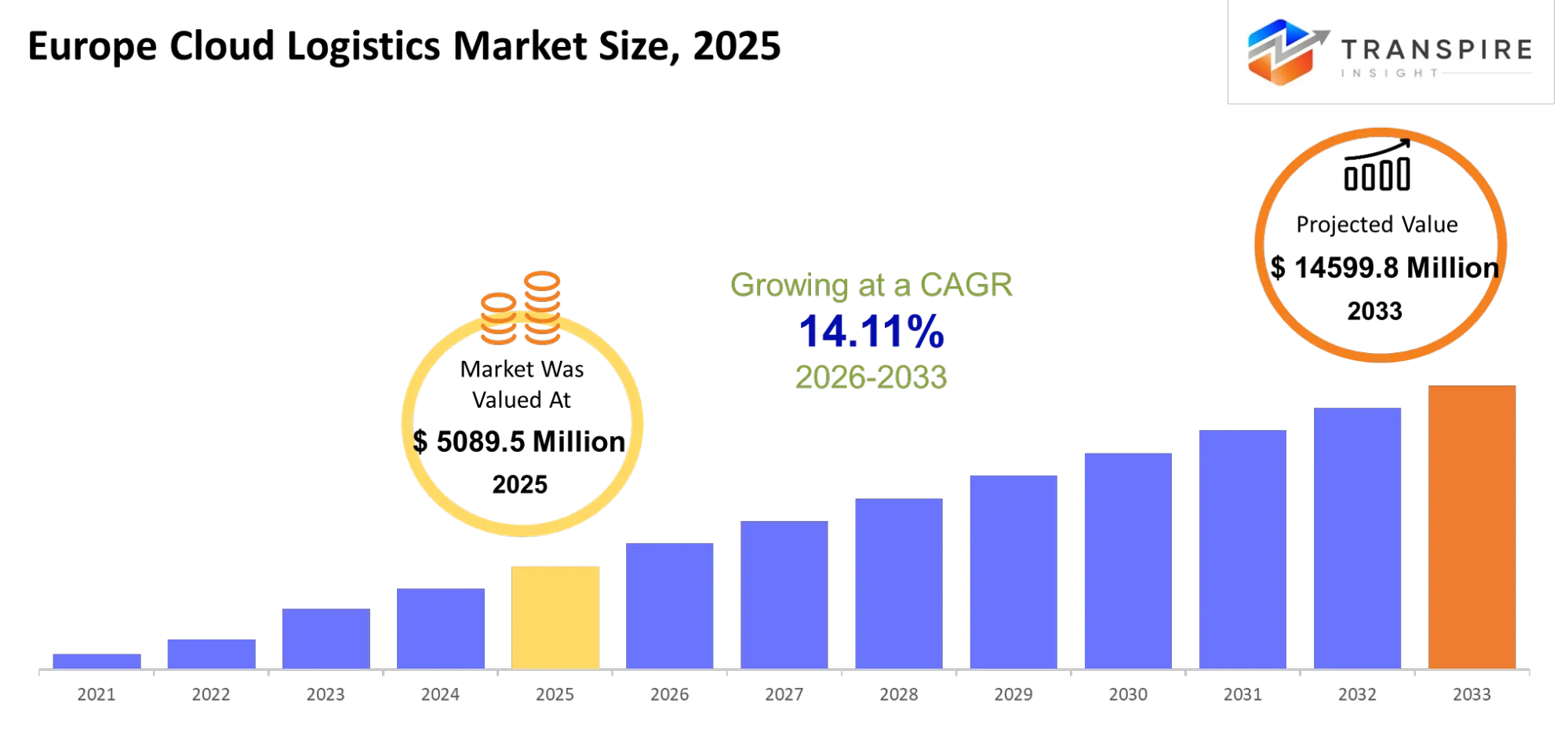
- Europe Cloud Logistics Market Size 2025: USD 5089.5 Million
- Europe Cloud Logistics Market Size 2033: USD 14599.8 Million
- Europe Cloud Logistics Market CAGR: 14.11%
- Europe Cloud Logistics Market Segments: By Type (Warehouse Management, Transportation Management, Fleet Management, Order Management, Others); By Application (E-commerce, Retail, Manufacturing, Healthcare, Automotive, Others); By End-User (Enterprises, SMEs, Logistics Providers, Retailers, Manufacturers, Others); By Deployment (Public Cloud, Private Cloud, Hybrid Cloud, SaaS, Others)
To learn more about this report,  Download Free Sample Report
Europe Cloud Logistics Market Summary:
The Europe Cloud Logistics Market size is estimated at USD 5089.5 Million in 2025 and is anticipated to reach USD 14599.8 Million by 2033, growing at a CAGR of 14.11% from 2026 to 2033. European cloud logistics, which forms a part of the digital supply chain and logistics technology sector, would be marked by software-driven orchestration of transport, storage, and final mile logistics for the region. The growth trajectory for this market would be driven by the requirements of retailers and manufacturers for rapid deliveries, transparency in deliveries, and more flexible ways of delivering products as expectations from e-commerce increase. This would be done via the deployment of cloud-based platforms for predictive route planning, automatic inventory synchronization, and compliance with evolving regulations around data and sustainability in Europe.
What Has the Impact of Artificial Intelligence Been on the Europe Cloud Logistics Market?
The Europe cloud logistics market undergoes transformation through artificial intelligence, which uses operational data to create intelligence that enables quick and precise decision-making. The Europe cloud logistics market benefits from AI platforms because they enable better market research and data analysis through their ability to find hidden demand patterns and shipment behaviors and regional consumption changes. The data-centric method improves visibility throughout the divided supply chains while enabling active scheduling processes.
The Europe cloud logistics market systems of artificial intelligence drive both smart automation growth and operational efficiency improvements. The combination of AI-powered routing with warehouse automation and predictive analytics capabilities enables enterprises to decrease delays while increasing fleet efficiency and reducing transportation expenses. The Europe cloud logistics market will gain advantages from intelligent supply chain optimization, where algorithms dynamically adjust logistics flows based on weather, traffic, and regulatory constraints across Europe. The system will enable organizations to achieve better cost monitoring and enhanced delivery accuracy.
The deployment of AI solutions for Europe cloud logistics operations will increase operational efficiency while creating new pathways for innovation that generate competitive advantages. Companies will gain a competitive edge through personalized logistics services and adaptive pricing models and real-time customer insights.
Key Market Trends & Insights:
- The market share of Western Europe exceeds nearly 45% in the forecast year 2025 owing to its superior infrastructure and technology use.
- Eastern Europe is the largest growing region, expected to witness over 16% CAGR owing to logistics modernization during the forecast period.
- Transportation Management Systems lead the segment with almost 38% market share because of high shipment visibility demands.
- Warehouse Management Systems have been ranked second in terms of share, owing to growing needs in the area of e-commerce.
- AI-empowered logistics platform segment is projected to grow the fastest over the period, owing to increased usage of analytics.
- Retail and e-commerce have become leading application areas, accounting for more than 40% market share, thanks to fast growth of online purchases.
- Manufacturing logistics segment is the fastest growing application, backed by growing automation in manufacturing units.
- Third party logistics providers have occupied nearly 42% market share, owing to scalability advantages of cloud-based technology.
- Small and Medium Enterprises (SMEs) account for the fastest growing segment owing to their use of logistics cloud.
Europe Cloud Logistics Market Segmentation
By Type
The warehousing management system will concentrate on inventory management, storage management, and expedited order processing through cloud applications. The transportation management system will be used for route optimization, shipment tracking, and cost optimization through data integration in real-time. The fleet management system will be used for vehicle tracking, vehicle maintenance scheduling, and fuel efficiency improvement through interconnected systems. The order management system will provide complete order processing, including placement to delivery.
Other logistics-related solutions include reverse logistics management and demand synchronization. These software systems will work in conjunction to form a smooth workflow process. The implementation of these solutions will allow businesses to have better logistics management control and reduce logistics expenses. Innovations will continue to enhance the use of cloud applications in logistics management.
By Application
E-commerce will fuel the need for quick delivery and real-time tracking services, thus promoting the use of cloud logistics software. The retail industry will depend on such logistics tools to help it control its inventory in various sales channels and increase consumer satisfaction. In manufacturing, the use of cloud logistics can assist companies to coordinate their manufacturing processes with available resources in the supply chain.
In healthcare, cloud logistics is necessary to provide reliable logistics support for the transportation of sensitive goods such as medications and medical equipment. Automotive logistics can benefit from better coordination of the supply of parts. Other industries will follow suit and embrace cloud logistics technology to increase efficiency.

To learn more about this report, Download Free Sample Report
By End-User
Businesses will make significant investments in cloud logistics to cater to their extensive operations and intricate logistics networks. SMEs will deploy economical means of increasing productivity and competing against bigger companies. Logistic firms will utilize cloud-based technology for the management of several customers and the delivery of high-quality services. Merchants will rely on such systems for seamless movement of goods and deliveries.
Factories will incorporate logistics systems into production planning to increase coordination. End-users in other sectors will seek ways of using cloud technology to increase efficiency and eliminate wastage. Different adoption trends will emerge, depending on the level of operations and industry demands. The europe cloud logistics market will cater to varied end-user requirements through flexible means.
By Deployment
A public cloud solution can be used due to scalability and relatively low initial costs. A private cloud solution may give better control and security; this is good for industries with compliance requirements. A hybrid cloud solution can combine all the advantages of the two models above. SaaS models can make access to the tools of logistics easier with little need for infrastructural changes.
Other deployment solutions will be used based on different criteria. Factors like data security and cost will determine which model will be chosen. All the models will have pros and cons that will determine which option is the best one.
What are the Main Challenges for the Europe Cloud Logistics Market Growth?
Several technical and operational factors impede the widespread use of europe cloud logistics market services and hamper their optimal performance when applied to large-scale business operations. The integration with existing transportation and warehousing information management platforms proves difficult, resulting in siloed data and inadequate network-wide visibility. System reliability, high latency, and cybersecurity threats pose additional challenges, especially where real-time cargo tracking and analytics are vital. Such technical issues encountered within europe cloud logistics market environments generate operational inconveniences and raise doubts regarding the stability and scalability of the logistics management systems.
Growth barriers within the manufacturing and commercialization of europe cloud logistics market applications arise from the need to meet the high standards of European legislation regarding data privacy and cross-border regulations. High expenses for implementing secure and certified information management platforms and frequent updates of the software components further complicate the process of implementing new logistics solutions. Slow implementation rates may be attributed to intricate vendor relations and extended integration periods.
The problems that come with adoption pose even more barriers to growth for the europe cloud logistics market, particularly those faced by areas with low levels of technology and shortage of a trained labor force. Most of the SMEs face difficulties in terms of expenses and skills required for implementing cloud technologies. Financial barriers and the different level of technological maturity will limit the adoption of cloud services.
Competition and risks will determine the future outlook for the europe cloud logistics market. The conventional logistics systems and alternative forms of technologies will continue competing due to the lower prices and familiarity among users. Issues related to pricing, changes in technologies, and regulatory policies will always be part of the game.
Country Insights
The Europe cloud logistics market will continue to grow because digital logistics systems become more widely used by different industries. The need for real-time tracking and faster delivery times and better supply chain coordination will drive up market demand. Organizations will use cloud-based tools to achieve data visibility which will help them reduce operational waste in their transportation and storage processes. Organizations will develop systems that can grow according to their changing business requirements.
Organizations will use technology adoption to create their operational frameworks which will use analytics and automation to enhance their planning and execution processes. The system design and data handling methods used in Europe will depend on the regulatory standards established by different European nations. Organizations will increase their investment in secure and adaptable platforms because they want to deliver dependable services. The market will develop through the process of finding a balance between cost efficiency and performance and compliance requirements.
Western Europe will lead because it possesses robust infrastructure and excellent digital capabilities and has established cloud logistics systems. Germany France and the UK will allocate funding for automation and data-centric logistics solutions that enable their extensive operations. The region will achieve greater power through the development of advanced transportation systems.
The economy of Eastern Europe will experience unprecedented growth since it is working hard to achieve digitalization in its logistics operations. Future economies will grow through technology and infrastructure development investments. Small businesses will play a part in ensuring the growth in the coming future. The demand in the area will be increased because of the growing cross-border trade activities in European nations.
Recent Development News
In March 2026, IFS AB completed the acquisition of Softeon. The deal expanded its cloud warehouse management capabilities and strengthened logistics software offerings across Europe.https://en.wikipedia.org/wiki/IFS_AB
In February 2026, Mistral AI announced acquisition of Koyeb. The move aimed to build stronger cloud infrastructure and enhance AI-driven logistics and computing capabilities in Europe.https://www.reuters.com
|
Report Metrics |
Details |
|
Market size value in 2025 |
USD 5089.5 Million |
|
Market size value in 2026 |
USD 5796.7 Million |
|
Revenue forecast in 2033 |
USD 14599.8 Million |
|
Growth rate |
CAGR of 14.11% from 2026 to 2033 |
|
Base year |
2025 |
|
Historical data |
2021 - 2024 |
|
Forecast period |
2026 - 2033 |
|
Report coverage |
Revenue forecast, competitive landscape, growth factors, and trends |
|
Regional scope |
Europe (Germany, United Kingdom, France, Italy, Spain, Rest of Europe) |
|
Key company profiled |
SAP, Oracle, IBM, Microsoft, Amazon, Google, Manhattan Associates, Blue Yonder, Descartes Systems, Infor, Epicor, JDA Software, Kinaxis, Logility, FourKites |
|
Customization scope |
Free report customization (country, regional & segment scope). Avail customized purchase options to meet your exact research needs. |
|
Report Segmentation |
By Type (Warehouse Management, Transportation Management, Fleet Management, Order Management, Others); By Application (E-commerce, Retail, Manufacturing, Healthcare, Automotive, Others); By End-User (Enterprises, SMEs, Logistics Providers, Retailers, Manufacturers, Others); By Deployment (Public Cloud, Private Cloud, Hybrid Cloud, SaaS, Others) |
How Can New Companies Establish a Strong Foothold in the Europe Cloud Logistics Market?
New entrants can secure traction in the europe cloud logistics market by targeting underserved niches where operational gaps remain high and competition is limited. Startups can develop solutions that solve specific problems through their dedicated efforts in healthcare logistics and cold-chain distribution and urban last-mile delivery. In the europe cloud logistics market, companies that design platforms around compliance-heavy industries will gain faster trust and adoption. Organizations will establish stronger initial market presence through reliable solutions which offer proof of tracking and compliance with regulations.
To achieve success in the europe cloud logistics market companies need to establish technology differentiation through their implementation of AI-based optimization and predictive analytics and real-time visibility systems. Startups should develop cloud systems based on modular architecture which enables smooth integration with existing systems thus decreasing client onboarding challenges. The use of automation technologies in the functioning of warehouses, as well as the creation of intelligent routes for busy city streets, will improve efficiency and lower costs. This will enable industries to develop according to the principle of flexibility and logistics based on analytics.
The establishment of strategic partnerships will drive enhanced development in the europe cloud logistics market. The company will enhance its market presence and operational efficiency through partnerships with local logistics companies and e-commerce businesses and cloud infrastructure providers. The case studies of emerging companies like Sennder and Packhelp demonstrate that digital-first strategies and platform-based business models enable rapid growth by providing solutions to divided logistics systems. New companies will create lasting market advantages through their dedication to ecosystem integration and targeted product development.
Key Europe Cloud Logistics Market Company Insights
The European cloud logistics market will experience ongoing growth because businesses are adopting digital systems for their transportation and storage and delivery operation management requirements. The need for speedier services and enhanced tracking capabilities and better supply chain coordination results in increased demand. Cloud platforms will enable users to access real-time data which will help them operate their systems without experiencing any operational interruptions.
The logistics industry will undergo transformation through technological adoption because automation and analytics capabilities will enhance operational planning and execution processes. European countries will establish international regulations that dictate both system design practices and their respective data handling methods. Organizations will boost their investments in adaptable security solutions because they want to enhance their operational efficiency while providing uninterrupted service to customers.
The battle between global technological firms and domestic enterprises will persist due to the efforts made by each to develop new technologies for logistics in the future. The firms will use their innovative capabilities and their efficient operations and their dependable service delivery to establish a competitive lead in their market. The organizations will increase their service capabilities through strategic partnerships while they upgrade their technological infrastructure.
The entry of new market competitors will disrupt existing companies through their development of affordable and specialized market solutions which address particular business requirements. The development of cloud infrastructure and analytics capabilities will drive ongoing improvement in competitive market conditions. Companies in the market will compete based on their ability to grow and their operational efficiency and their capacity to respond to shifting market demands.
Company List
- SAP
- Oracle
- IBM
- Microsoft
- Amazon
- Manhattan Associates
- Blue Yonder
- Descartes Systems
- Infor
- Epicor
- JDA Software
- Kinaxis
- Logility
- FourKites
What are the Key Use-Cases Driving the Growth of the Europe Cloud Logistics Market?
The europe cloud logistics market is experiencing growth because businesses are implementing cloud systems to handle their complex supply chains which span multiple locations. Real-time shipment tracking and dynamic route optimization stand as the most important application of the europe cloud logistics market which e-commerce and retail companies commonly use. The capabilities help businesses to decrease their delivery times while increasing customer satisfaction and decreasing transportation expenses which leads to market expansion through increased adoption.
The europe cloud logistics market provides manufacturing and automotive industries with integrated platforms which enable them to coordinate their production and logistics operations. Through cloud systems manufacturers can synchronize their raw material supply process with their production timetable which reduces both equipment downtime and storage expenses. Companies use predictive analytics to enhance their demand forecasting abilities which enables them to swiftly adjust to market changes. The industrial supply chains experience improved efficiency and better scalability through this use-case.
Healthcare logistics represents an essential use case for the europe cloud logistics market which requires secure delivery of time-sensitive medical supplies. Cloud platforms provide pharmaceutical and medical equipment companies with temperature monitoring capabilities and compliance tracking features and complete system visibility. Enterprise logistics operations use these solutions to achieve centralized control and data-based decision-making and international shipping management. The market demonstrates strong potential for innovation through these various use-cases which will expand its influence to different business sectors.
Europe Cloud Logistics Market Report Segmentation
By Type
- Warehouse Management
- Transportation Management
- Fleet Management
- Order Management
- Others
By Application
- E-commerce
- Retail
- Manufacturing
- Healthcare
- Automotive
- Others
By End-User
- Enterprises
- SMEs
- Logistics Providers
- Retailers
- Manufacturers
- Others
By Deployment
- Public Cloud
- Private Cloud
- Hybrid Cloud
- SaaS
- Others
Frequently Asked Questions
Find quick answers to common questions.
The approximate Europe Cloud Logistics Market size for the market will be USD 14599.8 Million in 2033.
Key segments for the Europe Cloud Logistics Market are By Type (Warehouse Management, Transportation Management, Fleet Management, Order Management, Others); By Application (E-commerce, Retail, Manufacturing, Healthcare, Automotive, Others); By End-User (Enterprises, SMEs, Logistics Providers, Retailers, Manufacturers, Others); By Deployment (Public Cloud, Private Cloud, Hybrid Cloud, SaaS, Others).
Major Europe Cloud Logistics Market players are SAP, Oracle, IBM, Microsoft, Amazon, Google, Manhattan Associates, Blue Yonder, Descartes Systems, Infor, Epicor, JDA Software, Kinaxis, Logility, FourKites.
The Europe Cloud Logistics Market size is USD 5089.5 Million in 2025.
The Europe Cloud Logistics Market CAGR is 14.11%.
- SAP
- Oracle
- IBM
- Microsoft
- Amazon
- Manhattan Associates
- Blue Yonder
- Descartes Systems
- Infor
- Epicor
- JDA Software
- Kinaxis
- Logility
- FourKites
Recently Published Reports
-
Apr 2026
3D Optical Profiler Market
3D Optical Profiler Market Size, Share & Analysis Report By Type (Desktop 3D Optical Profiler, and Portable 3D Optical Profiler), By Technology (Confocal Technology, and White Light Interference), By End-Use Industry (Manufacturing, Research Institutions, Automotive, Aerospace and Defense, Medical Devices, and Other), and Geography (North America, Europe, Asia-Pacific, Middle East and Africa, South and Central America), 2021 - 2031
-
Apr 2026
Depth Sensor Market
Depth Sensor Market Size, Share & Analysis Report By Type (Infrared Depth Sensors, Time-of-Flight (ToF) Sensors, Stereo Vision Sensors, Structured Light Sensors, Ultrasonic Depth Sensors), By Application (Automotive, Robotics, Gaming, Consumer Electronics, Industrial Automation, Healthcare, Security & Surveillance, Others), By End Users (Automotive Manufacturers, Consumer Electronics Companies, Healthcare Providers, Industrial Companies, Security Agencies, Gaming Companies, Robotics Companies, Others), and Geography (North America, Europe, Asia-Pacific, Middle East and Africa, South and Central America), 2021 – 2031
-
Apr 2026
Digital Manufacturing Market
Digital Manufacturing Market Size, Share & Analysis Report By Component (Hardware, Software, and Services), By Technology (Robotics, 3D Printing, Internet of Things (IoT), and Others), By Application (Automotive and Transportation, Aerospace and Defense, Consumer Electronics, Industrial Machinery, and Others), By Process Type (Computer-Based Designing, Computer-Based Simulation, Computer 3D Visualization, Analytics, and Others), and Geography (North America, Europe, Asia-Pacific, Middle East and Africa, South and Central America), 2021 – 2031
-
Apr 2026
Digital Visa Services Market
Digital Visa Services Market Size, Share & Analysis Report By Type (Individual Travelers, Group Travelers), By Application (Tourism, Business Travel, Others), and Geography (North America, Europe, Asia-Pacific, Middle East and Africa, South and Central America), 2021 – 2031