

North America Fourth Party Logistics Market Size & Forecast:
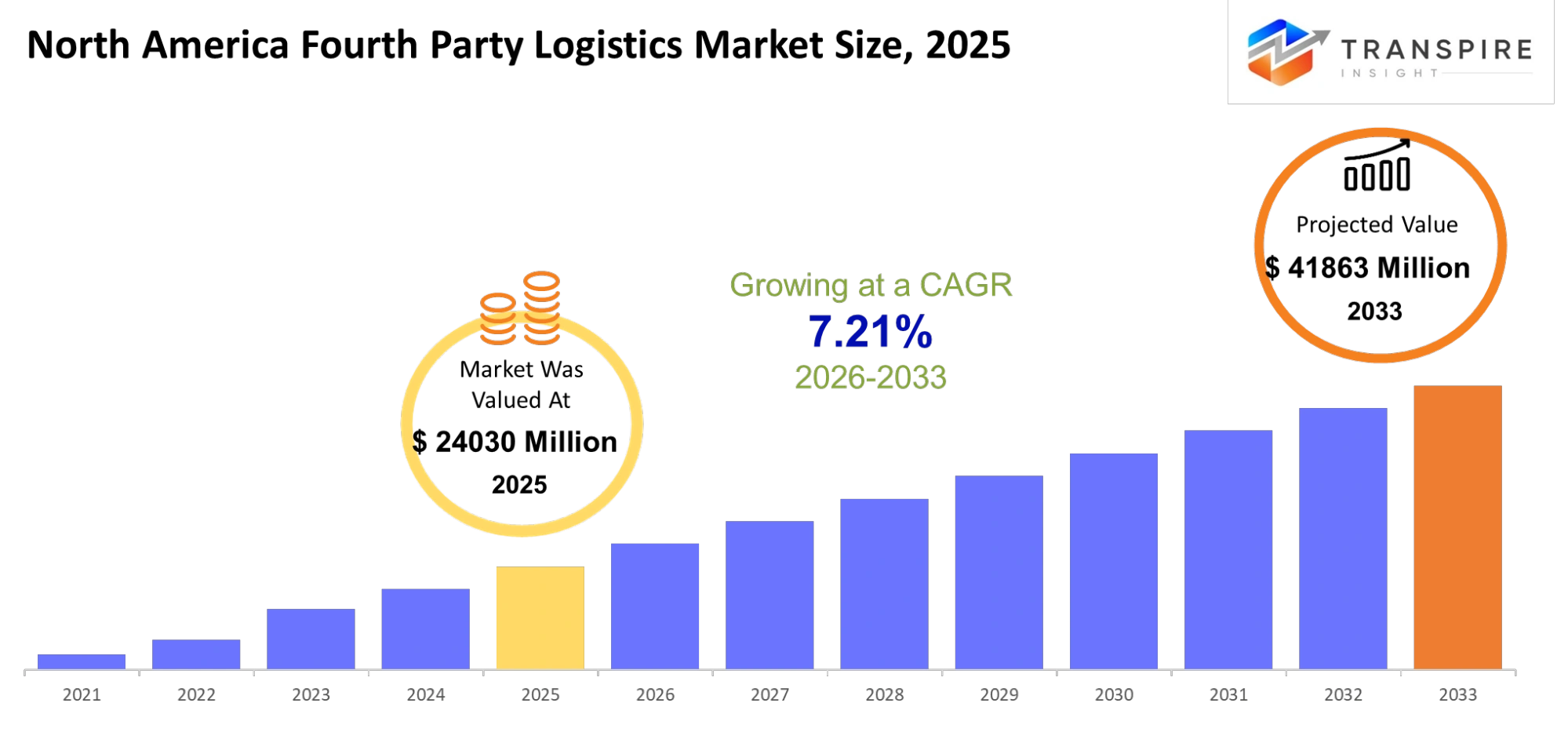
- North America Fourth Party Logistics Market Size 2025: USD 24030 Million
- North America Fourth Party Logistics Market Size 2033: USD 41863 Million
- North America Fourth Party Logistics Market CAGR: 7.21%
- North America Fourth Party Logistics Market Segments: By Type (Integrated 4PL, Lead Logistics Provider, Supply Chain Orchestration, Digital 4PL, Consulting Services, Others), By Application (Transportation, Warehousing, Distribution, Supply Chain Optimization, Inventory Mgmt, Others), By End-User (Manufacturing, Retail, Healthcare, Automotive, FMCG, Others), By Deployment (Cloud, On-premises, Hybrid, Digital Platforms, SaaS, Others).
To learn more about this report,  Download Free Sample Report
North America Fourth Party Logistics Market Summary:
The North America Fourth Party Logistics Market size is estimated at USD 24030 Million in 2025 and is anticipated to reach USD 41863 Million by 2033, growing at a CAGR of 7.21% from 2026 to 2033. The North America Fourth Party Logistics (4PL) Market is experiencing significant growth as enterprises increasingly seek end-to-end supply chain integration and strategic logistics management. The 4PL business model provides its customers with a single contact point who manages all their logistics needs through advanced data analysis and technology solutions.
The adoption of 4PL services by North American industries including retail and manufacturing and healthcare continues to rise because of two factors which drive organizations to develop complex global supply chains while needing to operate efficiently and maintain supply chain transparency.
Digital transformation serves as the primary force which drives the North America Fourth Party Logistics Market because AI and IoT and cloud-based platforms improve real-time tracking and predictive analytics and supply chain visibility. Companies are increasingly outsourcing logistics management to focus on core competencies while improving scalability and flexibility. The e-commerce market and cross-border trade activities in the region are driving market growth because businesses need flexible integrated logistics systems to compete in the rapidly changing market.
What Has the Impact of Artificial Intelligence Been on the North America Fourth Party Logistics Market?
Artificial Intelligence is rapidly changing the North America Fourth Party Logistics Market which now uses AI to manage logistics processes and analyze data and make decisions throughout its complex supply chains. AI systems in the North America fourth party logistics market use real-time data processing to enhance market research accuracy because they enable companies to track changing customer needs and operational problems.
The implementation of AI technology in the North America Fourth Party Logistics Market enables logistics providers to create more precise predictive models which help them anticipate disruptions and optimize delivery routes and build stronger supply chain systems.
Artificial intelligence technology in the North America Fourth Party Logistics Market creates automation advancements and cost reduction through its application of smart automation and machine learning models. These technologies enable efficient warehouse management by decreasing the need for human work and boosting operational performance throughout the logistics system.
The North America Fourth Party Logistics Market now experiences improved market response capabilities together with enhanced system capacity to handle business growth. The North America Fourth Party Logistics Market transforms into a more advanced system which enables enterprises to achieve their innovation targets while maintaining sustainable supply chain operations because of their increasing use of predictive analytics and AI optimization systems.
Key Market Trends & Insights:
- The United States controls approximately 70-75 per cent of the North America Fourth Party Logistics Market because of its advanced logistics infrastructure and business outsourcing practices which will establish 2025 as its peak market share year.
- The North America fourth party logistics market designates Canada as its fastest expanding region because e-commerce logistics requirements will drive market growth until 2026 2030 period.
- North America Fourth Party Logistics Market distribution area control functions as the leading sector because it generates over 40 operational share through centralized control of logistics operations.
- Data analytics services create the second largest market segment because companies need data based insights to make logistics choices.
- Digital platform-based orchestration services are the fastest-growing segment from 2024 to 2030 because they use AI and track systems that operate in real time.
- Retail and e-commerce control the North America Fourth Party Logistics Market with their 35 application share because online shopping has increased at an accelerated pace.
- Healthcare logistics emerges as the most rapidly expanding application sector because pharmaceutical supply chains create complex operational requirements and regulatory compliance demands.
- Large enterprises comprise the main end-user market with over 60 percent share because their supply chains require multiple interconnected points to operate.
- The end-user group of SMEs experiences the fastest growth because outsourcing logistics enables them to decrease operational expenses while achieving greater business flexibility.
- The companies strengthen their market position through three main strategies which include AI-powered logistics platforms, strategic alliance building, and expansion across different markets.
- The company improves its operational performance through constant investment in advanced machine learning, predictive analytics technology and intelligent automation solutions.
North America Fourth Party Logistics Market Segmentation
By Type
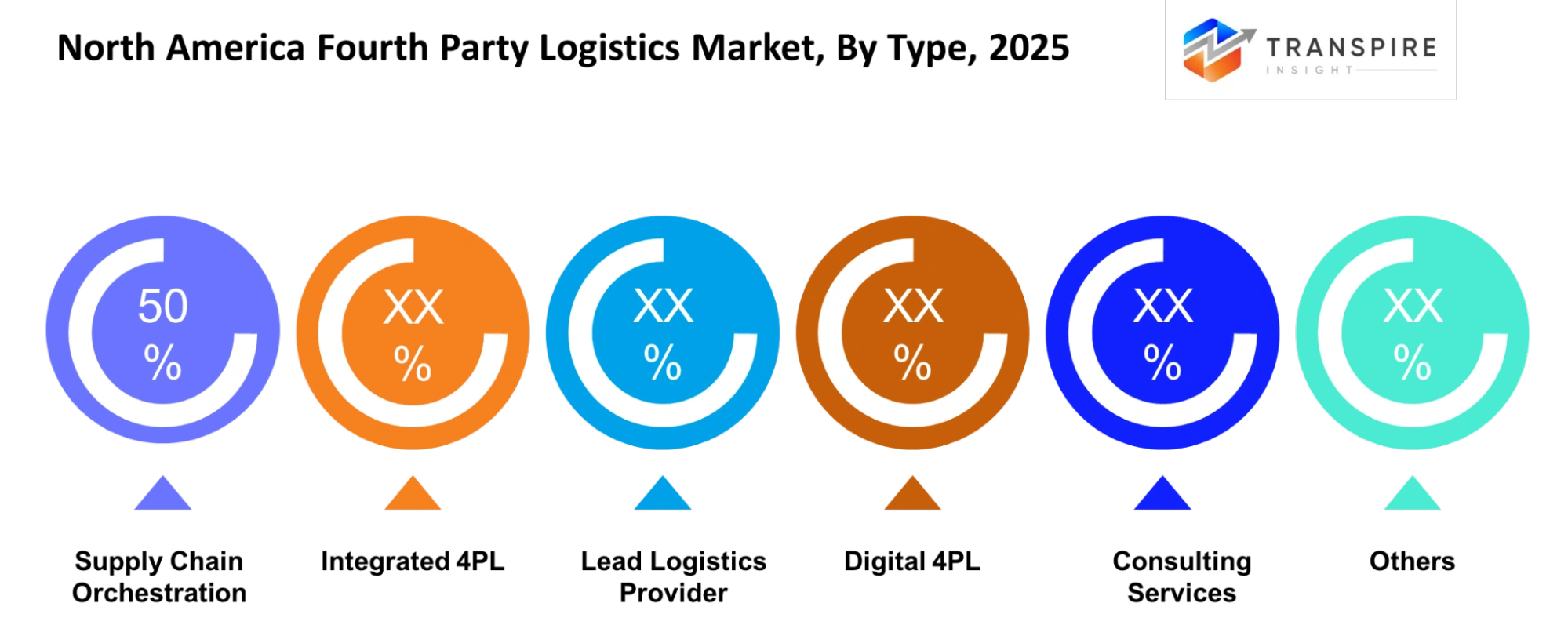
The North America Fourth Party Logistics Market by type is shaped by rising demand for complete supply chain control and better coordination across multiple logistics partners. Integrated 4PL services lead the demand as companies prefer a single control system for all logistics activities. Lead logistics providers also play an important role by managing contracts and performance across carriers and warehouses.
Digital 4PL solutions have become popular because they offer users the ability to track shipments in real time while accessing vital data about their shipments. Supply chain orchestration has become essential for businesses that want to achieve faster delivery times while minimizing operational interruptions. Consulting services help businesses create and test their logistics plans for success in the North America Fourth Party Logistics Market.
Many firms use consulting to identify gaps in operations and improve efficiency. Digital 4PL is growing faster as businesses shift toward automation and smart systems. Integrated models continue to expand because they reduce complexity in large supply chains. The segment shows a clear tendency to adopt centralized control while using technology for logistics management.
To learn more about this report, Download Free Sample Report
By Application
The North America Fourth Party Logistics Market application segment receives its main driving force from two essential requirements which include transportation needs and supply chain optimization needs. Companies use transportation as their primary method to achieve two objectives which are cost control and timely delivery. The warehousing services enable efficient storage operations which result in improved inventory management throughout different geographical areas.
The growth of distribution operations is directly linked to the increasing demand from e-commerce businesses. Supply chain optimization has become the primary application used by companies to achieve their goals of reducing work interruptions and boosting their operational efficiency. The North America Fourth Party Logistics Market is experiencing rising demand for inventory management because businesses need to maintain precise records of their stock inventory.
Companies utilize data systems to prevent stock shortages and excess inventory situations. The distribution networks have become more effective because suppliers and retailers now work together more efficiently. The transportation sector maintains its leading position because it delivers essential services which directly influence how satisfied customers. The application trends show organizations now prefer methods which deliver better efficiency and higher accuracy and improved product movement throughout their operations.
By End-User
The manufacturing sector which needs advanced supply chain management operations leads the end-user market for Fourth Party Logistics services in North America. The manufacturing sector relies on 4PL systems which help them handle both raw material resources and finished product distribution. The retail sector represents another important market as consumers demand quick product delivery together with efficient inventory management.
Healthcare organizations extend their operations because they need to fulfill stringent supply chain regulations while delivering medical products on schedule. Automotive companies depend on logistics integration to control both their parts distribution and their production timing. FMCG companies are also a strong part of the North America Fourth Party Logistics Market as they require fast and continuous distribution. The companies in this segment work to achieve two main objectives which involve decreasing delivery.
The manufacturing sector remains the leading force because companies need to operate at great scale while they obtain materials from international sources. The retail sector together with the healthcare sector experiences greater growth because consumers demand more products while organizations need to meet regulatory requirements. The demand from end-users now prefers logistics systems which provide both speed and dependable performance and system interoperability.
By Deployment
The North America Fourth Party Logistics Market deployment segment benefits from cloud-based systems which provide real-time access and scalable capabilities. Cloud solutions are used extensively because they lower infrastructure expenses while enabling better data distribution across multiple networks.
Organizations that need to protect their confidential information continue to use on-premises systems. The market shows growing interest in hybrid models because they deliver both security and operational flexibility. Logistics companies are developing digital platforms to achieve improved operational visibility and better coordination. North America Fourth Party Logistics Market SaaS solutions demonstrate rapid growth because they offer easy access and their subscription-based pricing model.
Companies choose SaaS because it enables them to start using the system quickly without making large upfront payments. Businesses now prefer cloud and hybrid systems because they enable better operational expansion. Digital platforms enable supply chain partners to communicate effectively while reducing operational interruptions. The deployment trends show a strong movement toward logistics systems which offer both flexible and scalable technology-based solutions.
What are the Main Challenges for the North America Fourth Party Logistics Market Growth?
The main challenges for the North American Fourth-Party Logistics Market are strongly linked to technical and operational limitations within complex supply chain systems. The North America fourth party logistics market often faces difficulties when multiple logistics partners need to be integrated into a unified platform which results in slower real-time decision-making.
The two operational problems which organizations face stem from their inability to standardize logistics processes and their data systems which produce fragmented information. Organizations face difficulties when they need to expand 4PL frameworks through their whole supply networks which contain multiple levels of operations.
The North America Fourth Party Logistics Market suffers from high implementation costs which create strict compliance requirements according to manufacturing and commercialization needs. Many companies find it difficult to implement advanced logistics systems because they must comply with both regulatory requirements and operational standards.
The North America Fourth Party Logistics Market faces deployment challenges because it takes time to build operational systems, and organizations need to adapt those systems for different business operations. Organizations need to identify ways to reduce their cost pressures because those pressures create delays in completing advanced 4PL solutions which organizations need for their complete business operations.
The North America Fourth Party Logistics Market experiences restricted growth because small and mid-sized enterprises face obstacles from both adoption challenges and infrastructure deficiencies. The shortage of qualified workers who can operate digital logistics systems together with the incomplete development of integration systems results in lower operational efficiency and delayed adoption of new technology.
Digital transformation projects in cost-sensitive sectors face obstacles because organizations fail to secure necessary funding. The North America Fourth Party Logistics Market exhibits market limitations which result in different industries showing varying rates of technology adoption.
Country Insights
The North America Fourth Party Logistics Market shows strong regional variation, with the United States leading due to advanced supply chain systems and high digital adoption. Large enterprises in the United States support wide use of integrated logistics platforms and data-driven operations.
Canadian companies are increasing their presence by investing in better transport networks and cross-border trade efficiency. Mexico supports expansion through manufacturing-linked logistics demand and cost-effective distribution channels. The North America Fourth Party Logistics Market benefits from strong infrastructure and high technology use across these regions.
The United States continues to hold the largest share in the North America Fourth Party Logistics Market due to strong e-commerce growth and advanced warehouse automation systems. The Canadian market will experience steady growth because companies will invest in better logistics operations and enhanced supply chain management.
The industrial sector in Mexico will drive more companies to adopt new technologies because of rising demands for exports. The North America Fourth Party Logistics Market will experience regional growth because companies are implementing strategies to deliver products faster while reducing expenses and increasing supply chain management efficiency.
Recent Development News
In March 2026, Major logistics consolidation reshapes U.S. 4PL ecosystem: A wave of large-scale mergers is reshaping the U.S. logistics structure, including a $50+ billion deal cycle in early 2026. Companies are integrating digital freight platforms and supply chain management systems to strengthen 4PL capabilities. This consolidation is increasing competition among integrated logistics providers across the North American Fourth-Party Logistics market.
Source: https://cxtms.com
In March 2026, DHL expands its U.S. data-center logistics network: DHL Supply Chain is expanding operations in the United States by launching multiple large-scale warehouses to support fast-growing data center infrastructure demand. This move reflects the rising need for integrated, end-to-end logistics solutions aligned with fourth-party logistics models. The expansion strengthens service capabilities in handling complex, high-value technology equipment across U.S. supply chains.
Source: https://www.wsj.com
|
Report Metrics |
Details |
|
Market size value in 2025 |
USD 24030 Million |
|
Market size value in 2026 |
USD 25711 Million |
|
Revenue forecast in 2033 |
USD 41863 Million |
|
Growth rate |
CAGR of 7.21% from 2026 to 2033 |
|
Base year |
2025 |
|
Historical data |
2021 – 2024 |
|
Forecast period |
2026 – 2033 |
|
Report coverage |
Revenue forecast, competitive landscape, growth factors, and trends |
|
Country scope |
North America (Canada, The United States, and Mexico) |
|
Key company profiled |
DHL Supply Chain, XPO Logistics, Kuehne+Nagel, DB Schenker, UPS Supply Chain, FedEx Logistics, CEVA Logistics, Ryder, Penske Logistics, Geodis, Expeditors, Nippon Express, Agility Logistics, Sinotrans, DSV |
|
Customization scope |
Free report customization (country, regional & segment scope). Avail customized purchase options to meet your exact research needs. |
|
Report Segmentation |
By Type (Integrated 4PL, Lead Logistics Provider, Supply Chain Orchestration, Digital 4PL, Consulting Services, Others), By Application (Transportation, Warehousing, Distribution, Supply Chain Optimization, Inventory Mgmt, Others), By End-User (Manufacturing, Retail, Healthcare, Automotive, FMCG, Others), By Deployment (Cloud, On-premises, Hybrid, Digital Platforms, SaaS, Others). |
How Can New Companies Establish a Strong Foothold in the North America Fourth Party Logistics Market?
The North America Fourth Party Logistics Market requires new companies to establish a sustainable business model through technology-based differentiation which addresses particular supply chain requirements. The North America Fourth Party Logistics Market experiences increased demand for real-time operational visibility and predictive analytics solutions and unified logistics management systems.
Startups that focus their operations on healthcare logistics and cold-chain monitoring can achieve initial market success by developing solutions which solve vital operational challenges. The company Project44 has demonstrated how its real-time shipment visibility platform enables organizations to enhance their operational efficiency through better decision-making processes.
North American Fourth-Party Logistics businesses need to establish partnerships with major carriers and enterprise customers because these agreements help them overcome market entry challenges and build credibility with their customers. AI-powered route optimization together with intelligent automation technologies enables new businesses to enhance their delivery service capabilities while reducing their operational expenses.
Flexport has shown that digital-first freight forwarding solutions can achieve fast business growth by integrating software development with operational logistics. The digital transformation process serves as a fundamental business growth driver for North America fourth party logistics market which continues to expand through its current development approach.
Industrial enterprises need to establish long-term viability through their financial support of expandable cloud computing systems and industry-specific predictive analytics software. The North America Fourth Party Logistics Market awards successful companies that deliver adaptable data-based solutions to clients in manufacturing and retail distribution sectors.
Key North America Fourth Party Logistics Market Company Insights
The North America Fourth Party Logistics Market experiences its competitive dynamics from two main forces which include companies developing their digital operations and companies developing their supply chain systems. Major companies such as DHL Supply Chain and XPO Logistics and C.H. Robinson and UPS Supply Chain Solutions and Kuehne + Nagel continue to strengthen their positions through advanced logistics platforms.
The North America Fourth Party Logistics Market shows rising competition as firms invest in AI-based systems and predictive analytics and automation to improve visibility and reduce delivery delays across complex supply chains. Technology-driven entrants that use software-first logistics models create mounting challenges for the North America Fourth Party Logistics Market.
Companies are building partnerships with carriers and retailers to expand service coverage and improve operational efficiency. Companies achieve their cost reductions and decision-making efficiency improvements through their investments in cloud platforms and smart automation tools. The North America Fourth Party Logistics Market continues to become more competitive as companies focus on innovation and faster delivery systems and data-led logistics optimization to gain stronger market positioning.
Company List
- DHL Supply Chain
- XPO Logistics
- Kuehne+Nagel
- DB Schenker
- UPS Supply Chain
- FedEx Logistics
- CEVA Logistics
- Ryder
- Penske Logistics
- Geodis
- Expeditors
- Nippon Express
- Agility Logistics
- Sinotrans
- DSV
What are the Key Use-Cases Driving the Growth of the North America Fourth Party Logistics Market?
The North America Fourth Party Logistics Market experiences its main growth through two essential use cases which involve complete supply chain management and the ability to track shipments throughout complicated transportation networks. The North America fourth party logistics market is experiencing strong growth because businesses require a single system to manage their various logistics partners and transportation options and storage facilities.
Companies that implement 4PL business models gain operational efficiency through improved delivery processes because they use data analysis and predictive tools to make better supply chain decisions. The North America Fourth Party Logistics Market serves the healthcare industry through its capabilities to manage pharmaceutical distribution that requires special handling together with cold-chain monitoring and logistics operations that depend on regulatory requirements.
The automotive industry also depends on 4PL solutions for managing just-in-time inventory, parts distribution, and cross-border supply coordination. The manufacturing and retail industries are driving increased adoption because businesses need to achieve cost savings while delivering products faster and maintaining better control over their stock. The use cases demonstrate how the North America fourth party logistics market helps organizations achieve operational effectiveness while minimizing interruptions to their supply chain activities.
E-commerce fulfillment represents another important use case for the North America Fourth Party Logistics Market because companies need flexible logistics solutions that can support their changing needs and provide fast delivery services. Businesses use advanced digital technology to improve their warehouse operations through better route planning and demand prediction methods. The market achieves its expansion through these innovative applications which enable businesses to grow their operations across various industrial sectors.
North America Fourth Party Logistics Market Report Segmentation
By Type
- Integrated 4PL
- Lead Logistics Provider
- Supply Chain Orchestration
- Digital 4PL
- Consulting Services
- Others
By Application
- Transportation
- Warehousing
- Distribution
- Supply Chain Optimization
- Inventory Mgmt
- Others
By End-User
- Manufacturing
- Retail
- Healthcare
- Automotive
- FMCG
- Others
By Deployment
- Cloud
- On-premise
- Hybrid
- Digital Platforms
- SaaS
- Others
Frequently Asked Questions
Find quick answers to common questions.
The approximate North America Fourth Party Logistics Market size for the market will be USD 41863 Million in 2033.
The key segments of the North America Fourth Party Logistics Market are By Type (Integrated 4PL, Lead Logistics Provider, Supply Chain Orchestration, Digital 4PL, Consulting Services, Others), By Application (Transportation, Warehousing, Distribution, Supply Chain Optimization, Inventory Mgmt, Others), By End-User (Manufacturing, Retail, Healthcare, Automotive, FMCG, Others), By Deployment (Cloud, On-premises, Hybrid, Digital Platforms, SaaS, Others).
Major players in the North America Fourth Party Logistics Market are DHL Supply Chain, XPO Logistics, Kuehne+Nagel, DB Schenker, UPS Supply Chain, FedEx Logistics, CEVA Logistics, Ryder, Penske Logistics, Geodis, Expeditors, Nippon Express, Agility Logistics, Sinotrans, DSV.
The current market size of the North America Fourth Party Logistics Market is USD 24030 Million in 2025.
The North America Fourth Party Logistics Market CAGR is 7.21%.
- DHL Supply Chain
- XPO Logistics
- Kuehne+Nagel
- DB Schenker
- UPS Supply Chain
- FedEx Logistics
- CEVA Logistics
- Ryder
- Penske Logistics
- Geodis
- Expeditors
- Nippon Express
- Agility Logistics
- Sinotrans
- DSV
Recently Published Reports
-
Apr 2026
Handling and Lifting Equipment Market
Handling and Lifting Equipment Market Size, Share & Analysis Report By Product (Cranes and Hoists, Forklifts, Conveyor Systems, Aerial Work Platforms, Others), By Application (E-Commerce, Automotive and Railway, Food and Beverages, Aviation, Others), and Geography (North America, Europe, Asia-Pacific, Middle East and Africa, South and Central America), 2021 - 2031
-
Apr 2026
HVAC Equipment Market
HVAC Equipment Market Size, Share & Analysis Report By Heating Equipment Type (Boilers and Furnaces, Heat Pumps, and Unitary Heaters), By Ventilation Equipment (Air Handling Units, Humidifiers and Dehumidifiers, Air Filters, and Fan Coiling Units), By Air Conditioning Equipment (Unitary Air Conditioners, Room Air Conditioners, Packaged Terminal Air Conditioners, and Chillers), By End User (Commercial, Residential, Industrial, and others), and Geography (North America, Europe, Asia-Pacific, Middle East and Africa, South and Central America), 2021 – 2031
-
Apr 2026
Refrigeration Valves Market
Refrigeration Valves Market Size, Share & Analysis Report By Type (Solenoid Valves, Expansion Valves, Check Valves, Service Valves, Others), By Application (Commercial Refrigeration, Industrial Refrigeration, Transport Refrigeration, Residential Refrigeration, Air Conditioning Systems), By End User (Food and Beverage Industry, Pharmaceutical Industry, HVAC Industry, Chemical Industry, Others), and Geography (North America, Europe, Asia-Pacific, Middle East and Africa, South and Central America), 2021 – 2031
-
Apr 2026
E-Commerce Packaging Materials Market
E-Commerce Packaging Materials Market By Material Type (Corrugated Boxes, Paper & Paperboard, Foam & Cushioning Materials, Plastic Packaging, Flexible Packaging, Protective Packaging, Others), By Product(Primary Packaging, Secondary Packaging, Tertiary Packaging), By Packaging Function (Protective Packaging, Branding & Presentation Packaging, Transit & Logistic Packaging, Sustainable Packaging, Tamper Evidence Packaging), By End-User (Retail & Consumer Goods, Electronic Appliances, Food & Beverages, Healthcare & Pharmaceutical, Fashion & Apparel, Home & Furnishing, Others); By Industry Analysis, Size, Share, Growth, Trends, and Forecasts 2021-2033