

Asia Pacific Digital Map Market Size & Forecast:
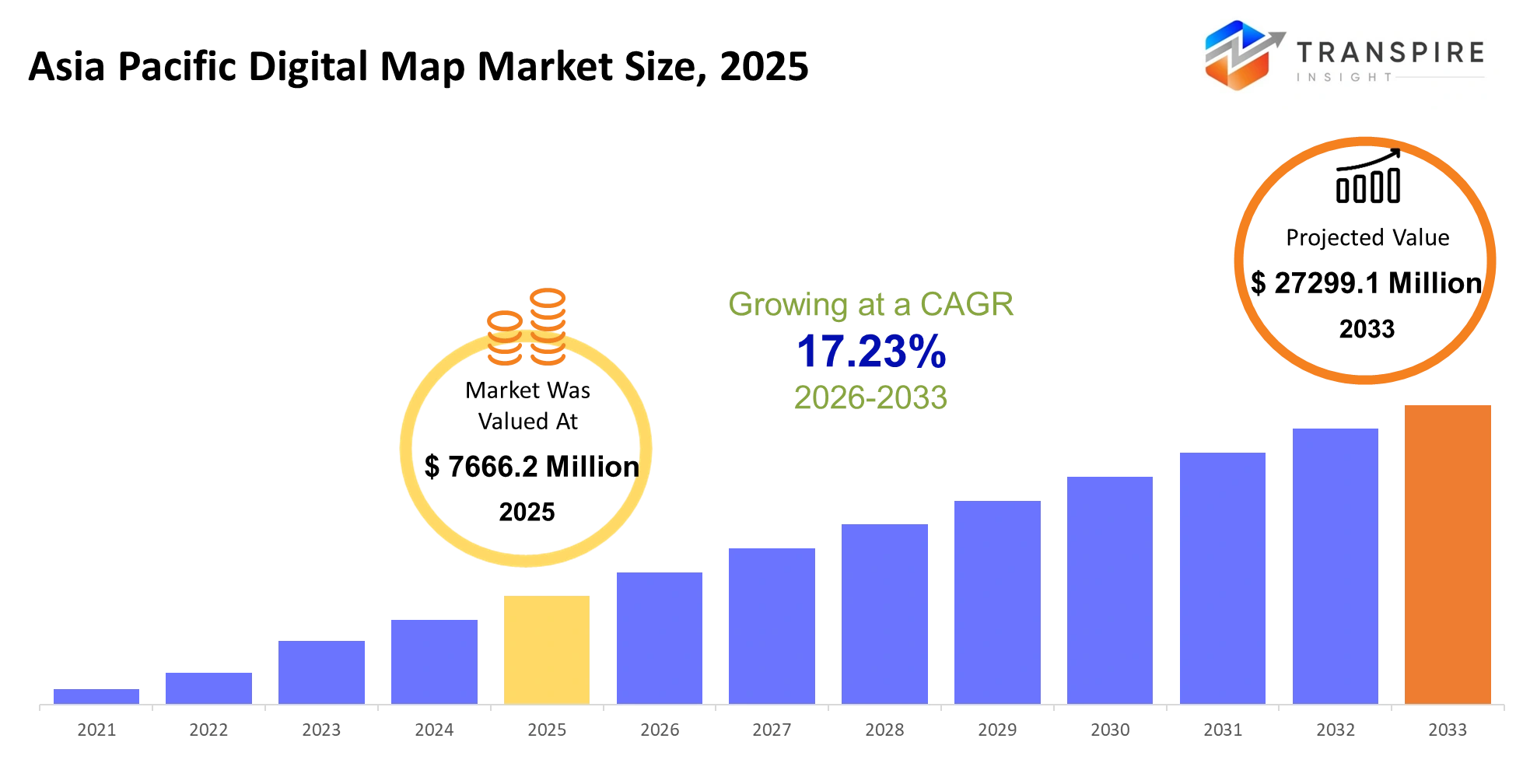
- Asia Pacific Digital Map Market Size 2025: USD 7666.2 Million
- Asia Pacific Digital Map Market Size 2033: USD 27299.1 Million
- Asia Pacific Digital Map Market CAGR: 17.23%
- Asia Pacific Digital Map Market Segments: By Type (Navigation Maps, GIS Maps, Satellite Maps, Indoor Maps, 3D Maps, Others); By Application (Automotive, Mobile Devices, Logistics, Urban Planning, Defense, Others); By End-User (Consumers, Enterprises, Govt, Automotive OEMs, Logistics Companies, Others); By Platform (Mobile, Web, Embedded Systems, Cloud, APIs, Others).
To learn more about this report,  Download Free Sample Report
Asia Pacific Digital Map Market Summary:
The Asia Pacific Digital Map Market size is estimated at USD 7666.2 Million in 2025 and is anticipated to reach USD 27299.1 Million by 2033, growing at a CAGR of 17.23% from 2026 to 2033. The digital map market for the Asia Pacific region exists within the geospatial technology and location intelligence sector because its growth will depend on three core factors which include accuracy and quickness and flexible operational capability. Urban users will increasingly expect real-time navigation layered with hyperlocal insights, while businesses will demand dynamic mapping tied to logistics and customer behavior. The regional governments will implement stricter data governance regulations which require businesses to establish secure mapping systems that meet compliance standards. The development of satellite imaging technology and AI-based cartography methods and mobile mapping systems will transform the process of map creation and usage. Consumer preference will shift toward personalized, interactive experiences, which will drive providers to develop digital environments that use predictive and context-dependent capabilities instead of static content.
What Has the Impact of Artificial Intelligence Been on the Asia Pacific Digital Map Market?
The artificial intelligence technology will transform the direction in which asia pacific digital map market operates by offering fast interpretation of information and highly reactive maps. The current AI in asia pacific digital map market will facilitate interpretation of geospatial big data in real time, hence ensuring that market research becomes more precise and reliable. Further, machine learning models will continue to offer deeper analysis of location-based information for the identification of user behaviors and regional differences in demand for services.
In the area of operations of asia pacific digital map market, the artificial intelligence will enhance demand forecasting and prediction of market trends. The use of predictive analytics will help predict movement in traffic, expansion in urban areas, and logistics demands. As a result, decisions will be based on future changes in market trends to match changing demands in the region.
On the operations side, the artificial intelligence is likely to improve the efficiency of operations through automated production of maps and cartography. The mapping processes will not require much effort since there will be minimal human interference during the map creation process. Further, there will be automated update of maps in order to avoid delay.
The Asia Pacific digital mapping market will benefit from AI capabilities which will create new technological solutions and enable customized experiences for users. The system uses advanced algorithms to provide users with navigation solutions which include context-based recommendations and personalized routing options. Organizations will achieve a marketplace edge because modern users expect digital mapping systems to provide intelligent systems which adapt to their requirements while delivering continuous unbroken service throughout the entire area.
Key Market Trends & Insights:
- China will control more than 35% of the Asia Pacific digital maps market in 2025 because its smart city programs and complete mapping infrastructure.
- The Indian market will become the fastest expanding regional market because it will experience mobile navigation growth which will drive its development at 16% CAGR between 2020 and 2030.
- The navigation and routing segment holds the leading market position, holding more than 40% market share in 2025, backed by automotive and mobility platform integrations.
- Location-based services form the second largest market segment, backed by rising demand for retail, deliveries, and hyper-local targeting solutions.
- 3D mapping and real-time geospatial analytics would be the fastest-growing segments, experiencing explosive growth until 2028 due to advancements via AI solutions.
- Transportation & logistics lead the industry with almost 38% market share, on account of rising adoption of route optimization and fleet tracking solutions.
- Urban planning & smart city applications would be the fastest growing segments, backed by government initiatives for digitization and urban planning.
- Automotive & Mobility Platforms dominate the Asia Pacific Digital Maps Market share, contributing over 30% share due to connected vehicles adoption.
Asia Pacific Digital Map Market Segmentation
By Type
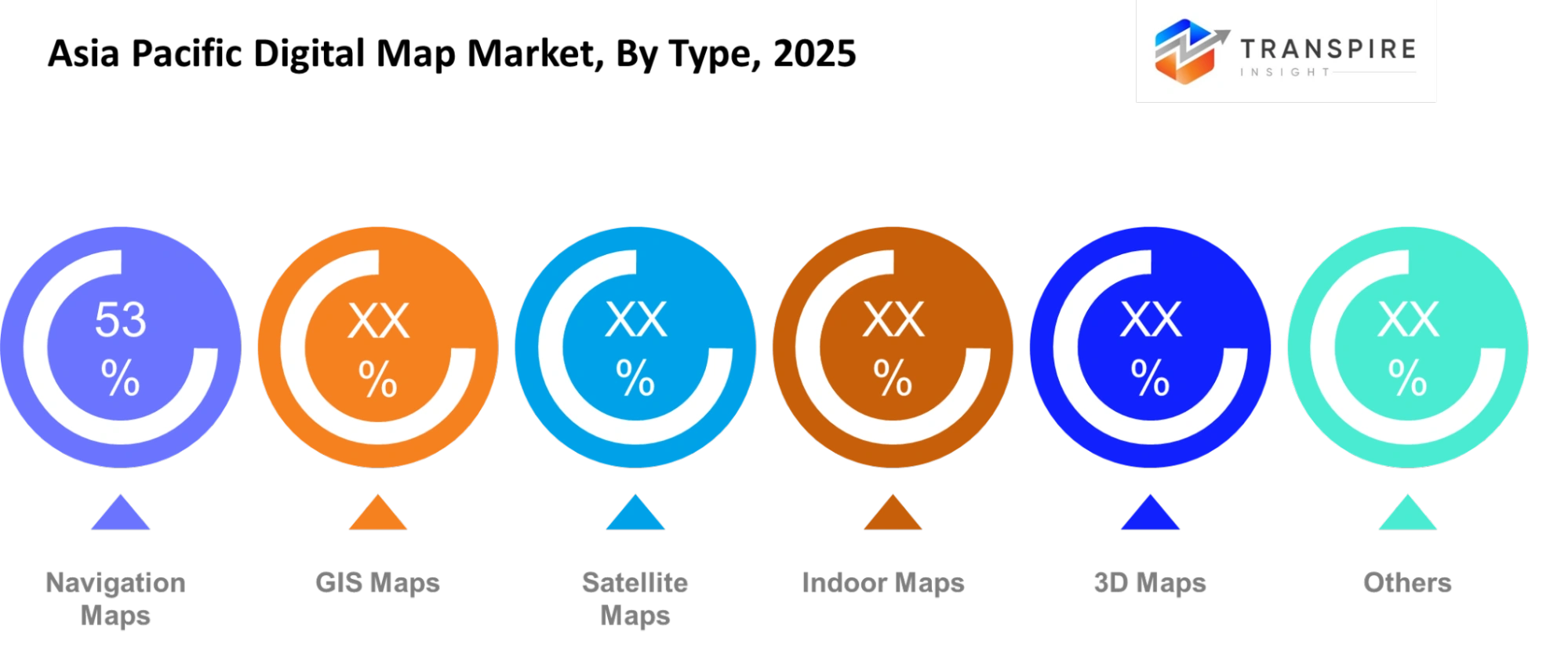
Maps for navigation will be characterized by real-time guidance, traffic information, and route planning for urban as well as highway settings. Maps using GIS technology will assist different industries to cope with their challenges regarding managing land records, utilities, and the environment. Satellite maps will allow surface imagery in high detail, allowing efficient monitoring and action plans during natural occurrences.
Maps for indoor purposes will facilitate the task of navigating in spaces such as shopping malls, hospitals, and airports, where signal limitations hinder this process. 3D maps will show images in three dimensions, assisting tasks related to designing and planning. The other maps will cater to other specialized requirements for the asia pacific digital map market.
To learn more about this report, Download Free Sample Report
By Application
Applications in automotive will include mapping technology in navigation, safety solutions, and connected cars. Mobile devices will continue to be an important factor since smartphone use in navigation and location search will be common. Mapping will be a significant aspect of logistics in relation to planning routes and efficient delivery within the regions.
Urban planning will involve the use of mapping technology in infrastructural development, zoning, and smart city solutions. Mapping will be crucial in defense in terms of surveillance, coordination, and mission planning. Other applications will also become increasingly common with more widespread usage in industries related to the Asia Pacific digital map market.
By End-User
The consumers will employ digital maps for purposes of navigation, travel, and discovery via mobile channels. The enterprises will incorporate mapping software for business purposes, gaining insights from customers, and improving operations. The government agencies will utilize maps for provision of public services, infrastructural development, and emergency response.
The automakers will integrate mapping software in their cars for improved performance and enhanced safety features. The logistics companies will rely on digital maps for supply chain visibility and optimal routing. End-users will gradually increase as adoption of digital solutions grows in the asia pacific digital map market.
By Platform
The mobile platform will encourage usage with high penetration and availability of maps on smartphones. The web platform will allow users to access maps using their browser without installing any software. Embedded systems will offer functionalities such as navigation maps in cars and special equipment.
The cloud platform will be used for data management and distribution among other benefits. The API platform will integrate map applications into various software programs. Platforms other than those mentioned above will evolve to satisfy technological requirements in the asia pacific digital map market.
What are the Main Challenges for the Asia Pacific Digital Map Market Growth?
There are several technical and operational hurdles facing the asia pacific digital map market industry. Data accuracy in real-time will be an important issue because regular updates will necessitate advanced data processing and secure network connection. The integration of AI and geospatial technology will make the system more complex, thus posing some challenges in ensuring consistency. Other barriers to growth in asia pacific digital map market industries will be data security and efficient management of large datasets.
Production and commercialization will also pose significant barriers to the growth of the asia pacific digital map market industry. The high expenses associated with satellite imagery, data gathering, and platform creation will result in difficulties for firms seeking to generate profits. The regulations around geospatial data policy will differ among nations, resulting in lengthy approval processes before entering the market.
The problems related to adoption will continue to persist, particularly in developing countries where the infrastructure required for adopting digital maps will not be adequate. The lack of specialists in geographic information systems and artificial intelligence will limit the proper execution of digital maps. There will also be challenges related to funding and the availability of advanced technology.
There will be increased competition in the asia pacific digital map market. The competition will be brought about by both global and regional organizations investing in more advanced technologies. The pricing competition and changes in technology will create an environment of uncertainty. There will also be changes in regulation and data security issues.
Regional Insights
North Asia is positioned to become the leading force in the Asia Pacific digital map industry because of its existing digital infrastructure and mapping technology. China and Japan and South Korea will allocate huge resources to develop smart cities and self-driving technologies. The implementation of advanced mapping systems together with data privacy regulations will foster positive business expansion. The Asia Pacific digital map industry will thrive because of ongoing technological advancements together with government support programs.
Urban consumers will use their phones frequently because strong connections and high smartphone ownership rates exist. Businesses need exact geospatial information to support their logistical operations and management activities. Domestic companies will develop their mapping-related artificial intelligence expertise through their own internal development. The combination of infrastructure growth and policy implementation will create sustainable development throughout the period.
The Asia Pacific digital map market will experience fast growth in India and its neighboring countries because of increasing mobile phone usage and digital transformation activities. The demand for navigation services and location-based services will increase throughout India and other countries. Companies will create affordable products because businesses will work on solutions that help them save costs.
Rural areas will continue to show infrastructure deficiencies which will result in problems with maintaining quality service. Government-led programs for digital transformation will assist public sector operations based on their mapping service needs. Local startups will play a crucial role in delivering solutions that meet regional needs. The world will experience additional expansion because digital connectivity continues to spread throughout the globe.
Southeast Asia will experience substantial economic growth which will stem from its e-commerce and ride-hailing and logistics sectors. Countries such as Indonesia and Vietnam and Thailand intend to adopt mapping technologies for their logistics and mobility operations. The demand for advanced mapping systems will increase because of the rapid urbanization patterns we currently observe. The asia pacific digital map market would benefit from increased digitization efforts in the region.
Mapping software will be used by most mobile-first customers to perform different tasks. Businesses will use location intelligence services to enhance their operational processes. The region will achieve technology transfer together with innovation development through its collaborative partnerships. Digital ecosystem development will create steady growth across all industrial sectors.
Recent Development News
In March 2026, Google launched “Ask Maps,” an AI-powered conversational feature within Google Maps to enhance navigation and personalized location discovery.
Source: https://blog.google/
In April 2026, Google introduced new 3D mapping and routing APIs, including dynamic map updates and enhanced 3D route visualization for developers.
Source: https://developers.google.com/
|
Report Metrics |
Details |
|
Market size value in 2025 |
USD 7666.2 Million |
|
Market size value in 2026 |
USD 8969.4 Million |
|
Revenue forecast in 2033 |
USD 27299.1 Million |
|
Growth rate |
CAGR of 17.23% from 2026 to 2033 |
|
Base year |
2025 |
|
Historical data |
2021 - 2024 |
|
Forecast period |
2026 - 2033 |
|
Report coverage |
Revenue forecast, competitive landscape, growth factors, and trends |
|
Regional scope |
Asia Pacific (China, India, Japan, South Korea, Australia, Rest of Asia Pacific) |
|
Key company profiled |
Google, Apple, HERE Technologies, TomTom, Mapbox, ESRI, Garmin, Baidu Maps, Tencent Maps, NavInfo, OpenStreetMap, Trimble, Microsoft, Alibaba, Huawei. |
|
Customization scope |
Free report customization (country, regional & segment scope). Avail customized purchase options to meet your exact research needs. |
|
Report Segmentation |
By Type (Navigation Maps, GIS Maps, Satellite Maps, Indoor Maps, 3D Maps, Others); By Application (Automotive, Mobile Devices, Logistics, Urban Planning, Defense, Others); By End-User (Consumers, Enterprises, Govt, Automotive OEMs, Logistics Companies, Others); By Platform (Mobile, Web, Embedded Systems, Cloud, APIs, Others). |
How Can New Companies Establish a Strong Foothold in the Asia Pacific Digital Map Market?
The digital map market in Asia Pacific shows businesses opportunities which new market entrants can exploit through their specialized approach of filling the customization gaps which existing major companies provide. Startups should focus on developing their services for specific fields which include healthcare logistics and agricultural mapping and regional shopping routes instead of trying to compete with established global map platforms. The existing market trends will become their profitable business opportunity.
Innovation and technology differentiation are two factors that will help firms gain traction in the asia pacific digital map market. Innovations that incorporate the use of advanced technologies like real time mapping and analysis, AI-based navigation, predictive routing systems, etc., will be successful. Innovations in the form of lightweight mapping for low band width areas, off line navigation tools, etc. will enable companies to overcome challenges in the existing industry environment.
The establishment of strategic alliances will provide companies with enhanced opportunities to enter new markets and develop their business operations. The organization will improve its capabilities to access information and expand its operations through partnerships with telecommunications companies and government institutions and mobility solution providers. The companies MapmyIndia and Nearmap demonstrate how innovation combined with regional market focus can provide businesses with competitive advantages. The organizations have used their regional data and advanced imaging technology to achieve dominance in specialized market segments.
Organizations need to develop flexible systems that execute their plans without any mistakes. Companies that want to join the Asia Pacific digital mapping market must continuously adjust their products to match both changing consumer preferences and upcoming legal requirements. The capacity to create new value through innovation and execute operations will serve as the primary requirement for organizational achievement.
Key Asia Pacific Digital Map Market Company Insights
Good positioning will require a strategy that centers on the needs of industries rather than competition. There will be targeting of various sectors such as logistics, urban planning, and mobility solutions. Value propositions will play an important role in developing a good relationship with users. The asia pacific digital map market will favor players who come up with localized and accurate maps.
High performance and ease of use will contribute to the development of brands. Regional customization will help the companies connect well with the needs of the consumers in various places. Collaboration with government policies will also enable growth in various areas.
Technological advances will be responsible for creating competitive advantages in the asia pacific digital map market. Integration of artificial intelligence, machine learning, and analytics tools will contribute to high accuracy and faster production. Companies will prioritize automation to minimize manual mapping efforts. In the asia pacific digital map market, there will be stiff competition in speed and adaptability.
Innovations in 3D maps and predictive routing will present opportunities to players. Cloud-based systems will facilitate scalability and management of big data. Regular updates will be necessary in order to address evolving customer needs.
The importance of collaborations cannot be ignored in improving the geographical reach and enhancing the service delivery capacity. Collaboration with companies such as telecommunications companies, automotive companies, and governmental agencies would lead to better availability of data and infrastructure. The asia pacific digital map market would benefit from this strategy.
The process of establishing joint ventures would also help companies enter the markets faster. Companies could employ collaboration for improvement of services. Information exchanges would ensure the provision of updated and reliable maps. This approach would aid the progress and sustainability of the companies.
Constant innovations would continue to be necessary for maintaining the competitiveness of companies in providing mapping services. Companies will engage in research activities to improve accuracy and introduce other benefits in the services provided. The expansion into underdeveloped territories would present new opportunities. This would result in the development of the asia pacific digital map market.
Launching innovative products would involve addressing the needs of the market. Innovative approaches would help in accommodating local requirements of individual industries. Expansion strategies would cover aspects such as technological and infrastructural developments.
Company List
- Apple
- HERE Technologies
- TomTom
- Mapbox
- ESRI
- Garmin
- Baidu Maps
- Tencent Maps
- NavInfo
- OpenStreetMap
- Trimble
- Microsoft
- Alibaba
- Huawei
What are the Key Use-Cases Driving the Growth of the Asia Pacific Digital Map Market?
Digital maps will gain traction in the asia pacific digital map market because of some very practical applications in the areas of automobiles and mobility. Digital maps will play a key role in the connected vehicle space by offering capabilities such as advanced driver assistance systems (ADAS) and routing in ride-hailing applications. These maps will improve safety, speed, and efficiency in transportation, and will therefore be key elements in modern transportation.
Other key industry verticals that will aid in the digital map market development include logistics and ecommerce. Companies in the logistics space will utilize the strength of digital maps in fleet management and last mile deliveries. Fuel savings and optimized delivery processes depend on maps.
Mapping technology will be more widely used through urban planning and smart city implementations. Governments will utilize digital maps in building infrastructure and planning for traffic and disaster management. There will also be an increased utilization of mapping technology in healthcare facilities in terms of emergency response planning and routing. These will enhance the significance of the application of mapping technology in the industry.
The continued influence of consumer-oriented uses will impact the demands for asia pacific digital map software. The uses include mobile navigation and location-based services, such as localized searches and recommendation engines. Future growth will be dependent on the integration of artificial intelligence and other advanced concepts.
Asia Pacific Digital Map Market Report Segmentation
By Type
- Navigation Maps
- GIS Maps
- Satellite Maps
- Indoor Maps
- 3D Maps
- Others
By Application
- Automotive
- Mobile Devices
- Logistics
- Urban Planning
- Defense
- Others
By End-User
- Consumers
- Enterprises
- Govt
- Automotive OEMs
- Logistics Companies
- Others
By Platform
- Mobile
- Web
- Embedded Systems
- Cloud
- APIs
- Others
Frequently Asked Questions
Find quick answers to common questions.
The approximate Asia Pacific Digital Map Market size for the market will be USD 27299.1 Million in 2033.
Key segments for the Asia Pacific Digital Map Market are By Type (Navigation Maps, GIS Maps, Satellite Maps, Indoor Maps, 3D Maps, Others); By Application (Automotive, Mobile Devices, Logistics, Urban Planning, Defense, Others); By End-User (Consumers, Enterprises, Govt, Automotive OEMs, Logistics Companies, Others); By Platform (Mobile, Web, Embedded Systems, Cloud, APIs, Others).
Major Asia Pacific Digital Map Market players are Google, Apple, HERE Technologies, TomTom, Mapbox, ESRI, Garmin, Baidu Maps, Tencent Maps, NavInfo, OpenStreetMap, Trimble, Microsoft, Alibaba, Huawei.
The Asia Pacific Digital Map Market size is USD 7666.2 Million in 2025.
The Asia Pacific Digital Map Market CAGR is 17.23%.
- Apple
- HERE Technologies
- TomTom
- Mapbox
- ESRI
- Garmin
- Baidu Maps
- Tencent Maps
- NavInfo
- OpenStreetMap
- Trimble
- Microsoft
- Alibaba
- Huawei
Recently Published Reports
-
Dec 2024
3D Optical Profiler Market
3D Optical Profiler Market Size, Share & Analysis Report By Type (Desktop 3D Optical Profiler, and Portable 3D Optical Profiler), By Technology (Confocal Technology, and White Light Interference), By End-Use Industry (Manufacturing, Research Institutions, Automotive, Aerospace and Defense, Medical Devices, and Other), and Geography (North America, Europe, Asia-Pacific, Middle East and Africa, South and Central America), 2021 - 2031
-
Feb 2025
Depth Sensor Market
Depth Sensor Market Size, Share & Analysis Report By Type (Infrared Depth Sensors, Time-of-Flight (ToF) Sensors, Stereo Vision Sensors, Structured Light Sensors, Ultrasonic Depth Sensors), By Application (Automotive, Robotics, Gaming, Consumer Electronics, Industrial Automation, Healthcare, Security & Surveillance, Others), By End Users (Automotive Manufacturers, Consumer Electronics Companies, Healthcare Providers, Industrial Companies, Security Agencies, Gaming Companies, Robotics Companies, Others), and Geography (North America, Europe, Asia-Pacific, Middle East and Africa, South and Central America), 2021 – 2031
-
Feb 2025
Digital Manufacturing Market
Digital Manufacturing Market Size, Share & Analysis Report By Component (Hardware, Software, and Services), By Technology (Robotics, 3D Printing, Internet of Things (IoT), and Others), By Application (Automotive and Transportation, Aerospace and Defense, Consumer Electronics, Industrial Machinery, and Others), By Process Type (Computer-Based Designing, Computer-Based Simulation, Computer 3D Visualization, Analytics, and Others), and Geography (North America, Europe, Asia-Pacific, Middle East and Africa, South and Central America), 2021 – 2031
-
Feb 2025
Digital Visa Services Market
Digital Visa Services Market Size, Share & Analysis Report By Type (Individual Travelers, Group Travelers), By Application (Tourism, Business Travel, Others), and Geography (North America, Europe, Asia-Pacific, Middle East and Africa, South and Central America), 2021 – 2031