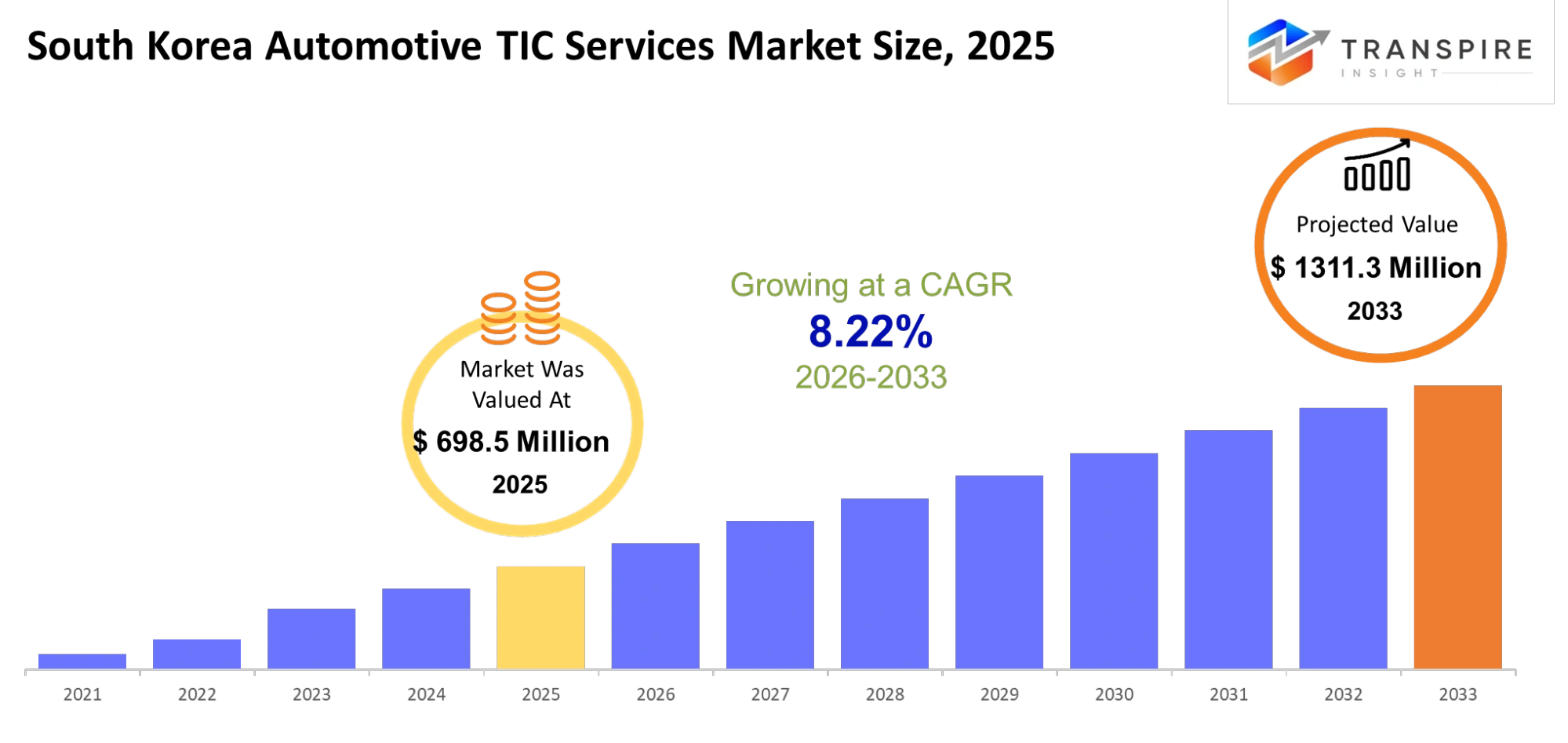
South Korea Automotive TIC Services Market Size & Forecast:
- South Korea Automotive TIC Services Market Size 2025: USD 698.5 Million
- South Korea Automotive TIC Services Market Size 2033: USD 1311.3 Million
- South Korea Automotive TIC Services Market CAGR: 8.22%
- South Korea Automotive TIC Services Market Segments: By Type (Testing, Inspection, Certification, Compliance, Quality Assurance, Others); By Application (Vehicle Testing, Emission Testing, Safety Testing, Component Testing, EV Testing, Others); By End-User (Automotive OEMs, Suppliers, Govt, Regulatory Bodies, Fleet Operators, Others); By Service (On-site, Off-site, Digital, Remote, Lab Testing, Others)
To learn more about this report,  Download Free Sample Report
South Korea Automotive TIC Services Market Summary:
The South Korea Automotive TIC Services Market size is estimated at USD 698.5 Million in 2025 and is anticipated to reach USD 1311.3 Million by 2033, growing at a CAGR of 8.22% from 2026 to 2033.
The South Korean automotive sector includes a specialized segment called automotive testing inspection and certification services market which conducts tests and inspections to certify vehicles for safety and operational standards. The current industry structure exists because of three main factors which include more strict emissions regulations and increased electric vehicle usage and consumer demand for better product quality information. Local manufacturers will increasingly rely on advanced diagnostics digital auditing and cross-border certification to compete in global markets. Service providers will integrate data analytics and automation into their operations to meet changing regulatory requirements and the new buying habits of South Korean customers. The changes will create stronger trust relationships between customers and companies while they transform how businesses deliver their services.
What Has the Impact of Artificial Intelligence Been on the South Korea Automotive TIC Services Market?
The development of artificial intelligence has emerged as the primary element which drives changes in the South Korean automotive testing inspection and certification market through its introduction of advanced testing methods which provide precise results with faster execution and better analytical capacity.
The implementation of artificial intelligence in South Korean automotive testing inspection and certification operations has improved market research capabilities by enabling organizations to analyze data from connected vehicles and regulatory databases and manufacturing systems through real-time data processing. Artificial intelligence in South Korea automotive testing, inspection and certification operations enables service providers to use predictive analytics for identifying compliance risks while they detect faults and forecast safety and emissions standard changes. The current capabilities of these systems meet market requirements, as both local manufacturers and export-oriented automotive companies require precise, rapid validation processes.
The evolution process enables businesses to enhance their supply chain operations while decreasing their operational expenses and better managing their available resources. The South Korean automotive testing inspection and certification market will achieve heightened AI adoption because businesses seek to enhance their competitive edge through innovation and personalized customer service approaches.
Key Market Trends & Insights:
- The South Korea automotive testing and inspection service market in 2025 will reach 45% market share through its Seoul metropolitan area which benefits from extensive automotive manufacturing facilities.
- The Ulsan and Gyeonggi regions will experience the fastest growth until 2030 because of their electric vehicle production and testing facility development.
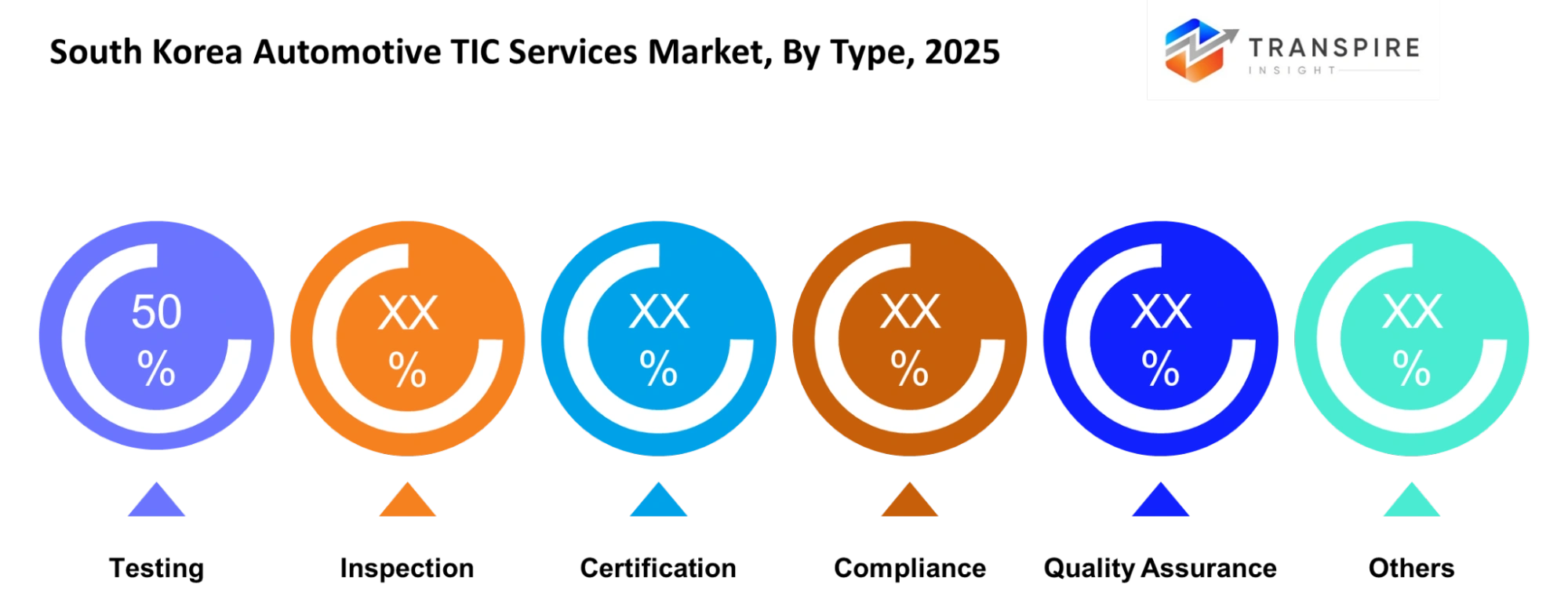
- The testing services sector controls more than 50% of the South Korean automotive testing and inspection market because of the stringent requirements for emissions testing and safety assessment.
- The inspection services sector stands as the second biggest market segment because it includes both periodic vehicle compliance checks and export quality verification processes.
- The certification services market segment will experience its fastest growth between 2025 and 2030 because of the worldwide homologation demand and the need for cross-border regulatory harmonization.
- The passenger vehicle market holds 60% market share because producers maintain high manufacturing rates while safety regulations continue to develop.
- The OEMs sector holds the biggest market share which exceeds 55% because manufacturers must achieve ongoing compliance throughout their production processes.
- The companies are using AI-based testing methods together with smart automation and predictive analytics to achieve better service precision and operational productivity.
- The company is expanding its market reach through partnerships with electric vehicle manufacturers and the establishment of laboratory facilities in different regions.
- The company enhances its competitive position and certification process efficiency by continuously funding its digital systems and machine learning development efforts.
South Korea Automotive TIC Services Market Segmentation
By Type:
The testing segment includes six segments which include Testing, Inspection, Certification, Compliance, Quality Assurance and Other services. Testing verifies the product's ability to perform according to established test conditions. The inspection process evaluates production materials through two methods which assess their physical attributes and their visual appearance. Certification verifies that products comply with all regulatory standards which creates market trust for both domestic and international customers. Compliance requires organizations to follow all environmental regulations and safety standards which include legal requirements.
Through process control and monitoring activities, quality assurance establishes stable production results. The organization provides advisory and technical support as its additional service. The automotive manufacturing process will achieve better reliability through this testing, enabling manufacturers to comply with international production standards while competing in the global market.
To learn more about this report, Download Free Sample Report
By Application:
Vehicle testing evaluates overall performance, durability, and efficiency under varied conditions. South Korea maintains strict environmental regulations, which emission testing must follow. The safety testing process requires tests to assess crash resistance, braking efficiency, and passenger protection systems, which help to confirm that consumer safety standards have been achieved.
Component testing assesses the performance of various engine components, electronic components, and structural elements. The growing electric vehicle adoption requires more EV testing, which includes testing both batteries and charging systems. The organization uses special evaluations to assess innovative automotive technologies, which automotive products need to enter the market.
By End-User:
The automotive OEMs use TIC services to validate their product quality and market compliance requirements. The suppliers utilize these services to verify their components while sustaining their manufacturing standards. Government bodies and regulatory agencies establish safety standards which they enforce through mandatory certified testing for environmental safety.
Fleet operators depend on testing and inspection services to achieve effective operations while decreasing their equipment failure times. The research institutions and service providers represent the remaining end-user category. The automotive industry needs every group to contribute toward maintaining product quality and safety and compliance with regulations.
By Service:
The different service types include On-site service, Off-site service, Digital service, Remote service, Lab Testing service, and Other service types. The On-site services enable real-time testing and inspection at manufacturing sites which results in better operational efficiency. The Off-site services require external evaluation centers which provide both specialized equipment and expert knowledge. Digital services enable data-driven analysis and reporting which helps organizations to make quicker decisions.
The Remote services enable organizations to monitor activities and validate information without needing staff members to be present at the location. The Lab testing process provides accurate and controlled assessment methods for testing materials and components. The automotive value chain needs support from consulting services and tailored solutions which make up the other available services.
What are the Main Challenges for the South Korea Automotive TIC Services Market Growth?
The south korea automotive tic services market expansion process gets affected by both technical problems and operational problems that create delays in market growth. The growing complexity of vehicle systems which includes electric and connected technologies requires more testing time to achieve accurate results. Service providers face difficulties in maintaining testing consistency because they must handle large testing volumes. The industry requires continuous upgrades of equipment and testing processes to keep up with new standards which creates restrictions on market growth.
The development of the south korea automotive tic services market gets affected by both manufacturing challenges and commercialization challenges. The high expenses associated with advanced testing facilities together with the need to comply with strict regulations create delays in service activation. The certification process experiences delays because of ongoing modifications to safety and emission standards which create manufacturing bottlenecks. The south korea automotive tic services market faces operational obstacles which decrease efficiency and extend product development time in the automotive sector.
The adoption of advanced testing technologies faces major obstacles because there is insufficient access to qualified personnel who possess the necessary expertise. The service expansion process gets restricted by infrastructure gaps that exist specifically in the area of specialized EV testing facilities. The funding limitations faced by smaller firms prevent them from implementing complete TIC solutions which creates additional obstacles to market development in the south korea automotive tic services market.
The competitive landscape of the market together with upcoming threats creates additional challenges for the south korea automotive tic services market. The increasing pressure on prices from both global and regional competitors leads to decreased profit margins. The industry needs to make ongoing investments because of the rapid evolution of technology. The market faces threats from unpredictable changes in regulations and the growing use of different validation methods.
Regional Insights
South Korea Automotive TIC Services Market shows stable progress because strong automotive production and strict regulatory standards support its development. The demand for testing and inspection and certification services will grow because safety and emissions and electric vehicle validation requirements are becoming more important. The automotive value chain will deliver consistent service quality because advanced infrastructure and technological adoption provide support.
The expansion of export-oriented manufacturing will drive growth because global compliance standards remain vital for this sector. The efficiency of operations will improve through ongoing testing facility upgrades and digital system integration. The market participants plan to achieve competitive advantage through precise operations that deliver faster results while meeting international standards for automotive validation services.
TIC services experience high demand in Seoul and Ulsan and Gyeonggi province because these areas contain major automotive manufacturing facilities. The automotive manufacturing ecosystem maintains steady operation because OEMs and suppliers exist throughout the industry. The industrial clusters in these areas generate continuous requirements for testing facilities and certification processes and inspection services which follow strict regulatory standards.
The growing production of electric vehicles in major regions will create an increased requirement for dedicated testing facilities. Government backing for sustainable transportation and innovative solutions will enhance the regional development abilities. The development of service networks in smaller areas has started but remains incomplete because advanced facilities are not yet available which affects the equitable growth of various regions in the nation.
Recent Development News
In April 2026, DEKRA announced the launch of sustainability certification services aligned with the SPC Scheme. The initiative focuses on validating sustainability data processes within global TIC frameworks, strengthening compliance and transparency across automotive and industrial sectors. https://www.dekra.com
In April 2026, Bureau Veritas announced the upcoming release of its Q1 2026 financial results. The update highlights ongoing business performance tracking and reflects continued focus on growth and operational transparency within testing, inspection, and certification services. https://group.bureauveritas.com
|
Report Metrics |
Details |
|
Market size value in 2025 |
USD 698.5 Million |
|
Market size value in 2026 |
USD 754.4 Million |
|
Revenue forecast in 2033 |
USD 1311.3 Million |
|
Growth rate |
CAGR of 8.22% from 2026 to 2033 |
|
Base year |
2025 |
|
Historical data |
2021 - 2024 |
|
Forecast period |
2026 - 2033 |
|
Report coverage |
Revenue forecast, competitive landscape, growth factors, and trends |
|
Regional scope |
United States; Canada; Mexico; United Kingdom; Germany; France; Italy; Spain; Denmark; Sweden; Norway; China; Japan; India; Australia; South Korea; Thailand; Brazil; Argentina; South Africa; Saudi Arabia; United Arab Emirates |
|
Key company profiled |
TUV SUD, SGS, Bureau Veritas, Intertek, DEKRA, UL Solutions, Applus+, Eurofins, Element Materials, ALS Limited, DNV, TUV Rheinland, Kiwa, NSF International, CSA Group |
|
Customization scope |
Free report customization (country, regional & segment scope). Avail customized purchase options to meet your exact research needs. |
|
Report Segmentation |
By Type (Testing, Inspection, Certification, Compliance, Quality Assurance, Others); By Application (Vehicle Testing, Emission Testing, Safety Testing, Component Testing, EV Testing, Others); By End-User (Automotive OEMs, Suppliers, Govt, Regulatory Bodies, Fleet Operators, Others); By Service (On-site, Off-site, Digital, Remote, Lab Testing, Others) |
How Can New Companies Establish a Strong Foothold in the South Korea Automotive TIC Services Market?
New companies aiming to enter the south korea automotive tic services market will need a focused strategy built on specialization and clear value delivery. Firms can focus their efforts on specific market segments which include EV battery validation and autonomous system testing and cybersecurity compliance. The two segments exhibit strong market expansion while their low competitor presence enables swift market entry and brand development.
Technology differentiation will play a key role in gaining traction in the south korea automotive tic services market. Companies that invest in AI-driven testing platforms, real-time data analytics, and digital inspection tools will reduce turnaround time and improve accuracy. Automotive manufacturers will seek efficiency and reliability through innovation strategies that solve industry challenges which include delayed certification and limited testing capacity.
Market entry will receive additional support through strategic partnerships. Companies can access infrastructure and client networks through partnerships with original equipment manufacturers and component suppliers and research institutions. The South Korea automotive TIC services market shows that emerging companies which include AI-based inspection startups and EV-focused testing firms can establish credibility through their specialized innovation initiatives.
Companies need to maintain their dedication to regulatory compliance and quality control procedures. The ability of companies to deliver scalable services while meeting compliance requirements will help them gain a competitive edge. Organizations need to establish market presence through their technical expertise and their ability to work with local partners while they track changes in industry developments.
Key South Korea Automotive TIC Services Market Company Insights
The South Korea Automotive TIC Services Market will experience strong growth because of three factors which include safety regulation enforcement and increased export activities and development of advanced vehicle manufacturing capabilities. The testing inspection and certification services will maintain quality standards for both individual components and complete vehicles. The growth of electric mobility will create requirements for additional testing services. Local companies and international providers will develop their operational capabilities to satisfy industry requirements for both performance and service delivery.
The laboratories and digital tools will receive continuous upgrades which will result in better accuracy and faster results. The government will implement policies which will require organizations to comply with international standards while maintaining their operational standards. The manufacturing industry will see an increase in collaborative partnerships with service providers. The automotive industry will experience steady market growth because companies will concentrate on delivering reliable products which meet safety standards and demonstrate their operational capabilities throughout the entire automotive production process.
The presence of established international companies and strong domestic competitors will maintain active market competition. The company must establish its market position through evaluation of three factors which include service quality and turnaround time and technical capability. The company will use its investment in advanced testing equipment to distinguish itself from its competitors. The company will use strategic alliances and long-term contracts with manufacturers to enhance its market power.
The combination of price balance and service range will determine how clients make their purchasing choices. The company will establish itself in new markets through its testing services for electric vehicles and autonomous vehicles. The organization will achieve service excellence through ongoing employee training and certification programs. Market participants will focus on trust, compliance record, and consistent delivery to maintain and grow market share.
Company List
- TUV SUD
- SGS
- Bureau Veritas
- Intertek
- DEKRA
- UL Solutions
- Applus+
- Eurofins
- Element Materials
- ALS Limited
- DNV
- TUV Rheinland
- Kiwa
- NSF International
- CSA Group
What are the Key Use-Cases Driving the Growth of the South Korea Automotive TIC Services Market?
The primary application areas within the South Korean automotive testing and inspection services industry directly relate to automobile safety standards and mandatory vehicle testing requirements. The safety examination procedures verify crash test outcomes and braking system functionality and electronic stability control systems to determine whether vehicles comply with both domestic and international safety regulations. Automotive exports receive direct backing from these services which make compliance validation their primary market driver and their requirement for ongoing service delivery.
The South Korean automotive testing and inspection services market sees emission testing as an essential application that drives its development. Advanced testing methods enable manufacturers to achieve greater fuel efficiency while decreasing their environmental footprint which becomes necessary due to stricter environmental regulations.
Electric vehicles have introduced fresh business prospects to the South Korean automotive testing and inspection services sector, especially in battery assessment and charging infrastructure examination.
The significance of component testing together with digital validation processes continues to rise. Modern vehicle manufacturing requires manufacturers to assess their vehicle sensors and software programs and internet-connected components with exact accuracy. The current trend demonstrates future growth potential because autonomous driving and smart transportation innovation will lead to greater dependence on testing both inspection and certification services which will help the market develop over an extended period.
South Korea Automotive TIC Services Market Report Segmentation
By Type
- Testing
- Inspection
- Certification
- Compliance
- Quality Assurance
- Others
By Application
- Vehicle Testing
- Emission Testing
- Safety Testing
- Component Testing
- EV Testing
- Others
By End-User
- Automotive OEMs
- Suppliers
- Govt
- Regulatory Bodies
- Fleet Operators
- Others
By Service
- On-site
- Off-site
- Digital
- Remote
- Lab Testing
- Others
Frequently Asked Questions
Find quick answers to common questions.
The approximate South Korea Automotive TIC Services Market size for the market will be USD 1311.3 Million in 2033.
Key segments for the South Korea Automotive TIC Services Market are By Type (Testing, Inspection, Certification, Compliance, Quality Assurance, Others); By Application (Vehicle Testing, Emission Testing, Safety Testing, Component Testing, EV Testing, Others); By End-User (Automotive OEMs, Suppliers, Govt, Regulatory Bodies, Fleet Operators, Others); By Service (On-site, Off-site, Digital, Remote, Lab Testing, Others).
Major South Korea Automotive TIC Services Market players are TUV SUD, SGS, Bureau Veritas, Intertek, DEKRA, UL Solutions, Applus+, Eurofins, Element Materials, ALS Limited, DNV, TUV Rheinland, Kiwa, NSF International, CSA Group.
The South Korea Automotive TIC Services Market size is USD 698.5 Million in 2025.
The South Korea Automotive TIC Services Market CAGR is 8.22%
- TUV SUD
- SGS
- Bureau Veritas
- Intertek
- DEKRA
- UL Solutions
- Applus+
- Eurofins
- Element Materials
- ALS Limited
- DNV
- TUV Rheinland
- Kiwa
- NSF International
- CSA Group
Recently Published Reports
-
Dec 2024
ATV & UTV Market
ATV & UTV Market Size, Share & Analysis Report By Type (ATV, and UTV), By Variants (Less Than 400 CC, 400 CC To 800 CC, and More Than 800 CC), and Geography (North America, Europe, Asia-Pacific, Middle East and Africa, South and Central America), 2021 - 2031
-
Jan 2025
Automotive Central Gateway Module Market
Automotive Central Gateway Module Market Size, Share & Analysis Report By Type (Ethernet Central Gateway Module, CAN Central Gateway Module, LIN Central Gateway Module, and FlexRay), By Application (Powertrain Control, Body Control, Infotainment System, Advanced Driver Assistance Systems (ADAS), and Others), By End User (Passenger Vehicles, and Commercial Vehicles), and Geography (North America, Europe, Asia-Pacific, Middle East and Africa, South and Central America), 2021 - 2031
-
Jan 2025
Automotive Engine Oil Filter Market
Automotive Engine Oil Filter Market Size, Share & Analysis Report By Filter Type (Fuel Filter, Engine Oil Filter, Hydraulic Oil Filter, and Others), By Filter Media (Cellulose, Synthetic, and Micro), By Sales Channel (OEMs, and Aftermarket), By Vehicle Type (Passenger Cars, Light Commercial Vehicles, Heavy Duty Trucks, Buses and Coaches, and Off-road Vehicles), and Geography (North America, Europe, Asia-Pacific, Middle East and Africa, South and Central America), 2021 - 2031
-
Jan 2025
Automotive Parts Aluminium Die Casting Market
Automotive Parts Aluminium Die Casting Market Size, Share & Analysis Report By Production Process (Pressure Die Casting, Vacuum Die Casting, Squeeze Die Casting, Gravity Die Casting), By Application (Body Parts, Engine Parts, Transmission Parts, Battery And Related Components, Other Application Types), and Geography (North America, Europe, Asia-Pacific, Middle East and Africa, South and Central America), 2021 - 2031
Our Clients