

Germany Logistics Automation Market Size & Forecast:
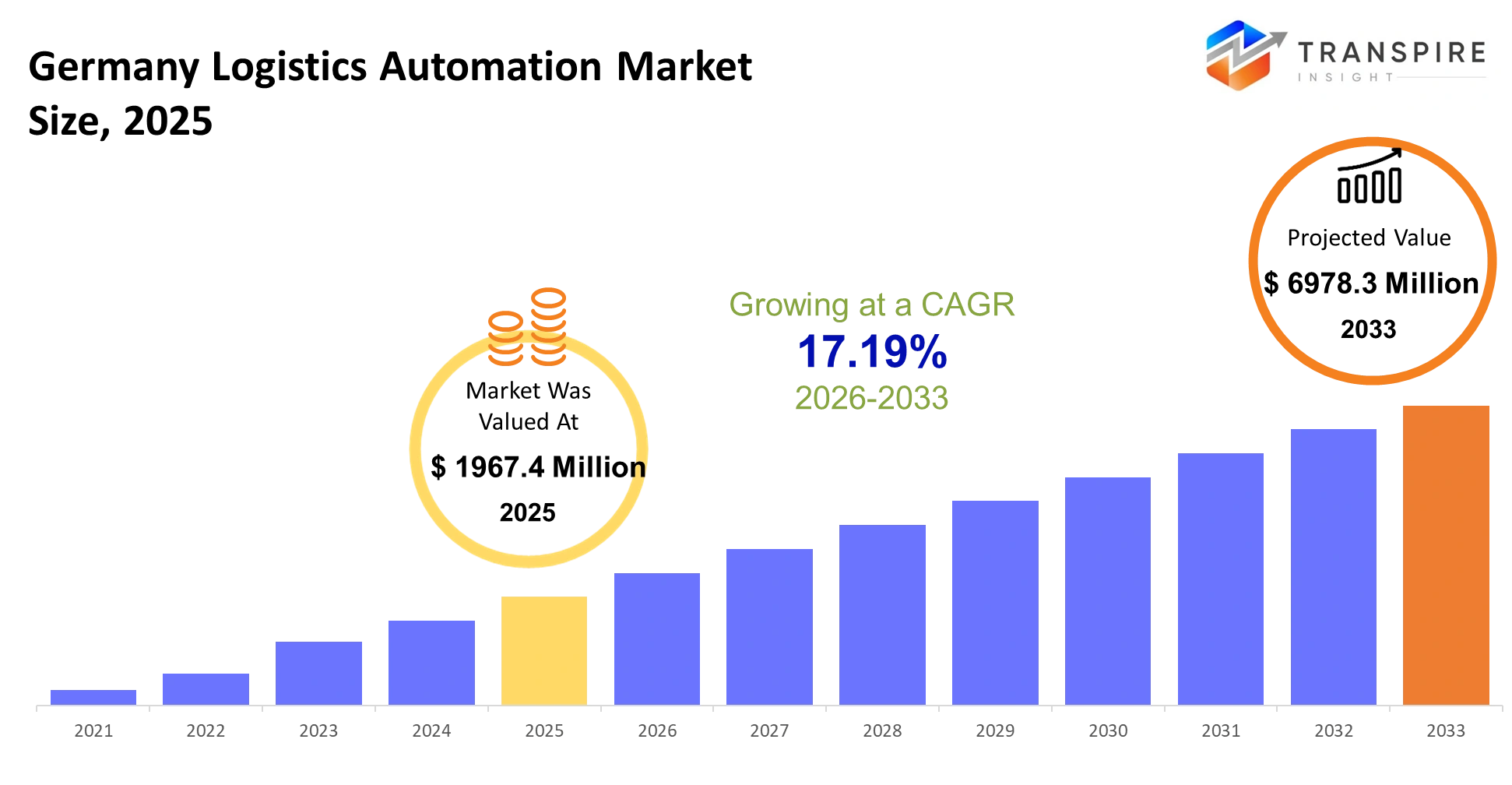
- Germany Logistics Automation Market Size 2025: USD 1967.4 Million
- Germany Logistics Automation Market Size 2033: USD 6978.3 Million
- Germany Logistics Automation Market CAGR: 17.19%
- Germany Logistics Automation Market Segments: by Component (Hardware, Software, Services), by Application (Warehouse & Storage, Transportation Management, Distribution & Fulfillment), by End User (Retail & E-commerce, Manufacturing, Automotive, Healthcare, Food & Beverage).
 To learn more about this report,
  Download Free Sample Report
Germany Logistics Automation Market Summary:
The Germany Logistics Automation Market size was estimated at USD 2298.3 Millionin 2026 and is anticipated to reach USD 6978.3 Million by 2033, growing at a CAGR of 17.19% from 2026 to 2033.The German logistics automation market has developed through the industrial automation and supply chain technology sector because of increased demands from retail networks and cross-border trade and Germany's distinct expertise in precision engineering. The warehouse will implement automated storage systems with robotic pallet handling and sensor-guided conveyor networks to replace its existing manual picking system. Distribution centers in Hamburg and Frankfurt will face new operational changes because consumers demand quick delivery times and precise order fulfillment. Logistics operators will redesign their facilities to enable machines to move between tasks while they maintain their sorting and packaging functions.
Technological progress will further influence how facilities operate over the coming years. Daily logistics operations will increasingly depend on machine vision systems and predictive maintenance software and data-driven warehouse management platforms. German manufacturers supplying automotive parts and pharmaceuticals and electronics will expect their distribution partners to maintain both operational speed and product traceability which will lead to increased automation in their storage and dispatch functions. Equipment design and operational standards will develop through regulatory discussions which focus on worker safety and energy efficiency and digital transparency. The combined shifts will determine how logistics companies upgrade their infrastructure because automated systems need to boost industrial production while matching the growing demand for online shopping..
Key Market Trends & Insights:
- Distribution centers are experiencing increased adoption of robotic picking systems, automated guided vehicles, and smart sorting lines. Large retail groups and e-commerce operators push efficiency targets, faster order cycles, and lower labor pressure. The installation activities that increase in number create growth momentum for the Germany Logistics Automation Market while fostering technology partnerships.
- Major urban areas experience online retail expansion which drives up the need for high-speed solutions that handle picking, packing, and pallet movement. Large fulfillment hubs use conveyor intelligence and automated storage systems and data-driven inventory control systems. Companies keep investing in automation because it helps them achieve operational speed and accuracy improvements while maintaining cost control.
- Warehouse operators increasingly choose automated transport systems and robotic palletizing systems and intelligent sorting equipment because of their need to address two challenges: the aging workforce and ongoing labor shortages. The need for productive operations and continuous work processes leads organizations to invest in technology through long-term planning and capital expenditures which boosts demand for technology solutions that support the Germany Logistics Automation Market growth.
- The three systems of machine vision inspection, predictive maintenance software, and advanced analytics platforms help warehouses make better operational decisions. Operational planning benefits from data visibility that covers transport scheduling and inventory flow and demand forecasting. Technology vendors promote integrated platforms that connect robotics with sensors and warehouse management software.
- The combination of environmental policy requirements with corporate sustainability goals drives companies to implement energy-efficient conveyors and low-power robotics and optimized warehouse designs. Smart routing systems decrease vehicle traffic which results in decreased electricity consumption and decreased material waste. The implementation of green logistics strategies establishes a connection between companies' automation expenditures and their sustained operational productivity.
Germany Logistics Automation Market Segmentation
By Component :
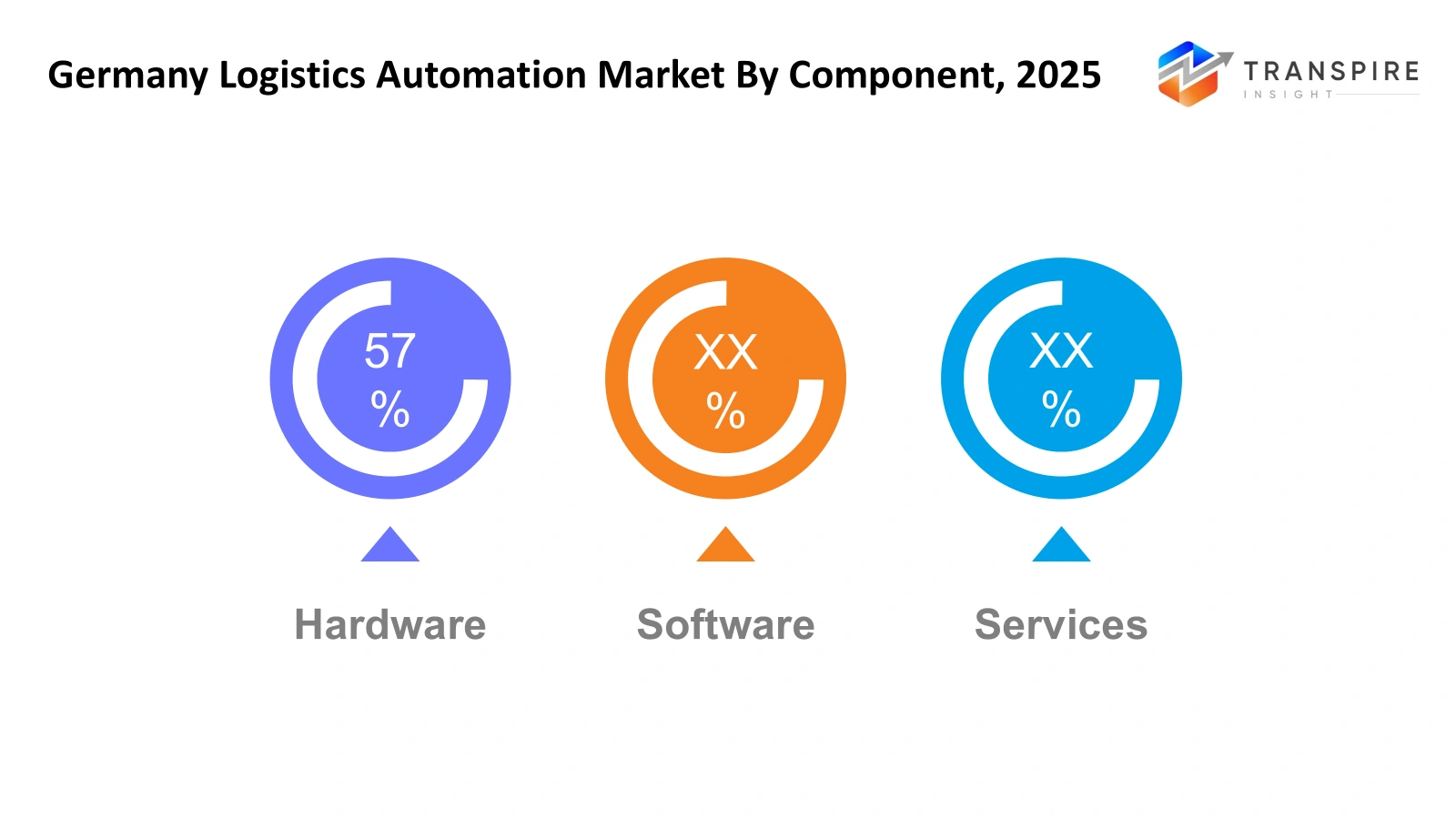
- Hardware: Hardware forms a strong base for automation activities within the Germany Logistics Automation Market. Robotic arms, automated guided vehicles, smart conveyors, barcode scanners, and sensor systems support physical movement of goods. Strong hardware networks improve speed, reduce manual handling, and support accurate inventory flow across warehouses, distribution centers, and transport facilities.
- Software: Software systems guide decision making and operational control in automated logistics environments. Warehouse management systems, transport planning platforms, and inventory monitoring tools organize large volumes of operational data. Within the Germany Logistics Automation Market, software helps schedule tasks, track shipments, and coordinate equipment activity for smoother supply chain operations.
- Services: Service support ensures proper installation, maintenance, and long-term performance of automation systems. Consulting, system integration, training, and technical maintenance play an important role in operational stability. Service providers assist logistics operators with system upgrades, performance checks, and process improvements that support steady expansion of automated logistics infrastructure.
 To learn more about this report, Download Free Sample Report
By Application :
- Warehouse & Storage: Warehouse and storage facilities represent a major area of automation adoption. Automated storage systems, robotic picking solutions, and smart shelving structures help organize high product volumes. Efficient warehouse automation reduces handling time, lowers error rates, and supports faster order preparation across logistics hubs throughout the Germany Logistics Automation Market.
- Transportation Management: Transportation management systems support route planning, shipment tracking, and delivery coordination across national and international supply networks. Digital platforms connect vehicles, warehouses, and distribution centers through data monitoring. Growth in freight movement encourages logistics operators within the Germany Logistics Automation Market to adopt automated planning and real-time transport monitoring solutions.
- Distribution & Fulfillment: Distribution and fulfillment centers depend on automated sorting, packaging, and order processing technologies. Conveyor networks, robotic sorting equipment, and scanning systems accelerate parcel movement. Strong fulfillment automation supports high order volumes generated by digital commerce and large retail supply networks operating across the Germany Logistics Automation Market.
By End User :
- Retail & E-commerce: Retail and e-commerce companies require rapid order processing, accurate inventory control, and reliable delivery operations. Automated picking systems, smart packaging stations, and digital tracking platforms support large daily order volumes. Rising online purchasing activity drives strong automation demand across retail logistics facilities and fulfillment centers in Germany.
- Manufacturing: Manufacturing industries depend on steady material flow between suppliers, production units, and distribution centers. Automated guided vehicles, robotic pallet handling, and warehouse control systems maintain efficient supply chain movement. Logistics automation helps manufacturing companies reduce operational delays, improve inventory visibility, and support continuous production activities.
- Automotive, Healthcare, Food & Beverage: Automotive, healthcare, and food & beverage sectors require high accuracy, strict handling standards, and timely delivery. Automated tracking systems, temperature-controlled storage automation, and robotic transport equipment support safe product movement. Growing demand for reliability and regulatory compliance strengthens automation adoption within the Germany Logistics Automation Market.
Country Insights
- Germany maintains its position as an industrial powerhouse because of its skilled workforce and advanced manufacturing capabilities and efficient supply chain networks. The German Logistics Automation Market experiences continuous growth because of increasing warehouse digitalization and robotics implementation and the rising need for rapid delivery services. The automotive and retail and e-commerce industries drive businesses to invest in automated storage systems and sorting equipment and intelligent material handling solutions.
- The combination of strong transport infrastructure and extensive highway networks and high freight traffic creates ideal conditions for businesses to implement automation technologies. Distribution centers throughout Hamburg and Frankfurt and Munich and Ruhr industrial areas operate with a focus on enhancing their operational efficiency. Businesses implement robotics and automated guided vehicles and smart warehouse systems because of rising labor costs and their need to ensure dependable order fulfillment.
- Government support for Industry 4.0 programs and research partnerships together with technology funding creates better conditions for logistics modernization. German engineering companies and global automation providers maintain strong presence in warehouse equipment, sensors, and software integration. The increasing online retail market and cross-border European trade activities drive supply chain networks to make permanent automation investments in their logistics operations.
Recent Development News
Germany’s logistics leader DHL Group (formerly Deutsche Post) is expanding automation initiatives under its Strategy 2030 program, focusing on digital sales systems, automated warehouses, and advanced robotics in fulfillment centers. Automation and efficiency programs generated over €600 million in profit improvements in 2025, and the company aims to reach €1 billion in efficiency gains by 2027 through automation and digitalization. Source: https://www.wsj.com/business/earnings/dhl-parent-deutsche-post-expects-earnings-growth-despite-uncertain-conditions-79aa6be1?
Strategic partnerships are further shaping the automation ecosystem. In January 2026, Bharat Forge signed an agreement with Germany-based Agile Robots SE to collaborate on AI-driven robotics technologies for industrial automation applications. The partnership aims to accelerate development of intelligent robotic systems capable of supporting complex manufacturing and logistics processes. Source: https://scanx.trade/stock-market-news/stocks/bharat-forge-partners-with-germany-s-agile-robots-for-ai-driven-industrial-automation/29488097?
|
Report Metrics |
Details |
|
Market size value in 2025 |
USD 1967.4 Million |
|
Market size value in 2026 |
USD 2298.3 Million |
|
Revenue forecast in 2033 |
USD 6978.3 Million |
|
Growth rate |
CAGR of 17.19% from 2026 to 2033 |
|
Base year |
2025 |
|
Historical data |
2021 - 2024 |
|
Forecast period |
2026 - 2033 |
|
Report coverage |
Revenue forecast, competitive landscape, growth factors, and trends |
|
Country scope |
Germany |
|
Key company profiled |
Daifuku Co. Ltd., SSI Schaefer Group, Dematic (KION Group), Honeywell Intelligrated, Swisslog Holding AG, Murata Machinery, Vanderlande Industries, TGW Logistics Group, Knapp AG, Mecalux SA, BEUMER Group, Toyota Industries Corporation, Bastian Solutions, GreyOrange, Geek+ Robotics. |
|
Customization scope |
Free report customization (country, regional & segment scope). Avail customized purchase options to meet your exact research needs. |
|
Report Segmentation |
by Component (Hardware, Software, Services), by Application (Warehouse & Storage, Transportation Management, Distribution & Fulfillment), by End User (Retail & E-commerce, Manufacturing, Automotive, Healthcare, Food & Beverage). |
Key Germany Logistics Automation Company Insights
- The Germany Logistics Automation Market experiences continuous expansion because major industrial players provide support through their implementation of warehouse robots and automated storage solutions and sorting systems and intelligent software platforms. The engineering capabilities and manufacturing abilities of German logistics facilities combined with their ongoing product development efforts enable them to achieve faster and more precise operations which help them maintain cost efficiency across their distribution and fulfillment processes.
- The industrial leaders Siemens AG and KUKA AG and SSI Schaefer Group develop advanced automation equipment which serves the needs of warehouses and manufacturing supply chains and e-commerce fulfillment centers. The product range consists of robotic picking systems and automated conveyors and pallet handling solutions and digital warehouse management software.
- Companies operating within the Germany Logistics Automation Market establish their market presence through strategic partnerships and research investment and facility expansion activities. Organizations achieve higher warehouse productivity through their ongoing development of robotics and artificial intelligence systems and sensor technology. The strong domestic demand from retail and automotive and manufacturing logistics operations drives German supply chain networks to implement automation solutions.
Germany Logistics Automation Market Companies:
- Daifuku Co. Ltd.
- SSI Schaefer Group
- Dematic (KION Group)
- Honeywell Intelligrated
- Swisslog Holding AG
- Murata Machinery
- Vanderlande Industries
- TGW Logistics Group
- Knapp AG
- Mecalux SA
- BEUMER Group
- Toyota Industries Corporation
- Bastian Solutions
- GreyOrange
- Geek+ Robotics
Germany Logistics Automation Market Segmentation
By Component
- Hardware
- Software
- Services
By Application
- Warehouse & Storage
- Transportation Management
- Distribution & Fulfillment
By End User
- Retail & E-commerce
- Manufacturing
- Automotive
- Healthcare
- Food & Beverage
Frequently Asked Questions
Find quick answers to common questions.
The approximate Germany Logistics Automation Market size for the market will be USD 6978.3 Million in 2033.
Key segments for the Germany Logistics Automation market are by Component (Hardware, Software, Services), by Application (Warehouse & Storage, Transportation Management, Distribution & Fulfillment), by End User (Retail & E-commerce, Manufacturing, Automotive, Healthcare, Food & Beverage).
Major Germany Logistics Automation Market players are Daifuku Co. Ltd., SSI Schaefer Group, Dematic (KION Group), Honeywell Intelligrated, Swisslog Holding AG, Murata Machinery, Vanderlande Industries, TGW Logistics Group, Knapp AG, Mecalux SA, BEUMER Group, Toyota Industries Corporation, Bastian Solutions, GreyOrange, Geek+ Robotics.
The Germany Logistics Automation Market size is USD 1967.4 Million in 2025.
The Germany Logistics Automation Market CAGR is 17.19%.
- Daifuku Co. Ltd.
- SSI Schaefer Group
- Dematic (KION Group)
- Honeywell Intelligrated
- Swisslog Holding AG
- Murata Machinery
- Vanderlande Industries
- TGW Logistics Group
- Knapp AG
- Mecalux SA
- BEUMER Group
- Toyota Industries Corporation
- Bastian Solutions
- GreyOrange
- Geek+ Robotics
Recently Published Reports
-
Apr 2026
3D Optical Profiler Market
3D Optical Profiler Market Size, Share & Analysis Report By Type (Desktop 3D Optical Profiler, and Portable 3D Optical Profiler), By Technology (Confocal Technology, and White Light Interference), By End-Use Industry (Manufacturing, Research Institutions, Automotive, Aerospace and Defense, Medical Devices, and Other), and Geography (North America, Europe, Asia-Pacific, Middle East and Africa, South and Central America), 2021 - 2031
-
Apr 2026
Depth Sensor Market
Depth Sensor Market Size, Share & Analysis Report By Type (Infrared Depth Sensors, Time-of-Flight (ToF) Sensors, Stereo Vision Sensors, Structured Light Sensors, Ultrasonic Depth Sensors), By Application (Automotive, Robotics, Gaming, Consumer Electronics, Industrial Automation, Healthcare, Security & Surveillance, Others), By End Users (Automotive Manufacturers, Consumer Electronics Companies, Healthcare Providers, Industrial Companies, Security Agencies, Gaming Companies, Robotics Companies, Others), and Geography (North America, Europe, Asia-Pacific, Middle East and Africa, South and Central America), 2021 – 2031
-
Apr 2026
Digital Manufacturing Market
Digital Manufacturing Market Size, Share & Analysis Report By Component (Hardware, Software, and Services), By Technology (Robotics, 3D Printing, Internet of Things (IoT), and Others), By Application (Automotive and Transportation, Aerospace and Defense, Consumer Electronics, Industrial Machinery, and Others), By Process Type (Computer-Based Designing, Computer-Based Simulation, Computer 3D Visualization, Analytics, and Others), and Geography (North America, Europe, Asia-Pacific, Middle East and Africa, South and Central America), 2021 – 2031
-
Apr 2026
Digital Visa Services Market
Digital Visa Services Market Size, Share & Analysis Report By Type (Individual Travelers, Group Travelers), By Application (Tourism, Business Travel, Others), and Geography (North America, Europe, Asia-Pacific, Middle East and Africa, South and Central America), 2021 – 2031