

Europe Connected Logistics Market Size & Forecast:
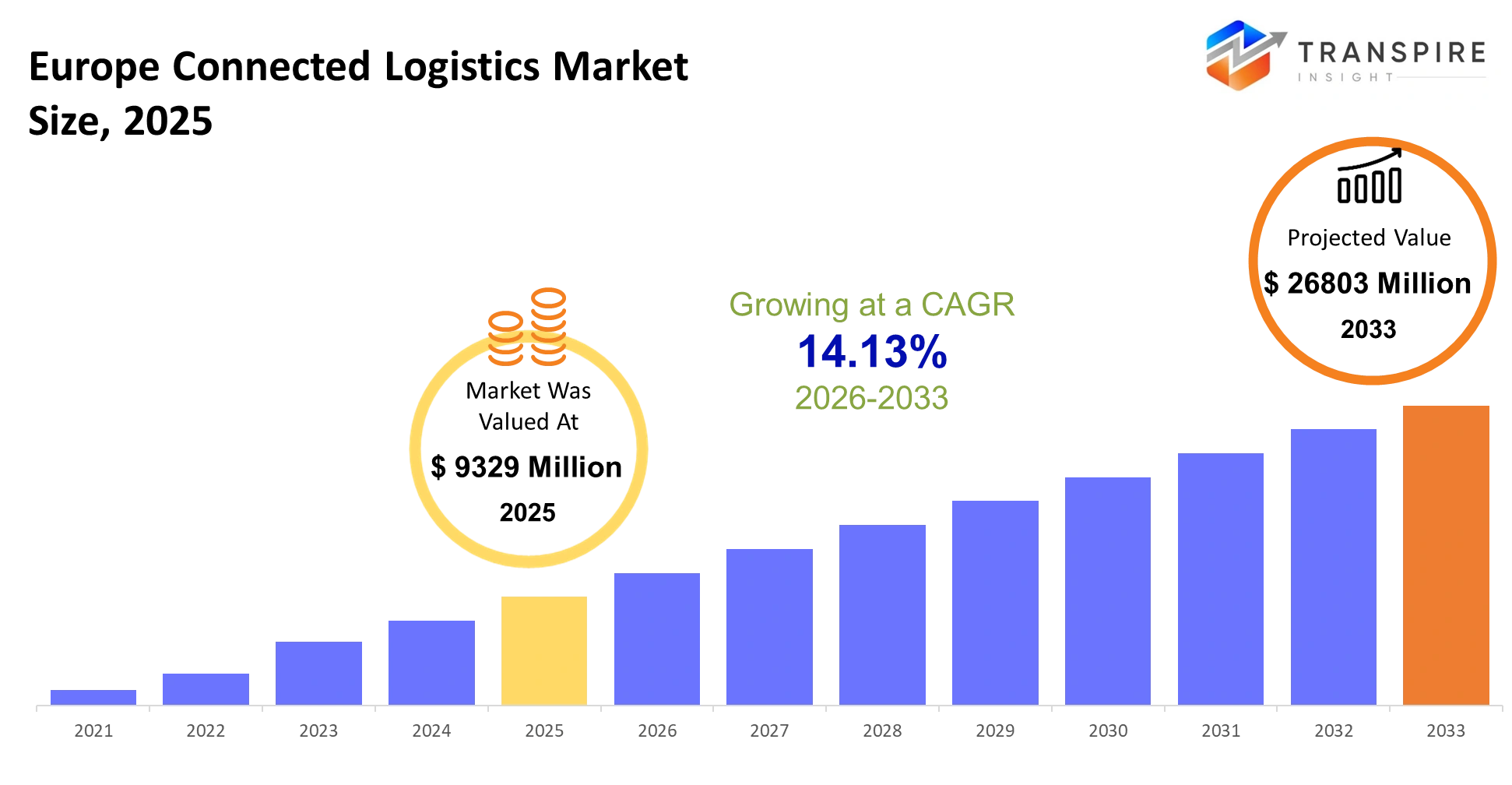
- Europe Connected Logistics Market Size 2025: USD 9329 Million
- Europe Connected Logistics Market Size 2033: USD 26803 Million
- Europe Connected Logistics Market CAGR: 14.13%
- Europe Connected Logistics Market Segments: By Type (Hardware, Software, Services, IoT Platforms, Others), By Application (Fleet Management, Asset Tracking, Warehouse Management, Supply Chain Optimization, Others), By End-User (Logistics Companies, Retailers, Manufacturers, Others), By Deployment (Cloud, On-premise, Hybrid, Others).
To learn more about this report,  Download Free Sample Report
Europe Connected Logistics Market Summary:
The Europe Connected Logistics Market size is estimated at USD 9329 Million in 2025 and is anticipated to reach USD 26803 Million by 2033, growing at a CAGR of 14.13% from 2026 to 2033. The Europe Connected Logistics Market has become a vital coordination system which enables freight operators and ports and warehouses and industrial manufacturers to transport their products with reduced delays and decreased fuel expenses and minimized inventory requirements. The connected logistics platforms of a company use Internet of Things sensors and telematics systems and cloud-based tracking and artificial intelligence routing technology to monitor their transportation operations through road and rail and maritime and last-mile delivery systems. The process results in decreased unproductive resources and lost cargo and determined operational schedule mistakes which became financially damaging after the latest supply chain disruptions.
The market has transformed during the past three to five years because organizations now use their fleet for both basic vehicle tracking and advanced autonomous logistics operations. The COVID-19 pandemic brought major disruptions which continued through the Russia-Ukraine conflict and subsequent energy price fluctuations which revealed how expensive Europe suffers from broken logistic networks. The connected infrastructure investments of manufacturers and transport providers, which they make to enhance resilience and fulfil EU emissions reporting requirements and streamline multimodal freight operations, serve as their response to this situation. The ongoing transition process leads to increased software subscription income and data-service usage and sustained investment in digital infrastructure throughout the entire area.
Key Market Insights
- The Europe Connected Logistics Market in 2025 saw Western Europe achieve its highest market share of almost 42% through the economic strength of Germany, France, and the Netherlands.
- The Northern Europe market will experience its highest growth until 2030 because of its advanced smart port infrastructure and green logistics investment projects.
- The German economy generates the most revenue because the automotive and industrial and e-commerce industries expand their adoption of connected freight network systems.
- The UK logistics technology sector showed impressive growth when companies adopted AI-based fleet monitoring and warehouse automation platforms between 2023 and 2025.
- Businesses in Europe Connected Logistics Market used software platforms to create their operations because more than 48% of market share in 2025.
- The second largest market segment for IoT-enabled fleet management solutions developed through rising demand for predictive maintenance and route optimization.
- Cloud-based connected logistics services represent the fastest-growing segment because organizations update their outdated transport systems during the forecast period.
- Digital freight matching platforms gained strong market traction by reducing idle vehicle utilization and improving delivery efficiency across Europe.
- The freight transportation management sector achieved 37% market share in 2025 because cross-border trade and multimodal logistics operations experienced growth.
- Retailers who implement automated fulfillment systems and same-day delivery services create a new demand for warehouse and inventory monitoring applications.
- Pharmaceutical and food logistics providers who need to monitor temperature-sensitive shipments adopted real-time cargo tracking solutions.
What are the Key Drivers, Restraints, and Opportunities in the Europe Connected Logistics Market?
The Europe Connected Logistics Market experiences its most powerful growth from the urgent need to establish real-time supply chain visibility which emerged after the COVID-19 pandemic and the Russia-Ukraine conflict. European manufacturers and logistics operators discovered that their existing transportation systems created multiple delivery problems which resulted in financial losses and inventory shortages. The European Union established new emissions reporting requirements which forced fleet operators to track their fuel consumption and route efficiency and cargo operations with greater accuracy. Organizations invested heavily in Internet of Things tracking systems and artificial intelligence-driven route optimization and cloud-based logistics solutions. Software subscription revenue and managed logistics service contracts now cover the entire range of freight and warehousing and multimodal transport networks.
The biggest structural barrier remains the fragmented digital infrastructure across Europe’s logistics ecosystem. Many small and mid-sized transport providers still operate legacy fleet management systems that cannot integrate easily with modern connected logistics platforms. Organizations need to spend large amounts of money to replace their current systems which will also require them to train their employees and wait through long periods until all systems work together. The highly fragmented European freight market creates interoperability gaps which prevent platform standardization and their cross-company implementation while affecting Eastern and Southern European regions.
Smart port and rail freight digitization create significant business growth potential for companies that operate in this sector. The Netherlands and Germany are making substantial investments in artificial intelligence port automation and 5G cargo monitoring systems and digital freight corridors. The connected logistics providers can develop their operations through these investments because they will establish optimal conditions for implementing their predictive analytics and autonomous scheduling and real-time customs coordination services throughout Europe's major trade networks.
What Has the Impact of Artificial Intelligence Been on the Europe Connected Logistics Market?
The logistics operations of Europe face transformation through artificial intelligence and advanced digital technologies which create data-driven automated systems from their existing fragmented transport networks. The logistics industry now employs AI-based control towers to handle automated compliance tracking and route management and cargo tracking for all modes of transportation including road and rail and maritime operations. The telematics systems which use IoT sensors to monitor real-time data streams of fuel usage and driver activity and cargo temperature and delivery timetables enable operators to achieve their shipment goals with less need for human involvement.
Engineers develop predictive maintenance solutions and operational forecasting methods through their use of machine learning models. Fleet operators use predictive analytics to predict upcoming component failures which permits them to decrease unplanned vehicle downtime while increasing their equipment lifespan. AI-based platforms for route optimization use their capabilities to predict traffic conditions and weather interruptions and fuel needs, which helps transportation companies achieve better delivery results and decrease their fuel expenses through measurable improvements. AI-enabled scheduling and automation systems have produced positive results for cargo throughput efficiency and warehouse space management in multiple European logistics centers and smart ports.
The process of adopting new technology encounters major obstacles because of existing structural limitations. Many logistics operators rely on outdated legacy infrastructure that cannot easily integrate with AI systems. The cross-border freight movement process experiences two major challenges which reduce prediction accuracy and delay the implementation of large-scale operations because of inconsistent data formats and lack of real-time system connections across remote transport routes.
Key Market Trends
- European manufacturers adopted AI logistics control towers from 2021 to 2025 after they stopped using manual shipment coordination methods to decrease inventory disruptions and delivery delays.
- Germany and the Netherlands expanded smart port investments after 2022 which led to faster implementation of automated cargo scheduling and real-time container tracking systems.
- Logistics providers switched from using standalone fleet software to adopting cloud-native platforms which combine telematics and predictive maintenance and emissions reporting into unified dashboards.
- European freight operators developed multiple transport routes and dedicated substantial funding to multimodal logistics visibility technologies since the Russia-Ukraine conflict began to strengthen their operational resilience.
- Retailers and third-party logistics firms adopted warehouse automation technologies at a faster rate after e-commerce delivery volumes reached levels that exceeded the storage capacity of their facilities which had existed before 2020.
- DHL and Maersk developed AI-driven route optimization tools to decrease fuel consumption and enhance their delivery accuracy.
- Transport operators needed to implement connected fleet monitoring systems which could measure their emissions of carbon dioxide because the EU carbon reporting requirements became effective in 2023.
- Cross-border logistics operators increasingly adopted blockchain-enabled documentation systems which helped them to decrease customs delays while they tracked shipments throughout European trade corridors.
- The need for 5G-enabled logistics infrastructure rose between 2022 and 2026 because ports and rail operators prioritized developing low-latency cargo communication networks.
- Mid-sized transport companies experience reduced progress in digital transformation because their existing fleet systems create expensive challenges for system compatibility and data sharing in their divided supply networks.
Europe Connected Logistics Market Segmentation
By Type
The software platforms maintain their top market share because logistics operators now demand three essential features which include centralized visibility and AI-based analytics and real-time shipment tracking across multiple transport systems. The deployment of hardware solutions, which include IoT sensors and telematics devices and RFID tags and edge connectivity systems, enables widespread implementation across all types of vehicles and storage facilities and port operations. The transport providers who faced difficulties in integrating their old systems with new cloud technology found that integration and maintenance and consulting services became their most valuable resources.
Enterprises adopted IoT platforms because they needed to implement predictive logistics planning and automated compliance reporting solutions. The current demand patterns in the market prefer businesses to adopt software ecosystems that support interoperability instead of using individual tracking systems which do not work together. The future development of the type segment will establish AI-powered orchestration platforms that enable organizations to merge fleet operations with warehouse performance and emissions data into an integrated system which generates continuous revenue streams for technology vendors and infrastructure providers.
By Application
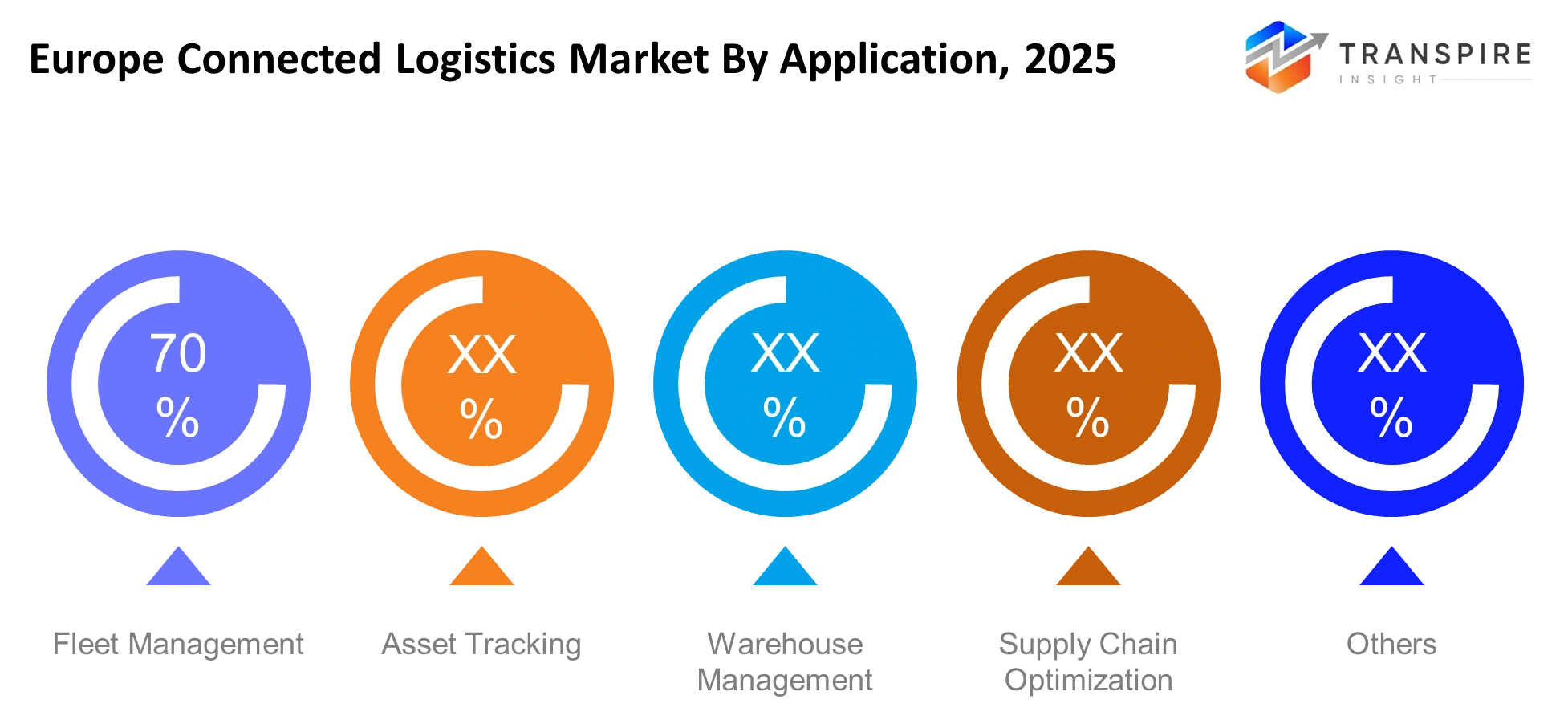
The main application area of fleet management system develops into its main operational segment because fuel optimization and route efficiency together with driver monitoring and real-time compliance tracking create direct effects which impact operating margins for all transport businesses. Retailers and manufacturers experienced delivery delay problems which required better inventory visibility so they developed their asset tracking and warehouse management systems. The recent disruptions which revealed hidden weaknesses in European logistics systems resulted in substantial growth for supply chain optimization platforms.
Large logistics providers use predictive analytics to track cargo movements, predict potential disruptions, and automate scheduling processes through their operations at ports and rail systems and road freight corridors. Pharmaceutical and food distribution companies which need to monitor temperature-sensitive shipments show growing demand for integrated logistics visibility systems. The upcoming investment trends predict that companies will adopt autonomous planning systems and digital freight matching platforms and AI-based warehouse coordination tools at a higher rate. The software vendors who specialize in operational intelligence and predictive logistics services will experience increasing competition because these developments create more opportunities for data monetization.
To learn more about this report, Download Free Sample Report
By End-User
The largest end-user segment of logistics companies exists because transport operators need to handle complex freight coordination tasks which require them to monitor shipments throughout the process and manage dynamic routes while they track international shipments. The second largest market segment consists of retailers who face ongoing e-commerce fulfillment demands and customers who expect their orders to be delivered with precise timing. Manufacturing companies also keep increasing their investments in connected logistics systems which enable them to match their production activities with the timing of received raw materials and their outgoing distribution systems. The different end-user groups experience separate patterns of demand.
Retailers focus their efforts on warehouse automation together with last-mile visibility whereas manufacturers dedicate their resources to building supply chain resilience and optimizing inventory levels. Third-party logistics providers today invest more resources in cloud-based coordination systems which help them to achieve better fleet managementand decrease their empty return trips to base. The requirement for cold-chain compliance has made healthcare and pharmaceutical logistics operators to become one of the fastest-growing industry segments because this standard needs shipments to maintain complete visibility and continuous monitoring of their status during transport. Future market direction suggests stronger collaboration between logistics providers, industrial manufacturers, and digital infrastructure vendors to build highly integrated transport ecosystems.
By Deployment
The deployment segment of the market experiences its highest share from cloud deployment because transport providers need to access logistics data in real time across multiple locations that they control. The adoption of cloud platforms becomes more appealing for multinational freight operators and retailers because these platforms enable faster software updates and centralized analytics and simpler integration with IoT-enabled tracking systems. Organizations that need to protect their operational data through strict security measures or who work in highly controlled industrial fields still find on-premise deployment to be valuable. Organizations that needed to update their outdated systems without completely replacing their active systems found hybrid deployment models to be an effective solution.
The process of cloud migration experiences delays for smaller logistics operators because they face two main challenges which are cost sensitivity and cybersecurity threats that affect their operations in transported freight operations through different regional networks. The current trend of investment distribution shows a preference for cloud-native logistics ecosystems which provide support for AI-based forecasting and predictive maintenance and automated compliance reporting. The deployment of upcoming systems will prioritize interoperability and edge computing and low-latency communication systems which enable logistics networks to handle real-time operational data across their ports and warehouses and freight corridors.
What are the Key Use Cases Driving the Europe Connected Logistics Market?
European freight and transportation networks use real-time fleet management systems as their most important use case which drives system adoption throughout their networks. Logistics operators use linked systems to improve their routing operations while tracking fuel usage and driver behavior and decreasing expensive delivery delays which occur during international trade between border points. Retailers pharmaceutical distributors and manufacturing companies are increasing their implementation of warehouse automation systems together with asset tracking technology.
E-commerce fulfillment centers use Internet of Things-enabled inventory systems and artificial intelligence-based scheduling software to achieve better order accuracy and speed up their final delivery processes. The healthcare logistics sector experienced increased cold-chain monitoring adoption following the implementation of stricter pharmaceutical transport compliance regulations throughout Europe.
Smart port orchestration systems and autonomous freight coordination systems represent new emerging applications. The ports of the Netherlands and Germany use AI-enabled cargo scheduling and predictive berth allocation and 5G-connected container monitoring systems to enhance their cargo turnaround efficiency. Rail freight operators are also exploring predictive traffic management platforms to reduce congestion across high-volume industrial transport routes.
|
Report Metrics |
Details |
|
Market size value in 2025 |
USD 9329 Million |
|
Market size value in 2026 |
USD 10626 Million |
|
Revenue forecast in 2033 |
USD 26803 Million |
|
Growth rate |
CAGR of 14.13% from 2026 to 2033 |
|
Base year |
2025 |
|
Historical data |
2021 - 2024 |
|
Forecast period |
2026 - 2033 |
|
Report coverage |
Revenue forecast, competitive landscape, growth factors, and trends |
|
Regional scope |
Europe (Germany, United Kingdom, France, Italy, Spain and Rest of Europe) |
|
Key company profiled |
IBM, Cisco, SAP, Oracle, Microsoft, Zebra Technologies, Honeywell, Siemens, Bosch, AT&T, Verizon, DHL, FedEx, UPS, Geotab |
|
Customization scope |
Free report customization (country, regional & segment scope). Avail customized purchase options to meet your exact research needs. |
|
Report Segmentation |
By Type (Hardware, Software, Services, IoT Platforms, Others), By Application (Fleet Management, Asset Tracking, Warehouse Management, Supply Chain Optimization, Others), By End-User (Logistics Companies, Retailers, Manufacturers, Others), By Deployment (Cloud, On-premise, Hybrid, Others) |
Which Regions are Driving the Europe Connected Logistics Market Growth?
The market is dominated by Western Europe because Germany, the Netherlands, and France maintain their freight corridors through their advanced port and warehouse systems. Companies needed to use AI-based fleet tracking systems and territory logistics visibility tools because of the EU emissions reporting regulations and digital freight compliance standards. Major ports such as Rotterdam and Hamburg continue to invest in smart cargo handling systems and automated scheduling technologies and 5G container tracking systems. The region maintains its leadership in connected freight operations because of its strong cloud infrastructure and established logistics providers and unified transport regulations.
Northern Europe represents the second-largest regional contributor, but growth dynamics differ from Western Europe because stability and long-term infrastructure planning drive investment decisions. Scandinavian countries focus on developing sustainable freight systems through their electrified transport corridors and low-emission logistics operations which receive consistent funding from their governments. The large logistics operators in Sweden and Denmark and Finland proceed with their digital fleet system updates through gradual implementation instead of sudden system changes. The logistics technology market benefits from this investment approach which generates stable income for providers while decreasing operational hazards faced by transport companies and industrial freight operators.
The current transportation infrastructure modernization efforts in Eastern Europe drive its economic expansion because of increased international trade activities that followed the recent supply chain interruptions which changed freight transportation patterns across Europe.
Who are the Key Players in the Europe Connected Logistics Market and How Do They Compete?
The competitive landscape maintains moderate fragmentation because global enterprise software providers face competition from both regional logistics technology companies and integrated freight operators. Enterprises now compete based on their platform interoperability and predictive analytics capabilities and their ability to provide real-time supply chain visibility which has become more important than traditional pricing methods. Established logistics groups maintain their market position through AI and IoT system integration which enables emissions monitoring within their current transport networks, while cloud-native providers who use cloud technology, aim to serve mid-sized businesses that existing systems fail to support. Competition between companies develops through their ability to access key resources which include port facilities and warehouse systems and cross-border freight routes that extend throughout European trade routes.
SAP creates its competitive advantage through advanced enterprise resource planning systems which enable manufacturers and logistics companies to operate inventory control and transportation monitoring and procurement processes within a single digital framework. The company expands its logistics cloud capabilities through AI-based forecasting systems and by establishing partnerships with companies that specialize in industrial automation. DHL invests in building operational capacity and automated systems for order processing by utilizing robotics and intelligent warehouse technology and using predictive algorithms to enhance delivery efficiency in European online shopping networks. The continuous development of regional fulfillment centers and environmentally friendly transportation fleets enables retailers and healthcare organizations to keep their long-term contracts through sustainable operations.
Company List
- IBM
- Cisco
- SAP
- Oracle
- Microsoft
- Zebra Technologies
- Honeywell
- Siemens
- Bosch
- AT&T
- Verizon
- DHL
- FedEx
- UPS
- Geotab
Recent Development News
In May 2026, Shipping giant CMA CGM accelerates expansion into European land logistics networks: CMA CGM is actively expanding its European logistics capabilities by integrating trucking, warehousing, rail, and air logistics under its CEVA Logistics arm. The company is shifting from pure shipping to end-to-end connected logistics solutions across Europe, strengthening its digital and physical supply chain control. This move supports resilient, multimodal logistics operations across key European corridors.
Source: https://www.lemonde.fr
In May 2026, Adani Ports commits $1.36 billion investment to expand European offshore logistics services: Adani Ports revealed a large-scale expansion plan targeting Europe’s offshore logistics sector through its marine services division Astra Offshore. The strategy includes developing a specialized vessel fleet to serve growing European offshore logistics demand and strengthening cross-border maritime connectivity.
Source: https://www.reuters.com
What Strategic Insights Define the Future of the Europe Connected Logistics Market?
The Europe Connected Logistics Market will evolve during the next 5 to 7 years from its current state of using separate digital tracking systems to implement complete systems that use artificial intelligence for managing logistics through its three components of tracking freight, measuring emissions, and planning operations autonomously. The organization will achieve its operational goals through compliance with carbon reporting regulations and supply chain resilience requirements and cross-border freight transparency standards instead of basic efficiency targets. The ability to predict operational outcomes through platform interoperability will become essential for transport operators who need to consolidate data from their port and warehouse and rail and trucking operations.
A dangerous threat exists because the cloud infrastructure and enterprise software market relies too heavily on a few major providers. Logistics operators face three main risks of digital ecosystem dependence which include pricing pressure and integration lock-in and cybersecurity vulnerability. Eastern Europe presents a major growth opportunity because companies increasingly adopt nearshoring which drives the development of regional warehouses and rail systems and smart freight corridors.
Market participants need to develop systems that operate through modular components which work together with existing systems because closed proprietary platforms prevent their organizations from developing future growth.
Europe Connected Logistics Market Report Segmentation
By Type
- Hardware
- Software
- Services
- IoT Platforms
- Others
By Application
- Fleet Management
- Asset Tracking
- Warehouse Management
- Supply Chain Optimization
- Others
By End-User
- Logistics Companies
- Retailers
- Manufacturers
- Others
By Deployment
- Cloud
- On-premise
- Hybrid
- Others
Frequently Asked Questions
Find quick answers to common questions.
The approximate Europe Connected Logistics Market size for the market will be USD 26803 Million in 2033.
The key segments of the Europe Connected Logistics Market are By Type (Hardware, Software, Services, IoT Platforms, Others), By Application (Fleet Management, Asset Tracking, Warehouse Management, Supply Chain Optimization, Others), By End-User (Logistics Companies, Retailers, Manufacturers, Others), By Deployment (Cloud, On-premise, Hybrid, Others).
Major players in the Europe Connected Logistics Market are IBM, Cisco, SAP, Oracle, Microsoft, Zebra Technologies, Honeywell, Siemens, Bosch, AT&T, Verizon, DHL, FedEx, UPS, Geotab.
The current market size of the Europe Connected Logistics Market is USD 9329 Million in 2025.
The Europe Connected Logistics Market CAGR is 14.13%.
- IBM
- Cisco
- SAP
- Oracle
- Microsoft
- Zebra Technologies
- Honeywell
- Siemens
- Bosch
- AT&T
- Verizon
- DHL
- FedEx
- UPS
- Geotab
Recently Published Reports
-
Apr 2026
Handling and Lifting Equipment Market
Handling and Lifting Equipment Market Size, Share & Analysis Report By Product (Cranes and Hoists, Forklifts, Conveyor Systems, Aerial Work Platforms, Others), By Application (E-Commerce, Automotive and Railway, Food and Beverages, Aviation, Others), and Geography (North America, Europe, Asia-Pacific, Middle East and Africa, South and Central America), 2021 - 2031
-
Apr 2026
HVAC Equipment Market
HVAC Equipment Market Size, Share & Analysis Report By Heating Equipment Type (Boilers and Furnaces, Heat Pumps, and Unitary Heaters), By Ventilation Equipment (Air Handling Units, Humidifiers and Dehumidifiers, Air Filters, and Fan Coiling Units), By Air Conditioning Equipment (Unitary Air Conditioners, Room Air Conditioners, Packaged Terminal Air Conditioners, and Chillers), By End User (Commercial, Residential, Industrial, and others), and Geography (North America, Europe, Asia-Pacific, Middle East and Africa, South and Central America), 2021 – 2031
-
Apr 2026
Refrigeration Valves Market
Refrigeration Valves Market Size, Share & Analysis Report By Type (Solenoid Valves, Expansion Valves, Check Valves, Service Valves, Others), By Application (Commercial Refrigeration, Industrial Refrigeration, Transport Refrigeration, Residential Refrigeration, Air Conditioning Systems), By End User (Food and Beverage Industry, Pharmaceutical Industry, HVAC Industry, Chemical Industry, Others), and Geography (North America, Europe, Asia-Pacific, Middle East and Africa, South and Central America), 2021 – 2031
-
Apr 2026
E-Commerce Packaging Materials Market
E-Commerce Packaging Materials Market By Material Type (Corrugated Boxes, Paper & Paperboard, Foam & Cushioning Materials, Plastic Packaging, Flexible Packaging, Protective Packaging, Others), By Product(Primary Packaging, Secondary Packaging, Tertiary Packaging), By Packaging Function (Protective Packaging, Branding & Presentation Packaging, Transit & Logistic Packaging, Sustainable Packaging, Tamper Evidence Packaging), By End-User (Retail & Consumer Goods, Electronic Appliances, Food & Beverages, Healthcare & Pharmaceutical, Fashion & Apparel, Home & Furnishing, Others); By Industry Analysis, Size, Share, Growth, Trends, and Forecasts 2021-2033