

Middle East and Africa Private Cloud Migration Market Size & Forecast:
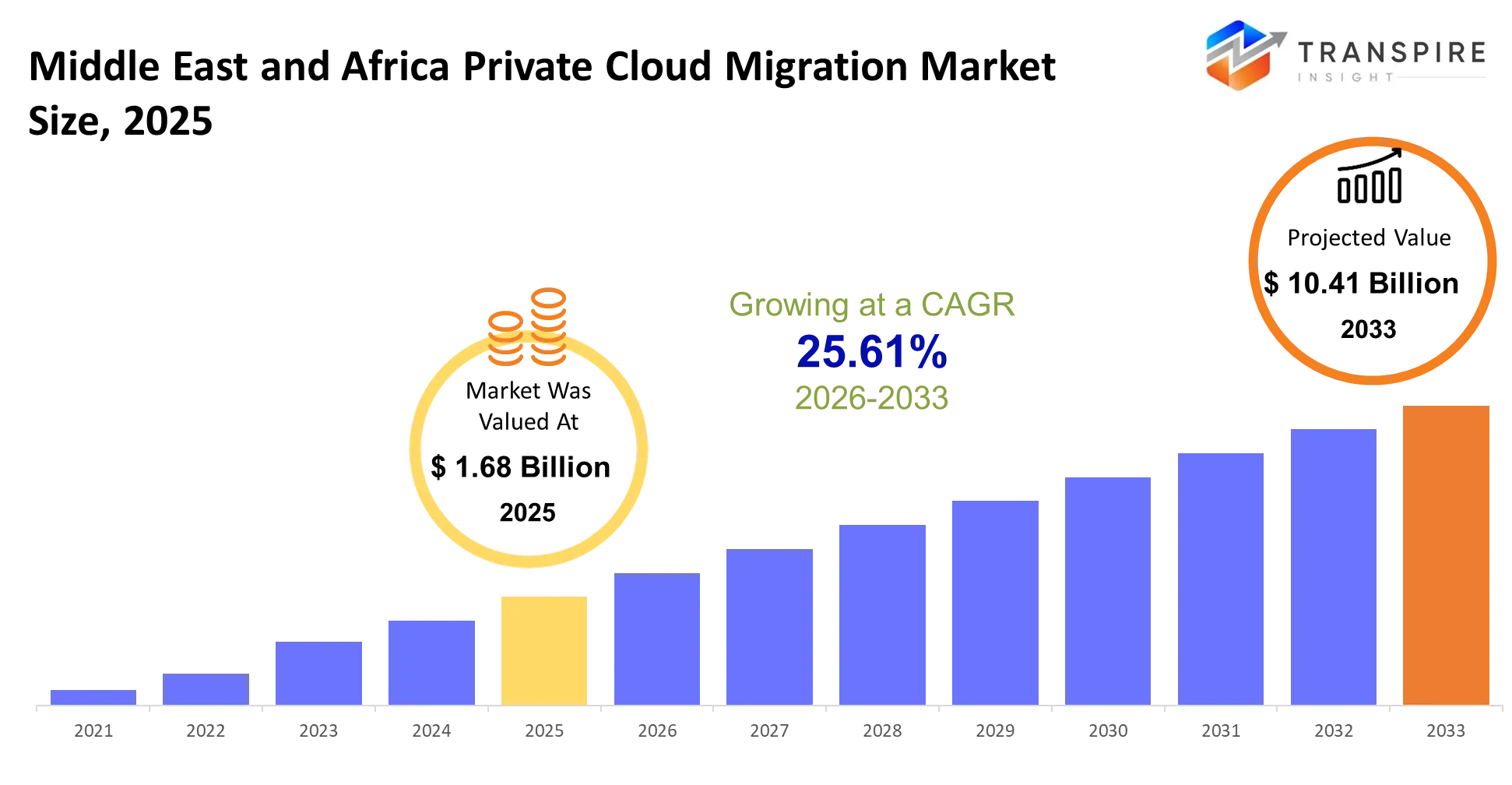
- Middle East and Africa Private Cloud Migration Market Size 2025: USD 1.68 Billion
- Middle East and Africa Private Cloud Migration Market Size 2033: USD 10.41 Billion
- Middle East and Africa Private Cloud Migration Market CAGR: 25.61%
- Middle East and Africa Private Cloud Migration Market Segments: By Type (Infrastructure Migration, Application Migration, Data Migration, Platform Migration, Others); By Application (IT Modernization, Disaster Recovery, Data Management, Security Enhancement, Business Continuity, Others); By End-User (Enterprises, SMEs, IT Companies, BFSI, Healthcare, Government, Others); By Deployment (Private Cloud, Hybrid Cloud, Multi-cloud, Others)
To learn more about this report,  Download Free Sample Report
Middle East and Africa Private Cloud Migration Market Summary
The Middle East and Africa Private Cloud Migration Market was valued at USD 1.68 Billion in 2025. It is forecast to reach USD 10.41 Billion by 2033. That is a CAGR of 25.61% over the period.
The private cloud migration market in the Middle East and Africa enables organizations to transition their essential applications and databases and operational workloads from outdated on-premise systems into protected private cloud environments which provide superior management and expansion capabilities and regulatory compliance. This technology enables banks and telecom companies and energy firms and government organizations to update their IT systems without using public cloud services which contain their protected information, which is critical for sectors that demand data sovereignty and operational continuity.
The market has evolved during the past five years from its previous practice of migrating specific workloads to its current adoption of hybrid and private cloud transformation methods. The new data residency requirements established by Saudi Arabia and UAE national laws force enterprises to store specific data within their home country infrastructure. Organizations needed to improve their infrastructure resilience because their digital transformation efforts increased after the pandemic remote work period and regional cybersecurity breaches. Organizations that need to modernize their systems through secure methods will spend their budget on managed migration services and private cloud orchestration and automation tools, which will increase revenue for local cloud providers and system integrators.
Key Market Insights
- The Gulf Cooperation Council region controls the Middle East and Africa Private Cloud Migration Market through its control of 48% market share which will reach 2025 because of its infrastructure investment projects.
- Through 2030 South Africa will become the fastest-growing market in the region because of rising financial services cloud adoption and enterprise modernization initiatives.
- The UAE private cloud migration market expands through hyperscale data center construction and enterprise cloud collaboration agreements.
- Enterprise workload transition complexity drives migration and deployment services which will reach a 39% market share in 2025.
- Enterprises which want to improve their infrastructure by outsourcing their needs make managed private cloud services the second-biggest market category.
- The period from now until 2030 will show rapid development of cloud orchestration and automation platforms because AI-based workload management systems drive their growth.
- Infrastructure planning for resilience purposes creates the primary market share which reaches 34% in 2025 through two main applications of data storage and disaster recovery.
- The banking and financial services sector holds the largest market share of the Middle East and Africa Private Cloud Migration Market because their operations require strict compliance with government regulations.
- Healthcare and public sector organizations demonstrate their strongest development because they use digital records and national cloud strategies to expand their services.
- Energy and utilities companies create new business requirements through their efforts to centralize operational data.
What are the Key Drivers, Restraints, and Opportunities in the Middle East and Africa Private Cloud Migration Market?
The primary factor driving growth in the Middle East and Africa Private Cloud Migration Market stems from governments in major countries like Saudi Arabia and the UAE and South Africa establishing stricter data sovereignty and cybersecurity laws. The establishment of digital transformation initiatives by governments together with enhanced cross-border data transfer restrictions has compelled businesses to evaluate their existing IT systems. The new regulatory framework has resulted in increased expenses for businesses to transition to private cloud solutions and secure workload orchestration products and local cloud infrastructure. Financial institutions and public sector entities together with telecom operators are accelerating their adoption of private cloud systems because regulatory requirements now affect their operational permits and customer confidence and their ability to continue business operations.
The main obstacle which prevents progress happens because various African nations and emerging Middle Eastern nations lack advanced digital infrastructures. The industry faces enduring challenges which stem from insufficient hyperscale-ready data centers and unreliable network connections and the lack of cloud architecture experts. The development of cloud infrastructure requires multiple years of funding and needs regulatory approval and requires training programs for employees. The process delays enterprise system transitions while increasing expenses for deployment and decreasing potential revenue for service providers who want to expand their presence in regional markets.
The development of sovereign cloud systems presents the most apparent path forward for upcoming business growth. The Saudi Arabian government is currently developing its cloud infrastructure through public and private sector partnerships which create optimal conditions for businesses to adopt private cloud services. The use of AI-based cloud automation systems in these settings enables managed service providers to establish new business pathways while organizations can expedite their digital transformation processes.
What Has the Impact of Artificial Intelligence Been on the Middle East and Africa Private Cloud Migration Market?
The Middle East and Africa business sector now adopts private cloud migration to their operational systems because artificial intelligence together with advanced digital technologies enables them to make cloud transitions with automated processes that produce predictable results and enhance their operational efficiency. Organizations can use AI-driven migration platforms which automatically detect their current workloads to create application dependency maps and establish their required infrastructure settings that will help them complete essential deployment tasks faster. Intelligent orchestration systems in banking and telecom environments provide continuous workload monitoring to their systems which automatically readjusts compute resources according to real-time usage patterns, thus enhancing system availability while minimizing infrastructure expenses.
The development of machine learning models improves organizations ability to predict future outcomes. Enterprises use these systems to forecast application performance after migration, identify potential latency bottlenecks, and detect vulnerabilities before workloads are transferred to private cloud environments. Organizations can achieve better outcomes through predictive analytics which decrease post-migration incidents and critical operational disruptions while automated resource optimization boosts server utilization rates between 20% and 30%, which decreases their infrastructure expenditure.
The advanced observability platforms improve regulatory compliance through their constant monitoring of data residency controls and access management policies and system integrity across private cloud environments. The process improves regulatory compliance because it decreases the time required to prepare for audits while it improves the governance processes that regulated industries need to follow.
The process of adoption encounters two major challenges because organizations do not have access to clean historical infrastructure data which is essential for developing accurate AI models. The integration of legacy systems which are spread across multiple locations results in higher costs for implementation thus preventing mid-sized businesses from adopting the system while it hinders the overall progress of cloud modernization throughout the region.
Key Market Trends
- The financial sector in Saudi Arabia and the UAE has moved away from testing public cloud systems because of their increased data localization requirements which they established in 2022.
- Enterprise buyers now implement multi-cloud transformation programs because they prefer hybrid architectures as their primary solution for telecom and banking operations.
- The regional cloud infrastructure experienced major growth after 2023 because Oracle and Microsoft increased their investments in local data centers to obtain contracts from enterprises that needed to meet compliance requirements.
- AI-based migration assessment tools reduced infrastructure discovery timelines by nearly 30% since 2024 which resulted in procurement teams selecting automation-enabled managed service providers for their needs.
- The cybersecurity incidents which affected regional enterprises since 2021 have caused organizations to purchase private cloud systems that implement zero-trust security and enhanced workload isolation mechanisms.
- The market for managed migration services expanded because enterprises now seek cloud modernization services from companies like IBM and Dell Technologies to maintain their regular business operations.
- African markets have developed production-grade private cloud environments which South African BFSI institutions now use for their operations since they stopped testing pilot projects.
- The development of localized cloud delivery models through telecom alliances by global providers resulted in reduced deployment complexity which benefited government and healthcare clients.
- Enterprises began to focus on AI-enabled observability platforms as their main priority in 2024 because they needed better predictive workload management and continuous compliance monitoring capabilities.
Middle East and Africa Private Cloud Migration Market Segmentation
By Type:
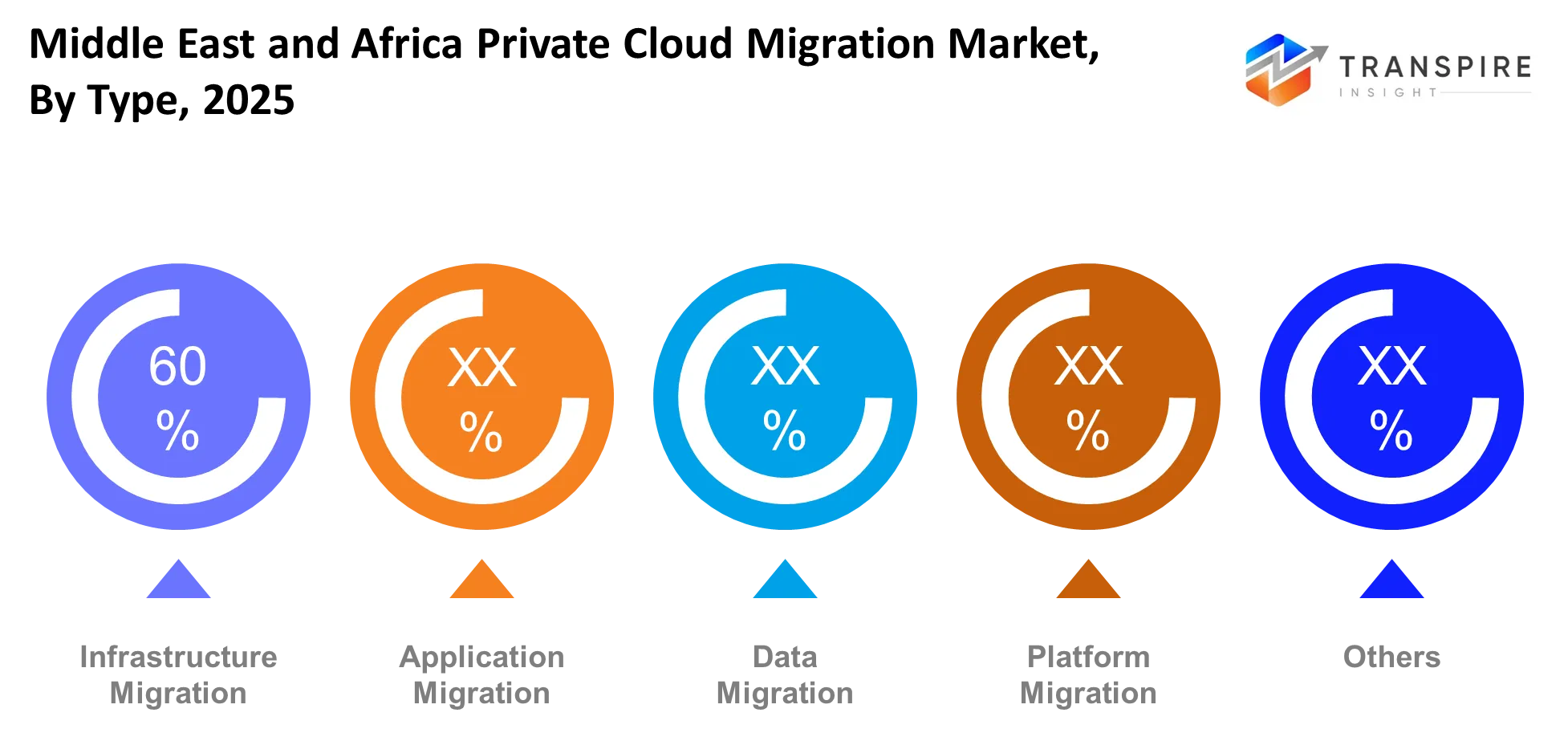
The infrastructure migration segment in the Middle East and Africa Private Cloud Migration Market focuses on moving servers, storage systems, and network resources into private cloud environments. The system performance improves, resource utilization becomes more efficient, and operational control receives enhancement through this transition. Businesses continue to operate this transition process because they want to replace their outdated systems with digital solutions that provide better flexibility.
Application migration involves transferring business software and workloads into private cloud systems for improved access, speed, and management. Data migration enables secure transfer of large data sets which preserves reliability and compliance requirements. Platform migration enables organizations to transfer their operational systems and development environments while other migration processes develop tailored solutions which address their evolving business demands.
To learn more about this report, Download Free Sample Report
By Application:
The Middle East and Africa Private Cloud Migration Market considers IT modernization to be its most significant application area because businesses transform their outdated systems into advanced digital solutions. Private cloud migration enables companies to expand their operations while keeping complete management over their infrastructure. This process enables organizations to establish efficient operational processes while enhancing their capacity to adopt upcoming technological advancements.
Organizations choose disaster recovery solutions because they want to establish dependable backup systems which will decrease their chances of handling operational disruptions. Private cloud systems provide organizations with better control over their data management and security processes, which leads them to implement migration initiatives. The applications provide solutions which address specific industrial requirements, while their essential operations depend on secure infrastructure and continuous access.
By End-User:
The digital demands of large enterprises and their requirements for advanced infrastructure management capabilities create a substantial market need. Organizations achieve operational benefits through private cloud migration because it enhances system performance and compliance capabilities while decreasing their need for legacy technology. All industries that require complex operations to function are currently increasing their investments in private cloud systems.
Small and medium-sized enterprises are also expanding adoption as cost-efficient private cloud solutions become more accessible. IT companies use migration to enhance their service delivery capabilities while BFSI and healthcare and governmental organizations focus on protecting their data assets. Businesses use migration strategies to enhance their operational flexibility while ensuring their systems can adapt to upcoming changes in business requirements.
By Deployment:
The Middle East and Africa Private Cloud Migration Market recognizes private cloud deployment as its leading deployment method because organizations choose dedicated infrastructure to enhance their security and customization abilities and compliance management function. Organizations that handle sensitive data establish this model which enables them to monitor their performance and storage capabilities. Businesses in industries with established operational requirements choose this deployment method.
Organizations use hybrid cloud deployment to achieve operational flexibility through the combination of their private infrastructure and their chosen public cloud resources. Multi-cloud strategies enable organizations to distribute their workloads across multiple environments which enhances operational resilience and system performance. The deployment methods enable organizations to achieve their desired infrastructure results because they enable active management of essential business programs and confidential operational data.
What are the Key Use Cases Driving the Middle East and Africa Private Cloud Migration Market?
The Middle East and Africa regions mainly use private cloud services to provide secure core application hosting for banking and telecom and government systems. The organizations require private cloud environments because their operations involve handling highly sensitive transactional data and citizen information which must comply with strict regional data residency and cybersecurity regulations while maintaining business operations.
The healthcare and energy sectors are experiencing rapid growth through their development of adjacent applications. Hospitals are migrating electronic health records and diagnostic platforms to private cloud infrastructure to strengthen data control, while oil and gas operators use private cloud environments to centralize operational analytics and support remote asset monitoring across distributed facilities.
AI model hosting and edge-to-cloud integration for smart city infrastructure represent new use cases that are currently developing. Private cloud platforms enable countries such as Saudi Arabia and the UAE to implement digital urban projects by providing support for low-latency analytics and autonomous system coordination and sovereign AI workloads that depend on localized computing resources.
|
Report Metrics |
Details |
|
Market size value in 2025 |
USD 1.68 Billion |
|
Market size value in 2026 |
USD 2.11 Billion |
|
Revenue forecast in 2033 |
USD 10.41 Billion |
|
Growth rate |
CAGR of 25.61% from 2026 to 2033 |
|
Base year |
2025 |
|
Historical data |
2021 - 2024 |
|
Forecast period |
2026 - 2033 |
|
Report coverage |
Revenue forecast, competitive landscape, growth factors, and trends |
|
Regional scope |
Middle East and Africa (Saudi Arabia, United Arab Emirates, South Africa, Rest of Middle East and Africa) |
|
Key company profiled |
IBM, Microsoft, AWS, Google, Oracle, SAP, VMware, Dell, HPE, Cisco, Accenture, TCS, Infosys, Wipro, Capgemini |
|
Customization scope |
Free report customization (country, regional & segment scope). Avail customized purchase options to meet your exact research needs. |
|
Report Segmentation |
By Type (Infrastructure Migration, Application Migration, Data Migration, Platform Migration, Others); By Application (IT Modernization, Disaster Recovery, Data Management, Security Enhancement, Business Continuity, Others); By End-User (Enterprises, SMEs, IT Companies, BFSI, Healthcare, Government, Others); By Deployment (Private Cloud, Hybrid Cloud, Multi-cloud, Others) |
Which Regions are Driving the Middle East and Africa Private Cloud Migration Market Growth?
The Gulf Cooperation Council region leads the Middle East and Africa private cloud migration market, with Saudi Arabia and the UAE accounting for the largest concentration of enterprise cloud transformation activity. The country maintains its leadership position through its active national digitalization efforts together with its enforcement of stringent data sovereignty requirements and its ongoing development of hyperscale infrastructure. The policy framework created through government-backed initiatives such as sovereign cloud programs operates to drive private cloud deployment in local areas. The market leader strength exists because the complete ecosystem support includes telecom operators and regional data center providers and cybersecurity firms and global technology partnerships.
The second-largest regional contributor in South Africa displays different market behavior than Gulf states because its growth pattern comes from private enterprise modernization instead of government-led digital infrastructure development. The country benefits from a comparatively established financial services sector, strong enterprise IT maturity, and consistent regulatory development around data protection. Large banks and insurers together with healthcare groups have dedicated resources to shift their operations to private cloud environments which helps them achieve greater operational resilience and regulatory compliance. The stable enterprise-led adoption pattern in South Africa establishes the country as a reliable source of regional market revenue.
The broader African emerging markets segment, particularly Kenya, Egypt, and Nigeria, shows the strongest growth momentum heading into 2026–2033. The regional outlook has shifted through recent data center infrastructure expansion and improved subsea connectivity and public sector digital modernization efforts. The infrastructure developments currently enable organizations to implement private cloud solutions which existed as barriers before. The market entrants and investors should see this as a high-potential expansion corridor which requires them to establish early infrastructure partnerships and managed service investments for future competitive advantage.
Who are the Key Players in the Middle East and Africa Private Cloud Migration Market and How Do They Compete?
The Middle East and Africa private cloud migration market shows moderate competition because global infrastructure providers compete with regional system integrators and telecom-based cloud service providers. Enterprises choose their service providers based on three factors which include compliance readiness and migration difficulty and their ability to provide services in local areas, not just on their ability to offer cheap services. Established companies expand their network infrastructure to defend their market position, while new companies pursue unique market segments through their government cloud services and specific migration support offerings. The main factors that drive competition between businesses include their ability to integrate technology and their proximity to businesses that require regulated services.
Microsoft competes through its regional cloud infrastructure expansion and hybrid cloud architecture capabilities, particularly through Azure Stack-based private deployments that help enterprises meet local data residency mandates. Through its partnerships with regional telecom operators, the company establishes a stronger last-mile enterprise reach. Oracle develops its unique business model through its provision of dedicated cloud environments which serve the specific needs of highly regulated industries, thus creating an appealing solution for financial institutions and public sector clients who require isolated infrastructure control.
IBM focuses on modernizing regulated workloads by using private cloud migration together with advanced cybersecurity and AI-driven automation tools. The system enables organizations to decrease migration hazards in their complicated legacy systems. Dell Technologies benefits from infrastructure flexibility which enables businesses to create personalized private cloud systems that function independently from major hyperscale cloud providers. Huawei is growing its business by establishing strong regional partnerships while building local infrastructure in African markets that need affordable cloud enterprise modernization solutions.
Company List
Recent Development News
In February 2026, NTT DATA announced the acquisition of Zero&One. The acquisition of Zero&One by NTT DATA resulted in expanded cloud migration and private-cloud modernization services for its Middle Eastern and African operations which strengthened enterprise support for application modernization and secure cloud transformation projects.
Source https://www.nttdata.com/
In February 2026, Microsoft confirmed the launch of its Saudi Arabia East cloud region for Q4 2026. The regional infrastructure development will help Saudi businesses to quickly shift their operations to private and hybrid cloud systems because it provides data storage in their home country and faster system response times and supports their required operational updates. Source https://www.datacenterdynamics.com/
What Strategic Insights Define the Future of the Middle East and Africa Private Cloud Migration Market?
The Middle East and Africa private cloud migration market will move toward sovereign AI-enabled cloud systems which operate under regulatory frameworks and provide optimized performance for specific industry workloads within the next five to seven years. The current trend results from three factors which include countries establishing stricter data management regulations and countries developing their digital networks and businesses needing better control of their key software systems. The process of private cloud migration will evolve from its primary focus on updating existing systems to serving as a strategic foundation for businesses to implement localized artificial intelligence solutions and provide protected online services.
The existence of a market concentration risk becomes apparent through the dominance of a few hyperscale-compatible service providers. Enterprises that depend too much on specific infrastructure systems will face reduced power to negotiate pricing and control their services and ensure their systems will work together in the future especially in African markets where fewer options exist.
The development of edge-enabled sovereign cloud solutions has become an important opportunity for smart city and industrial automation projects in Saudi Arabia and the UAE and Egypt. Market participants should act now by forming telecom and regional data center partnerships that combine localized infrastructure with AI-driven migration orchestration, positioning themselves ahead of the next wave of enterprise cloud transformation.
Middle East and Africa Private Cloud Migration Market Report Segmentation
By Type
- Infrastructure Migration
- Application Migration
- Data Migration
- Platform Migration
By Application
- IT Modernization
- Disaster Recovery
- Data Management
- Security Enhancement
- Business Continuity
By End-User
- Enterprises
- SMEs
- IT Companies
- BFSI
- Healthcare
- Government
By Deployment
- Private Cloud
- Hybrid Cloud
- Multi-cloud
Frequently Asked Questions
Find quick answers to common questions.
The Middle East and Africa Private Cloud Migration Market size is USD 10.41 Billion in 2033.
Key segments for the Middle East and Africa Private Cloud Migration Market are By Type (Infrastructure Migration, Application Migration, Data Migration, Platform Migration, Others); By Application (IT Modernization, Disaster Recovery, Data Management, Security Enhancement, Business Continuity, Others); By End-User (Enterprises, SMEs, IT Companies, BFSI, Healthcare, Government, Others); By Deployment (Private Cloud, Hybrid Cloud, Multi-cloud, Others).
Major Middle East and Africa Private Cloud Migration Market players are IBM, Microsoft, AWS, Google, Oracle, SAP, VMware, Dell, HPE, Cisco, Accenture, TCS, Infosys, Wipro, Capgemini.
The Middle East and Africa Private Cloud Migration Market size is USD 1.68 Billion in 2025.
The Middle East and Africa Private Cloud Migration Market CAGR is 25.61% from 2026 to 2033.
- IBM
- Microsoft
- AWS
- Oracle
- SAP
- VMware
- Dell
- HPE
- Cisco
- Accenture
- TCS
- Infosys
- Wipro
- Capgemini
Recently Published Reports
-
Apr 2026
3D Optical Profiler Market
3D Optical Profiler Market Size, Share & Analysis Report By Type (Desktop 3D Optical Profiler, and Portable 3D Optical Profiler), By Technology (Confocal Technology, and White Light Interference), By End-Use Industry (Manufacturing, Research Institutions, Automotive, Aerospace and Defense, Medical Devices, and Other), and Geography (North America, Europe, Asia-Pacific, Middle East and Africa, South and Central America), 2021 - 2031
-
Apr 2026
Depth Sensor Market
Depth Sensor Market Size, Share & Analysis Report By Type (Infrared Depth Sensors, Time-of-Flight (ToF) Sensors, Stereo Vision Sensors, Structured Light Sensors, Ultrasonic Depth Sensors), By Application (Automotive, Robotics, Gaming, Consumer Electronics, Industrial Automation, Healthcare, Security & Surveillance, Others), By End Users (Automotive Manufacturers, Consumer Electronics Companies, Healthcare Providers, Industrial Companies, Security Agencies, Gaming Companies, Robotics Companies, Others), and Geography (North America, Europe, Asia-Pacific, Middle East and Africa, South and Central America), 2021 – 2031
-
Apr 2026
Digital Manufacturing Market
Digital Manufacturing Market Size, Share & Analysis Report By Component (Hardware, Software, and Services), By Technology (Robotics, 3D Printing, Internet of Things (IoT), and Others), By Application (Automotive and Transportation, Aerospace and Defense, Consumer Electronics, Industrial Machinery, and Others), By Process Type (Computer-Based Designing, Computer-Based Simulation, Computer 3D Visualization, Analytics, and Others), and Geography (North America, Europe, Asia-Pacific, Middle East and Africa, South and Central America), 2021 – 2031
-
Apr 2026
Digital Visa Services Market
Digital Visa Services Market Size, Share & Analysis Report By Type (Individual Travelers, Group Travelers), By Application (Tourism, Business Travel, Others), and Geography (North America, Europe, Asia-Pacific, Middle East and Africa, South and Central America), 2021 – 2031