
South Korea Cloud Security Market Size & Forecast:
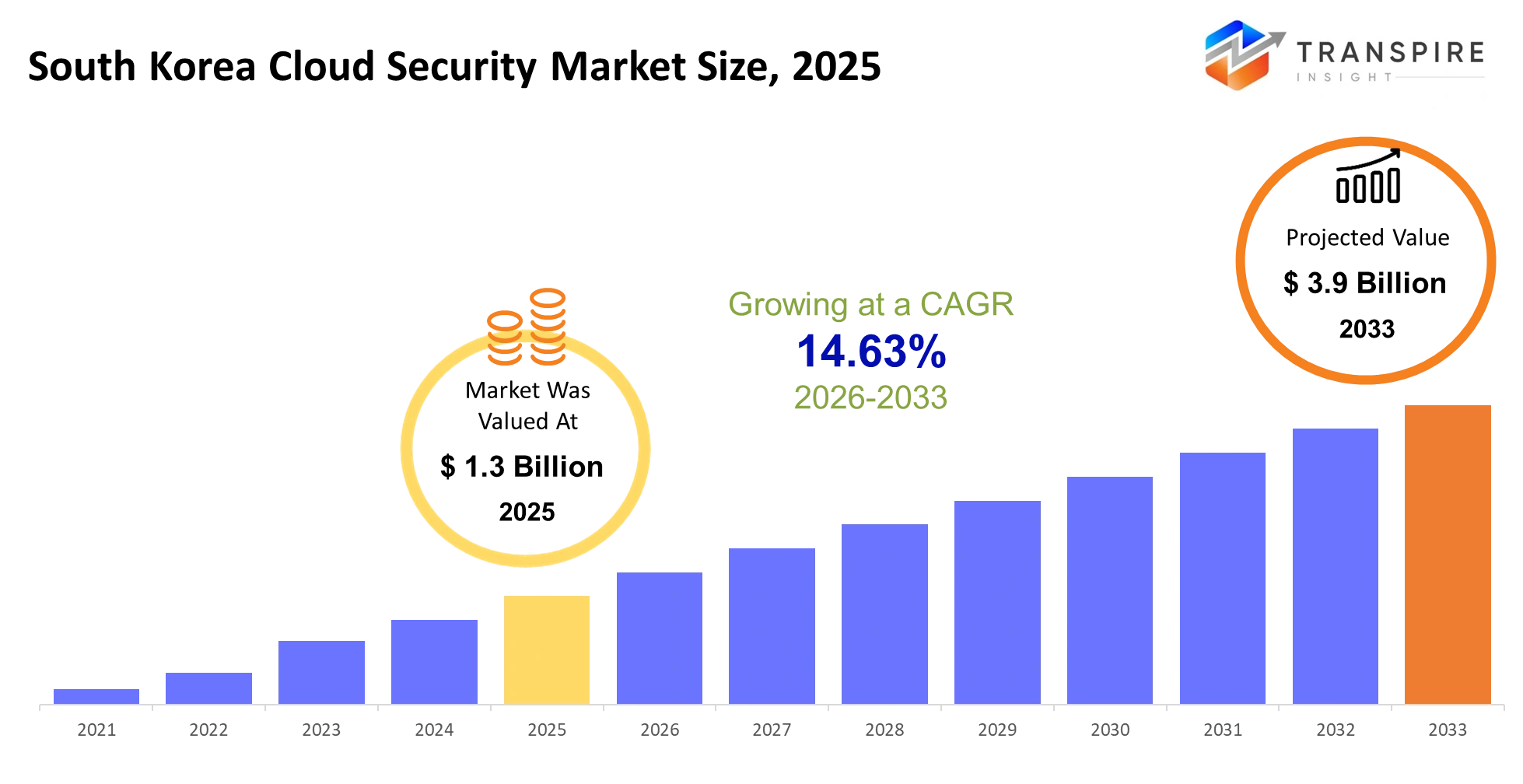
- South Korea Cloud Security Market Size 2025: USD 1.3 Billion
- South Korea Cloud Security Market Size 2033: USD 3.9 Billion
- South Korea Cloud Security Market CAGR: 14.63%
- South Korea Cloud Security Market Segments: By Solution Type (Cloud Identity & Access Management, Cloud Workload Protection, Cloud Encryption, Cloud Security Information & Event Management, Others); By Deployment (Public Cloud Security, Private Cloud Security, Hybrid Cloud Security, Multi-cloud Security, Others); By Application (Data Protection, Threat Detection, Compliance Management, Network Security, Others); By Technology (AI-driven Security, Zero Trust Security, CASB Solutions, DevSecOps, Others); By End User (BFSI, Healthcare, Government, IT & Telecom, Retail, Others).
To learn more about this report,  Download Free Sample Report
South Korea Cloud Security Market Summary
The South Korea Cloud Security Market was valued at USD 1.3 Billion in 2025. It is forecast to reach USD 3.9 Billion by 2033. That is a CAGR of 14.63% over the period.
In South Korea, the cloud security market is now kinda a central piece of what banks, manufacturers, logistics companies, telecom operators, and government agencies use to protect information moving through remote networks, AI platforms, and connected industrial setups. Instead of just leaning on standalone on-premise servers, most organizations are running things in hybrid setups and multi-cloud environments, and because of that identity protection, workload security, and real-time threat visibility have become basically unavoidable for staying operational. Over the last five years the whole focus has moved away from perimeter-centered cybersecurity and more toward zero-trust design plus cloud-native security frameworks, since companies pushed harder with digital transformation initiatives.
One noticeable shift happened around the COVID-19 period, when widespread remote work and fast cloud migration showed gaps in older security measures . Meanwhile, tighter South Korean data governance rules and financial security regulations also pressured enterprises to upgrade their compliance foundations . So you get this mix of regulatory enforcement and a constantly expanding set of cloud workloads, which has led many firms to spend more on managed security services, AI-enabled threat detection, and secure access platforms. That also means vendors can expect longer-term recurring revenue, rather than only one-time projects.
Key Market Insights
- In 2025 the Seoul metropolitan region was pretty much the dominant area for the South Korea cloud security market, with almost 48% market share because the enterprise IT infrastructure was kind of concentrated there.
- Between 2025 and 2030, Gyeonggi Province seems to be the fastest mover, with growth that really stood out, partly because hyperscale data center expansion kept going, and also smart manufacturing initiatives.
- Meanwhile Busan was seeing a rising appetite for cloud security, especially from logistics, maritime, and port automation sectors, as they adopted connected operational technologies, to keep things running smoothly.
- Cloud Identity and Access Management held more than 32% of the industry share in 2025, since organizations strengthened zero-trust security frameworks , pretty actively.
- And for managed cloud security, more mid-sized enterprises started leaning into these services, mainly because they simply didn’t have dedicated in-house cybersecurity teams to manage everything.
- BFSI applications were basically dominant at around 29% of the revenue share in 2025, mainly because strict financial compliance requirements and digital banking expansion kept pushing budgets forward.
- Healthcare also showed up as the quickest moving segment, hospitals ramped up cloud based patient data management and telemedicine infrastructure investments, so the growth rate kind of took off.
- In Manufacturing, companies sped up cloud security deployment to safeguard industrial IoT networks and these connected factory setups against ransomware incidents.
- Meanwhile, big enterprises made up almost 61% of the South Korea cloud cybersecurity market size in 2025, largely due to broad hybrid cloud operations happening across many groups.
- On the other hand, Government agencies increased their cloud security spending after stricter national cybersecurity frameworks and public sector digital transformation initiatives were rolled out.
What are the Key Drivers, Restraints, and Opportunities in the South Korea Cloud Security Market?
The strongest force pushing the South Korea Cloud Security Market forward is, honestly, the fast movement of enterprise workloads into hybrid and multi-cloud infrastructure, after remote operations and AI-based business systems grew bigger. South Korea’s financial regulators and data protection authorities then tightened cybersecurity compliance requirements following a few very visible data exposure incidents, tied to online platforms and telecom systems. That kind of pressure basically made banks, healthcare providers, and manufacturers rethink things and swap older perimeter defenses for cloud-native security platforms, identity management tools, plus zero-trust architectures. And as companies start placing more operational data and customer records inside cloud environments, vendors keep seeing recurring revenue take shape via subscription-based security monitoring, managed detection services, and AI-driven threat analytics.
Still, one big structural obstacle stays in place: there just aren’t enough experienced cloud cybersecurity professionals who can handle the messy reality of complex hybrid setups. More South Korean enterprises run operations across multiple cloud providers, but the domestic talent pipeline isn’t expanding as quickly, or maybe it’s lagging in a quiet way. This mismatch tends to inflate deployment costs, stretches out system integration schedules , and discourages adoption among mid-sized companies that can’t staff a dedicated security team all the time. The downstream effect is delayed migration efforts, and slower monetization for security vendors trying to reach smaller enterprises.
A big growth chance is showing up with South Korea’s move toward smart manufacturing plus all those hyperscale data center investments, and honestly it feels like everything is converging. In semiconductor plants, battery makers, and industrial automation facilities, the operational technology systems are being linked to cloud platforms for things like predictive upkeep and real time analytics. So this shift drives a need for very specific industrial cloud security offerings that can guard factory networks , edge devices and even the AI led production systems.
What Has the Impact of Artificial Intelligence Been on the South Korea Cloud Security Market?
Artificial intelligence is shifting the way enterprises in South Korea handle cloud security operations. It does this by cutting down on a lot of manual threat analysis, and speeding up incident response across hybrid infrastructure, so things are less painfully slow. Bigger financial institutions, telecom operators, and semiconductor manufacturers have been rolling out AI-enabled security orchestration platforms. These platforms can automate identity checks , flag abnormal login attempts and keep an eye on compliance in multi cloud setups.
Because of that, security teams are leaning more and more on automated response systems that can isolate a suspected workload or revoke suspicious access credentials within seconds. It sounds simple but it helps with operational continuity , and it also shortens the time needed to deal with a breach. In practice, that means the organization gets back to normal faster, instead of spending hours triaging alerts.
There’s also the predictive side, where machine learning models provide stronger cybersecurity foresight. Cloud security tools examine network traffic signatures, user behavior, and endpoint telemetry, then they try to anticipate ransomware attempts or insider risks before these issues start to disrupt operations. Some enterprises using AI based threat intelligence systems say they are seeing fewer false positives, and quicker detection cycles. This tends to reduce downtime, and it supports compliance with South Korea’s tighter data protection requirements. Meanwhile, AI supported workload optimization tools also help organizations place computing resources more wisely. The result is less wasteful cloud consumption, and a better overall uptime picture.
Still, AI adoption has a big hitch. Lots of South Korean companies run legacy IT systems, and those systems don’t always connect cleanly with modern cloud native security platforms. The integration spend stays high, and if there’s limited access to industry specific training data, the accuracy of machine learning models can drop. Then in complex real world enterprise environments, the model outputs may not match what teams expect.
Key Market Trends
- In 2022, South Korean banks , including KB Financial Group, started putting more money into zero trust spending after regulators got stricter with cybersecurity audits for hybrid cloud deployments, so yeah it sort of changed the rhythm.
- Between 2021 and 2025, ransomware incidents aimed at manufacturing and healthcare providers pushed organizations to lean toward managed detection and response services, not just standalone firewalls, basically a shift away from the old approach.
- South Korea’s public cloud migration plan kind of sped up demand for domestic security suppliers after government agencies said they wanted locally hosted data protection, plus compliance monitoring tools running there.
- In 2023, telecom firms like SK Telecom expanded AI driven threat analytics platforms to guard the growing 5G and edge computing workloads, across the country too.
- After 2022, cloud native application development jumped quickly, so enterprises had to bring in container security and API protection earlier inside their software release cycles; it didn’t wait around.
- During 2024, big conglomerates changed purchasing strategies by consolidating cybersecurity vendors, which reduced their reliance on pieced together endpoint, network, and cloud security platforms, all over the place.
- Demand for sovereign cloud services got stronger after tougher enforcement of the Personal Information Protection Act brought higher penalties for overseas data movement and third party breaches.
- Since 2023, South Korean enterprises operating in multi cloud setups increasingly chose integrated security posture management platforms, including options from Palo Alto Networks and Trend Micro.
- AI generated phishing attempts climbed a lot during 2024, and that pushed insurers and e-commerce companies to expand employee focused cloud security training along with identity verification programs.
South Korea Cloud Security Market Segmentation
By Solution Type:
Cloud Identity & Access Management helps organizations steer employee and customer access across cloud platforms , by using authentication tools, password monitoring, and user verification systems , sorta like a gatekeeper with receipts . After remote working really took hold and hybrid operations grew inside day to day workflows, South Korean companies started increasing spend on identity protection, especially across financial services , healthcare, and telecom. At the same time, businesses leaned into lowering unauthorized access hazards because cloud-based operations became routine .
Cloud Workload Protection focuses on safeguarding applications , databases and the workloads running inside cloud environments. Cloud Encryption , in turn protects sensitive business information by turning data into guarded formats during storage and transfer . Cloud Security Information and Event Management helps firms watch for cyber threats with centralized alerts and analytics, rather than scattered observations. Other solutions include email security, endpoint protection, plus disaster recovery systems , supporting operational steadiness across various industries , and yes , this all connects back to how providers to
By Deployment:
Public Cloud Security keeps systems and data safe when they are placed with third party cloud service providers, kind of outsourced but you know, still managed with care. Large enterprises and start-ups in South Korea kept using public cloud services because they had lower infrastructure costs, plus flexible storage options which sounds simple, but it really helps. At the same time security needs kept rising, since many businesses moved customer databases, applications, and internal operations into public cloud environments, while they also tried to stay focused on data privacy and network defense.
Private Cloud Security is for organizations that want more command over sensitive information and day to day operations. Hybrid Cloud Security mixes public and private setups, allowing businesses to juggle adaptability with protection. Multi-cloud Security covers environments spread across several cloud providers, so the business isn’t too tied to one vendor. And beyond that, there are other deployment patterns too, like community cloud systems, plus industry oriented cloud infrastructure meant for sectors with strict compliance rules and operational standards.
By Application:
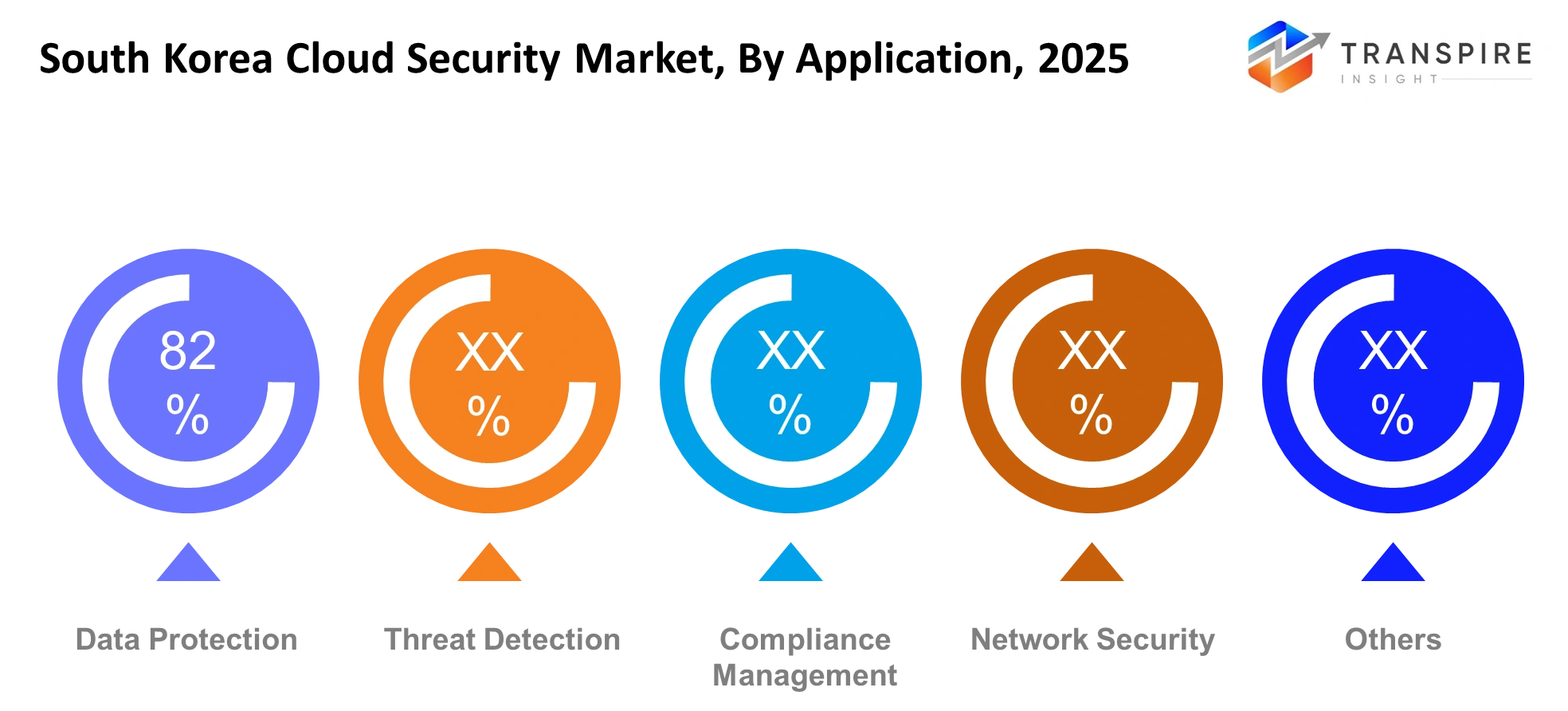
Data Protection stayed a big application area because many companies were dealing with ever-growing amounts of financial records, customer information, and digital exchanges. In South Korea, enterprises also kept tuning backup systems, encryption routines, and access watch tools , so they could shrink exposure to data theft and cyberattacks. At the same time , businesses made their recovery workflows better, in order to keep going with daily operations when a security incident showed up , or when the network had disruptions.
Threat Detection got more focus as organizations had to deal with more capable malware, spear-phishing campaigns, and ransomware actions that were hitting cloud environments. Compliance Management helped firms keep pace with government rules and their own internal security standards. Network Security supported companies in locking down digital communication lines and cloud-based links, even for remote workplaces. Other areas involved things like risk control, security evaluations, and cloud monitoring systems, which all helped keep business operations steady across different industries.
To learn more about this report, Download Free Sample Report
By Technology:
AI driven security has been improving, or like, upgrading threat identification and also response capabilities by looking at strange network patterns and security signals in real time. In South Korea , more and more companies are adopting automated security systems to cut down on the manual monitoring work and speed up the reaction when cyber incidents show up. The AI based tools additionally backed predictive analysis, so organizations could spot potential risks before they turn into major operational damage, you know, at scale.
Zero Trust Security is also getting stronger adoption, largely because teams started verifying every user, every device, before granting access to anything sensitive. CASB solutions supported businesses in keeping an eye on cloud application usage, while strengthening data visibility and compliance management at the same time. DevSecOps helped bring security into the software development workflow, which tends to reduce vulnerabilities around the deployment stage. Other supporting techs included blockchain based verification systems, behavioral analytics and automated cloud governance tools.
By End User:
BFSI organizations boosted their cloud security spending as digital banking , online payments, and various financial applications kept expanding throughout South Korea. Healthcare providers also went harder on security, in order to safeguard patient records, link medical devices together, and keep digital consultation platforms protected. Meanwhile government agencies improved their cybersecurity frameworks so they could support public cloud adoption ,but still keep national and administrative information handled in a careful way.
Across the board, IT & Telecom companies stayed among the biggest buyers of cloud security solutions, mainly because 5G infrastructure kept growing, edge computing started spreading faster, and customer data management at scale became unavoidable. Retail businesses then adopted cloud protection systems to secure online transactions and digital supply chains during the fast push of e-commerce. Other end users—like manufacturing, education, logistics , and energy—were also moving toward stronger operational security across all these connected digital environments.
What are the Key Use Cases Driving the South Korea Cloud Security Market?
Data protection still feels like the main use case in the South Korea Cloud Security Market , because banks, telecom providers and e-commerce companies basically juggle huge chunks of customer information across cloud platforms. On top of that, strict privacy rules, plus more frequent ransomware incidents, keep nudging companies into stronger encryption, better identity management, and more active threat monitoring setups.
Healthcare and government are also moving faster, mainly for compliance management and more secure remote access. Hospitals are using cloud security tools to safeguard patient records and connected medical systems , while public agencies are tightening hybrid cloud environments so they can handle digital administration and meet national cybersecurity obligations too.
Some newer scenarios are starting to show up as well, like AI-based cloud threat prediction, and protection measures tailored for edge computing networks that plug into 5G infrastructure. Manufacturing firms and smart factory operators are running tests on cloud security controls for industrial IoT devices, and this will probably turn into steady long-term demand across connected operations.
|
Report Metrics |
Details |
|
Market size value in 2025 |
USD 1.3 Billion |
|
Market size value in 2026 |
USD 1.5 Billion |
|
Revenue forecast in 2033 |
USD 3.9 Billion |
|
Growth rate |
CAGR of 14.63% from 2026 to 2033 |
|
Base year |
2025 |
|
Historical data |
2021 - 2024 |
|
Forecast period |
2026 - 2033 |
|
Report coverage |
Revenue forecast, competitive landscape, growth factors, and trends |
|
Country scope |
South Korea |
|
Key company profiled |
Palo Alto Networks, Fortinet, Cisco Systems, Microsoft, IBM, Check Point Software Technologies, Trend Micro, CrowdStrike, Zscaler, Broadcom, Samsung SDS, LG CNS, Amazon Web Services, Google Cloud, Oracle. |
|
Customization scope |
Free report customization (country, regional & segment scope). Avail customized purchase options to meet your exact research needs. |
|
Report Segmentation |
By Solution Type (Cloud Identity & Access Management, Cloud Workload Protection, Cloud Encryption, Cloud Security Information & Event Management, Others); By Deployment (Public Cloud Security, Private Cloud Security, Hybrid Cloud Security, Multi-cloud Security, Others); By Application (Data Protection, Threat Detection, Compliance Management, Network Security, Others); By Technology (AI-driven Security, Zero Trust Security, CASB Solutions, DevSecOps, Others); By End User (BFSI, Healthcare, Government, IT & Telecom, Retail, Others). |
Which Regions are Driving the South Korea Cloud Security Market Growth?
North America kind of leads the cloud security market, because enterprises across the United States and Canada keep up pretty high cloud adoption rates and they also have this real strong ability for cybersecurity spending. Plus there are strict data privacy rules, and like frequent cyberattack incidents… and that whole early shift toward zero trust frameworks keeps nudging bigger investments especially in banking, healthcare, and government. A lot of big technology companies, cybersecurity vendors, and hyperscale cloud providers have solid operational networks across the region, so you end up with a fairly mature security ecosystem. Also better digital infrastructure, plus ongoing enterprise modernization, seems to help organizations roll out AI based threat detection and multi cloud security systems sooner than most other global markets.
Europe stays as a stable contributor too, mainly because companies there lean into compliance driven security spending rather than just racing toward expansion. GDPR and also national cybersecurity directives push organizations to hold steady or long term funding for cloud monitoring, encryption, and identity management solutions. When you compare it with North America, European enterprises often favor operational transparency, secure cross border data handling, and consistent governance frameworks. And then you have strong industrial sectors, established telecom infrastructure, and steady investment from financial institutions, which together keep market demand balanced across Germany, the United Kingdom, France, and the Nordic countries.
Asia Pacific seems to show the quickest growth momentum, as governments as well as enterprises are speeding up digital transformation programs across China, India, South Korea, Japan, and Southeast Asia. At the same time, rolling out more 5G networks, higher e-commerce activity, and wider adoption of public cloud services are generating new cybersecurity risks, and it’s pushing organizations toward more advanced cloud security platforms. A few countries lately also tightened cybersecurity policies, while at the same time they increased investments in smart city infrastructure, data centers, and national cloud initiatives, which ends up broadening the demand for security that can scale. Overall, this fast expansion should create solid opportunities for cloud security providers, managed service firms, and AI driven cybersecurity vendors, aiming at sustained growth from 2026 until 2033.
Who are the Key Players in the South Korea Cloud Security Market and How Do They Compete?
South Korea's cloud security market looks kind of moderately consolidated, you see global cybersecurity players right next to domestic telecom and IT services folks. Lately the race is not just about pricing anymore , it’s more about AI based threat sensing, compliance oversight, and the whole secure multi cloud integration piece. Big established vendors still push to keep enterprise accounts with long term service agreements, plus they lean hard on local data protection know-how. Meanwhile smaller companies tend to aim at more specific angles, like cloud workload monitoring, and managed detection services. Also, demand from banks, public bodies, and telecom operators kinda pressured suppliers to build tighter local partnerships and offer more security features that fit the industry, not only generic controls.
Palo Alto Networks is going all in on AI led cloud protection and a zero trust design, which helps large enterprises handle messy hybrid cloud setups using one unified security platform. Their edge comes from automated threat assessment and integrated security operations, so incident response gets faster, not slower. Trend Micro also boosted its position by growing cloud workload protection services for manufacturing and financial services. With solid regional operations across Asia, plus specialized ransomware defense capabilities, they keep customers longer and stay ready for new enterprise deals.
SK Telecom, uses telecom infrastructure and has 5G network expertise , to bring cloud security services that are tailored for domestic enterprises and public sector customers. it also expanded partnerships with cloud providers and AI security companies, so the whole thing helps with edge computing protection and better handling of secure data traffic management. Samsung SDS on the other hand sort of differentiates itself via integrated cloud management and cybersecurity advisory work, plus enterprise compliance services, especially for big Korean conglomerates. Cisco Systems keeps growing by rolling out secure networking solutions and cloud-native security platforms, and those are aimed at remote workforce protection, while also offering multi-cloud visibility across distributed operations.
Company List
- Palo Alto Networks
- Fortinet
- Cisco Systems
- Microsoft
- IBM
- Check Point Software Technologies
- Trend Micro
- CrowdStrike
- Zscaler
- Broadcom
- Samsung SDS
- LG CNS
- Amazon Web Services
- Google Cloud
- Oracle
Recent Development News
In March 2026, SK Telecom was linked to one of the country’s largest privacy enforcement actions after regulators imposed penalties exceeding KRW 134.7 billion related to a major data breach investigation. The case reinforced demand for stronger cloud security and data protection infrastructure across South Korea’s enterprise sector.
Source: https://practiceguides.chambers.com/
In March 2026, Coupang remained under investigation and legal pressure following disclosure of a breach affecting 33.7 million accounts. The incident triggered lawsuits and heightened scrutiny of cloud-based data protection practices among major South Korean digital platforms.
Source: https://www.cigionline.org/
What Strategic Insights Define the Future of the South Korea Cloud Security Market?
South Korea Cloud Security Market is, I think, going to slide more and more toward autonomous and connected security ecosystems because of AI adoption, the whole push to multi-cloud infrastructure and also tougher national rules on data governance. Most enterprises will probably move away from the old reactive cybersecurity way of doing things, and toward predictive threat intelligence platforms that can handle edge networks, industrial IoT setups, and day to day digital operations in near real time. Still, there’s this quieter danger that feels like it is growing—being too dependent on a small cluster of global cloud and cybersecurity providers, which can make vendor concentration risks higher and can also shrink operational flexibility for local firms when geopolitics heats up or when supply chains get interrupted.
One real opportunity that is starting to show up is developing cloud security solutions for smart manufacturing and AI-driven factories, especially now that South Korea is ramping up semiconductor output and other advanced electronics production. Vendors that craft specialized industrial cloud protection platforms may end up with longer term advantages. So market players should concentrate on building local technology partnerships and putting money into security services tuned to specific sectors, rather than trying to win only by offering typical cloud protection packages.
South Korea Cloud Security Market Report Segmentation
By Solution Type
- Cloud Identity & Access Management
- Cloud Workload Protection
- Cloud Encryption
- Cloud Security Information & Event Management
By Deployment
- Public Cloud Security
- Private Cloud Security
- Hybrid Cloud Security
- Multi-cloud Security
By Application
- Data Protection
- Threat Detection
- Compliance Management
- Network Security
By Technology
- AI-driven Security
- Zero Trust Security
- CASB Solutions
- DevSecOps
By End User
- BFSI
- Healthcare
- Government
- IT & Telecom
- Retail
Frequently Asked Questions
Find quick answers to common questions.
The South Korea Cloud Security Market size is USD 3.9 Billion in 2033.
Key segments for the South Korea Cloud Security Market are By Solution Type (Cloud Identity & Access Management, Cloud Workload Protection, Cloud Encryption, Cloud Security Information & Event Management, Others); By Deployment (Public Cloud Security, Private Cloud Security, Hybrid Cloud Security, Multi-cloud Security, Others); By Application (Data Protection, Threat Detection, Compliance Management, Network Security, Others); By Technology (AI-driven Security, Zero Trust Security, CASB Solutions, DevSecOps, Others); By End User (BFSI, Healthcare, Government, IT & Telecom, Retail, Others).
Major South Korea Cloud Security Market players are Palo Alto Networks, Fortinet, Cisco Systems, Microsoft, IBM, Check Point Software Technologies, Trend Micro, CrowdStrike, Zscaler, Broadcom, Samsung SDS, LG CNS, Amazon Web Services, Google Cloud, Oracle.
The South Korea Cloud Security Market size is USD 1.3 Billion in 2025.
The South Korea Cloud Security Market CAGR is 14.63% from 2026 to 2033.
- Palo Alto Networks
- Fortinet
- Cisco Systems
- Microsoft
- IBM
- Check Point Software Technologies
- Trend Micro
- CrowdStrike
- Zscaler
- Broadcom
- Samsung SDS
- LG CNS
- Amazon Web Services
- Google Cloud
- Oracle
Recently Published Reports
-
Apr 2026
3D Optical Profiler Market
3D Optical Profiler Market Size, Share & Analysis Report By Type (Desktop 3D Optical Profiler, and Portable 3D Optical Profiler), By Technology (Confocal Technology, and White Light Interference), By End-Use Industry (Manufacturing, Research Institutions, Automotive, Aerospace and Defense, Medical Devices, and Other), and Geography (North America, Europe, Asia-Pacific, Middle East and Africa, South and Central America), 2021 - 2031
-
Apr 2026
Depth Sensor Market
Depth Sensor Market Size, Share & Analysis Report By Type (Infrared Depth Sensors, Time-of-Flight (ToF) Sensors, Stereo Vision Sensors, Structured Light Sensors, Ultrasonic Depth Sensors), By Application (Automotive, Robotics, Gaming, Consumer Electronics, Industrial Automation, Healthcare, Security & Surveillance, Others), By End Users (Automotive Manufacturers, Consumer Electronics Companies, Healthcare Providers, Industrial Companies, Security Agencies, Gaming Companies, Robotics Companies, Others), and Geography (North America, Europe, Asia-Pacific, Middle East and Africa, South and Central America), 2021 – 2031
-
Apr 2026
Digital Manufacturing Market
Digital Manufacturing Market Size, Share & Analysis Report By Component (Hardware, Software, and Services), By Technology (Robotics, 3D Printing, Internet of Things (IoT), and Others), By Application (Automotive and Transportation, Aerospace and Defense, Consumer Electronics, Industrial Machinery, and Others), By Process Type (Computer-Based Designing, Computer-Based Simulation, Computer 3D Visualization, Analytics, and Others), and Geography (North America, Europe, Asia-Pacific, Middle East and Africa, South and Central America), 2021 – 2031
-
Apr 2026
Digital Visa Services Market
Digital Visa Services Market Size, Share & Analysis Report By Type (Individual Travelers, Group Travelers), By Application (Tourism, Business Travel, Others), and Geography (North America, Europe, Asia-Pacific, Middle East and Africa, South and Central America), 2021 – 2031