

Europe Cloud Security Posture Management Market Size & Forecast:
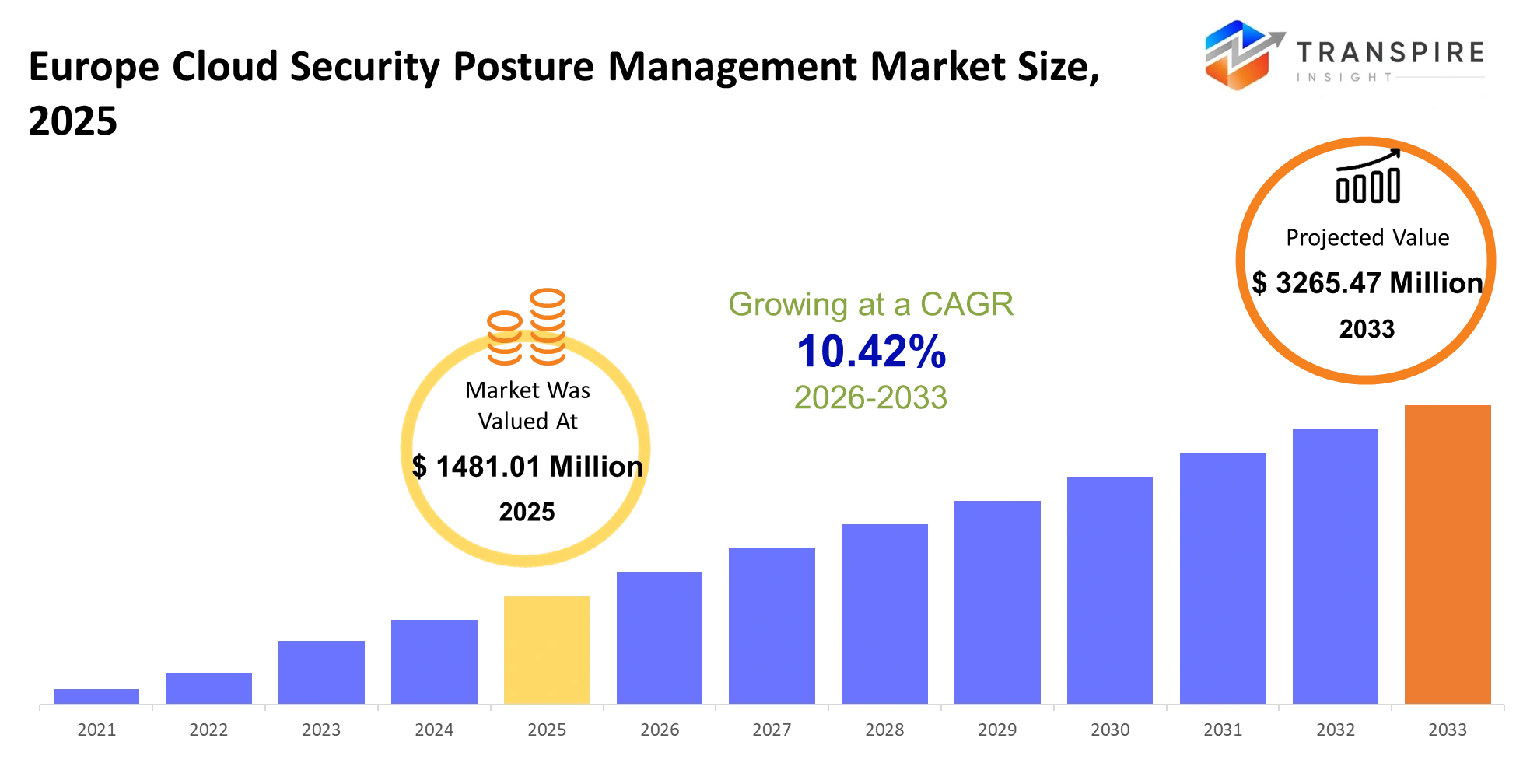
- Europe Cloud Security Posture Management Market Size 2025: USD 1481.01 Million
- Europe Cloud Security Posture Management Market Size 2033: USD 3265.47 Million
- Europe Cloud Security Posture Management Market CAGR: 10.42%
- Europe Cloud Security Posture Management Market Segments: By Type (Cloud Security Tools, Compliance Tools, Risk Assessment Tools, Threat Detection Tools, Others), By Application (Cloud Monitoring, Risk Management, Compliance, Threat Detection, Data Protection, Others), By End-User (Enterprises, SMEs, BFSI, IT & Telecom, Government, Healthcare, Others), By Deployment (Cloud, On-premise, Hybrid, Others).
To learn more about this report,  Download Free Sample Report
Europe Cloud Security Posture Management Market Summary:
The Europe Cloud Security Posture Management Market size is estimated at USD 1481.01 Million in 2025 and is anticipated to reach USD 3265.47 Million by 2033, growing at a CAGR of 10.42% from 2026 to 2033. European Cloud Security Posture Management functions as a permanent assessment system which secures cloud environments by detecting security policy breaches and unapproved system access and misconfigured settings before they result in security incidents. The system enables organizations to control their extensive cloud resources which they utilize for financial operations and manufacturing processes and essential public services.
The security market has transformed its fundamental structure during the last three to five years by moving away from traditional security tools toward automated security systems which use established rules to manage security through DevOps development workflows. The shift to cloud-native systems requires manual operational processes to be replaced by automated systems which handle security operations. The main reason for this development occurred when there was an increase of notable cloud security breaches which happened because organizations lacked full control of their cloud resources during the quick adoption of cloud technology throughout the pandemic period.
Organizations now incorporate CSPM into their development processes at earlier stages of development work. Security has transformed into a necessary component which businesses must follow to maintain their systems because it establishes operational duties which result in continuous financial investment and increased use of technology throughout their corporate IT systems.
Key Market Insights
- Western Europe controls 45% of the Europe Cloud Security Posture Management Market in 2025 because of its established cloud usage.
- Through 2030 Northern Europe develops as the most rapidly expanding area because of its strong digitalization efforts and effective cybersecurity regulations.
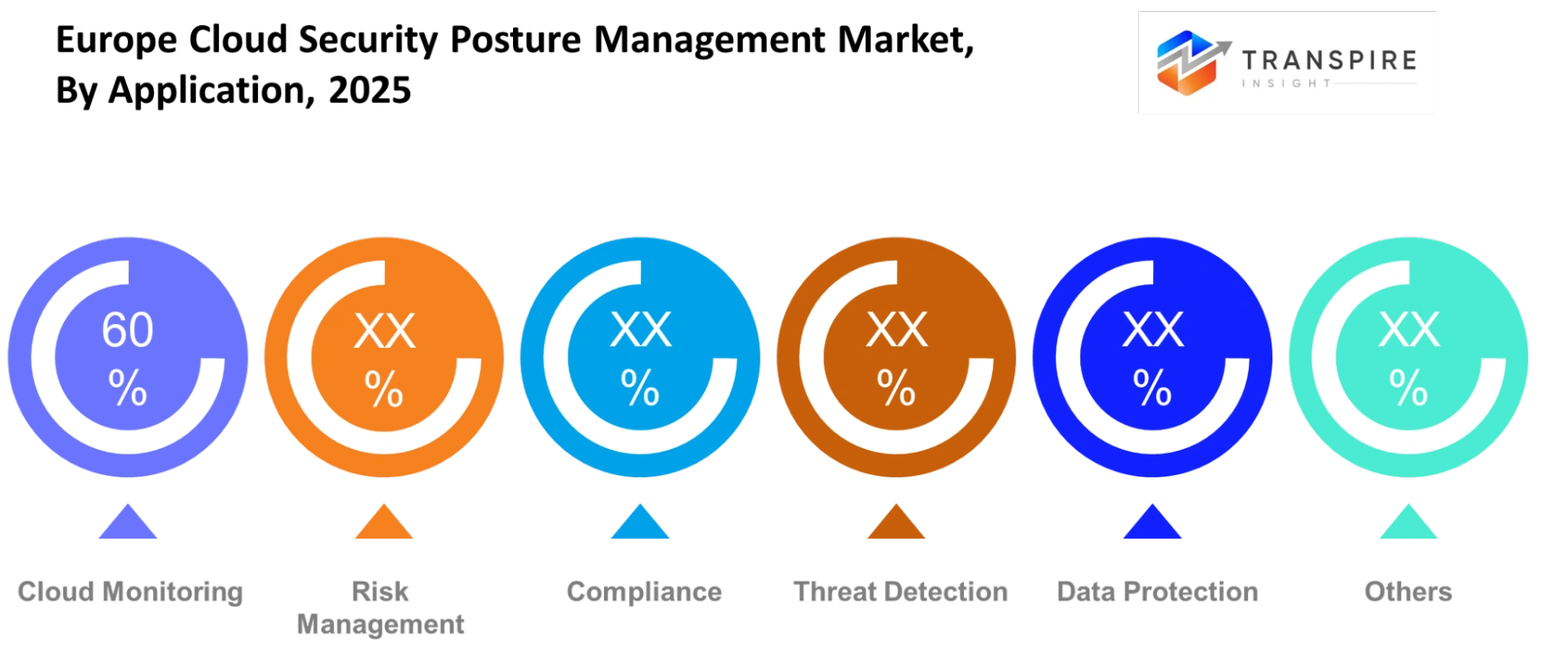
- CSPM platforms dominate with nearly 60% share in 2025 because enterprises choose automated integrated solutions for managing their cloud security posture.
- The second-largest market share belongs to cloud compliance and risk management services which exist because organizations need to follow GDPR rules and complete audit requirements.
- AI-driven CSPM solutions represent the fastest-growing segment which shows rapid growth between 2025 and 2030 because of its ability to detect threats in real time.
- Misconfiguration detection leads the market with over 40% share because configuration errors continue to be the main reason for cloud security breaches.
- The zero-trust security model has led to identity and access management monitoring becoming the most rapidly expanding application across all businesses.
- CSPM tools allow large enterprises to handle their complex multi-cloud operations which account for more than 65% of the market in 2025.
- The fastest-growing segment from now until 2030 consists of SMEs who adapt to SaaS solutions while their vulnerability to cloud threats increases.
What are the Key Drivers, Restraints, and Opportunities in the Europe Cloud Security Posture Management Market?
The Europe Cloud Security Posture Management Market experiences its main growth driver through stricter enforcement of regulations which include both GDPR regulations and the new European Union cybersecurity laws that include NIS2. The regulatory authorities have changed their approach from providing guidance to establishing active infringement penalty systems which require businesses to demonstrate their ongoing compliance in various cloud environments. The need for CSPM has shifted from being an optional security measure to essential compliance obligation which requires funding. Organizations implement automated posture management systems to produce audit-compliant documentation while they stop configuration drift which results in higher contract values and increases recurring income through subscription-based business models.
The multi-cloud and hybrid architectural systems create a fundamental obstacle because they make it impossible to see all cloud platforms including AWS and Azure and private cloud systems. The main reason enterprises experience this problem is because they need to standardize their legacy systems and move their workloads which carries high operational risks. Organizations experience delays in implementing security solutions because they lack cohesive security policies and the necessary cloud security experts. Organizations choose to implement CSPM systems in a limited capacity which results in decreased revenue for the market and extends the time needed for businesses to adopt the technology across their entire operations.
The main opportunity exists because CSPM technology has reached its peak performance through its combination with Cloud-Native Application Protection Platforms. The vendors have developed unified platforms which combine posture management with runtime protection and identity security solutions. Security teams can concentrate on finding exploitable misconfigurations because CNAPP solutions utilize AI-powered risk prioritization. The integrated approach enables European enterprises to achieve greater market penetration through their growing Kubernetes and container deployment.
What Has the Impact of Artificial Intelligence Been on the Europe Cloud Security Posture Management Market?
Artificial intelligence currently leads the transformation of cloud security posture management because it uses automated systems to monitor configurations and enforce policies and track compliance across different cloud environments. The AI-powered system automatically scans cloud assets to find misconfigurations which it then fixes through automated processes that require no human action. The system decreases response times from hours to seconds which enables security teams to oversee thousands of assets while needing only minimal resources. The implementation of infrastructure-as-code digital technology guarantees that security policies get included in deployment pipelines which block risks from reaching production environments.
The analysis of historical misconfigurations and user behavior and threat patterns through machine learning models creates predictive risk scoring capabilities. These models prioritize vulnerabilities according to their likelihood of being exploited which enables organizations to concentrate on their most dangerous security threats. The company experienced better readiness for compliance audits which resulted in fewer security incidents and decreased operational expenses related to manual evaluations.
The main challenge exists because organizations find it hard to connect artificial intelligence models across different cloud computing environments. The absence of standardized data formats together with the ongoing evolution of cloud systems leads to difficulties in model deployment and creates accuracy problems which prevent organizations from adopting solutions that provide operational advantages.
Key Market Trends
- Since 2020 organizations now conduct continuous monitoring of their cloud security posture instead of performing intermittent cloud security audits which results in detection times for configuration errors decreasing from weeks to immediate detection.
- The 2021 GDPR enforcement actions forced organizations to implement automated compliance reporting systems which resulted in CSPM tools becoming essential for audit processes instead of serving as optional security features.
- Between 2022 and 2025European enterprises adopted multi-cloud environments which exceeded 70% while their customers required them to provide integrated CSPM solutions instead of single-cloud security products.
- The CSPM market developed through its vendors Microsoft and Palo Alto Networks who transformed it into CNAPP solutions because organizations started to implement unified security frameworks for their cloud environments.
- After 2021 buyers started to implement security measures into their DevOps processes by adding posture assessments to their code deployment pipeline instead of conducting checks after their systems had already been launched.
- The introduction of AI-driven risk prioritization systems after 2023 allowed security teams to decrease alert numbers by more than 40% while they concentrated on fixing vulnerable misconfigurations.
- The 2024 NIS2 framework expansion to regulatory requirements brought about changes in purchasing behavior because mid-sized companies started to enter the CSPM market to fulfill new compliance requirements.
- The demand for CSPM tools increased after 2022 because cloud-native workloads which operate on containers and Kubernetes platforms started to dominate the market.
- The European enterprise market saw CSPM vendors forge strategic alliances with hyperscalers such as Amazon Web Services to enhance their native integration capabilities which resulted in smoother deployment processes through improved system deployment across enterprises.
Europe Cloud Security Posture Management Market Segmentation
By Type
The market for cloud security tools is currently controlled by organizations that choose unified platforms which provide visibility and misconfiguration detection and automated remediation. The market share of these tools exceeds all others because enterprises prefer to use integrated solutions instead of individual point products. The market for compliance tools follows this trend because European regulatory requirements demand companies to maintain continuous audit readiness and reporting.
Organizations now use risk assessment and threat detection tools because they want to obtain better insights into potential risks instead of using traditional methods to identify static dangers. The market for this industry segment grows because vendors now bundle their various capabilities into single product offerings. The market for standalone tools will shrink because customers increasingly seek products that work together and provide automated functions. The transition process requires vendors to develop AI-based analytics solutions while they diversify their product lines and investors concentrate on platforms that produce consistent revenue streams through scalable solutions.
By Application
The largest market segment currently belongs to cloud monitoring and risk management solutions because organizations require ongoing visibility throughout their complex multi-cloud operations. The applications enable organizations to identify configuration drift while they monitor security vulnerabilities that need their attention during active monitoring. The financial and healthcare sectors depend on compliance applications because their audit process failures result in severe financial losses and damage to their public image.
As organizations expand their cloud operations to handle increasing complexity, companies develop threat detection and data protection systems to safeguard their data which now exists outside traditional security boundaries. The market growth in this segment shows organizations shifting their security methods from response-based protection to security measures which organizations implement at their software development stages. The integrated application layers that combine monitoring and compliance and threat intelligence will drive future demand according to which vendors need to develop unified dashboards that provide predictive insights for better operational decision making.
To learn more about this report, Download Free Sample Report
By End-User
The end-user base of large enterprises leads cloud adoption because their complex cloud systems need more regulatory compliance. These organizations allocate significant budgets to secure multi-cloud environments and ensure compliance across jurisdictions. BFSI and IT and telecom sectors lead in spending because they handle sensitive data and depend on their digital systems. The government and healthcare sectors are growing at a steady pace because they need more digital services and stricter data protection laws.
The adoption of cloud-native applications and managed security services has made small and medium enterprises the fastest-growing business segment. The segment will grow through affordable solutions which customers can implement without needing specialized knowledge. Vendors will develop solutions for smaller organizations according to their future expectations while investors will focus on service models which can grow to meet mid-market demand.
By Deployment
Cloud-based solutions become the primary choice for organizations because they need systems that can grow, which they can establish quickly, and which they can update without interruption. The current operational model supports the industry transition to cloud-native infrastructure by offering continuous system monitoring between distinct organizational sites. Organizations increasingly adopt hybrid deployment because they need to protect their sensitive data through their private systems while they apply security measures to their public cloud services.
The use of on-premise solutions is decreasing because they limit operational freedom and require more upkeep, but they remain the only option for some regulated sectors that need to keep their data within national borders. Organizations use deployment growth strategies because they want to maintain their ability to operate effectively while protecting their confidential information. Organizations will adopt hybrid models in increasing numbers because they need to monitor all their operational spaces. The current trend leads vendors to create better cross-platform system compatibility which enables customers to choose deployment methods that meet their changing regulatory needs and operational requirements.
What are the Key Use Cases Driving the Europe Cloud Security Posture Management Market?
The primary application use case involves ongoing monitoring of cloud system settings together with automatic enforcement of compliance standards for banking and financial services institutions and large-scale IT systems of enterprises. The organizations handle intricate multi-cloud system environments while complying with strict GDPR regulations together with NIS2 compliance standards.
The system now supports new use cases which require identity access governance together with integration into the DevSecOps framework. The IT and telecommunications industry requires CSPM security checks to protect their code during the CI/CD development process before it reaches production. Healthcare providers increasingly use these tools to protect sensitive patient data across SaaS platforms, where mismanaged access controls can expose critical records.
The current use cases focus on protecting containerized workloads together with Kubernetes-based systems. European businesses implement cloud-native systems which require CSPM solutions to deliver runtime risk monitoring and API security management. Security teams now use AI-based risk evaluation methods which direct their attention toward active security threats instead of standard security alerts.
|
Report Metrics |
Details |
|
Market size value in 2025 |
USD 1481.01 Million |
|
Market size value in 2026 |
USD 1632.02 Million |
|
Revenue forecast in 2033 |
USD 3265.47 Million |
|
Growth rate |
CAGR of 10.42% from 2026 to 2033 |
|
Base year |
2025 |
|
Historical data |
2021 - 2024 |
|
Forecast period |
2026 - 2033 |
|
Report coverage |
Revenue forecast, competitive landscape, growth factors, and trends |
|
Regional scope |
Europe (Germany, United Kingdom, France, Italy, Spain and Rest of Europe) |
|
Key company profiled |
Palo Alto Networks, Check Point, Microsoft, IBM, AWS, Google, Cisco, Fortinet, Trend Micro, McAfee, Qualys, Rapid7, Lacework, Orca Security, Wiz. |
|
Customization scope |
Free report customization (country, regional & segment scope). Avail customized purchase options to meet your exact research needs. |
|
Report Segmentation |
By Type (Cloud Security Tools, Compliance Tools, Risk Assessment Tools, Threat Detection Tools, Others), By Application (Cloud Monitoring, Risk Management, Compliance, Threat Detection, Data Protection, Others), By End-User (Enterprises, SMEs, BFSI, IT & Telecom, Government, Healthcare, Others), By Deployment (Cloud, On-premise, Hybrid, Others). |
Which Regions are Driving the Europe Cloud Security Posture Management Market Growth?
The market is dominated by Western Europe because the region enforces GDPR regulations. The NIS2 directives are being implemented throughout Europe. The cloud ecosystems in Germany France and the Netherlands have developed into advanced systems which rely on hyperscale data centers and strong enterprise IT spending. The major financial institutions together with industrial companies start to use new technologies when they include continuous compliance and risk monitoring systems into their business workflows. The existing cloud provider network together with cybersecurity vendors and regulatory bodies creates sustainable advantages for the organization while it speeds up the process of establishing platform standards.
Northern Europe maintains its status as a reliable contributor because of its advanced digital capabilities and effective cloud governance methods. Sweden Denmark and Finland invest in cybersecurity for the long term instead of using funds to address immediate threats. The region's companies implement CSPM solutions as part of their digital transformation programs which extend beyond compliance requirements. The predictable nature of demand creates steady vendor relationships which will continue over time despite Western Europe having larger business operations.
Central and Eastern Europe has become the fastest developing area because of increased cloud adoption and the new policy alignment with EU cybersecurity standards. Polish Czech Republic and Romanian governments together with their enterprises have raised their spending on cloud infrastructure and data protection since 2022. Organizations need to update their outdated IT systems through this shift which regulatory pressure has caused. Vendors can grow their operations from 2026 to 2033 because the region experiences rapid growth which allows them to create affordable products through local business partnerships.
Who are the Key Players in the Europe Cloud Security Posture Management Market and How Do They Compete?
The Europe Cloud Security Posture Management market demonstrates moderate consolidation because global cybersecurity vendors maintain control over most market share while niche security providers emerge. The competition between companies emerges from their technological expertise and platform integration capabilities because businesses seek combined solutions that deliver both posture management and complete cloud security protection. Established companies maintain their market position through development into Cloud-Native Application Protection Platforms while startup companies develop solutions that address security automation and developer-focused security gaps. The industry faces increased competition between companies because of the growing demand for organizations to implement multiple cloud systems which creates need for seamless system operation and instant risk management solutions.
Palo Alto Networks drives its technological development through the Prisma Cloud platform which combines CSPM with identity and workload protection systems. The unified solution decreases the need for multiple tools which benefits enterprises that operate their cloud environments with high complexity. Check Point Software Technologies establishes its unique position through its advanced threat intelligence capabilities and compliance mapping system which enables customers to create detailed security policies that comply with European legal requirements. Both companies expand through partnerships with cloud providers and continuous feature enhancements that improve automation and analytics.
Microsoft uses its Azure ecosystem to offer native cloud services CSPM capabilities which provide customers with a unified monitoring experience. Amazon Web Services provides users with native security tools and scalable solutions which enable them to assess security risks within their known operational environments. IBM develops hybrid cloud security solutions through its combination of consulting services and technological systems to meet the security needs of complex business operations.
Company List
- Palo Alto Networks
- Check Point
- Microsoft
- IBM
- AWS
- Cisco
- Fortinet
- Trend Micro
- McAfee
- Qualys
- Rapid7
- Lacework
- Orca Security
- Wiz
Recent Development News
In April 2026, Microsoft strengthens EU cloud security and sovereignty controls across Europe: Microsoft detailed expanded European cloud infrastructure and security controls, including enhanced EU Data Boundary and sovereignty-focused protections. The company reinforced its European Security Program and compliance alignment with regional regulations. These upgrades directly support improved cloud security posture management across European enterprises using Azure.
Source: https://www.itpro.com
In January 2026, Group-IB launches Cloud Security Posture Management (CSPM) solution to reduce cloud misconfigurations: Group-IB introduced a CSPM solution integrated into its Unified Risk Platform, targeting misconfiguration risks and compliance gaps in cloud environments. The tool focuses on continuous monitoring and automated remediation, helping enterprises strengthen cloud governance across regulated environments in Europe. It also integrates threat intelligence to prioritize real-world exploit risks.
Source: https://www.group-ib.com
What Strategic Insights Define the Future of the Europe Cloud Security Posture Management Market?
The European Cloud Security Posture Management market currently trends toward unified cloud security platforms, which combine posture management, identity protection, and runtime defense into a single control layer. The increasing complexity of multi-cloud and containerized environments creates a need for integrated tools, which provide real-time risk visibility and automated remediation capabilities to operate at large scale. The next five to seven years will establish CSPM as a core component of cloud-native security frameworks which will replace its current status as an independent security category.
The market faces a hidden danger because vendors focus their business operations on hyperscaler ecosystems. The implementation of native security features by providers will lead enterprises to decrease their use of third-party platforms, which will result in decreased vendor margins and reduced ability to separate themselves from competitors.
AI-powered security copilots present a new opportunity because they convert posture information into guideable remediation actions for developers. Vendors that operationalize this capability early can gain traction.
To stay relevant in the market, security organizations need to achieve complete integration of their systems with DevOps and multi-cloud orchestration systems because security practices are increasingly becoming part of application development processes.
Europe Cloud Security Posture Management Market Report Segmentation
By Type
- Cloud Security Tools
- Compliance Tools
- Risk Assessment Tools
- Threat Detection Tools
- Others
By Application
- Cloud Monitoring
- Risk Management
- Compliance
- Threat Detection
- Data Protection
- Others
By End-User
- Enterprise
- SMEs
- BFSI
- IT & Telecom
- Government
- Healthcare
- Others
By Deployment
- Cloud
- On-premise
- Hybrid
- Others
Frequently Asked Questions
Find quick answers to common questions.
The approximate Europe Cloud Security Posture Management Market size for the market will be USD 3265.47 Million in 2033.
The key segments of the Europe Cloud Security Posture Management Market are By Type (Cloud Security Tools, Compliance Tools, Risk Assessment Tools, Threat Detection Tools, Others), By Application (Cloud Monitoring, Risk Management, Compliance, Threat Detection, Data Protection, Others), By End-User (Enterprises, SMEs, BFSI, IT & Telecom, Government, Healthcare, Others), By Deployment (Cloud, On-premise, Hybrid, Others).
Major players in the Europe Cloud Security Posture Management Market are Palo Alto Networks, Check Point, Microsoft, IBM, AWS, Google, Cisco, Fortinet, Trend Micro, McAfee, Qualys, Rapid7, Lacework, Orca Security, Wiz.
The current market size of the Europe Cloud Security Posture Management Market is USD 1481.01 Million in 2025.
The Europe Cloud Security Posture Management Market CAGR is 10.42%.
- Palo Alto Networks
- Check Point
- Microsoft
- IBM
- AWS
- Cisco
- Fortinet
- Trend Micro
- McAfee
- Qualys
- Rapid7
- Lacework
- Orca Security
- Wiz
Recently Published Reports
-
Apr 2026
3D Optical Profiler Market
3D Optical Profiler Market Size, Share & Analysis Report By Type (Desktop 3D Optical Profiler, and Portable 3D Optical Profiler), By Technology (Confocal Technology, and White Light Interference), By End-Use Industry (Manufacturing, Research Institutions, Automotive, Aerospace and Defense, Medical Devices, and Other), and Geography (North America, Europe, Asia-Pacific, Middle East and Africa, South and Central America), 2021 - 2031
-
Apr 2026
Depth Sensor Market
Depth Sensor Market Size, Share & Analysis Report By Type (Infrared Depth Sensors, Time-of-Flight (ToF) Sensors, Stereo Vision Sensors, Structured Light Sensors, Ultrasonic Depth Sensors), By Application (Automotive, Robotics, Gaming, Consumer Electronics, Industrial Automation, Healthcare, Security & Surveillance, Others), By End Users (Automotive Manufacturers, Consumer Electronics Companies, Healthcare Providers, Industrial Companies, Security Agencies, Gaming Companies, Robotics Companies, Others), and Geography (North America, Europe, Asia-Pacific, Middle East and Africa, South and Central America), 2021 – 2031
-
Apr 2026
Digital Manufacturing Market
Digital Manufacturing Market Size, Share & Analysis Report By Component (Hardware, Software, and Services), By Technology (Robotics, 3D Printing, Internet of Things (IoT), and Others), By Application (Automotive and Transportation, Aerospace and Defense, Consumer Electronics, Industrial Machinery, and Others), By Process Type (Computer-Based Designing, Computer-Based Simulation, Computer 3D Visualization, Analytics, and Others), and Geography (North America, Europe, Asia-Pacific, Middle East and Africa, South and Central America), 2021 – 2031
-
Apr 2026
Digital Visa Services Market
Digital Visa Services Market Size, Share & Analysis Report By Type (Individual Travelers, Group Travelers), By Application (Tourism, Business Travel, Others), and Geography (North America, Europe, Asia-Pacific, Middle East and Africa, South and Central America), 2021 – 2031