
South Korea FMCG Logistics Market Size & Forecast:
- South Korea FMCG Logistics Market Size 2025: USD 16.2 Billion
- South Korea FMCG Logistics Market Size 2033: USD 25.7 Billion
- South Korea FMCG Logistics Market CAGR: 5.99%
- South Korea FMCG Logistics Market Segments: By Service Type (Transportation Services, Warehousing Services, Cold Chain Logistics, Inventory Management, Last-mile Delivery, Others); By Mode of Transport (Road Transport, Rail Transport, Air Freight, Sea Freight, Others); By Application (Food & Beverage Logistics, Personal Care Logistics, Household Product Logistics, E-commerce FMCG Logistics, Others); By End User (Retail Chains, FMCG Manufacturers, E-commerce Companies, Others)
To learn more about this report,  Download Free Sample Report
South Korea FMCG Logistics Market Summary
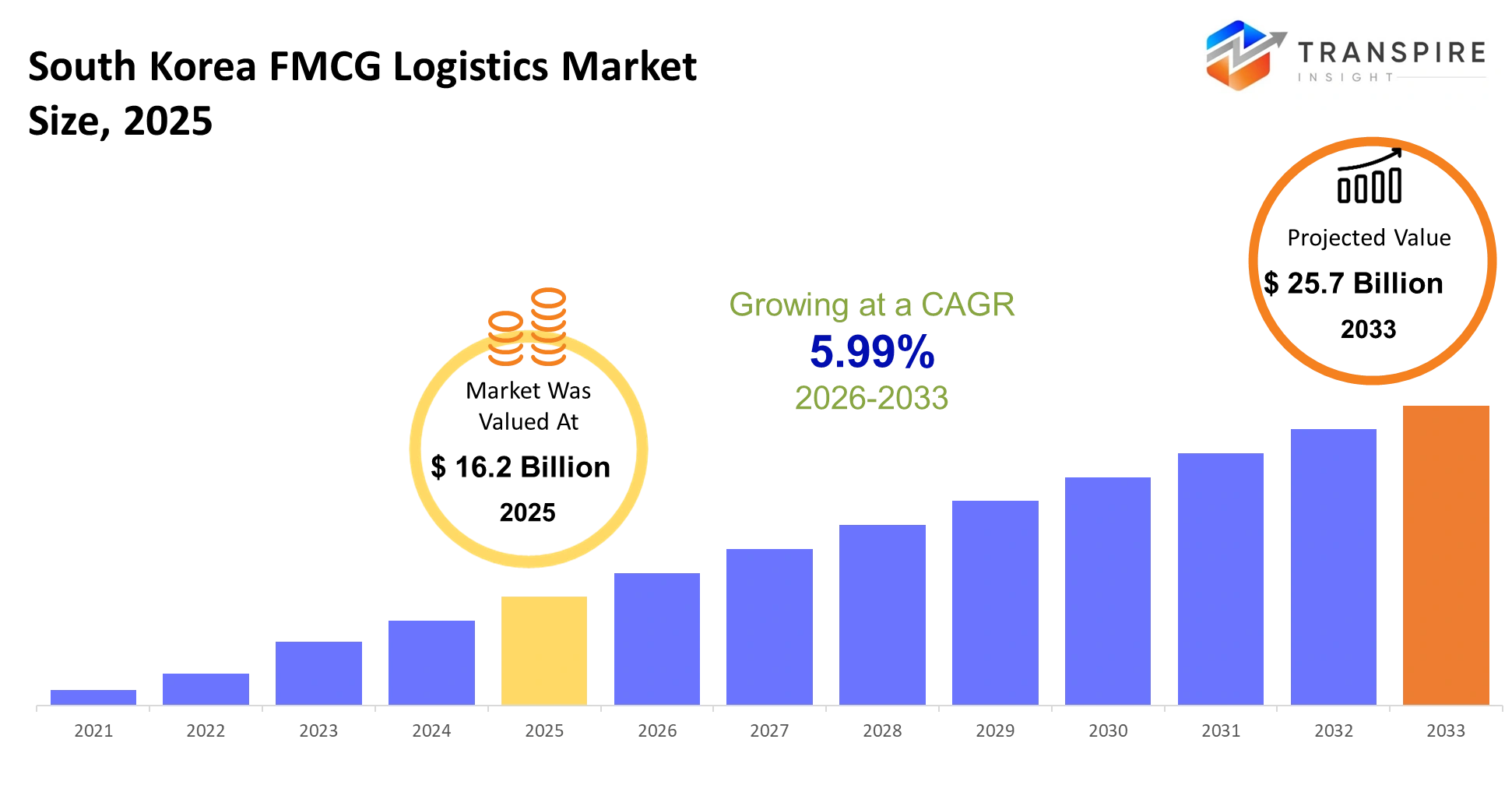
The South Korea FMCG Logistics Market was valued at USD 16.2 Billion in 2025. It is forecast to reach USD 25.7 Billion by 2033. That is a CAGR of 5.99% over the period.
South Korea’s FMCG logistics market keeps the whole fast-moving retail vibe going, like really fast, by shifting packaged foods, drinks, household necessities, and personal care items from ports and manufacturing zones to convenience shops, bigger supermarkets, and e-commerce delivery points, with as little lag as possible. Lately the whole thing has kinda moved away from just cost-focused hauling, toward more data-led distribution routes, with temperature-controlled handling and strict time windows. That kind of setup helps retailers handle shorter product cycles, and it even fits same-day delivery expectations too.
In the last five years, the quick rise of online grocery and quick commerce platforms has really altered how warehouses are laid out, where stock is placed, and how last-mile teams operate. Alongside that, the COVID-19 period exposed supply chain weak spots, especially around import reliance and delivery timing, so many logistics players started putting money into automation plus real-time visibility tools.
So yeah, this shift is boosting revenue, because FMCG brands now treat distribution quickness, inventory precision, and cold-chain dependability as “front line” advantages, not just invisible back-end logistics chores.
Key Market Insights
- The Seoul Capital Area kind of dominated the South Korea FMCG Logistics Market with almost 48% share back in 2025, largely because of those dense retail distribution nets.
- Meanwhile Busan showed up as the fastest-growing regional logistics hub, helped by port upgrades and more cross border FMCG trade expansion all the way through 2030.
- Incheon also picked up a noticeable chunk from cold-chain warehousing investments, due to strong demand for airport linked food as well as pharmaceutical distribution.
- For types of services, transportation services stayed in the lead, taking in more than 42% revenue share in 2025, mainly from nationwide retail replenishment operations.
- On the warehousing side, Warehousing and inventory management ended up as the second-largest segment because multi-temperature fulfillment facilities are being asked for more and more.
- And then there’s cold-chain logistics which is moving the quickest, pushed by online fresh food delivery and the steady rise in premium packaged food consumption from 2025 through 2030.
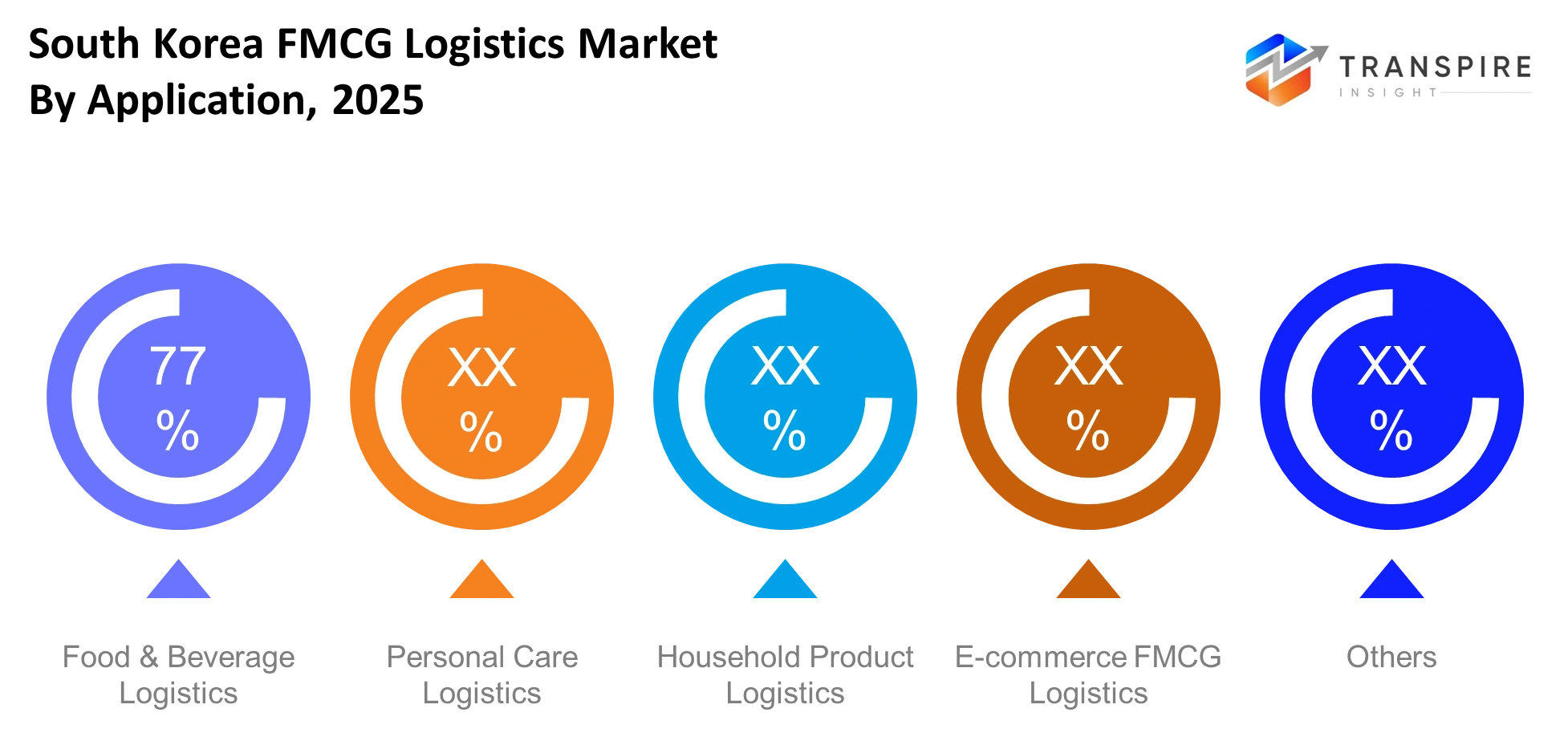
- Food and beverage logistics applications, well pretty much dominated the market with close to 46% share in 2025 due to the high frequency urban retail consumption patterns that keep repeating.
- Personal care plus household product distribution also looked like it was starting to pick up, mainly because direct-to-consumer e-commerce fulfillment channels are getting more traction now.
- Online grocery fulfillment showed up as the fastest growing segment, and this isn’t surprising, once same-day delivery expectations ramped up, companies had to put more money into logistics infrastructure.
- Convenience store chains helped drive solid logistics demand too, since South Korea runs one of the highest per-capita convenience store densities in the world.
What are the Key Drivers, Restraints, and Opportunities in the South Korea FMCG Logistics Market?
The most powerful thing driving the South Korea FMCG logistics market is the fast push of online grocery plus quick-commerce platforms. This change really sped up once COVID-19 messed with how consumers buy, and retailers had to shrink delivery windows , from days down to hours. Big retailers and delivery companies then went ahead and invested in automated fulfillment centers, AI-driven route optimization, and a bunch of urban micro-warehouses near Seoul and Incheon. That shift makes logistics spending per order go up because FMCG players now compete on delivery speed, inventory accuracy, and cold-chain trustworthiness, not only on product pricing. So third-party logistics firms are seeing bigger revenue from value-added warehousing and same-day delivery options.
On the other side the biggest restraint is the built-in cost load tied to urban logistics infrastructure and the availability of labor. South Korea is very dense, so warehouses can’t just expand easily near the highest-demand areas , and labor costs keep climbing which squeezes last-mile delivery unit economics. And this situation can’t get fixed quickly, since land availability , zoning approvals, and worker shortages need longer-term policy moves and infrastructure upgrades. Basically expansion capacity gets delayed and logistics providers’ operating margins get thinner.
A meaningful opportunity is also starting to show up, mainly via AI-enabled smart logistics networks and cold-chain modernization. Funding for robotics-supported fulfillment hubs around Busan and Incheon is boosting handling speed for temperature-sensitive FMCG items and also backing export-focused distribution growth.
What Has the Impact of Artificial Intelligence Been on the South Korea FMCG Logistics Market?
Artificial intelligence plus advanced digital technologies are kinda reshaping the South Korea FMCG logistics market, mainly by boosting warehouse automation, upping delivery precision, and making inventory visibility more clear across high-volume retail networks. Logistics operators are pushing AI powered warehouse management systems into place so they can automate order sorting, pallet movement, and inventory allocation inside fulfillment centers that support online grocery platforms and convenience store chains. Machine learning models then look at real-time buying behavior, weather conditions, and even traffic signals to tune delivery routes and cut down on failed deliveries, especially in dense city zones like Seoul and Incheon. A few operators are also betting on predictive analytics to anticipate inventory shortfalls and then adjust replenishment timing automatically for temperature-sensitive food and beverage items.
All of this seems to bring real operational gains, not just theory. Automated picking and robotics-assisted fulfillment are cutting order handling durations while also lifting warehouse throughput when demand spikes. On top of that, AI driven route optimization is trimming fuel use and delivery delays by spotting congestion trends before trucks even leave. Cold-chain monitoring platforms, with IoT sensors included, are helping distributors lower spoilage risk and keep compliance tighter for perishable goods, even when regulations are strict.
Still, there is a big limitation with AI adoption. Bridging older logistics infrastructure with cloud-based automation systems takes a lot of upfront spending and that’s where problems show up. Smaller regional logistics providers often don’t have the funds or the data integration know-how needed to roll out these advanced predictive platforms at scale, so the progress is uneven.
Key Market Trends
- Since 2020, the adoption of same-day grocery deliveries has gone up a lot ,like really noticeable, because Korean consumers moved more toward mobile based convenience buying ,and they started expecting faster fulfillment than before.
- CJ Logistics and Lotte Global Logistics were expanding automated fulfillment centers in the 2022 to 2025 window, mostly to shrink the urban delivery turnaround times, faster stops basically.
- After the pandemic, cold-chain warehousing investments picked up speed, since disruptions showed clear weak spots in how inventory moved for frozen goods and fresh produce distribution.
- Retailers then tended to shift away from purely centralized distribution, and they leaned into micro fulfillment hubs close to Seoul and Incheon, so the last mile delivery actually feels smoother.
- AI powered route optimization platforms also helped , by cutting delivery delays and fuel use, while operators dealt with heavier order density across metro areas after 2021.
- Convenience store chains have been reinforcing logistics partnerships with third party operators too, because those frequent replenishment cycles created more inventory pressure across urban retail outlets.
- Starting in 2023 , electric delivery vehicle adoption has broadened across major operators, mainly as emissions policies got stricter and urban fuel costs kept climbing.
- Cross border FMCG logistics via Busan Port increased as South Korean distributors diversified their sourcing approaches, after global shipping disruptions hit during 2021 and 2022.
- And finally, robotics assisted warehouse picking systems started gaining traction, because labor shortages and wage inflation pushed operating costs higher in big scale fulfillment facilities, so automation looked less optional.
South Korea FMCG Logistics Market Segmentation
By Service Type:
Transportation services help keep stuff moving all the time with packaged food, drinks, personal care items, and household products across city routes and regional lanes. Warehousing services sort of keep the inventory flow more organized and boost storage efficiency, for both stores and online commerce, that part is important. Cold chain logistics has become more and more critical because fresh food drop offs, plus frozen product movement, need steady temperature control during transit and also while items are sitting in storage.
Inventory management services support the business by letting them watch stock levels, cut down on product shortages and also better align supply decisions across several selling channels. Last-mile delivery operations have grown fast too, especially as online grocery platforms expand and customers expect same day delivery in big cities. Other supporting services include packaging support, reverse logistics, and distribution planning, all of that helps with smoother operational coordination across FMCG supply networks.
By Mode of Transport:
Road transport is still the main option because convenience shops, supermarkets and online delivery apps really want fast flexible urban distribution. Truck-based logistics networks allow high frequency deliveries, and they make it easier to reach retail outlets across metropolitan regions. Rail transport plays a smaller role but it can still be useful for bulk product movement between industrial zones and inland logistics hubs.
Air freight services are used for urgent movement of premium FMCG goods, imported packaged products, and temperature sensitive inventory where shorter transit windows matter a lot. Sea freight is still key for international trade, especially for imported food components, consumer goods, and export distribution via major ports such as Busan, Incheon. Other transport modes also matter, for specialized logistics requirements that don’t always fit standard patterns …
By Application:
Food and beverage logistics takes up a big slice, because packaged foods, frozen products, dairy items, and beverages really need steady restocking across both retail stores and online delivery. Along the way, the push for fresh grocery delivery also made cold storage locations more important, plus faster fulfillment setups especially in city zones.
Personal care logistics is basically about getting cosmetics, hygiene products, and healthcare related FMCG items to where they’re sold, like supermarkets, pharmacies, and e-commerce marketplaces. Household product logistics meanwhile handles the flow of cleaning supplies, paper goods and other daily-use consumer items. And E-commerce FMCG logistics keeps growing, since shopping on a phone means orders must be processed quickly, inventory has to be tracked with good accuracy, and last mile deliveries need to stay dependable across crowded areas.
To learn more about this report, Download Free Sample Report
By End User:
Retail chains show up as a major end user group, because supermarkets, hypermarkets, and convenience store networks count on continuous shelf availability and rapid replenishment cycles. Big retail operators invest in advanced warehousing systems, and also automated distribution facilities, to get better inventory control plus quicker delivery times across many places.
FMCG manufacturers lean on logistics providers for transport, storage, packaging coordination, and distribution management across both domestic routes and export markets. E-commerce firms keep tightening logistics partnerships, to meet quick delivery commitments and deal with very high online order volumes. Other users still matter too, like wholesalers, regional distributors, and standalone retailers, who all need a stable supply chain back end for daily consumer product movement.
What are the Key Use Cases Driving the South Korea FMCG Logistics Market?
Food and beverage distribution is still basically the main reason people adopt solutions in the South Korea FMCG logistics market . Convenience store groups, supermarkets, and online grocery apps need replenishment over and over, plus temperature-controlled storage , and fast last mile delivery so products stay fresh and shelves don’t run out so quickly in crowded cities.
Personal care and household product transport is growing too, mainly because e-commerce firms push more direct consumer shipments across different regions . Cosmetics brands and hygiene manufacturers are putting money into automated fulfillment systems, and also inventory tracking platforms, to get better delivery accuracy and handle the higher online order levels during promo weeks and seasonal sales.
Other emerging use cases are starting to show up like AI based micro fulfillment centers, plus robotics assisted dark store layouts, all aimed at super fast urban grocery drop-offs . At the same time, logistics providers are trialing electric delivery fleets, and smart cold chain monitoring systems, to meet tighter environmental targets, while also lifting day to day operational efficiency across metropolitan distribution routes.
|
Report Metrics |
Details |
|
Market size value in 2025 |
USD 16.2 Billion |
|
Market size value in 2026 |
USD 17.1 Billion |
|
Revenue forecast in 2033 |
USD 25.7 Billion |
|
Growth rate |
CAGR of 5.99% from 2026 to 2033 |
|
Base year |
2025 |
|
Historical data |
2021 - 2024 |
|
Forecast period |
2026 - 2033 |
|
Report coverage |
Revenue forecast, competitive landscape, growth factors, and trends |
|
Country scope |
South Korea |
|
Key company profiled |
CJ Logistics, Hyundai Glovis, Lotte Global Logistics, DHL Supply Chain, FedEx, UPS, DB Schenker, Maersk, Nippon Express, Kerry Logistics, SF Express, Kuehne + Nagel, GXO Logistics, XPO Logistics, Samsung SDS |
|
Customization scope |
Free report customization (country, regional & segment scope). Avail customized purchase options to meet your exact research needs. |
|
Report Segmentation |
By Service Type (Transportation Services, Warehousing Services, Cold Chain Logistics, Inventory Management, Last-mile Delivery, Others); By Mode of Transport (Road Transport, Rail Transport, Air Freight, Sea Freight, Others); By Application (Food & Beverage Logistics, Personal Care Logistics, Household Product Logistics, E-commerce FMCG Logistics, Others); By End User (Retail Chains, FMCG Manufacturers, E-commerce Companies, Others) |
Which Regions are Driving the South Korea FMCG Logistics Market Growth?
Seoul Capital Area is still the main, leading region in South Korea's FMCG logistics market. I mean, the country’s biggest retail , e-commerce, and distribution networks are basically running inside Seoul, Gyeonggi Province and Incheon. Because the population density is high , and consumer purchase activity stays strong, there’s always that need for quick inventory movement, plus same-day delivery services. On top of that, the area has advanced transportation infrastructure and automated fulfillment centers. It also has easy access to Incheon International Airport, so high-value cargo , and temperature-sensitive stuff can be handled more smoothly. Big retail chains, online grocery operators and third-party logistics providers keep putting money into AI-based warehousing. They’re also building urban micro-fulfillment facilities, and honestly that helps lock in the region’s long-term dominance.
Busan, on the other hand, shows up as the second-largest regional contributor, but the growth logic isn’t really the same as the Seoul metropolitan pattern. It’s not just about domestic retail consumption, instead Busan is more port driven, with trade activity and fairly stable international cargo movement. That includes imported FMCG products and export distribution, so the flow feels steadier. Busan Port plays a key role too, supporting continual warehousing demand, container handling, and cold-chain logistics for packaged food and consumer goods makers. There’s also consistent investment in infrastructure, and shipping networks have been around for a long time. So even if urban delivery intensity is a bit slower than Seoul, the region is still a dependable contributor to logistics revenue.
Incheon seems to be popping up as the fastest-growing region, mainly because logistics operators are widening airport-linked fulfillment hubs and adding smart cold-chain infrastructure close to big transportation corridors. There was recent investment into automated warehouses and cross border e-commerce logistics, and honestly it has been speeding up the regional rollout since 2023. At the same time, more imported premium food products, cosmetics, and healthcare related FMCG goods are arriving, so the need for temperature-controlled storage and quick customs clearance services is getting louder. This whole push is basically opening up solid chances for logistics technology providers, cold-chain operators, and automated warehousing companies looking at expansion somewhere between 2026 and 2033.
Who are the Key Players in the South Korea FMCG Logistics Market and How Do They Compete?
South Korea's FMCG logistics market is looking kind of moderately consolidated, in the sense that the bigger domestic logistics companies tend to run the big retail and e-commerce distribution lanes, while smaller regional players show up with more niche delivery services, plus local warehousing know-how. Over time the fight between firms is no longer mostly about transportation pricing, instead it’s been tilting toward automation efficiency, cold chain dependability and same day delivery performance. The well established operators keep trying to hold their share by pouring money into AI enabled fulfillment systems, robotics based warehousing, and linked inventory visibility platforms. Meanwhile, the more tech minded delivery startups are moving into urban logistics areas too, with quicker dispatch rhythms and app led order coordination models, which feels a bit faster paced than before.
For example CJ Logistics, they’ve built their standing with big automated fulfillment centers and AI powered route selection tools, all of that helps boost delivery speed across the major metro zones. Also their nationwide warehouse coverage, paired with more advanced cold chain infrastructure, lets them move high volume grocery and convenience store shipments with less friction than smaller competitors. Lotte Global Logistics on the other hand leans hard on connecting with retail and e commerce networks that tie back to the Lotte Group ecosystem. That setup brings more steady long term distribution demand, and it also supports their push into smart warehousing, as well as temperature controlled logistics services, even when the market gets a little more crowded, and yes, sometimes messy.
Hanjin kinda differentiates what they do by mixing port-linked freight handling with a sort of global cargo logistics that is tied to the Busan and Incheon corridors. On top of that, the investment in digital freight management and some automated cargo processing systems has made the day to day coordination better especially for imported FMCG products , somehow. DHL meanwhile competes using cross-border supply-chain know how plus those premium, time-sensitive delivery abilities for multinational FMCG brands that are operating across South Korea. They also build strategic alliances with e-commerce platforms, and keep putting more money into sustainable delivery fleets, and this is really helping both local and outside operators grow their regional logistics capacity somewhere between 2026 and 2033.
Company List
- CJ Logistics
- Hyundai Glovis
- Lotte Global Logistics
- DHL Supply Chain
- FedEx
- UPS
- DB Schenker
- Maersk
- Nippon Express
- Kerry Logistics
- SF Express
- Kuehne + Nagel
- GXO Logistics
- XPO Logistics
- Samsung SDS
Recent Development News
In January 2026, CJ Logistics entered a partnership with COEX to launch Korea’s first AI-based exhibition logistics service, ‘ExBox.’ The platform introduced AI-driven dispatching and route optimization for exhibition cargo, improving logistics efficiency for retail and FMCG-related trade events across South Korea. Source https://en.sedaily.com/
In March 2026, CJ Logistics entered a partnership with Merlo Lab to co-develop a smart indoor positioning technology for warehouse operations. The collaboration uses IoT sensor-based worker tracking to improve operational efficiency and automation in logistics facilities serving FMCG and retail distribution networks. Source https://en.sedaily.com/
What Strategic Insights Define the Future of the South Korea FMCG Logistics Market?
The South Korea FMCG logistics market is sort of moving, structurally, toward hyper-automated, data driven distribution systems that are really built around city fast fulfillment and cold-chain accuracy . Over the next five to seven years, competitive edge will stop being mostly about warehouse scale alone and start leaning more on predictive inventory steering, AI enabled routing , and micro-fulfillment proximity near dense consumer corridors. The core push behind this shift is the lasting change in how retail works, where online grocery, same day delivery, and direct to consumer ordering are settling in as habitual ways of buying , not just “temporary” movement.
One not so visible risk shows up in how concentrated the market is becoming around a small set of major logistics operators, mainly those with sophisticated automation. Smaller regional providers may have a hard time raising funds for robotics integration and cloud based infrastructure refreshes, which can cause a capacity mismatch and pricing pressure that ripples across the whole supply chain. Over time this may shrink retailers’ operational flexibility, especially those that rely on a limited number of logistics networks.
A big opportunity that’s emerging is smart cold-chain hubs positioned around Incheon and Busan, connected to cross border e-commerce and higher value food imports. Companies in this space should really focus on alliances with AI software providers plus regional fulfillment operators, so digital integration gets locked in before automation costs jump even more.
South Korea FMCG Logistics Market Report Segmentation
By Service Type
- Transportation Services
- Warehousing Services
- Cold Chain Logistics
- Inventory Management
- Last-mile Delivery
By Mode of Transport
- Road Transport
- Rail Transport
- Air Freight
- Sea Freight
By Application
- Food & Beverage Logistics
- Personal Care Logistics
- Household Product Logistics
- E-commerce FMCG Logistics
By End User
- Retail Chains
- FMCG Manufacturers
- E-commerce Companies
Frequently Asked Questions
Find quick answers to common questions.
The South Korea FMCG Logistics Market size is USD 25.7 Billion in 2033.
Key segments for the South Korea FMCG Logistics Market are By Service Type (Transportation Services, Warehousing Services, Cold Chain Logistics, Inventory Management, Last-mile Delivery, Others); By Mode of Transport (Road Transport, Rail Transport, Air Freight, Sea Freight, Others); By Application (Food & Beverage Logistics, Personal Care Logistics, Household Product Logistics, E-commerce FMCG Logistics, Others); By End User (Retail Chains, FMCG Manufacturers, E-commerce Companies, Others).
Major South Korea FMCG Logistics Market players are CJ Logistics, Hyundai Glovis, Lotte Global Logistics, DHL Supply Chain, FedEx, UPS, DB Schenker, Maersk, Nippon Express, Kerry Logistics, SF Express, Kuehne + Nagel, GXO Logistics, XPO Logistics, Samsung SDS.
The South Korea FMCG Logistics Market size is USD 16.2 Billion in 2025.
The South Korea FMCG Logistics Market CAGR is 5.99% from 2026 to 2033.
- CJ Logistics
- Hyundai Glovis
- Lotte Global Logistics
- DHL Supply Chain
- FedEx
- UPS
- DB Schenker
- Maersk
- Nippon Express
- Kerry Logistics
- SF Express
- Kuehne + Nagel
- GXO Logistics
- XPO Logistics
- Samsung SDS
Recently Published Reports
-
Apr 2026
Bottled Water Market
Bottled Water Market Size, Share & Analysis Report By Product Type (Still Bottled Water, Carbonated Bottled Water, Functional Bottled Water, and Others), By Packaging (PET, Cans, and Others), By Sales Channel (Supermarkets/Hypermarkets, Convenience Stores/Drug Stores, Grocery Stores/Club Stores, Foodservice, and Others) and Geography (North America, Europe, Asia-Pacific, Middle East and Africa, South and Central America), 2021 - 2032
-
Apr 2026
Color Cosmetic Packaging Market
Color Cosmetic Packaging Market Size, Share & Analysis Report By Application (Mascara Packaging, Liquid Packaging, and Liquid Face), By Type (Tubes & Bottles, Pens & Markers, Compacts & Containers, and Droppers & Pumps), and Geography (North America, Europe, Asia-Pacific, Middle East and Africa, South and Central America), 2021 - 2031
-
Apr 2026
External Microphone For Camera Market
External Microphone For Camera Market Size, Share & Analysis Report By Type (Shotgun Microphone, Lavalier Microphone, and Others), By Application (Digital Camera, Professional Video Camera, and Others), and Geography (North America, Europe, Asia-Pacific, Middle East and Africa, South and Central America), 2021 - 2031
-
Apr 2026
Foot Orthotic Insoles Market
Foot Orthotic Insoles Market Size, Share & Analysis Report By Type (Pre-fabricated, and Custom-made), By Material (Thermoplastic, Composite Carbon Fiber, and Others), By Distribution Channel (Drug Stores, Hospitals & Clinics, and Others), and Geography (North America, Europe, Asia-Pacific, Middle East and Africa, South and Central America), 2021 - 2031