
United States Defense Logistics Market Size & Forecast:
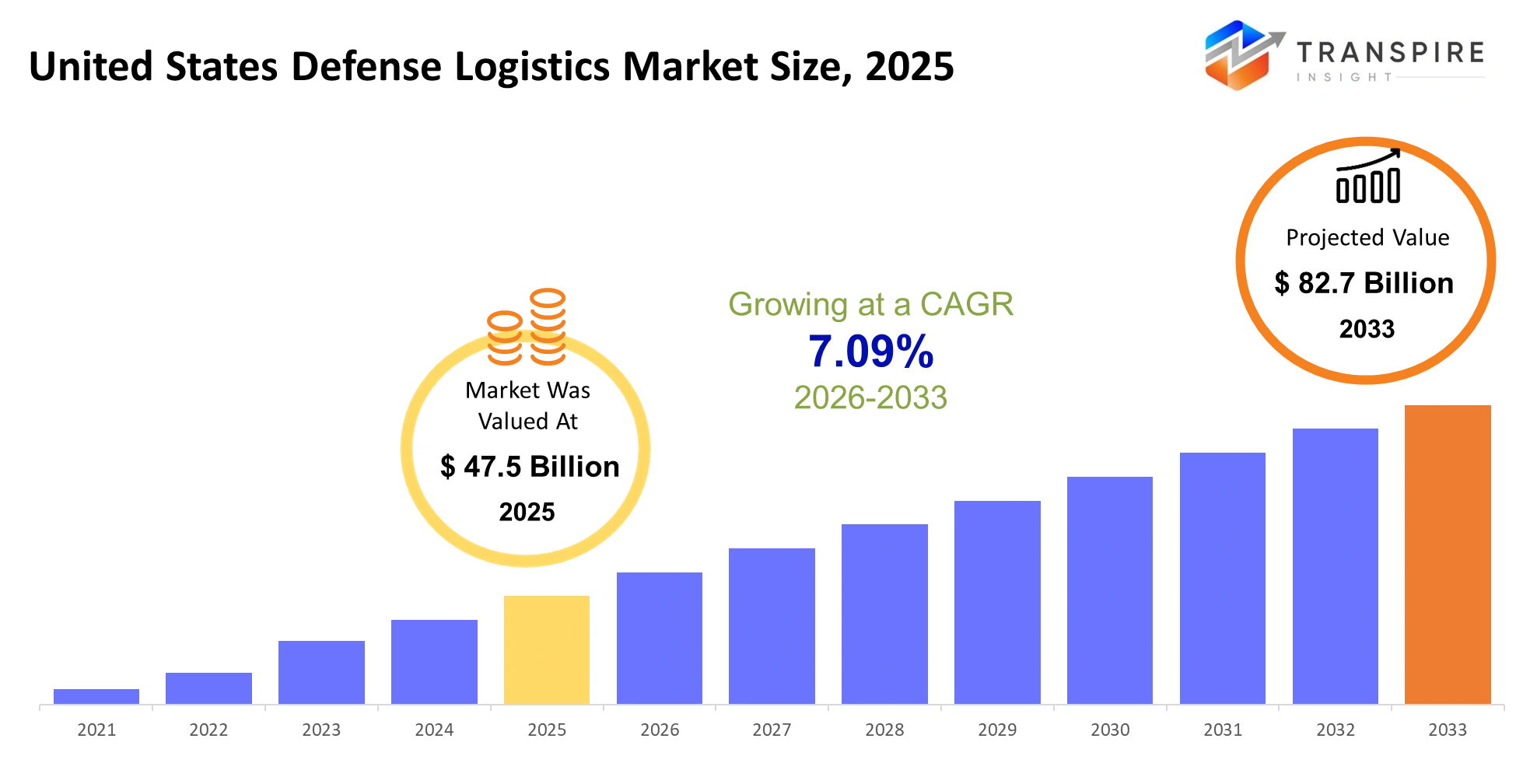
- United States Defense Logistics Market Size 2025: USD 47.5 Billion
- United States Defense Logistics Market Size 2033: USD 82.7 Billion
- United States Defense Logistics Market CAGR: 7.09%
- United States Defense Logistics Market Segments: By Service Type (Transportation, Inventory Management, Warehousing, Procurement, Maintenance Services, Others), By Mode of Transport (Air Transport, Sea Transport, Land Transport, Rail Transport, Multimodal Transport, Others), By Application (Military Operations, Humanitarian Missions, Equipment Supply, Ammunition Transport, Medical Support, Others), By End User (Army, Navy, Air Force, Homeland Security, Defense Contractors, Others).
To learn more about this report,  Download Free Sample Report
United States Defense Logistics Market Summary:
The United States Defense Logistics Market size is estimated at USD 47.5 Billion in 2025 and is anticipated to reach USD 82.7 Billion by 2033, growing at a CAGR of 7.09% from 2026 to 2033. The United States defense logistics market, kinda keeps military operations running by aligning things like storage , transport, upkeep, and delivery of fuel, armaments, spare parts, medical provisions and mission-critical gear across stateside installations and global deployment zones. In real life, it addresses the operational headache of keeping combat readiness alive in environments that shift quickly, with a lot of complexity , and where even small delays can mess up mission outcomes.
Over the last five years, the market has moved away from the older, inventory-heavy logistics style and toward data-driven, connected supply networks that lean on predictive analytics, automation, and real-time asset visibility. The Russia-Ukraine conflict basically highlighted weak points in defense supply chains , and it also sped up federal funding for resilient sourcing , onshore production capacity, and fast deployment infrastructure. Meanwhile, Indo-Pacific force posture has pushed more demand for pre-positioned stockpiles and nimble transportation corridors. As a result, spending has grown for AI-enabled logistics platforms, automated delivery systems , and integrated defense supply ecosystems, which opens longer-term revenue chances for contractors who can raise pace, traceability, and overall operational resilience.
Key Market Insights
- The Southern United States kind of dominated the United States Defense Logistics Market, with close to 38% market share in 2025 . This happened mostly because of large military bases plus port infrastructure.
- The Western region is showing the quickest growth for the defense logistics hub through 2032, backed by Indo-Pacific deployment approaches and continued naval modernization investments.
- After 2022, the Gulf Coast logistics corridors picked up meaningful share , largely because defense agencies grew fuel storage and built faster deployment infrastructure.
- Strategic expansion of defense transport networks across Texas, Virginia, and California keeps adding to the regional market size, as well as operational capacity.
- Transportation and distribution services ended up leading the United States Defense Logistics Market, taking roughly 34% of revenue share in 2025.
- Warehousing and inventory management came in as the second-largest segment. This is mainly tied to rising needs for real-time military inventory visibility.
- AI-powered supply chain management solutions are moving the fastest segment during the forecast period, pushed by predictive logistics uptake.
- Autonomous logistics systems and unmanned cargo delivery options are gaining momentum across military modernization programs after 2023.
- Military operations and deployment support accounted for nearly 41% share of the United States Defense Logistics Market in 2025.
- Maintenance, repair, and overhaul applications are beginning to draw more attention due to aging defense equipment plus ongoing fleet sustainment obligations.
- Cyber-secure logistics platforms are becoming more and more essential, since defense agencies are focusing on operational resilience against digital supply chain threats.
What are the Key Drivers, Restraints, and Opportunities in the United States Defense Logistics Market?
The main force moving the United States Defense Logistics Market is the Pentagon’s shift toward digitally woven and faster on-the-spot supply networks. Honestly this transition got more traction after the Russia-Ukraine conflict showed some gaps in ammunition replenishment cycles, coordination during transport, and the way suppliers cluster in a few places. In response, the U.S. Department of Defense has been pushing expanded investment into predictive maintenance software, into AI enabled inventory systems and real-time logistics monitoring platforms, kind of like a package. Together these tools reduce equipment downtime time, and they also let deployments move more rapidly across far-ranging operations, which is what matters most. Since military agencies now lean more on operational readiness than on hoarding inventory, contractors that can deliver automated logistics capabilities are landing bigger multi-year service contracts and also steady recurring revenue streams that are software driven.
The market’s biggest structural obstacle is the sheer difficulty of upgrading legacy military logistics infrastructure. Quite a lot of defense distribution setups still sit on fragmented procurement databases, old warehouse facilities, and communication networks that were designed decades ago but never really fit together. To replace them, organizations must run through heavy cybersecurity certification, interoperability trials, and federal procurement clearances, and all of that can stretch across multiple budget periods. Because of that adoption of advanced logistics technologies tends to lag, and full integration across service branches stays incomplete for longer. In practice this means logistics providers deal with extended sales cycles, higher rollout expense, and it ends up suppressing near term revenue growth.
A major future chance sits in autonomous, and unmanned defense logistics systems. The U.S. military is ramping up investment in autonomous cargo drones, robotic warehouses, and unmanned ground resupply vehicles for contested areas in the Indo-Pacific region. These systems can lower human risk, while also making supply delivery faster in remote mission zones. And as the geopolitical focus drifts toward distributed maritime operations, defense contractors building autonomous logistics platforms are kind of set to snag the next wave of procurement spending.
What Has the Impact of Artificial Intelligence Been on the United States Defense Logistics Market?
Artificial intelligence and more advanced digital technologies, are quietly reshaping the United States Defense Logistics Market, kind of like it’s tightening the whole loop. In day to day terms this transformation helps with supply chain coordination, boosts equipment readiness, and also improves mission responsiveness across most military operations. Defense agencies are using AI driven logistics platforms more and more , to automate inventory tracking, fleet movement scheduling, and compliance monitoring tied to fuel usage, maintenance cycles, and mission critical assets. Automated control systems now process live sensor information from transport vehicles, aircraft and naval platforms , to spot delays, improve routing choices, and reduce those repetitive manual coordination loads that slow teams down.
Then there’s machine learning, which is quietly making predictive maintenance feel more reliable. Defense contractors apply AI algorithms to inspect vibration profiles, engine temperature swings, and component wear information, so they can forecast equipment failures before any real breakdown. In practice this has cut unplanned maintenance downtime and improved fleet availability rates across military transportation networks. Predictive analytics tools are also supporting better fuel efficiency, by adjusting cargo loads, selecting routes more carefully, and even fine tuning warehouse distribution patterns , which tends to lower operational costs while still backing faster deployment readiness.
Still, AI adoption has a big snag. Bringing advanced analytics into legacy military infrastructure is hard , and it’s also expensive. A lot of defense logistics systems run on older databases and disconnected communications networks. That situation limits real-time data sharing, and it reduces how accurate the AI forecasts stay in complicated field conditions, especially when conditions change faster than the systems can adapt.
Key Market Trends
- Since 2021 , the Pentagon has been putting more money into predictive logistics software, to cut down on equipment downtime and make operational readiness better across global deployments.
- Defense agencies moved away from a single source approach to procurement, and leaned more into diversified supplier networks after the Russia-Ukraine conflict interruptions, which in 2022 highlighted ammunition and component shortages in a pretty direct way.
- After 2023, autonomous cargo drones plus unmanned ground resupply vehicles got more testing momentum, especially for contested Indo-Pacific activity and far away battlefield logistics missions, even where resupply is hard.
- Real time asset tracking platforms began replacing manual inventory coordination across several military branches, and that improved how deployments could be seen, while also reducing transportation delays quite a lot.
- Companies such as Lockheed Martin and Leidos expanded AI enabled logistics agreements to boost predictive maintenance and also battlefield supply coordination, basically doing the same job but smarter.
- Cybersecurity spending within defense logistics systems increased noticeably after 2022, as military agencies reacted to growing risks tied to digital supply chain vulnerabilities, which sounded manageable until it wasn’t.
- The U.S. Navy pushed harder on pre positioned inventory programs along Pacific logistics corridors between 2023 and 2025, aiming to support distributed maritime operations where the distance never really helps.
- Warehouse automation adoption grew steadily after labor shortages and higher operational costs kept pressuring defense contractors to improve throughput efficiency and inventory accuracy, because delays get expensive.
- Cloud based logistics platforms started replacing older military databases more often, allowing faster procurement coordination, better supplier visibility, and mission critical decision making that doesn’t take forever.
- Defense contractors also strengthened domestic manufacturing partnerships after 2021 , to reduce reliance on foreign components, and to improve supply chain resilience during geopolitical disruptions, not just in theory.
United States Defense Logistics Market Segmentation
By Service Type
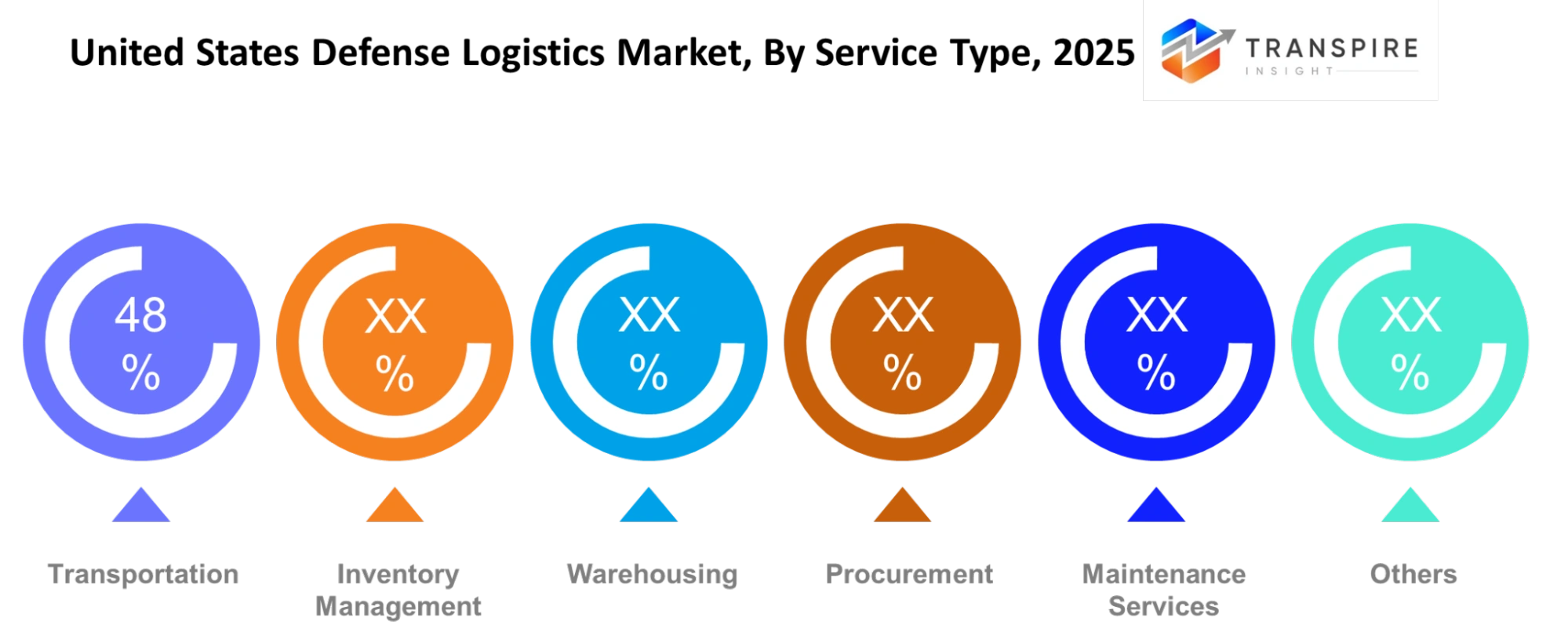
Transportation services seem to stay at the front of the service type breakdown,mostly because they tie so directly to mission readiness, quick deployment needs,and ongoing operations that keep going across both domestic and overseas military networks. When it comes to money, the high value movement of equipment, fuel, and tactical supplies keeps taking the largest chunk of logistics spending. At the same time, inventory management along with warehousing has gotten more strategic weight, since many military agencies are moving toward near real-time stock visibility and a more decentralized storage approach. Procurement services also help, by nudging supplier diversity and making contract efficiency better, and maintenance services are rising as well , especially when predictive servicing tools get used, plus lifecycle support agreements are already in place.
Overall , the demand pattern has begun to tip toward integrated service platforms, kind of like ones that blend transportation, storage, and digital coordination inside one operating setup , instead of treating each bit separately. Looking forward, the market direction feels as if it is moving toward automated fulfillment centers, AI enabled supply chain orchestration, and longer term managed service contracts. That combination should open clearer paths for technology providers, infrastructure investors,and logistics integrators to expand.
To learn more about this report, Download Free Sample Report
By Mode of Transport
Air transport stays basically the main thing because it has that unmatched swiftness for tactical deployments , emergency response runs, and high-priority equipment transfers. At the strategic level, airlift capacity still gets serious defense investment, global operational needs are what pushing rapid force mobility, so it keeps being favored. Sea transport has a key role for moving big-volume loads, particularly when it comes to armored vehicles, fuel reserves, and maritime supply work along Indo Pacific routes.
Land transport, meanwhile, helps with domestic base linkages and regional distribution efficiency, while rail transport handles more specific heavy-load military movements, with cost advantages that tend to matter. More and more, multimodal transport is picking up momentum, because defense agencies want extra flexibility through synchronized routing plans across the land sea and air channels. Going forward, growth will hinge on digital route optimization, resilient port infrastructure and interoperable transport networks that boost delivery accuracy and also limit logistical weak spots.
By Application
Military operations are the leading application segment, mostly because long term combat readiness hinges on nonstop supply movement, equipment replenishment, and that ongoing operational sustainment across the active theaters. Equipment supply along with ammunition transport stays a key support duty, it is pushed further by modernization initiatives and also larger stockpile needs, after these recent geopolitical tensions. Medical support logistics has gotten stronger too, as defense agencies tighten emergency readiness and field more deployable healthcare capabilities. Humanitarian missions look kinda similar, especially when military units are involved in disaster relief operations, and even broader international stabilization work.
Each application, really wants its own mix of service tempo ,security expectations, and transport priorities, and that ends up steering procurement choices, as well as the level of infrastructure spend ing. In practice it can get messy because the requirements shift fast, and nobody follows one single formula. What comes next will likely lean on adaptive logistics systems that can re assign resources quickly between different mission styles, meaning there is a real need for improved planning tools, autonomous support platforms, and more flexible supply chain partnerships.
By End-User
Army logistics still grabs the largest end user share, mostly because they keep a lot of people in motion, huge inventories of materiel, and wide area responsibilities that just won’t really shrink. Ongoing spend in land force mobility , ammo readiness, plus field sustainment keeps procurement activity looking solid. For the Navy, demand is growing quickly too, driven by maritime repositioning approaches and distributed operations, which really call for resilient ocean based supply networks. Air Force logistics stays centered on aircraft maintenance support, quick component delivery, and fuel management that’s more efficient than before, so parts and fuel don’t get stuck in the middle.
Homeland security agencies bring specialized demand, tied to border missions and emergency response readiness, while defense contractors show up more often through outsourced logistics support , and more integrated service delivery. Looking ahead, the next segment will likely lean toward a cooperative ecosystem, where service branches and private providers share digital platforms, which helps with coordination, visibility, and longer term operational efficiency, kind of like everybody seeing the same dashboard.
What are the Key Use Cases Driving the United States Defense Logistics Market?
Military deployment support is still kinda the main reason logistics gets adopted, because combat readiness hinges on nonstop movement of ammunition, fuel, vehicles, and repair components across global bases and the actual operational zones. Rapid airlift coordination plus pre-positioned inventory systems tend to drive the biggest logistics spending inside Army and Navy operations, kinda straightforward.
Humanitarian response missions and medical support logistics are showing more pull now , as defense agencies widen disaster relief capabilities and tune up emergency deployment readiness. Naval fleets and Homeland Security operations are leaning harder on integrated supply tracking systems, to line up food, medical equipment, and field infrastructure during climate related crises and border security missions.
What’s next includes autonomous resupply drones, and AI powered battlefield inventory management platforms meant for contested Indo Pacific operations. Defense contractors are also testing robotic warehousing paired with predictive logistics systems, these help raise delivery accuracy and lower personnel exposure in high-risk operational environments, even when things get messy.
|
Report Metrics |
Details |
|
Market size value in 2025 |
USD 47.5 Billion |
|
Market size value in 2026 |
USD 51.2 Billion |
|
Revenue forecast in 2033 |
USD 82.7 Billion |
|
Growth rate |
CAGR of 7.09% from 2026 to 2033 |
|
Base year |
2025 |
|
Historical data |
2021 - 2024 |
|
Forecast period |
2026 - 2033 |
|
Report coverage |
Revenue forecast, competitive landscape, growth factors, and trends |
|
Geographic scope |
United States of America |
|
Key company profiled |
Lockheed Martin, Northrop Grumman, Raytheon Technologies, KBR, AECOM, BAE Systems, Leidos, General Dynamics, CACI International, DHL Supply Chain, UPS Government Services, FedEx Logistics, Fluor Corporation, SAIC, Booz Allen Hamilton. |
|
Customization scope |
Free report customization (country, regional & segment scope). Avail customized purchase options to meet your exact research needs. |
|
Report Segmentation |
By Service Type (Transportation, Inventory Management, Warehousing, Procurement, Maintenance Services, Others), By Mode of Transport (Air Transport, Sea Transport, Land Transport, Rail Transport, Multimodal Transport, Others), By Application (Military Operations, Humanitarian Missions, Equipment Supply, Ammunition Transport, Medical Support, Others), By End User (Army, Navy, Air Force, Homeland Security, Defense Contractors, Others). |
Which Regions are Driving the United States Defense Logistics Market Growth?
The Southern United States leads defense logistics overall in a way that feels kind of obvious once you look at it, because the region sort of brings together big military installations, access to deep-water port space, and a decent transportation link-up across air rail and highway routes. States like Texas, Virginia, and Florida, keep moving high volumes of military cargo via well established naval bases, defense depots and aerospace sites. Even federal defense spending seems to keep leaning toward Gulf Coast and Atlantic corridor infrastructure, not just for the deployment plans, but also for faster mobilization. And there is this mature mix of contractors, shipyards, warehousing providers plus digital logistics firms, which helps keep everything steady and supports long-term operational readiness programs, no drama.
The Western United States is basically the next major contributor, though the way it grows is a bit different, since the demand centers are more about Indo-Pacific posture and the integration of newer defense technology rather than the huge domestic distribution model. California, Washington, and Hawaii keep logistics activity fairly consistent, through naval operations, aerospace production and coordination across the Pacific supply side. There’s also continued investment in cybersecurity, predictive maintenance platforms, and smart port systems, so the logistics performance stays reliable across the region. When defense agencies, tech companies, and transport operators work together in a regular rhythm, procurement stays active and regional revenue feels more stable.
The Midwest is basically showing up as the fastest-growing regional market, but not just because of one thing. Military agencies keep pushing farther inland, for manufacturing resilience and to diversify how they depend on the supply chain after a few recent geopolitical disruptions. Since 2022, defense planners have been upping the bet on ammunition production facilities , rail-connected logistics hubs and more advanced warehousing infrastructure across states like Ohio , Indiana, and Illinois. It helps that operating costs are lower and the industrial manufacturing capacity stays strong, so suppliers are moving in a quicker way and they’re leaning toward inventory decentralization strategies. For the 2026–2033 stretch, this regional shift should produce meaningful opportunities for automation providers, freight operators, and private investors who are hunting for long-term defense infrastructure partnerships.
Who are the Key Players in the United States Defense Logistics Market and How Do They Compete?
The competitive structure of the United States Defense Logistics Market stays fairly consolidated, in the sense that big defense contractors manage large federal programs while other specialized logistics providers, sort of linger and compete inside more narrow operational pockets. Lately the fight is less about pure transportation size, and more about digital logistics competence, faster deployment, cybersecurity compliance , and service delivery that feels truly integrated. The older incumbents keep defending their position using long term Department of Defense contracts and supply networks that are vertically locked in, but newer, technology minded entrants are starting to gain momentum with predictive analytics, autonomous delivery systems, and cloud logistics orchestration. At the procurement level, agencies are now prioritizing operational resilience plus real time visibility, which makes competitors pour resources into AI powered logistics infrastructure and also into data handling platforms that are secure.
Lockheed Martin stands out by offering integrated sustainment platforms that bring together fleet maintenance , supply coordination, and mission support inside one operational framework that is kind of unified and not fragmented. Their growth focus increasingly lands on AI enabled predictive maintenance systems and digital twin approaches, aiming to boost equipment readiness across naval and air defense programs. Leidos competes by leaning hard on advanced data analytics and cyber secure logistics software designed for military command settings. Their strong federal IT integration helps them roll out real time tracking and automated logistics management solutions across dispersed military operations , without as much delay as some rivals.
KBR kinda leans into expeditionary logistics and also overseas operational support, so it builds that competitive edge via rapid deployment know how in high-risk situations. On top of that, its long-term military base support deals and infrastructure management skills help keep the recurring revenue steady-ish. Meanwhile General Dynamics brings shipbuilding, armored systems, and defense communications know-how into the mix, supporting integrated logistics across both land and maritime operations, in a more joined up way. Boeing then keeps pushing ahead on defense sustainment services—aircraft lifecycle support programs, digital inventory tracking, plus partnerships connected to next-generation military mobility platforms.
Company List
- Lockheed Martin
- Northrop Grumman
- Raytheon Technologies
- KBR
- AECOM
- BAE Systems
- Leidos
- General Dynamics
- CACI International
- DHL Supply Chain
- UPS Government Services
- FedEx Logistics
- Fluor Corporation
- SAIC
- Booz Allen Hamilton
Recent Development News
In May 2026, Pentagon Launches Low-Cost Missile Logistics Supply Program : The U.S. Department of Defense has signed new framework agreements under the Low-Cost Containerized Munitions (LCCM) program to rapidly scale missile stockpiles through commercial logistics channels. Firms including Anduril, Leidos, CoAspire, and Zone 5 will supply test missiles starting June 2026, marking a shift toward faster, modular defense supply chains.
Source: https://www.reuters.com
In May 2026, Pentagon Expands Defense Logistics Base via Startup Missile Suppliers: The U.S. defense logistics ecosystem is being reshaped as the Pentagon formally integrates smaller defense-tech firms into long-term supply pipelines. The initiative reduces dependence on traditional contractors and prioritizes scalable logistics production for missile stockpiles in response to global conflict readiness needs.
Source: https://www.businessinsider.com
What Strategic Insights Define the Future of the United States Defense Logistics Market?
The United States Defense Logistics Market is kind of moving, structurally toward decentralized software-defined logistics networks that put a premium on speed, resilience, and predictive coordination, rather than just relying on big static inventory models. The main force pushing this transition is the military’s readiness for distributed operations across the Indo-Pacific where supply chains have to keep working under contested, very fast-changing conditions. Over the next five to seven years, procurement activity will probably veer more frequently toward autonomous transport systems, AI-enabled routing platforms , and modular logistics infrastructure that gets stood up quickly then keeps adapting in real time.
There is also a less noisy risk that can be kinda easy to overlook, namely, overly heavy reliance on a small set of prime contractors that effectively steer critical digital logistics architecture. That level of concentration might slow down innovation cycles, raise cybersecurity exposure, and turn into an operational chokepoint if one major supplier gets disrupted. At the same time, there’s an emerging opening too, tied to inland smart logistics hubs linked through rail-integrated defense corridors in the Midwest, where lower costs and manufacturing bandwidth help sustain stronger, more resilient supply positioning.
For market participants, it would be smart to stress interoperable digital platforms, and to build strategic partnerships with regional manufacturing and automation firms. This can improve long-term contract competitiveness, and also leave more operational flexibility when conditions change.
United States Defense Logistics Market Report Segmentation
By Service Type
- Transportation
- Inventory Management
- Warehousing
- Procurement
- Maintenance Services
- Others
By Mode of Transport
- Air Transport
- Sea Transport
- Land Transport
- Rail Transport
- Multimodal Transport
- Others
By Application
- Military Operations
- Humanitarian Missions
- Equipment Supply
- Ammunition Transport
- Medical Support
- Others
By End User
- Army
- Navy
- Air Force
- Homeland Security
- Defense Contractors
- Others
Frequently Asked Questions
Find quick answers to common questions.
The approximate United States Defense Logistics Market size for the market will be USD 82.7 Billion in 2033.
The key segments of the United States Defense Logistics Market are By Service Type (Transportation, Inventory Management, Warehousing, Procurement, Maintenance Services, Others), By Mode of Transport (Air Transport, Sea Transport, Land Transport, Rail Transport, Multimodal Transport, Others), By Application (Military Operations, Humanitarian Missions, Equipment Supply, Ammunition Transport, Medical Support, Others), By End User (Army, Navy, Air Force, Homeland Security, Defense Contractors, Others).
Major players in the United States Defense Logistics Market are Lockheed Martin, Northrop Grumman, Raytheon Technologies, KBR, AECOM, BAE Systems, Leidos, General Dynamics, CACI International, DHL Supply Chain, UPS Government Services, FedEx Logistics, Fluor Corporation, SAIC, Booz Allen Hamilton.
The current market size of the United States Defense Logistics Market is USD 47.5 Billion in 2025.
The United States Defense Logistics Market CAGR is 7.09%.
- Lockheed Martin
- Northrop Grumman
- Raytheon Technologies
- KBR
- AECOM
- BAE Systems
- Leidos
- General Dynamics
- CACI International
- DHL Supply Chain
- UPS Government Services
- FedEx Logistics
- Fluor Corporation
- SAIC
- Booz Allen Hamilton
Recently Published Reports
-
Apr 2026
Aerospace Fluoropolymers Market
Aerospace Fluoropolymers Market Size, Share & Analysis Report By Type (PTFE, FEP, PFA, ETFE, and Others), By Application (Electrical Insulation, Seals & Gaskets, Coatings, and Others), By End User (Commercial Aviation, Military Aviation, General Aviation, and Others), and Geography (North America, Europe, Asia-Pacific, Middle East and Africa, South and Central America), 2021 - 2031
-
Apr 2026
Airborne SATCOM System Market
Airborne SATCOM System Market Size, Share & Analysis Report By Type (SATCOM Terminals, Transceivers, Airborne Radio, Modems and Routers, SATCOM Radomes, and Other), By Application (Government and Defense and Commercial), and Geography (North America, Europe, Asia-Pacific, Middle East and Africa, South and Central America), 2021 – 2031
-
Apr 2026
Ship Leasing Market
Ship Leasing Market Size, Share & Analysis Report By Vessel Type (Container Ships, Bulk Carriers, Tankers, and Specialized Vessels), By Lease Duration (Short-Term Lease (Less than 1 year), Medium-Term Lease (1-5 years), and Long-Term Lease (More than 5 years)), By Lease Type (Bareboat Charter, Time Charter, Financial Lease, and Others), By End-User Industry (Oil and Gas, Manufacturing and Industrial, Automotive, Agriculture and Food, Retail and Consumer Goods, and Others), and Geography (North America, Europe, Asia-Pacific, Middle East and Africa, South and Central America), 2021 – 2031
-
Apr 2026
Thread Rolling Dies Market
Thread Rolling Dies Market Size, Share & Analysis Report By Type (Flat Thread Rolling Dies, Circular (Cylindrical) Dies, Tangential Thread Rolling Dies, Planetary Thread Rolling Dies, and Other Types), By Material Type (High-Speed Steel (HSS), Carbide, Tool Steel, Alloy Steel, and Other Specialized Alloys), By Distribution Channel (Direct Sales, Distributors and Dealers, and Online Platforms), By Application (Automotive Industry, Aerospace and Defense, Construction and Infrastructure, Industrial Machinery, Electronics and Electrical Components, Medical Devices, and Fastener Production), and Geography (North America, Europe, Asia-Pacific, Middle East and Africa, South and Central America), 2021 – 2031
Our Clients