
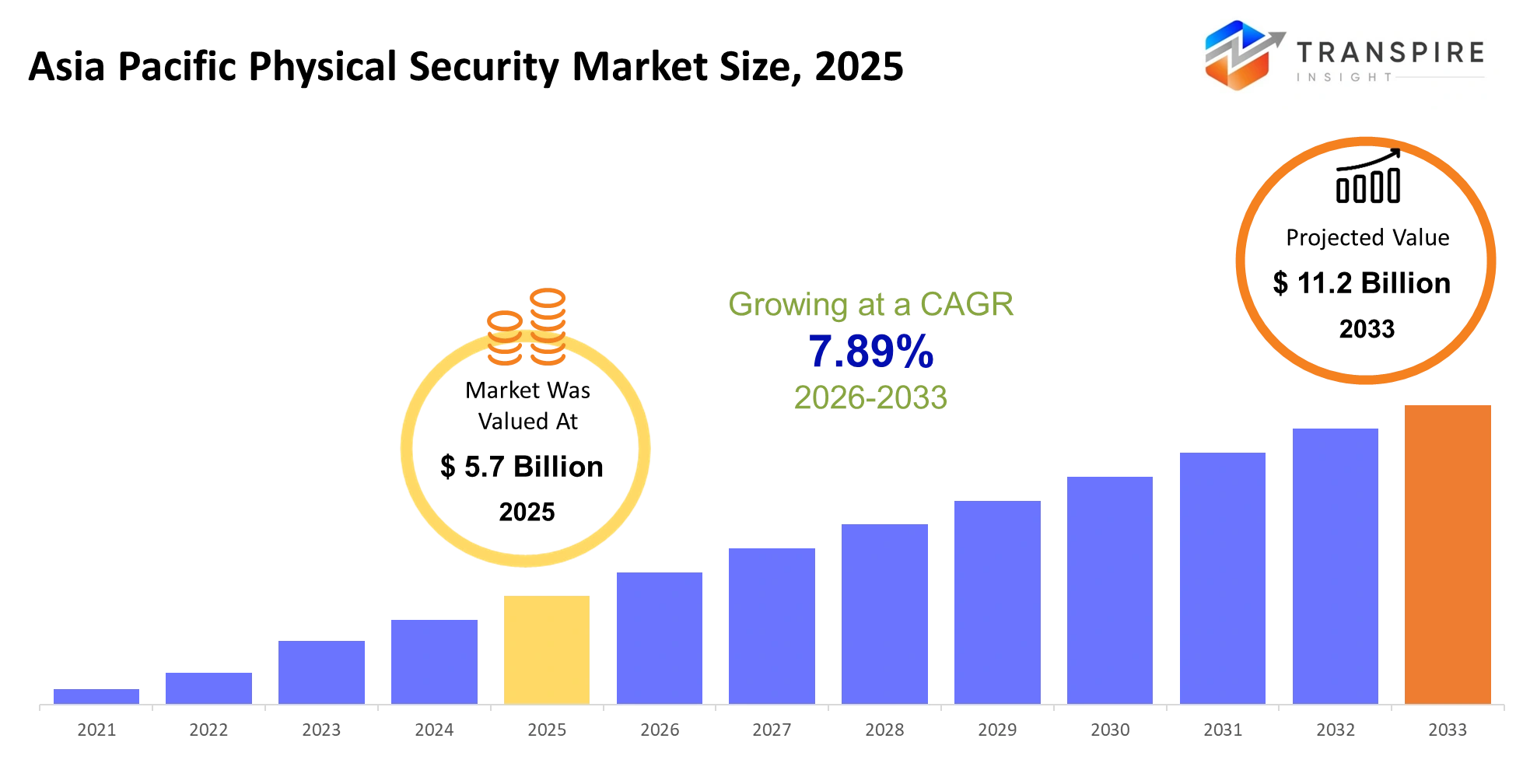
Asia Pacific Physical Security Market Size & Forecast:
- Asia Pacific Physical Security Market Size 2025: USD 5.7 Billion
- Asia Pacific Physical Security Market Size 2033: USD 11.2 Billion
- Asia Pacific Physical Security Market CAGR: 7.89%
- Asia Pacific Physical Security Market Segments: By Type (Access Control Systems, Video Surveillance, Intrusion Detection, Others); By Application (Commercial Buildings, Residential, Government, Industrial, Transportation, Others); By End-User (Enterprises, Government, Households, Industrial Sector, Retailers, Others); By Technology (Biometrics, RFID, AI-based Surveillance, Others).
To learn more about this report,  Download Free Sample Report
Asia Pacific Physical Security Market Summary
The Asia Pacific Physical Security Market was valued at USD 5.7 Billion in 2025. It is forecast to reach USD 11.2 Billion by 2033. That is a CAGR of 7.89% over the period.
The Asia Pacific physical security market protects all vital industrial and commercial operational assets which include manufacturing plants and logistics hubs and data centers and airports and critical infrastructure facilities. The solution enables organizations to safeguard their premises against unauthorized entry while it provides them with tools to identify operational threats and sustain their business operations during times when critical interruptions risk creating severe financial and operational impacts.
Security systems have evolved during the past three to five years from using separate surveillance equipment toward adopting complete security solutions which operate through software and incorporate AI video analysis and biometric authentication systems and centralized monitoring solutions. The transition accelerated after COVID-19 showed weaknesses in managing physical site access and remote security monitoring while increasing geopolitical conflicts and cyber-physical attacks against regional infrastructure forced governments and businesses to enforce stricter security measures. Organizations now allocate their finances toward infrastructure improvements which will create sustainable development benefits instead of spending their resources to comply with essential installation requirements. The organization generates ongoing income growth through its regional business activities which include providing managed services and system upgrades and security operations that use analytics-based approaches.
Key Market Insights
- The Asia Pacific Physical Security Market is moving away from hardware-based security implementations toward security systems which combine software solutions and cloud-based monitoring with predictive threat detection capabilities.
- Asian Pacific countries are increasing their security investments through smart infrastructure projects which primarily benefit the transportation and manufacturing sectors and the commercial real estate market.
- Between 2021 and 2025 organizations implemented AI-powered surveillance analytics which resulted in a 25% increase in adoption while delivering operational efficiency gains and decreasing expenses for manual monitoring.
- The Asia Pacific Physical Security Market will experience permanent growth because cities continue to expand and essential infrastructure systems undergo complete digital transformation.
- China controls the Asia Pacific Physical Security Market through its 2025 market share of approximately 38% which results from its extensive smart city development projects.
- The region of Southeast Asia displays new market demand because of transportation hub expansion and automated manufacturing system development.
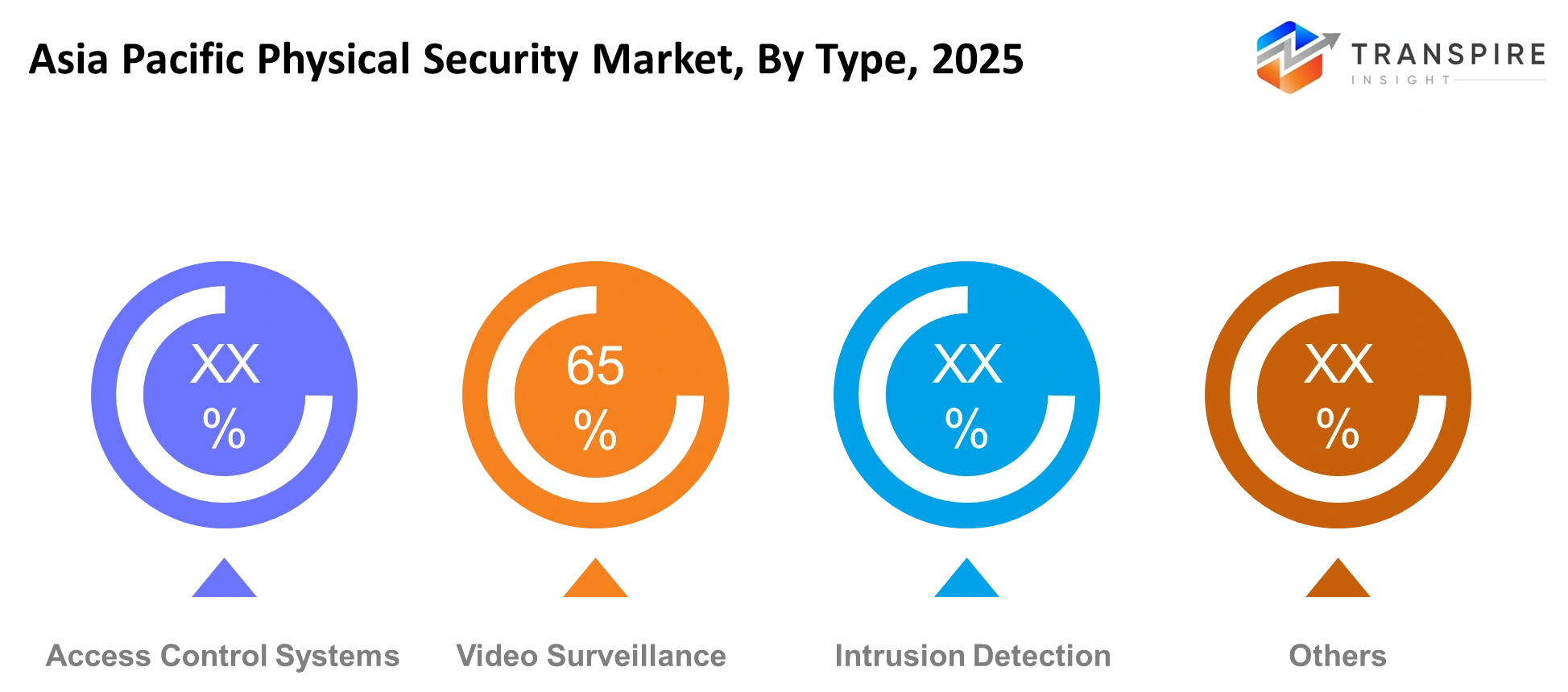
- The revenue share of video surveillance systems will reach 42% in 2025 because AI cameras have been installed throughout various locations.
- The market share of critical infrastructure protection solutions exceeds 35% because security compliance requirements have become more stringent.
- Airports, rail networks, and ports implement new monitoring technologies to protect their smart transportation security systems.
- More than 30% of the market share belongs to government and public sector organizations because they undertake extensive surveillance system upgrades.
What are the Key Drivers, Restraints, and Opportunities in the Asia Pacific Physical Security Market?
The main factor driving growth in the Asia Pacific Physical Security Market 2023 base exists because national infrastructure modernization programs now adopt AI-based surveillance and access control systems. The security breaches which affected transport and utilities operations forced governments to establish smart city programs that required stronger protection of vital infrastructure. The established regulations force both business organizations and government entities to upgrade outdated analog technologies with modern intelligent systems that provide continuous monitoring of security threats. The market now generates additional revenue because customers demand expensive software analytics and cloud monitoring services and extended security management contracts instead of purchasing hardware products.
The digital infrastructure needs across developing Asia Pacific markets create the main obstacle which prevents market development. The majority of industrial operations continue to use outdated networking systems which lack the capability to operate advanced IP-based security solutions. Organizations need to make large financial investments which require system outages and expert technical implementation for their networks to upgrade. The process of implementing improvements takes longer time periods because organizations need to wait for complete equipment upgrades which particularly affects mid-sized manufacturing companies and regional logistics businesses.
The growth of hyperscale data centers throughout India and Southeast Asia presents a major business opportunity. The operating companies need to implement biometric access control systems along with thermal surveillance technology and AI-based perimeter protection systems because global cloud service providers invest billions into their regional data center capacity. The construction of this infrastructure creates an important business opportunity for vendors who sell complete security solutions that use integrated software systems.
What Has the Impact of Artificial Intelligence Been on the Asia Pacific Physical Security Market?
The security monitoring and management systems for commercial buildings, industrial facilities, transportation terminals and critical infrastructure sites throughout the Asia Pacific region now operate under new procedures that artificial intelligence and advanced digital technologies have introduced. The implementation of AI-powered video analytics systems enables automatic threat detection through the technology's ability to detect unauthorized entry, detect abandoned objects, detect perimeter violations, and detect unusual movement patterns through real-time monitoring, which eliminates the requirement for ongoing manual observation. The integrated command platforms use real-time risk assessments to activate lockdown systems, contact emergency response personnel, and redirect security units, which results in 30 to 50 percent faster emergency response times for high-traffic operational areas.
Machine learning creates predictive capabilities for surveillance networks through its application within that domain. Security operators use these models to forecast equipment failure in cameras, biometric readers, and access control hardware by analyzing performance anomalies, network latency, and environmental stress indicators. The predictive maintenance system achieved a system uptime increase with maintenance cost savings of 20 percent through its implementation in extensive operational environments.
The advanced analytics technology enables operators to achieve better operational efficiency while maintaining regulatory compliance through staffing management and monitoring operation optimization. AI adoption in the region encounters a critical challenge because intelligent analytics cannot function with existing analog systems due to high costs and difficult technical requirements. The majority of industrial facilities lack the necessary digital systems and training data needed to implement AI-based detection systems, which causes their systems to underperform during actual operational conditions.
Key Market Trends
- Since 2022, more than 40% of new enterprise deployments have shifted from standalone CCTV systems to AI-enabled integrated surveillance platforms.
- The period from 2021 to 2025 saw governments in China, India, and Singapore implement stricter security regulations which required facilities to upgrade their outdated analog surveillance systems.
- Organizations now prefer subscription-based monitoring services because they find managed security contracts more effective than purchasing hardware through traditional one-time payment methods.
- Cloud-connected access control systems gained significant traction after 2021, which enabled high-density commercial facilities to achieve faster response times that reached 35% better performance.
- The expansion of hyperscale infrastructure in Southeast Asia and India led data center operators to choose biometric multi-layer authentication as their preferred method.
- Security buyers increasingly prioritize interoperability, which leads vendors like Honeywell International and Johnson Controls to create open-platform ecosystems.
- Regional manufacturers have reduced dependence on imported semiconductor components since 2022, which has transformed their supply chains after they experienced post-pandemic sourcing disruptions.
- Privacy regulations which emerged between 2023 and 2025 required suppliers to build facial recognition systems that included improved data governance mechanisms.
- Organizations now establish strategic alliances with telecom and cloud vendors to enable them to implement real-time analytics throughout their industrial and transportation networks.
Asia Pacific Physical Security Market Segmentation
By Type:
Commercial buildings account for a significant share as offices, shopping complexes, hospitality spaces, and mixed-use developments require layered protection systems. Security deployment in these settings will continue growing because of increasing foot traffic and asset protection needs. The demand for centralized monitoring systems leads to increased installation of these systems throughout commercial buildings.
The residential market for smart home security solutions is growing because their prices keep decreasing. Government facilities maintain strong demand because of national security priorities and public infrastructure protection. The industrial sector and transportation sector use physical security measures to secure their assets and logistics operations and passenger movement. The other category includes educational and healthcare institutions adopting stronger security frameworks for a safer operational environment.
To learn more about this report, Download Free Sample Report
By Application:
Commercial buildings account for a significant share as offices, shopping complexes, hospitality spaces, and mixed-use developments require layered protection systems. Security deployment in these settings will continue growing because of increasing foot traffic and asset protection needs. The demand for centralized monitoring systems leads to increased installation of these systems throughout commercial buildings.
The residential market for smart home security solutions is growing because their prices keep decreasing. Government facilities maintain strong demand because of national security priorities and public infrastructure protection. The industrial sector and transportation sector use physical security measures to secure their assets and logistics operations and passenger movement. The other category includes educational and healthcare institutions adopting stronger security frameworks for a safer operational environment.
By End-User:
The Asia Pacific Physical Security Market relies on access control systems because commercial and residential and industrial spaces need secure entry management solutions. The implementation of card readers and biometric scanners and mobile access systems will lead to increased system adoption. Major urban centers will maintain their investment growth because organizations demand better protection against unauthorized access.
Organizations use video surveillance systems because they need to monitor security in real time. The usage of intrusion detection systems has increased because alarm systems and sensor-based monitoring solutions enable better threat detection. Security systems, which include perimeter protection and integrated alarm technologies, are expected to increase in popularity because security infrastructure systems in the region develop further.
By Technology:
Commercial buildings account for a significant share as offices, shopping complexes, hospitality spaces, and mixed-use developments need security systems that provide multiple protective layers. Security deployment in these settings will continue to grow because of increasing foot traffic and asset protection needs. Commercial facilities require centralized monitoring systems which drive their demand for systems that track multiple locations.
The market for residential smart home security solutions keeps growing because these products have become more affordable. Government facilities maintain strong demand because of national security priorities and public infrastructure protection. The industrial and transportation sectors depend on physical security to safeguard their assets and logistics operations and passenger transportation activities. The other category includes educational and healthcare institutions that implement more secure security systems to create protected work environments.
What are the Key Use Cases Driving the Asia Pacific Physical Security Market?
The Asia Pacific physical security market experiences its largest growth through video surveillance implementation at critical infrastructure sites. The highest demand exists for airports and rail terminals and manufacturing facilities and utility substations because these locations need constant surveillance to stop operational disruptions and theft and unauthorized access while complying with ever-tightening government security standards.
Hyperscale data centers and advanced manufacturing sites require both access control systems and perimeter protection systems to meet their security needs. Data center operators use biometric authentication together with multi-layer entry systems to protect their most valuable digital assets, while pharmaceutical and semiconductor manufacturers strengthen their restricted-area monitoring system to safeguard intellectual property and maintain regulatory compliance.
Smart city infrastructure and autonomous logistics ecosystems are developing new applications. AI-powered crowd behavior analytics systems are used in large public spaces, while integrated security systems for automated warehouses and drone-monitored industrial campuses demonstrate strong potential for future growth as regional automation investments increase.
|
Report Metrics |
Details |
|
Market size value in 2025 |
USD 5.7 Billion |
|
Market size value in 2026 |
USD 6.58 Billion |
|
Revenue forecast in 2033 |
USD 11.2 Billion |
|
Growth rate |
CAGR of 7.89% from 2026 to 2033 |
|
Base year |
2025 |
|
Historical data |
2021 - 2024 |
|
Forecast period |
2026 - 2033 |
|
Report coverage |
Revenue forecast, competitive landscape, growth factors, and trends |
|
Regional scope |
Asia Pacific (China, India, Japan, South Korea, Australia, Rest of Asia Pacific) |
|
Key company profiled |
Hikvision, Dahua, Bosch, Honeywell, Johnson Controls, Axis Communications, Genetec, Pelco, Avigilon, Hanwha Vision, Panasonic, NEC, Cisco, Huawei, FLIR Systems. |
|
Customization scope |
Free report customization (country, regional & segment scope). Avail customized purchase options to meet your exact research needs. |
|
Report Segmentation |
By Type (Access Control Systems, Video Surveillance, Intrusion Detection, Others); By Application (Commercial Buildings, Residential, Government, Industrial, Transportation, Others); By End-User (Enterprises, Government, Households, Industrial Sector, Retailers, Others); By Technology (Biometrics, RFID, AI-based Surveillance, Others). |
Which Regions are Driving the Asia Pacific Physical Security Market Growth?
The Asia Pacific physical security market is mostly controlled by East Asia which China Japan and South Korea lead as its main powers. The region maintains its leadership position because of its strong smart city development, strict protection rules for critical infrastructure, and superior transportation and industrial systems. The governments operating in these markets have shown their dedication by funding intelligent surveillance systems and biometric access platforms and AI-driven public safety systems. The country maintains its market leadership position because of its established domestic manufacturing ecosystem which includes semiconductor production and systems integration and its existing regulatory systems that enable ongoing technological advancements.
Southeast Asia represents the second-largest regional contributor, but its market dynamics differ significantly from East Asia. Economic resilience and foreign direct investment stability together with logistics and tourism and commercial real estate sectors, create a foundation that supports technological growth in this region. Singapore and Malaysia and Thailand build enterprise-grade security systems through gradual regulatory expansion and funding from private companies. The vendors establish a reliable income stream by providing long-lasting infrastructure improvements which replace short-term government procurement methods.
India serves as the central point for South Asia's status as its fastest-growing region. The regional business landscape underwent transformation during the past three years because of two major developments which included public infrastructure projects and data center construction and urban security system deployment. The implementation of new digital governance initiatives together with rising investment in transport corridor security has resulted in the increased use of integrated monitoring systems by both public organizations and private entities. Software-based solutions and managed security service providers will gain significant business opportunities from 2026 until 2033 because they will make their first attempts to acquire major customers.
Who are the Key Players in the Asia Pacific Physical Security Market and How Do They Compete?
The Asia Pacific physical security market undergoes moderate consolidation because international technology firms compete against established domestic manufacturers and specialized system integration companies.The competitive landscape has evolved from hardware price competition to platform intelligence and software interoperability and long-term managed service capabilities. Established vendors maintain their market position by including AI analytics and cloud connectivity and cybersecurity features in their products while new companies focus on providing flexible subscription-based deployment models to serve mid-market clients who currently lack proper service. Critical infrastructure and hyperscale commercial operations now require organizations to focus on technology depth and regional integration expertise instead of relying on cost as their primary assessment factor.
Hikvision uses its ability to implement large-scale AI video analytics systems and its complete control of production processes to establish competitive prices and accelerate product development for its entire enterprise surveillance system. The company plans to grow by creating stronger software partnerships that extend to Southeast Asian public infrastructure projects which require customized local solutions. Dahua Technology uses edge-based intelligent processing to create a unique solution that enables immediate threat detection in industrial sites and transport hubs which need fast response times.
Honeywell International creates its competitive advantage through its building management systems which enable customers to combine security functions with their operational control systems. Johnson Controls achieves business expansion through its service-based lifetime contracts which provide continuous revenue streams for its customers. Axis Communications secures market growth through its open-platform design and channel partnership strategies which enable businesses to achieve interoperability in environments that use products from multiple vendors while minimizing their future switching expenses.
Company List
- Hikvision
- Dahua
- Bosch
- Honeywell
- Johnson Controls
- Axis Communications
- Genetec
- Pelco
- Avigilon
- Hanwha Vision
- Panasonic
- NEC
- Cisco
- Huawei
- FLIR Systems
Recent Development News
In April 2026, AirTrunk announced the acquisition of India’s Lumina CloudInfra, a major hyperscale data centre developer with a large planned capacity pipeline across India. The deal strengthens AirTrunk’s regional footprint and expands its secured digital infrastructure capacity across Asia Pacific, reinforcing demand for integrated physical security systems in hyperscale facilities.
Source: https://www.moneycontrol.com/
In April 2026, Gorilla Technology Group increased its strategic investment in Astrikos.AI, a Bengaluru-based infrastructure intelligence company specializing in AI-driven security and IoT systems. The move deepens collaboration across India, the US, and UAE, enhancing deployment of AI-enabled security intelligence systems relevant to physical security monitoring and infrastructure protection.
Source: https://www.nasdaq.com/
What Strategic Insights Define the Future of the Asia Pacific Physical Security Market?
The Asia Pacific physical security market will evolve during the next five to seven years into autonomous security systems which use software-based security systems that operate with artificial intelligence analytics and cloud-based system control and real-time emergency management as basic operational functions. The essential infrastructure digitization process meets enterprise requirements for unified monitoring systems that connect different security methods with operational intelligence. The company will generate increasing revenue through its software subscription services and managed security offerings instead of relying on hardware replacement business.
Regulatory fragmentation across data privacy and facial recognition governance creates a less evident risk. The different compliance requirements between major regional markets will create challenges for vendors who depend on standardization to operate their cross-border business while increasing their operational costs. The total value of edge-AI security systems is currently developing in India and Southeast Asia because new data center pathways and industrial automation systems create a requirement for advanced monitoring systems which operate with minimal delays.
Market participants should prioritize open-architecture platforms with localized compliance adaptability. The vendors and investors who create systems with interoperability today will gain an advantage in winning enterprise contracts because regional buyers are moving away from closed hardware-based systems.
Asia Pacific Physical Security Market Report Segmentation
By Type
- Access Control Systems
- Video Surveillance
- Intrusion Detection
By Application
- Commercial Buildings
- Residential
- Government
- Industrial
- Transportation
By End-User
- Enterprises
- Government
- Households
- Industrial Sector
- Retailers
By Technology
- Biometrics
- RFID
- AI-based Surveillance
Frequently Asked Questions
Find quick answers to common questions.
The Asia Pacific Physical Security Market size is USD 11.2 Billion in 2033.
Key segments for the Asia Pacific Physical Security Market are By Type (Access Control Systems, Video Surveillance, Intrusion Detection, Others); By Application (Commercial Buildings, Residential, Government, Industrial, Transportation, Others); By End-User (Enterprises, Government, Households, Industrial Sector, Retailers, Others); By Technology (Biometrics, RFID, AI-based Surveillance, Others).
Major Asia Pacific Physical Security Market players are Hikvision, Dahua, Bosch, Honeywell, Johnson Controls, Axis Communications, Genetec, Pelco, Avigilon, Hanwha Vision, Panasonic, NEC, Cisco, Huawei, FLIR Systems.
The Asia Pacific Physical Security Market size is USD 5.7 Billion in 2025.
The Asia Pacific Physical Security Market CAGR is 7.89% from 2026 to 2033.
- Hikvision
- Dahua
- Bosch
- Honeywell
- Johnson Controls
- Axis Communications
- Genetec
- Pelco
- Avigilon
- Hanwha Vision
- Panasonic
- NEC
- Cisco
- Huawei
- FLIR Systems
Recently Published Reports
-
Apr 2026
3D Optical Profiler Market
3D Optical Profiler Market Size, Share & Analysis Report By Type (Desktop 3D Optical Profiler, and Portable 3D Optical Profiler), By Technology (Confocal Technology, and White Light Interference), By End-Use Industry (Manufacturing, Research Institutions, Automotive, Aerospace and Defense, Medical Devices, and Other), and Geography (North America, Europe, Asia-Pacific, Middle East and Africa, South and Central America), 2021 - 2031
-
Apr 2026
Depth Sensor Market
Depth Sensor Market Size, Share & Analysis Report By Type (Infrared Depth Sensors, Time-of-Flight (ToF) Sensors, Stereo Vision Sensors, Structured Light Sensors, Ultrasonic Depth Sensors), By Application (Automotive, Robotics, Gaming, Consumer Electronics, Industrial Automation, Healthcare, Security & Surveillance, Others), By End Users (Automotive Manufacturers, Consumer Electronics Companies, Healthcare Providers, Industrial Companies, Security Agencies, Gaming Companies, Robotics Companies, Others), and Geography (North America, Europe, Asia-Pacific, Middle East and Africa, South and Central America), 2021 – 2031
-
Apr 2026
Digital Manufacturing Market
Digital Manufacturing Market Size, Share & Analysis Report By Component (Hardware, Software, and Services), By Technology (Robotics, 3D Printing, Internet of Things (IoT), and Others), By Application (Automotive and Transportation, Aerospace and Defense, Consumer Electronics, Industrial Machinery, and Others), By Process Type (Computer-Based Designing, Computer-Based Simulation, Computer 3D Visualization, Analytics, and Others), and Geography (North America, Europe, Asia-Pacific, Middle East and Africa, South and Central America), 2021 – 2031
-
Apr 2026
Digital Visa Services Market
Digital Visa Services Market Size, Share & Analysis Report By Type (Individual Travelers, Group Travelers), By Application (Tourism, Business Travel, Others), and Geography (North America, Europe, Asia-Pacific, Middle East and Africa, South and Central America), 2021 – 2031