
Asia Pacific RTD Beverages Market Size & Forecast:
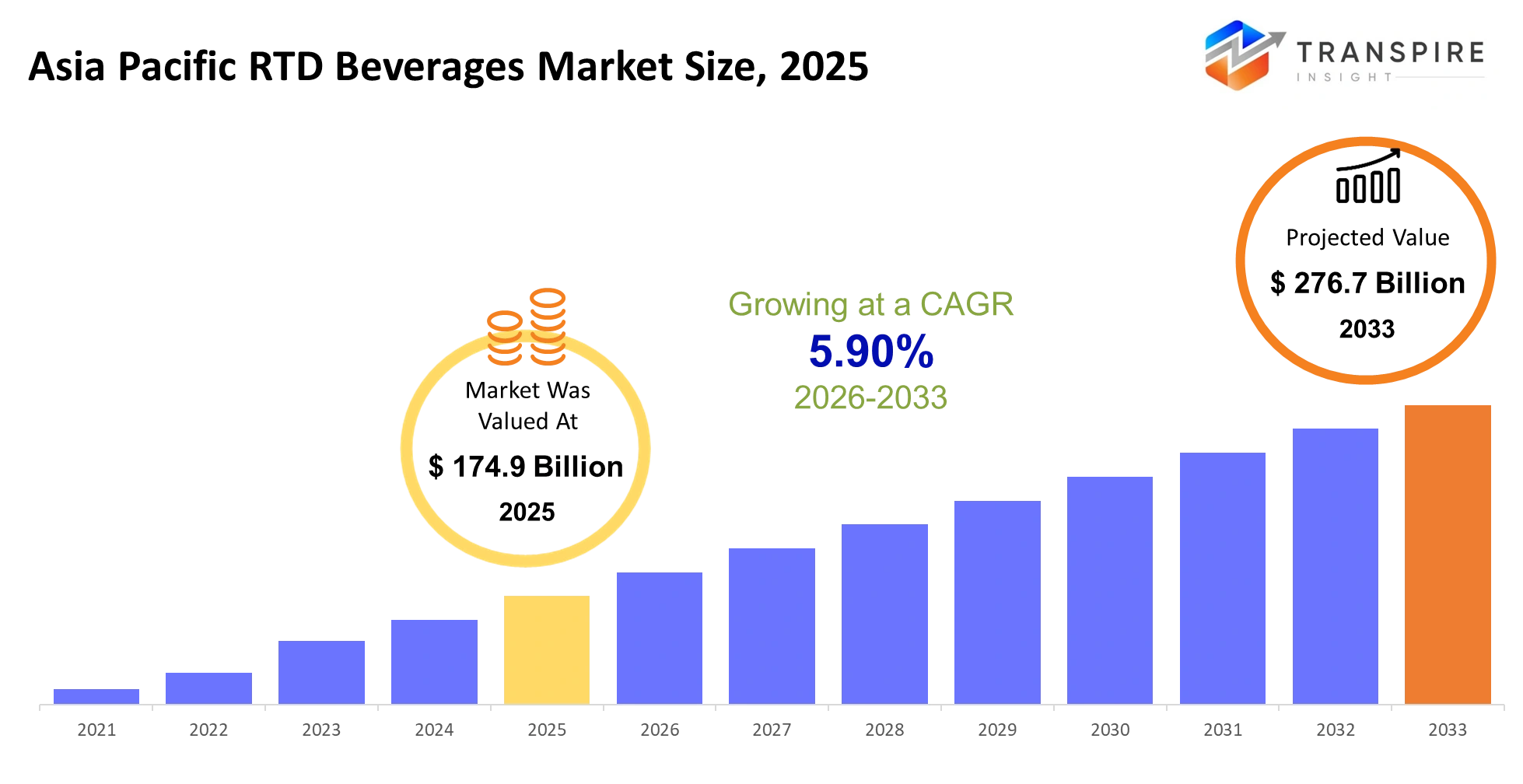
- Asia Pacific RTD Beverages Market Size 2025: USD 174.9 Billion
- Asia Pacific RTD Beverages Market Size 2033: USD 276.7 Billion
- Asia Pacific RTD Beverages Market CAGR: 5.90%
- Asia Pacific RTD Beverages Market Segments: By Type (Tea-based RTD, Coffee-based RTD, Energy Drinks, Functional Drinks, Others); By Application (Refreshment, Energy Boost, Health & Wellness, Sports Nutrition, Others); By End-User (Consumers, Fitness Enthusiasts, Working Professionals, Athletes, Youth Population, Others); By Distribution (Supermarkets, Convenience Stores, Online, Specialty Stores, Others).
To learn more about this report,  Download Free Sample Report
Asia Pacific RTD Beverages Market Summary
The Asia Pacific RTD Beverages Market was valued at USD 174.9 Billion in 2025. It is forecast to reach USD 276.7 Billion by 2033. That is a CAGR of 5.90% over the period.
The Asia Pacific RTD beverages market provides essential support to contemporary foodservice and retail operations through its delivery of easily transportable beverages that remain fresh for extended periods and match the requirements of customers who need quick access to their products. The company supplies its products to various distribution points which include supermarkets and convenience stores and vending networks and e-commerce platforms through its development of items that need short preparation time and match the needs of customers who want to consume products while they travel.
The market experienced its first major transformation during the last five years when customers started preferring functional drinks and premium teas and protein drinks and low-calorie products instead of sugar-based carbonated beverages which existed in the market. The pandemic served as the primary catalyst which drove people to consume more food and beverages at home while creating a need for brands to improve their online retail presence and direct sales operations. The new way of making purchases became a permanent change. Producers are increasing their premium product lines because urban lifestyles demand quick access to healthy food, which results in higher product prices and better revenue gains for both developed and developing Asian markets.
Key Market Insights
- Asia Pacific RTD Beverages Market is led by East Asia which contributes more than 41% market share in 2025, comprising countries like China, Japan, and South Korea.
- The fastest growing regional market segment will be Southeast Asia, owing to the growth in urbanization, along with increasing presence of modern retail stores till 2031.
- In 2025, India witnessed more than 12% category expansion on a year-on-year basis, owing to ready-to-drink tea, coffee and functional beverages segments.
- Ready-to-drink tea commands a leading market share of approximately 29%, owing to high consumer preference in Japan and China.
- RTD coffee is the second highest contributing segment, due to premium quality café-style launches, along with ease of consumption.
- Functional RTD beverages will be the fastest-growing market, with strong growth expected up to 2031 as health-conscious formulations become popular.
- The retail and convenience stores channel dominates the market, accounting for almost 46% of the Asia Pacific RTD Beverages Market in 2025.
- The most rapidly expanding application category in e-commerce will be beverage services which receive support from subscription-based systems and products designed for digital distribution.
- The primary consumer group will consist of urban working professionals who will account for over 38% of total demand because their hectic schedules require them to buy products that provide easy access.
- Generation Z will become the fastest expanding consumer segment which prefers ready-to-drink beverages that contain no calories and deliver health benefits and plant-based ingredients.
What are the Key Drivers, Restraints, and Opportunities in the Asia Pacific RTD Beverages Market?
The Asia Pacific RTD beverages market experiences its main growth driver through the product reformulation process which enterprises use to meet health standards that result from new sugar labeling regulations and sugar tax regulations established by countries like Thailand and Malaysia and certain areas in Australia. As a result, beverage companies have been forced to focus on producing low-sugar drinks, as well as functional and fortified ready-to-drink beverages. Additionally, technological advancements in the field of natural sweeteners and the ability to stabilize flavors allow for more affordable reformulated beverages, thus increasing revenue streams by enhancing the number of premium launches, shelf presence at modern retailers, and price levels.
The primary constraint affecting the Asia Pacific RTD beverages market is the poorly developed cold chain and logistics network in emerging Asian economies, which affects beverage delivery to secondary and rural markets. While cities have a highly developed logistics system that allows for effective distribution of beverages, secondary cities and rural areas experience issues with refrigeration, high costs of transportation, and restricted storage capacity in the retail sector. This issue cannot be addressed quickly, as substantial investments in logistics and retailing are required.
The functional hydrating beverages segment appears to have the most obvious potential for the next phase of growth, especially in India and Southeast Asia. Increased investment is being made into electrolyte-infused beverages, plant-based protein drinks, and adaptogenic beverages.
What Has the Impact of Artificial Intelligence Been on the Asia Pacific RTD Beverages Market?
Beverage manufacturing and distribution within the Asia Pacific have also been impacted by artificial intelligence and advanced digital technology due to its ability to help firms optimize their operations on a more precise basis. Beverage producers have started to use AI to manage their productions. Such systems are currently being implemented in large-scale bottle plants and have the ability to optimize quality control, improve the precision of filling, and tune up the process. Using computer vision systems makes it possible to detect product defects and package seal inconsistency at an extremely high line speed. Smart inventories which are capable of using retail sell-through data for ordering are already in use by some regional beverage companies.
Predictive maintenance systems using machine learning have also become commonplace in processing and packaging lines. These systems analyze vibration, temperature changes, and other factors to identify machine wear conditions. The use of such systems helps prevent equipment failures and improves production uptime. Predictive maintenance allows optimizing maintenance costs since it only requires maintenance when necessary. Additionally, AI systems are used to optimize beverage manufacturing and help to reduce overproduction costs.
This technology also aids in the optimization of routes in distribution networks, leading to increased efficiency and reduced logistics expenses. Nevertheless, there is a critical barrier that limits its widespread use, which includes making heavy financial investments to incorporate AI into existing manufacturing plants and having ample amounts of quality data.
Key Market Trends
- Since 2021, the implementation of sugar tax policies in Thailand and Malaysia has forced firms to innovate with low-sugar beverage launches growing by almost 30%.
- From 2022 to 2025, firms like Suntory Holdings and Kirin Holdings have increased their R&D spending on functional hydration drinks as well as drinks with botanical ingredients.
- Beverage e-commerce has seen double-digit growth since 2020, resulting in a need for changes in beverage packaging to accommodate e-commerce logistics requirements.
- Premium ready-to-drink coffee beverages have become more common in supermarkets since 2021 due to convenience and similarity to café style beverages.
- Regional beverage manufacturing firms have started localizing raw material sourcing since 2022 due to supply chain disruptions to cut back on lead time.
- The use of AI for demand forecasting has become common among beverage firms since 2023 to help with stock management in retail outlets.
- Plant-based protein beverages were launched after 2022 following a decline in the consumption of carbonated beverages.
- Pricing is no longer the key source of competition after 2024, with firms such as Nestlé relying on functionality and recyclable packaging.
- Convenience retailing’s development in India since 2021 has affected distribution strategies, leading foreign companies to invest more in secondary-city cold chains.
Asia Pacific RTD Beverages Market Segmentation
By Type :
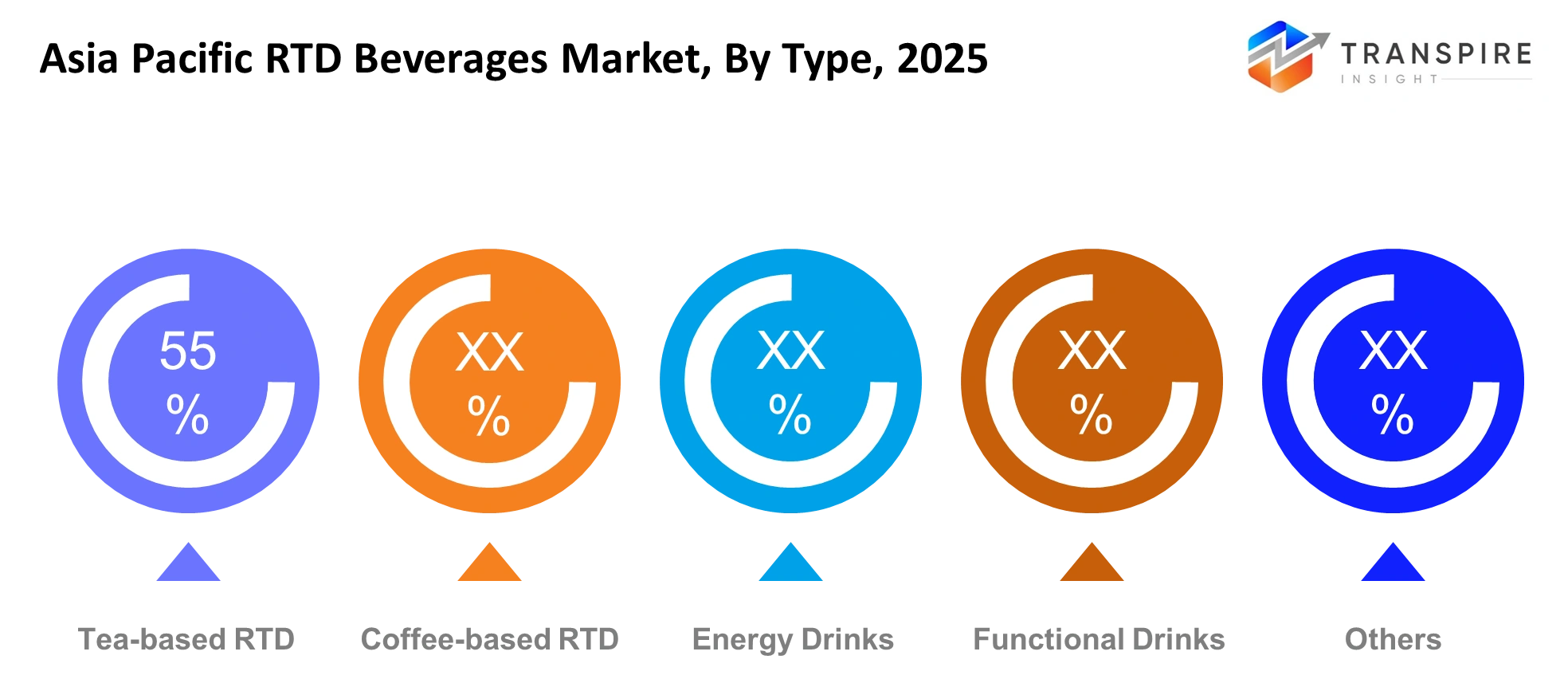
The Asia Pacific RTD Beverages Market displays a diverse range of products which different consumer preferences and lifestyle requirements. Tea-based RTD products maintain a significant market share because tea consumption holds deep-rooted cultural significance in countries such as China, Japan, India and South Korea. Consumers prefer bottled green tea and black tea and fruit-infused tea because these drinks provide familiar taste and easy access. The beverages provide refreshing taste which satisfies local drinking customs, making tea-based drinks popular among people of all ages. The category will experience increased demand because of ongoing flavor development and upcoming healthier products which contain reduced sugar content.
The popularity of coffee-based RTD beverages increases throughout urban areas as more people seek quick and convenient ways to get their caffeine. Ready-to-drink coffee serves as the preferred choice for working individuals who need immediate energy during their travel and office time. Energy drinks and functional drinks experience substantial market growth because people become more health-conscious while demanding products that boost their performance capabilities. Buyers who want extra wellness benefits are drawn to functional beverages that contain vitamins and minerals and natural components. The Asia Pacific RTD Beverages Market enables brands to develop new products through milk-based flavored drinks and herbal beverages which customers now prefer.
To learn more about this report, Download Free Sample Report
By Application :
The Asia Pacific RTD Beverages Market maintains its highest market share through the refreshment application segment because most customers use these beverages to hydrate themselves while enjoying their flavor. Chilled packaged drinks experience high demand across Asia Pacific countries because customers require beverages that deliver instant cooling and convenient access during hot weather. The product category which includes fruit-based teas and sparkling beverages and flavored drinks has become a popular choice among customers who purchase their products through retail stores and vending machines.
The demand for energy boost products keeps increasing because people now work different hours and study longer and they choose drinks which deliver instant energy. The beverage market in this category consists mainly of coffee-based drinks and energy beverages. The clean-label trends which control customer purchasing behavior lead to continuous development of health and wellness products. Products which contain antioxidants and probiotics and vitamins and herbal extracts appeal to customers who want to acquire healthy benefits. Urban residents who adopt fitness-oriented routines drive the growth of sports nutrition products. Beverage manufacturers in the Asia Pacific RTD Beverages Market develop new products which help customers to relax and support their immune system and match their specific daily routines.
By End-User :
The Asia Pacific RTD Beverages Market shows its largest user base through general consumers who can access products with multiple flavor options. The beverage market maintains constant demand because consumers buy packaged drinks during their regular shopping activities. People choose ready-to-drink products because they provide easy-to-carry items that enable quick drinking during trips and at home and while socializing. Market expansion across developed nations and emerging markets depends on this extensive consumer base.
Working professionals form an important segment because their busy schedules lead them to depend on convenient beverages which help them maintain their energy levels and stay refreshed. Fitness enthusiasts and athletes drive demand for functional and performance-oriented drinks which help them maintain their hydration levels and their recovery needs and their endurance requirements. The youth population also contributes significantly through strong preference for trendy flavors and premium packaging and products which they discover through digital campaigns. Niche end-users drive product innovation because beverage manufacturers develop specialized products that meet changing consumption patterns in the Asia Pacific RTD Beverages Market.
By Distribution :
Supermarkets function as the main distribution method for the Asia Pacific RTD Beverages Market because their large retail spaces enable consumers to see many products while comparing different brands and flavors and prices. The channel experiences increased sales because customers take advantage of bulk purchasing and special promotional deals. Customers who travel through urban areas rely on convenience stores because these stores provide them with instant access to products they need for their day-to-day needs.The region experiences rapid online distribution growth because digital shopping habits become more popular.
E-commerce platforms provide customers with convenient product access through subscription models which include premium and imported beverages that physical stores may not stock. Specialty stores provide niche markets with health-focused organic and premium RTD beverages which they sell to specific customer groups. The distribution channels achieve product reach through their distribution balance which enables the Asia Pacific RTD Beverages Market to expand.
What are the Key Use Cases Driving the Asia Pacific RTD Beverages Market?
The fundamental use case that fuels market demand for RTD beverages in the Asia Pacific is consumption on-the-go via convenient outlets such as convenience stores, supermarkets, and transit retail locations. The greatest demand will be for ready-to-drink tea and coffee, since they align well with hectic urban lifestyles and do not require preparation, making them ideal products for repeat purchase.
There are some promising new use cases in the workplace wellness space and fitness-related retail channels. Hydration and protein beverages continue to grow in popularity among corporate employees, people who frequent gyms, and health-conscious young consumers via vending machines, retail chain stores, and grocery delivery apps.
New emerging use cases include personal nutrition beverages and digital-enabled subscription-based functional beverage services. Companies have also started to explore adaptogenic beverages as well as wellness-based functional drinks aimed at stress reduction and brain function improvement, especially in Japan and South Korea.
|
Report Metrics |
Details |
|
Market size value in 2025 |
USD 174.9 Billion |
|
Market size value in 2026 |
USD 185.2 Billion |
|
Revenue forecast in 2033 |
USD 276.7 Billion |
|
Growth rate |
CAGR of 5.90% from 2026 to 2033 |
|
Base year |
2025 |
|
Historical data |
2021 - 2024 |
|
Forecast period |
2026 - 2033 |
|
Report coverage |
Revenue forecast, competitive landscape, growth factors, and trends |
|
Regional scope |
Asia Pacific (China, India, Japan, South Korea, Australia, Rest of Asia Pacific) |
|
Key company profiled |
Coca-Cola, PepsiCo, Nestlé, Red Bull, Monster Beverage, Suntory, Danone, Unilever, Tata Consumer, Asahi, Kirin, Nongfu Spring, Tingyi, Otsuka, Yakult. |
|
Customization scope |
Free report customization (country, regional & segment scope). Avail customized purchase options to meet your exact research needs. |
|
Report Segmentation |
By Type (Tea-based RTD, Coffee-based RTD, Energy Drinks, Functional Drinks, Others); By Application (Refreshment, Energy Boost, Health & Wellness, Sports Nutrition, Others); By End-User (Consumers, Fitness Enthusiasts, Working Professionals, Athletes, Youth Population, Others); By Distribution (Supermarkets, Convenience Stores, Online, Specialty Stores, Others). |
Which Regions are Driving the Asia Pacific RTD Beverages Market Growth?
The leading regions in the APAC market for ready to drink beverages are the East Asia countries like China, Japan, and South Korea. The key drivers behind such dominance lie in the developed retail sector, efficient manufacturing sector, and the consumer awareness regarding the beverages and their packaging formats. The existing convenient beverages culture in Japan, along with the large-scale production capacity of China, offer unparalleled volume potential and innovative offerings in this space. All these drivers are complemented with advanced cold chain logistic networks and a significant number of convenience stores.
The next most important region in terms of size and importance is Oceania, with its market dynamics distinct from that of East Asia because of the focus on premiumization rather than scale growth. These two countries have established consumption behaviors supported by efficient retail distribution systems and consistent regulation in regard to food labeling, resulting in regular product updates within the portfolio. Consumers here prefer beverages with low sugar content, organic ingredients, and clear labeling, driving average selling prices up in this market.
South and Southeast Asia constitute the region showing the fastest growth owing to the high rate of urbanization, digitized groceries, and changing trends of beverage consumption. The investments made into building retail infrastructure, cold chain, and regional production plants have increased product availability in India, Indonesia, Vietnam, and Thailand. Since 2022, the rise in app-based deliveries has helped penetrate the markets beyond large metro areas. Thus, between 2026 and 2033, there will be ample opportunities for new entrants and investments to gain the first mover’s advantage through product customization and logistics.
Who are the Key Players in the Asia Pacific RTD Beverages Market and How Do They Compete?
The competition within the Asia Pacific RTD beverages market is moderately concentrated at the top level, where multinational beverage corporations hold huge market shares because of their wide distribution networks, whereas regional companies are disrupting particular beverage categories using innovative approaches. Pricing strategy has become less relevant in the competition among manufacturers compared to innovations in the area of formulation and speed to market in both functional and premium beverages. Competitors are increasingly competing by introducing healthier beverage options and leveraging digital retail platforms. Simultaneously, the new competitors entering the market are attracting the attention of consumers due to their unique propositions, such as plant-based nutrition, botanical health products, and regional flavors.
Suntory Holdings benefits from its high knowledge about ready-to-drink teas and coffees due to its effective development strategies for those beverages based on the experience gained in the matured East Asian markets of convenience. The company has been successfully implementing an innovative approach to flavor development, packaging design, and regional consumer insight analysis, which allows it to compete effectively with other market participants.
Competitive advantage for Nestlé stems from its strategy of leveraging nutrition science in order to attract premium buyers through fortified products and health-based beverages. Growth strategy for PepsiCo involves making bold investments in hydration products as well as running digital-first marketing campaigns. Kirin Holdings is expanding via fermentation innovation and wellness partnerships in specialty beverages.
Company List
- Coca-Cola
- PepsiCo
- Nestlé
- Red Bull
- Monster Beverage
- Suntory
- Danone
- Unilever
- Tata Consumer
- Asahi
- Kirin
- Nongfu Spring
- Tingyi
- Otsuka
- Yakult
Recent Development News
In March 2026, Asahi Group Holdings launched Asahi CLEAR HIGHBALL. The ready-to-drink product launch expanded Asahi’s premium canned cocktail portfolio across Asia-Pacific and reinforced its strategy to scale Japanese-origin RTD brands globally as demand for convenient premium alcohol beverages accelerates.
Source: https://www.asahigroup-holdings.com/
In February 2026, Suntory Beverage & Food launched new beverages in its ‘drinkable supplement’ series. The April retail rollout of these nutrient-fortified RTD beverages in Japan strengthened functional beverage innovation in Asia Pacific and responded to rising consumer demand for health-positioned convenience drinks.
Source: https://japantoday.com/
What Strategic Insights Define the Future of the Asia Pacific RTD Beverages Market?
Over the coming five to seven years, APAC RTD beverages' structural shift is expected towards highly personalized consumption driven by the digital intelligence of retailing and localized manufacturing. What drives this evolution is the trend towards stricter nutritional standards and consumer demand for products that deliver a certain level of convenience along with health-related benefits – driven by data science and analysis. The growth will shift from conventional categories of ready-to-drink beverages and towards premium functional products.
There is an additional risk in relation to raw materials, specifically those that have a more specialized nature, such as plant-based proteins, adaptogens, and natural sweeteners. The supply chain or prices may disrupt the production cycle and affect margins and innovations. On the other hand, AI-driven personalization of beverages within APAC markets including Japan, South Korea, and urbanized India will present a valuable emerging trend as well.
It is important for all market players to consider regional partnerships and capacity to produce small batches of products. Companies should focus on building flexible manufacturing solutions alongside developing advanced predictive consumer analysis tools.
Asia Pacific RTD Beverages Market Report Segmentation
By Type
- Tea-based RTD
- Coffee-based RTD
- Energy Drinks
- Functional Drinks
By Application
- Refreshment
- Energy Boost
- Health & Wellness
- Sports Nutrition
By End-User
- Consumers
- Fitness Enthusiasts
- Working Professionals
- Athletes
- Youth Population
By Distribution
- Supermarkets
- Convenience Stores
- Online
- Specialty Stores
Frequently Asked Questions
Find quick answers to common questions.
The Asia Pacific RTD Beverages Market size is USD 276.7 Billion in 2033.
Key segments for the Asia Pacific RTD Beverages Market are By Type (Tea-based RTD, Coffee-based RTD, Energy Drinks, Functional Drinks, Others); By Application (Refreshment, Energy Boost, Health & Wellness, Sports Nutrition, Others); By End-User (Consumers, Fitness Enthusiasts, Working Professionals, Athletes, Youth Population, Others); By Distribution (Supermarkets, Convenience Stores, Online, Specialty Stores, Others).
Major Asia Pacific RTD Beverages Market players are Coca-Cola, PepsiCo, Nestlé, Red Bull, Monster Beverage, Suntory, Danone, Unilever, Tata Consumer, Asahi, Kirin, Nongfu Spring, Tingyi, Otsuka, Yakult.
The Asia Pacific RTD Beverages Market size is USD 174.9 Billion in 2025.
The Asia Pacific RTD Beverages Market CAGR is 5.90% from 2026 to 2033.
- Coca-Cola
- PepsiCo
- Nestlé
- Red Bull
- Monster Beverage
- Suntory
- Danone
- Unilever
- Tata Consumer
- Asahi
- Kirin
- Nongfu Spring
- Tingyi
- Otsuka
- Yakult
Recently Published Reports
-
Apr 2026
Baby Infant Formula Market
Baby Infant Formula Market Size, Share & Analysis Report By ype (Infant Milk, Follow On Milk, Specialty Baby Milk, Growing-Up Milk), By Ingredient (Carbohydrate, Fat, Protein, Minerals, Vitamins, and Others), By Product Form (Powder, Liquid, and Ready-to-feed), By Distribution Channels (Supermarket/Hypermarket, Specialty Store, Pharmacies, Online Retail, and Others), and Geography (North America, Europe, Asia-Pacific, Middle East and Africa, South and Central America), 2021 - 2031
-
Apr 2026
Edible Insects for Animal Feed Market
Edible Insects for Animal Feed Market Size, Share & Analysis Report By Type (Insect Powder, Insect Meal, Insect Bar, Insect Paste, Insect Oil, and Others), By Insect Type (Beetles, Cricket, Caterpillar, Hymenoptera, Orthoptera, Tree Bugs, and Others), By Application (Livestock, Pet Food, and Aquaculture), By Livestock Type (Poultry, Swine, and Others), and Geography (North America, Europe, Asia-Pacific, Middle East and Africa, South and Central America), 2021 - 2031
-
Apr 2026
Food Industry Disinfection and Bacterial Control Market
Food Industry Disinfection and Bacterial Control Market Size, Share & Analysis Report By Type (Chemical Disinfectants, Physical Disinfectants, and Biocides and Antimicrobials), By Application (Food Processing Equipment Surface Disinfection, Food Preparation Areas Surface Disinfection, Storage Areas Surface Disinfection, Anti-microbial Coatings Food Preservation, and Preservative Solutions Food Preservation), By End User (Meat and Poultry Processing, Dairy Processing, Seafood Processing, Bakery and Confectionery, Restaurants and Commercial Kitchens, and Food Service Providers), By Sales Channel (Online, Offline), and Geography (North America, Europe, Asia-Pacific, Middle East and Africa, South and Central America), 2021 - 2031
-
Apr 2026
Freeze Dried Food Market
Freeze Dried Food Market Size, Share & Analysis Report By Product Type (Fruits, Vegetables, Freeze-Dried Dairy Products, Freeze-Dried Meat and Seafood, Freeze-Dried Pet Food, and Prepared Meal), By Nature (Organic, and Conventional), By Form (Powdered, Granules, and Diced), By End Use (Breakfast Cereals, Dairy Products, Bakery & Confectionery, Nutritional Bars & Supplements, Powdered Beverages, Snacks, and Retail (Household)), and Geography (North America, Europe, Asia-Pacific, Middle East and Africa, South and Central America), 2021 - 2031