

Europe Thermal Jumpers Market Size & Forecast:
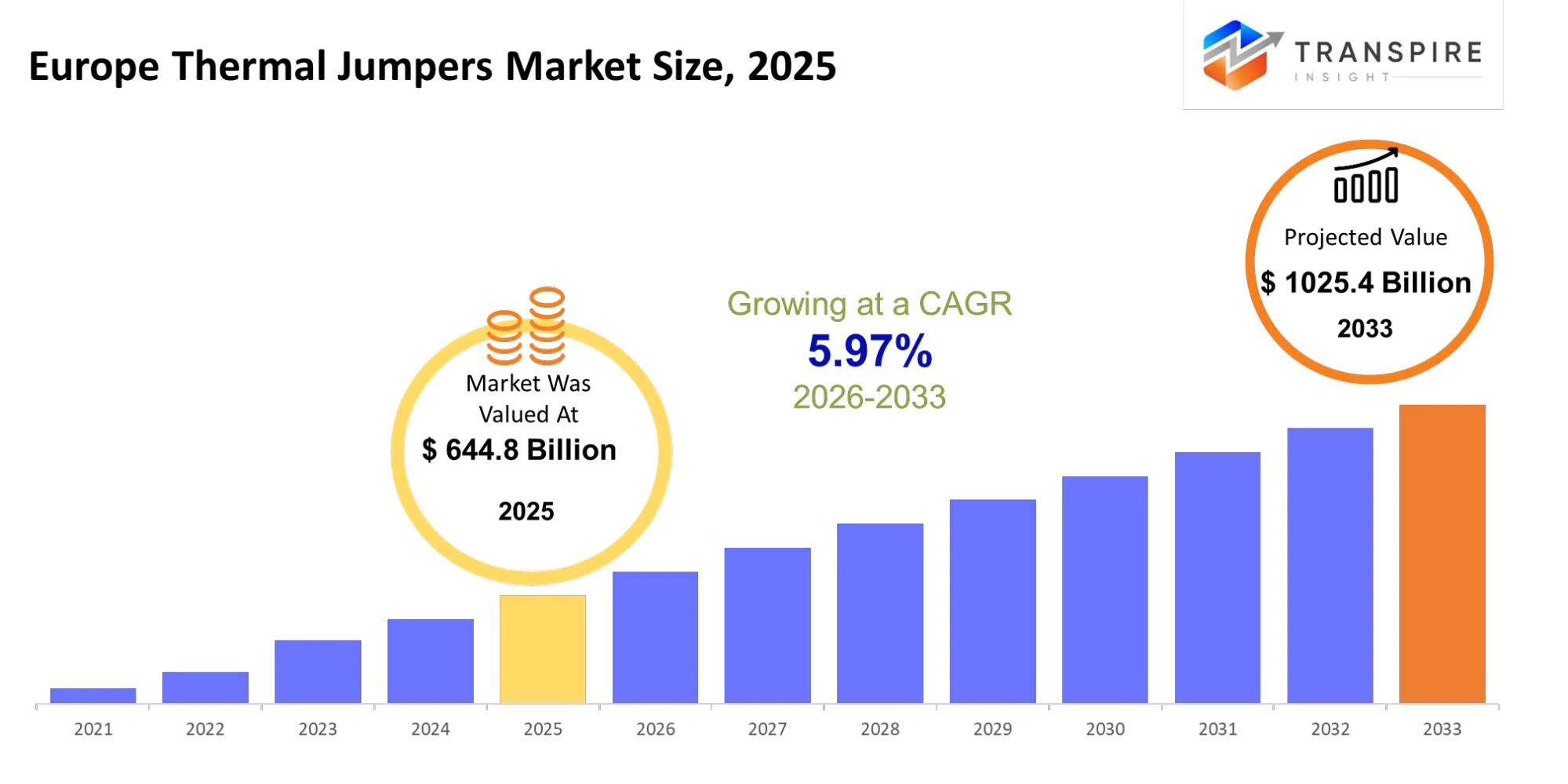
- Europe Thermal Jumpers Market Size 2025: USD 644.8 Billion
- Europe Thermal Jumpers Market Size 2033: USD 1025.4 Billion
- Europe Thermal Jumpers Market CAGR: 5.97%
- Europe Thermal Jumpers Market Segments: By Type (Electric Jumpers, Manual Jumpers, Others), By Application (Automotive Repair, Emergency Start, Industrial Use, Others), By End-User (Vehicle Owners, Workshops, Fleet Operators, Others), By Distribution (Online, Retail Stores, Others).
To learn more about this report,  Download Free Sample Report
Europe Thermal Jumpers Market Summary:
The Europe Thermal Jumpers Market size is estimated at USD 644.8 Billion in 2025 and is anticipated to reach USD 1025.4 Billion by 2033, growing at a CAGR of 5.97% from 2026 to 2033. The Europe Thermal Jumpers Market supports heat retention and thermal insulation across offshore platforms, marine piping systems, ship engines, and industrial processing units where temperature stability directly affects operational safety and energy efficiency. The use of thermal jumpers in industrial environments enables operators to maintain operational processes while reducing heat transmission and creating safe work areas that shield workers from dangerous surface temperatures.
The market has evolved during the past five years because companies now prefer modular removable thermal jumper systems which provide predictive maintenance and energy optimization benefits instead of traditional insulation wraps. The European Union implemented stricter industrial emission control measures together with energy efficiency standards which accelerated this transition to decarbonization regulations. The Russia-Ukraine conflict created energy supply disruptions in the region which compelled industries to decrease their fuel waste while enhancing their existing thermal performance capabilities.
Operators began to view thermal insulation upgrades as cost-control investments when energy prices increased because they wanted to reduce their expenses. The industry now experiences higher retrofit demand for its older industrial equipment which results in more frequent equipment replacements and increased revenue streams for companies that supply specialized thermal protection products.
Key Market Insights
- The Europe Thermal Jumpers Market will be led by Northern Europe in 2025 because it has 38% of the total market share which relies on its offshore energy and shipbuilding operations.
- The Western Europe market will experience the highest growth rate until 2030 because industrial decarbonization projects and marine infrastructure development work together to create new opportunities.
- The European Thermal Jumpers Market generates its major revenue from Germany and Norway and the Netherlands which all have energy-intensive manufacturing industries.
- The UK offshore maintenance sector saw its spending increase by more than 12% during the period from 2023 to 2025 which helped thermal insulation systems become more widely used.
- The Europe Thermal Jumpers Market gives removable thermal jumpers about 46% market share because these products enable simpler maintenance procedures and better operational efficiency.
- High-temperature insulation jumpers hold the second-largest market share because refineries and petrochemical processes require these products.
- Between 2025 and 2030 the customized modular thermal jumpers segment will experience the highest growth rate because operators need systems which can be retrofitted.
- The demand for lightweight composite insulation materials grew by 18% during 2025 because these materials protect thermal insulation systems used in marine and offshore operations.
- The Europe Thermal Jumpers Market has its major application segment in offshore oil and gas operations which hold a market share exceeding 41% during 2025.
- Marine engine insulation applications are now becoming increasingly popular because shipping companies want to improve their fuel efficiency through better fuel use management.
- Industrial processing plants now implement advanced thermal jumpers which help them decrease energy waste while meeting emission control standards.
- The LNG infrastructure projects across Europe led to an increase in thermal insulation systems which were needed for both cryogenic and high-temperature operational systems.
What are the Key Drivers, Restraints, and Opportunities in the Europe Thermal Jumpers Market?
The European Thermal Jumpers Market experiences its most powerful growth because industrial energy expenses increased after the Russia-Ukraine conflict and energy supply disruptions began to affect Europe. The existing industrial infrastructure of heavy industries and offshore platforms and marine operators needed immediate solutions to control thermal losses instead of complete equipment upgrades. The function of thermal jumpers changed from being a maintenance tool to becoming a method for managing operational expenses. The European Union established more rigorous energy efficiency requirements which compelled refineries and LNG terminals and power plants to enhance their insulation systems to prevent increased operational costs and regulatory violations. The demand for retrofitting solutions increased because of aging industrial equipment which led to greater aftermarket sales of removable and modular thermal jumper systems.
The industrial infrastructure of Europe faces its major structural limitation because of its dispersed industrial organization. Offshore and industrial facilities use piping systems that have been uniquely designed and combined with outdated equipment which makes it necessary to create custom thermal jumper solutions. The process of creating standard solutions for large-scale applications becomes difficult because of this situation which increases installation expenses. The offshore sector experiences deployment delays because of thermal insulation labor shortages which affect the entire process and require certification for skilled workers. These factors suppress faster adoption among mid-sized operators with limited maintenance budgets.
Europe's developing LNG and hydrogen infrastructure projects create a major growth opportunity. The countries of Germany and the Netherlands are undertaking substantial investments to construct new energy terminals which need advanced high-temperature and cryogenic insulation systems. Thermal jumper manufacturers who create lightweight composite materials with digital temperature-monitoring systems will obtain long-term supply contracts for next-generation energy facilities.
What Has the Impact of Artificial Intelligence Been on the Europe Thermal Jumpers Market?
The combination of artificial intelligence and digital technologies enables better thermal insulation management across Europe's marine offshore and industrial sectors by enhancing operational monitoring capabilities and decreasing unscheduled maintenance problems. Operators use IoT-enabled sensors to track surface temperature changes and insulation material degradation and heat-loss patterns through their integration with thermal jumper systems. The central control system of offshore facilities and marine engine rooms now operates with automated monitoring platforms which detect thermal inefficiencies before they disrupt equipment performance or fuel efficiency.
Machine learning models enable organizations to develop better systems for predicting when their equipment will require maintenance. Industrial operators use historical temperature data and vibration analysis together with operating-cycle patterns to forecast insulation failure risks and schedule targeted maintenance interventions.The system eliminates unnecessary equipment shutdowns while it extends the operational duration of machines. The implementation of predictive thermal management systems in offshore settings has achieved a maintenance-related downtime reduction of approximately 15% which leads to better energy efficiency through decreased heat loss in insulated pipelines and valves.
The performance optimization process receives additional support from digital twin technology which creates operating condition simulations that show how thermal loads will affect system performance. The process of implementing AI technologies still encounters obstacles which limit its effectiveness. The majority of European industrial facilities built before modern times use outdated systems which create additional expenses for sensor network integration while preventing effective deployment of new technologies throughout their aging marine and industrial environments.
Key Market Trends
- The offshore maintenance contracts which started in 2025 used removable thermal jumpers instead of traditional fixed insulation systems for nearly 40 percent of their new projects.
- European manufacturers increasingly adopted lightweight composite insulation materials which enabled them to install systems 20 percent faster than traditional thermal coverings.
- The LNG terminal expansion projects at German and Dutch facilities shifted their supplier requirements to focus on cryogenic thermal protection systems after the year 2022.
- Industrial buyers abandoned their traditional method of replacing insulation at scheduled times, instead adopting predictive maintenance procedures which use IoT thermal monitoring together with digital inspection technologies.
- Rockwool Group and Saint-Gobain developed new high-temperature insulation products for offshore energy operations and marine industry needs.
- European Union industrial energy efficiency rules required refineries and petrochemical companies to focus on projects that decrease heat loss from 2021 until 2025.
- European thermal insulation manufacturers established local production facilities during 2022 to decrease their need for overseas sourced raw materials because of supply chain challenges.
- Marine operators used thermal jumper systems together with digital asset management systems to enhance their maintenance scheduling procedures while minimizing unexpected operational interruptions.
- The competition moved away from price-based bidding to life cycle performance guarantees which suppliers introduced through their extended service periods and corrosion-resistant insulation products.
Europe Thermal Jumpers Market Segmentation
By Type
The type segment of thermal jumpers features removable thermal jumpers as its leading option because offshore facilities and refineries and marine operators need insulation systems which allow them to conduct maintenance work more quickly while reducing their downtime. Fixed thermal jumpers continue serving heavy industrial installations where long-term static insulation remains cost effective, particularly in older European processing plants. High-temperature variants also maintain a notable share because LNG terminals and steam pipelines and petrochemical operations use them extensively.
Energy-intensive industries shifted their focus toward thermal loss reduction and operational efficiency improvement after 2022 which created new demand patterns. Maintenance teams now prefer reusable solutions which decrease labor expenses during inspections and equipment servicing work, which has led to increased adoption of modular insulation systems. Future investment is expected to move toward lightweight composite materials and digitally monitored insulation products. The development of corrosion-resistant thermal jumpers with sensor capabilities will help manufacturers establish better long-term contracts for their offshore and industrial retrofit projects.

To learn more about this report, Download Free Sample Report
By Application
The application segment of the study shows offshore oil and gas applications as its main component because subsea pipelines and valves and high-temperature processing systems require extensive thermal insulation. Marine engine insulation follows closely because ship operators continue investing in fuel-efficiency improvements and emission-control compliance upgrades. European manufacturers expanded industrial processing applications because they needed to control their energy expenses and meet new operational efficiency standards.
The LNG infrastructure developed into a rapidly growing application field because multiple European nations started terminal expansion projects to enhance their energy security. Between 2023 and 2026 organizations increased their purchasing of thermal management solutions that provide cryogenic environment protection. The offshore facilities demand distinct patterns of usage because they need equipment that functions in extreme conditions, while industrial buyers seek equipment that offers operational cost reduction and maintenance scheduling options. Future growth will focus on developing thermal systems that provide hydrogen infrastructure support and advanced marine propulsion systems and digitally controlled energy plants.
By End-User
The power generation sector and offshore platforms operate at their most efficient level because thermal insulation affects both their operational performance and their equipment durability and their ability to meet regulatory standards. The petrochemical sector remains important because its operations require continuous high-temperature insulation solutions for their processing needs. Shipbuilding companies and marine maintenance contractors emerged as rapidly growing end users after European shipping operators intensified fleet modernization programs and fuel-efficiency initiatives.
The two industries display different demand patterns because offshore energy operators base their decisions on lifecycle performance and corrosion resistance, while industrial facilities focus on their needs for maintenance access and their expected costs for future operations. The budget limitations of smaller industrial operators prevent them from completing major insulation replacement work because they need to update insulation throughout their outdated manufacturing plants. The future market development will result in increased partnerships between insulation suppliers and industrial asset-management providers because organizations will start using predictive maintenance and thermal monitoring technologies in their operational systems.
By Distribution
The distribution segment relies on direct sales channels because industrial buyers and offshore operators need customized engineering support and technical assessments and project-specific installation services. Specialized industrial distributors also maintain an important role by supporting regional maintenance contractors and providing replacement insulation systems for smaller facilities. Online procurement channels experienced gradual expansion after 2021 because industrial purchasing platforms developed better technical documentation and product comparison tools and supply-chain transparency.
Digital sales face limitations because thermal insulation projects need site inspections and customized specifications before procurement decisions can be made. The supply-chain disruptions that affected regions in 2022 made buyers choose local distributors and European manufacturing partners who could deliver products and provide technical support more quickly. The upcoming distribution methods will use digital procurement systems together with engineering-based consultation services. Suppliers who develop integrated service models and regional inventory hubs and predictive maintenance partnerships will enhance customer retention and create more long-term contract opportunities.
What are the Key Use Cases Driving the Europe Thermal Jumpers Market?
European shipping companies increasingly build their cargo vessels and ferries with advanced thermal protection systems because these systems enhance fuel efficiency while helping them follow new maritime emission regulations. The operators of LNG infrastructure use high-temperature and cryogenic insulation systems to maintain thermal stability in their storage and transfer equipment.European shipping companies increasingly build their cargo vessels and ferries with advanced thermal protection systems because these systems enhance fuel efficiency while helping them follow new maritime emission regulations.
The operators of LNG infrastructure use high-temperature and cryogenic insulation systems to maintain thermal stability in their storage and transfer equipment.European shipping companies increasingly build their cargo vessels and ferries with advanced thermal protection systems because these systems enhance fuel efficiency while helping them follow new maritime emission regulations. The operators of LNG infrastructure use high-temperature and cryogenic insulation systems to maintain thermal stability in their storage and transfer equipment.
European shipping companies increasingly build their cargo vessels and ferries with advanced thermal protection systems because these systems enhance fuel efficiency while helping them follow new maritime emission regulations. The operators of LNG infrastructure use high-temperature and cryogenic insulation systems to maintain thermal stability in their storage and transfer equipment.
|
Report Metrics |
Details |
|
Market size value in 2025 |
USD 644.8 Billion |
|
Market size value in 2026 |
USD 683.3 Billion |
|
Revenue forecast in 2033 |
USD 1025.4 Billion |
|
Growth rate |
CAGR of 5.97% from 2026 to 2033 |
|
Base year |
2025 |
|
Historical data |
2021 - 2024 |
|
Forecast period |
2026 - 2033 |
|
Report coverage |
Revenue forecast, competitive landscape, growth factors, and trends |
|
Regional scope |
Europe (Germany, United Kingdom, France, Italy, Spain and Rest of Europe) |
|
Key company profiled |
Schumacher Electric, NOCO, Clore Automotive, Stanley Black & Decker, Bosch, DeWalt, Makita, Einhell, Ring Automotive, Sealey, Halfords, Black+Decker, Battery Tender, Tacklife, Gooloo |
|
Customization scope |
Free report customization (country, regional & segment scope). Avail customized purchase options to meet your exact research needs. |
|
Report Segmentation |
By Type (Electric Jumpers, Manual Jumpers, Others), By Application (Automotive Repair, Emergency Start, Industrial Use, Others), By End-User (Vehicle Owners, Workshops, Fleet Operators, Others), By Distribution (Online, Retail Stores, Others) |
Which Regions are Driving the Europe Thermal Jumpers Market Growth?
Northern Europe leads the market because its offshore oil and gas infrastructure operates in Norway, the United Kingdom, and Denmark. The strict enforcement of industrial energy-efficiency standards together with advanced offshore maintenance practices leads to widespread implementation of thermal insulation systems. The presence of major ports and established shipyards together with specialized engineering contractors establishes an advanced system that enables ongoing retrofit and replacement work. The regional operators maintain larger maintenance budgets compared to most European markets which enables them to implement advanced thermal jumpers that can be removed and monitored through digital systems at a quicker pace.
The industrial manufacturing and petrochemical operations in Western Europe drive procurement activities although the region holds the second-largest market position which operates differently from Northern Europe. Germany and the Netherlands together with Belgium continue their maintenance of steady investments toward refinery upgrades and LNG logistics development and industrial energy efficiency improvement initiatives. The region provides a dependable long-term market revenue source because its regulatory framework operates stably while its industrial output maintains consistent levels. The thermal maintenance contracts which large industrial groups across Western Europe prefer to establish for multiple years produce consistent insulation replacement requirements for insulation providers and engineering service companies.
The Southern and Eastern European markets experience the fastest growth rate because port modernization programs and maritime infrastructure development projects accelerated after 2023. The countries of Greece and Italy together with Poland raised their budget for LNG terminals and commercial fleet upgrades and industrial energy efficiency initiatives.
Who are the Key Players in the Europe Thermal Jumpers Market and How Do They Compete?
The Europe Thermal Jumpers Market shows moderate market fragmentation because regional engineering companies work against international insulation companies and overseas service providers. Established companies maintain their market position through integrated maintenance contracts and technical certifications and tailored insulation services instead of using price competition. Buyers increasingly prioritize lifecycle performance and corrosion resistance and installation flexibility for offshore and LNG applications because these markets experience high downtime costs. New market entrants encounter obstacles which include industrial safety approval processes and offshore operational standards and engineering specifications for specific projects which prevents fast market entry by budget-friendly suppliers.
Rockwool Group develops stone wool insulation systems which provide high performance for extreme industrial applications and offshore environments. The company obtains contracts for petrochemical plants and marine infrastructure projects in Northern Europe through its fire-resistance certifications and thermal efficiency capabilities. The company provides lightweight insulation products and energy-efficient design assistance which enables customers to accomplish industrial retrofitting projects with less difficulty. The company now focuses its expansion efforts on LNG terminals and hydrogen infrastructure because these markets offer higher profits from tailored thermal protection systems.
Advanced Insulation PLCremovable insulation jackets for offshore oil and gas assets, creating competitive advantage through rapid installation and maintenance access in high-risk.
Company List
- Schumacher Electric
- NOCO
- Clore Automotive
- Stanley Black & Decker
- Bosch
- DeWalt
- Makita
- Einhell
- Ring Automotive
- Sealey
- Halfords
- Black+Decker
- Battery Tender
- Tacklife
- Gooloo
Recent Development News
In April 2026, UK outdoor brand Rab expands its technical first-layer apparel portfolio for SS26: UK-based outdoor apparel company Rab introduced a new SS26 first-layer apparel collection focused on UV protection, heat management, and high-output mountain activity performance. The launch strengthens Rab’s positioning in Europe’s technical thermal apparel and base-layer segment, where demand for lightweight temperature-regulating garments continues to rise among outdoor consumers.
Source: https://www.instagram.com
In January 2026, Under Armour Unveils New Women’s Baselayer Line Through London “LDN Layers” Event: Under Armour introduced its latest women’s thermal baselayer apparel in London through its “LDN Layers” campaign event. The company positioned the collection as a fusion of performance wear and streetwear styling, highlighting growing demand for fashionable thermal layering products across Europe’s activewear sector. The launch also reinforced London’s role as a strategic marketing hub for premium thermal apparel innovation.
Source: https://about.underarmour.com
What Strategic Insights Define the Future of the Europe Thermal Jumpers Market?
The Europe Thermal Jumpers Market is turning towards integrated thermal management systems which provide combined insulation insulation performance and predictive maintenance and digital monitoring capabilities. The next five to seven years will see growth through retrofit modernization of LNG terminals and offshore energy assets and hydrogen infrastructure which will exceed traditional replacement demand. Industrial energy costs are rising while operational efficiency standards become more strict, which forces operators to view thermal insulation as a performance asset that affects their fuel consumption and emissions control and equipment reliability.
The supply-chain dependency and raw material concentration create an underappreciated risk for advanced insulation composites and specialty high-temperature materials. A prolonged disruption in European industrial minerals or engineered fiber supply will harm margins and extend project schedules, especially for customized offshore installations. Hydrogen transport infrastructure in Germany and the Netherlands creates an emerging opportunity because existing insulation technologies cannot handle changing thermal loads and corrosive operational conditions.
Market participants should choose modular insulation platforms which have embedded sensor compatibility and local manufacturing capacity to obtain industrial retrofit contracts for long-term periods while decreasing supply-chain risks.
Europe Thermal Jumpers Market Report Segmentation
By Type
- Electric Jumpers
- Manual Jumpers
- Others
By Application
- Automotive Repair
- Emergency Start
- Industrial Use
- Others
By End-User
- Vehicle Owners
- Workshops
- Fleet Operators
- Others
By Distribution
- Online
- Retail Stores
- Others
Frequently Asked Questions
Find quick answers to common questions.
The approximate Europe Thermal Jumpers Market size for the market will be USD 1025.4 Billion in 2033.
The key segments of the Europe Thermal Jumpers Market are By Type (Electric Jumpers, Manual Jumpers, Others), By Application (Automotive Repair, Emergency Start, Industrial Use, Others), By End-User (Vehicle Owners, Workshops, Fleet Operators, Others), By Distribution (Online, Retail Stores, Others).
Major players in the Europe Thermal Jumpers Market are Schumacher Electric, NOCO, Clore Automotive, Stanley Black & Decker, Bosch, DeWalt, Makita, Einhell, Ring Automotive, Sealey, Halfords, Black+Decker, Battery Tender, Tacklife, Gooloo.
The current market size of the Europe Thermal Jumpers Market is USD 644.8 Billion in 2025.
The Europe Thermal Jumpers Market CAGR is 5.97%.
- Schumacher Electric
- NOCO
- Clore Automotive
- Stanley Black & Decker
- Bosch
- DeWalt
- Makita
- Einhell
- Ring Automotive
- Sealey
- Halfords
- Black+Decker
- Battery Tender
- Tacklife
- Gooloo
Recently Published Reports
-
Apr 2026
Fiber Optic Faceplates Market
Fiber Optic Faceplates Market Size, Share & Analysis Report By Type (< 300 mm2, 300-350 mm2, and > 350 mm2, By Application (Night Vision, Holographic Imaging, Medical, and Others), and Geography (North America, Europe, Asia-Pacific, Middle East and Africa, South and Central America), 2021 - 2031
-
Apr 2026
High Temperature Superconductors Market
High Temperature Superconductors Market Size, Share & Analysis Report By Type (1G HTS, and 2G HTS), By Application (Power Cable, Fault Current Limiter, and Transformer), and Geography (North America, Europe, Asia-Pacific, Middle East and Africa, South and Central America), 2021 - 2031
-
Apr 2026
Industrial Plugs and Socket Market
Industrial Plugs and Socket Market Size, Share & Analysis Report By Type (Industrial Plugs, Industrial Sockets), By Current (Up to 32 A, 32 to 125 A, Above 125 A), By Protection (Dustproof and Splash Proof, Waterproof, Explosion Proof), By End User (Heavy Industries, Oil and Gas, Chemicals and Pharmaceuticals, Power Generation, Others), and Geography (North America, Europe, Asia-Pacific, Middle East and Africa, South and Central America), 2021 - 2031
-
Apr 2026
InGaAs Avalanche Photodiodes Market
InGaAs Avalanche Photodiodes Market Size, Share & Analysis Report By Type (1100 - 1700 nm, and 1000 - 1600 nm), By Application (Missile Warning System, Muzzle Flash Detection, Wafer Defect Inspection, Laser Rangefinders, and Others), and Geography (North America, Europe, Asia-Pacific, Middle East and Africa, South and Central America), 2021 - 2031