
Global Telematics Systems Market Size & Forecast
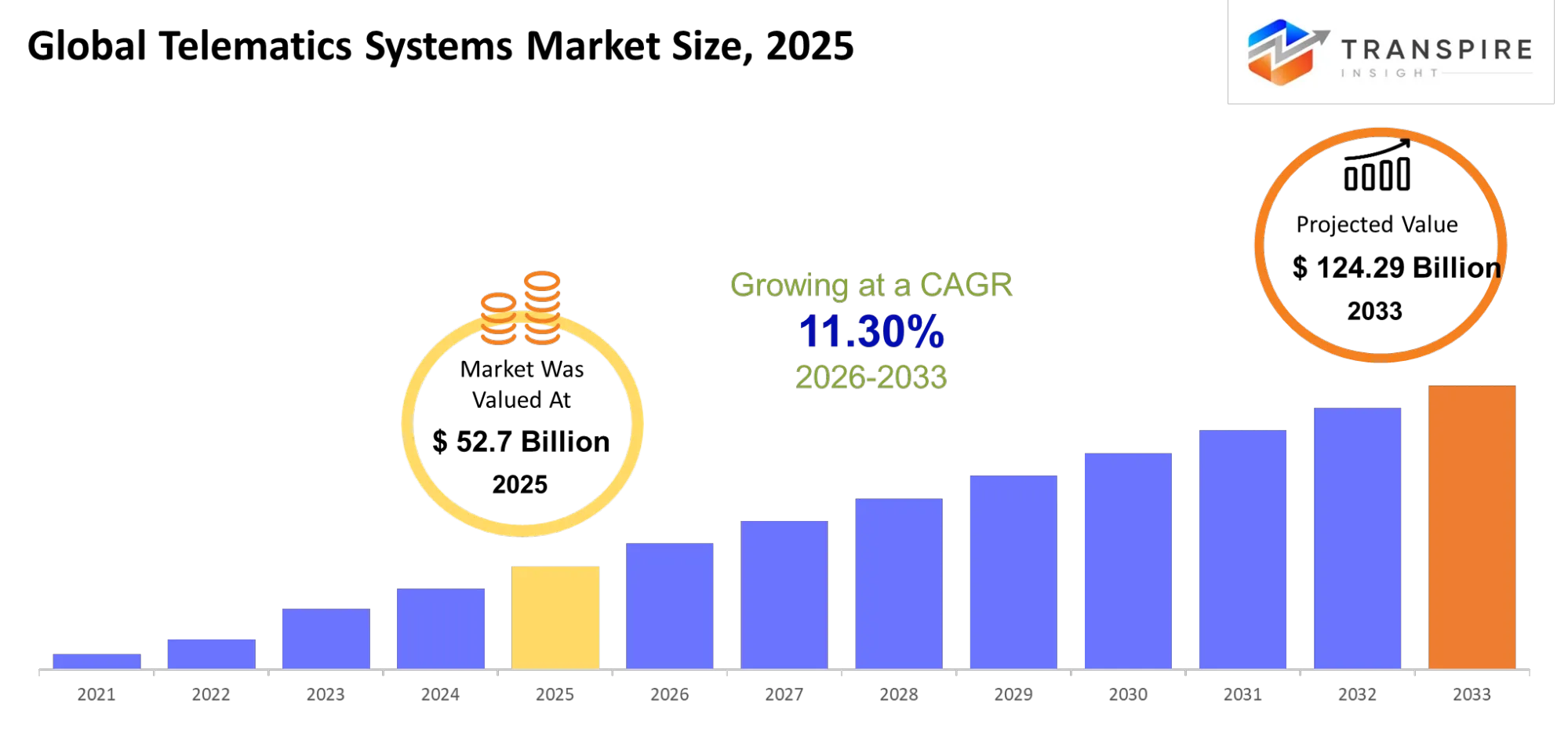
- Global Telematics Systems Market Size 2025: USD 52.7 Billion
- Global Telematics Systems Market Size 2033: USD 124.29 Billion
- Global Telematics Systems Market CAGR: 11.30%
- Global Telematics Systems Market Segments: By Component (Hardware, Software, Services), By Vehicle Type (Passenger Cars, Commercial Vehicles), By Application (Fleet Management, Navigation & Infotainment, Safety & Security)
To learn more about this report,  Download Free Sample Report
Global Telematics Systems Market Summary
Telematics systems connect vehicles to centralized data networks, enabling real-time communication between fleet operators, drivers, and backend management platforms. In practice, this means a logistics company can track every truck in its network, monitor fuel consumption per trip, and receive engine diagnostics before a breakdown occurs. This function has moved from a premium add-on to a baseline operational requirement across commercial transport.
The structural shift over the last four years is the migration from hardware-centric device installations to software-defined telematics platforms delivered via cloud. Original equipment manufacturers now embed telematics chipsets directly into vehicle architecture rather than retrofitting third-party hardware. The trigger that accelerated this transition was the COVID-19 supply chain crisis: fleet operators who lacked real-time visibility into vehicle location and cargo status faced severe disruptions, and that experience forced adoption decisions that had been deferred for years. The result is a market where demand now tracks digital fleet maturity rather than simply fleet size.
Key Global Telematics Systems Market Insights
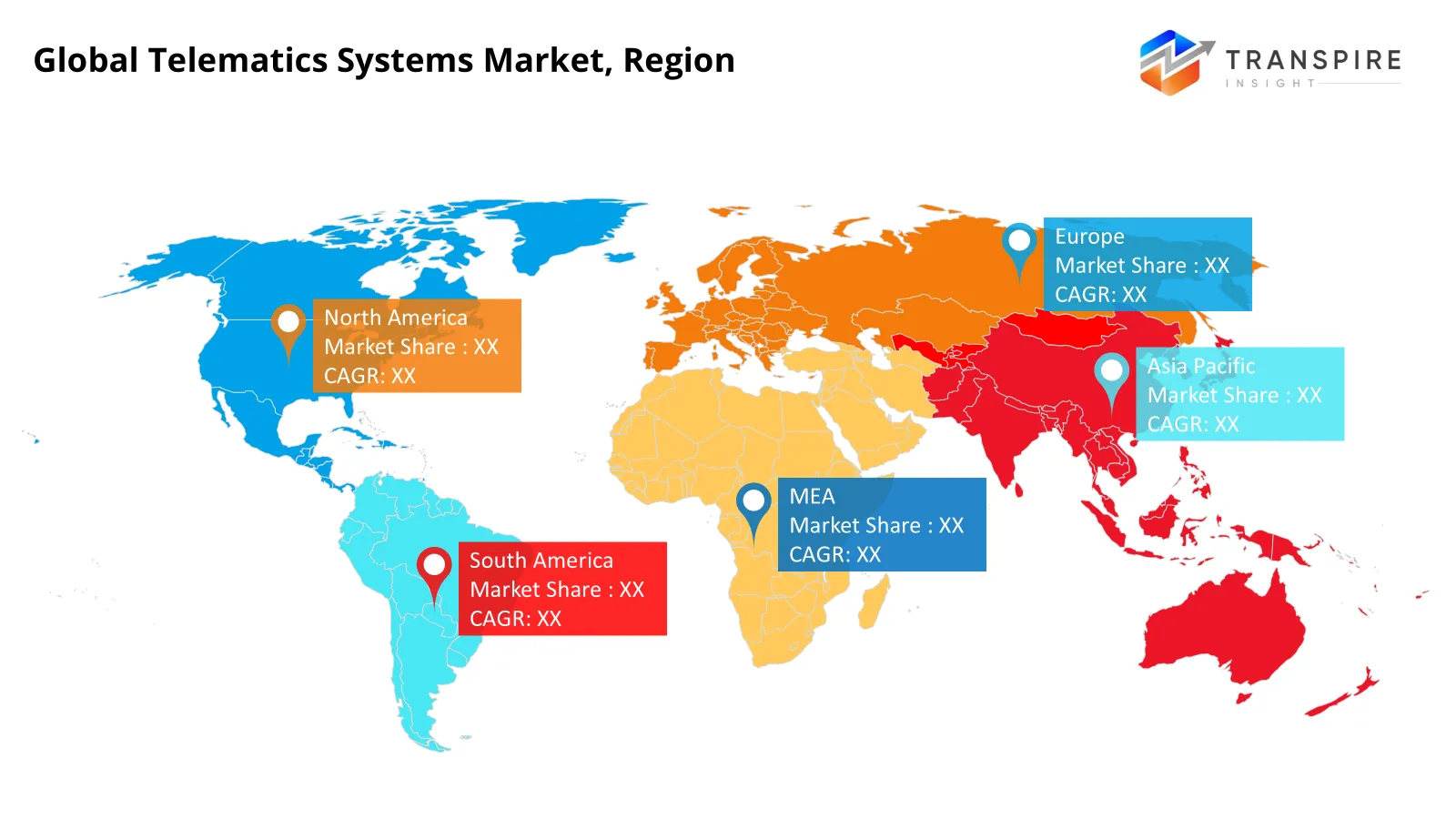
- North America dominates the global telematics systems market with approximately 36% share in 2024, supported by mandatory ELD regulations, advanced LTE/5G infrastructure, and high commercial fleet density.
- Asia Pacific is the fastest-growing region, projected to record over 13% CAGR from 2026 to 2033, driven by India's vehicle tracking mandates and China's smart transportation programs.
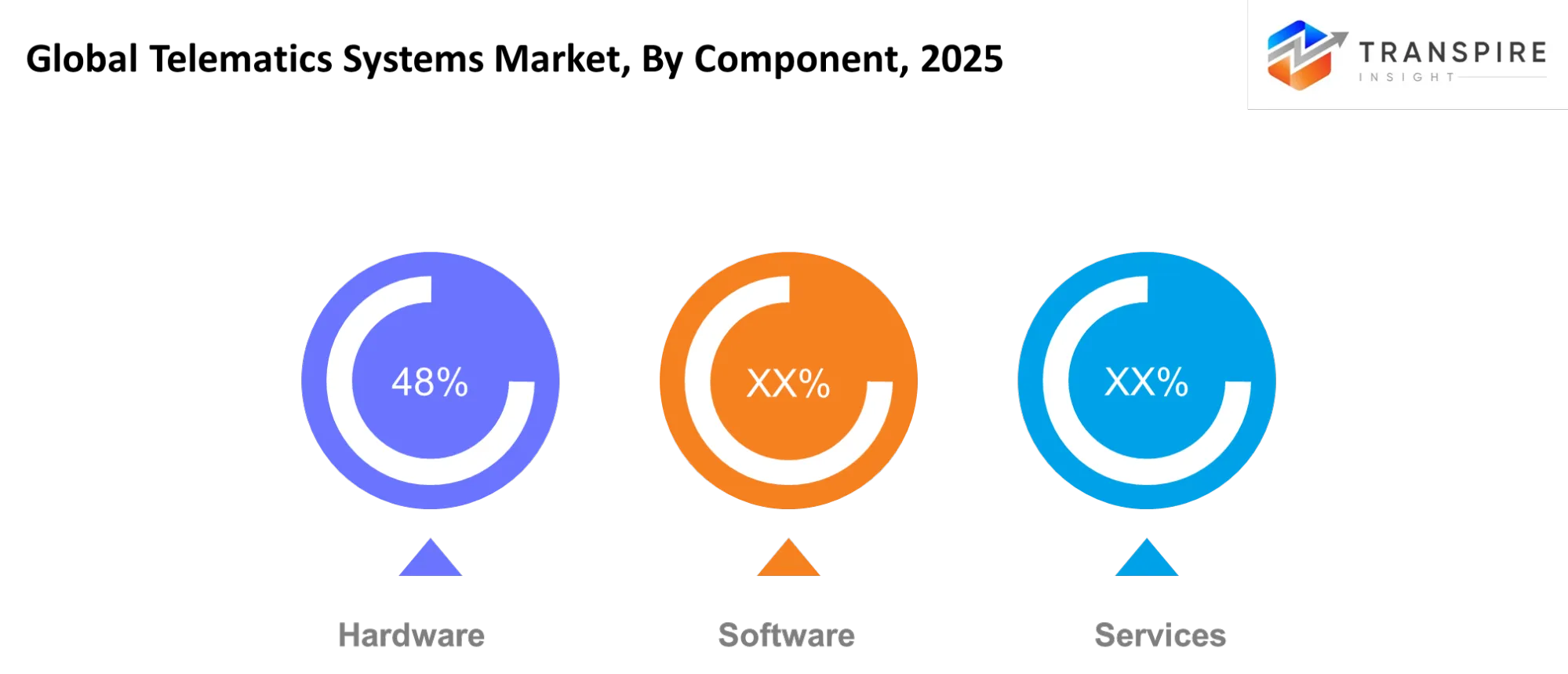
- Hardware leads the component landscape with a 48% revenue share in 2024, anchored by OBD devices, GPS modules, and embedded telematics control units shipped with new vehicles.
- The software segment is gaining ground rapidly, with cloud-based fleet management platforms growing faster than hardware as operators seek subscription-based analytics over one-time device purchases.
- Fleet management is the dominant application segment, accounting for over 42% of global telematics systems market revenue in 2024, driven by logistics operators seeking fuel optimization and driver behavior monitoring.
- Safety and security applications represent the fastest-growing segment, fueled by insurance telematics programs and government-mandated eCall systems in Europe and expanding markets.
- Commercial vehicles lead by vehicle type with over 58% revenue share, as fleet operators generate the highest telematics ROI from fuel savings, maintenance scheduling, and compliance management.
- Passenger car telematics is expanding through OEM-embedded systems, with automakers including connected vehicle packages in standard configurations rather than optional upgrades.
- Verizon Connect, Geotab, and Trimble hold significant combined share in the North American fleet management segment, competing on platform integration depth and third-party API connectivity.
- European insurers and fleet operators are driving adoption of usage-based insurance telematics, which rewards fuel-efficient and safe driving behavior with premium discounts, expanding the end-user base beyond traditional logistics.
What are the Key Drivers, Restraints, and Opportunities in the Global Telematics Systems Market?
Government mandates are the primary force propelling telematics adoption. The U.S. Federal Motor Carrier Safety Administration's Electronic Logging Device rule, now fully enforced, removed the option for commercial carriers to skip telematics investment entirely. Similar mandates operate in the European Union through the smart tachograph requirement and in India through the Ministry of Road Transport's vehicle tracking directive. These regulations did not create awareness of telematics; they created non-negotiable procurement timelines. The result is a compliance-driven demand floor that sustains revenue growth independent of macroeconomic conditions.
The most persistent barrier is integration complexity with legacy fleet management infrastructure. Large logistics operators managing fleets built over 10 to 15 years often run fragmented systems across different vehicle generations, hardware vendors, and software platforms. Replacing or unifying these systems requires significant IT investment, workflow redesign, and staff retraining. This structural friction delays the upgrade cycle for mid-market operators who cannot justify a wholesale platform migration. The problem is architectural, not financial. Cheaper hardware and subscription pricing models have not resolved the core issue of connecting telematics output to existing enterprise resource planning systems.
The forward opportunity sits at the intersection of telematics and electric vehicle fleet management. Battery electric commercial vehicles require fundamentally different monitoring than combustion vehicles. State of charge tracking, charging station routing, thermal management alerts, and range prediction under load all demand telematics data streams that existing platforms were not designed to handle. The first platforms purpose-built for EV fleet telematics will capture a structurally differentiated customer base, and several European markets, including the Netherlands and Norway, have commercial fleets transitioning rapidly enough to validate early product investments.
What Has the Impact of Artificial Intelligence Been on the Global Telematics Systems Market?
AI has moved from marketing language to operational reality within telematics platforms over the past three years. Fleet operators now use machine learning models to process continuous GPS, accelerometer, and engine data feeds, translating raw telemetry into actionable driver behavior scores, route efficiency recommendations, and predictive maintenance alerts. Geotab's MyGeotab platform uses AI to cluster driving events and flag high-risk driver patterns before incidents occur. Verizon Connect applies similar models to fuel consumption forecasting, generating per-vehicle optimization recommendations that fleet managers can act on without manual data analysis.
Predictive maintenance is where AI delivers the most quantifiable return in this market. Models trained on engine temperature, brake pressure cycles, and transmission behavior can identify component wear patterns 300 to 500 operating hours before failure. Several large logistics operators report a 20 to 25% reduction in unplanned vehicle downtime after deploying AI-enabled predictive maintenance through their telematics platform. Emissions forecasting models also help fleet operators adjust routing in advance of entering low-emission zones, reducing compliance penalties.
The concrete limitation of current AI deployment is data quality at the edge. Many commercial vehicles, particularly older models in developing markets, generate incomplete or inconsistent sensor data due to aging CAN bus hardware or intermittent connectivity. AI models trained on high-quality OEM-embedded sensor data perform poorly when applied to aftermarket device installations on aging fleets, which limits the accuracy of predictive outputs in exactly the segments where cost savings would matter most.
Key Market Trends
The global telematics systems market is moving toward software-defined platforms and AI-integrated analytics, with fleet connectivity becoming a mandatory operational standard. The market is forecast to cross USD 124 billion by 2033, driven by regulatory mandates, EV fleet expansion, and enterprise demand for real-time logistics visibility.
- North America held approximately 36% of global telematics revenue in 2024, supported by ELD mandates that made commercial vehicle tracking non-optional for carriers crossing state lines.
- Asia Pacific surpassed Europe as the second-largest regional market by 2023, with India's AIS-140 vehicle tracking standard creating compulsory fleet telematics demand across public transport and goods vehicles.
- Hardware held a 48% component share in 2024 but is losing margin ground to software subscriptions, which now represent over 60% of net new annual contract value for leading platform vendors.
- Subscription-based telematics grew from under 20% of revenue in 2018 to over 40% by 2024, reflecting operator preference for operating expense models over capital procurement.
- Fleet management displaced navigation as the largest application category by 2021, as logistics operators shifted priority from route guidance to comprehensive vehicle health and driver behavior monitoring.
- Usage-based insurance programs expanded telematics adoption into the passenger car segment in Europe and North America, with over 15 million policies using telematics data for premium calculation as of 2024.
- OEM-embedded telematics units now ship as standard equipment on over 70% of new commercial vehicles sold in North America and Europe, reducing reliance on aftermarket hardware retrofits.
- Geotab and Trimble expanded platform interoperability in 2023, enabling third-party application integration that reduced vendor lock-in concerns and accelerated enterprise adoption among mid-market fleets.
- Safety and security applications recorded the fastest growth rate among all telematics applications between 2021 and 2024, driven by eCall mandates, crash reconstruction requirements, and theft recovery program expansion.
Global Telematics Systems Market Segmentation
By Component
Hardware holds the largest share of the global telematics systems market, accounting for approximately 48% of revenue in 2024. This position reflects the physical foundation of all telematics activity: GPS modules, OBD-II connectors, telematics control units, and onboard sensors must be present before any software or service layer can function. OEM vehicle manufacturers now ship embedded telematics hardware as standard, which means hardware revenue is tied directly to vehicle production volumes rather than fleet manager discretion. Over the forecast period, hardware average selling prices will compress as competition among chipset suppliers intensifies, but unit volume growth from new vehicle production and fleet electrification programs will sustain segment revenue.
Services complete the component picture. Installation, system integration, maintenance contracts, and remote technical support represent a stable and margin-rich revenue stream. Services spending tends to track hardware installed base size, which means it grows more slowly than software but declines less abruptly during downturns. Value-added services such as compliance management consulting and custom data analytics are expanding the addressable opportunity for telematics providers beyond pure technology delivery.
To learn more about this report, Download Free Sample Report
By Vehicle Type
Commercial vehicles account for over 58% of global telematics systems market revenue and represent the segment where the financial case for telematics is clearest. A commercial vehicle burning 30,000 liters of diesel annually generates enough telematics-driven fuel savings, when optimized for routing, idling reduction, and maintenance timing, to recover technology investment within 18 to 24 months. That payback logic, combined with regulatory mandates requiring ELDs and tachographs, makes commercial vehicle telematics adoption largely non-discretionary for operators above a certain fleet size. Freight, construction, municipal services, and field service fleets all fall into this category.
Passenger car telematics is growing at a faster rate than commercial vehicles on a percentage basis, though from a smaller revenue base. The growth mechanism is different: rather than operator-driven fleet management investment, passenger car adoption flows through three distinct channels: OEM-embedded connectivity packages sold as standard features, insurance telematics programs offered by carriers to drivers willing to share driving behavior data, and rental fleet monitoring deployed by car rental companies seeking theft prevention and utilization optimization. Each channel operates through different procurement relationships and contract structures, making the passenger car segment more fragmented than commercial but also more resilient to any single regulatory change.
By Application
Fleet management is the anchor application of the global telematics systems market. This application integrates GPS tracking, engine diagnostics, fuel monitoring, driver behavior scoring, and maintenance scheduling into a single operational dashboard. Logistics operators, utilities, and municipal fleets use fleet management platforms to reduce fuel costs, improve driver safety records, and demonstrate regulatory compliance. The segment's dominance reflects the measurable ROI that fleet managers can present to finance teams, which accelerates budget approval cycles compared to other telematics applications. Fleet management platforms are also the most competitive segment, with Geotab, Verizon Connect, Trimble, and Teletrac Navman all competing for enterprise contracts.
Navigation and infotainment telematics serves a broader user base including passenger car drivers, delivery personnel, and driver assistance systems. This segment has evolved from standalone GPS units to integrated in-vehicle experience platforms that combine real-time traffic, entertainment, and vehicle health data. Safety and security applications represent the fastest-growing segment across the forecast period. Mandatory eCall systems in the European Union, expanding insurance telematics programs, and fleet theft recovery services all funnel investment into this category. Crash notification, geofencing alerts, remote immobilization, and driver fatigue monitoring are the primary use cases generating new contract volume.
What are the Key Use Cases Driving the Global Telematics Systems Market?
The dominant use case is commercial fleet management, where telematics delivers its clearest financial return. Logistics operators use real-time GPS tracking, engine diagnostics, and fuel monitoring to reduce operational costs across large vehicle pools. A mid-sized carrier running 500 trucks can recover telematics platform costs within two years through fuel efficiency gains and reduced unplanned maintenance. This use case generates the majority of current global telematics revenue and drives recurring software subscription growth as operators expand data analytics capabilities beyond basic tracking.
Adjacent demand is growing in insurance telematics and driver risk management. Auto insurers in the United Kingdom, United States, and Italy now offer usage-based policies that price premiums based on actual driving behavior data collected through telematics devices. This expands telematics adoption into the passenger car segment and creates a new B2B2C market structure where telematics vendors supply insurers rather than fleet operators directly. Corporate fleet programs are also using telematics data to monitor driver safety compliance and reduce accident liability, which adds an HR and risk management dimension to the technology purchase decision.
Emerging use cases center on electric vehicle fleet monitoring and autonomous vehicle data infrastructure. Battery electric commercial vehicles require charge state tracking, thermal management, and charging network routing that combustion telematics platforms do not natively support. Startups building EV-native telematics platforms are beginning to secure contracts with early electric van and truck fleets in Europe and California. The regulatory and infrastructure conditions for this use case are forming now, positioning the EV telematics segment to become commercially significant by 2027 to 2028.
Report Overview Table
|
Report Metrics |
Details |
|
Market size value in 2025 |
USD 52.7 Billion |
|
Market size value in 2026 |
USD 58.76 Billion |
|
Revenue forecast in 2033 |
USD 124.29 Billion |
|
Growth rate |
CAGR of 11.30% from 2026 to 2033 |
|
Base year |
2025 |
|
Historical data |
2021 – 2024 |
|
Forecast period |
2026 – 2033 |
|
Report coverage |
Revenue forecast, competitive landscape, growth factors, and trends |
|
Regional scope |
United States; Canada; Mexico; United Kingdom; Germany; France; Italy; Spain; Denmark; Sweden; Norway; China; Japan; India; Australia; South Korea; Thailand; Brazil; Argentina; South Africa; Saudi Arabia; United Arab Emirates |
|
Key companies profiled |
Verizon Communications Inc., AT&T Inc., Trimble Inc., TomTom N.V., Geotab Inc., Robert Bosch GmbH, Continental AG, Qualcomm Incorporated, Harman International Industries Inc., Octo Telematics S.p.A., CalAmp Corp., Mix Telematics Ltd., Teletrac Navman US Ltd., Sierra Wireless Inc., Zonar Systems Inc. |
|
Customization scope |
Free report customization (country, regional & segment scope). Avail customized purchase options to meet your exact research needs. |
|
Report Segmentation |
By Component (Hardware, Software, Services), By Vehicle Type (Passenger Cars, Commercial Vehicles), By Application (Fleet Management, Navigation & Infotainment, Safety & Security) |
Which Regions are Driving the Global Telematics Systems Market Growth?
North America leads the global telematics systems market, and regulatory architecture is the primary reason. The Federal Motor Carrier Safety Administration's Electronic Logging Device mandate, fully enforced since 2020, made telematics installation non-optional for commercial carriers operating across state lines. This policy did not incentivize adoption; it required it. The supporting ecosystem reinforces this position: U.S. carriers operate on highly developed LTE and 5G networks that enable continuous data streaming even in remote regions, and the domestic software development community has built a deep catalog of fleet analytics applications that integrate with leading telematics platforms. Canada's operator network adds complementary volume.
Europe contributes a stable and growing share anchored by the EU's smart tachograph regulation and the mandatory pan-European eCall system, which requires all new passenger cars and light commercial vehicles sold from 2018 onward to carry an embedded emergency call telematics unit. Unlike North America's fleet-operator focus, European telematics demand is more evenly distributed across fleet management, safety applications, and passenger car connectivity. Germany, France, and the United Kingdom generate the largest revenue volumes, supported by high new vehicle sales rates and a mature insurance telematics sector. The European market's stability comes from its regulatory layering: multiple overlapping mandates sustain demand regardless of freight cycle fluctuations.
Asia Pacific is the fastest-growing region and the gap with Europe is narrowing faster than most earlier forecasts anticipated. India's AIS-140 vehicle tracking standard mandated GPS units on commercial vehicles and public transport fleets, creating compulsory procurement across millions of vehicles within a short rollout window. China's smart transportation investment programs are embedding telematics infrastructure at the city and provincial level, creating procurement volumes that individual fleet operators in Western markets cannot match. For market entrants and investors, Asia Pacific offers the highest installation growth rate through 2033, with India and Southeast Asia representing particularly attractive opportunities given low current telematics penetration relative to fleet size.
To learn more about this report, Download Free Sample Report
Who are the Key Players in the Global Telematics Systems Market and How Do They Compete?
The global telematics systems market operates in a moderately consolidated state at the platform layer but remains fragmented at the hardware and regional service levels. Geotab, Verizon Connect, Trimble, and TomTom Telematics collectively hold a significant share of the North American and European enterprise fleet management segment, but no single provider commands a dominant global position. Competition operates primarily on platform integration depth, third-party API ecosystem breadth, and the ability to deliver compliance reporting across multiple regulatory frameworks simultaneously. Hardware is increasingly commoditized, shifting the competitive battle to software retention and data analytics sophistication.
Geotab differentiates through its open platform architecture. The company's MyGeotab system connects to over 200 third-party applications and generates a data marketplace dynamic where fleet operators can add specialized modules for EV management, fuel card integration, or driver coaching without switching core platforms. This reduces churn and increases contract value per customer over time. Verizon Connect competes on network reliability and enterprise scale, leveraging Verizon's wireless infrastructure to guarantee connectivity in geographic areas where competitive telematics providers face service gaps. Trimble takes a vertical integration approach, embedding telematics deeply into its construction, agriculture, and transportation management software stacks rather than selling telematics as a standalone product.
Robert Bosch and Continental AG compete from the hardware side, supplying OEM-embedded telematics control units to vehicle manufacturers and using that installed base to offer data services directly to fleet operators. Their competitive advantage is access to vehicle architecture data that aftermarket providers cannot match. Octo Telematics has built a defensible niche in insurance telematics, serving carriers across Europe and North America with driving behavior data products that require actuarial integration expertise most fleet-focused competitors lack.
Recent Developments
In February 2026, Geotab announced a strategic partnership with ChargePoint Holdings to integrate EV charging network data directly into the MyGeotab fleet management platform. The integration enables fleet operators to plan charging stops alongside route optimization, addressing a key operational gap for mixed fleets transitioning to battery electric vehicles. https://www.geotab.com/press-release/ (Geotab Press Room).
In January 2026, Trimble Inc. completed the acquisition of Transporeon, a European transport management platform, expanding its telematics and logistics coordination capabilities across the European freight market. The acquisition positions Trimble to offer end-to-end supply chain visibility from shipper to carrier to vehicle. https://www.trimble.com/news (Trimble Newsroom).
In March 2026, Verizon Connect launched an updated version of its Reveal fleet management platform with embedded AI-driven predictive maintenance alerts, using real-time engine sensor data to flag component issues before they result in breakdowns. The update targets mid-market fleets of 50 to 500 vehicles seeking lower total cost of ownership without dedicated telematics analysts. https://www.verizonconnect.com/news (Verizon Connect Newsroom).
What Strategic Insights Define the Future of the Global Telematics Systems Market?
Over the next five to seven years, the global telematics systems market will shift from adoption growth to platform consolidation. The regulatory mandates that drove initial fleet telematics deployments in North America and Europe are largely in place. What changes now is depth of usage: operators who installed basic tracking systems to meet compliance requirements will face competitive pressure to extract more value from the data those systems generate. This creates an upgrade cycle within the existing installed base that is as significant as net new fleet adoption, particularly in the 2027 to 2030 window.
The risk that headline CAGR figures obscure is platform dependency concentration. As large telematics platforms integrate deeper into enterprise fleet operations, the switching cost for operators rises significantly. If market consolidation continues and two or three platforms capture the majority of enterprise contracts globally, those operators will face pricing power asymmetry at contract renewal. This risk matters for corporate fleet buyers negotiating multi-year agreements and for smaller telematics providers whose survival depends on maintaining customer relationships against well-capitalized incumbents.
The opportunity not yet reflected in current market sizing is the intersection of telematics and carbon accounting. Regulatory frameworks in the EU and emerging frameworks in North America are beginning to require scope 3 fleet emission reporting. Telematics platforms that can generate auditable, per-vehicle carbon output data will unlock a new enterprise buyer segment: sustainability officers and ESG compliance teams who currently have no telematics relationship. The concrete recommendation for market participants: invest in carbon data reporting capabilities now, before the regulatory deadline creates a compliance rush that overwhelms implementation capacity.
Global Telematics Systems Market Companies
- Verizon Communications Inc.
- AT&T Inc.
- Trimble Inc.
- TomTom N.V.
- Geotab Inc.
- Robert Bosch GmbH
- Continental AG
- Qualcomm Incorporated
- Harman International Industries Inc.
- Octo Telematics S.p.A.
- CalAmp Corp.
- Mix Telematics Ltd.
- Teletrac Navman US Ltd.
- Sierra Wireless Inc.
- Zonar Systems Inc.
Global Telematics Systems Market Report Segmentation
By Component
- Hardware
- Software
- Services
By Vehicle Type
- Passenger Cars
- Commercial Vehicles
By Application
- Fleet Management
- Navigation & Infotainment
- Safety & Security
Frequently Asked Questions
Find quick answers to common questions.
The Global Telematics Systems Market size is expected to reach USD 124.29 Billion by 2033.
Key segments for the Global Telematics Systems Market are By Component (Hardware, Software, Services), By Vehicle Type (Passenger Cars, Commercial Vehicles), By Application (Fleet Management, Navigation & Infotainment, Safety & Security).
Major Global Telematics Systems Market players are Verizon Communications Inc., AT&T Inc., Trimble Inc., TomTom N.V., Geotab Inc., Robert Bosch GmbH, Continental AG, Qualcomm Incorporated, Harman International Industries Inc., Octo Telematics S.p.A., CalAmp Corp., Mix Telematics Ltd., Teletrac Navman US Ltd., Sierra Wireless Inc., and Zonar Systems Inc.
The Global Telematics Systems Market size is USD 52.7 Billion in 2025.
The Global Telematics Systems Market CAGR is 11.30% from 2026 to 2033.
- Verizon Communications Inc.
- AT&T Inc.
- Trimble Inc.
- TomTom N.V.
- Geotab Inc.
- Robert Bosch GmbH
- Continental AG
- Qualcomm Incorporated
- Harman International Industries Inc.
- Octo Telematics S.p.A.
- CalAmp Corp.
- Mix Telematics Ltd.
- Teletrac Navman US Ltd.
- Sierra Wireless Inc.
- Zonar Systems Inc.
Recently Published Reports
-
Apr 2026
ATV & UTV Market
ATV & UTV Market Size, Share & Analysis Report By Type (ATV, and UTV), By Variants (Less Than 400 CC, 400 CC To 800 CC, and More Than 800 CC), and Geography (North America, Europe, Asia-Pacific, Middle East and Africa, South and Central America), 2021 - 2031
-
Apr 2026
Automotive Central Gateway Module Market
Automotive Central Gateway Module Market Size, Share & Analysis Report By Type (Ethernet Central Gateway Module, CAN Central Gateway Module, LIN Central Gateway Module, and FlexRay), By Application (Powertrain Control, Body Control, Infotainment System, Advanced Driver Assistance Systems (ADAS), and Others), By End User (Passenger Vehicles, and Commercial Vehicles), and Geography (North America, Europe, Asia-Pacific, Middle East and Africa, South and Central America), 2021 - 2031
-
Apr 2026
Automotive Engine Oil Filter Market
Automotive Engine Oil Filter Market Size, Share & Analysis Report By Filter Type (Fuel Filter, Engine Oil Filter, Hydraulic Oil Filter, and Others), By Filter Media (Cellulose, Synthetic, and Micro), By Sales Channel (OEMs, and Aftermarket), By Vehicle Type (Passenger Cars, Light Commercial Vehicles, Heavy Duty Trucks, Buses and Coaches, and Off-road Vehicles), and Geography (North America, Europe, Asia-Pacific, Middle East and Africa, South and Central America), 2021 - 2031
-
Apr 2026
Automotive Parts Aluminium Die Casting Market
Automotive Parts Aluminium Die Casting Market Size, Share & Analysis Report By Production Process (Pressure Die Casting, Vacuum Die Casting, Squeeze Die Casting, Gravity Die Casting), By Application (Body Parts, Engine Parts, Transmission Parts, Battery And Related Components, Other Application Types), and Geography (North America, Europe, Asia-Pacific, Middle East and Africa, South and Central America), 2021 - 2031
Our Clients