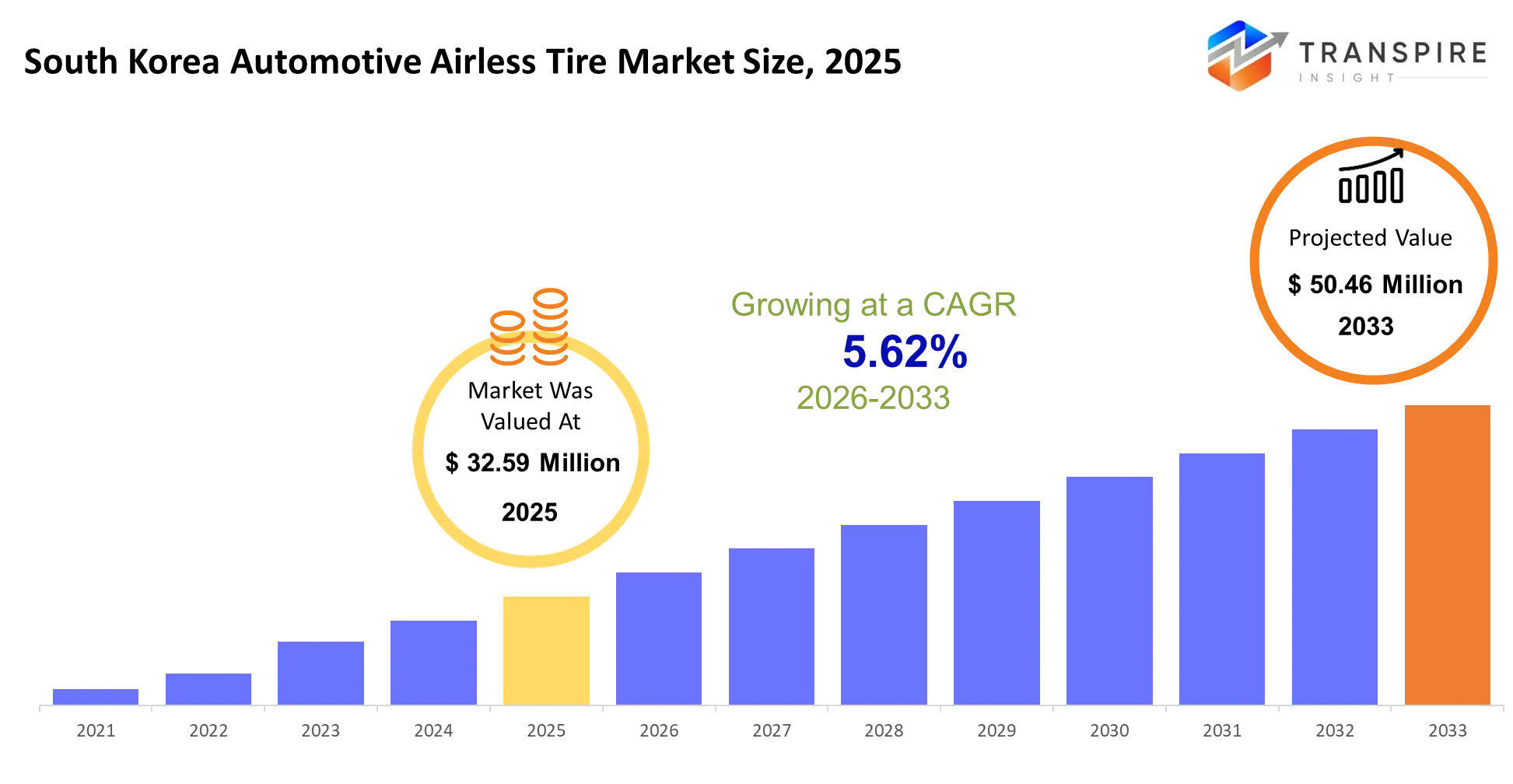
South Korea Automotive Airless Tire Market Size & Forecast:
- South Korea Automotive Airless Tire Market Size 2025: USD 32.59 Million
- South Korea Automotive Airless Tire Market Size 2033: USD 50.46 Million
- South Korea Automotive Airless Tire Market CAGR: 5.62%
- South Korea Automotive Airless Tire Market Segments: By Tire Type (Radial Airless Tires, Bias Airless Tires, Hybrid Airless Tires, Others); By Vehicle Type (Passenger Vehicles, Commercial Vehicles, Electric Vehicles, Off-road Vehicles, Others); By Material (Polyurethane Tires, Composite Rubber Tires, Thermoplastic Resin Tires, Others); By Application (On-road Vehicles, Military Vehicles, Agricultural Vehicles, Industrial Vehicles, Others); By Distribution Channel (OEM Sales, Aftermarket Sales, Online Retail, Others)
To learn more about this report,  Download Free Sample Report
South Korea Automotive Airless Tire Market Summary
The South Korea Automotive Airless Tire Market was valued at USD 32.59 Million in 2025. It is forecast to reach USD 50.46 Million by 2033. That is a CAGR of 5.62% over the period.
In practice automotive airless tires do away with the need for pressurized air setups, so there’s less vehicle downtime linked to punctures , blowouts , and the usual routine upkeep, across passenger cars as well as light commercial fleets. In South Korea, people are now looking at this kind of technology more and more for last mile delivery vans, defense mobility platforms and even next generation EV prototype work, mainly because keeping operations running smoothly and lowering servicing costs feel more important than sticking to the old tire change schedules.
Over the past 3–5 years, there’s been a pretty noticeable change in direction. EV centered mobility programs plus improvements in advanced polymer composite manufacturing have boosted material toughness and better load bearing steadiness. At the same time, supply chain hiccups sparked by post pandemic raw material swings made fleet operators question the whole dependence on conventional pneumatic tires. Put together, this sped up pilot rollouts for OEM connected test fleets and logistics teams. So now the momentum is driven not so much by novelty, but by lifecycle cost optimization and uptime assurance, which is carving out a more stable commercial lane for premium, non-pneumatic tire systems inside the wider automotive ecosystem.
Key Market Insights
- South Korea Automotive Airless Tire Market is seeing a climb in OEM trial runs , mostly pushed by EV fleet modernization, and the whole idea of less dependency on maintenance routines.
- The overall industry size keeps widening too, as logistics operators start grabbing puncture proof tire systems, for last mile delivery , with noticeable efficiency gains stretching across 2025–2033.
- Market forecasts suggest the biggest push comes from lightweight, composite leaning airless tire designs, gradually replacing regular pneumatic alternatives.
- In terms of geography, the Seoul Capital Region is basically where demand is most concentrated, taking up more than 40% of the estimated share , because there are so many EVs plus active fleet operations packed in.
- Meanwhile, Ulsan industrial corridor shows up as the fastest growing area, supported by deeper automotive manufacturing links, and a steady stream of test track validation programs.
- On the product side, polymer based airless tires remain in the lead, while hybrid support structures are showing the quickest adoption curve, tech wise.
- For applications, passenger EV use takes the lion share, since South Korea Automotive Airless Tire Market integration lines up well with urban mobility platforms.
- Commercial logistics is emerging as the fastest growing application, mainly due to the expansion of warehouse to consumer delivery.
- Key players , like Michelin and Bridgestone, are putting money into airless prototypes as well as mobility partnerships.
- Competitive moves typically revolve around material innovation , stronger EV OEM collaboration, and expanding regional testing across Asia Pacific supply chains.
What are the Key Drivers, Restraints, and Opportunities in the South Korea Automotive Airless Tire Market?
The main growth driver is that vehicle fleets are getting electrified fast combined with a rising appetite for low-maintenance mobility systems. In South Korea EV logistics expansion, especially for urban delivery networks, people are looking more at airless tire systems. These reduce downtime from punctures and pressure failures. OEMs and fleet operators are really focused on cutting lifecycle costs, and this has changed the buying logic, toward durable non-pneumatic tire technologies. So, revenue growth is getting more connected to pilot deployments, that then turn into longer-term fleet integration contracts.
The biggest headwind is still the high material complexity and the fact that airless tire systems aren’t mass-produced at scale yet. Composite structures need precise engineering and advanced elastomer blends , which pushes the unit cost above conventional tires. This “structure constraint” slows adoption because fleet operators still work with very tight cost-per-kilometer benchmarks. Also, performance consistency at high speeds and during heavy loads hasn’t fully matched pneumatic standards yet, so broader OEM certification is taking longer than expected.
A strong opportunity lies in linking these tires with autonomous delivery fleets and smart mobility platforms that are being tested in South Korea logistics zones under tighter controls. Companies like Hankook Tire are moving forward with modular airless concepts that fit EV platforms, and partnerships with mobility startups could help enable scalable rollout in robotics-based delivery vehicles. That basically opens a route for early commercialization inside closed-loop urban logistics ecosystems.
What Has the Impact of Artificial Intelligence Been on the South Korea Automotive Airless Tire Market?
Artificial intelligence is getting more and more tangled up in design validation and performance optimization for airless tire systems. It does this by simulating how stress distributes, where heat builds up, and how material fatigue shows up when road conditions keep changing. Manufacturers then lean on machine learning models to fine tune tread geometry, and even those spoke-like internal structures, so they can cut down on prototype cycles and get durability outcomes that look better before any real physical testing even starts.
In day to day operations, AI driven fleet analytics platforms also help predict wear patterns in airless tires, especially in EV delivery fleets. These models take driving behavior, load swings, and route topology, then they forecast replacement timing with more precision than older mileage based approaches. The result is steadier uptime for logistics operators, plus fewer nasty surprises in maintenance costs.
You can see operational improvements in reduced testing time and better material efficiency, and some OEM development efforts even mention quicker iteration cycles during prototype validation. Still, the overall adoption feels limited, partly because integration costs are high. Also there’s the issue of not having large scale real world datasets that are truly specific to non-pneumatic tire behavior across diverse climatic and road conditions, particularly in South Korea. Without standardized datasets, model accuracy stays capped, and that keeps slowing the full AI driven commercialization across the automotive tire ecosystem.
Key Market Trends
- Adoption sort of moved from concept testing in 2020–2022 into more structured OEM pilot programs during 2024–2026, sort of like it changed pace.
- Bridgestone expanded its airless tire R&D collaborations with an emphasis on EV and autonomous mobility platforms, kind of aiming at the same direction.
- In South Korea, the Automotive Airless Tire Market is increasingly aligning with EV logistics fleet optimization playbooks for urban centers, which sounds very practical.
- Composite polymer adoption jumped after 2023, mostly because durability went up and deformation rates went down.
- Michelin also sped up prototype validation programs, focusing on next generation non-pneumatic mobility systems across Asia-Pacific.
- Commercial fleet operators cut back on pneumatic tires, mainly because maintenance downtime costs kept climbing.
- And the South Korea Automotive Airless Tire Market is seeing more alignment with smart mobility, and robotics based delivery systems, as if the two are tied together.
- Government supported EV infrastructure expansion indirectly helps adoption of advanced tire technologies, even if it’s not direct.
- Continental AG pushed forward structural airless concepts and connected them to digital vehicle monitoring platforms.
- Nexen Tire increased its attention on localized testing programs to get better adaptation to Korean road conditions, rather than relying on generic results.
South Korea Automotive Airless Tire Market Segmentation
By Tire Type
Radial airless tires are keeping the lead in this segment, more or less because they’re structurally similar to the usual radial types, so there is less “pushback” when OEM testing programs start. They also fit well with the existing tire assembly systems ,which helps them lock in early sales, especially with EV prototype fleets and light commercial vehicles. On top of that, the radial setup tends to spread heat in a steadier way and keeps load stability better. That makes them a good match for urban mobility where day to day consistency really matters
Bias airless tires still keep solid demand in situations that are slow and tough, like industrial use and off road mobility systems. Because they’re more rigid ,they work nicely in controlled environments where durability wins over ride comfort. Then there are hybrid airless tires, they seem to be growing quicker since they blend flexibility with better shock absorption ,so they don’t inherit all the weaknesses from the earlier rigid versions. The “others” category stays a bit experimental, and it shows up mostly in defense related and specialized mobility trials. Over the forecast period, hybrid designs are expected to gather momentum as material engineering gets better ,while radial designs keep anchoring most mainstream automotive adoption.
By Vehicle Type
Electric vehicles kind of dominate the market path , because there’s strong integration of airless tire systems in EV fleet testing programs and newer mobility platforms. With high torque loads, plus battery weight compensation requirements, EVs seem like a natural fit for adopting non-pneumatic tire technology. OEM validation programs, more and more, are treating EV platforms as the main thing for durability testing , which basically keeps them in front during the early commercialization stages.
Commercial vehicles keep showing steady expansion, mostly from logistics fleet operators who want less downtime and a more predictable servicing rhythm. Off-road vehicles still matter a lot in controlled industrial and defense settings, where puncture resistance gives an obvious operational edge. Passenger vehicles are more like early-stage adopters , centered on premium EV prototypes , and then the “others” bucket includes robotics-based mobility systems and similar setups. Across the forecast window, the commercial and EV segments should grow the quickest as fleet utilization intensity climbs, and lifecycle cost optimization becomes the key procurement factor.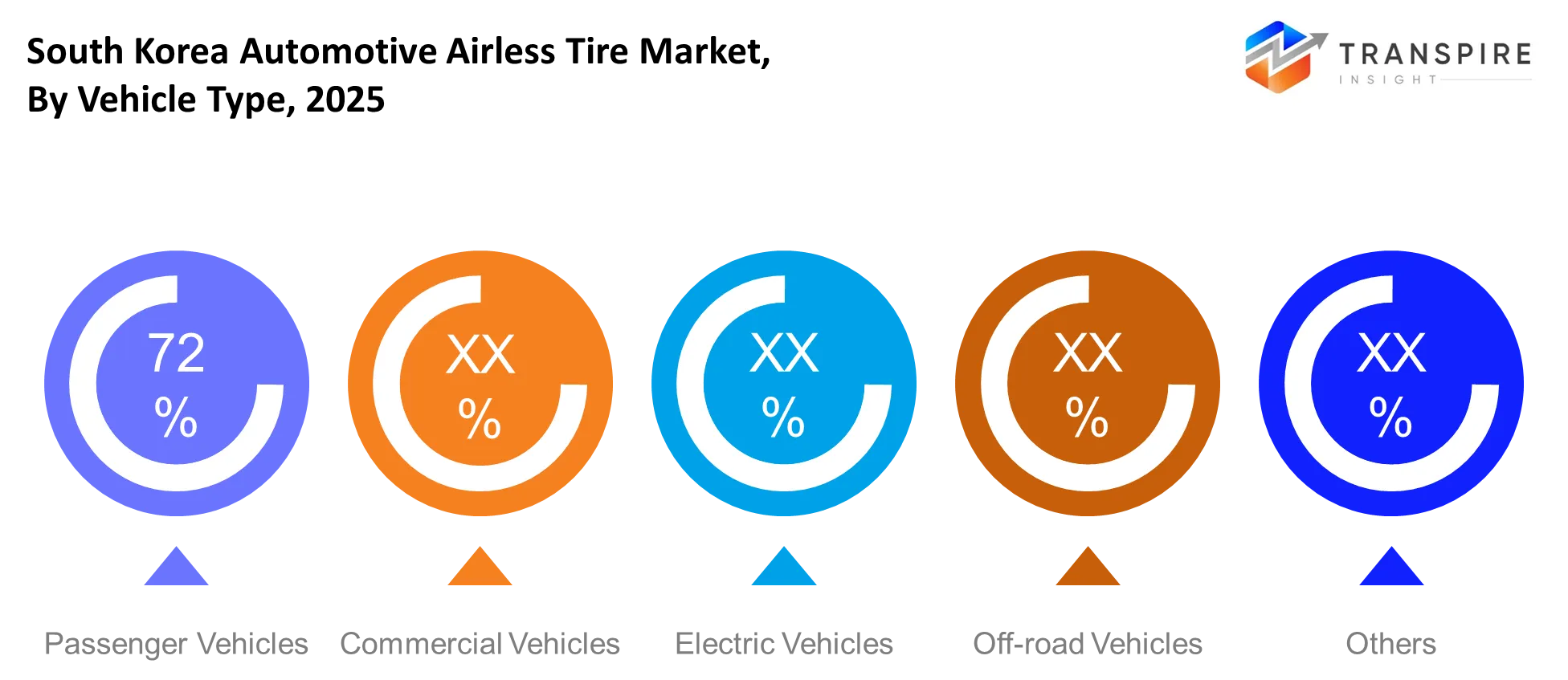
To learn more about this report, Download Free Sample Report
By Material
Polyurethane tires seem to take the leading spot because they’re flexible enough, they handle loads efficiently, and they don’t deform so easily when the stress keeps repeating, you know. They also fit nicely with those modular spoke-like frameworks, so they show up in a lot of prototype work and pilot-scale deployments. And honestly, the material maturity plus easier manufacturing kind of pushes them ahead during the first commercialization phase.
Composite rubber tires are starting to get more attention too, mainly for better durability and steadier performance when the road conditions swing around, especially for city mobility use cases. Then there are thermoplastic resin tires which are growing the quickest, as makers look for lighter build types that still manage strong energy absorption, without getting too fragile. Beyond that, you’ll also find experimental bio-composites, plus hybrid elastomers in ongoing development. Over the forecast period, thermoplastic materials should speed up adoption as production scales up, while polyurethane keeps its structural dominance through the early deployment cycles.
By Application
On road vehicles kind of hold the leading spot , mostly because there is widespread testing across EV passenger and commercial fleets, moving around in urban zones. In city logistics networks you get these high frequency stop-and-go moments and that makes airless tire systems look really attractive, mainly for cutting down maintenance downtime and keeping operational efficiency up. There’s also strong OEM involvement in on road pilot programs and it kinda strengthens this segment’s leadership role.
Military vehicles are seeing steady adoption, pushed by the need for puncture resistance in controlled defense mobility setups . Agricultural vehicles still maintain solid demand in low speed and high load working contexts, where durability is more important than ride comfort. Industrial vehicles are the one that is really growing, supported by warehouse automation and heavy equipment usage. Then there are other uses too, like autonomous delivery systems and robotics platforms.During the forecast period, industrial and on road applications will expand the fastest , since automation and logistics intensification end up reshaping the overall mobility demand structure.
By Distribution Channel
OEM sales keep the dominant position, largely because airless tire systems are plugged in directly into EV platforms , prototype fleets , and those mobility test programs too. There’s also strong teamwork between tire manufacturers and automotive OEMs, so validation happens early on, and deployment stays controlled. This is really what makes OEM channel leadership stick around.
For the aftermarket side, sales are still pretty limited but they’re slowly moving upward. Retrofit demand is starting to show up more in commercial and industrial fleets, so things are widening a bit. Online retail is the fastest moving channel for low-volume specialty uses, especially for experimental mobility and more niche industrial installs. There are also other paths, like direct institutional purchasing, for defense and government mobility initiatives. Over the forecast period, OEM dominance should remain in place since commercialization is still in the early stage. Meanwhile, the aftermarket channels should gradually broaden as standardization improves, and the cost hurdles slowly ease off, even if it’s not instant.
What are the Key Use Cases Driving the South Korea Automotive Airless Tire Market?
Core demand gets driven by electric passenger cars and light commercial fleets moving through dense urban areas, where airless tires cut down on stoppage time from punctures and also do away with pressure maintenance stuff. This use case keeps leading, basically because logistics teams care more about vehicle uptime , and more predictable operating costs, than they care about replacement cycles.
When it comes to expansion, last mile delivery vans show up a lot, plus shared mobility fleets run by e-commerce brands and ride hailing platforms. These groups like the consistent performance in stop and go traffic, and in high utilization routines. It’s especially noticeable along Seoul’s metropolitan logistics corridors.
Then there are emerging scenarios like autonomous delivery robots, and also defense mobility platforms, where reliability matters a ton for unmanned, or remote controlled operation. You see these systems getting tested more often inside controlled settings like smart industrial zones, and within restricted access logistics campuses.
|
Report Metrics |
Details |
|
Market size value in 2025 |
USD 32.59 Million |
|
Market size value in 2026 |
USD 34.42 Million |
|
Revenue forecast in 2033 |
USD 50.46 Million |
|
Growth rate |
CAGR of 5.62% from 2026 to 2033 |
|
Base year |
2025 |
|
Historical data |
2021 - 2024 |
|
Forecast period |
2026 - 2033 |
|
Report coverage |
Revenue forecast, competitive landscape, growth factors, and trends |
|
Regional scope |
South Korea |
|
Key company profiled |
Michelin, Bridgestone, Hankook Tire, Goodyear, Continental AG, Toyo Tire, Yokohama Rubber, Kumho Tire, Sumitomo Rubber Industries, MRF, Apollo Tyres, Pirelli, Nexen Tire, Tannus, Resilient Technologies |
|
Customization scope |
Free report customization (country, regional & segment scope). Avail customized purchase options to meet your exact research needs. |
|
Report Segmentation |
By Tire Type (Radial Airless Tires, Bias Airless Tires, Hybrid Airless Tires, Others); By Vehicle Type (Passenger Vehicles, Commercial Vehicles, Electric Vehicles, Off-road Vehicles, Others); By Material (Polyurethane Tires, Composite Rubber Tires, Thermoplastic Resin Tires, Others); By Application (On-road Vehicles, Military Vehicles, Agricultural Vehicles, Industrial Vehicles, Others); By Distribution Channel (OEM Sales, Aftermarket Sales, Online Retail, Others) |
Which Regions are Driving the South Korea Automotive Airless Tire Market Growth?
The Seoul Capital Region is basically leading the South Korea Automotive Airless Tire Market , mostly because it has a dense mix of EV fleets, logistics hubs, and those city mobility pilots going on, all together . On top of that there is strong government backing for cleaner transportation and smart city initiatives, so early adoption happens faster than elsewhere. Fleet operators here tend to care a lot about operational uptime , so airless tire systems feel more compelling . Also the big OEM testing centers nearby kind of make the whole ecosystem more mature sooner .
The Ulsan and Gyeonggi industrial belt acts more like a stable secondary region, led by automotive manufacturing muscle and deeper supplier integration. In contrast to Seoul which is more consumption oriented, this area leans into production linked testing plus validation. There, automotive OEM facilities and tire manufacturers run structured trials, under controlled setups and careful conditions. So adoption becomes consistent, but it still moves slower compared with the capital region, in a way that feels a bit less rushed .
Now the fastest growth is showing up around emerging logistics corridors near Daejeon and the southern distribution hubs, where e-commerce expansion keeps reshaping fleet expectations . Because of recent investments in automated warehousing and intercity delivery routes, demand for durable tire systems has been rising. That kind of change opens new doors for technology providers aiming at mid tier logistics operators. If things keep going, over 2026–2033 this region could turn into a real scaling zone for commercial deployment.
Who are the Key Players in the South Korea Automotive Airless Tire Market and How Do They Compete?
Competition in the South Korea Automotive Airless Tire Market is still, sort of moderately consolidated, with worldwide tire giants driving a lot of the early stage development while local players keep leaning on localization and repeated testing. The main battle is technology innovation, especially how well the structure is designed, and how durable the materials stay when EV loads get heavy. Everyone seems to be sprinting to lock in OEM partnerships , before mass commercialization really starts.
Michelin feels like the front-runner because it already put in place early airless tire commercialization initiatives, plus it does long term prototype testing inside mobility ecosystems. Their approach is mostly advanced structural engineering and partnerships with EV builders, just to validate how it actually works in real situations.
Bridgestone is pushing next generation non-pneumatic mobility systems, and it also works with autonomous vehicle developers. What makes it different is this integrated tire-suspension idea, kind of tuned for fleet based mobility platforms . That combined angle gives it more than just a tire, more like a system. Hankook Tire leans into regional leverage by aligning itself with South Korean OEMs and the testing environments that already exist there. It’s also expanding via EV-focused tire innovation programs, and then doing domestic pilot deployments to make sure the outcomes hold up.
Continental AG, meanwhile, is moving toward digitalized tire monitoring systems that pair with structural airless concepts, and that combo helps it stay strong in smart mobility ecosystems. Nexen Tire concentrates on localized adaptation, running road-condition-specific tests to improve performance reliability, especially in Korean urban settings where conditions can change quickly.
Company List
- Michelin
- Bridgestone
- Hankook Tire
- Goodyear
- Continental AG
- Toyo Tire
- Yokohama Rubber
- Kumho Tire
- Sumitomo Rubber Industries
- MRF
- Apollo Tyres
- Pirelli
- Nexen Tire
- Tannus
- Resilient Technologies
Recent Development News
In January 2026, Bridgestone announced an agreement to sell its tyre reinforcement business in China and Thailand to Bekaert. The restructuring strengthens Bridgestone’s focus on next-generation tire technologies, including non-pneumatic and EV-oriented tire systems, improving capital allocation toward advanced mobility R&D.https://www.bridgestone.com
In March 2025, Bridgestone and Michelin expanded joint pilot testing programs for puncture-free airless tire systems. The collaboration supports real-world trials for autonomous shuttles and fleet vehicles, accelerating commercialization pathways for airless tire platforms across Asia-Pacific mobility markets.https://www.ft.com
In 2025, Hankook Tire advanced its i-Flex airless tire development through mobility technology demonstrations in partnership with Hyundai Motor Group. The initiative focuses on improving structural flexibility and EV compatibility, supporting South Korea’s transition toward next-generation mobility ecosystems.https://www.tirereview.com
What Strategic Insights Define the Future of the South Korea Automotive Airless Tire Market?
South Korea's Automotive Airless Tire Market is kind of edging toward more structured commercialization, sorta anchored in EV fleet ecosystems and autonomous logistics platforms. The growth story seems to be fueled by long-term fleet cost optimization and connection with smart mobility infrastructure, not really by those traditional aftermarket replacement cycles. For the next 5–7 years, adoption will likely depend a lot on OEM validation and the ability to scale materials at, you know , volume.
There is also a risk that’s not super obvious, like a technology swap pressure from advanced self-healing pneumatic tires. That angle could lower the urgency for full airless adoption in mid-range fleets. On top of that, there s a constraint tied to dependence on specialized composite supply chains, which might cap production scaling.
Still, an opportunity is forming in autonomous delivery corridors and those closed-loop logistics campuses, where operational control helps enable earlier deployment of airless systems. Market players should focus on OEM integration partnerships and fleet pilot programs instead of doing standalone product launches. The goal is to lock in early positioning inside South Korea’s changing mobility ecosystem, not just get headlines.
South Korea Automotive Airless Tire Market Report Segmentation
By Tire Type
- Radial Airless Tires
- Bias Airless Tires
- Hybrid Airless Tires
- Others
By Vehicle Type
- Passenger Vehicles
- Commercial Vehicles
- Electric Vehicles
- Off-road Vehicles
- Others
By Material
- Polyurethane Tires
- Composite Rubber Tires
- Thermoplastic Resin Tires
- Others
By Application
- On-road Vehicles
- Military Vehicles
- Agricultural Vehicles
- Industrial Vehicles
- Others
By Distribution Channel
- OEM Sales
- Aftermarket Sales
- Online Retail
- Others
Frequently Asked Questions
Find quick answers to common questions.
The Estimated South Korea Automotive Airless Tire Market size for the Market will be USD 50.46 Million in 2033.
Key Segments for the South Korea Automotive Airless Tire Market are By Tire Type (Radial Airless Tires, Bias Airless Tires, Hybrid Airless Tires, Others); By Vehicle Type (Passenger Vehicles, Commercial Vehicles, Electric Vehicles, Off-road Vehicles, Others); By Material (Polyurethane Tires, Composite Rubber Tires, Thermoplastic Resin Tires, Others); By Application (On-road Vehicles, Military Vehicles, Agricultural Vehicles, Industrial Vehicles, Others); By Distribution Channel (OEM Sales, Aftermarket Sales, Online Retail, Others).
Major South Korea Automotive Airless Tire Market Players are Michelin, Bridgestone, Hankook Tire, Goodyear, Continental AG, Toyo Tire, Yokohama Rubber, Kumho Tire, Sumitomo Rubber Industries, MRF, Apollo Tyres, Pirelli, Nexen Tire, Tannus, Resilient Technologies.
The Current South Korea Automotive Airless Tire Market size is USD 32.59 Million in 2025.
The South Korea Automotive Airless Tire Market CAGR is 5.62% from 2026 to 2033.
- Michelin
- Bridgestone
- Hankook Tire
- Goodyear
- Continental AG
- Toyo Tire
- Yokohama Rubber
- Kumho Tire
- Sumitomo Rubber Industries
- MRF
- Apollo Tyres
- Pirelli
- Nexen Tire
- Tannus
- Resilient Technologies
Recently Published Reports
-
Apr 2026
ATV & UTV Market
ATV & UTV Market Size, Share & Analysis Report By Type (ATV, and UTV), By Variants (Less Than 400 CC, 400 CC To 800 CC, and More Than 800 CC), and Geography (North America, Europe, Asia-Pacific, Middle East and Africa, South and Central America), 2021 - 2031
-
Apr 2026
Automotive Central Gateway Module Market
Automotive Central Gateway Module Market Size, Share & Analysis Report By Type (Ethernet Central Gateway Module, CAN Central Gateway Module, LIN Central Gateway Module, and FlexRay), By Application (Powertrain Control, Body Control, Infotainment System, Advanced Driver Assistance Systems (ADAS), and Others), By End User (Passenger Vehicles, and Commercial Vehicles), and Geography (North America, Europe, Asia-Pacific, Middle East and Africa, South and Central America), 2021 - 2031
-
Apr 2026
Automotive Engine Oil Filter Market
Automotive Engine Oil Filter Market Size, Share & Analysis Report By Filter Type (Fuel Filter, Engine Oil Filter, Hydraulic Oil Filter, and Others), By Filter Media (Cellulose, Synthetic, and Micro), By Sales Channel (OEMs, and Aftermarket), By Vehicle Type (Passenger Cars, Light Commercial Vehicles, Heavy Duty Trucks, Buses and Coaches, and Off-road Vehicles), and Geography (North America, Europe, Asia-Pacific, Middle East and Africa, South and Central America), 2021 - 2031
-
Apr 2026
Automotive Parts Aluminium Die Casting Market
Automotive Parts Aluminium Die Casting Market Size, Share & Analysis Report By Production Process (Pressure Die Casting, Vacuum Die Casting, Squeeze Die Casting, Gravity Die Casting), By Application (Body Parts, Engine Parts, Transmission Parts, Battery And Related Components, Other Application Types), and Geography (North America, Europe, Asia-Pacific, Middle East and Africa, South and Central America), 2021 - 2031
Our Clients