
France Off-highway Vehicles Market Size & Forecast:
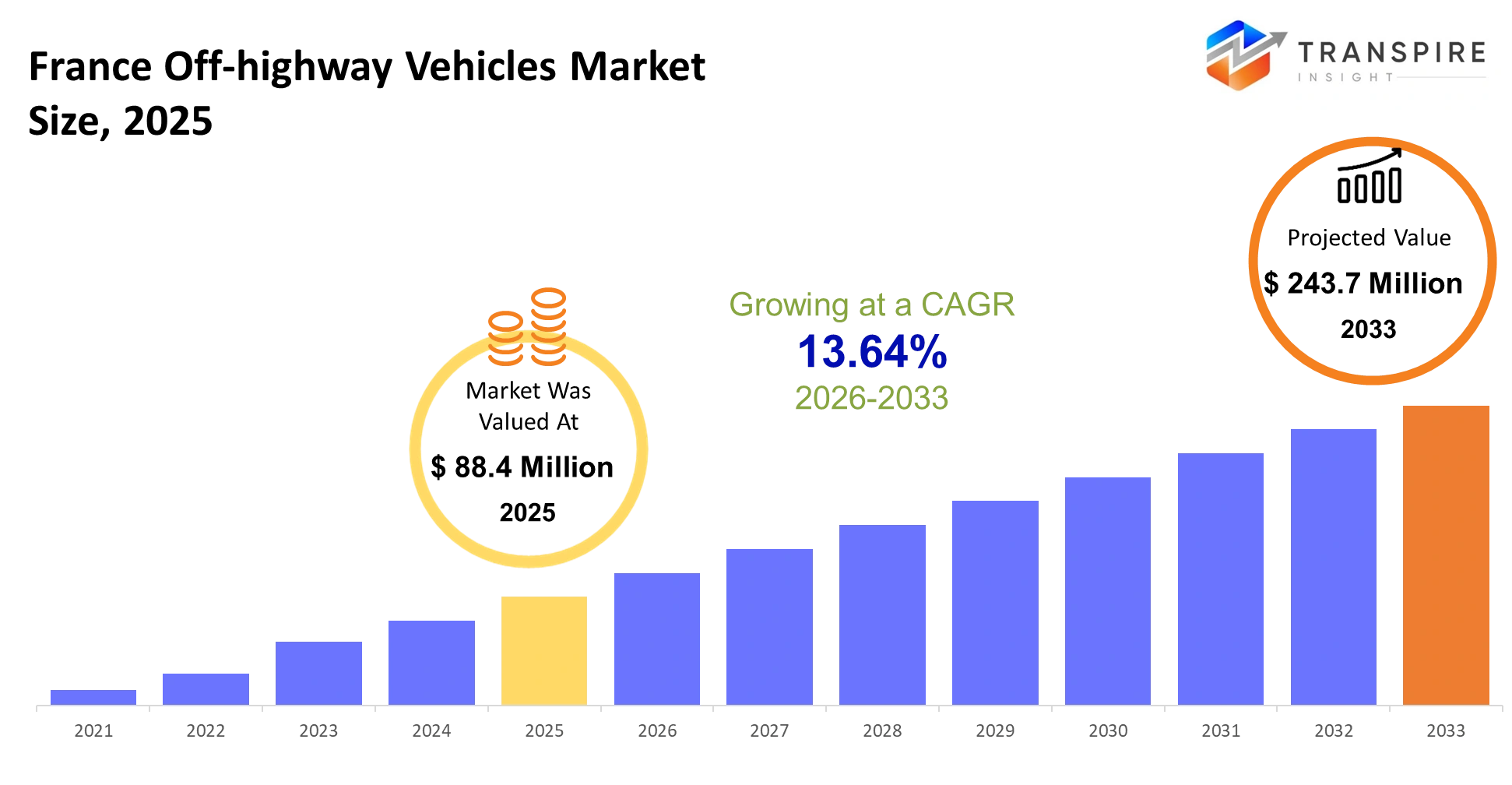
- France Off-highway Vehicles Market Size 2025: USD 88.4 Million
- France Off-highway Vehicles Market Size 2033: USD 243.7 Million
- France Off-highway Vehicles Market CAGR: 13.64%
- France Off-highway Vehicles Market Segments: By Type (Construction Equipment, Agricultural Machinery, Mining Equipment, Others); By Application (Construction, Agriculture, Mining, Forestry, Others); By End-User (Construction Firms, Farmers, Mining Companies, Government, Others); By Power Source (Diesel, Electric, Hybrid, Others)
To learn more about this report,  Download Free Sample Report
France Off-highway Vehicles Market Summary
The France Off-highway Vehicles Market was valued at USD 88.4 Million in 2025. It is forecast to reach USD 243.7 Million by 2033. That is a CAGR of 13.64% over the period.
The France Off-highway Vehicles Market serves all industrial activities which require vehicles to operate in areas that standard road vehicles cannot access for construction and agriculture and mining and forestry and infrastructure maintenance operations. These machines perform material handling activities through their capacity to transport heavy loads and they execute excavation and land preparation activities while enabling movement across construction sites in difficult terrain which necessitates equipment with high torque and long-lasting power and precise operational capabilities. The market has undergone a transformation during the past five years because fleet operators now prefer electric and digitally connected equipment which helps them achieve reduced fuel consumption and meet stricter emissions standards and increase equipment utilization.
The transition accelerated after European Stage V emission regulations and post-pandemic infrastructure stimulus programs increased pressure on contractors to modernize aging fleets. The requirement for construction and agricultural work has increased because of rising labor costs and reduced project completion time which drives operators to choose semi-autonomous machinery with telematics capabilities. Infrastructure and industrial projects experience increased equipment downtime costs which lead buyers to purchase advanced off-highway vehicles that include predictive maintenance systems and fuel optimization technology because these features create ongoing demand for equipment replacement and aftermarket service sales.
Key Market Insights
- The France Off-highway Vehicles Market showed increased fleet modernization efforts because Stage V emissions standards required operators to replace their old diesel equipment.
- The Northern France region controlled almost 36% of the market share in 2025 because construction projects and logistics infrastructure developments created demand for their services.
- The Southern France market experienced its fastest growth period from 2026 to 2033 because of increased investments in renewable energy and rail infrastructure.
- The construction equipment segment emerged as the market leader because public infrastructure rehabilitation projects required additional excavator and loader equipment.
- The agricultural off-highway vehicle segment became the second largest segment because commercial farmers now use precision agriculture methods and advanced farming equipment.
- The electric and hybrid off-highway vehicle market experienced its fastest growth after 2023 because contractors wanted to reduce their operational and legal compliance expenditures.
- Infrastructure construction accounted for more than 41% of application distribution in 2025 because metropolitan areas experienced growth in transportation and urban redevelopment initiatives.
- Smart farming applications achieved their fastest growth through the use of GPS-guided tractors and AI-enabled harvest systems which enhanced agricultural productivity and fuel efficiency.
- Manufacturers developed more partnerships with software and battery companies to enhance their capabilities in predictive maintenance and remote diagnostics and fleet utilization analytics.
- The manufacturing industry formed new partnerships between software developers and battery manufacturers to enhance their predictive maintenance and remote diagnostics and fleet utilization analytics capabilities.
What are the Key Drivers, Restraints, and Opportunities in the France Off-highway Vehicles Market?
The French Off-highway Vehicles Market experiences its fastest growth because French and European investment programs fund major modernization efforts of transportation, energy, and public infrastructure assets. Contractors and industrial operators had to accelerate their diesel fleet retirement schedule because Stage V emissions regulations required them to do so. Construction companies increasingly purchase advanced excavators and loaders and dump vehicles which come with telematics and fuel optimization systems because project delays and fuel price fluctuations directly impact their operating costs. The transition has created increased demand for equipment replacement together with market growth in financing operations and aftermarket service agreements.
The most significant restraint remains the high acquisition and ownership cost of technologically advanced off-highway equipment. Electrified powertrains autonomous systems and AI-enabled fleet monitoring technologies require expensive hardware integration and specialized maintenance capabilities. Smaller contractors and agricultural operators often delay fleet replacement because financing costs and supply chain volatility increase total ownership expenses over multiple years. Advanced equipment adoption faces obstacles from this structural cost barrier which affects regional and mid-sized industrial operations leading to slower market growth.
A major opportunity is emerging through electrified construction and agricultural machinery designed for low-emission urban projects and precision farming applications. The market for battery-powered compact loaders and autonomous tractors is increasing in areas that enforce environmental procurement standards and experience labor shortages. The development of hydrogen-powered heavy equipment together with connected fleet management platforms is creating new investment opportunities.
What Has the Impact of Artificial Intelligence Been on the France Off-highway Vehicles Market?
The use of artificial intelligence and modern digital technologies causes changes to off-highway vehicle operations which apply to construction and agriculture and mining and industrial logistics work in France. Equipment manufacturers increasingly integrate AI-driven telematics systems into excavators, tractors, loaders, and dump trucks to automate fleet monitoring and route optimization and operational control functions. The use of real-time machine data enables contractors and fleet operators to monitor fuel consumption and idle time and operator behavior and equipment utilization throughout extensive construction projects.
Machine learning models support predictive maintenance through their analysis of vibration patterns and hydraulic pressure fluctuations and engine temperatures and component wear conditions which precede critical failures. These systems assist operators in decreasing unexpected equipment downtime while they enhance fleet operational capacity and prolong asset operational periods. Precision agriculture equipment equipped with AI-guided navigation and sensor-based field analytics further improves planting accuracy and fertilizer application efficiency and fuel management. Multiple industrial operators achieved measurable decreases in maintenance expenses and fuel consumption after they implemented connected fleet intelligence systems.
AI-enabled fleet systems enhance project scheduling efficiency while they prevent equipment misuse and they improve emissions compliance reporting which meets European environmental standards. The current adoption of the technology faces obstacles because of expensive integration requirements and the presence of disconnected digital systems at small organizations and the lack of reliable field network coverage in isolated industrial and agricultural locations.
Key Market Trends
- The construction industry began its transition from diesel-powered equipment when French authorities enforced new Stage V emission regulations which made existing diesel equipment unlawful in 2023.
- The period between 2024 and 2026 saw people adopt electric compact loaders and mini excavators for urban building projects and quiet construction work.
- The agricultural sector witnessed a rise in GPS-equipped tractor adoption together with autonomous harvesting technology as operators utilized these systems to achieve better fuel savings and decrease their need for seasonal workers.
- The companies Caterpillar and Komatsu implemented telematics systems across their entire machinery fleets to enhance their capacity for forecast maintenance and remote operational equipment evaluation.
- Hydrogen-powered construction vehicle pilot programs began in Western France because local authorities had increased their funding for low-emission sustainable infrastructure projects.
- The rental industry developed new off-highway equipment leasing systems because mid-sized construction companies reduced their equipment ownership through rising interest rates.
- Manufacturers established local production facilities for their components because supply chain interruptions from 2021 to 2024 forced them to create backup plans for their component requirements.
- European construction equipment manufacturers and battery suppliers established strategic alliances to speed up the development of electric-powered heavy machinery in the European market.
- AI-powered fleet analysis systems enhanced equipment availability and improved project management for major infrastructure construction companies after 2024.
- The agricultural industry experienced substantial smart farming investment growth because precision farming technology decreased fertilizer usage while increasing commercial farm production capacity.
France Off-highway Vehicles Market Segmentation
By Type
The construction equipment sector dominates the market because ongoing infrastructure modernizations and railway expansions and urban redevelopment projects together create high demand for equipment purchases throughout France. Contractors who operate public and private construction projects that require extensive material handling need excavators and loaders and bulldozers and compact earthmoving machines for their work. The need to replace Stage V-compliant machinery creates a continuous demand for construction businesses to invest in advanced equipment fleets.
The agricultural machinery market holds the second-largest market share because commercial farming operations increasingly adopt mechanization and precision agriculture technologies. GPS-guided tractors and automated harvest systems and telematics-enabled equipment help large farming enterprises achieve higher productivity and better fuel efficiency. Mining equipment displays stable demand because quarry operations and mineral extraction activities require heavy-duty machinery that can withstand challenging operational environments. The “others” category, which includes forestry and industrial handling equipment, experiences gradual growth because biomass projects and land management operations expand throughout regional industrial sectors. The forecast period will see manufacturers focus on developing electrification and autonomous controls and connected fleet technologies for all vehicle types.
By Application
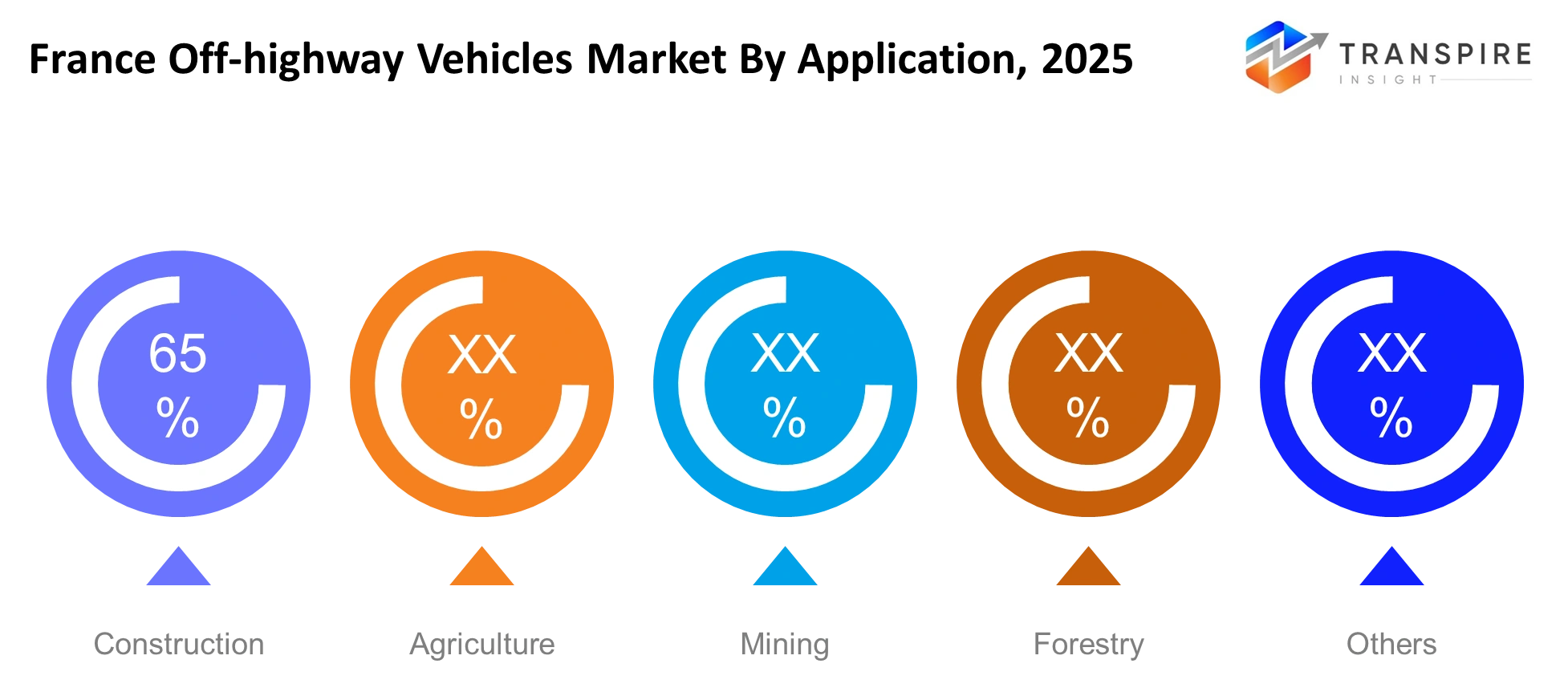
Construction stands as the primary industrial sector because heavy equipment usage remains essential for public infrastructure projects and transportation improvements and commercial real estate expansion. Contractors now use advanced off-highway vehicles to boost project productivity while decreasing fuel expenses in order to comply with new environmental standards. The ongoing redevelopment projects in major French cities create constant demand for both lightweight and heavy-duty construction equipment.
Agricultural operations show consistent growth because precision farming technologies enhance productivity while decreasing the need for human labor during harvesting and planting. Mining companies maintain their investment in modern haulage and excavation technologies to achieve better output and machinery performance in extreme work environments. Forestry applications show steady development because sustainable land management practices and biomass energy initiatives need special off-road vehicles to handle timber and access different terrains. The "others" category, which includes industrial logistics and municipal maintenance, is making progress as regional authorities upgrade their fleet systems. The upcoming years will see application development shift towards three main focus areas which include low-emission operations and autonomous navigation systems and AI-assisted fleet management solutions.
To learn more about this report, Download Free Sample Report
By End-User
Construction companies hold the main market share because infrastructure builders need to acquire substantial quantities of excavators and loaders and dump trucks and compact machines for their ongoing work activities. Public investment in transportation infrastructure and renewable energy facilities continues strengthening procurement activity among large and mid-sized construction companies. Equipment rental partnerships and fleet modernization programs create extended purchasing stability for the construction industry.
Farmers represent one of the fastest-growing end-user segments as commercial agriculture operations increasingly adopt precision farming technologies and automated machinery systems. Mining companies maintain their investments in robust off-highway vehicles which incorporate predictive maintenance systems and fuel optimization technologies to decrease their operational downtime. Government organizations maintain stable procurement activity through municipal infrastructure projects, road maintenance programs, and environmental land management operations. The “others” category, which contains logistics operators and forestry service providers, is expanding because industrial sectors need specialized off-road transportation solutions. Manufacturers will introduce more interconnected equipment platforms which provide specific operational capabilities throughout the forecast period.
By Power Source
The diesel engine system maintains its dominant market share because heavy construction equipment and mining machinery and agricultural machines need high torque and continuous operation and established diesel fuel systems. The construction industry and industrial companies still choose diesel equipment because their work requires operations in locations without reliable battery charging networks. The strong resale value and extensive maintenance services available for diesel equipment drive its adoption throughout various regional markets. Electric off-highway vehicles are experiencing fast growth because upcoming emissions regulations and construction noise control standards push cities to adopt electric-powered vehicles for their building projects. Battery-powered systems are becoming common in compact loaders and mini excavators and utility machinery to decrease fuel usage and meet environmental standards.
Fleet operators prefer hybrid power systems because these systems provide operational efficiency with lower emissions and extended operating time without needing complete charging. The category of "others" now consists of hydrogen-powered vehicles and alternative fuel vehicles which are becoming more visible as manufacturers start working on their development of next-generation low-emission heavy machinery technologies. The powertrain development process will increasingly concentrate on developing battery efficiency and improving charging speed and creating hydrogen systems and building advanced energy management systems until the end of the forecast period.
What are the Key Use Cases Driving the France Off-highway Vehicles Market?
The primary use case that drives French off-highway vehicle adoption remains infrastructure construction. Rail expansion projects and highway rehabilitation projects and urban redevelopment projects and renewable energy projects require extensive use of excavators and loaders and dump trucks and compact earthmoving equipment. The construction industry shows strong equipment demand because public infrastructure projects require completion within strict time limits which construction contractors and equipment rental companies need to fulfill.
The agricultural sector and industrial material handling sector are experiencing continuous growth in precision agricultural and industrial material handling solutions. Agricultural operators increasingly adopt GPS-controlled tractors and automatic harvesting systems and telematics-equipped equipment to increase their agricultural efficiency and decrease their fuel consumption. Mining and quarry operators continue to modernize their equipment fleets to enhance their operational safety while decreasing their equipment maintenance requirements.
The construction industry is testing two new technologies which include electric compact construction vehicles for low-emission urban projects and hydrogen-powered heavy machinery for industrial infrastructure operations. The combination of autonomous site equipment with AI-powered fleet management systems creates long-term value which companies need to adapt to changing workforce requirements and emissions regulations.
|
Report Metrics |
Details |
|
Market size value in 2025 |
USD 88.4 Million |
|
Market size value in 2026 |
USD 99.6 Million |
|
Revenue forecast in 2033 |
USD 243.7 Million |
|
Growth rate |
CAGR of 13.64% from 2026 to 2033 |
|
Base year |
2025 |
|
Historical data |
2021 - 2024 |
|
Forecast period |
2026 - 2033 |
|
Report coverage |
Revenue forecast, competitive landscape, growth factors, and trends |
|
Regional scope |
France |
|
Key company profiled |
Caterpillar, Komatsu, Volvo, John Deere, Hitachi Construction, Liebherr, CNH Industrial, JCB, Doosan, Kubota, Hyundai, Terex, Sany, XCMG, Mahindra |
|
Customization scope |
Free report customization (country, regional & segment scope). Avail customized purchase options to meet your exact research needs. |
|
Report Segmentation |
By Type (Construction Equipment, Agricultural Machinery, Mining Equipment, Others); By Application (Construction, Agriculture, Mining, Forestry, Others); By End-User (Construction Firms, Farmers, Mining Companies, Government, Others); By Power Source (Diesel, Electric, Hybrid, Others) |
Which Regions are Driving the France Off-highway Vehicles Market Growth?
The primary market of Northern France maintains its position because essential infrastructure projects and logistical centers and industrial construction work create ongoing requirements for equipment. The area benefits from its extensive highway systems and new railway development projects and its location near international trade routes that link Belgium with Germany. The major construction companies together with equipment rental businesses operate extensive fleet networks throughout the Hauts-de-France region and its industrial areas. The region maintains high off-highway vehicle usage because of its well-established system of component suppliers and maintenance services and financing institutions.
The agricultural sector in Western France combined with its renewable energy development projects makes this area a dependable business partner. Northern France receives less construction activity than its cities while its economic growth depends on agricultural development projects and energy infrastructure construction. The commercial farming industry in Brittany and Pays de la Loire shows consistent demand for tractors and harvest systems and land management equipment. The western market maintains its equipment acquisition patterns because of ongoing regional funding and regular fleet upgrades.
Southern France has become the fastest-expanding area because renewable energy projects and urban transportation systems and low-emission building initiatives receive increased funding. Regional authorities increasingly prioritize electric and hybrid machinery procurement to comply with stricter environmental standards introduced after 2023. The expansion of hydrogen infrastructure pilots and smart city development programs increased the need for innovative off-highway equipment.
Who are the Key Players in the France Off-highway Vehicles Market and How Do They Compete?
The France Off-highway Vehicles Market maintains its competitive nature because international manufacturers compete through their technological advances and fuel-efficient products and durable machinery and post-sale service options. The large companies in the market maintain their market share through expanding their dealer networks and developing predictive maintenance systems and building their electric equipment collections, while Asian companies enter the market with lower prices for their compact and mid-sized equipment. Fleet operators now use software connectivity and lifecycle operating costs and emissions compliance to select equipment instead of relying on machine performance for their choices.
Caterpillar improves its competitive position through its connected fleet management systems and predictive maintenance analytics and fuel-efficient heavy machinery which is built for major infrastructure projects. Komatsu sets itself apart from others through its autonomous haulage systems and AI-powered construction site optimization technologies which boost equipment efficiency while decreasing operational downtime. Volvo Construction Equipment concentrates its efforts on developing electrified compact machinery together with low-emission construction equipment which meets environmental regulations for urban infrastructure projects.
John Deere achieves strong market presence in precision agriculture through its GPS-guided tractors and autonomous farming systems and cloud-based field analytics platforms which help large commercial farms operate more efficiently. JCB expands its hydrogen-powered machinery development effort to create unique advantages in sustainable construction equipment markets. Chinese companies including SANY and XCMG have started to compete more aggressively by lowering their prices and extending their distribution networks to European markets.
Company List
- Caterpillar
- Komatsu
- Volvo
- John Deere
- Hitachi Construction
- Liebherr
- CNH Industrial
- JCB
- Doosan
- Kubota
- Hyundai
- Terex
- Sany
- XCMG
- Mahindra
Recent Development News
In March 2026, Volvo Construction Equipment launched upgraded electric compact excavators and wheel loaders for European construction markets. The launch strengthened Volvo’s low-emission equipment portfolio for urban infrastructure projects and accelerated electrified machinery adoption across France. Source URL:http://www.volvoce.com
In February 2026, JCB announced expansion of hydrogen combustion engine testing across heavy construction equipment platforms. The development strengthened alternative fuel technology investment and supported France’s low-emission infrastructure equipment transition strategy. Source URL:http://www.jcb.com
What Strategic Insights Define the Future of the France Off-highway Vehicles Market?
The France Off-highway Vehicles Market currently develops toward intelligent machinery which includes low-emission technology and software-based systems rather than through sales of individual equipment items. The industry now requires construction and agricultural and industrial sectors to adopt new fleet buying methods because of electrification requirements and growing infrastructure automation and fuel efficiency demands. Future market leadership will depend less on engine capacity alone and more on data integration, predictive maintenance capability, and lifecycle operating efficiency. The company faces a hidden risk because it depends on imported battery materials and semiconductors and electronic control systems.
Any supply chain problems together with trade limitations from geopolitical issues will result in increased production expenses and shipment delays for fleet upgrades throughout Europe. Hydrogen-powered heavy machinery creates a significant new market opportunity which benefits large construction and quarry operations that face battery capacity challenges. Manufacturing companies and investors must establish partnerships with software developers and battery companies and fleet analytics organizations instead of concentrating on expanding their mechanical equipment inventory. Companies that combine alternative powertrain innovation with connected fleet intelligence will likely secure the strongest long-term competitive positioning between 2026 and 2033.
France Off-highway Vehicles Market Report Segmentation
By Type
- Construction Equipment
- Agricultural Machinery
- Mining Equipment
- Others
By Application
- Construction
- Agriculture
- Mining
- Forestry
- Others
By End-User
- Construction Firms
- Farmers
- Mining Companies
- Government
- Others
By Power Source
- Diesel
- Electric
- Hybrid
- Others
Frequently Asked Questions
Find quick answers to common questions.
The confirmed 2033 market size figure in USD 243.7 Million.
Key segments for the France Off-highway Vehicles Market are By Type (Construction Equipment, Agricultural Machinery, Mining Equipment, Others); By Application (Construction, Agriculture, Mining, Forestry, Others); By End-User (Construction Firms, Farmers, Mining Companies, Government, Others); By Power Source (Diesel, Electric, Hybrid, Others).
Major France Off-highway Vehicles Market players are Caterpillar, Komatsu, Volvo, John Deere, Hitachi Construction, Liebherr, CNH Industrial, JCB, Doosan, Kubota, Hyundai, Terex, Sany, XCMG, Mahindra.
The France Off-highway Vehicles Market size is USD 88.4 Million in 2025.
The France Off-highway Vehicles Market CAGR is 13.64% from 2026 to 2033.
- Caterpillar
- Komatsu
- Volvo
- John Deere
- Hitachi Construction
- Liebherr
- CNH Industrial
- JCB
- Doosan
- Kubota
- Hyundai
- Terex
- Sany
- XCMG
- Mahindra
Recently Published Reports
-
Apr 2026
ATV & UTV Market
ATV & UTV Market Size, Share & Analysis Report By Type (ATV, and UTV), By Variants (Less Than 400 CC, 400 CC To 800 CC, and More Than 800 CC), and Geography (North America, Europe, Asia-Pacific, Middle East and Africa, South and Central America), 2021 - 2031
-
Apr 2026
Automotive Central Gateway Module Market
Automotive Central Gateway Module Market Size, Share & Analysis Report By Type (Ethernet Central Gateway Module, CAN Central Gateway Module, LIN Central Gateway Module, and FlexRay), By Application (Powertrain Control, Body Control, Infotainment System, Advanced Driver Assistance Systems (ADAS), and Others), By End User (Passenger Vehicles, and Commercial Vehicles), and Geography (North America, Europe, Asia-Pacific, Middle East and Africa, South and Central America), 2021 - 2031
-
Apr 2026
Automotive Engine Oil Filter Market
Automotive Engine Oil Filter Market Size, Share & Analysis Report By Filter Type (Fuel Filter, Engine Oil Filter, Hydraulic Oil Filter, and Others), By Filter Media (Cellulose, Synthetic, and Micro), By Sales Channel (OEMs, and Aftermarket), By Vehicle Type (Passenger Cars, Light Commercial Vehicles, Heavy Duty Trucks, Buses and Coaches, and Off-road Vehicles), and Geography (North America, Europe, Asia-Pacific, Middle East and Africa, South and Central America), 2021 - 2031
-
Apr 2026
Automotive Parts Aluminium Die Casting Market
Automotive Parts Aluminium Die Casting Market Size, Share & Analysis Report By Production Process (Pressure Die Casting, Vacuum Die Casting, Squeeze Die Casting, Gravity Die Casting), By Application (Body Parts, Engine Parts, Transmission Parts, Battery And Related Components, Other Application Types), and Geography (North America, Europe, Asia-Pacific, Middle East and Africa, South and Central America), 2021 - 2031
Our Clients