South Korea Electric Vehicle Motor Market Size & Forecast:
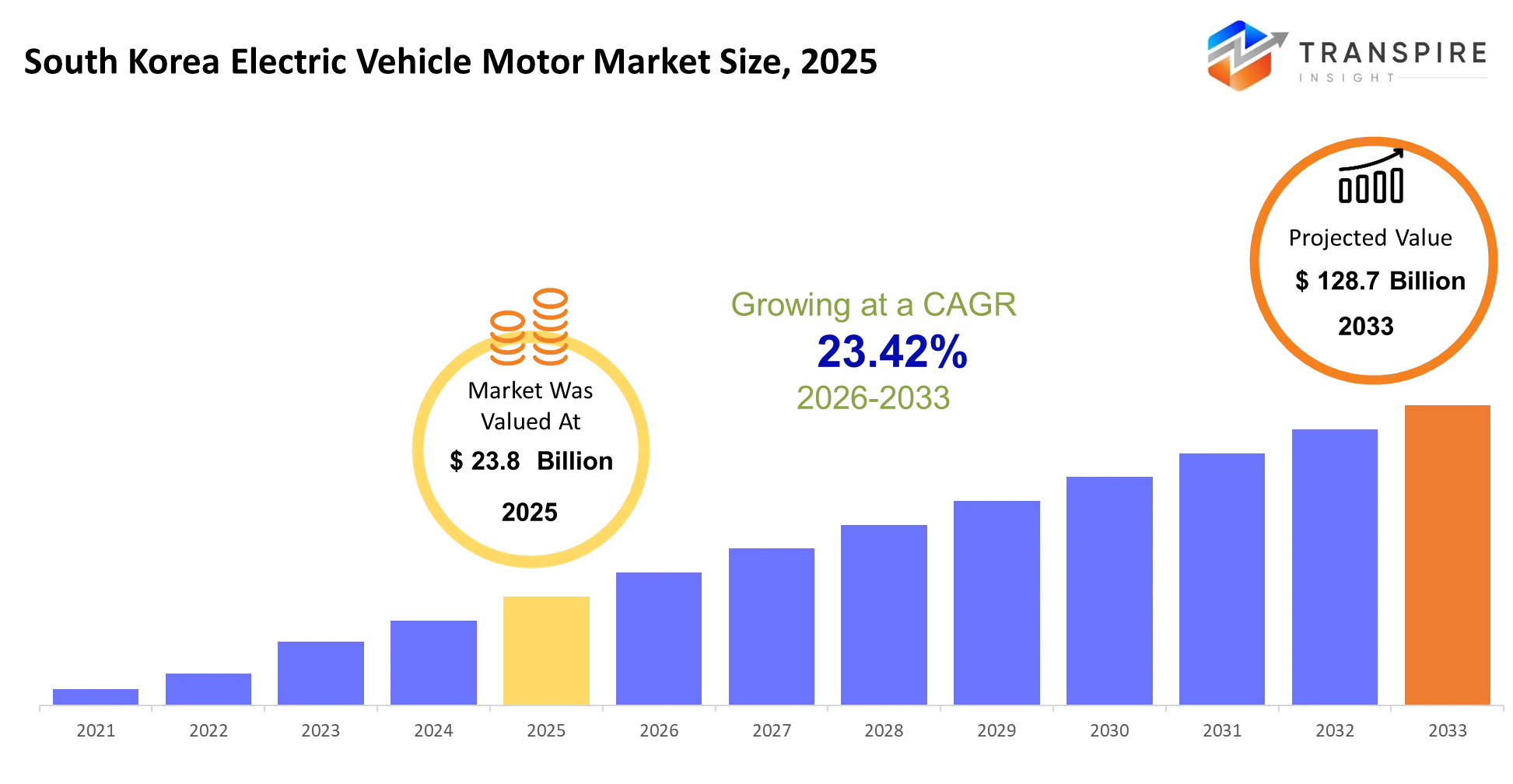
- South Korea Electric Vehicle Motor Market Size 2025: USD 23.8 Billion
- South Korea Electric Vehicle Motor Market Size 2033: USD 128.7 Billion
- South Korea Electric Vehicle Motor Market CAGR: 23.42%
- South Korea Electric Vehicle Motor Market Segments: By Motor Type (Permanent Magnet Synchronous Motors, Induction Motors, Brushless DC Motors, Switched Reluctance Motors, Others); By Vehicle Type (Passenger EVs, Commercial EVs, Electric Buses, Hybrid Vehicles, Others); By Application (Traction Motors, Auxiliary Motors, Power Steering Motors, Others); By Power Output (Below 100 kW, 100–250 kW, Above 250 kW, Others); By End User (Automotive OEMs, Motor Manufacturers, Fleet Operators, Others)
To learn more about this report,  Download Free Sample Report
South Korea Electric Vehicle Motor Market Summary
The South Korea Electric Vehicle Motor Market was valued at USD 23.8 Billion in 2025. It is forecast to reach USD 128.7 Billion by 2033. That is a CAGR of 23.42% over the period.
South Korea Electric Vehicle Motor Market kind of sits right in the middle of how battery power gets turned into real motion across passenger cars, buses, last mile delivery fleets, and even industrial mobility systems. In practice EV motors decide how torque comes through, how quickly the vehicle can ramp up, whether thermal stability holds under stress and, in the end, how far the car can go. So yeah, it becomes one of those performance-critical pieces in electric transportation, not something you can treat as “secondary”.
In the last five years the market has been moving away from the more conventional induction motors toward high-efficiency permanent magnet synchronous motors, mainly because automakers were chasing longer driving ranges and lighter vehicle layouts. That shift actually got more momentum when carbon neutrality targets tightened and when South Korea expanded its EV subsidy framework, which in turn backed domestic production and more local sourcing of powertrain components. Also during the global semiconductor shortage, supply chain disruptions weren’t just a delay, they pushed manufacturers to rethink motor control systems and use more diversified sourcing approaches.
Meanwhile, as battery costs kept sliding down bit by bit and electrification expanded beyond private vehicles into commercial fleets, motor suppliers started to hold stronger pricing influence, they gained larger production volumes, and they found deeper integration chances with automotive OEMs and battery manufacturers alike.
Key Market Insights
- The South Korea Electric Vehicle Motor market kind of shifted strongly toward permanent magnet synchronous motors, and by 2025 they will be over 60% share because of those efficiency advantages.
- Meanwhile passenger electric vehicles really did dominate industry demand, with nearly 68% market share, and Hyundai and Kia accelerated dedicated EV platform production.
- In the meantime, Busan and Gyeonggi regions emerged as major manufacturing hubs, backed by battery ecosystem investments, and also the government pushed for automotive cluster expansion initiatives.
- On top of that, commercial electric vehicles became the fastest growing segment after 2023. This happened mainly from logistics fleet electrification, plus stricter urban emission control policies that kept tightening.
- Between 2022 and 2025 integrated e-axle systems gained traction , since manufacturers reduced drivetrain weight and improved energy conversion efficiency by nearly 15%.
- Also, the South Korea Electric Vehicle Motor Market saw stronger domestic sourcing after semiconductor disruptions showed how much dependency there was on imported motor control components.
- AI-enabled thermal management systems improved motor efficiency and battery synchronization too, which helped EV manufacturers extend driving range even under high-load operating conditions.
- Hyundai Motor Company, Kia Corporation, LG Energy Solution, and Samsung SDI also expanded strategic partnerships for integrated EV powertrain development.
- And after 2024, axial flux motor technology drew new R&D investments, because automakers wanted lighter motors and higher torque density for premium EV models.
- Finally, export-oriented manufacturers increased investments in silicon carbide inverters and advanced motor controllers, so they can boost global competitiveness and reduce energy losses overall.
What are the Key Drivers, Restraints, and Opportunities in the South Korea Electric Vehicle Motor Market?
The main driver pushing the South Korea Electric Vehicle Motor Market forward is the country’s aggressive shift toward electrification, together with a big domestic EV manufacturing push that’s happening in parallel. In practice, government incentives for zero-emission vehicles, tighter fleet emission requirements, plus dedicated spending on charging infrastructure basically motivated automakers to ramp up electric vehicle production quickly right after 2021 . That rise then boosts demand for high-efficiency traction motors, integrated e-axles, and more advanced thermal management systems too. And as automakers rolled out dedicated EV platforms, motor suppliers also got pulled in by long-term procurement deals and bigger production volumes. Somehow this helps with manufacturing economies of scale and keeps revenue more stable, even when the market mood shifts a bit.
Still, the biggest restraint stays the structural reliance on rare earth materials used in permanent magnet motors. Neodymium and dysprosium supply chains are not really anchored inside South Korea, so they’re concentrated elsewhere and that opens the door to price swings and geopolitical concerns. Unfortunately this cannot be fixed fast, because swapping to other motor chemistries, or building localized rare earth processing capabilities, needs huge capital outlays and takes a long time to mature. So in the end, production costs run higher, and there can be periodic bumps in vehicle release timelines. It’s not dramatic every quarter, but it shows up.
Looking ahead, one notable opportunity is next-generation axial flux motors, along with silicon carbide based power electronics. South Korean automakers, along with component suppliers, are startin g to spend more on compact, lighter propulsion setups that can sit nicely in premium EVs , but also work for commercial electric fleets. Meanwhile the shift toward software-defined vehicles and high voltage architectures is basically creating good conditions for newer motor tech. With these changes, you can get better torque density, and they also help with faster, more dependable charging, which seems to be the point really.
What Has the Impact of Artificial Intelligence Been on the South Korea Electric Vehicle Motor Market?
Artificial intelligence is starting to reshape the South Korea Electric Vehicle Motor Market, kind of quietly at first then all at once, by lifting motor efficiency, doing predictive diagnostics, and pushing automated manufacturing precision to a different level. EV manufacturers today are using AI based analytics for motor calibration, for thermal behavior, and even for battery-to-motor energy distribution in real time, so the whole drivetrain can respond faster than before. With advanced machine learning systems they keep watching torque patterns, temperature swings, and what the vehicle is actually doing on the road, basically turning that information into fewer energy losses and a longer stretch of operational efficiency.
In the manufacturing facilities, AI enabled inspection systems are now doing the rotor alignment verification, winding accuracy checks, and defect detection during motor assembly. As a result, production mistakes are down, and output steadiness looks better, especially for high volume EV production lines. Beyond that, automotive suppliers rely on predictive maintenance algorithms to catch bearing wear, inverter degradation, and cooling system irregularities before they turn into real failures. Fleet operators, in turn, usually see less unexpected downtime, and maintenance expenses tend to drop too.
Also, AI powered digital twins are getting more and more important for simulating how the motor performs when driving loads change, and when weather conditions shift. With these simulations, manufacturers can cut down development timelines and hit efficiency targets earlier, before physical prototyping even starts. Some EV makers say they saw real, measurable improvements in drivetrain efficiency along with reduced thermal losses after they integrated AI assisted control approaches.
Still, AI adoption is not perfectly smooth. There are limits tied to integration costs and messy, fragmented operational data.Smaller component suppliers often don’t have standardized data sets, and without that, predictive modeling accuracy can sort of slip. At the same time, top tier AI solutions usually need advanced semiconductor infrastructure and specialized engineering know how, which many groups have a hard time to obtain or keep.
Key Market Trends
- Permanent magnet synchronous motors kinda replaced the older induction setups across most EV models between 2021 and 2025, because the energy efficiency was simply better, or at least that’s what everyone kept saying.
- Hyundai Motor Group then expanded a dedicated EV platform production after 2023, which bumped up the need for integrated e-axle motor assemblies across domestic supply chains, more than before.
- Motor manufacturers also went harder on localization strategies after the semiconductor shortages, since those shortages kinda messed up the imported inverter and controller component flow during 2021 and 2022.
- Then silicon carbide inverter adoption picked up a lot after 2024, and it improved drivetrain efficiency by nearly 5% in high-voltage electric vehicle architectures, which sounds small but it adds up in practice.
- Commercial fleet electrification gained momentum too, because logistics operators leaned toward electric delivery vans as urban emissions rules got stricter.
- South Korean suppliers increased investment in axial flux motor research, while automakers pursued lighter propulsion systems for premium and performance EV platforms, you know the kind of “fast but efficient” direction.
- AI-enabled predictive maintenance tools became more common inside EV production plants, and they reduced the unplanned equipment downtime, improving manufacturing consistency at the same time.
- Battery and motor integration partnerships also intensified between LG Energy Solution, Samsung SDI, and domestic automakers, aiming to optimize drivetrain performance and thermal stability, more or less in sync.
- Export-focused suppliers expanded capacity in Gyeonggi Province and Ulsan to keep up with the rising EV motor demand coming from North American and European markets, and that pressure kept building.
- Finally, Automotive OEMs increasingly adopted software-controlled motor management systems, to sharpen regenerative braking precision and extend vehicle driving range, even when conditions change.
South Korea Electric Vehicle Motor Market Segmentation
By Motor Type
Permanent Magnet Synchronous Motors basically keep the first place in the South Korea Electric Vehicle Motor Market, mainly because they’re high in efficiency, they come in a compact layout, and the torque delivery stays strong. Because of that, vehicle makers tend to choose this motor family for premium and mid-range EV setups where squeezing more driving range is still a major must. When you look at large-scale manufacturing, the roll-out across passenger EV production lines kind of strengthens the sense that they’re already dominant in today’s installations.
This particular segment grows as passenger vehicles get electrified faster and as buyers ask for more energy efficient powertrains. Induction motors still get picked for cost sensitive, and durability minded roles, especially in some commercial platforms where the rare-earth dependency needs to be kept down. Meanwhile, Brushless DC motors are starting to show up more in auxiliary units and in lighter electric cars, and switched reluctance motors are also getting attention as an alternative option because they rely less on those same materials. There are also other kinds such as experimental high-speed motor architectures. Over the forecast window, induction motors and switched reluctance motors should keep expanding, sort of in a steady way, since supply chain diversification is becoming a strategic priority for manufacturers.
By Vehicle Type
Passenger EVs are basically the ones taking over the South Korea Electric Vehicle Motor Market, not because it’s just “whatever” but because big automakers focus hard on electrifying sedans, SUVs, and these smaller compact vehicles for both local sales and overseas export. The scale of production is high , plus government encouragements and incentives keep stacking up for private EV adoption, so the segment keeps its lead pretty consistently. And there are already established manufacturing platforms, so the whole thing kind of stays locked in place.
Demand for passenger EVs is also being pushed up by lower battery costs, and the charging network is growing steadily across most urban neighborhoods. On the other hand, commercial EVs are picking up speed from logistics electrification, and there’s more emphasis on last mile delivery expansions. Electric buses are being rolled out more often in public transport modernization plans. Hybrid vehicles still matter in transitional markets where full electrification isn’t totally workable yet, or not yet affordable. There are also specialty EVs used for industrial mobility and other niche operations. Over the forecast period, commercial EVs are expected to grow the quickest, mainly due to fleet electrification policies, and because day to day operating cost advantages make them look attractive.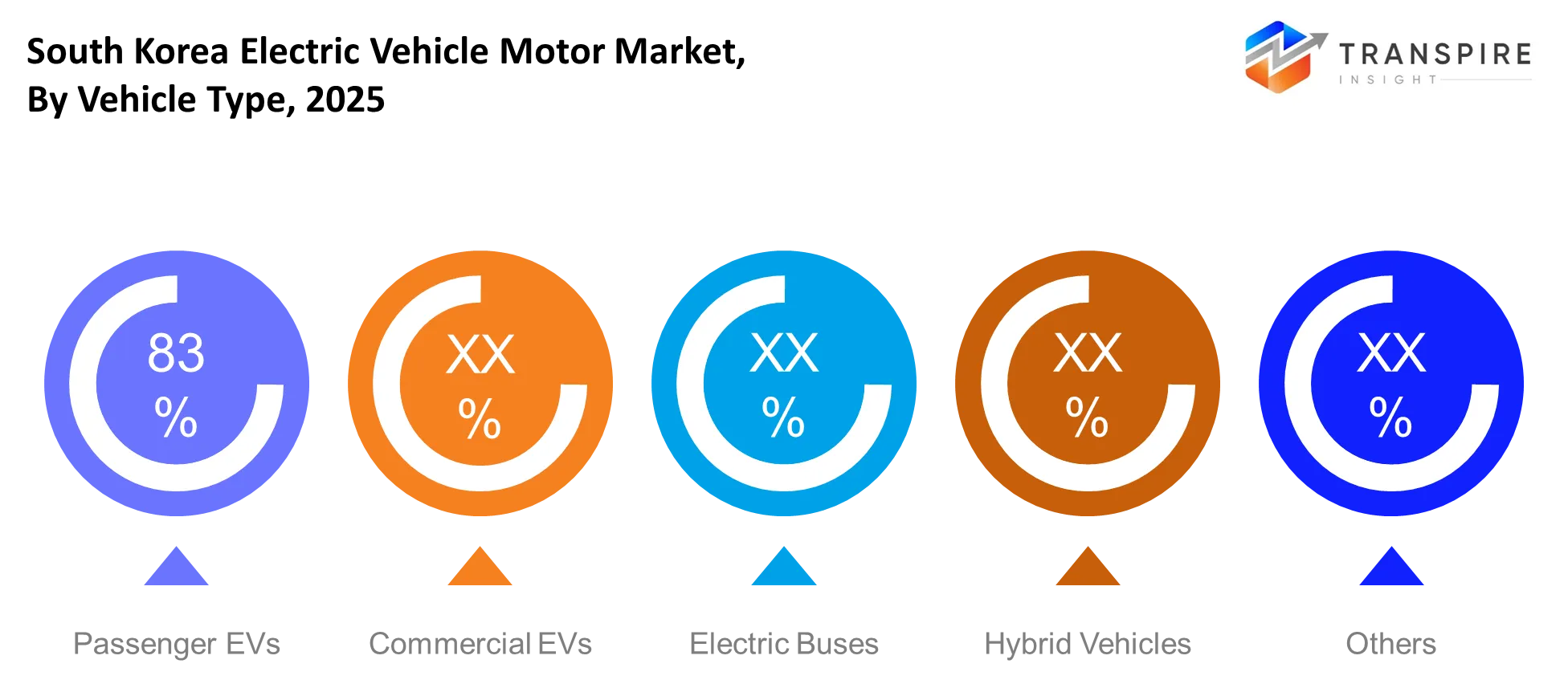
To learn more about this report, Download Free Sample Report
By Application
Traction motors keep the dominant role because they directly power the vehicle propulsion across pretty much all EV types. They bring strong torque efficiency, plus they fit nicely into advanced e-axle systems, so they kind of end up being essential for performance minded EV platforms. Also, steady OEM demand basically makes sure production can scale in a consistent way.
When it comes to traction growth, it is mostly tied to wider adoption of high voltage EV architectures, along with the need for more performance tuning and optimization. At the same time, auxiliary motors are steadily getting pulled into HVAC duties, battery cooling, and the onboard electronics stack. Power steering motors are also becoming increasingly important, especially as advanced driver assistance systems continue to expand. Other applications might include niche motion control setups in premium EVs. Over the forecast period, auxiliary motors should rise at a steady pace as vehicle electronics get more intricate, and energy management systems get tighter integrated.
By Power Output
In that 100–250 kW slice, it kind of keeps the leading spot, mainly because it fits what most passenger EVs and mid sized SUV models actually ask for. Manufacturers tend to like this band since it sort of hits the right tradeoff between noticeable performance , good efficiency, and cost wise optimization. And when you look at it globally, the big production runs on multiple EV platforms make this range feel even more dominant.
What really pulls growth here is the growing appetite for mid range electric cars, you know, the ones with extra driving range, and smoother acceleration in day to day traffic. Under 100 kW motors usually get pushed into compact vehicles, plus light mobility use cases. Then once you pass 250 kW , these systems increasingly show up in premium EVs and performance cars that need high torque output. There are also other setups, like customized industrial propulsion systems, which don't follow the mainstream pattern as much.Over the forecast period, motors above 250 kW are expected to grow the quickest, largely because premium EV adoption keeps climbing, and the high performance mobility segment keeps expanding too.
By End User
Automotive OEMs kind of dominate the South Korea Electric Vehicle Motor Market because they can steer vehicle design, drivetrain integration, and even lock in big scale procurement contracts. Their strong vertical integration approach, especially from the major manufacturers, basically keeps the demand centralized for those advanced motor systems. And then the long term supply agreements help everyone keep production plans more stable for motor suppliers too.
When OEM demand grows it seems tied to platform-based EV development , plus more localization in powertrain manufacturing. Motor manufacturers are also pushing outward by focusing on component specialization and doing periodic technology upgrades. At the same time fleet operators are adopting EV motors to lower day-to-day operational costs, and to satisfy emission targets. There are also other segments like aftermarket services and specialty mobility providers, depending on how you count them. Over the forecast period fleet operators are projected to expand the fastest, mainly because electrification is moving quickly across logistics, and public transport systems.
What are the Key Use Cases Driving the South Korea Electric Vehicle Motor Market?
Passenger electric vehicles remain the main use case for EV motors in South Korea, more or less. Automakers lean on high efficiency traction motors so they can get better acceleration feel, longer driving range and stronger energy conversion efficiency across compact cars, SUVs, and those premium EV platforms. The steady domestic output from Hyundai and Kia keeps pulling in a lot of need for advanced motor assemblies, plus integrated e axle systems , kind of all at once.
Commercial transportation is turning into a big deal too. Electric delivery vans, city buses, and logistics fleets are using high torque propulsion systems more often. They do this to match tighter urban emission requirements, and also to cut down fuel operating costs, at least over time. Industrial mobility equipment and electric utility vehicles are following that route as well, by adopting compact high performance motors designed for continuous-duty work.
You can also spot newer areas on the horizon: autonomous delivery robots, electric construction equipment, and the next wave of urban air mobility platforms. These setups need motors that are lightweight but still push high torque density, along with smart thermal management. That combo is what creates long term chances for advanced motor manufacturers, and for specialized component suppliers, working in parallel.
|
Report Metrics |
Details |
|
Market size value in 2025 |
USD 23.8 Billion |
|
Market size value in 2026 |
USD 29.5 Billion |
|
Revenue forecast in 2033 |
USD 128.7 Billion |
|
Growth rate |
CAGR of 23.42% from 2026 to 2033 |
|
Base year |
2025 |
|
Historical data |
2021 - 2024 |
|
Forecast period |
2026 - 2033 |
|
Report coverage |
Revenue forecast, competitive landscape, growth factors, and trends |
|
Regional scope |
South Korea |
|
Key company profiled |
Hyundai Mobis, LG Magna e-Powertrain, Bosch, Nidec Corporation, Denso, Mitsubishi Electric, Hitachi Astemo, Siemens, ABB, Toshiba, Magna International, Valeo, BYD, Tesla, Yaskawa Electric |
|
Customization scope |
Free report customization (country, regional & segment scope). Avail customized purchase options to meet your exact research needs. |
|
Report Segmentation |
By Motor Type (Permanent Magnet Synchronous Motors, Induction Motors, Brushless DC Motors, Switched Reluctance Motors, Others); By Vehicle Type (Passenger EVs, Commercial EVs, Electric Buses, Hybrid Vehicles, Others); By Application (Traction Motors, Auxiliary Motors, Power Steering Motors, Others); By Power Output (Below 100 kW, 100–250 kW, Above 250 kW, Others); By End User (Automotive OEMs, Motor Manufacturers, Fleet Operators, Others) |
Which Regions are Driving the South Korea Electric Vehicle Motor Market Growth?
The Seoul Capital Area, especially Gyeonggi Province and Incheon, is still the largest region in South Korea’s Electric Vehicle Motor Market because it combines automotive manufacturing density, advanced semiconductor infrastructure, and well-coordinated policy action in one place. In practice, major EV production plants, R&D centers, and battery suppliers run inside closely linked industrial clusters, so logistics costs get trimmed and component integration moves faster, sometimes like immediately. On top of that, government-backed electrification programs and smart mobility investments quietly boosted the area’s appeal for higher-value motor and inverter manufacturing projects.
Ulsan shows up as the second-largest contributor, but its momentum logic isn’t the same as the Seoul metro kind of vibe. Rather than leaning mostly on raw technology concentration, Ulsan leans on older, well established industrial know-how, stable export infrastructure, and vertically integrated automotive production. Investment keeps coming steadily, since major OEMs keep upgrading the assets they already have, instead of starting completely new industrial corridors all over again. Its port system and heavy-industry supply chain also make the whole setup more resilient when global logistics get weird or disrupted, so Ulsan stays a dependable production base for EV drivetrain exports and large-scale motor assembly operations.
Chungcheong Province, on the other hand, is rising fast as a regional market, mainly because of new investments in battery materials, power electronics, and EV component manufacturing facilities. Over the last three years, local governments expanded industrial incentives and sped up land approvals for electric mobility projects, bringing in both domestic suppliers and foreign technology partners.
Who are the Key Players in the South Korea Electric Vehicle Motor Market and How Do They Compete?
Competition in the South Korea Electric Vehicle Motor Market is, sort of, moderately consolidated. You can see large automotive suppliers controlling a lot of the high volume drivetrain business, while specialized motor technology firms still push harder on efficiency based innovation and integrated system design . In practice the market is leaning more and more toward companies that can bundle motors , inverters, software controls, and thermal systems into compact electrified powertrain platforms. Yes, cost competitiveness still has weight, but technology integration, localization strength, and long term OEM partnerships now end up steering market positioning more than plain manufacturing scale.
Hyundai Mobis stands out with integrated e axle systems that bring motors, inverters, and reduction gearboxes into tighter architectures tuned for Hyundai Motor Group EV platforms. The company keeps expanding software defined vehicle capabilities and advanced mobility technologies , and that is how it tries to extend those vertical integration benefits . LG Magna e Powertrain goes after a different angle, using close collaboration between LG’s electronics know how and Magna’s automotive building capabilities , so it can deliver highly integrated electric propulsion systems for global automakers. Its growth plan leans toward advanced inverter systems and scalable EV drivetrain platforms aimed at international OEM customers.
Nidec Corporation is focused, almost aggressively, on high efficiency traction motors using standardized production platforms. The idea is to cut manufacturing complexity and support quicker scalability. Bosch, meanwhile, leans on its global automotive electronics ecosystem to tie motor systems together with advanced driver assistance and energy management technologies . ABB differentiates via industrial electrification know-how and high performance power , the kind that plays well with demanding applications.
Company List
- Hyundai Mobis
- LG Magna e-Powertrain
- Bosch
- Nidec Corporation
- Denso
- Mitsubishi Electric
- Hitachi Astemo
- Siemens
- ABB
- Toshiba
- Magna International
- Valeo
- BYD
- Tesla
- Yaskawa Electric
Recent Development News
“In April 2026, Hyundai Motor Group entered a joint development partnership with TVS Motor Company for electric three-wheelers. The collaboration expands Hyundai’s electric mobility ecosystem and supports broader adoption of compact EV motor technologies in emerging transportation markets.http://www.hyundai.com
“In January 2026, Hyundai Motor Group announced more than USD 500 million in AI infrastructure and robotics investments at CES 2026. The investment strengthens intelligent EV manufacturing capabilities and accelerates development of advanced electric drivetrain and motor systems.https://www.hyundaimotorgroup.com
“In January 2026, OPmobility signed an agreement to explore acquisition of Hyundai Mobis’ lighting business. The proposed transaction allows Hyundai Mobis to sharpen its focus on electrification technologies and next-generation EV powertrain systems.https://www.reuters.com
What Strategic Insights Define the Future of the South Korea Electric Vehicle Motor Market?
South Korea Electric Vehicle Motor Market is, kinda slowly, drifting toward more highly integrated software led propulsion setups where motors, inverters, thermal management, and AI enabled control designs get bundled into one whole platform. This trend seems to be pushed mostly by automakers wanting lighter drivetrains, more miles between charges, and less manufacturing headache—across both passenger cars and commercial EVs. Still, there is this less obvious issue lurking in the background: the whole market keeps relying on rare earth materials and imported semiconductor know-how, so manufacturers can end up exposed to supply slowdowns and pricing swings when geopolitics or trade turbulence hits.
At the same time, a fresh chance is taking shape around axial flux motors and silicon carbide power electronics for premium EVs, and for autonomous mobility platforms too. These solutions are still in the earlier phase, but they might change what “efficient enough” means for drivetrains over the next ten years. Players in the market should probably lock in strategic partnerships with semiconductor companies, battery suppliers, and AI software providers so they can keep technical options open longer and avoid some of the future supply chain fragility.
South Korea Electric Vehicle Motor Market Report Segmentation
By Motor Type
- Permanent Magnet Synchronous Motors
- Induction Motors
- Brushless DC Motors
- Switched Reluctance Motors
- Others
By Vehicle Type
- Passenger EVs
- Commercial EVs
- Electric Buses
- Hybrid Vehicles
- Others
By Application
- Traction Motors
- Auxiliary Motors
- Power Steering Motors
- Others
By Power Output
- Below 100 kW
- 100–250 kW
- Above 250 kW
- Others
By End User
- Automotive OEMs
- Motor Manufacturers
- Fleet Operators
- Others
Frequently Asked Questions
Find quick answers to common questions.
The Expected South Korea Electric Vehicle Motor Market size for the Market will be USD 128.7 Billion in 2033.
Key Segments for the South Korea Electric Vehicle Motor Market are By Motor Type (Permanent Magnet Synchronous Motors, Induction Motors, Brushless DC Motors, Switched Reluctance Motors, Others); By Vehicle Type (Passenger EVs, Commercial EVs, Electric Buses, Hybrid Vehicles, Others); By Application (Traction Motors, Auxiliary Motors, Power Steering Motors, Others); By Power Output (Below 100 kW, 100–250 kW, Above 250 kW, Others); By End User (Automotive OEMs, Motor Manufacturers, Fleet Operators, Others).
Major South Korea Electric Vehicle Motor Market Players are Hyundai Mobis, LG Magna e-Powertrain, Bosch, Nidec Corporation, Denso, Mitsubishi Electric, Hitachi Astemo, Siemens, ABB, Toshiba, Magna International, Valeo, BYD, Tesla, Yaskawa Electric.
The Current South Korea Electric Vehicle Motor Market size is USD 23.8 Billion in 2025.
The South Korea Electric Vehicle Motor Market CAGR is 23.42% from 2026 to 2033.
- Hyundai Mobis
- LG Magna e-Powertrain
- Bosch
- Nidec Corporation
- Denso
- Mitsubishi Electric
- Hitachi Astemo
- Siemens
- ABB
- Toshiba
- Magna International
- Valeo
- BYD
- Tesla
- Yaskawa Electric
Recently Published Reports
-
Apr 2026
ATV & UTV Market
ATV & UTV Market Size, Share & Analysis Report By Type (ATV, and UTV), By Variants (Less Than 400 CC, 400 CC To 800 CC, and More Than 800 CC), and Geography (North America, Europe, Asia-Pacific, Middle East and Africa, South and Central America), 2021 - 2031
-
Apr 2026
Automotive Central Gateway Module Market
Automotive Central Gateway Module Market Size, Share & Analysis Report By Type (Ethernet Central Gateway Module, CAN Central Gateway Module, LIN Central Gateway Module, and FlexRay), By Application (Powertrain Control, Body Control, Infotainment System, Advanced Driver Assistance Systems (ADAS), and Others), By End User (Passenger Vehicles, and Commercial Vehicles), and Geography (North America, Europe, Asia-Pacific, Middle East and Africa, South and Central America), 2021 - 2031
-
Apr 2026
Automotive Engine Oil Filter Market
Automotive Engine Oil Filter Market Size, Share & Analysis Report By Filter Type (Fuel Filter, Engine Oil Filter, Hydraulic Oil Filter, and Others), By Filter Media (Cellulose, Synthetic, and Micro), By Sales Channel (OEMs, and Aftermarket), By Vehicle Type (Passenger Cars, Light Commercial Vehicles, Heavy Duty Trucks, Buses and Coaches, and Off-road Vehicles), and Geography (North America, Europe, Asia-Pacific, Middle East and Africa, South and Central America), 2021 - 2031
-
Apr 2026
Automotive Parts Aluminium Die Casting Market
Automotive Parts Aluminium Die Casting Market Size, Share & Analysis Report By Production Process (Pressure Die Casting, Vacuum Die Casting, Squeeze Die Casting, Gravity Die Casting), By Application (Body Parts, Engine Parts, Transmission Parts, Battery And Related Components, Other Application Types), and Geography (North America, Europe, Asia-Pacific, Middle East and Africa, South and Central America), 2021 - 2031
Our Clients