

Global Induction Motor Market Size & Forecast
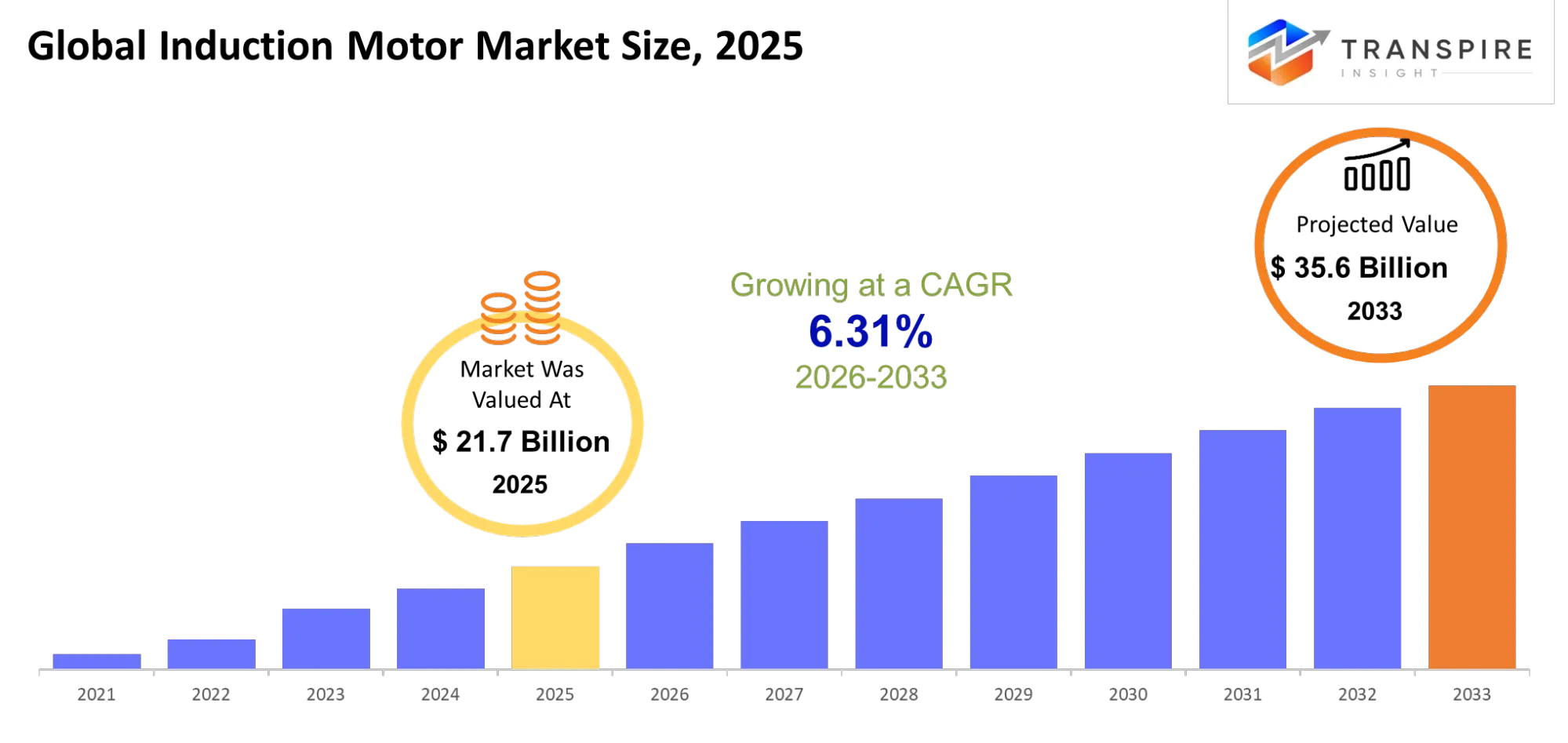
- Global Induction Motor Market Size 2025: USD 21.7 Billion
- Global Induction Motor Market Size 2033: USD 35.6 Billion
- Global Induction Motor Market CAGR: 6.31%
- Global Induction Motor Market Segments: By Motor Type (Single-Phase Induction Motor, Three-Phase Induction Motor), By Voltage (Low Voltage, Medium Voltage, High Voltage), By End-User Industry (Manufacturing, Oil & Gas, Power Generation, Mining)
To learn more about this report,  Download Free Sample Report
Global Induction Motor Market Summary
The global induction motor market was valued at USD 21.7 billion in 2025. It is expected to reach USD 35.6 billion by 2033, growing at a CAGR of 6.31%. Induction motors are the workhorses of industrial machinery. The worldwide induction motor market comprises of electric motors - used in quite a few industries, commercial settings, and infrastructure projects - for producing power mechanically very efficiently. The market remains strong indeed, being pushed along by consistent industrial production and even more widespread electrification, with recent developments including energy-efficient motor updates, adoption of the IE3/IE4 standards, and integrating them with variable-frequency drives (VFDs).
These advances decrease energy use and running costs - greatly accelerating replacement demand itself. Growth is mainly driven by industrial automation, expansion of heating, ventilation, and air conditioning (HVAC) systems, and much tighter energy-efficiency rules across regions. Furthermore, increasing investments in manufacturing and infrastructure, especially in up-and-coming economies, really are adding to the demand. As industries focus more on both efficiency and sustainability, the market continues to grow ever larger - with a very strong emphasis placed on high-performance, low-energy motor solutions.
What Has the Impact of Artificial Intelligence Been on the Global Induction Motor Market?
Artificial intelligence is transforming how induction motors are monitored - and maintained. Smart motor monitoring systems now utilise AI algorithms to find early warnings of bearing wear-out, overheating - or winding degradation itself. This really reduces unplanned downtime considerably. In the world-wide induction motor market, predictive maintenance powered by AI is lowering operating costs quite sharply for manufacturers running very large fleets of motors across a number of facilities.
AI-driven motor control is also increasing energy efficiency. Variable frequency drives that have been integrated with machine learning can optimise motor speed - and torque in real time all based on actual load conditions. This leads to a 20 to 40% reduction in energy consumption when compared to fixed-speed operation. In the world-wide induction motor market, the combination of AI and drives is making older motor installations far more efficient - quite without replacing all the equipment, which is a pretty attractive value proposition indeed for plant operators feeling great pressure from rising energy costs.
On the design side, AI tools are greatly shortening the development process for entirely new motor configurations. Manufacturers like ABB and Siemens actually use simulation software powered by machine learning to further optimise stator geometry, winding patterns - and cooling systems themselves. This really speeds up the introduction of IE5-class motors. As the world-wide induction motor market continues moving toward even higher efficiency standards, AI-assisted design will give companies a much faster route to meeting next-generation regulatory requirements itself.
Key Market Trends & Insights
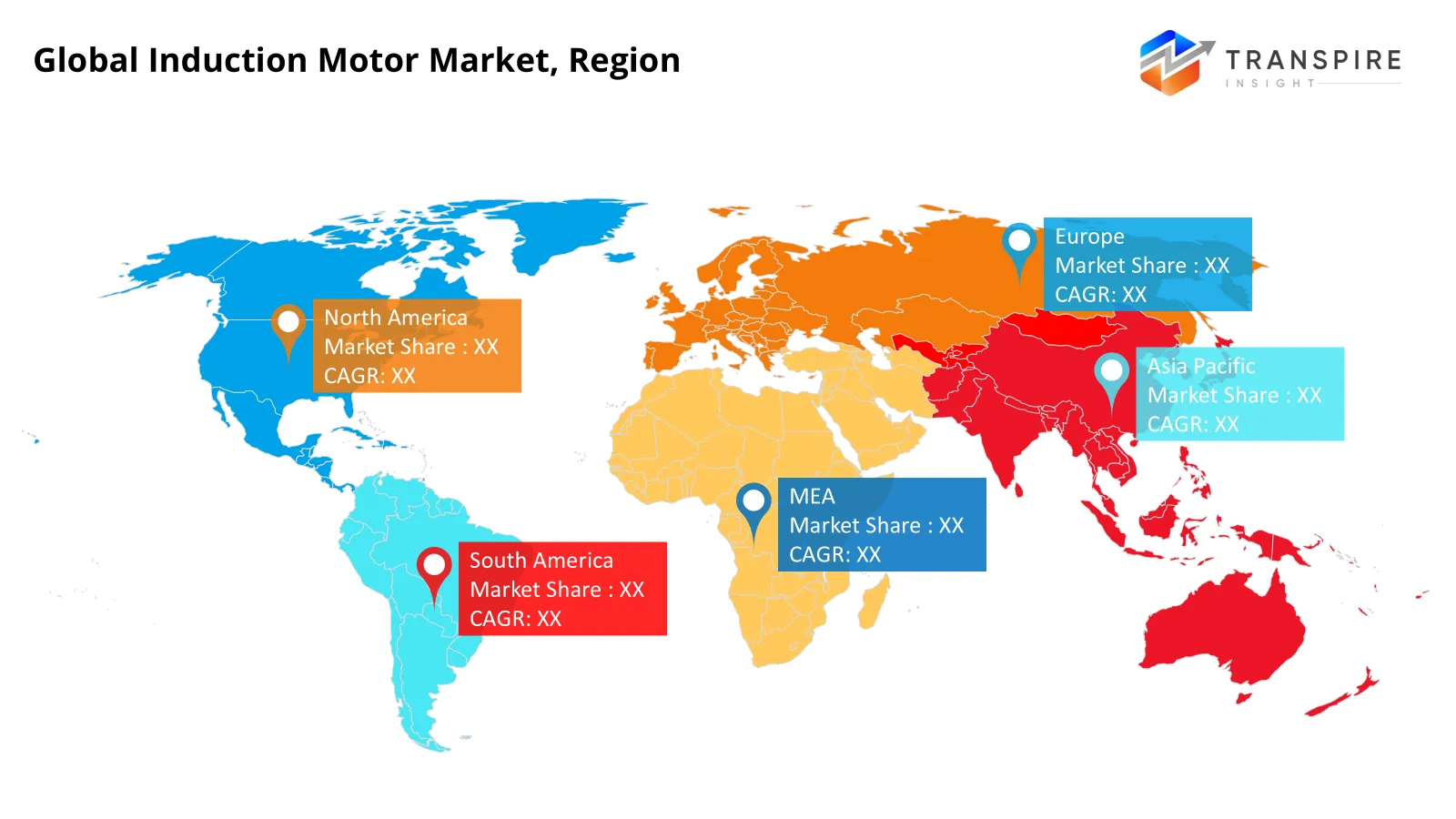
- Asia-Pacific dominates the market with over 41% share in 2025. China, India, and Southeast Asia are driving demand through rapid industrialization, infrastructure buildout, and expanding manufacturing capacity.
- North America is growing at a steady pace, with US DOE motor efficiency regulations pushing industrial buyers toward IE3 and IE4-class replacements faster than replacement cycles would normally allow.
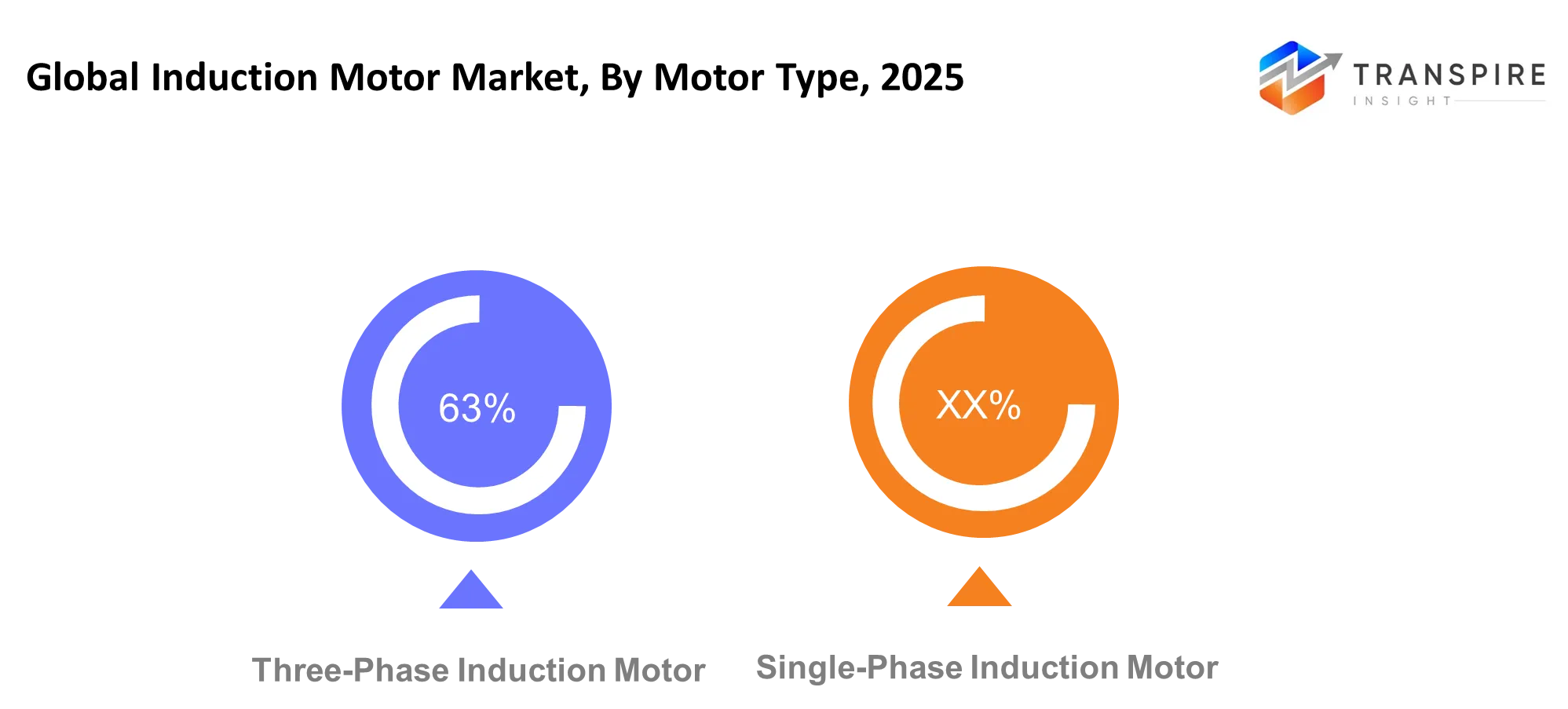
- Three-phase induction motors lead all segments at 63% share. They are the standard choice for machinery above 5 horsepower in manufacturing, pumping, and process industries.
- The manufacturing end-user segment holds the largest share of the global induction motor market. Automotive, food and beverage, chemicals, and mining all run high motor counts continuously.
- Low-voltage motors account for the largest volume by unit count. Medium-voltage systems are growing faster as oil & gas and power generation facilities expand capacity with larger equipment.
- IE4 and IE5 efficiency motors are gaining share. Buyers in Germany and Japan sourced roughly 62% of new motors from IE4-certified suppliers by 2025, drawn by 40% lifecycle cost savings.
- Nidec completed its USD 1.8 billion acquisition of Kollmorgen in December 2025, adding motion control reach across semiconductors, medical robotics, and aerospace to its induction motor base.
- Siemens committed EUR 200 million to expand its Bad Neustadt factory in January 2026 for IE5 motor production, adding 150,000 units of annual capacity by 2027.
Global Induction Motor Market Segmentation
By Motor Type
The global induction motor market separates itself into single-phase and three-phase motor types - each catering to a quite different assortment of applications and power needs. Single-phase motors attach right into the standard utility supply line and are common in residential settings, small commercial equipment, and light industrial machinery. Three-phase motors run on perfectly balanced three-phase power and dominate the industrial segment itself. Three-phase units hold a remarkable 63% of the global induction motor market - because they produce a steady, extremely high torque output for the most demanding applications. The type split reflects the differences between general-purpose and heavy-duty end markets, and it really shapes procurement patterns, voltage class selection, and drive compatibility decisions all along the supply chain.
Motor type choice has a direct effect on energy efficiency outcomes and regulatory compliance requirements. Three-phase motors pair very naturally with variable frequency drives - making them the preferred option as factories automate and efficiency standards get tighter. Single-phase motors remain relevant in regions where three-phase grid infrastructure is limited - particularly in rural and developing markets across Asia, Africa, and Latin America. Over the forecast period, three-phase share is expected to grow even more as industrial electrification investment continues to outpace residential motor demand - pulling the overall market toward higher-power, higher-efficiency configurations.
To learn more about this report, Download Free Sample Report
By Voltage
Voltage class really determines just how an induction motor will integrate into a facility's power distribution system. Low-voltage motors serve the broadest range of applications - and account for the highest unit volumes globally - covering general manufacturing, HVAC, water pumping, and light process equipment. Medium-voltage motors manage much larger loads in oil refineries, mining operations, water treatment plants, and power generation - where low-voltage designs just can't deliver the required power density efficiently. High-voltage motors serve the heaviest industrial processes - including large pipeline compressors, major pumping stations, and marine propulsion drives. Each tier targets a very distinct buyer profile with different procurement timetables, engineering requirements, and aftermarket service expectations.
The voltage mix in the global induction motor market is actually shifting as industrial facilities scale up their operations even more. Medium-voltage motor demand is growing at a faster rate than low-voltage in revenue terms - because individual units are much larger and more complex, carrying much higher price tags and longer service contract value. High-voltage motor orders track very closely with infrastructure investment cycles in oil and gas, mining, and power generation. Low-voltage remains the dominant segment by unit count - driven by a continuous replacement cycle as efficiency regulations in North America and Europe push facilities to upgrade from IE2 to IE3 and IE4 class motors well before regulatory deadlines.
By End-User Industry
The global induction motor market has four core end-user sectors: manufacturing, oil and gas, power generation, and mining. Each of these sectors has its very own unique application needs - which greatly shape motor specifications, voltage class options, and even procurement behavior itself. Manufacturing makes up the biggest segment, taking in car production facilities, chemical processing plants, food and drink production, and textile mills. These facilities operate with constant, high-volume motor fleets all the time - and are basically the number one driver of three-phase motor demand. Oil and gas operations really make use of motors all along the upstream drilling, midstream pipeline compression, and downstream refinery processes - favoring explosion-proof and extremely tough designs for really hazardous environments. Power generation facilities depend on induction motors for their auxiliary systems, while mining operations use motors in the most physically demanding settings of any industry.
The specific end-user industry mix really determines the technical and commercial requirements all over the global induction motor market. Each sector builds a completely different demand profile for motor type, efficiency rating, enclosure rating, and even after-sales service. Manufacturing buyers put a lot of stock in compatibility with automation systems and meeting energy efficiency standards. Oil and gas buyers require certified hazardous-location designs with reliable performance records. Power generation buyers specify long-life motors with really minimal maintenance requirements. Mining buyers need high starting torque, extremely robust construction, and very extended service intervals for remote or underground setups. This incredible diversity of end-user requirements really keeps a very broad product line available - and supports demand across lots of motor configurations right through the forecast period.
What are the Main Challenges for the Global Induction Motor Market Growth?
The world-wide induction motor market really faces a big challenge due to limitations in speed control. Induction motors operate at a speed determined by supply frequency and the number of poles. To control speed, you need variable frequency drives - which add lots of extra cost and complexity. In applications where very accurate speed control matters, buyers sometimes like DC motors or permanent magnet synchronous motors even better. This technical limitation restricts the adoption of induction motors in some automation applications that require variable torque and very precise positioning.
High initial costs for premium efficiency motors is yet another hurdle. IE4 and IE5 motors cost up to 50 percent more right out of the gate than standard IE2 models. Small and medium-sized manufacturers in emerging markets usually choose lower-efficiency motors since they just can't afford the higher capital cost - even if lifetime energy savings justify the premium. This makes a price division in the global induction motor market where buyers who must comply in North America and Europe buy premium units - whilst very price-conscious buyers elsewhere still opt for cheaper alternatives.
Competition from permanent magnet motors is really growing now. PM motors offer greater efficiency and a lot more power density than induction designs, especially at partial loads. As the price of rare earth magnets stabilizes and PM motor costs decrease, the technology is getting used in applications previously mainly dominated by induction motors. HVAC systems, pumps, and light industrial machinery are probably the most vulnerable areas. The global induction motor market really needs to keep improving IE4 and IE5 induction motor efficiency so it remains the go-to choice in these applications.
Supply chain risk for copper and electrical steel is always an ongoing issue. Both materials are essential inputs for making induction motors. Copper prices have really fluctuated quite a bit due to rising demand from our energy transition - including EV batteries, grid infrastructure, and renewable energy equipment. Cost increases for raw materials really puts pressure on motor manufacturers' profit margins - and can also slow down customers' purchasing decisions when motor prices increase faster than their expected plant budgets allow.
Regional Insights
Asia-Pacific is the truly dominant region in the world-wide induction motor market. China represents the biggest individual market - a result of very fast industrial development, big investments in infrastructure and a huge domestic manufacturing industry all pushing forward constant demand. India stands out as the fastest-growing major market in the region - with government initiatives in manufacturing, railways, and electrification providing continuous support to motor purchasing. The Asia-Pacific region also benefits from local manufacturing by ABB, Siemens, WEG, and Nidec - which really compete fiercely for large orders.
North America ranks second in terms of size. The US market is driven by demand for motor replacements related to DOE efficiency standards - which actually require facilities to upgrade motors over a certain horsepower threshold whenever they fail or get replaced. Oil and gas, mining, and manufacturing are the three strongest end-user sectors in North America. Canada contributes through oil sands activities and hydroelectric power infrastructure. Mexico represents a growing market - thanks to increased investment in manufacturing, especially in automotive and electronics - adding more motor demand close to the US border.
Europe is the third-largest market - and also the region really active in efficiency standards. The EU's Ecodesign Directive has kind of pushed motor buyers towards IE3 as a minimum standard, with IE4 adoption accelerating in Germany, Scandinavia, and the Netherlands. Germany hosts a large motor manufacturing facility operated by Siemens and is also one of the biggest buyers. Industrial modernization programs all over Europe are funding plant upgrades that include motor system replacements. The Middle East is a rapidly developing growth area - with massive oil and gas, desalination, and power generation projects continuously creating a demand for medium- and high-voltage induction motors.
To learn more about this report, Download Free Sample Report
Recent Development News
In April 2026, Tata Motors announced progress toward completing its planned acquisition of Iveco. The company outlined funding plans and targeted deal closure by April 2026, strengthening its commercial vehicle and powertrain portfolio relevant to electric and motor systems.https://www.outlookbusiness.com
In March 2026, SoftBank was reported to be pursuing the acquisition of ABB Robotics as part of broader 2026 M&A activity, aiming to expand industrial automation capabilities closely tied to motor-driven systems and robotics.https://dealroom.net
Report Overview Table
|
Report Metrics |
Details |
|
Market size value in 2025 |
USD 21.7 Billion |
|
Market size value in 2026 |
USD 23.2 Billion |
|
Revenue forecast in 2033 |
USD 35.6 Billion |
|
Growth rate |
CAGR of 6.31% from 2026 to 2033 |
|
Base year |
2025 |
|
Historical data |
2021 – 2024 |
|
Forecast period |
2026 – 2033 |
|
Report coverage |
Revenue forecast, competitive landscape, growth factors, and trends |
|
Regional scope |
United States; Canada; Mexico; United Kingdom; Germany; France; Italy; Spain; Denmark; Sweden; Norway; China; Japan; India; Australia; South Korea; Thailand; Brazil; Argentina; South Africa; Saudi Arabia; United Arab Emirates |
|
Key companies profiled |
ABB Ltd., Siemens AG, WEG S.A., Nidec Corporation, Toshiba Corporation, Mitsubishi Electric Corporation, Regal Rexnord Corporation, TECO Electric & Machinery Co. Ltd., Hitachi Ltd., Johnson Electric Holdings Ltd., Schneider Electric SE, Emerson Electric Co., Bharat Heavy Electricals Ltd., Havells India Ltd., CG Power & Industrial Solutions Ltd. |
|
Customization scope |
Free report customization (country, regional & segment scope). Avail customized purchase options to meet your exact research needs. |
|
Report Segmentation |
By Motor Type (Single-Phase Induction Motor, Three-Phase Induction Motor), By Voltage (Low Voltage, Medium Voltage, High Voltage), By End-User Industry (Manufacturing, Oil & Gas, Power Generation, Mining) |
How Can New Companies Establish a Strong Foothold in the Global Induction Motor Market?
New entrants in the global induction motor market face a concentrated competitive landscape. ABB, Siemens, WEG, and Nidec together hold significant market share and have deep customer relationships built over decades. Competing on standard low-voltage motors across all segments is expensive and slow. The more viable path is to focus on a specific end-user vertical or efficiency class where larger players have gaps. IE5 motors for specific industrial applications, or motors designed for hazardous environments in oil and gas, are examples where smaller companies can build expertise before expanding.
Custom motor solutions for niche applications offer a realistic market entry point. Mining equipment manufacturers, specialized HVAC system builders, and agricultural machinery producers sometimes need motor designs that off-the-shelf catalog products do not fully address. New companies that invest in application engineering capabilities can win business from these buyers even without the scale of larger competitors. Once reference installations are established, expanding into adjacent applications becomes easier.
After-sales service is often underserved in developing markets. In countries across Southeast Asia, Africa, and Latin America, motor buyers struggle to find qualified service partners for large induction motor installations. A new entrant that builds a service and repair network in an underserved region before establishing a manufacturing presence can develop strong customer relationships that translate into equipment sales. Partnering with local distributors who already serve industrial customers is faster than building a direct sales force from scratch.
Key Global Induction Motor Market Company Insights
ABB Ltd. really leads the worldwide induction motor market by having a really wide range of products - from low to high voltage - and its very strong presence in very energy-intensive industries itself. ABB's purchase of Siemens' NEMA low-voltage motor business in 2023 gave it a quite dominant 35 to 40% share of the North American NEMA motor market. The company's IE5 synchronous reluctance motors, launched in 2025 with snap-fit construction for easier disassembly and recycling, show just how ABB is getting ready for a lot more strict efficiency and sustainability requirements even more.
Siemens AG competes with its SIMOTICS motor platform and its integration with drives and digital services itself. Siemens' EUR 200 million investment in Bad Neustadt really shows a long-term commitment to being a leader on IE5 efficiency in Europe itself. The company's MACHINUM digitalization platform, unveiled at IMTEX 2025, combines motor and drive hardware with condition monitoring software, giving industrial buyers a one-stop-shop way to smart motor management altogether.
WEG S. A. is actually one of the most aggressive global expanders in the motor market right now. The Brazilian manufacturer has been setting up and buying production capacity all over its own market, including low-voltage motor production capacity in Italy expanded in June 2025 itself. WEG competes on price and delivery time in markets where European and Japanese brands have a premium pricing strategy, and its really growing service network is improving its ability to keep customers after the initial equipment sales itself.
Nidec Corporation has actually changed from a small motor specialist into one of the largest electric motor companies in the world itself through buying other companies. The Kollmorgen acquisition in December 2025 adds precision motion control to Nidec's portfolio alongside its main induction motor business. Regal Rexnord, Mitsubishi Electric, and Toshiba each hold really strong regional positions and serve very specialized end-users in HVAC, oil and gas, and power generation where application knowledge means just as much as product specifications itself.
Global Induction Motor Market Companies
- ABB Ltd.
- Siemens AG
- WEG S.A.
- Nidec Corporation
- Toshiba Corporation
- Mitsubishi Electric Corporation
- Regal Rexnord Corporation
- TECO Electric & Machinery Co. Ltd.
- Hitachi Ltd.
- Johnson Electric Holdings Ltd.
- Schneider Electric SE
- Emerson Electric Co.
- Bharat Heavy Electricals Ltd.
- Havells India Ltd.
- CG Power & Industrial Solutions Ltd.
What are the Key Use-Cases Driving the Growth of the Global Induction Motor Market?
The world wide induction motor market is seeing very rapid growth - all because of its extremely common use in industrial manufacturing processes. Induction motors power really crucial equipment such as pumps, compressors, conveyors, and HVAC systems - so they're basically essential in industries like metals, chemicals, and food processing. As industries keep adopting more automation and smart factory solutions, the need for both energy-efficient and low-maintenance motor systems continues to get bigger - further speeding up the growth of the global induction motor market.
In the automotive field, the world wide induction motor market is gaining a lot of attention because of growing electric vehicle (EV) production and very advanced manufacturing lines. Induction motors are very commonly used in EV powertrains and robotic assembly systems, offering quite a bit of durability and also being very cost-efficient.
Infrastructure and commercial applications further add to the growth of the world wide induction motor market. These motors are actually integral to building automation systems, elevators, escalators, and water treatment facilities. Rapid urbanization and big investments in smart cities are increasing the deployment of induction motors in even more energy-efficient building systems - supporting our sustainable development goals.
Newer use-cases in renewable energy and agriculture are also shaping the future of the world wide induction motor market. Applications such as wind energy systems, irrigation pumps, and solar-powered motor solutions show many new opportunities for growth. With continuous innovation in motor efficiency and digital monitoring, the market is set for really scalable, long-term expansion across all sorts of industries.
Global Induction Motor Market Report Segmentation
By Motor Type
- Single-Phase Induction Motor
- Three-Phase Induction Motor
By Voltage
- Low Voltage
- Medium Voltage
- High Voltage
By End-User Industry
- Manufacturing
- Oil & Gas
- Power Generation
- Mining
Frequently Asked Questions
Find quick answers to common questions.
The Global Induction Motor Market size is expected to reach USD 35.6 Billion by 2033.
The key segments of the Global Induction Motor Market are By Motor Type (Single-Phase Induction Motor, Three-Phase Induction Motor), By Voltage (Low Voltage, Medium Voltage, High Voltage), By End-User Industry (Manufacturing, Oil & Gas, Power Generation, Mining).
Major players in the Global Induction Motor Market include ABB Ltd., Siemens AG, WEG S.A., Nidec Corporation, Toshiba Corporation, Mitsubishi Electric Corporation, Regal Rexnord Corporation, TECO Electric & Machinery Co. Ltd., Hitachi Ltd., Johnson Electric Holdings Ltd., Schneider Electric SE, Emerson Electric Co., Bharat Heavy Electricals Ltd., Havells India Ltd., and CG Power & Industrial Solutions Ltd.
The Global Induction Motor Market size is USD 21.7 Billion in 2025.
The Global Induction Motor Market CAGR is 6.31% from 2026 to 2033.
- ABB Ltd.
- Siemens AG
- WEG S.A.
- Nidec Corporation
- Toshiba Corporation
- Mitsubishi Electric Corporation
- Regal Rexnord Corporation
- TECO Electric & Machinery Co. Ltd.
- Hitachi Ltd.
- Johnson Electric Holdings Ltd.
- Schneider Electric SE
- Emerson Electric Co.
- Bharat Heavy Electricals Ltd.
- Havells India Ltd.
- CG Power & Industrial Solutions Ltd.
Recently Published Reports
-
Apr 2026
Handling and Lifting Equipment Market
Handling and Lifting Equipment Market Size, Share & Analysis Report By Product (Cranes and Hoists, Forklifts, Conveyor Systems, Aerial Work Platforms, Others), By Application (E-Commerce, Automotive and Railway, Food and Beverages, Aviation, Others), and Geography (North America, Europe, Asia-Pacific, Middle East and Africa, South and Central America), 2021 - 2031
-
Apr 2026
HVAC Equipment Market
HVAC Equipment Market Size, Share & Analysis Report By Heating Equipment Type (Boilers and Furnaces, Heat Pumps, and Unitary Heaters), By Ventilation Equipment (Air Handling Units, Humidifiers and Dehumidifiers, Air Filters, and Fan Coiling Units), By Air Conditioning Equipment (Unitary Air Conditioners, Room Air Conditioners, Packaged Terminal Air Conditioners, and Chillers), By End User (Commercial, Residential, Industrial, and others), and Geography (North America, Europe, Asia-Pacific, Middle East and Africa, South and Central America), 2021 – 2031
-
Apr 2026
Refrigeration Valves Market
Refrigeration Valves Market Size, Share & Analysis Report By Type (Solenoid Valves, Expansion Valves, Check Valves, Service Valves, Others), By Application (Commercial Refrigeration, Industrial Refrigeration, Transport Refrigeration, Residential Refrigeration, Air Conditioning Systems), By End User (Food and Beverage Industry, Pharmaceutical Industry, HVAC Industry, Chemical Industry, Others), and Geography (North America, Europe, Asia-Pacific, Middle East and Africa, South and Central America), 2021 – 2031
-
Apr 2026
E-Commerce Packaging Materials Market
E-Commerce Packaging Materials Market By Material Type (Corrugated Boxes, Paper & Paperboard, Foam & Cushioning Materials, Plastic Packaging, Flexible Packaging, Protective Packaging, Others), By Product(Primary Packaging, Secondary Packaging, Tertiary Packaging), By Packaging Function (Protective Packaging, Branding & Presentation Packaging, Transit & Logistic Packaging, Sustainable Packaging, Tamper Evidence Packaging), By End-User (Retail & Consumer Goods, Electronic Appliances, Food & Beverages, Healthcare & Pharmaceutical, Fashion & Apparel, Home & Furnishing, Others); By Industry Analysis, Size, Share, Growth, Trends, and Forecasts 2021-2033