

United Kingdom Commercial Printing Market Size & Forecast:
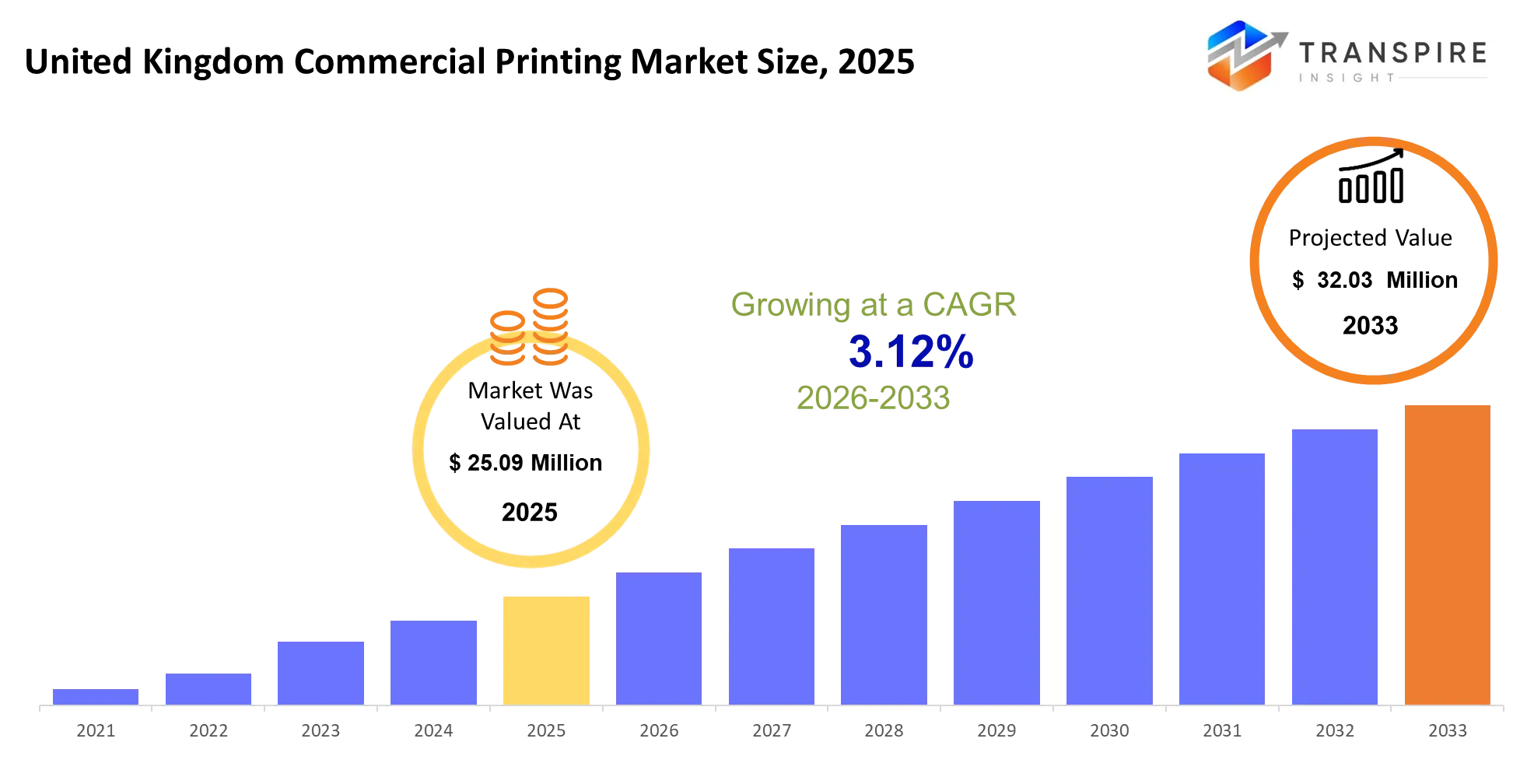
- United Kingdom Commercial Printing Market Size 2025: USD 25.09 Million
- United Kingdom Commercial Printing Market Size 2033: USD 32.03 Million
- United Kingdom Commercial Printing Market CAGR: 3.12%
- United Kingdom Commercial Printing Market Segments: By Type (Digital Printing, Offset Printing, Flexographic Printing, Screen Printing, 3D Printing, Others); By Application (Advertising, Packaging, Publishing, Labels, Commercial Materials, Others); By End-User (Corporates, Publishers, Retailers, Advertising Agencies, SMEs, Others); By Technology (Inkjet, Laser, UV Printing, Thermal Printing, Hybrid Printing, Others)
To learn more about this report,  Download Free Sample Report
United Kingdom Commercial Printing Market Summary
The United Kingdom Commercial Printing Market was valued at USD 25.09 Million in 2025. It is forecast to reach USD 32.03 Million by 2033. That is a CAGR of 3.12% over the period.
In the United Kingdom, the commercial printing market, kind of anchors the tangible communication layer behind retail packaging, publishing, direct mail, product labeling, and corporate marketing. Printers end up helping companies move beyond just ideas, so they can convert digital concepts into packaging that has to meet rules, promotional pieces, and those large-scale transactional documents that still feel important in logistics, healthcare, food distribution, and everyday consumer goods. Over the past five years things shifted, sort of gradually at first, from mostly conventional, offset-heavy production toward short run digital printing plus more automated workflows that cut down on waste and also speed up turnaround times.
This shift picked up momentum after Brexit , and during the pandemic era, when supply chain disruptions made the downsides of overseas sourcing more obvious , plus delays in packaging imports were hard to ignore. Meanwhile, extended producer responsibility requirements and sustainability goals pushed brands to rethink how their packaging is formatted, and to use more recyclable print materials. All of that is basically steering investment into high speed digital presses, variable data printing ,and more localized production networks, so printers can win higher margin customization jobs, while also keeping delivery reliability stronger for enterprise customers.
Key Market Insights
- England pretty much dominated the United Kingdom Commercial Printing Market back in 2025 with close to 72% market share, mainly because the publishing , and packaging infrastructure got really concentrated there.
- London still shows up as the main commercial print hub, largely backed by steady demand from retail advertising, and also financial services.
- Scotland looks like the fastest-growing regional market up to 2030 , pulled along by investments in sustainable packaging and a more localized print manufacturing expansion, kind of in that direction.
- Northern England is also picking up meaningful share gains, mostly tied to logistics , corrugated packaging, and industrial label printing facilities, more or less.
- For printing methods, digital printing had the upper hand in the UK commercial printing industry size, at around 46% share in 2025, mainly because the need for short-run customization stayed high.
- Offset printing stayed the second-largest segment too, since big-volume publishing and catalog work still need cost-effective mass production style capabilities.
- Variable data printing is moving the quickest across the forecast period, as brands push more personalized marketing activities and more targeted direct mail.
- On the applications side, packaging applications were nearly 41% of the United Kingdom Commercial Printing Market share in 2025 , supported by e-commerce fulfillment and labeling requirements.
- Commercial advertising materials kept solid market demand, especially from retail chains hospitality firms and those event marketing pushes.
- Retail and consumer goods companies, basically controlled end-user demand with over 38% revenue share, because packaging needs plus promotional print requirements keep coming up.
What are the Key Drivers, Restraints, and Opportunities in the United Kingdom Commercial Printing Market?
Driver: The most powerful force moving the United Kingdom Commercial Printing Market is this quick pull toward digitally produced packaging and short-run production. This move started picking up steam after Brexit and then the pandemic really disrupted imported packaging supply chains, so UK brands had to localize sourcing and kinda back off from heavy inventory dependence. At the same time, retailers and e-commerce firms started asking for quicker packaging revisions, seasonal brand updates, and personalized promotional inserts that older offset setups couldn’t handle neatly, or at least not with the same speed. Because of that, commercial printers put a lot of money into high-speed inkjet presses, workflow automation, and variable data printing platforms. Those upgrades made orders more adaptable and boosted margins, since they made it feasible to profit from low-volume jobs and that, in turn, opened up more revenue paths across packaging, direct mail, and retail marketing.
Restraint: The market’s biggest long-term brake is still the ongoing drop in traditional print media consumption. Newspaper readership, catalog distribution, and office document printing keep shrinking as companies shift toward digital communication routes. It’s hard to unwind this, not only because of budgets, but because it points to lasting changes in how people consume content and how enterprises run everyday tasks, not just short-term economic swings. A number of smaller, mid-sized print operators still depend on legacy offset infrastructure that was built for high-output publishing, so their plants end up underused, and the cash available for modernization becomes tighter. This mismatch drags down profitability and slows the move toward advanced digital printing technologies.
Opportunity: at an industrial scale, sustainable packaging printing seems to be the most obvious , durable growth chance. In the UK, food producers and consumer goods firms are reworking package formats a bit more and more, to stay aligned with extended producer responsibility rules and recyclable material targets. As a result, there’s been a solid push for investment into water-based inks, fiber derived flexible packaging, and also digitally produced corrugated options. Printers in the commercial space that bundle automated finishing systems with recyclable substrate know how are likely placed quite well to win long-term deals from multinational retail players and FMCG companies.
What Has the Impact of Artificial Intelligence Been on the United Kingdom Commercial Printing Market?
Artificial intelligence and advanced digital technologies are quietly reshaping the United Kingdom commercial printing market, mostly by boosting production efficiency, cutting off waste, and supporting very automated print operations, like, for real. Commercial printers are more and more rolling out AI-enabled workflow management systems, which schedule print jobs by themselves, squeeze better press utilization, and even catch color issues in real time, before anyone notices. In practice this reduces setup times, and it can really minimize material waste, especially for short run digital printing and some packaging use cases. Also, machine learning models are being stitched into predictive maintenance platforms that keep an eye on inkjet heads, rollers, and finishing equipment, then flag performance drift before mechanical failures show up. That style of monitoring helps operators curb unplanned downtime, stretch equipment life, and generally lift plant productivity while maintenance costs stay lower.
On top of that, advanced data analytics tools are tightening operational control across high volume print facilities. Printers are now using cloud-connected sensors along with AI driven inspection systems, to follow print quality, energy consumption, and substrate behavior across the whole production cycle. A number of UK printing firms talk about noticeable, directional improvements in turnaround speed, lower spoilage rates, and better order accuracy once they introduced automated prepress plus quality assurance technologies. Still, adoption hits a big wall: connecting AI platforms with legacy offset printing infrastructure takes real capital investment and specialist technical know-how. Many mid sized printing companies also keep working in scattered production environments, where standardized data architecture is missing, which then slows down larger scale digital transformation efforts.
Key Market Trends
- Since 2021 , UK printers have upped digital press installs, kinda because retailers wanted faster pack revisions and also smaller minimum order quantities—like less of that waiting around, you know.
- Brexit related import delays pushed packaging buyers toward homegrown commercial printing suppliers, which lowered the reliance on continental European production pathways.
- From 2020 to 2025, variable data printing took off more and more , as brands leaned into bespoke direct mail , plus more precise, not just general, promotional efforts.
- Big names like HP Inc. and Canon Inc. rolled out AI enabled workflow platforms that cut down setup times and reduced print waste across production sites.
- Commercial catalog and newspaper printing volumes kept sliding after 2020, since companies moved parts of their ad budgets toward digital marketing channels, for real.
- UK food and beverage manufacturers also bumped their request for recyclable corrugated packaging after extended producer responsibility rules got stricter and made compliance harder to ignore.
- Since 2022 , mid sized print providers have been merging operations , trying to balance out higher electricity , paper and ink prices across those high output facilities.
- Cloud connected print management systems started getting real traction after labor shortages put pressure on printers to automate scheduling, color adjustments, and quality checks.
- E commerce fulfillment growth changed buying habits too, with online retailers more often choosing localized short run packaging rather than bulk, imported inventory production.
- Scottish and Northern England print hubs saw extra investment from 2023 to 2025, because logistics operators expanded regional packaging distribution infrastructure, sort of opening up the flow.
United Kingdom Commercial Printing Market Segmentation
By Type
Digital printing is still in the lead across commercial print, largely because retailers, packaging converters , and marketing agencies now ask for short-run work plus quick design revisions. Variable data printing is being adopted more and more, and on-demand packaging is pushing digital’s share up, especially for advertising, and also e-commerce. With faster setup times and less need to stock huge inventories, many buyers keep moving away from the classic long-run production setups. On top of that, spending on automated inkjet presses and cloud connected workflow platforms has made medium-volume jobs run smoother, more reliably.
Offset printing stays the second-biggest slice, mainly because catalog publishing, newspapers, and big format commercial pieces still lean on it, where unit cost looks better when volumes are high. Still, the overall declines in print media readership and the ongoing rise in paper costs keep squeezing long-run offset demand. Flexographic printing is holding steady momentum, mostly since food and beverage manufacturers want high throughput flexible packaging, plus corrugated related solutions. Screen printing meanwhile stays relevant in a smaller lane like textiles, signage, and niche or specialty graphics. And 3D printing is picking up speed too, particularly for industrial prototyping, and even customized promotional items. During the forecast window, blended production approaches—think offset plus digital—are expected to grow, since print operators want more operational flexibility while also reducing waste.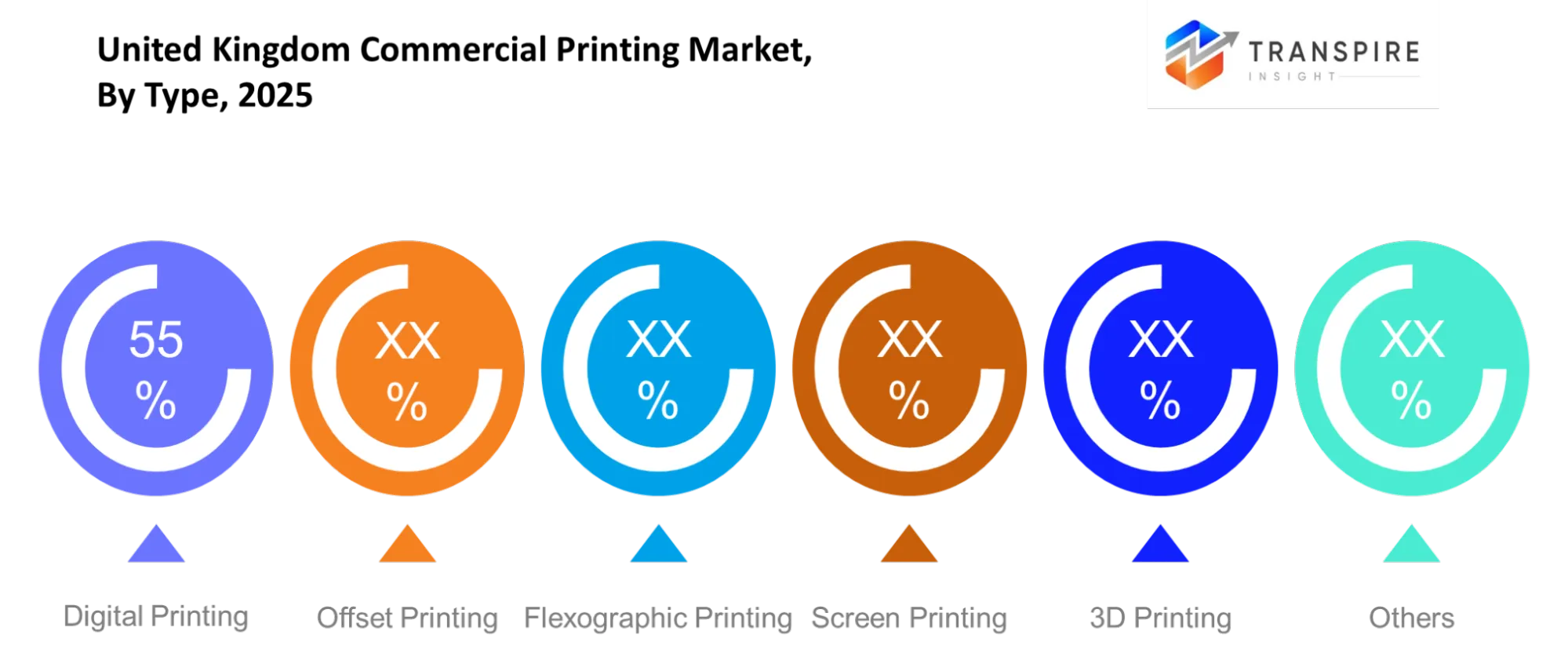
To learn more about this report, Download Free Sample Report
By Application
Packaging applications are kind of everywhere when it comes to commercial print, mainly because e commerce fulfillment, food distribution, and retail branding are now more and more tied to high quality printed cartons, labels, and that flexible packaging stuff. There’s also a stronger regulatory push around recyclable packaging along with traceability rules, which has sped up investment in digitally printed corrugated and fiber based packaging solutions. Packaging converters keep growing their localized production options , this helps cut down on supply chain issues and generally makes deliveries faster. Because of that, commercial print operators that serve consumer goods manufacturers are seeing better long term contract prospects.
Advertising and other commercial materials still bring steady revenue even if traditional print circulation keeps sliding. Retail campaigns, outdoor visuals, and promotional pieces continue to support demand for customized short run printing services. Publishing applications are moving slower though, since digital media platforms keep replacing physical newspapers and magazines across multiple consumer segments. Label printing seems to be one of the quickest movers, driven by increased pharmaceutical serialization needs and broader food safety regulations. Looking ahead, most investment will likely lean into smart labels, QR enabled packaging, and digitally integrated marketing materials, basically connecting the physical print with online consumer engagement systems.
By End-User
Corporates count as the biggest end-user group, since financial institutions, logistics providers, healthcare companies, and retail chains keep purchasing high-volume packaging, transactional printing, and branded communication assets. Many large enterprises are moving toward automated print procurement systems ,and more sustainable packaging formats so they can keep operational consistency across multiple sites. In addition, long-run service agreements and managed print contracts have pushed recurring revenue possibilities for commercial printing vendors. SMEs are following that direction too, they are raising their print spend, because localized branding and customized packaging matter more for online retail discoverability.
Retailers and advertising agencies still sit at the center of demand for personalized promotional waves, seasonal packaging runs, and specific direct mail output. Publishers show steadier volumes, yet they’re drifting downward, as digital content distribution platforms keep pulling attention away. Pharmaceutical and healthcare organizations are becoming even more strategic for vendors, partly because regulatory labeling and product traceability requirements demand high-precision printing capabilities. Over the forecast span, commercial printers focused on fast moving consumer goods and healthcare are likely to draw higher investment levels , due to compliance-led demand that stays relatively dependable.
By Technology
In the Technology segment, inkjet technology still kind of leads, because high speed digital presses make it easier to do rapid customization, the setup expenses are generally lower, and short run work can be handled more efficiently. A lot of packaging converters and marketing agencies now lean toward inkjet systems for variable data printing, and also for those personalized promotional campaigns, which just makes it feel more effective. Printhead durability keeps getting better, and color consistency too, so inkjet is seeing more adoption in labels, flexible packaging, and even corrugated uses. On top of that, AI enabled workflow integration, plus automated quality inspection systems, are quietly boosting production throughput across digitally managed print facilities.
Meanwhile, laser printing stays steady in demand, especially for office documentation, transactional printing, and commercial publishing, mainly because it delivers reliable high volume output. UV printing, however, is picking up momentum faster as durable, high resolution graphics are more often needed for signage, industrial labeling, and specialty packaging runs. Thermal printing keeps expanding as well, mainly in logistics and healthcare, where barcode labeling and inventory tracking systems demand precise printing performance that doesn’t wobble.
Hybrid printing technologies are projected to grow quicker across the forecast period. The reason is pretty simple, manufacturers want production setups that can manage both high volume traditional jobs and customized short run digital orders, even when everything sits inside the same workflow environment.
What are the Key Use Cases Driving the United Kingdom Commercial Printing Market?
Packaging production still feels like the biggest use case across the United Kingdom Commercial Printing Market , since food retailers, e-commerce companies, and consumer goods manufacturers are basically locked into high-volume printed cartons, label runs and corrugated materials. At the same time product turnover keeps getting quicker ,and promotional cycles are getting shorter too , so brands are leaning more into digitally printed short-run packaging. That approach gives faster turnaround which everyone seems to want right now.
Commercial advertising is also getting bigger and so is pharmaceutical labeling, kind of across the whole market. Retail chains , and advertising agencies too, are using personalized direct mail , point-of-sale graphics, and seasonal promotional collateral more often in order to boost localized marketing results. On the pharma side, companies are putting more money into serialized labels and compliant packaging formats. The aim is to satisfy UK traceability rules and product safety needs.
Smart packaging plus connected print feels like the newer territory, but it looks like it has strong upside over the longer term. QR enabled packs, augmented reality style print campaigns, and digitally embedded authentication labels are drawing attention, especially from premium retail and healthcare brands that want stronger engagement with shoppers along with real counterfeit resistance.
|
Report Metrics |
Details |
|
Market size value in 2025 |
USD 25.09 Million |
|
Market size value in 2026 |
USD 25.84 Million |
|
Revenue forecast in 2033 |
USD 32.03 Million |
|
Growth rate |
CAGR of 3.12% from 2026 to 2033 |
|
Base year |
2025 |
|
Historical data |
2021 - 2024 |
|
Forecast period |
2026 - 2033 |
|
Report coverage |
Revenue forecast, competitive landscape, growth factors, and trends |
|
Regional scope |
United Kingdom |
|
Key company profiled |
RR Donnelley, Quad/Graphics, Cimpress, Xerox, HP, Canon, Ricoh, Konica Minolta, Heidelberg, Agfa-Gevaert, EFI, Brother, Epson, Lexmark, Kyocera |
|
Customization scope |
Free report customization (country, regional & segment scope). Avail customized purchase options to meet your exact research needs. |
|
Report Segmentation |
By Type (Digital Printing, Offset Printing, Flexographic Printing, Screen Printing, 3D Printing, Others); By Application (Advertising, Packaging, Publishing, Labels, Commercial Materials, Others); By End-User (Corporates, Publishers, Retailers, Advertising Agencies, SMEs, Others); By Technology (Inkjet, Laser, UV Printing, Thermal Printing, Hybrid Printing, Others) |
Which Regions are Driving the United Kingdom Commercial Printing Market Growth?
England still shows up as the strongest region in the United Kingdom Commercial Printing Market because London, Manchester and Birmingham— sort of host the biggest pile of publishing houses , packaging converters, retail headquarters, and advertising agencies. The logistics setup is solid too, and the proximity to main distribution corridors means print providers can move fast for fast moving consumer goods, e-commerce packaging, and those nationwide promotional runs. Basically shorter delivery cycles are easier to manage, and that matters a lot in practice. On top of this, regulatory pressure about recyclable packaging keeps pushing bigger investments into digital corrugated printing, along with more sustainable substrate technologies across the main English manufacturing clusters. You can also see how a mature supplier ecosystem, covering inks, finishing machinery, software integration, and automated workflow services, keeps reinforcing that regional lead.
Scotland comes in as the second-largest contributor, though the growth pattern feels a bit different. A lot more of the demand leans toward industrial packaging, food labeling, and export oriented manufacturing rather than advertising driven commercial publishing. Most Scottish print operators get steadier demand linked to whisky exports, pharmaceutical packaging, and regional food processing industries, instead of depending as much on headline marketing cycles. Then there is consistent investment in sustainable packaging production, plus localized supply chain resilience, which helps keep revenue generation fairly stable even when traditional print media demand wobbles. Another thing that keeps things solid is the collaboration between regional manufacturers and packaging converters, it supports long-term modernization of equipment and general operational stability too.
Northern England and parts of Wales, kind of are showing up as the fastest growing regional markets lately , mainly because logistics infrastructure and e-commerce fulfillment have been expanding really fast since 2022. You can see it in the way more warehouses are being built , plus regional distribution investments are going up so the need for corrugated packaging, barcode labels and digital printing shipping materials is rising. On top of that there are government-backed industrial redevelopment programs. And operating costs are lower than London, so commercial printers are more willing to spread production capacity beyond the usual metropolitan centers. All of this, together should turn into some pretty attractive openings for technology providers, packaging specialists and makers of automated print equipment, roughly between 2026 and 2033.
Who are the Key Players in the United Kingdom Commercial Printing Market and How Do They Compete?
The United Kingdom Commercial Printing Market still looks moderately fragmented, with rivalry spread across multinational printing technology providers, regional packaging converters and specialized commercial print operators, kind of all moving at their own pace. Cost efficiency remains a big deal in high-volume output, but technology integration and turnaround speed have been, slowly but surely, taking a lot more weight when it comes to winning contracts across packaging, retail, and direct mail use. Many established print companies are defending their positions via automation upgrades, sustainable substrate offerings, and localized production networks, rather than just leaning on pricing alone. Meanwhile smaller digital-first entrants are quietly upsetting older offset-focused workflows by pushing short-run customization, cloud based ordering, and quicker fulfillment models that feel more responsive.
HP Inc. plays its part with high speed Indigo and PageWide digital printing systems, aimed at variable data jobs and fast packaging customization. When workflow software ties in tightly with automated color management tools, HP can stand out through less setup waste, and shorter production cycles. Canon Inc., on the other hand, leans into AI-enabled print automation plus inkjet progress, especially for transactional printing and commercial packaging applications. Through strategic partnerships with packaging converters and software vendors, Canon improves its ability to deliver end-to-end digital print ecosystems, not merely standalone hardware.
Konica Minolta, Inc. has been growing influence by focusing on mid-sized print operators that want hybrid offset-digital production capabilities, but with lower capital burdens. Advanced remote monitoring, along with predictive maintenance tools helps cut down operational downtime, which in turn supports day to day reliability for commercial print facilities.Cimpress plc kind of differentiates with web to print platforms , plus localized fulfillment setup that sort of supports small business branding and customized promotional materials all across the UK . Meanwhile, Xerox Holdings Corporation keeps bolstering enterprise print services via cloud connected workflow management and more automated document production systems, targeted toward corporate and healthcare environments.
Company List
- RR Donnelley
- Quad/Graphics
- Cimpress
- Xerox
- HP
- Canon
- Ricoh
- Konica Minolta
- Heidelberg
- Agfa-Gevaert
- EFI
- Brother
- Epson
- Lexmark
- Kyocera
Recent Development News
“In March 2026, HP announced a strategic agreement with Shutterfly to deploy 35 HP Indigo 120K digital presses. The multi-year expansion strengthens industrial-scale digital printing capacity and accelerates automation-led personalized print production across commercial printing operations. https://www.hp.com/us-en=
“In February 2026, Konica Minolta entered a collaboration with the iPrint Institute in Switzerland to expand industrial applications of inkjet technology. The partnership supports development of advanced high-mix, low-volume digital printing systems while improving automation and reducing environmental impact across commercial production environments. https://www.konicaminolta.com
What Strategic Insights Define the Future of the United Kingdom Commercial Printing Market?
The United Kingdom Commercial Printing Market is structurally moving toward highly automated, packaging-centric, and digitally integrated production models over the next five to seven years. Demand is gradually shifting away from traditional publishing and toward intelligent packaging, localized fulfillment, and data-driven print customization. AI-enabled workflow systems, variable data printing, and recyclable substrate technologies will increasingly define comptitive positioning as retailers and consumer goods manufacturers prioritize shorter production cycles and supply chain resilience.
One hidden risk lies in the market’s growing dependence on imported paper pulp, specialty inks, and digital print components. Continued geopolitical trade disruptions or energy price volatility could compress margins for mid-sized print operators that lack procurement scale or long-term supplier contracts. At the same time, connected packaging applications such as QR-enabled authentication labels and smart retail packaging are emerging as a significant future opportunity, particularly across healthcare and premium consumer goods sectors.
Commercial printers should prioritize investment in hybrid digital production infrastructure and automated finishing capabilities rather than incremental upgrades to legacy offset systems. This shift will better position operators to capture higher-margin packaging and personalized print contracts while improving operational flexibility.
United Kingdom Commercial Printing Market Report Segmentation
By Type
- Digital Printing
- Offset Printing
- Flexographic Printing
- Screen Printing
- 3D Printing, Others
By Application
- Advertising
- Packaging
- Publishing
- Labels
- Commercial Materials
- Others
By End-User
- Corporates
- Publishers
- Retailers
- Advertising Agencies
- SMEs
- Others
By Technology
- Inkjet
- Laser
- UV Printing
- Thermal Printing
- Hybrid Printing
- Others
Frequently Asked Questions
Find quick answers to common questions.
The Expected United Kingdom Commercial Printing Market size is USD 32.03 Million in 2033.
Key Segments for the United Kingdom Commercial Printing Market are By Type (Digital Printing, Offset Printing, Flexographic Printing, Screen Printing, 3D Printing, Others); By Application (Advertising, Packaging, Publishing, Labels, Commercial Materials, Others); By End-User (Corporates, Publishers, Retailers, Advertising Agencies, SMEs, Others); By Technology (Inkjet, Laser, UV Printing, Thermal Printing, Hybrid Printing, Others).
Major United Kingdom Commercial Printing Market Players are RR Donnelley, Quad/Graphics, Cimpress, Xerox, HP, Canon, Ricoh, Konica Minolta, Heidelberg, Agfa-Gevaert, EFI, Brother, Epson, Lexmark, Kyocera.
The Current United Kingdom Commercial Printing Market size is USD 25.09 Million in 2025.
The United Kingdom Commercial Printing Market CAGR is 3.12% from 2026 to 2033.
- RR Donnelley
- Quad/Graphics
- Cimpress
- Xerox
- HP
- Canon
- Ricoh
- Konica Minolta
- Heidelberg
- Agfa-Gevaert
- EFI
- Brother
- Epson
- Lexmark
- Kyocera
Recently Published Reports
-
Apr 2026
Handling and Lifting Equipment Market
Handling and Lifting Equipment Market Size, Share & Analysis Report By Product (Cranes and Hoists, Forklifts, Conveyor Systems, Aerial Work Platforms, Others), By Application (E-Commerce, Automotive and Railway, Food and Beverages, Aviation, Others), and Geography (North America, Europe, Asia-Pacific, Middle East and Africa, South and Central America), 2021 - 2031
-
Apr 2026
HVAC Equipment Market
HVAC Equipment Market Size, Share & Analysis Report By Heating Equipment Type (Boilers and Furnaces, Heat Pumps, and Unitary Heaters), By Ventilation Equipment (Air Handling Units, Humidifiers and Dehumidifiers, Air Filters, and Fan Coiling Units), By Air Conditioning Equipment (Unitary Air Conditioners, Room Air Conditioners, Packaged Terminal Air Conditioners, and Chillers), By End User (Commercial, Residential, Industrial, and others), and Geography (North America, Europe, Asia-Pacific, Middle East and Africa, South and Central America), 2021 – 2031
-
Apr 2026
Refrigeration Valves Market
Refrigeration Valves Market Size, Share & Analysis Report By Type (Solenoid Valves, Expansion Valves, Check Valves, Service Valves, Others), By Application (Commercial Refrigeration, Industrial Refrigeration, Transport Refrigeration, Residential Refrigeration, Air Conditioning Systems), By End User (Food and Beverage Industry, Pharmaceutical Industry, HVAC Industry, Chemical Industry, Others), and Geography (North America, Europe, Asia-Pacific, Middle East and Africa, South and Central America), 2021 – 2031
-
Apr 2026
E-Commerce Packaging Materials Market
E-Commerce Packaging Materials Market By Material Type (Corrugated Boxes, Paper & Paperboard, Foam & Cushioning Materials, Plastic Packaging, Flexible Packaging, Protective Packaging, Others), By Product(Primary Packaging, Secondary Packaging, Tertiary Packaging), By Packaging Function (Protective Packaging, Branding & Presentation Packaging, Transit & Logistic Packaging, Sustainable Packaging, Tamper Evidence Packaging), By End-User (Retail & Consumer Goods, Electronic Appliances, Food & Beverages, Healthcare & Pharmaceutical, Fashion & Apparel, Home & Furnishing, Others); By Industry Analysis, Size, Share, Growth, Trends, and Forecasts 2021-2033