

United States Healthcare Blister Packaging Market Size & Forecast:
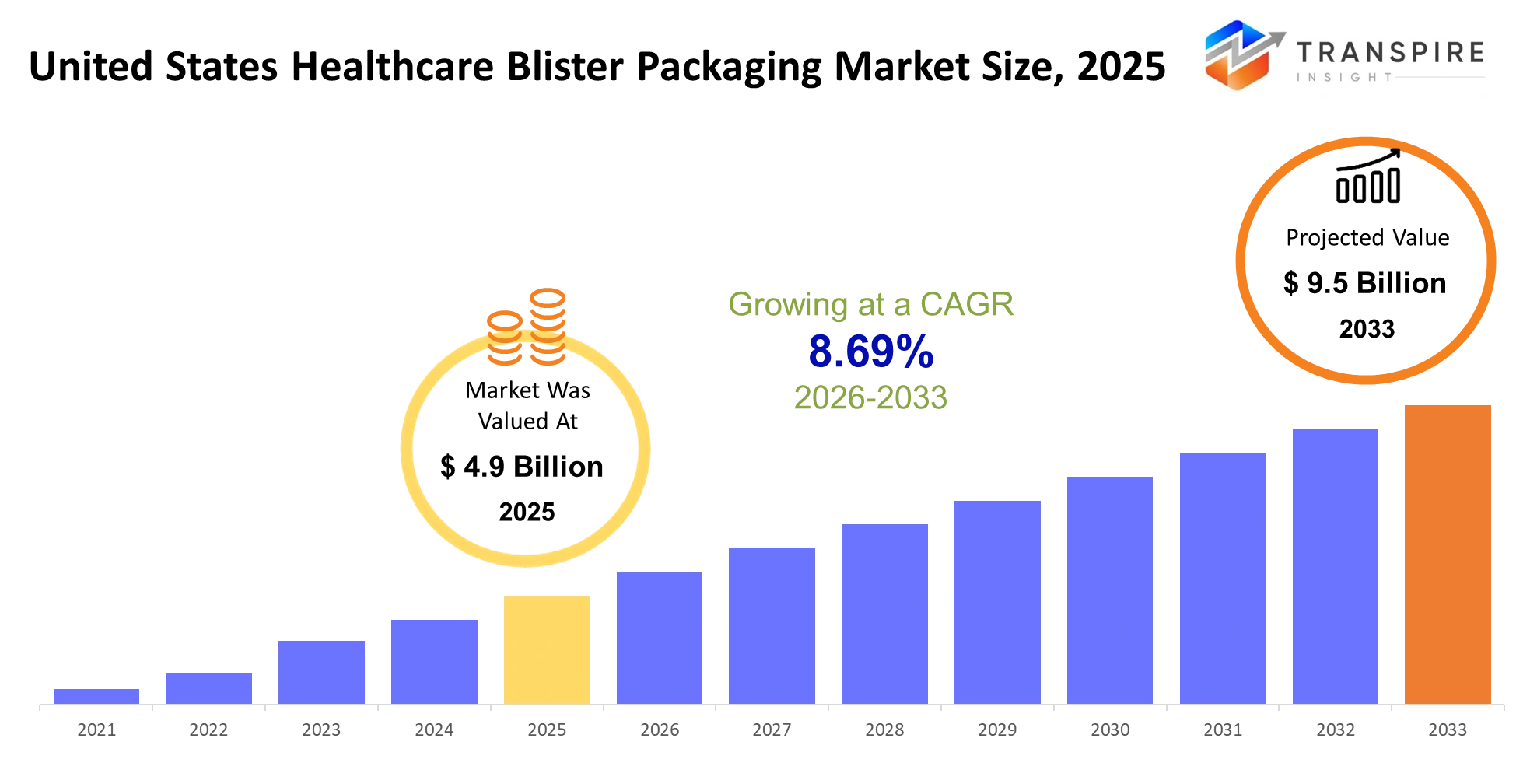
- United States Healthcare Blister Packaging Market Size 2025: USD 4.9 Billion
- United States Healthcare Blister Packaging Market Size 2033: USD 9.5 Billion
- United States Healthcare Blister Packaging Market CAGR: 8.69%
- United States Healthcare Blister Packaging Market Segments: By Material Type (Plastic Films, Aluminum Foils, Paper-based Materials, PVC, PVDC, Others); By Product Type (Carded Blister Packaging, Clamshell Packaging, Push-through Packaging, Child-resistant Packaging, Others); By Application (Pharmaceutical Packaging, Medical Device Packaging, Nutraceutical Packaging, Diagnostic Kit Packaging, Others); By End User (Pharmaceutical Companies, Hospitals, Contract Packaging Companies, Others).
To learn more about this report,  Download Free Sample Report
United States Healthcare Blister Packaging Market Summary
The United States Healthcare Blister Packaging Market was valued at USD 4.9 Billion in 2025. It is forecast to reach USD 9.5 Billion by 2033. That is a CAGR of 8.69% over the period.
In the United States, healthcare blister packaging is used to seal and sort solid oral medications into unit-dose formats, so patients can follow along easier, dispense, and stash them properly. Hospitals, pharmacies, and drug manufacturers depend on it to cut down on dosing mistakes, back adherence programs, and keep the drugs protected from moisture, plus contamination during distribution, sort of.
Over the last few years, the market has been moving toward more adoption of child resistant and senior friendly designs, alongside more strict pharmaceutical traceability requirements under changing drug supply chain security rules. At the same time, the COVID-19 period revealed some weak points in global packaging supply chains , which pushed manufacturers to source closer to home and invest in automated thermoforming lines. all that together has sped up the need for pre-validated, compliance ready packaging formats.
So, pharmaceutical companies are now folding blister packaging earlier into drug development and packaging design calls, not only as a last step but more like part of compliance , and also a patient adherence strategy, which helps secure better long term commercial traction.
Key Market Insights
- The Northeast and Midwest kind of dominate the United States Healthcare Blister Packaging Market , with nearly 38% share, mainly because there is a strong pharmaceutical manufacturing concentration in 2025.
- Western states show steady adoption , backed by biotech innovation clusters and a growing need for unit-dose packaging solutions across hospital networks.
- Thermoformed blister packs hold the leading share of about 52% in the United States Healthcare Blister Packaging Market, because they are cost efficient and fairly scalable too.
- Cold-form blister packaging takes the second spot. It’s widely used for moisture-sensitive medicines, where extended shelf stability and high-barrier protection really matter.
- Alu-Alu blister formats are the fastest-growing segment, fueled by the rising demand for premium high-protection pharmaceutical packaging solutions through 2032.
- Unit-dose dispensing within hospitals is kinda growing fast, and it is becoming one of the quickest expanding uses, mainly because medication safety rules and digital pharmacy connections are getting more attention and more “linked” every year.
- For end-use demand, pharmaceutical manufacturers still play the biggest role with roughly 48% share , and they lean on blister packs to support compliance plus some product differentiation planning.
- On the other side, hospitals and clinics seem to be the fastest-growing end-user group, since the take-up of medication adherence packaging systems keeps rising , and that trend doesn’t really stop.
- Meanwhile, retail pharmacies are holding a more stable demand pace, as prescription fulfillment automation expands across multiple national pharmacy chains , so it feels steady overall.
What are the Key Drivers, Restraints, and Opportunities in the United States Healthcare Blister Packaging Market?
The main thing driving the United States Healthcare Blister Packaging Market is more than just demand, it’s the increasingly strict regulatory attention on medication traceability , patient safety, and the precision of unit-dose dispensing. When pharmaceutical serialization requirements got tighter and Drug Supply Chain Security Act compliance became harder to ignore, drug makers and hospital systems basically had no choice but to modernize their packaging formats. Those new formats help with tamper evidence and inventory tracking, which is the big point. Meanwhile, major pharmacy chains also rolled out expanded automated dispensing systems, and they tend to function better with blister-packed medications than with the older bottle style. Because of that, lots of capital is going into thermoforming equipment, high-barrier films, plus automated inspection tools, and this has boosted packaging revenues across the overall pharma supply networks, sort of directly.
The main restraint, on the other hand, is the pricey conversion effort linked to swapping out legacy bottle-filling infrastructure. A number of pharmaceutical facilities still run packaging lines that were built decades ago for bulk oral solid products. Moving to blister packaging means buying new machinery, completing production validation, retraining staff, and getting regulatory approvals, so it becomes a structural hurdle that smaller manufacturers just can’t shoulder quickly. So adoption stays uneven across generic drug producers, which slows down wider market penetration and also reduces how fast packaging modernization spending really moves.
A major opportunity is kind of emerging thanks to smart blister packaging, mixed in with digital adherence tracking tech, and it feels like this is moving faster than before. Pharmaceutical companies, along with healthcare providers, are now increasingly running trials on sensor-enabled blister packs that log when doses get taken, and then they link to remote patient monitoring platforms. In other words this shift is getting more traction inside chronic disease management programs, especially for cardiovascular and diabetes medications, where adherence rates really do matter—like directly affecting reimbursement results, and also the long-term treatment costs.
What Has the Impact of Artificial Intelligence Been on the United States Healthcare Blister Packaging Market?
Artificial intelligence together with advanced digital technologies are reshaping how blister packaging operations in the pharmaceutical industry get handled across the United States. Packaging manufacturers now lean on AI-enabled vision inspection setups that keep an eye on blister cavity integrity, seal performance, tablet placement and also print exactness all at once. In other words, these systems automatically spot defects that manual checks sometimes simply overlook, and that helps production lines cut down material loss while keeping batch-to-batch consistency more even. On top of that, automated packaging lines tied in with robotics and machine learning software, tend to fine-tune thermoforming temperatures, sealing pressure, and throughput speed, which usually boosts equipment uptime and brings reject rates down.
At the same time, predictive maintenance tools are getting more important especially in high-volume pharmaceutical packaging facilities. Machine learning models look at vibration signatures, motor load levels, and temperature swings to flag early signs of wear in the equipment before anything becomes a full-on failure. This tends to reduce surprise shutdowns and supports regulatory compliance during long continuous production runs. Several plants involved in pharmaceutical blister packaging have described real, measurable gains in day-to-day operations, like quicker line changeovers and reduced maintenance expenses after rolling out AI monitoring platforms.
Still, AI adoption has a major snag, mainly because plenty of legacy blister packaging facilities run on old infrastructure that can’t easily connect with cloud-linked analytics systems. The price of upgrading the machinery, validating AI-led workflows, plus the requirement to satisfy strict pharmaceutical compliance rules, all keep wider rollouts slower, particularly at smaller manufacturing sites.
Key Market Trends
- Since 2021, pharma manufacturers have been cranking up investments in automated thermoforming lines, to cut down labor dependence and make packaging feel more consistent, if that makes sense.
- Drug Supply Chain Security Act compliance, kind of pushed serialization- enabled blister packaging adoption across the main pharmaceutical distribution networks after 2023.
- Amcor and Constantia Flexibles, kept expanding their high-barrier blister film production as moisture-sensitive drug demand started rising between 2022 and 2025.
- Hospital pharmacies also shifted more toward unit-dose blister dispensing systems after medication error reduction programs got extra scrutiny, around the post-pandemic period.
- In several packaging facilities, AI -powered visual inspection systems replaced manual quality checks, and that reduced defect related waste too, while boosting throughput efficiency.
- Cold-formed aluminum blister packaging gained more traction after specialty drug manufacturers started prioritizing longer shelf stability for biologics and other high-value oral therapies, so yeah.
- Domestic sourcing strategies got stronger after COVID 19 revealed vulnerabilities in imported pharmaceutical packaging material supply chains during 2020 and 2021.
- And smart blister packs, with adherence tracking technologies woven in, started showing up in chronic disease management programs, particularly for cardiovascular and diabetes medication monitoring.
United States Healthcare Blister Packaging Market Segmentation
By Material Type:
Plastic films still take a big share in the United States Healthcare Blister Packaging Market, sort of because drugmakers and medical firms lean toward packaging that is light but also see-through, for tablets, capsules, and other medical products. The strong visibility plus moisture shielding helps the product last longer, and keeps storage safer. You can also see the need for flexible healthcare packing moving up, since hospitals and pharmacies are trying to use secure yet budget-smart packaging methods, basically they want less hassle with more protection.
Aluminum foils, though, stay equally important because a tough barrier layer really helps block contamination, from moisture, oxygen, and light. Meanwhile, paper based materials are getting more attention, mainly tied to sustainability targets in healthcare packaging operations. PVC and PVDC keep supporting blister packaging production as well, thanks to their durability and sealing performance, especially in pharmaceutical uses where product safety and stability still matter a lot during both transportation and storage.
By Product Type:
Carded blister packaging still keeps getting a lot of demand, sort of, because easy product visibility and secure sealing makes everything look more proper for pharmaceutical and healthcare product presentation. Clamshell packaging is also widely used for medical tools and healthcare accessories, since the sturdy layout kind of reduces product damage when it’s on the move, during transport. Push-through packaging remains a top choice for medicines though because the quick access together with dosage protection supports patient safety and also helps with proper medicine handling in everyday healthcare spaces.
Meanwhile child-resistant packaging is getting more important, as healthcare companies are putting more weight on patient protection and regulatory compliance. Secure opening systems help reduce accidental medicine consumption among children, but they still keep it accessible for adults, which is kind of the key point. Beyond that, other packaging formats keep expanding for specialized healthcare uses, where custom protection and product stability are necessary for sensitive medical products, and pharmaceutical items too.
By Application:
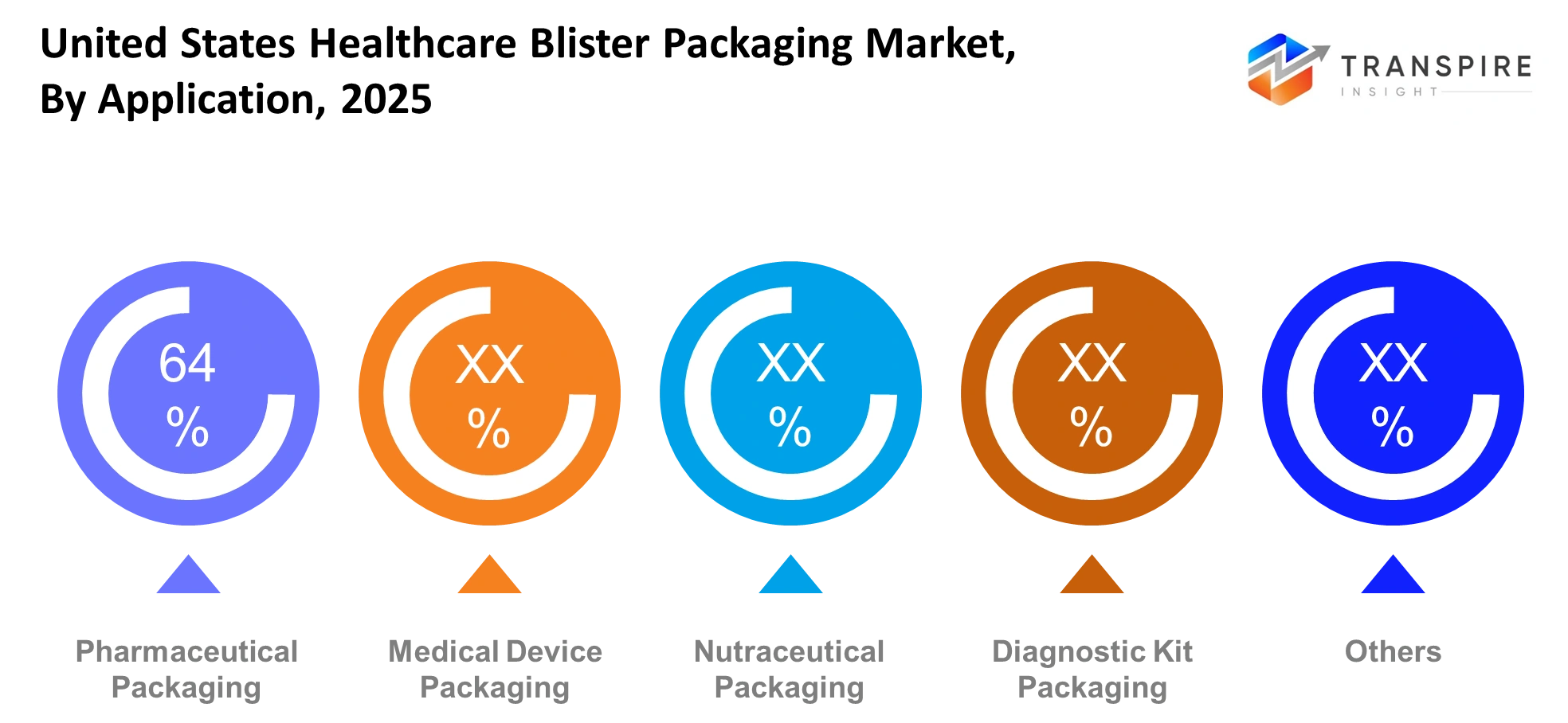
Pharmaceutical packaging, like really, dominates the United States Healthcare Blister Packaging Market because blister packs give accurate dosage control , plus they help with contamination protection, and they are also convenient for storage of medicines. More prescription drug usage and higher healthcare spending keep pushing packaging demand through pharmaceutical manufacturing facilities. Meanwhile, medical device packaging keeps rising steady too , since hospitals and healthcare providers need sterile and protective solutions for diagnostic tools , surgical equipment, and also for disposable medical products.
On another note, nutraceutical packaging is seeing stronger demand as consumers are getting more interested in vitamins, dietary supplements, and wellness products and that trend keeps climbing across the United States. Diagnostic kit packaging is picking up speed too , mainly because healthcare testing and home-based diagnostic services are expanding fast. Reliable blister packaging supports product shielding, makes daily usability better, and keeps hygiene expectations in place, which is required for many healthcare related uses.
To learn more about this report, Download Free Sample Report
By End User:
Pharmaceutical firms are basically a prime end-user part, because large scale medicine production needs dependable blister packaging, for storage, transport, and patient safety. Heavy investment in drug manufacture and research efforts is still going on which keeps demand alive for more advanced healthcare packaging types throughout the country. Hospitals also play a big role too, since orderly medicine distribution, plus safe handling behaviors, stay key inside healthcare locations.
Contract packaging businesses are seeing a noticeable lift in demand as pharma and healthcare brands choose to outsource packaging tasks. This is often done to boost efficiency, and also to lower operational costs. Specialized packaging service providers help move production schedules faster, while still meeting healthcare compliance requirements and related controls. As more cooperation grows between pharmaceutical manufacturers and packaging companies, packaging innovation should strengthen, and product safety benchmarks in the healthcare field will likely rise as well.
What are the Key Use Cases Driving the United States Healthcare Blister Packaging Market?
In the United States , the main factor behind the shift toward healthcare blister packaging is basically unit dose packing for prescription oral solid drugs. Pharmaceutical manufacturers and hospital pharmacies kind of lean on blister formats to cut down medication mistakes, make dosage tracking clearer, and stay aligned with regulatory expectations, especially when dispensing happens at a high volume.
Other roles are also growing , you see them spreading through over the counter medications, nutraceuticals, and specialty pharmaceutical products. Retail pharmacy chains are using blister packaging more often for automated prescription picking, and contract manufacturing organizations go for higher barrier formats when they need moisture resistance for therapies , and for biologic related support medications.
Newer situations are starting to appear too, like smart blister packs that are woven into digital adherence monitoring systems for chronic disease care programs. Providers of remote patient monitoring, along with healthcare technology companies, are trying connected packaging platforms that log dosing behavior for cardiovascular support, diabetes management, and post discharge medication routines.
|
Report Metrics |
Details |
|
Market size value in 2025 |
USD 4.9 Billion |
|
Market size value in 2026 |
USD 5.3 Billion |
|
Revenue forecast in 2033 |
USD 9.5 Billion |
|
Growth rate |
CAGR of 8.69% from 2026 to 2033 |
|
Base year |
2025 |
|
Historical data |
2021 - 2024 |
|
Forecast period |
2026 - 2033 |
|
Report coverage |
Revenue forecast, competitive landscape, growth factors, and trends |
|
Geographic scope |
United States of America |
|
Key company profiled |
Amcor, WestRock, Sonoco Products, Constantia Flexibles, Klöckner Pentaplast, Berry Global, Honeywell, UFlex, Winpak, Tekni-Plex, Bilcare, Gerresheimer, AptarGroup, Huhtamaki, Sealed Air. |
|
Customization scope |
Free report customization (country, regional & segment scope). Avail customized purchase options to meet your exact research needs. |
|
Report Segmentation |
By Material Type (Plastic Films, Aluminum Foils, Paper-based Materials, PVC, PVDC, Others); By Product Type (Carded Blister Packaging, Clamshell Packaging, Push-through Packaging, Child-resistant Packaging, Others); By Application (Pharmaceutical Packaging, Medical Device Packaging, Nutraceutical Packaging, Diagnostic Kit Packaging, Others); By End User (Pharmaceutical Companies, Hospitals, Contract Packaging Companies, Others). |
Which Regions are Driving the United States Healthcare Blister Packaging Market Growth?
The Northeast still feels like the leading area in the United States Healthcare Blister Packaging Market , mostly because it has this mix of heavy pharmaceutical manufacturing presence with strict regulatory attention, plus pretty developed healthcare infrastructure. Places like New Jersey, Pennsylvania , and Massachusetts house big drug manufacturers , contract packaging organizations, and also biotechnology firms. They end up using high volume blister packaging operations all the time. And honestly the region does well due to its close distance to FDA regulated production sites, research centers, and big hospital purchasing networks, which helps unit dose packaging get adopted faster. That whole connected ecosystem keeps encouraging ongoing investment in automated thermoforming systems, serialization know how, and high barrier pharmaceutical packaging materials.
The Midwest works a bit differently, more like long term operational steadiness rather than fast growth. Big pharmaceutical distribution hubs, lower day to day industrial costs, and mature manufacturing setups make states such as Illinois, Indiana and Ohio dependable for packaging production capacity. Compared with the Northeast, the Midwest market is less about rapid biotechnology breakthroughs, and more about steady pull from generic drug manufacturers plus large scale pharmacy fulfillment operations. With consistent capital spending on production efficiency and supply chain resilience , the region keeps finding dependable revenue throughout the broader packaging segment.
The Southern United States is kind of emerging as the fastest growing regional market, because pharmaceutical manufacturing expansion is accelerating, and then healthcare infrastructure investment is getting momentum too. States like Texas, North Carolina, Georgia, and Florida have been pulling in new packaging facilities, thanks to tax incentives, lower labor costs, and also that increasing pharmaceutical contract manufacturing work happening since 2022. A few companies even moved their packaging operations closer to where the domestic drug production sits, because the pandemic era supply disruptions showed some vulnerabilities in overseas sourcing, so they acted on it. Now all this is building a really solid wave of opportunities for packaging equipment suppliers , automation providers, and material manufacturers, especially if they are looking at growth across the 2026–2033 period.
Who are the Key Players in the United States Healthcare Blister Packaging Market and How Do They Compete?
The United States Healthcare Blister Packaging Market still looks fairly consolidated , but it’s not completely locked up, you know. Bigger packaging groups tend to land the high volume pharmaceutical contracts, while more specialized converters fight it out in those niche therapeutic areas . In practice, the contest is shifting toward automation capability and regulatory compliance know-how , plus high barrier material technology, not just “cheaper price” anymore. Larger players are defending share by offering integrated packaging services, like thermoforming along with serialization, inspection systems, and compliance support, bundled under long term pharmaceutical supply agreements . Meanwhile, smaller firms are pushing into targeted themes, for example smart adherence packaging and specialty cold forming solutions for high value oral drugs
Amcor puts a lot of weight on material innovation and strong pharmaceutical grade barrier performance . What stands out is its recyclable blister packaging development, plus advanced forming films meant for moisture sensitive therapies . Their growth approach basically leans into expanding healthcare packaging capacity across North America while also collaborating with pharmaceutical companies that want sustainable conversion . Constantia Flexibles competes with specialty aluminum based blister solutions that help extend shelf stability for complex formulations. It’s been growing its pharma presence by investing in high barrier packaging technologies and tailoring product development for regulated drug manufacturers .
Berry Global seems to push for big scale manufacturing efficiency and automated production more than anything else, and that sort of helps pharmaceutical clients shrink their packaging turnaround times. They kinda stand apart because they do vertically integrated material production and they also have broad domestic manufacturing coverage across the United States. On the other end Uhlmann Group plays mostly from the equipment and technology side, delivering fast blister packaging machinery that’s paired with AI enabled inspection and serialization systems. Their growth approach, more or less, is about assisting pharmaceutical producers modernize older packaging lines, plus they’re aiming to stay aligned with tougher compliance requirements and stronger traceability rules.
Company List
- Amcor
- WestRock
- Sonoco Products
- Constantia Flexibles
- Klöckner Pentaplast
- Berry Global
- Honeywell
- UFlex
- Winpak
- Tekni-Plex
- Bilcare
- Gerresheimer
- AptarGroup
- Huhtamaki
- Sealed Air
Recent Development News
In May 2026, TekniPlex Healthcare announced recyclable blister packaging solutions for pharmaceutical applications at The Pharma Days 2026. The company highlighted next-generation polymer blister formats designed to support pharmaceutical sustainability and compliance requirements, reinforcing innovation in healthcare blister packaging.
Source: https://tekni-plex.com/
In January 2026, TekniPlex Healthcare unveiled expanded multidose packaging capabilities and advanced barrier materials for pharmaceutical packaging at Pharmapack Europe. The development included recyclable blister packaging formats and increased production capacity for pharmaceutical applications, strengthening the company’s position in sustainable healthcare packaging solutions.
Source: https://macaubusiness.com/
What Strategic Insights Define the Future of the United States Healthcare Blister Packaging Market?
The United States Healthcare Blister Packaging Market is shifting, structurally, toward very automated , compliance focused and patient specific packaging ecosystems over the next five to seven years. The thing is, this path is not only about volume expansion, but more about the coming together of pharmaceutical traceability requirements, manufacturing labor shortages, and the healthcare sector pushing to improve medication adherence results. Packaging suppliers that can tie serialization, AI enabled inspection, and digital adherence monitoring into one continuous workflow will likely snag a bigger slice of pharmaceutical outsourcing agreements.
One risk people don’t talk about enough is how concentrated the high barrier film and aluminum foil supply is among just a few specialized material providers. If there is any disruption, like trade restrictions, energy pricing swings, or raw material constraints, packaging costs can jump quickly, and production timelines for pharmaceuticals could slide out of sync.
A notable emerging opportunity is smart blister packaging that is linked to remote patient monitoring platforms for chronic disease management. Organizations trying to enter this arena should set up partnerships with healthcare technology firms and hospital networks now, rather than later, because interoperability norms and reimbursement arrangements may become more locked in across the industry.
United States Healthcare Blister Packaging Market Report Segmentation
By Material Type
- Plastic Films
- Aluminum Foils
- Paper-based Materials
- PVC
- PVDC
By Product Type
- Carded Blister Packaging
- Clamshell Packaging
- Push-through Packaging
- Child-resistant Packaging
By Application
- Pharmaceutical Packaging
- Medical Device Packaging
- Nutraceutical Packaging
- Diagnostic Kit Packaging
By End User
- Pharmaceutical Companies
- Hospitals
- Contract Packaging Companies
Frequently Asked Questions
Find quick answers to common questions.
The United States Healthcare Blister Packaging Market size is USD 9.5 Billion in 2033.
Key segments for the United States Healthcare Blister Packaging Market are By Material Type (Plastic Films, Aluminum Foils, Paper-based Materials, PVC, PVDC, Others); By Product Type (Carded Blister Packaging, Clamshell Packaging, Push-through Packaging, Child-resistant Packaging, Others); By Application (Pharmaceutical Packaging, Medical Device Packaging, Nutraceutical Packaging, Diagnostic Kit Packaging, Others); By End User (Pharmaceutical Companies, Hospitals, Contract Packaging Companies, Others).
Major United States Healthcare Blister Packaging Market players are Amcor, WestRock, Sonoco Products, Constantia Flexibles, Klöckner Pentaplast, Berry Global, Honeywell, UFlex, Winpak, Tekni-Plex, Bilcare, Gerresheimer, AptarGroup, Huhtamaki, Sealed Air.
The United States Healthcare Blister Packaging Market size is USD 4.9 Billion in 2025.
The United States Healthcare Blister Packaging Market CAGR is 8.69% from 2026 to 2033.
- Amcor
- WestRock
- Sonoco Products
- Constantia Flexibles
- Klöckner Pentaplast
- Berry Global
- Honeywell
- UFlex
- Winpak
- Tekni-Plex
- Bilcare
- Gerresheimer
- AptarGroup
- Huhtamaki
- Sealed Air
Recently Published Reports
-
Apr 2026
Pharmaceutical Cold Chain Packaging Market
Pharmaceutical Cold Chain Packaging Market By Material (Plastic,(Polyethylene (PE), Polypropylene (PP), Polyethylene Terephthalate (PET), Expanded Polystyrene (EPS), Polyurethane (PU),Others), Paper, Metal, Others), By Product (Small Boxes, Pallets, Large Sized Pallet Containers, Others), By End Use (Biopharmaceutical Companies, Clinical Research Organizations, Hospitals, Research Institutes, Logistics and Distribution Companies, Others)”, By Industry Analysis, Size, Share, Growth, Trends, and Forecasts 2026-2033
-
Apr 2026
Active & Intelligent Packaging Market
Active & Intelligent Packaging Market By Type (Active Packaging, Smart Packaging), By Material (Polymer-Based, Paper & Board-Based, Metal-Based, Glass-Based), By Technology (Time-Temperature Indicators, Freshness Indicators, RFID, Antimicrobial Packaging, Modified Atmosphere Packaging), By Application (Food & Beverages, Pharmaceutical, Cosmetics & Personal Care, Electronics & Consumer Goods, Others), By Industry Analysis, Size, Share, Growth, Trends, and Forecasts 2026-2033
-
Apr 2026
Biodegradable Cut Flower Packaging Market
Biodegradable Cut Flower Packaging Market By Material Type (Paper & Paperboard, Biodegradable Plastics, Natural Fibers, Molded Pulp, Others), By Product Type (Sleeves, Wraps, Boxes & Cartons, Bags & Pouches, Inserts & Holders), By Application (Roses, Carnations, Tulips, Chrysanthemums, Mixed Flowers, Others) and By Distribution Channel (Direct Sales, Distributors & Wholesalers, Online Channels), By Industry Analysis, Size, Share, Growth, Trends, and Forecasts 2026-2033
-
May 2026
Pharmaceutical Packaging Market
Pharmaceutical Packaging Market By Material Type (Plastic, Glass, Metal, Paper & Paperboard, Others), By Packaging Type (Bottles, Blister Packs, Vials, Ampoules, Pouches & Sachets, Others) and By End User (Hospitals & Clinics, Retail Pharmacies, Online Pharmacies, Pharmaceutical Manufacturers), By Industry Analysis, Size, Share, Growth, Trends, and Forecasts 2026-2033