
Europe Aluminum Foil Packaging Market Size & Forecast:
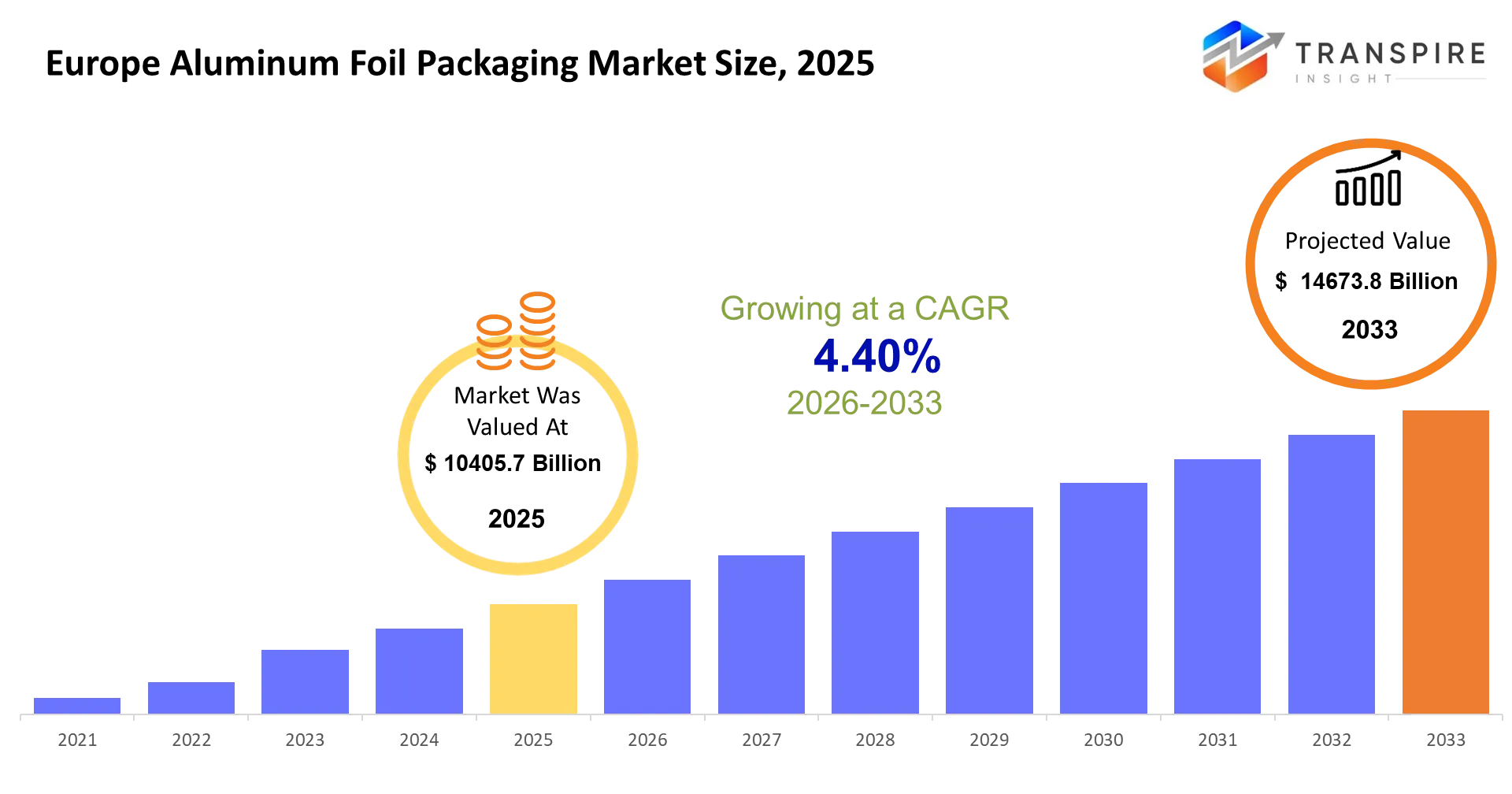
- Europe Aluminum Foil Packaging Market Size 2025: USD 10405.7 Billion
- Europe Aluminum Foil Packaging Market Size 2033: USD 14673.8 Billion
- Europe Aluminum Foil Packaging Market CAGR: 4.40%
- Europe Aluminum Foil Packaging Market Segments: By Type (Wraps, Containers, Blister Packs, Lids, Others), By Application (Food Packaging, Pharma Packaging, Industrial Packaging, Household Use, Others), By End-User (Food Industry, Pharma Industry, Retail, Others), By Thickness (Light Gauge, Medium Gauge, Heavy Gauge, Others).
To learn more about this report,  Download Free Sample Report
Europe Aluminum Foil Packaging Market Summary:
The Europe Aluminum Foil Packaging Market size is estimated at USD 10405.7 Billion in 2025 and is anticipated to reach USD 14673.8 Billion by 2033, growing at a CAGR of 4.40% from 2026 to 2033. The aluminum foil packaging market in Europe functions as a vital solution which protects products during their journey through extensive supply networks. Foil packaging serves as a vital resource for food processors, pharmaceutical manufacturers, and industrial exporters because it effectively stops moisture, oxygen, light, and contaminants from entering their products while it decreases spoilage, transport damage, and compliance risks. The system enables manufacturers to prolong product shelf life through minimal preservative applications while it facilitates safe international movement of products which require specific temperature control.
The market has transitioned during the past five years from using standard commodity-grade foil to adopting high-performance recyclable ultra-thin packaging materials. The European Union established stricter circular economy and packaging waste regulations which required converters to create new laminate designs that would achieve higher material recovery rates. The Russia-Ukraine conflict created an energy crisis which disrupted aluminum supply chains and resulted in soaring production costs, compelling buyers to establish local sourcing agreements while they funded packaging solutions that would enhance operational efficiency.
The combination of supply chain disturbances with regulatory requirements creates a situation which drives businesses toward increased sales through premium product offerings. The manufacturers use advanced foil solutions to protect their products and to decrease logistics losses which help them pass sustainability audits, while they need to keep their products safe during distribution through European distribution networks which have become more complicated.
Key Market Insights
- Germany established itself as the leading nation in the European Aluminum Foil Packaging Market during 2025 by securing approximately 24% of total market share through its strong capacity to produce pharmaceutical products and processed food items.
- Eastern Europe will develop into the fastest-growing regional market until 2032 because industrial development and packaging production relocation initiatives will drive market growth.
- The industry size reached 2025 because flexible aluminum foil packaging achieved more than 48% market share when brands selected lightweight and cost-effective barrier packaging options.
- Laminated foil structures developed into the second biggest product category because they gained popularity for use in dairy products and confectionery items and ready-to-eat meals.
- The European Union sustainability compliance requirements will create higher demand for ultra-thin recyclable foil packaging from 2026 until 2032.
- The food and beverage sector generated approximately 57% of total revenue for the Europe aluminum foil packaging market during 2025 because food products needed packaging to maintain their shelf life.
- Pharmaceutical blister packaging has become the fastest-growing application segment because Europe faces both an aging population problem and new medicine protection regulations.
- The processed food industry operates as the top end-user segment because it controls almost 46% of market share through its demand for packaging materials which can endure international shipping.
- Healthcare and pharmaceutical companies are quickly adopting aluminum foil packaging because it provides enhanced protection against moisture and contamination during drug distribution processes.
- The Europe Aluminum Foil Packaging Market is currently experiencing high interest in mono-material packaging solutions which enhance recyclability while maintaining effective barrier protection.
What are the Key Drivers, Restraints, and Opportunities in the Europe Aluminum Foil Packaging Market?
The European Aluminum Foil Packaging Market experiences its strongest growth through European package and food safety regulation enforcement which creates more stringent packaging requirements. The European Union established its circular economy framework together with its Packaging and Packaging Waste Regulation which required manufacturers to create new package designs that would be easier to recycle and use fewer materials. The production of processed foods and pharmaceutical blister packs experienced rapid growth which included temperature-controlled shipping operations. The converters started to spend more money on ultra-thin foil laminates and high-barrier flexible packaging formats which help products last longer while decreasing losses during shipping. The business outcomes lead to customers selecting premium-value foil products instead of standard commodity foil which drives up average selling prices while improving profit margins throughout the packaging value chain.
The market’s largest structural barrier remains Europe’s energy-intensive aluminum production model. Foil rolling and conversion operations depend heavily on stable electricity pricing, yet regional energy volatility continues to pressure production economics. The challenge requires multiple years of financial investment to establish smelting facilities, renewable energy sources, and recycling facilities. The high operational expenses force delays in expansion projects which also reduce mid-sized converters' ability to adjust prices while they compete with cheaper imported products.
Central and Eastern Europe present an important growth opportunity for pharmaceutical-grade recyclable foil packaging. Pharmaceutical manufacturing facilities are expanding their production capacity throughout the region because both government entities and private investors want to decrease their reliance on imported drugs which became apparent during the pandemic supply interruptions. The market now requires investment in cold-form blister foil and child-resistant packaging and advanced coated aluminum systems. European healthcare manufacturers will establish long-term supply contracts with companies that combine recycled materials with products that maintain high barrier performance.
What Has the Impact of Artificial Intelligence Been on the Europe Aluminum Foil Packaging Market?
Artificial intelligence together with advanced digital technologies are transforming the Europe Aluminum Foil Packaging Market because these technologies enable production to become more accurate while they minimize material waste and enhance operational efficiency throughout rolling mills and conversion facilities. Manufacturers use AI-powered vision inspection systems to find pinholes and coating defects and surface inconsistencies during their fast foil processing operations. The systems enable organizations to decrease rejection rates while they enhance production efficiency especially in the pharmaceutical and food-grade packaging sectors which require barrier integrity to meet regulatory standards and protect product safety.
Foil rolling equipment and annealing furnaces and slitting machines now use machine learning models to predict when maintenance work should occur. Manufacturers can detect component failures through vibration analysis and thermal performance assessment together with equipment load monitoring. European converters experience decreased maintenance expenses and unplanned downtime after they implement industrial analytics solutions in their manufacturing facilities. Digital twin technology enables packaging companies to enhance foil thickness and energy consumption and lamination performance, which results in better yield efficiency and reduced electricity costs during their operations that require high energy consumption.
The adoption of AI technologies encounters a significant obstacle because many legacy foil processing plants operate with disconnected automation systems and their data systems have multiple points of failure. AI platform implementation into existing production systems demands companies to spend extensive capital for equipment and take multiple months for testing their systems while they need specialized engineering skills which creates delays for mid-sized European packaging companies.
Key Market Trends
- The European food industry since 2022 has moved away from using multi-layer plastic laminates toward ultra-thin aluminum foil structures because these materials offer better recycling options and enable better compliance with international export regulations.
- Germany and France established regional foil conversion facilities after the Russia-Ukraine conflict caused energy-related import disruptions which affected aluminum packaging supply chain operations.
- European healthcare manufacturers increased their production of localized medicines which led to pharmaceutical blister packaging demand that surged throughout the period after 2021.
- Amcor plc and Constantia Flexibles joined other companies to increase their spending on environmentally friendly foil production methods which businesses required to fulfill their sustainability purchasing requirements.
- AI-powered systems for defect detection in production processes reduced the number of rejected foil materials during high-speed manufacturing operations which resulted in better operational efficiency for pharmaceutical and dairy packaging processes.
- The converters have transitioned to using thinner-gauge foil materials since 2023 because this change enables them to decrease transport weight while preserving oxygen and moisture barrier protection for their processed food products.
- Eastern Europe became a center for manufacturing expansion when lower operating expenses made it economical for packaging companies to move their production from Western European plants.
- EU circular economy regulations established stricter recyclability requirements for consumer packaging which led retailers to prefer mono-material packaging solutions.
- The energy-intensive foil rolling operations faced margin constraints during 2022 to 2024 which forced mid-sized converters to merge their purchasing operations and implement robotics in their production facilities.
- Packaging manufacturers expedited the implementation of digital traceability systems which included QR-based authentication methods to enhance anti-counterfeiting measures in high-value pharmaceutical distribution networks.
Europe Aluminum Foil Packaging Market Segmentation
By Type
The type segment of packaging materials for food processing and pharmaceutical manufacturing shows its strongest market presence through wrap and blister pack products which deliver essential barrier protection together with portable design and extended shelf-life capacity. The dairy and confectionery and frozen food industries show continuous use of flexible wraps because these materials provide advantages through lighter weight and decreased need for packaging materials. European healthcare companies require both tamper-resistant and moisture-protective packaging for their delicate medicines which makes blister packs more vital for commercial use.
The ready-to-eat meal packaging market and premium retail products demand containers and lids which manufacturers produce at higher costs but which they use less in budget-sensitive markets. Manufacturers increasingly invest in lightweight multilayer foil structures and recyclable sealing technologies to meet tightening packaging waste regulations. Companies will compete in this market by demonstrating their ability to use materials efficiently while developing recyclable products that work with automated filling systems. Multinational food and pharmaceutical companies will establish stronger supply contracts with companies that develop durable products using thinner materials.
By Application
The main use for aluminum foil products stays in food packaging because its properties create effective barriers against oxygen and moisture and light which keeps products fresh during extended distribution periods. Western and Central Europe consume large quantities of foil products because processed foods and dairy products and confectionery items and frozen meals drive their demand. The pharmaceutical packaging industry grows at the fastest rate because healthcare manufacturers increase their domestic medicine production while implementing improved contamination control measures.
In chemical and insulation applications, industrial packaging exists at a minor but constant level because these fields need thermal resistance and protective performance capabilities. Sustainable disposable packaging options now take over household waste patterns, but customers need affordable prices before they will choose these new products. The market for recyclable mono-material packaging solutions and thinner laminate materials that maintain barrier performance while cutting down logistics expenses shows increasing demand. The company will focus its future investments on developing pharmaceutical-grade foil coatings and advanced printing technologies and high-performance flexible packaging systems which manufacturers can use in automated production environments.
To learn more about this report, Download Free Sample Report
By End-User
The food industry represents the largest portion of end-user segments because manufacturers need reliable barrier packaging for their export distribution requirements. Aluminum foil usage among major packaged food producers continues to rise because of new shelf-life requirements and increasing customer demand for convenient meal options. The pharmaceutical industry functions as the most important growth sector because healthcare spending increases and drug manufacturing activities rise in response to pandemic-related supply chain disruptions.
Retail channels also contribute meaningful demand growth as supermarkets and private-label brands increasingly adopt premium foil packaging to improve product presentation and storage efficiency. The protective and heat-resistant packaging needs of cosmetics and industrial goods manufacturers create specialized demand patterns among smaller end-user groups. The future market direction depends on converters establishing long-term supply agreements with major food and healthcare enterprises. Manufacturers who possess advanced coating technologies together with recyclable packaging materials will gain better market position among premium end users.
By Thickness
The thickness category of aluminum foil products shows medium-gauge aluminum foil as its leading thickness because this specific thickness provides balanced strength and flexibility together with cost efficiency which makes it suitable for all types of food packaging and pharmaceutical packaging. The last three years have seen light-gauge foil become a popular choice because manufacturers need lightweight packaging solutions that help them decrease both transport expenses and material usage. Advanced lamination technologies enable flexible snack packaging and confectionery wraps to use thinner structures that support their packaging needs together with household foil products.
Heavy-gauge foil continues to function as essential material for industrial insulation and container manufacturing and specialized pharmaceutical applications which need structural strength. The adoption of thicker foil types remains restricted because production methods require substantial energy while raw material expenses continue to rise. The current investment trends show increasing preference for precision rolling technologies which produce ultra-thin foil that maintains both barrier performance and mechanical stability. The future competition environment will direct research towards developing materials with lower resource requirements and higher recycling abilities and better performance in automated packaging systems used by large manufacturing facilities.
What are the Key Use Cases Driving the Europe Aluminum Foil Packaging Market?
The primary reason European nations select aluminum foil as their product packaging solution arises from its vital role in protecting food items. Processors of pre-packaged meals and dairy products and frozen food distributors depend on foil packaging to preserve their products during international shipments and frozen food distribution processes.
Pharmaceutical companies and grocery store private-label brands are showing increased demand for blister pack packaging used in pharmaceuticals and retail-ready packaging solutions. Drug manufacturers increasingly use high-barrier foil laminates to protect moisture-sensitive medicines, while premium food retailers adopt lightweight foil containers and lids to improve product presentation and storage stability.
The development of new applications requires e-commerce food delivery recyclable mono-material packaging and smart foil packaging to progress. Advanced coated foil solutions deliver enduring benefits to biologic medicines and temperature-sensitive medical products because they comply with current European Union regulatory requirements.
|
Report Metrics |
Details |
|
Market size value in 2025 |
USD 10405.7 Billion |
|
Market size value in 2026 |
USD 10853.2 Billion |
|
Revenue forecast in 2033 |
USD 14673.8 Billion |
|
Growth rate |
CAGR of 4.40% from 2026 to 2033 |
|
Base year |
2025 |
|
Historical data |
2021 - 2024 |
|
Forecast period |
2026 - 2033 |
|
Report coverage |
Revenue forecast, competitive landscape, growth factors, and trends |
|
Regional scope |
Europe (Germany, United Kingdom, France, Italy, Spain and Rest of Europe) |
|
Key company profiled |
Amcor, Novelis, Constellium, UACJ, Hindalco, Alcoa, Norsk Hydro, Arconic, JW Aluminum, Eurofoil, Laminazione Sottile, Assan Aluminyum, Vimetco, Granges, Flexifoil |
|
Customization scope |
Free report customization (country, regional & segment scope). Avail customized purchase options to meet your exact research needs. |
|
Report Segmentation |
By Type (Wraps, Containers, Blister Packs, Lids, Others), By Application (Food Packaging, Pharma Packaging, Industrial Packaging, Household Use, Others), By End-User (Food Industry, Pharma Industry, Retail, Others), By Thickness (Light Gauge, Medium Gauge, Heavy Gauge, Others) |
Which Regions are Driving the Europe Aluminum Foil Packaging Market Growth?
The aluminum foil packaging market in Western Europe maintains its leading position because Germany, France, and Italy operate strong pharmaceutical and processed food and flexible packaging manufacturing industries. The European Union packaging waste regulations required all companies in the region to invest in recyclable foil structures and lightweight laminates and advanced conversion technologies. High-barrier packaging materials which meet certified compliance standards continue to receive steady demand from food exporters and healthcare manufacturers. The region maintains its leading market share because established recycling systems and developed transportation networks and strong partnerships between raw material suppliers and converters work together.
Northern Europe exists as a unique market because its stability derives from sustainable procurement methods and industrial planning that extends over lengthy periods which go beyond production capacities. Sweden Denmark and Finland exhibit permanent financial backing for their low-carbon packaging enterprises and manufacturing sites that operate using renewable energy. Regional retailers and consumer goods companies increasingly choose foil packaging that can be traced and recycled while meeting high-quality standards in order to achieve their environmental goals. The stable market conditions for packaging converters result in consistent income streams which continue throughout times when raw material costs experience fluctuations.
Eastern Europe has become the fastest-growing regional market because manufacturers are shifting their foil conversion and packaging operations to cost-effective industrial locations in Poland and Hungary and Romania.
Who are the Key Players in the Europe Aluminum Foil Packaging Market and How Do They Compete?
The Europe Aluminum Foil Packaging Market shows moderate consolidation because large multinational converters control premium pharmaceutical and food packaging contracts while regional players compete in cost-sensitive segments. Competition increasingly centers on recyclable material innovation and energy-efficient production and supply chain reliability because these factors provide better value than volume-based competition. The established manufacturers use long-term procurement agreements and advanced coating technologies and investments in lightweight foil structures to defend their market share. The mid-sized converters in Eastern Europe now establish market presence because they provide customers with cheaper operating expenses and quicker delivery services to nearby areas.
Amcor plc focuses its business operations on two main areas which include developing new packaging technologies and establishing itself as a leader in environmentally sustainable packaging solutions. The company develops recyclable high-barrier foil laminates and digital packaging solutions which enable food and pharmaceutical brands to achieve strict European compliance requirements. Constantia Flexibles stands out from competitors through its pharmaceutical-grade packaging knowledge and extensive manufacturing capacity which covers Central and Eastern Europe. Healthcare customers can depend on better supply reliability because businesses now invest in local manufacturing facilities which decrease transport expenses.
Huhtamaki uses fiber-based and hybrid packaging solutions to compete in the market because these solutions let food brands use foil barriers in combination with packaging systems that use less plastic. Novelis Inc. achieves a competitive edge through its closed-loop aluminum recycling systems which enable the company to produce packaging materials with low carbon emissions. Aluflexpack AG develops customized foil solutions which meet the product protection and precise printing needs of dairy and coffee and pharmaceutical packaging applications.
Company List
- Amcor
- Novelis
- Constellium
- UACJ
- Hindalco
- Alcoa
- Norsk Hydro
- Arconic
- JW Aluminum
- Eurofoil
- Laminazione Sottile
- Assan Aluminum
- Vimetco
- Granges
- Flexifoil
Recent Development News
In February 2026, Constantia Flexibles highlights decarbonization and Low Carbon Aluminum solutions at CFIA 2026: Constantia Flexibles presented its latest packaging innovations at CFIA 2026 in France, focusing on Low Carbon Aluminum and sustainable flexible packaging solutions. The company emphasized validated product carbon footprint data and industrial-ready foil-based packaging systems for European food and industrial applications.
Source: https://www.cflex.com
In April 2026, ACTEGA will showcase next-generation metal packaging solutions at METPACK 2026 in Germany: ACTEGA confirmed its participation at METPACK 2026 in Essen, Germany, presenting advanced coatings and sustainability-focused technologies for metal and foil-based packaging systems. The company highlighted innovations designed to improve recyclability and production efficiency in European packaging lines.
Source: https://www.actega.com
What Strategic Insights Define the Future of the Europe Aluminum Foil Packaging Market?
The Europe Aluminum Foil Packaging Market will undergo a structural transformation during the next five to seven years which will establish packaging systems that achieve high performance and low carbon emissions and comply with existing regulations. The transition process occurs because circular economy laws and government requirements for local pharmaceutical supply chains and retailer demands for recyclable packaging with tracking systems have created new business requirements.
Future market value will increasingly come from engineered foil solutions with advanced coatings, thinner gauges, and certified recycled content rather than from commodity-volume expansion alone. The market will generate future value through engineered foil products which include advanced coatings and thinner gauges and certified recycled materials.
The hidden risk exists because Europe relies on energy-heavy aluminum production methods which depend on imported essential raw materials. Major packaging companies face threats from ongoing electricity price fluctuations which make it difficult to maintain their business margins while carbon border adjustment regulations create challenges for all but the most powerful integrated companies. The packaging industry faces a new challenge as fiber-based barrier packaging technologies develop which will enable them to use dry-food applications without foil packaging.
Central and Eastern Europe currently presents a significant business opportunity because pharmaceutical manufacturing facilities establish a need for specialized cold-form blister foil and compliance-grade healthcare packaging products. Market participants should prioritize regional recycling partnerships and invest early in ultra-thin recyclable foil technologies to secure long-term contracts with regulated industries.
Europe Aluminum Foil Packaging Market Report Segmentation
By Type
- Wraps
- Containers
- Blister Packs
- Lids
- Others
By Application
- Food Packaging
- Pharma Packaging
- Industrial Packaging
- Household Use
- Others
By End-User
- Food Industry
- Pharma Industry
- Retail
- Others
By Thickness
- Light Gauge
- Medium Gauge
- Heavy Gauge
- Others
Frequently Asked Questions
Find quick answers to common questions.
The Approximate Europe Aluminum Foil Packaging Market size for the Market will be USD 14673.8 Billion in 2033.
The key Segments of the Europe Aluminum Foil Packaging Market are By Type (Wraps, Containers, Blister Packs, Lids, Others), By Application (Food Packaging, Pharma Packaging, Industrial Packaging, Household Use, Others), By End-User (Food Industry, Pharma Industry, Retail, Others), By Thickness (Light Gauge, Medium Gauge, Heavy Gauge, Others).
Major Players in the Europe Aluminum Foil Packaging Market are Amcor, Novelis, Constellium, UACJ, Hindalco, Alcoa, Norsk Hydro, Arconic, JW Aluminum, Eurofoil, Laminazione Sottile, Assan Aluminyum, Vimetco, Granges, Flexifoil.
The Current Market size of the Europe Aluminum Foil Packaging Market is USD 10405.7 Billion in 2025.
The Europe Aluminum Foil Packaging Market CAGR is 4.40%.
- Amcor
- Novelis
- Constellium
- UACJ
- Hindalco
- Alcoa
- Norsk Hydro
- Arconic
- JW Aluminum
- Eurofoil
- Laminazione Sottile
- Assan Aluminum
- Vimetco
- Granges
- Flexifoil
Recently Published Reports
-
Apr 2026
Healthcare Polymer Packaging Market
Healthcare Polymer Packaging Market Size, Share & Analysis Report By Packaging Type (Syringes, IV Bottles and Pouches, Clamshells, Blisters, Bottles & Jars, Containers, Tubes, IV Parental Packaging, Others), By Type (Regulated, Non-regulated), By Polymer Type (LDPE (Low-Density Polyethylene), HDPE (High-Density Polyethylene), Homo-polymer (Homo), Random Copolymer (Random), Block Copolymer (Block), PET, Polystyrene, Polyvinyl Chloride, Polyamide/EVOH, Others), and Geography (North America, Europe, Asia-Pacific, Middle East and Africa, South and Central America), 2021 - 2031
-
Apr 2026
Hydrophilic Tape (Waterstop) Market
Hydrophilic Tape (Waterstop) Market Size, Share & Analysis Report By Type (Bentonite-Based Hydrophilic Tape, Rubber-Based Hydrophilic Tape), By Application (Residential Buildings, Commercial Buildings, Infrastructure Projects), and Geography (North America, Europe, Asia-Pacific, Middle East and Africa, South and Central America), 2021 - 2031
-
Apr 2026
Metalens Market
Metalens Market Size, Share & Analysis Report By Type (Visible Light Metalens, and Infrared Metalens), By Application (Consumer Electronics, Automotive Electronics, Industrial, Medical, and Others), and Geography (North America, Europe, Asia-Pacific, Middle East and Africa, South and Central America), 2021 - 2031
-
Apr 2026
PBT Resin Market
PBT Resin Market Size, Share & Analysis Report By Type (Reinforced PBT Resin, Unreinforced PBT Resin), By Processing Method (Injection Molding, Extrusion, Blow Molding, Others), By End-User (Automotive, Electrical & Electronics, Consumer Appliances, Industrial Machinery, Medical Devices, Packaging, Others), and Geography (North America, Europe, Asia-Pacific, Middle East and Africa, South and Central America), 2021 - 2031