

Europe Food Processing and Handling Equipment Market Size & Forecast:
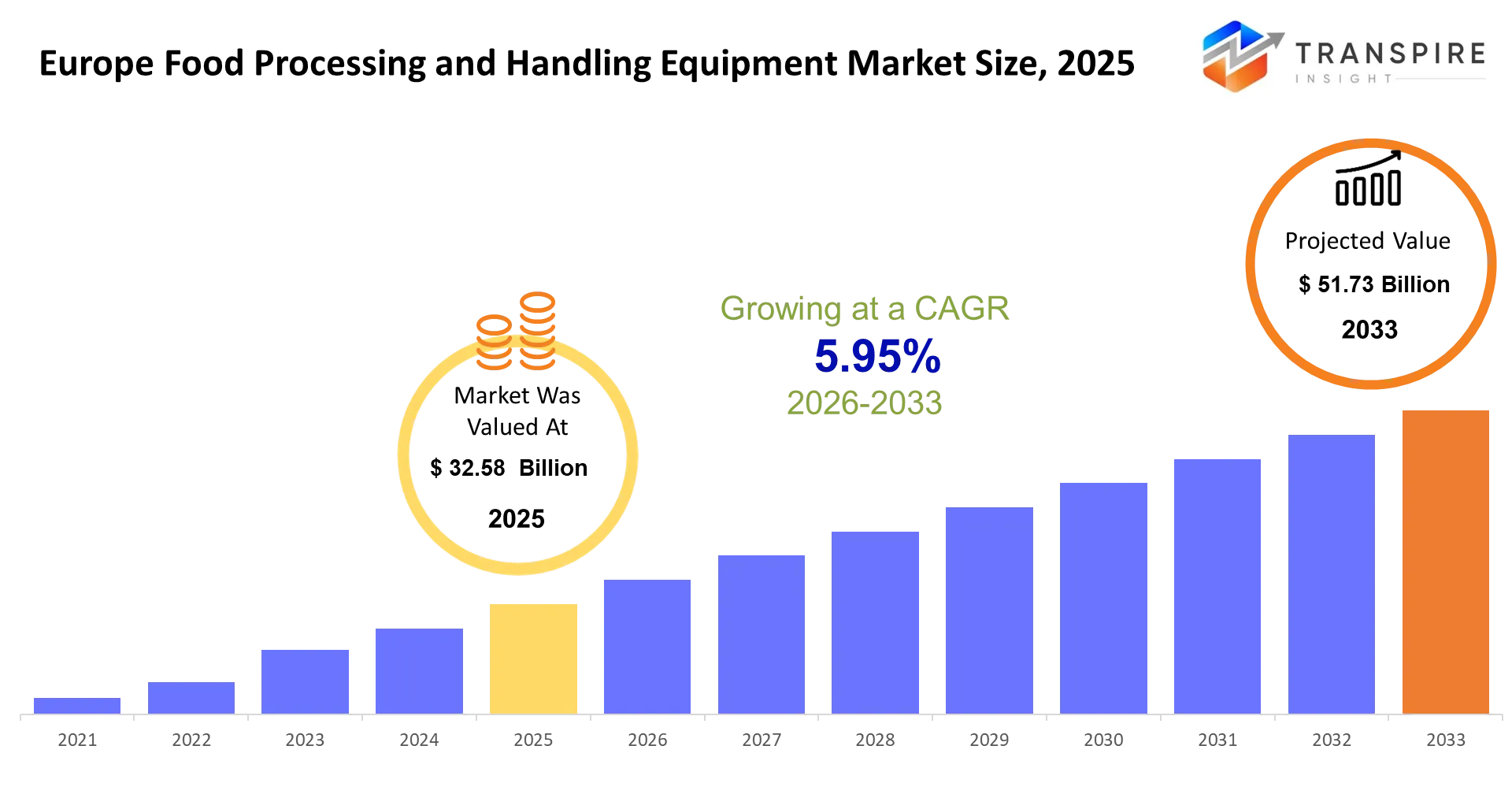
- Europe Food Processing and Handling Equipment Market Size 2025: USD 32.58 Billion
- Europe Food Processing and Handling Equipment Market Size 2033: USD 51.73 Billion
- Europe Food Processing and Handling Equipment Market CAGR: 5.95%
- Europe Food Processing and Handling Equipment Market Segments: By Type (Processing Equipment, Packaging Equipment, Handling Equipment, Cutting Equipment, Mixing Equipment, Others); By Application (Bakery, Dairy, Meat Processing, Beverage Processing, Fruits & Vegetables, Others); By End-User (Food Manufacturers, Restaurants, SMEs, Industrial Units, Others); By Automation (Manual, Semi-automatic, Fully Automatic, Others)
To learn more about this report,  Download Free Sample Report
Europe Food Processing and Handling Equipment Market Summary
The Europe Food Processing and Handling Equipment Market was valued at USD 32.58 Billion in 2025. It is forecast to reach USD 51.73 Billion by 2033. That is a CAGR of 5.95% over the period
The Europe Food Processing and Handling Equipment Market supports the transformation of raw agricultural inputs into packaged, safe, and distribution-ready food products across industrial plants, bakeries, dairies, and beverage facilities. It enables production lines to operate continuously while they use automatic systems for mixing and heating and cutting and packaging and sanitation processes which follow the strict hygiene and traceability requirements of EU food safety standards.
The market has moved from using separate mechanical systems to implementing complete production lines that operate with sensor technology during the past three to five years. The industry transition has happened because processing facilities need to implement automation and digital systems for monitoring their operations which maintain product quality and prevent contamination. The post-pandemic distribution chain interruptions which revealed labor deficiencies and manufacturing delays throughout European food production systems have become the main driver for this transition.
Manufacturers have increased their spending on robotics and predictive maintenance tools and energy-efficient machinery because these technologies help them maintain production levels and decrease downtime. The need to meet hygiene standards and sustainability requirements has led organizations to implement advanced systems which boost production efficiency while decreasing operational hazards and long-term operational expenses.
Key Market Insights
- The Food Processing and Handling Equipment Market of Europe receives its largest share through Western Europe which holds 38% of the market in 2025 because of its advanced food manufacturing infrastructure and its strong regulatory compliance frameworks.
- Northern Europe establishes itself as the most rapidly expanding area until 2030 because of its plant-based food innovation centers and its substantial investments in sustainable protein production facilities.
- The Europe Food Processing and Handling Equipment Market shows its highest value through processing equipment which controls approximately 42% of the market because of its strong demand from bakery and dairy and meat production processes.
- The packaging equipment segment stands as the second largest because food producers now use shelf-life extension and sustainable packaging technologies in their retail supply chains.
- The handling equipment segment shows the fastest growth rate because processing facilities with high-volume production systems now implement automation and robotics from 2024 to 2030.
- The Europe Food Processing and Handling Equipment Market shows its largest market share through bakery applications which account for nearly 30% of total sales because consumers continue buying packaged baked goods.
- The beverage processing industry experiences its fastest growth because carbonation and filling and smart bottling systems become popular in both functional and low-sugar beverage markets.
- Food manufacturers represent the largest customer segment because they need to modernize their production processes which require compliance with industry standards.
- The end-user segment of SMEs has grown the fastest because modular systems and semi-automatic systems create easier access points and enable businesses to grow production capacity.
- European businesses now gain their competitive edge through three main factors which include AI-based predictive maintenance systems and energy-efficient machine design and partnerships with alternative protein manufacturers.
What are the Key Drivers, Restraints, and Opportunities in the Europe Food Processing and Handling Equipment Market?
The ongoing labor shortages together with the increased enforcement of EU food safety regulations force businesses to invest continuously in advanced processing equipment and handling equipment. Producers across Germany and France and Italy replaced their manual processes because rising wage costs required them to implement robotic systems for cutting and mixing and packaging operations. Manufacturers increase their capital expenses for integrated production systems because they need to maintain stable production rates while managing contamination risks and meeting HACCP hygiene requirements.
The integration cost which requires businesses to spend money upfront serves as the main obstacle which small and mid-sized processors with outdated infrastructure face. Businesses need to spend money for new equipment and time to install digital control systems and stainless steel equipment and sensor networks on their existing production lines. The structural constraint prevents facilities from adopting new systems because they continue to use semi-manual operations which create operational problems that result in lost revenue opportunities for equipment makers.
Plant-based and alternative protein manufacturing provides a major growth opportunity because production facilities are expanding throughout the Netherlands and Germany and Scandinavia. Precision fermentation startups and pea-protein processors require highly specialized extrusion and fermentation and temperature-controlled handling systems. European agri-food funds invest into sustainable protein hubs which create a need for modular equipment that can be reconfigured to accommodate various product formulations enabling suppliers to secure initial technology lock-in benefits.
What Has the Impact of Artificial Intelligence Been on the Europe Food Processing and Handling Equipment Market?
The food processing industry now uses artificial intelligence to create automated systems which monitor operations in real time and control equipment through adaptive systems. The implementation of AI-based scrubber performance systems and exhaust gas cleaning systems by manufacturers enables industrial processing plants to achieve sanitary compliance while decreasing their requirements for manual inspections. Digital fleet-style tracking platforms enable plants to monitor their equipment usage across multiple locations while maintaining their operational standards and enhancing their audit traceability. The systems enable organizations to handle equipment failures through automated processes which decrease the time needed to resolve equipment problems.
Machine learning models use vibration and temperature and throughput data analysis to create predictive maintenance systems which identify equipment failures before they happen. Process optimization tools create energy-efficient systems which maintain product quality by adjusting mixing and heating and packaging operations. The operators experienced measurable benefits which included decreased unplanned downtime and increased uptime between 15 and 25 percent and decreased maintenance expenses through servicing based on equipment conditions. Energy optimization algorithms enable high-load bakery and dairy processing lines to achieve reduced energy consumption.
AI adoption encounters a basic obstacle which results from the expensive costs of system integration together with the existence of outdated system components in mid-sized manufacturing facilities. The availability of limited authentic training data from different processing environments leads to decreased model performance especially when production loads and sanitation cycles experience changes.
Key Market Trends
- Manufacturers started using robots to replace their manual production lines because they needed to solve ongoing labor shortages after 2020.
- The European Union established more stringent hygiene regulations that required manufacturers to upgrade their stainless-steel washdown-ready equipment with advanced systems for controlling contamination.
- The market demand for complete processing systems grew because customers wanted to purchase automated production systems that operated as unified systems instead of buying separate machines.
- Factories started using energy-efficient equipment after 2022 which resulted from rising electricity prices that compelled them to use energy-saving ovens and intelligent motors.
- Automated quality control systems based on AI technology became more widely used because factories switched from manual defect inspection to automated continuous monitoring systems.
- Sustainable packaging materials became the main focus for packaging innovation after 2021 which resulted in beverage and bakery companies redesigning their sealing and filling equipment.
- Mid-sized food producers increased their expenditures on semi-automatic systems because they needed to establish flexible production systems that would support their private label products and regional distribution.
- The frozen food and fresh meal industries advanced their cold chain systems because modern retail operations began distributing these products.
- Predictive maintenance tools gained industrial acceptance as downtime reduction became a key competitive factor among large-scale European processors.
Europe Food Processing and Handling Equipment Market Segmentation
By Type:
The Europe food processing and handling equipment market which currently supports its main production equipment products, has its highest demand from processing equipment products, because they operate essential functions within mass production systems that bakeries and dairy companies and meat processing plants need to operate. Food safety regulations from the European Union require facilities to maintain their output for production purposes, which results in facilities needing to spend large amounts of money on their ovens and pasteurizers and thermal systems. Branded food producers who want to extend their products' shelf life and create appealing retail displays propel the demand for packaging equipment, which comes after processing equipment in market share.
Mainstream factories keep expanding their operations through automated equipment, which they use to transport materials throughout their facilities, because this method helps them achieve better health standards while decreasing their workforce requirements. The protein processing and bakery industries maintain their need for cutting and mixing equipment, because these systems deliver precise and repeatable results which determine their product quality. The group of systems which includes inspection and cleaning systems, experiences a gradual increase because regulations for compliance become more stringent.
The industry will experience its upcoming growth stage through the development of production lines which combine multiple system functions into one streamlined equipment solution. Equipment manufacturers will concentrate on developing technologies which minimize power consumption, enable digital system tracking, and decrease machine operational interruptions. Today, buyers prefer systems which can scale to their requirements through incremental system development instead of requiring complete system replacement.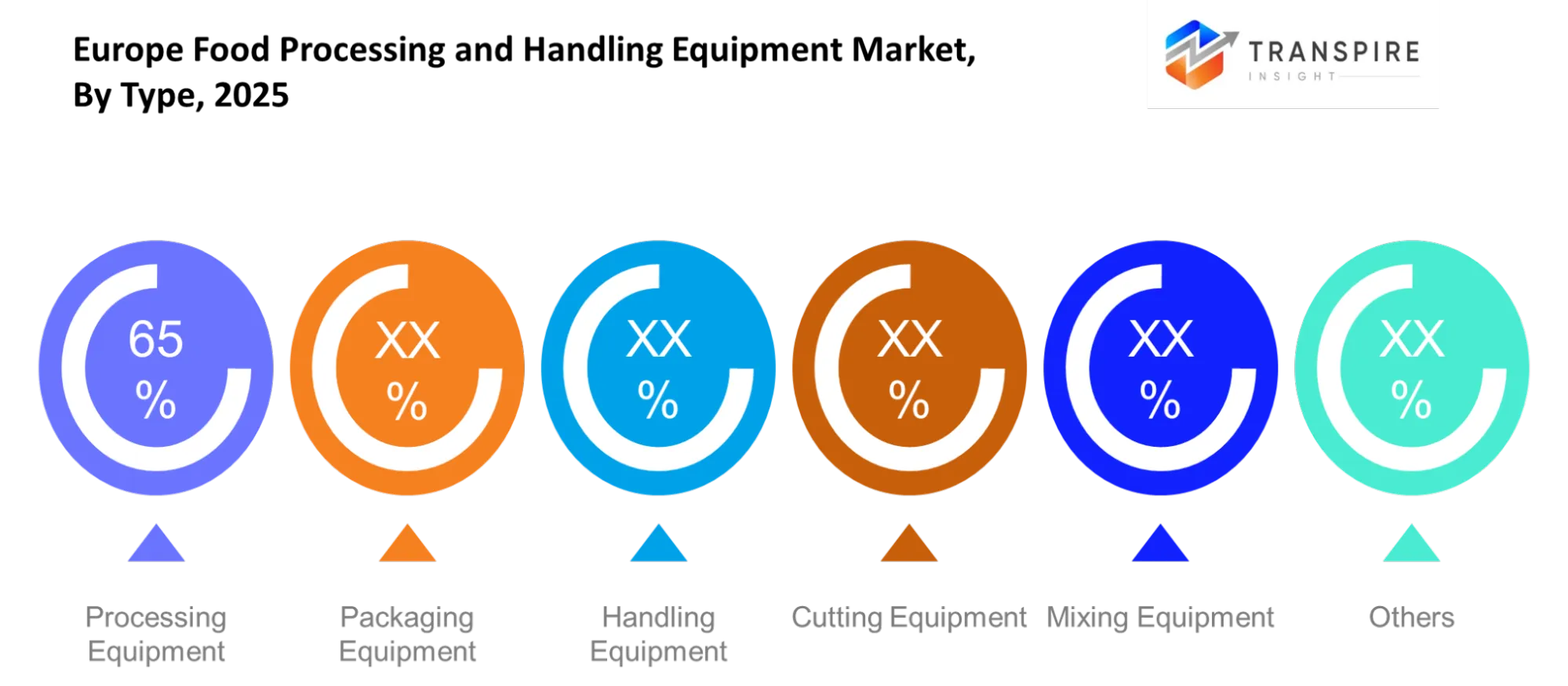
To learn more about this report, Download Free Sample Report
By Application:
The Europe food processing and handling equipment market operates through its bakery applications, which generate the highest market share because customers constantly seek bread and pastries and packaged baked goods, which exist in retail stores and foodservice establishments. The dairy processing industry remains strong because people highly consume milk and cheese and yogurt products, which need strict cold-chain storage procedures and automated pasteurization systems for processing.
The meat processing industry requires substantial equipment because its operations need strict hygiene standards while handling large quantities of meat during slaughtering and packaging activities. The beverage processing industry maintains its steady growth rate especially in bottled water and soft drinks and functional beverages which require fast-paced filling and labeling equipment. The processing of fruits and vegetables expands because urban retail outlets show increasing demand for frozen and pre-cut produce items.
The company plans its future growth to focus on producing ready-to-eat meals and convenience food products for both bakery and meat manufacturing sectors. The processing of plant-based foods will drive increased equipment usage for both dairy alternatives and protein substitute products. Manufacturers will focus their efforts on building production systems that enable quick changes between different product types without requiring extended periods of equipment unavailability.
By End-User:
Food manufacturers hold the dominant position in the European food processing equipment market because they need to produce large quantities of food while meeting strict regulatory requirements. Commercial kitchens make up the next largest segment because they rely on centralized production facilities to deliver products to both retail and export markets. These industries spend extensively on complete automation solutions which help them achieve maximum operational productivity and product tracking capabilities.
The restaurant and small business sector is expanding because compact semi-automatic machines help them decrease worker requirements while producing constant work rates. Small and medium-sized enterprises choose modular processing systems for their bakery and dairy and frozen food operations because entry-level automation helps them work more efficiently without needing heavy financial investment. The list of other markets includes institutional catering and contract food processing facilities.
The market will experience market expansion for automated systems that provide services to medium-sized businesses. The equipment industry will develop more versatile systems which can handle various production processes.Cost-effective solutions and simple maintenance procedures and compliance capabilities will become the main selection factors for buyers.
By Automation:
The European market for food processing and handling equipment currently operates with fully automatic systems as the top solution because large factories implement these systems to achieve efficient operations while maintaining sanitary conditions and reducing staff requirements. The systems operate in continuous mode to handle high-volume production of bakery items and meat products and beverages. The semi-automatic systems remain popular among mid-sized organizations because they enable efficient operations at an affordable cost.
Automatic systems continue to operate in small food production facilities that require specialized production methods for their low-volume custom products. The market presence of these systems remains restricted because businesses face increased expenses for workers and need to follow more stringent cleaning protocols. New hybrid systems develop in production companies that require partial automation to enhance efficiency because they want to keep their existing systems.
The development of the future market will benefit from automatic systems that use digital technology and connected devices together with maintenance solutions based on sensor data. The semi-automatic systems will progress into new hybrid systems through their evolution process. The buyers will choose automation systems that match their needs for business growth and legal compliance and their desire to cut expenses over time.
What are the Key Use Cases Driving the Europe Food Processing and Handling Equipment Market?
Automation in high-volume bakery, dairy, and meat processing facilities stands as the main application that drives European demand for food processing and handling equipment. Manufacturers improve their production capacity by implementing conveyor systems and industrial mixers and slicing equipment and robotic packaging lines which meet EU food safety and hygiene standards. Integrated handling systems become the preferred choice for large-scale processors because these systems decrease their need for human workers and provide protection against contamination and maintain consistent quality of packaged and ready-to-eat products.
The beverage bottling and frozen food production industry is experiencing growth in its secondary applications which are preferred by medium-sized food manufacturers and private-label suppliers. The market demand for precision filling and palletizing and cold-chain handling systems has risen because these systems enable manufacturers to produce goods using various packaging methods within shorter production cycles. Seafood processors and fresh produce exporters use advanced sorting and grading equipment to fulfill traceability needs that arise from international trade requirements.
Food manufacturing facilities now use AI-enabled inspection systems and energy-efficient handling equipment as their new applications. Producers test smart sensors and predictive maintenance platforms and autonomous mobile robots within high-sanitation environments. Plant-based food startups and alternative protein manufacturers create a new market need for specialized mixing and extrusion and temperature-controlled handling technologies which help their businesses meet new production requirements.
|
Report Metrics |
Details |
|
Market size value in 2025 |
USD 32.58 Billion |
|
Market size value in 2026 |
USD 34.52 Billion |
|
Revenue forecast in 2033 |
USD 51.73 Billion |
|
Growth rate |
CAGR of 5.95% from 2026 to 2033 |
|
Base year |
2025 |
|
Historical data |
2021 - 2024 |
|
Forecast period |
2026 - 2033 |
|
Report coverage |
Revenue forecast, competitive landscape, growth factors, and trends |
|
Regional scope |
Europe (Germany, United Kingdom, France, Italy, Spain, Rest of Europe) |
|
Key company profiled |
Tetra Pak, GEA Group, Buhler, Alfa Laval, Krones, SPX Flow, JBT Corporation, Marel, Middleby, Dover, Heat and Control, Baader, FAM, Multivac, Ishida |
|
Customization scope |
Free report customization (country, regional & segment scope). Avail customized purchase options to meet your exact research needs. |
|
Report Segmentation |
By Type (Processing Equipment, Packaging Equipment, Handling Equipment, Cutting Equipment, Mixing Equipment, Others); By Application (Bakery, Dairy, Meat Processing, Beverage Processing, Fruits & Vegetables, Others); By End-User (Food Manufacturers, Restaurants, SMEs, Industrial Units, Others); By Automation (Manual, Semi-automatic, Fully Automatic, Others) |
Which Regions are Driving the Europe Food Processing and Handling Equipment Market Growth?
The Europe food processing and handling equipment market remains dominated by Western Europe because the region implements strict food safety regulations while operating advanced automated manufacturing facilities. The European Union requires Germany, France, Italy, and the Netherlands to invest in advanced processing lines that will help them achieve sustainability and traceability and labor efficiency targets. The region possesses a complete industrial ecosystem which includes equipment manufacturers and industrial automation providers and cold-chain operators and food research institutions that support quick technology implementation. Western Europe maintains its dominant market position because multinational food companies keep investing in capital projects and export-focused food production operations.
Northern Europe contributes a smaller share of total revenue than Western Europe, but it stands out for its operational stability and early adoption of energy-efficient processing systems. The food manufacturing industries in Sweden and Denmark and Finland operate with consistent demand because dairy and seafood and packaged food producers use standardized production methods and make long-term investments. Northern Europe focuses on precision engineering and low-emission processing and digital monitoring technologies which enhance production efficiency through their complete operational lifespan. The region establishes itself as a dependable provider of equipment upkeep and replacement because its investment patterns remain consistent throughout time.
Eastern Europe has become the fastest-growing region because food manufacturing infrastructure modernization and European Union industrial investments are both increasing throughout the region. Food processing companies are establishing new facilities in Poland and Romania and Hungary because these countries provide reduced operational expenses and greater access to their supply chains. The recent funding programs which focus on energy efficiency and automation and agricultural value addition have created higher demand for modular processing systems and material handling systems. The period from 2026 to 2033 will provide equipment suppliers and automation software companies and investors who focus on mid-sized food producers with major business prospects because these producers will implement advanced production methods.
Who are the Key Players in the Europe Food Processing and Handling Equipment Market and How Do They Compete?
The Europe food processing and handling equipment market remains moderately consolidated, with multinational engineering firms controlling high-value automation and processing systems while regional manufacturers compete in specialized machinery segments. The market now evaluates vendors based on their ability to combine different technologies and minimize energy consumption and provide service support throughout product lifecycles instead of evaluating them through equipment pricing. Companies that already exist in the market use digital technologies and predictive maintenance systems and binding client support agreements to protect their customer base while smaller automation companies succeed by providing flexible system solutions designed for medium-sized food manufacturing businesses. Western European markets now see sustainability practices and workforce reduction methods as their primary factors for establishing competitive advantages.
GEA Group competes through automation-driven processing and packaging systems that reduce energy consumption and production downtime. The business establishes its competitive position through its use of AI-powered monitoring systems together with hygienic design requirements found in dairy and meat and beverage industry operations. The company continues expanding through strategic investments in digital service platforms and advanced packaging technologies. Bühler Group offers itself as a distinctive processing solution which provides precision processing technologies that make possible cocoa and alternative protein production and grain processing. The company has established itself as an industry leader through its extensive research and development efforts together with its energy-efficient extrusion systems which enable food producers to adopt sustainable manufacturing practices across Europe.
Tetra Pak maintains a competitive edge through end-to-end food processing and aseptic packaging integration which enables manufacturers to optimize their production process and track product movement through a unified system. The company is expanding through partnerships that focus on developing circular packaging systems and smart factory technology.Alfa Laval manufacturing develops hygienic food processing systems through its specialized expertise in heat transfer and fluid handling technologies. The company achieves its unique market position through process optimization systems that decrease operational water and energy consumption, while its recent partnerships for sustainable processing infrastructure development strengthen its high-efficiency manufacturing capabilities.
Company List
- Tetra Pak
- GEA Group
- Buhler
- Alfa Laval
- Krones
- SPX Flow
- JBT Corporation
- Marel
- Middleby
- Dover
- Heat and Control
- Baader
- FAM
- Multivac
- Ishida
Recent Development News
“In May 2026, Bühler Group launched multiple upgrades to its Grains & Food processing portfolio at Interpack 2026, including the Lucent cocoa roaster and Nutrex 7 extrusion systems. The launch expanded Bühler’s energy-efficient and hygiene-focused processing technologies, reinforcing automation and sustainability trends across Europe’s food manufacturing sector.https://www.buhlergroup.com
“In May 2025, SPX FLOW, Tetra Pak, Alfa Laval, and Krones formed the Food Manufacturing Technologies Europe (FMTE) coalition. The partnership was established to strengthen innovation, sustainability, and policy coordination in Europe’s food manufacturing technologies and equipment sector, signaling increased cross-industry collaboration in advanced processing infrastructure.https://www.spxflow.com
What Strategic Insights Define the Future of the Europe Food Processing and Handling Equipment Market?
The food processing and handling equipment market in Europe is experiencing a structural transformation towards production systems that use full automation, energy-saving technologies, and complete digital integration. The growth of the market occurs because food supply chain requirements and sustainability regulations create difficulties in hiring workers. The next 5 to 7 years will show a transition in competitive advantages which will rely on software-driven equipment that allows factories to forecast maintenance needs and check product quality while making different food products. The market depends on a small number of advanced component suppliers who supply essential sensors industrial semiconductors and robotics systems which creates a hidden risk that will cause manufacturers to experience continuous pricing instability and delivery interruptions. The EU sustainability funding and the trend of food manufacturing relocation to Eastern Europe create an emerging opportunity for businesses to implement modular processing systems. The market players need to establish strategic partnerships with industrial automation companies and AI analytics providers to create lasting competitive advantages that extend beyond their hardware products.
Europe Food Processing and Handling Equipment Market Report Segmentation
By Type
- Processing Equipment
- Packaging Equipment
- Handling Equipment
- Cutting Equipment
- Mixing Equipment
- Others
By Application
- Bakery
- Dairy
- Meat Processing
- Beverage Processing
- Fruits & Vegetables
- Others
By End-User
- Food Manufacturers
- Restaurants
- SMEs
- Industrial Units
- Others
By Automation
- Manual
- Semi-automatic
- Fully Automatic
- Others
Frequently Asked Questions
Find quick answers to common questions.
The Europe Food Processing and Handling Equipment Market size is USD 51.73 Billion in 2033.
Key Segments for the Europe Food Processing and Handling Equipment Market are By Type (Processing Equipment, Packaging Equipment, Handling Equipment, Cutting Equipment, Mixing Equipment, Others); By Application (Bakery, Dairy, Meat Processing, Beverage Processing, Fruits & Vegetables, Others); By End-User (Food Manufacturers, Restaurants, SMEs, Industrial Units, Others); By Automation (Manual, Semi-automatic, Fully Automatic, Others).
Major Europe Food Processing and Handling Equipment Market players are Tetra Pak, GEA Group, Buhler, Alfa Laval, Krones, SPX Flow, JBT Corporation, Marel, Middleby, Dover, Heat and Control, Baader, FAM, Multivac, Ishida.
The Europe Food Processing and Handling Equipment Market size is USD 32.58 Billion in 2025.
The Europe Food Processing and Handling Equipment Market CAGR is 5.95% from 2026 to 2033.
- Tetra Pak
- GEA Group
- Buhler
- Alfa Laval
- Krones
- SPX Flow
- JBT Corporation
- Marel
- Middleby
- Dover
- Heat and Control
- Baader
- FAM
- Multivac
- Ishida
Recently Published Reports
-
Apr 2026
Handling and Lifting Equipment Market
Handling and Lifting Equipment Market Size, Share & Analysis Report By Product (Cranes and Hoists, Forklifts, Conveyor Systems, Aerial Work Platforms, Others), By Application (E-Commerce, Automotive and Railway, Food and Beverages, Aviation, Others), and Geography (North America, Europe, Asia-Pacific, Middle East and Africa, South and Central America), 2021 - 2031
-
Apr 2026
HVAC Equipment Market
HVAC Equipment Market Size, Share & Analysis Report By Heating Equipment Type (Boilers and Furnaces, Heat Pumps, and Unitary Heaters), By Ventilation Equipment (Air Handling Units, Humidifiers and Dehumidifiers, Air Filters, and Fan Coiling Units), By Air Conditioning Equipment (Unitary Air Conditioners, Room Air Conditioners, Packaged Terminal Air Conditioners, and Chillers), By End User (Commercial, Residential, Industrial, and others), and Geography (North America, Europe, Asia-Pacific, Middle East and Africa, South and Central America), 2021 – 2031
-
Apr 2026
Refrigeration Valves Market
Refrigeration Valves Market Size, Share & Analysis Report By Type (Solenoid Valves, Expansion Valves, Check Valves, Service Valves, Others), By Application (Commercial Refrigeration, Industrial Refrigeration, Transport Refrigeration, Residential Refrigeration, Air Conditioning Systems), By End User (Food and Beverage Industry, Pharmaceutical Industry, HVAC Industry, Chemical Industry, Others), and Geography (North America, Europe, Asia-Pacific, Middle East and Africa, South and Central America), 2021 – 2031
-
Apr 2026
E-Commerce Packaging Materials Market
E-Commerce Packaging Materials Market By Material Type (Corrugated Boxes, Paper & Paperboard, Foam & Cushioning Materials, Plastic Packaging, Flexible Packaging, Protective Packaging, Others), By Product(Primary Packaging, Secondary Packaging, Tertiary Packaging), By Packaging Function (Protective Packaging, Branding & Presentation Packaging, Transit & Logistic Packaging, Sustainable Packaging, Tamper Evidence Packaging), By End-User (Retail & Consumer Goods, Electronic Appliances, Food & Beverages, Healthcare & Pharmaceutical, Fashion & Apparel, Home & Furnishing, Others); By Industry Analysis, Size, Share, Growth, Trends, and Forecasts 2021-2033