
Europe Automatic Identification And Data Capture Market Size & Forecast:
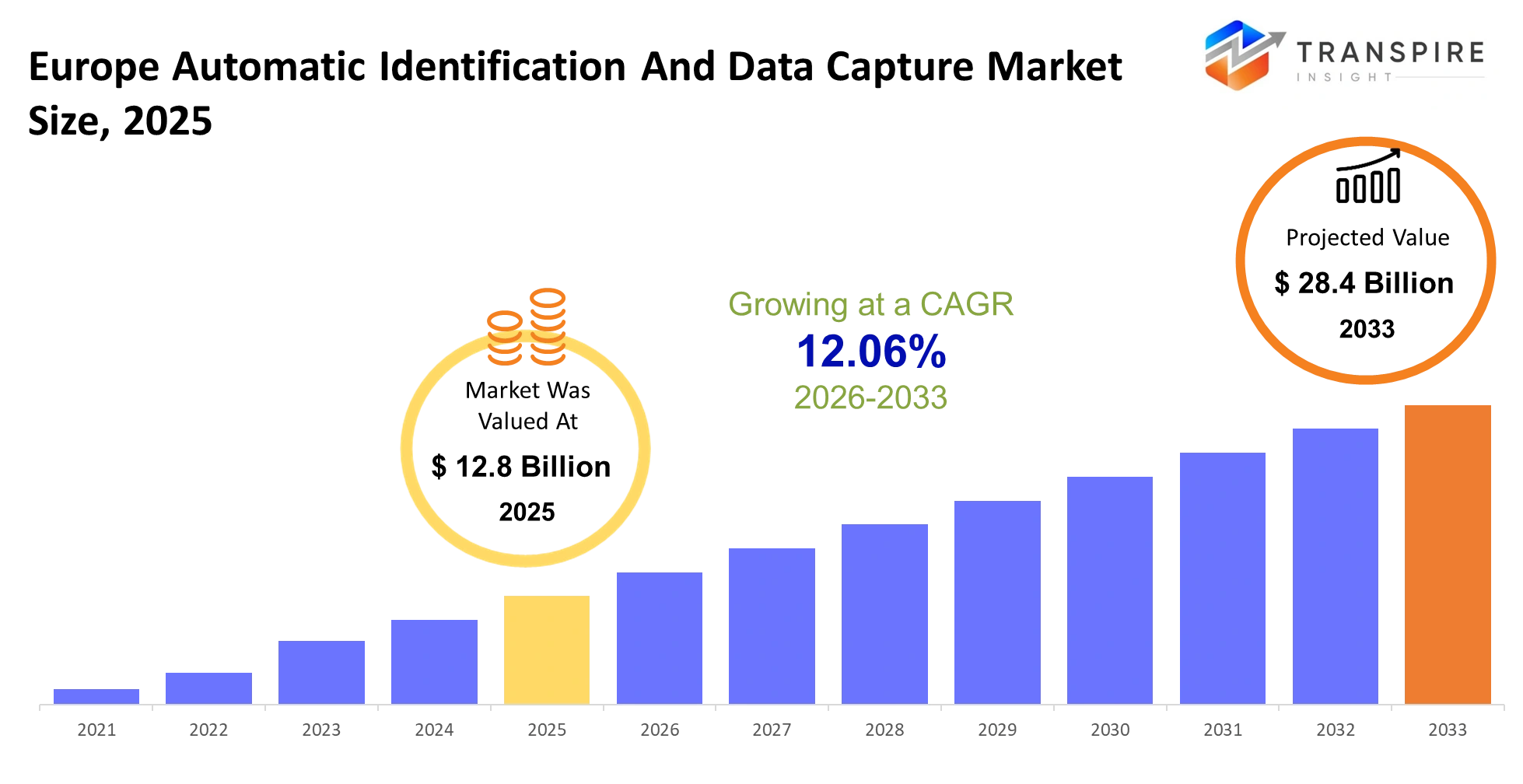
- Europe Automatic Identification And Data Capture Market Size 2025: USD 12.8 Billion
- Europe Automatic Identification And Data Capture Market Size 2033: USD 28.4 Billion
- Europe Automatic Identification And Data Capture Market CAGR: 12.06%
- Europe Automatic Identification And Data Capture Market Segments: By Type (Barcode Systems, RFID Systems, Smart Cards, Biometrics, Others), By Application (Retail, Healthcare, Logistics, Manufacturing, BFSI, Others), By End-User (Enterprises, SMEs, Retailers, Healthcare Providers, Logistics Companies, Others), By Technology (Optical Recognition, Magnetic Stripes, NFC, Sensors, Others).
To learn more about this report,  Download Free Sample Report
Europe Automatic Identification And Data Capture Market Summary:
The Europe Automatic Identification And Data Capture Market size is estimated at USD 12.8 Billion in 2025 and is anticipated to reach USD 28.4 Billion by 2033, growing at a CAGR of 12.06% from 2026 to 2033.The Europe Automatic Identification and Data Capture AIDC market enables businesses to track and identify and verify their products and assets and operational processes throughout their factories and warehouses and ports and retail networks. The system enables operators to track inventory through real-time inventory tracking which replaces manual logging with barcode scanning and RFID tagging and machine vision technology.
The market has completely shifted during the last 3 to 5 years because current businesses now prefer complete data solutions that connect to cloud systems and operate with enterprise software and analytics systems instead of using separate scanning equipment. The COVID-19 supply chain interruption became the main factor that demonstrated how vulnerable manual and semi-automated tracking systems actually are. Companies increased their automated identification systems funding because they needed immediate operational visibility and better system reliability. The business generates revenue through hardware sales and software solutions and data services and ongoing system integration agreements.
Key Market Insights
- Western Europe holds the primary position in the Europe Automatic Identification And Data Capture Market because of its advanced logistics infrastructure which enables the region to maintain a 45% market share in 2024.
- Germany and France and the UK lead adoption because of their industrial automation investments and their strong retail digitization initiatives.
- Eastern Europe will experience its most rapid growth period until 2030 because of its manufacturing sector growth and its efforts to modernize supply chain operations.
- Retail and warehousing operations extensively use barcode scanners which will achieve a market share exceeding 40% in 2024.
- RFID solutions maintain second-largest market share because businesses increasingly use them to track high-value assets and automate their inventory management processes.
- Machine vision and AI-based AIDC systems represent the fastest-growing segment which will experience rapid expansion until 2030 as smart factories become more common.
- Inventory and warehouse management industry controls approximately 35% market share because e-commerce businesses need to track stock levels in real time during order fulfillment.
- Asset tracking and field service management applications experience their fastest growth because businesses use IoT technology and predictive maintenance methods.
- Retail and e-commerce lead the Europe Automatic Identification And Data Capture Market with over 30% share due to omnichannel fulfillment complexity.
- The manufacturing sector grows most rapidly among end-user segments because businesses adopt Industry 4.0 technologies and implement production traceability systems.
What are the Key Drivers, Restraints, and Opportunities in the Europe Automatic Identification And Data Capture Market?
The shift toward real-time data-driven operations which operates throughout supply chains serves as the main factor which drives growth in the European Automatic Identification and Data Capture market. The transition began to develop its rapid pace because pandemic-related shutdowns revealed how financial losses occurred when businesses failed to track their inventory and needed more time to make decisions. The main response from large retailers and manufacturers involved using RFID technology and mobile scanning systems and cloud-based AIDC platforms as essential components of their main business processes. The starting point for this situation involved both the disruption and the reduced expenses associated with sensors and connectivity which enabled companies to implement their systems at a reasonable price. AIDC products have developed into tools which organizations use to protect their revenue streams. The combination of faster inventory turnover and reduced stockout occurrences and better order accuracy results in increased production capacity and measurable financial benefits.
The most significant restraint remains the complexity of integrating AIDC systems with legacy enterprise infrastructure. Many European firms still operate on fragmented ERP and warehouse management systems that lack interoperability with modern AIDC technologies. This situation acts as a permanent obstacle because organizations must spend multiple years and their complete operational capacity to implement system changes. The adoption process experiences delays because vendors need more time to complete their sales activities. The market loses potential revenue as projects are phased or deferred.
Central and Eastern Europe manufacturing hubs present a significant business opportunity through their current implementation of AI-based machine vision systems alongside their edge data collection technologies. Companies are acquiring automated inspection systems and tracking technologies because their factories undergo modernization through Industry 4.0 implementation. Machine vision systems enable defect detection and component monitoring without the requirement of manual scanning to identify defects. AIDC providers can develop new income sources through this transition because they can now use their technologies to track assets and provide immediate operational intelligence.
What Has the Impact of Artificial Intelligence Been on the Europe Automatic Identification And Data Capture Market?
The identification and data capture systems used in industrial and maritime operations now function as active decision systems because artificial intelligence has developed these systems from their original role as tracking tools. The AI-enabled AIDC platforms which operate in port facilities and onboard vessel fleets use sensor data together with barcode or RFID inputs to perform automatic compliance monitoring by tracking cargo movement and emission-related parameters. The system enables operators to carry out automatic compliance data recording which decreases the need for manual reporting while it helps them decrease their chances of facing regulatory violations.
The predictive abilities of machine learning models improve through their ability to study past scan results and equipment operation data and environmental condition information. The system enables predictive maintenance to function properly for scanning devices and onboard monitoring equipment and emission control system components. The system enables operators to forecast equipment failures and establish optimal inspection schedules which results in decreased unexpected equipment downtime and better equipment availability while reducing maintenance expenses.
The systems produce operational benefits which organizations can measure through their implementation. Companies experience enhanced cargo processing efficiency together with better fuel planning from improved asset tracking and increased compliance accuracy throughout their complicated logistics networks.
The existing data environments remain disjointed which creates a major obstacle because maritime operations experience restricted data access. AI systems need ongoing access to complete data streams because their performance depends on data quality which is affected by the insufficient system interoperability between old systems and contemporary platforms in real-world applications.
Key Market Trends
- Enterprises have adopted hybrid RFID and vision-based systems since 2020 which have improved their inventory accuracy by 25% in their large warehouses.
- After 2021 organizations started using cloud-based AIDC platforms which replaced on-premise systems to achieve real-time data synchronization for their European operations across multiple sites.
- Zebra Technologies and Honeywell International expanded their AI-enabled scanner products to meet retailer demand for analytics-driven decision support which goes beyond basic data capture functions.
- Logistics providers needed to implement complete tracking systems after the pandemic created supply chain disruptions which resulted in European distribution centers increasing their RFID usage by double-digit percentages since 2022.
- German and Italian manufacturing companies started using machine vision systems in 2021 to decrease their need for manual inspections while achieving better defect detection results during automated production processes.
- The regulatory environment needs product traceability which especially applies to pharmaceutical and food products. This requirement has led to AIDC adoption through compliance measures that mandate serialization systems in various EU directives.
- AIDC software buyers show growing preference for subscription models which offer software access through periodic payments instead of requiring upfront hardware purchases. This trend drives vendors to generate income through steady revenue streams and extended service agreements.
- Multinational companies expanded their logistics and production facilities into Eastern European markets which have become major growth areas since 2022 after digital development decreased operational costs in these regions.
- Since 2023 organizations have improved their system integration with IoT and edge computing technologies. Now they can process captured data directly at the source which decreases latency while enhancing their ability to respond to operational needs.
Europe Automatic Identification And Data Capture Market Segmentation
By Type
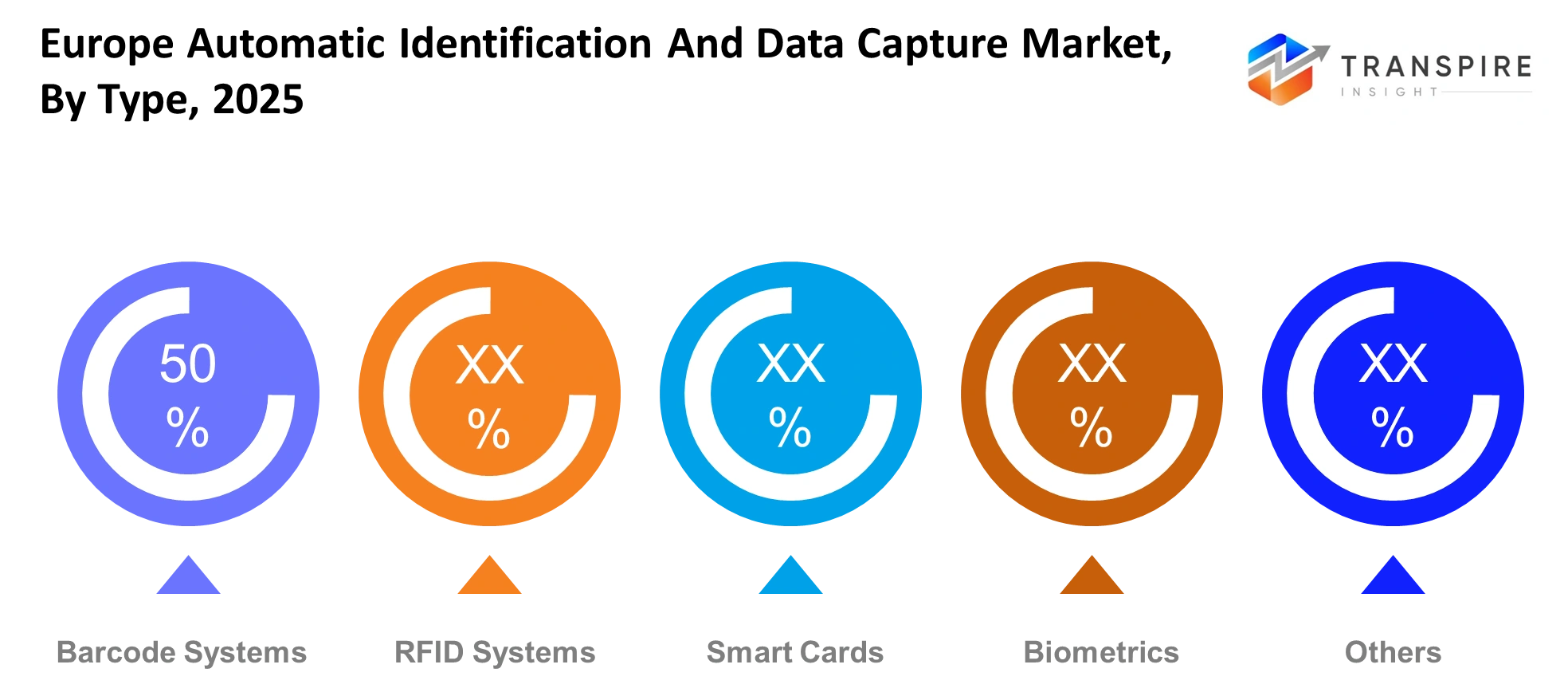
The Type barcode systems maintain their market lead because they offer low implementation expenses and established standards for both retail and logistics operations and they work with existing systems. Enterprises use RFID systems as their second most popular technology because they need to monitor inventory in real time and track their products across large operational spaces. Secure identification processes use smart cards and biometrics to fulfill essential needs which find their most important applications in banking financial services and healthcare settings.
Different growth patterns emerge across various sub-segments because RFID technologies experience rapid adoption in industries that need to decrease labor expenses while achieving greater operational precision. Small and mid-sized enterprises continue to use barcode systems because they provide affordable solutions for their budget-restricted business activities. The future development path leads to hybrid systems which combine barcode technology with RFID systems to provide manufacturers flexible solutions that allow customers to expand their operations without needing complete system upgrades.
To learn more about this report, Download Free Sample Report
By Application
The logistics and retail sectors dominate through their substantial transaction activity and requirement for ongoing inventory matching. The demand for scanning and tagging systems has grown because warehouse automation and e-commerce fulfillment and last-mile delivery operations now depend on these technologies. Healthcare is developing into a major growth market because patient safety needs and rules require tracking of drugs and medical equipment throughout their lifecycle.
The manufacturing sector maintains its growth trend because factories adopt data capture technologies to monitor product quality and track their assets throughout the production process. Each application employs different adoption systems because logistics needs fast operations while healthcare requires precise results and strict adherence to regulations. The upcoming expansion of the market will focus on creating integrated systems that enable supply chain and clinical and production data to work together through common platforms which will drive the development of systems that can communicate with one another.
By End-User
The financial capacity of large enterprises which use AIDC technology across multiple sites gives they complete control over their end-user distribution. The system expenditures of retail chains and logistics companies and global manufacturers are driven by their requirement for immediate operational oversight. The cost-sensitive nature of small and medium enterprises together with the complex process of integration handles their adoption needs yet cloud-based solutions are slowly decreasing these barriers.
Digital patient tracking and compliance systems have gained priority which has resulted in healthcare providers becoming the fastest growing user base. The demand patterns for enterprises enable them to scale operations through analytics while smaller users focus on implementing their solutions with simple processes. The subscription-based models which will emerge in the future will allow vendors to capture SME demand while preserving their revenue streams from enterprise clients.
By Technology
Optical recognition technologies through barcode scanning and machine vision systems currently hold the greatest market share because they have reached full development and industrial adoption. Organizations are adopting RFID and NFC technologies because they need solutions for contactless and automated identification processes. The integration of sensor-based systems with IoT systems enables organizations to track physical assets and monitor environmental conditions and operational activities.
The use of magnetic stripe technology decreases as organizations adopt digital and contactless identification systems that compete with traditional methods. Each technology follows a distinct growth curve, with optical systems maintaining stability while advanced technologies expand in high-value use cases. The future of multiple technologies shows a trend toward convergence which will enable manufacturers to create unique products through software integration and customers to obtain better operational performance with precise data.
What are the Key Use Cases Driving the Europe Automatic Identification And Data Capture Market?
The primary reason businesses adopt the technology remains its use in managing inventory at warehouses and retail locations. Companies operating high-volume fulfillment centers use barcode scanning together with RFID tagging technology to achieve real-time product tracking and to decrease picking mistakes while maintaining correct inventory levels. The rapid expansion of e-commerce together with the demand for quicker deliveries requires businesses to implement systems that provide immediate access to inventory information because these systems protect their revenues while enhancing customer contentment.
The healthcare sector together with the manufacturing sector shows continuous growth for their application base. Hospitals use patient wristband scanning and asset tagging to improve medication accuracy and equipment utilization. Manufacturers use data capture technology to track components which they implement throughout their production process because this system drives quality control and enables them to satisfy regulatory requirements in pharmaceuticals and automotive manufacturing industries.
The development of new use cases includes systems that use AI-based machine vision for inspection automation and intelligent logistics hubs that implement IoT-based tracking technology. The systems enable organizations to implement predictive processes while their operations operate independently, which becomes especially useful for industrial sites that exist in advanced European industrial areas.
|
Report Metrics |
Details |
|
Market size value in 2025 |
USD 12.8 Billion |
|
Market size value in 2026 |
USD 12.8 Billion |
|
Revenue forecast in 2033 |
USD 28.4 Billion |
|
Growth rate |
CAGR of 12.06% from 2026 to 2033 |
|
Base year |
2025 |
|
Historical data |
2021 - 2024 |
|
Forecast period |
2026 - 2033 |
|
Report coverage |
Revenue forecast, competitive landscape, growth factors, and trends |
|
Regional scope |
Europe (Germany, United Kingdom, France, Italy, Spain and Rest of Europe) |
|
Key company profiled |
Zebra Technologies, Honeywell, Datalogic, SATO, Toshiba Tec, Avery Dennison, HID Global, NXP, Impinj, Cognex, Siemens, IBM, Oracle, SAP, NEC. |
|
Customization scope |
Free report customization (country, regional & segment scope). Avail customized purchase options to meet your exact research needs. |
|
Report Segmentation |
By Type (Barcode Systems, RFID Systems, Smart Cards, Biometrics, Others), By Application (Retail, Healthcare, Logistics, Manufacturing, BFSI, Others), By End-User (Enterprises, SMEs, Retailers, Healthcare Providers, Logistics Companies, Others), By Technology (Optical Recognition, Magnetic Stripes, NFC, Sensors, Others). |
Which Regions are Driving the Europe Automatic Identification And Data Capture Market Growth?
Western Europe leads the market because it has reliable enforcement of regulations and it maintains advanced logistics networks while businesses use digital supply chain systems which developed during earlier times. Germany and the United Kingdom and France have dedicated substantial resources to creating automated warehousing and smart ports and standardized data capture systems. Pharmaceutical and food safety and industrial traceability industries enforce stringent compliance standards which require businesses to implement complete AIDC solutions throughout their operations. The established technology ecosystem which includes service providers and system integrators and cloud infrastructure enables ongoing system enhancements which help the business maintain its market position.
Northern Europe operates as a consistent contributor because Sweden and Denmark and the Netherlands focus on creating efficient and sustainable logistics systems. The region of Western Europe operates differently from this region because it develops new systems through gradual improvements instead of implementing complete system changes. The sector maintains its AIDC technology adoption because organizations continuously develop smart logistics corridors and they build their digital trade systems. Businesses establish dependable vendor relationships which result in revenue growth because public and private sectors work together effectively and regulatory rules remain stable.
Central and Eastern Europe has become the fastest expanding area since 2022 because industrial growth and supply chain shifts have accelerated. Multinational manufacturers are shifting their production operations and distribution centers to Poland and Hungary and the Czech Republic which creates greater demand for modern tracking systems.The adoption of RFID and automated data capture technologies received a boost from government-sponsored digitalization initiatives and EU infrastructure funding programs. The market expansion between 2026 and 2033 will create major business opportunities for vendors and investors who want to grow their operations in greenfield logistics and manufacturing facilities.
Who are the Key Players in the Europe Automatic Identification And Data Capture Market and How Do They Compete?
The Europe Automatic Identification and Data Capture market shows moderate consolidation because a few global technology providers maintain control over most market share while regional integrators operate in specific market segments. The competition between companies now focuses on technology integration because buyers need complete system visibility and analytical capabilities and system interoperability with their business operations. The existing market players retain their market position by developing new software and service offerings while new companies create specialized products for healthcare and logistics and industrial automation.
The adoption of cloud-connected systems and AI-driven data collection technologies has established higher requirements for market entry which benefits businesses that possess advanced research capabilities and strong partnerships within their industry ecosystem. Zebra Technologies develops new technological solutions through its research which combines analytics and AI with scanning and RFID systems to create predictive systems that generate insights from data. The company's hardware and software systems work together to create a complete ecosystem which helps the company establish its presence in the retail and logistics market throughout Western Europe. Honeywell International creates industrial-grade products which deliver superior durability and edge computing features for manufacturing and warehouse automation applications. Honeywell uses strategic partnerships with logistics providers and system integrators to expand its deployment capabilities throughout complex supply chain networks.
Datalogic S.p.A. creates competitive advantages by providing machine vision and industrial scanning solutions which are specifically designed for Southern European manufacturing facilities. SICK AG uses its sensor and automation technology expertise to create systems that provide precise identification for factory and logistics automation.The companies expand their operations through two strategies which include developing specialized applications and establishing industrial partnerships in different regions to compete against their larger global competitors.
Company List
- Zebra Technologies
- Honeywell
- Datalogic
- SATO
- Toshiba Tec
- Avery Dennison
- HID Global
- NXP
- Impinj
- Cognex
- Siemens
- IBM
- Oracle
- SAP
- NEC
Recent Development News
In April 2026, Amadeus to acquire IDEMIA Public Security for €1.2 billion: Amadeus, a Spain-based travel technology leader, announced the acquisition of French biometrics firm IDEMIA Public Security. The deal strengthens its footprint in biometric identification and automated passenger data capture systems, widely used in airports and border control across Europe. The acquisition is expected to expand Amadeus’ presence in secure identity verification technologies.
Source: https://www.reuters.com
In March 2026, SAP acquires Reltio : German software giant SAP SE announced acquisition of Reltio to enhance real-time enterprise data capture and identity management systems. The integration focuses on consolidating fragmented enterprise data into AI-ready structured systems—directly strengthening Europe’s enterprise AIDC and data capture ecosystem.
Source: https://www.nasdaq.com
What Strategic Insights Define the Future of the Europe Automatic Identification And Data Capture Market?
The Europe Automatic Identification and Data Capture market is progressing towards systems which combine all functions through intelligent technology for complete supply chain and industrial operational processes. Enterprises require platforms that deliver real-time decision-making capabilities and operational resilience through integrated systems which combine RFID technology with machine vision and cloud-based analytics solutions. The upcoming five to seven years will see companies transition their value creation methods from hardware sales toward software-driven recurring revenue streams and data service offerings.
The development of inexpensive computer vision technology and mobile scanning systems creates an undetected danger because these solutions enable users to operate without AIDC equipment which results in decreased equipment requirements and reduced profit margins for standard equipment manufacturers. Central and Eastern Europe manufacturing hubs are currently creating AI-driven edge processing solutions which allow their new manufacturing plants to implement advanced systems without needing existing systems.
Market participants should focus on developing software-based platforms which support system interoperability while establishing early-stage solution development partnerships for new industrial projects in greenfield locations.
Europe Automatic Identification And Data Capture Market Report Segmentation
By Type
- Barcode Systems
- RFID Systems
- Smart Cards
- Biometrics
- Others
By Application
- Retail
- Healthcare
- Logistics
- Manufacturing
- BFSI
- Others
By End-User
- Enterprises
- SMEs
- Retailers
- Healthcare Providers
- Logistics Companies
- Others
By Technology
- Optical Recognition
- Magnetic Stripes
- NFC
- Sensors
- Others
Frequently Asked Questions
Find quick answers to common questions.
The approximate Europe Automatic Identification And Data Capture Market size for the market will be USD 28.4 Billion in 2033.
The key segments of the Europe Automatic Identification And Data Capture Market are By Type (Barcode Systems, RFID Systems, Smart Cards, Biometrics, Others), By Application (Retail, Healthcare, Logistics, Manufacturing, BFSI, Others), By End-User (Enterprises, SMEs, Retailers, Healthcare Providers, Logistics Companies, Others), By Technology (Optical Recognition, Magnetic Stripes, NFC, Sensors, Others).
Major players in the Europe Automatic Identification And Data Capture Market are Zebra Technologies, Honeywell, Datalogic, SATO, Toshiba Tec, Avery Dennison, HID Global, NXP, Impinj, Cognex, Siemens, IBM, Oracle, SAP, NEC.
The current market size of the Europe Automatic Identification And Data Capture Market is USD 12.8 Billion in 2025.
The Europe Automatic Identification And Data Capture Market CAGR is 12.06%.
- Zebra Technologies
- Honeywell
- Datalogic
- SATO
- Toshiba Tec
- Avery Dennison
- HID Global
- NXP
- Impinj
- Cognex
- Siemens
- IBM
- Oracle
- SAP
- NEC
Recently Published Reports
-
Apr 2026
Handling and Lifting Equipment Market
Handling and Lifting Equipment Market Size, Share & Analysis Report By Product (Cranes and Hoists, Forklifts, Conveyor Systems, Aerial Work Platforms, Others), By Application (E-Commerce, Automotive and Railway, Food and Beverages, Aviation, Others), and Geography (North America, Europe, Asia-Pacific, Middle East and Africa, South and Central America), 2021 - 2031
-
Apr 2026
HVAC Equipment Market
HVAC Equipment Market Size, Share & Analysis Report By Heating Equipment Type (Boilers and Furnaces, Heat Pumps, and Unitary Heaters), By Ventilation Equipment (Air Handling Units, Humidifiers and Dehumidifiers, Air Filters, and Fan Coiling Units), By Air Conditioning Equipment (Unitary Air Conditioners, Room Air Conditioners, Packaged Terminal Air Conditioners, and Chillers), By End User (Commercial, Residential, Industrial, and others), and Geography (North America, Europe, Asia-Pacific, Middle East and Africa, South and Central America), 2021 – 2031
-
Apr 2026
Refrigeration Valves Market
Refrigeration Valves Market Size, Share & Analysis Report By Type (Solenoid Valves, Expansion Valves, Check Valves, Service Valves, Others), By Application (Commercial Refrigeration, Industrial Refrigeration, Transport Refrigeration, Residential Refrigeration, Air Conditioning Systems), By End User (Food and Beverage Industry, Pharmaceutical Industry, HVAC Industry, Chemical Industry, Others), and Geography (North America, Europe, Asia-Pacific, Middle East and Africa, South and Central America), 2021 – 2031
-
Apr 2026
E-Commerce Packaging Materials Market
E-Commerce Packaging Materials Market By Material Type (Corrugated Boxes, Paper & Paperboard, Foam & Cushioning Materials, Plastic Packaging, Flexible Packaging, Protective Packaging, Others), By Product(Primary Packaging, Secondary Packaging, Tertiary Packaging), By Packaging Function (Protective Packaging, Branding & Presentation Packaging, Transit & Logistic Packaging, Sustainable Packaging, Tamper Evidence Packaging), By End-User (Retail & Consumer Goods, Electronic Appliances, Food & Beverages, Healthcare & Pharmaceutical, Fashion & Apparel, Home & Furnishing, Others); By Industry Analysis, Size, Share, Growth, Trends, and Forecasts 2021-2033