

Europe Food Ingredients Market Size & Forecast:
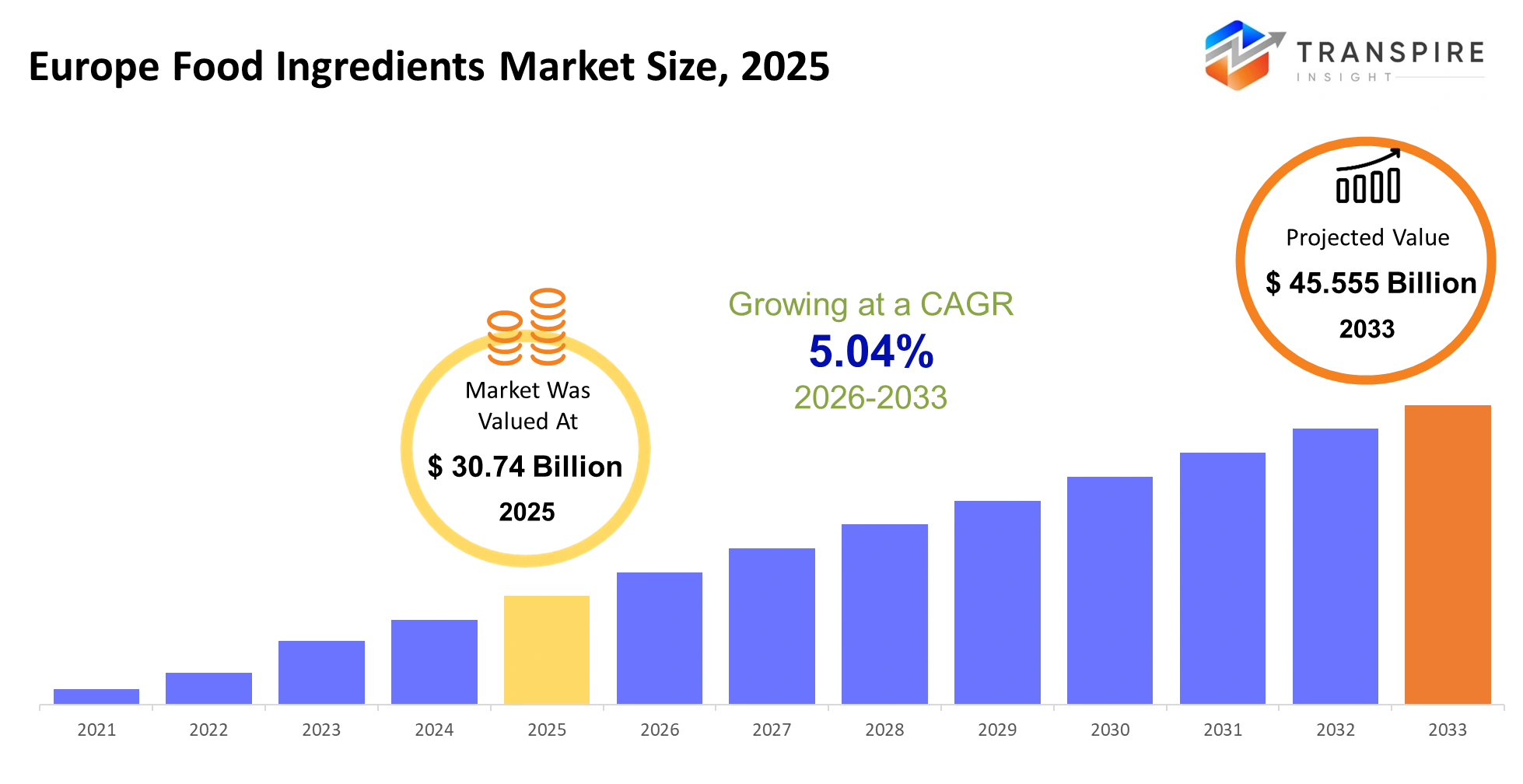
- Europe Food Ingredients Market Size 2025: USD 30.74 Billion
- Europe Food Ingredients Market Size 2033: USD 45.555 Billion
- Europe Food Ingredients Market CAGR: 5.04%
- Europe Food Ingredients Market Segments: By Type (Additives, Preservatives, Flavors, Sweeteners, Others), By Application (Bakery, Beverages, Dairy, Snacks, Others), By End-User (Food Manufacturers, Beverage Companies, Others), By Form (Powder, Liquid, Others).
To learn more about this report,  Download Free Sample Report
Europe Food Ingredients Market Summary:
The Europe Food Ingredients Market size is estimated at USD 30.74 Billion in 2025 and is anticipated to reach USD 45.555 Billion by 2033, growing at a CAGR of 5.04% from 2026 to 2033. The Europe Food Ingredients Market operates at the formulation layer of the food industry, enabling manufacturers to control taste, texture, shelf life, and nutritional value at scale. The system provides a solution to the challenge of producing food products that maintain safety and attractiveness while satisfying both legal requirements and financial restrictions in multiple market sectors.
The market has shifted during the last three to five years because manufacturers now choose to use functional ingredients and clean-label ingredients instead of artificial additives to create products with better nutritional value. The transition has gained momentum because European Union (EU) regulations increased their labeling requirements and established new product reformulation standards thereby requiring businesses to evaluate their methods for ingredient acquisition and production. Businesses used worldwide supply chains until COVID-19 caused supply chain problems which made them search for local suppliers and alternative materials.
The process of reformulating products together with premium product development drives business growth by making ingredients more complex while increasing the value that suppliers obtain from their products.
Key Market Insights
- Western Europe leads the Europe Food Ingredients Market by holding more than 45% of the market share in 2024 because it possesses established food processing facilities.
- Germany and France and the UK together create the largest market for specialty ingredients which they develop through their advanced manufacturing capabilities.
- Eastern Europe serves as the most rapidly expanding area which will maintain strong growth until 2030 because of its increasing food production facilities.
- The market for functional ingredients holds the leading position with more than 30% share because consumers demand health-oriented fortified food products.
- The second largest market segment includes flavors and enhancers which food processors use to develop new products and to create different sensory experiences.
- The segment that grows the fastest consists of plant-based and natural ingredients which will experience rapid growth until 2030 because of clean-label product requirements.
- The market for processed and packaged foods represents the biggest application area which will reach approximately 50% market share in 2024 because European consumers prefer these products.
- The market for functional beverages stands as the most rapidly expanding sector because consumers seek products that deliver immunity protection and energy boost and general wellness benefits.
- Food manufacturers operate as the main end-user group which controls more than 60% of the market because they need ingredients to create consistent products that can be produced at high volumes.
- The nutraceutical and health-focused brands establish themselves as fast-growing businesses because consumers now prefer preventive nutrition through functional food products.
What are the Key Drivers, Restraints, and Opportunities in the Europe Food Ingredients Market?
The Europe Food Ingredients Market experiences its primary growth engines from European Union mandates that require product reformulation. The implementation of sugar reduction policies and trans-fat elimination regulations and transparent product labeling requirements has forced companies to create new product formulas. The regulatory requirements have created an environment where companies widely use functional ingredients which include natural sweeteners and texturizers and preservatives. Ingredient suppliers achieve higher earnings through their specialized product formulas while food manufacturers need to buy more ingredients to satisfy their regulatory obligations. The process generates new income for the business because reformulation processes establish ongoing needs which extend beyond their initial implementation.
The essential materials market faces two main challenges which create permanent obstacles through price changes and supply interruptions that affect essential materials for both plant-based and special materials. The system requires climate-sensitive agricultural products which depend on seasonal resources and product delivery routes that lack rapid growth capabilities. Agricultural cycles and land resources and processing facilities have created a persistent restriction which will remain until these systems receive long-term development funding. The result creates financial difficulties for ingredient manufacturers while cost-sensitive food producers take extended periods to adopt new products which reduces their market entry possibilities.
The future presents a significant growth possibility through precision fermentation and enzyme engineering developments. Companies are investing in bio-based production of proteins, flavors, and emulsifiers, reducing dependence on traditional agriculture. Western Europe has developed its infrastructure and regulatory systems which now make fermentation-derived dairy alternatives viable for large-scale production and affordable ingredient development.
What Has the Impact of Artificial Intelligence Been on the Europe Food Ingredients Market?
The food ingredient manufacturers who operate in Europe now create their products through AI and advanced digital technologies which create new methods for product design and production and formulation control. The AI-based process control systems of the company execute automatic operations for mixing and fermentation and quality oversight through their system for real-time temperature control and pH measurement and viscosity monitoring. The process improves batch consistency while creating more predictable outcomes because enzymes and specialty proteins represent high-value products. The companies use machine learning models to forecast when equipment at their processing plants will fail which allows them to start predictive maintenance programs that decrease unexpected downtime between 15 and 25 percent while increasing equipment lifespan.
Through predictive AI models which review past production and demand patterns the system develops ingredient performance predictions across multiple product formulations. The digital twins of production lines enable companies to test process modifications before actual implementation which leads to better operational efficiency and less material waste. The system produces quantifiable benefits which include decreased energy usage and higher production efficiency and faster regulatory compliance through its automated systems for tracking product origins.
The industry needs to handle two main challenges which include expensive integration requirements and existing systems that lack unified data standards. The European food ingredient market faces deployment challenges because many facilities continue to use outdated systems which do not support standardized data formats that are essential for accurate AI model development.
Key Market Trends
- The European Union implemented sugar reduction targets for 2020 which compelled major manufacturers to substitute sucrose with stevia and polyols while they developed new products that included natural sweeteners.
- The period from 2021 to 2024 saw clean-label transitions which caused more than 60% of European food companies to stop using synthetic additives while they sought out natural preservatives and stabilizers.
- The supply disruptions which followed COVID forced Cargill and other companies to shift their sourcing methods toward regional solutions which decreased their reliance on extensive global supply networks while boosting their operational capacity to handle unexpected events.
- The period that starts in 2022 will see plant-based ingredient innovations which developed protein-based products to now include emulsifiers and flavor systems that create authentic meat and dairy substitutes.
- The research and development budget for Western Europe has shifted its focus to minimally processed foods and functional ingredients since 2023 because of increased regulatory examination of ultra-processed products.
- Product development time decreased by 30% because digital formulation software together with AI testing methods enabled companies to quickly adapt their products according to new customer and store needs.
- The implementation of ingredient traceability systems started to grow after 2021 because blockchain pilots enhanced compliance documentation and improved supplier responsibility throughout multi-tiered supply chain networks.
- The period since 2022 has led to Eastern Europe becoming a base for manufacturing because it offers lower costs which help develop ingredient processing plants and export-focused production facilities.
- Major companies such as DSM-Firmenich and Kerry Group dedicated more funds to their biotechnology platforms which enabled them to shift their product development process from extraction methods to fermentation techniques.
Europe Food Ingredients Market Segmentation
By Type
The food industry identifies additives and functional ingredients as essential components because these substances provide three main benefits which extend shelf life and control product texture and improve food nutritional value. The market demand for processed foods and packaged products needs preservatives and flavors to maintain product taste and visual appeal, which leads to their position as the second most important product.
The natural sweetener market, which includes stevia, is expanding because companies need to create safer products that meet sugar reduction standards. Manufacturers are moving towards high-value ingredient systems because they want to create unique products which regulatory bodies demand. The future will focus on developing ingredients from bio-based and fermentation methods because this approach will decrease the need for conventional extraction techniques. The shift will require biotechnology platform investment, which will transform supplier capabilities and cost structures throughout the entire value chain.

To learn more about this report, Download Free Sample Report
By Application
The bakery and processed foods sector maintains market dominance because of two factors: its high consumption rates and ongoing development of new texture and taste products. The dairy and beverage industries maintain successful performance because consumers want products that contain health-based nutritional supplements. The snack market has experienced rapid growth because people now prefer products that they can eat conveniently while receiving additional healthy benefits.
Each application displays its own unique requirements which drive demand because bakeries need stable operations with affordable production costs and beverage companies must develop products that let customers quickly absorb beneficial elements. The market for functional nutrition products and customized dietary solutions will experience growth according to future projections. The trend will require ingredient suppliers to develop customized solutions which fulfill particular formulation needs and regulatory standards for multiple food product categories.
By End-User
The food manufacturing sector makes up the largest portion of end-user markets because its production capacity allows it to buy materials and its ongoing need for product development work. The beverage industry ranks second, as its companies develop new functional drinks and ready-to-drink products. The health-focused market trends which drive product development among nutraceutical producers and other small market segments are enabling those segments to develop at a faster rate.
Large manufacturers focus on cost control and compliance obligations, whereas new companies in the market work to create unique products that reach customers quickly. The specialized end-user market will create future growth opportunities because it needs high-quality ingredients to produce specific health benefits. The shift will lead suppliers to create special ingredient systems while they work together throughout each stage of product development.
By Form
The food manufacturing industry prefers powder-based ingredients because they provide better storage options and extended product shelf life and they work well with the dry processing equipment that food manufacturers use. Liquids make up a large portion of the market because they provide essential properties for applications that require beverages and dairy products to dissolve and distribute their contents evenly. The market for controlled release products and stable products has expanded through the growing use of gels and encapsulated formats in specialized markets.
The processing efficiency of this segment directly boosts its operational capacity through its specialized processing needs. Future developments will likely focus on advanced delivery formats such as microencapsulation and hybrid forms that improve bioavailability and reduce waste. The evolution of this process will determine which equipment manufacturers choose to acquire and it will create new methods for ingredient integration into production systems.
What are the Key Use Cases Driving the Europe Food Ingredients Market?
The primary use case focuses on processed packaged food items which maintain their original flavor and texture and shelf life because their components create uniform character throughout their manufacturing process. The main food producers use stabilizing agents and preserving substances and taste systems to achieve EU safety requirements and product consistency standards which need to follow labeling regulations. The application creates the strongest demand because it helps businesses expand their operations while achieving required standards for their food production processes.
Beverage companies and health brands develop functional beverages and fortified dairy products through vitamin and probiotic and plant-based protein inclusion in their products. The product developers of this segment are establishing market presence through products which deliver particular health benefits that include energy enhancement and digestive health improvement. The retail market now competes through value-added products which provide extra advantages to customers.
Food industry professionals are starting to adopt two new applications which focus on precision fermentation for ingredient production and personalized dietary solutions. Startups and specialized producers are exploring bioengineered proteins and tailored nutrient blends which could reshape future product development strategies.
|
Report Metrics |
Details |
|
Market size value in 2025 |
USD 30.74 Billion |
|
Market size value in 2026 |
USD 32.29 Billion |
|
Revenue forecast in 2033 |
USD 45.555 Billion |
|
Growth rate |
CAGR of 5.04% from 2026 to 2033 |
|
Base year |
2025 |
|
Historical data |
2021 - 2024 |
|
Forecast period |
2026 - 2033 |
|
Report coverage |
Revenue forecast, competitive landscape, growth factors, and trends |
|
Regional scope |
Europe (Germany, United Kingdom, France, Italy, Spain and Rest of Europe) |
|
Key company profiled |
Cargill, ADM, Kerry Group, BASF, DSM, Tate & Lyle, Ingredion, Givaudan, Firmenich, IFF, Symrise, Corbion, Ajinomoto, Roquette, Sensient |
|
Customization scope |
Free report customization (country, regional & segment scope). Avail customized purchase options to meet your exact research needs. |
|
Report Segmentation |
By Type (Additives, Preservatives, Flavors, Sweeteners, Others), By Application (Bakery, Beverages, Dairy, Snacks, Others), By End-User (Food Manufacturers, Beverage Companies, Others), By Form (Powder, Liquid, Others) |
Which Regions are Driving the Europe Food Ingredients Market Growth?
Western Europe maintains market leadership because it possesses both robust regulatory systems and modern food production facilities. The strict EU labeling and reformulation standards which Germany and France and the Netherlands enforce create an environment which leads to ongoing development of new product components. The organization maintains its top position because it contains a complete system which includes international companies and research organizations and raw material producers. The region achieves its capacity to produce high-quality functional ingredients through its substantial expenditure in research development and biotechnology.
Southern Europe maintains its role as a permanent and dependable contributor to the market through traditional Italian and Spanish food production methods which they gradually modernize. The region maintains product authenticity through its growth process while it implements specific functional components to its products. The market for ingredients shows economic stability because domestic markets drive consumption and established export channels create demand. The regulatory system tracks EU standards which allows businesses to proceed with their operations through controlled processes that maintain their current state.
The region of Eastern Europe experiences its most rapid expansion because food processing facilities and supply chain systems received new funding in recent times. Poland and Hungary have developed their manufacturing systems to provide multinational food companies with cost-effective production options. The production increase has created a higher need for both essential and specialized product components. The region will experience development between 2026 and 2033 which will create business opportunities for suppliers and investors who operate in markets that prioritize affordable manufacturing and international sales.
Who are the Key Players in the Europe Food Ingredients Market and How Do They Compete?
The Europe Food Ingredients Market shows moderate competition because multinational ingredient suppliers hold control over valuable market segments while smaller regional companies target both commodity products and niche markets. The primary basis of competition has shifted from cost efficiency toward technology and formulation expertise as product complexity increases because of regulatory requirements and reformulation demands. The established companies use innovation and portfolio expansion to protect their market share while new companies develop their business through biotechnology and clean-label product segments. The market develops different levels of operation because businesses need to produce bulk ingredients through scale while they must create specialized products through unique methods.
DSM-Firmenich focuses on developing biotechnology innovations which include vitamins and enzymes and fermentation-based ingredients. The approach enables companies to achieve consistent product quality during manufacturing while reducing their reliance on conventional farming products. Kerry Group establishes its market position by offering complete taste and nutrition solutions which use flavor systems to provide functional advantages that accelerate product development for manufacturers. The two companies use strategic acquisitions and partnerships with food brands to develop specialized formulations for their business expansion.
Cargill uses its control over supply chains and raw material sources to create advantages which help the company maintain steady costs while getting uninterrupted supplies. Nestlé uses its internal development of ingredients to create proprietary products which establish an innovation system that requires no outside resources. The company has developed competitive advantages because it connects its ingredient development process with actual product results and market needs.
Company List
- Cargill
- ADM
- Kerry Group
- BASF
- DSM
- Tate & Lyle
- Ingredion
- Givaudan
- Firmenich
- IFF
- Symrise
- Corbion
- Ajinomoto
- Roquette
- Sensient
Recent Development News
In April 2026, KKR explores $10 billion sale of Europe-focused Flora Food Group: KKR is reportedly preparing the sale of Flora Food Group, a major European spreads and food ingredients business. The company owns widely used consumer brands across Europe and generates billions in annual sales, making it a significant transaction in the European food ingredients ecosystem.
Source: https://www.reuters.com
In March 2026, Puratos to acquire Dawn Foods to expand global bakery ingredients leadership: Puratos announced a definitive agreement to acquire Dawn Foods, strengthening its position in bakery and pastry ingredients across Europe and North America. The deal enhances its ability to translate food trends into industrial ingredient solutions for manufacturers and retailers.
Source: https://www.prnewswire.com
What Strategic Insights Define the Future of the Europe Food Ingredients Market?
The European Food Ingredients Market is moving toward bioengineered ingredients through precision formulation because EU regulations require manufacturers to develop new formulas for their processed foods. The next five to seven years will create value through high-performance ingredients which include fermentation-derived proteins and enzymes and natural substitutes that help food companies meet regulations while maintaining their flavor and cost control. The ability to conduct research and development and develop complete product formulations will give companies an advantage over competitors who depend only on their production capacity.
The supply chains for alternative ingredients present a less obvious danger because they depend on specific raw materials. Price fluctuations will increase and production capacity will decrease because demands will focus on particular crops and bio-based materials. The precision fermentation platforms provide a valuable business opportunity for Western European markets because their regulatory systems and funding environments are currently developing.
Market participants should invest in hybrid sourcing models that combine biotechnology with diversified raw material inputs to reduce risk while capturing innovation-driven margins.
Europe Food Ingredients Market Report Segmentation
By Type
- Additives
- Preservatives
- Flavors
- Sweeteners
- Others
By Application
- Bakery
- Beverages
- Dairy
- Snacks
- Others
By End-User
- Food Manufacturers
- Beverage Companies
- Others
By Form
- Powder
- Liquid
- Others
Frequently Asked Questions
Find quick answers to common questions.
The approximate Europe Food Ingredients Market size for the market will be USD 45.555 Billion in 2033.
The key segments of the Europe Food Ingredients Market are By Type (Additives, Preservatives, Flavors, Sweeteners, Others), By Application (Bakery, Beverages, Dairy, Snacks, Others), By End-User (Food Manufacturers, Beverage Companies, Others), By Form (Powder, Liquid, Others).
Major players in the Europe Food Ingredients Market are Cargill, ADM, Kerry Group, BASF, DSM, Tate & Lyle, Ingredion, Givaudan, Firmenich, IFF, Symrise, Corbion, Ajinomoto, Roquette, Sensient.
The current market size of the Europe Food Ingredients Market is USD 30.74 Billion in 2025.
The Europe Food Ingredients Market CAGR is 5.04%.
- Cargill
- ADM
- Kerry Group
- BASF
- DSM
- Tate & Lyle
- Ingredion
- Givaudan
- Firmenich
- IFF
- Symrise
- Corbion
- Ajinomoto
- Roquette
- Sensient
Recently Published Reports
-
Apr 2026
Baby Infant Formula Market
Baby Infant Formula Market Size, Share & Analysis Report By ype (Infant Milk, Follow On Milk, Specialty Baby Milk, Growing-Up Milk), By Ingredient (Carbohydrate, Fat, Protein, Minerals, Vitamins, and Others), By Product Form (Powder, Liquid, and Ready-to-feed), By Distribution Channels (Supermarket/Hypermarket, Specialty Store, Pharmacies, Online Retail, and Others), and Geography (North America, Europe, Asia-Pacific, Middle East and Africa, South and Central America), 2021 - 2031
-
Apr 2026
Edible Insects for Animal Feed Market
Edible Insects for Animal Feed Market Size, Share & Analysis Report By Type (Insect Powder, Insect Meal, Insect Bar, Insect Paste, Insect Oil, and Others), By Insect Type (Beetles, Cricket, Caterpillar, Hymenoptera, Orthoptera, Tree Bugs, and Others), By Application (Livestock, Pet Food, and Aquaculture), By Livestock Type (Poultry, Swine, and Others), and Geography (North America, Europe, Asia-Pacific, Middle East and Africa, South and Central America), 2021 - 2031
-
Apr 2026
Food Industry Disinfection and Bacterial Control Market
Food Industry Disinfection and Bacterial Control Market Size, Share & Analysis Report By Type (Chemical Disinfectants, Physical Disinfectants, and Biocides and Antimicrobials), By Application (Food Processing Equipment Surface Disinfection, Food Preparation Areas Surface Disinfection, Storage Areas Surface Disinfection, Anti-microbial Coatings Food Preservation, and Preservative Solutions Food Preservation), By End User (Meat and Poultry Processing, Dairy Processing, Seafood Processing, Bakery and Confectionery, Restaurants and Commercial Kitchens, and Food Service Providers), By Sales Channel (Online, Offline), and Geography (North America, Europe, Asia-Pacific, Middle East and Africa, South and Central America), 2021 - 2031
-
Apr 2026
Freeze Dried Food Market
Freeze Dried Food Market Size, Share & Analysis Report By Product Type (Fruits, Vegetables, Freeze-Dried Dairy Products, Freeze-Dried Meat and Seafood, Freeze-Dried Pet Food, and Prepared Meal), By Nature (Organic, and Conventional), By Form (Powdered, Granules, and Diced), By End Use (Breakfast Cereals, Dairy Products, Bakery & Confectionery, Nutritional Bars & Supplements, Powdered Beverages, Snacks, and Retail (Household)), and Geography (North America, Europe, Asia-Pacific, Middle East and Africa, South and Central America), 2021 - 2031