

Europe Bakery Products Market Size & Forecast:
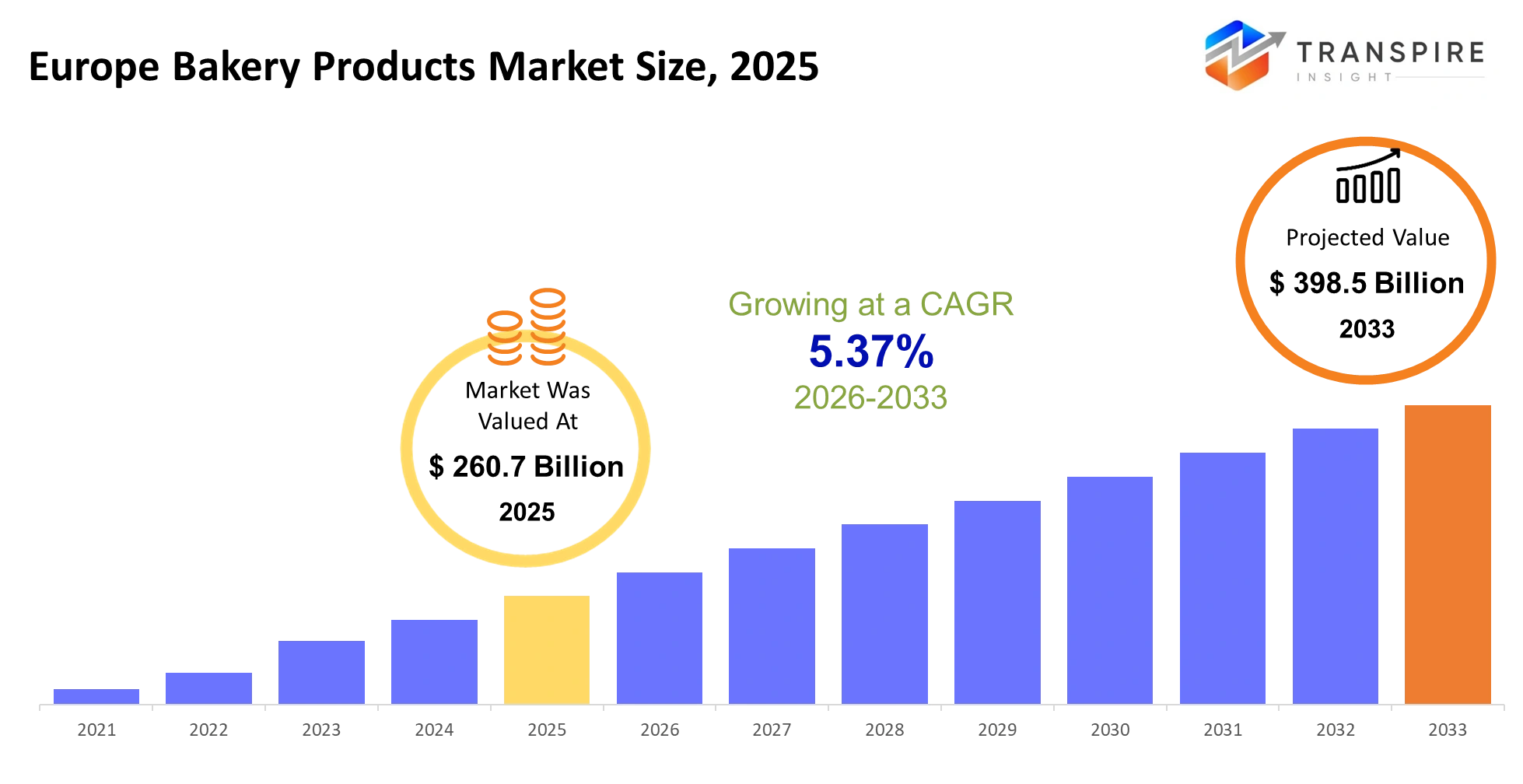
- Europe Bakery Products Market Size 2025: USD 260.7 Billion
- Europe Bakery Products Market Size 2033: USD 398.5 Billion
- Europe Bakery Products Market CAGR: 5.37%
- Europe Bakery Products Market Segments: By Type (Bread, Cakes & Pastries, Biscuits, Frozen Bakery, Others); By Application (Daily Consumption, Snacks, Desserts, Convenience Food, Others); By End-User (Households, Food Service Industry, Bakeries, Retailers, Hotels & Restaurants, Others); By Distribution (Supermarkets, Convenience Stores, Online, Specialty Stores, Others).
To learn more about this report,  Download Free Sample Report
Europe Bakery Products Market Summary:
The Europe Bakery Products Market size is estimated at USD 260.7 Billion in 2025 and is anticipated to reach USD 398.5 Billion by 2033, growing at a CAGR of 5.37% from 2026 to 2033.
The bakery products market in Europe experiences changes which result from both new consumer preferences and technological progress. The market sees shifts in consumer taste since people now prefer baked products that are both healthy and made through traditional baking methods. The European Union will implement new regulations which will change both ingredient standards and labeling requirements and food safety regulations during the next several years. The baking industry will achieve greater operational efficiency through companies adopting new technologies which enable them to develop more sustainable packaging solutions that satisfy both customer and business requirements. The upcoming changes will drive dietary trends and online shopping patterns to shape consumer buying habits across different geographical regions. The market outlook will maintain its ability to adapt to upcoming changes in the future.
What Has the Impact of Artificial Intelligence Been on the Europe Bakery Products Market?
The European bakery products market experiences rapid changes because artificial intelligence technology establishes new methods to measure consumer behavior and demand patterns. AI-powered solutions currently process extensive data in the European bakery products market to detect changes in consumer preferences and buying habits. Artificial intelligence in Europe bakery products market enables manufacturers to make quick decisions which help them detect market changes with more accurate results.
The European bakery products market uses predictive analytics to improve its demand forecasting capabilities through its evaluation of seasonal patterns and regional consumer preferences and its capability to analyze retail consumption patterns in real time. The implementation of smart automation systems enables bakeries to create production schedules while minimizing the need for manual work, which results in their ability to produce consistent products at higher volumes. Machine learning models enable supply chain optimization because they predict the need for raw materials while decreasing operational interruptions, which results in better cost management and stable operations throughout the European bakery products market.
AI-enabled innovation is also reshaping product development and customer engagement strategies. Bakeries are increasingly using intelligent systems to design personalized offerings based on dietary preferences and purchase history. Businesses can gain stronger competitive advantages through this shift because they can develop more precise solutions which satisfy specific consumer needs.The business sector will experience ongoing artificial intelligence effects which will enhance operational effectiveness and creative development and customer responsiveness as digital transformation progresses.
Key Market Trends & Insights:
- Western Europe holds almost 45% of the European bakery products market which will reach this share by 2025 because consumers prefer premium and organic bakery products.
- The Northern Europe market which currently leads all regions will experience a 5.8% annual growth rate until 2030 because people increasingly choose healthier products.
- The bakery products market in Europe finds Germany as its leading country because it maintains the highest production capacity and German citizens consume baked goods at the highest rate through retail channels.
- The bread products segment controls approximately 38% of the European bakery products market because households use bread as their main food source.
- The cakes and pastries segment occupies the second largest market position because consumers increasingly seek baked goods for their celebratory and indulgent purposes.
- The gluten-free and functional bakery products market represents the fastest-growing segment which will continue to expand until 2030.
- The European bakery products market reaches its highest point through retail consumption, which accounts for nearly 60% of the market because supermarkets and bakery chains have established their presence.
- The foodservice sector represents the fastest-expanding market segment because Europe's café culture and quick-service restaurant industry continue to grow.
- The European bakery products market finds its largest market share through household end-user consumption because people eat bakery products every day.
- The hospitality sector shows rapid expansion for institutional buyers which includes hospitals and catering services as tourism and hospitality sectors recover from previous downturns.
Europe Bakery Products Market Segmentation
By Type:
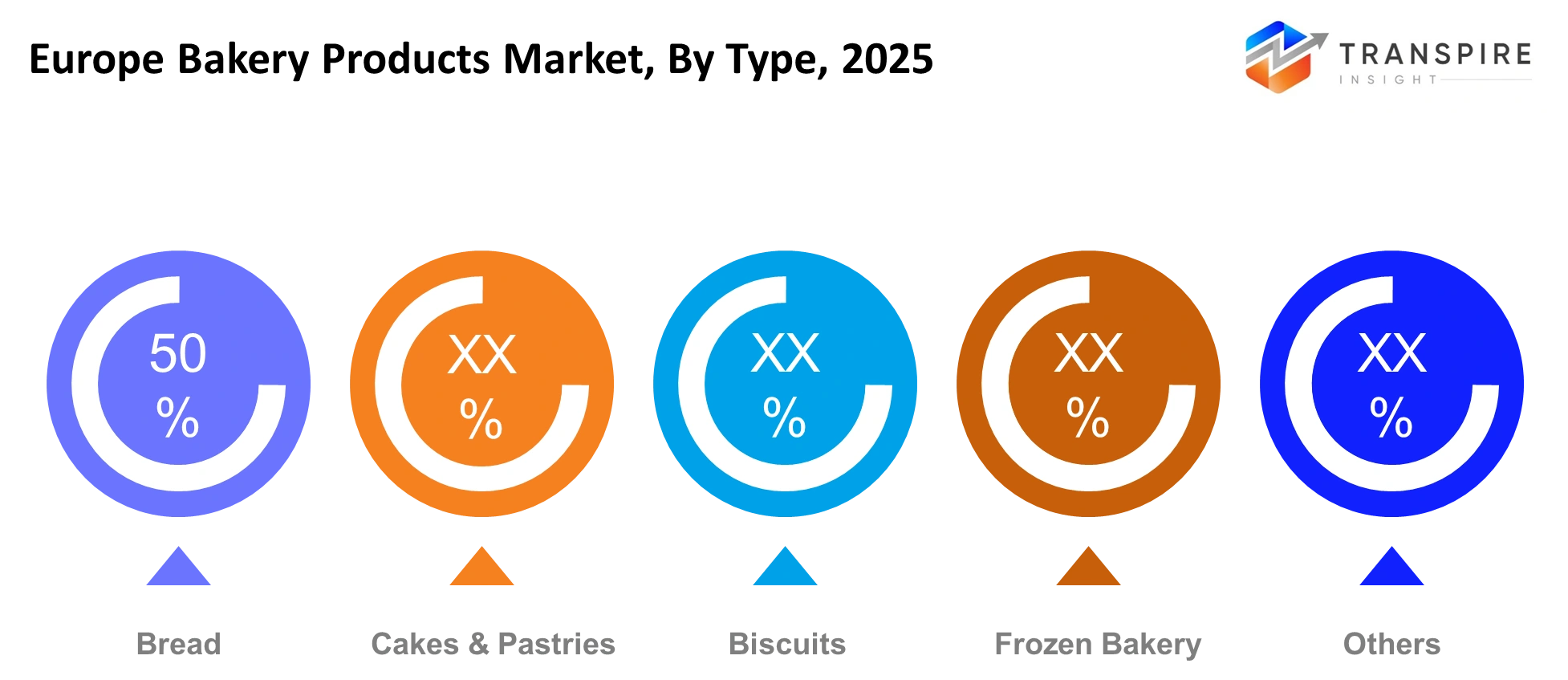
The market divided into five categories operates through Bread and Cakes and Pastries and Biscuits and Frozen Bakery and Other products. European households consume bread as their primary food item which maintains daily consumption patterns. Urban and rural areas experience constant product availability because stable demand enables manufacturers to produce at large scale. The Europe Bakery Products Market will keep relying on bread as a core product category due to its affordable price and cultural significance between health-focused bread varieties such as whole grain and multigrain products.
Cakes and pastries show significant demand growth because customers now spend more on premium products as they adopt new lifestyle choices. All age groups use biscuits as an easily accessible snack choice. Retail chains and foodservice outlets will develop frozen bakery products because they want to use products which remain fresh for extended periods. The market for niche baked goods will experience gradual growth through new product development which introduces innovative flavors and original ingredient combinations.
To learn more about this report, Download Free Sample Report
By Application:
The market divides into five categories which include Daily Consumption and Snacks and Desserts and Convenience Food and Other products. Daily consumption remains the strongest application area, driven by regular household purchasing behavior and staple food usage. The Europe Bakery Products Market will continue to depend on everyday bakery items as essential food choices across most regions. Snacks also show steady demand, especially among working populations and younger consumers who want to eat quickly.
Festive occasions and social events maintain dessert popularity because people increasingly want high-quality dessert options. The demand for convenience food will expand because more people choose ready-to-eat bakery products. The market for other applications will experience gradual growth because people develop greater understanding of dietary needs and nutritional information which drives their dietary choices.
By End-User:
The largest end-user group for baked goods consists of households because they consume these products throughout their daily meals. The Europe Bakery Products Market will continue to see strong household demand supported by wide product availability. The food service industry will experience growth because cafés and quick-service outlets and catering services will expand their operations.
Retailers and bakeries enable products to reach consumers through their distribution networks which serve local markets. The demand for hotels and restaurants continues to grow because tourism and hospitality sectors have resumed their activities throughout Europe. Institutional buyers and other end-users will begin to purchase more products because they will adopt bulk buying and organized food supply systems.
By Distribution:
Supermarkets operate as the main distribution channel because they offer extensive product selection which consumers trust. The European market for bakery products depends on supermarket sales to provide mass-market bakery items. Urban areas with high foot traffic depend on convenience stores to fulfill customers' need for quick purchases throughout the day.
Online distribution is growing because more people prefer digital shopping and delivery systems become better. Specialty stores draw customers who want premium and artisanal bakery products because these products have special quality characteristics. Local bakeries and direct sales channels will remain important because they build customer ties within the community and provide customers with new products.
What are the Main Challenges for the Europe Bakery Products Market Growth?
The European bakery products market faces technical and operational challenges because companies need to deliver consistent product quality throughout their large-scale manufacturing processes. The distribution efficiency of preservative-free and clean-label bakery products faces major limitations because their shelf-life stability remains insufficient. The European bakery products market encounters supply chain disruptions that affect raw material availability because essential ingredients like wheat and dairy products and specialty items face delivery interruptions.
Small manufacturers encounter scalability obstacles because their business operations rely heavily on automated manufacturing processes and temperature-controlled supply chain systems.
The Europe bakery products market faces manufacturing and commercialization hurdles because European food safety standards require businesses to comply with increasing regulatory requirements. The combination of strict labeling requirements and hygiene standards together with certification procedures leads to higher production expenses and prolonged timeframes for bringing products to market. The Europe bakery products market experiences profit margin pressures from changing energy prices and labor costs which creates competitive disadvantages for mid-sized manufacturers against larger industry players. The combination of these factors leads to a decline in innovation-to-market conversion speed.
Adoption and infrastructure limitations create additional challenges in the europe bakery products market, especially in less developed regions where advanced baking technologies and digital supply systems are not widely available. The industry faces operational constraints because there is a lack of skilled workers who can operate automated baking systems and food technology equipment. Small bakeries face funding challenges which prevent them from modernizing their operations and this leads to decreased competitiveness in an industry that is rapidly changing.
Regional Insights
The Europe Bakery Products Market in Western Europe operates through extensive retail networks which sustain its high baked goods consumption in everyday meals. The demand in Germany France and the United Kingdom remains stable because their supermarkets operate efficiently and their bakery customs maintain strong market presence. The Europe Bakery Products Market in this region will continue to benefit from premium product demand and consistent household consumption patterns.
The market in Northern Europe experiences consistent growth because consumers show a preference for healthier bakery products and products with clean-label certification. Consumer awareness around nutrition continues to influence buying behavior which leads to stronger demand for whole grain and organic baked items. The Europe Bakery Products Market in this region will also see gradual adoption of plant-based and functional bakery products which are supported by changing dietary patterns.
Southern Europe maintains strong cultural attachment to traditional bakery items which supports consistent demand across urban and rural areas. The bakery business in this region receives a boost from the tourist sector because it affects both hospitality and food service establishments. The Europe Bakery Products Market here will continue to grow through seasonal demand and local specialty products that reflect regional taste preferences.
Eastern European markets experience consistent growth because both disposable incomes and modern retail outlets become more available to consumers. Consumers now prefer packaged and branded bakery goods instead of purchasing basic bakery products. The Europe Bakery Products Market in this region will experience growth through retail modernization and supply chain improvements and increased access to international food trends.
Recent Development News
In March 2026, Aryzta AG announced a strategic production expansion across its European frozen bakery network to increase output capacity for its retail and foodservice operations. The company stated that better automation and enhanced facilities will help achieve more reliable frozen bakery supply across its main European markets.
Source: https://www.aryzta.com
In April 2026, The Barilla Group reported improved performance for its bakery segment because of increased demand for packaged baked goods and its expanded distribution network across Western Europe. The company said that its ongoing funding for production efficiency improvements and digital supply chain system development will enable its European bakery market operations to maintain consistent performance.
Source: https://www.barillagroup.com
|
Report Metrics |
Details |
|
Market size value in 2025 |
USD 260.7 Billion |
|
Market size value in 2026 |
USD 276.3 Billion |
|
Revenue forecast in 2033 |
USD 398.5 Billion |
|
Growth rate |
CAGR of 5.37% from 2026 to 2033 |
|
Base year |
2025 |
|
Historical data |
2021 - 2024 |
|
Forecast period |
2026 - 2033 |
|
Report coverage |
Revenue forecast, competitive landscape, growth factors, and trends |
|
Regional scope |
Europe (Germany, United Kingdom, France, Italy, Spain, Rest of Europe) |
|
Key company profiled |
Nestlé, Mondelez, Grupo Bimbo, Kellogg, General Mills, Associated British Foods, Yamazaki Baking, Britannia, Aryzta, Vandemoortele, Lantmannen, Barilla, Unilever, PepsiCo, Danone. |
|
Customization scope |
Free report customization (country, regional & segment scope). Avail customized purchase options to meet your exact research needs. |
|
Report Segmentation |
By Type (Bread, Cakes & Pastries, Biscuits, Frozen Bakery, Others); By Application (Daily Consumption, Snacks, Desserts, Convenience Food, Others); By End-User (Households, Food Service Industry, Bakeries, Retailers, Hotels & Restaurants, Others); By Distribution (Supermarkets, Convenience Stores, Online, Specialty Stores, Others). |
How Can New Companies Establish a Strong Foothold in the Europe Bakery Products Market?
New companies entering the europe bakery products market will need a clear focus on niche positioning and product differentiation to compete with established players. Startups in the Europe bakery products market should focus on specific customer needs for gluten-free and high-protein and clean-label bakery products because the market has intense competition. The USA-based company One Mighty Mill demonstrates that European consumers who prioritize health will choose stone-milled bakery products which contain no additives and base their products as premium health food options.
Innovation in production and distribution methods will determine which companies gain strong market presence in the European bakery products industry. Smart automation and digital supply chain tracking and predictive analytics will help bakery operations decrease waste while increasing operational efficiency. Emerging startups such as ReGrained demonstrate how upcycled ingredients can be used to create sustainable baked goods, which meet environmental needs in the European bakery products market and enable better cost control and brand value development.
Market entry success will increase through strategic partnerships which retail chains and cafés and foodservice providers establish with the company. The established distributors will help new businesses to expand their operations in European bakery markets which already exist. The company will achieve lower logistics expenses through their investment in local production facilities which will also enable them to deliver products fresher than their competitors do throughout Europe.
The success of European bakery products businesses depends on their ability to innovate while maintaining compliance with regulations and meeting changing consumer needs. Companies that combine sustainability with smart manufacturing and customized products will achieve better market position and sustained business growth in the bakery industry.
Key Europe Bakery Products Market Company
The Europe Bakery Products Market experiences strong competition because international companies and local businesses fight to control their market share. Large companies focus on scale, pricing strength, and wide distribution networks, while smaller firms depend on niche offerings and local taste preferences. The Europe Bakery Products Market will experience ongoing price pressure because businesses introduce more products and customers demand healthier and premium bakery items.
Innovation serves as the primary element which determines how businesses establish their competitive edge in the Europe Bakery Products Market through their clean-label organic and functional bakery product offerings. Companies use their resources to build automation and digital systems that enable them to produce products more quickly while decreasing their operational expenses. The Europe Bakery Products Market will see an increase in data tool usage which enables better demand forecasting and more effective supply chain management.
Partnerships with retailers, cafés, and foodservice operators help strengthen market reach and brand visibility. Many companies in the Europe Bakery Products Market expand through joint ventures and regional collaborations to access new customer bases. The ability to compete with other businesses will require companies to maintain product freshness and consistency while quickly meeting market demands across various areas.
Company List
- Nestlé
- Mondelez
- Grupo Bimbo
- Kellogg
- General Mills
- Associated British Foods
- Yamazaki Baking
- Britannia
- Aryzta
- Vandemoortele
- Lantmannen
- Barilla
- Unilever
- PepsiCo
- Danone
What are the Key Use-Cases Driving the Growth of the Europe Bakery Products Market?
The Europe bakery products market operates mainly through strong everyday consumption patterns because baked goods function as essential food items which European households consume. The Europe bakery products market depends on high demand which exists for bread rolls and packaged bakery products that people consume during their regular meals and breakfast times. People who live in cities and have busy lives will increasingly use ready-to-eat bakery products which will create steady growth for the market.
The Europe bakery products market uses foodservice and hospitality sector demand which serves as another important market application. Standardized bakery products serve as essential components for cafés quick-service restaurants and hotels which operate their menus and catering services and bulk supply operations. The Europe bakery products market will experience stronger growth in this segment because European cities are gaining more tourists and the dining-out culture continues to develop.
Health-focused consumption is driving new product development in the Europe bakery products market which focuses on wellness-oriented diets and functional food products. Fitness and healthcare dietary plans now include bakery products which contain fiber and protein or have reduced sugar content. Retail pharmacies and wellness stores are adding these products to their inventory because they help customers meet their nutritional requirements while entering new markets beyond standard food distribution.
The Europe bakery products market receives additional support from convenience-based retail and online grocery platforms which provide easier access to frozen and packaged bakery items. Digital shopping patterns will cause these use-cases to grow because they enable quicker product delivery and allow customers to purchase products from multiple locations.
Europe Bakery Products Market Report Segmentation
By Type
- Bread
- Cakes & Pastries
- Biscuits
- Frozen Bakery
- Others
By Application
- Daily Consumption
- Snacks
- Desserts
- Convenience Food
- Others
By End-User
- Households
- Food Service Industry
- Bakeries
- Retailers
- Hotels & Restaurants
- Others
By Distribution
- Supermarkets
- Convenience Stores
- Online
- Specialty Stores
- Others
Frequently Asked Questions
Find quick answers to common questions.
The approximate Europe Bakery Products Market size for the market will be USD 398.5 Billion in 2033.
Key segments for the Europe Bakery Products Market are By Type (Bread, Cakes & Pastries, Biscuits, Frozen Bakery, Others); By Application (Daily Consumption, Snacks, Desserts, Convenience Food, Others); By End-User (Households, Food Service Industry, Bakeries, Retailers, Hotels & Restaurants, Others); By Distribution (Supermarkets, Convenience Stores, Online, Specialty Stores, Others).
Major Europe Bakery Products Market players are Nestlé, Mondelez, Grupo Bimbo, Kellogg, General Mills, Associated British Foods, Yamazaki Baking, Britannia, Aryzta, Vandemoortele, Lantmannen, Barilla, Unilever, PepsiCo, Danone.
The Europe Bakery Products Market size is USD 260.7 Billion in 2025.
The Europe Bakery Products Market CAGR is 5.37%.
- Nestlé
- Mondelez
- Grupo Bimbo
- Kellogg
- General Mills
- Associated British Foods
- Yamazaki Baking
- Britannia
- Aryzta
- Vandemoortele
- Lantmannen
- Barilla
- Unilever
- PepsiCo
- Danone
Recently Published Reports
-
Apr 2026
Baby Infant Formula Market
Baby Infant Formula Market Size, Share & Analysis Report By ype (Infant Milk, Follow On Milk, Specialty Baby Milk, Growing-Up Milk), By Ingredient (Carbohydrate, Fat, Protein, Minerals, Vitamins, and Others), By Product Form (Powder, Liquid, and Ready-to-feed), By Distribution Channels (Supermarket/Hypermarket, Specialty Store, Pharmacies, Online Retail, and Others), and Geography (North America, Europe, Asia-Pacific, Middle East and Africa, South and Central America), 2021 - 2031
-
Apr 2026
Edible Insects for Animal Feed Market
Edible Insects for Animal Feed Market Size, Share & Analysis Report By Type (Insect Powder, Insect Meal, Insect Bar, Insect Paste, Insect Oil, and Others), By Insect Type (Beetles, Cricket, Caterpillar, Hymenoptera, Orthoptera, Tree Bugs, and Others), By Application (Livestock, Pet Food, and Aquaculture), By Livestock Type (Poultry, Swine, and Others), and Geography (North America, Europe, Asia-Pacific, Middle East and Africa, South and Central America), 2021 - 2031
-
Apr 2026
Food Industry Disinfection and Bacterial Control Market
Food Industry Disinfection and Bacterial Control Market Size, Share & Analysis Report By Type (Chemical Disinfectants, Physical Disinfectants, and Biocides and Antimicrobials), By Application (Food Processing Equipment Surface Disinfection, Food Preparation Areas Surface Disinfection, Storage Areas Surface Disinfection, Anti-microbial Coatings Food Preservation, and Preservative Solutions Food Preservation), By End User (Meat and Poultry Processing, Dairy Processing, Seafood Processing, Bakery and Confectionery, Restaurants and Commercial Kitchens, and Food Service Providers), By Sales Channel (Online, Offline), and Geography (North America, Europe, Asia-Pacific, Middle East and Africa, South and Central America), 2021 - 2031
-
Apr 2026
Freeze Dried Food Market
Freeze Dried Food Market Size, Share & Analysis Report By Product Type (Fruits, Vegetables, Freeze-Dried Dairy Products, Freeze-Dried Meat and Seafood, Freeze-Dried Pet Food, and Prepared Meal), By Nature (Organic, and Conventional), By Form (Powdered, Granules, and Diced), By End Use (Breakfast Cereals, Dairy Products, Bakery & Confectionery, Nutritional Bars & Supplements, Powdered Beverages, Snacks, and Retail (Household)), and Geography (North America, Europe, Asia-Pacific, Middle East and Africa, South and Central America), 2021 - 2031