

Europe Corrugated Packaging Market Size & Forecast:
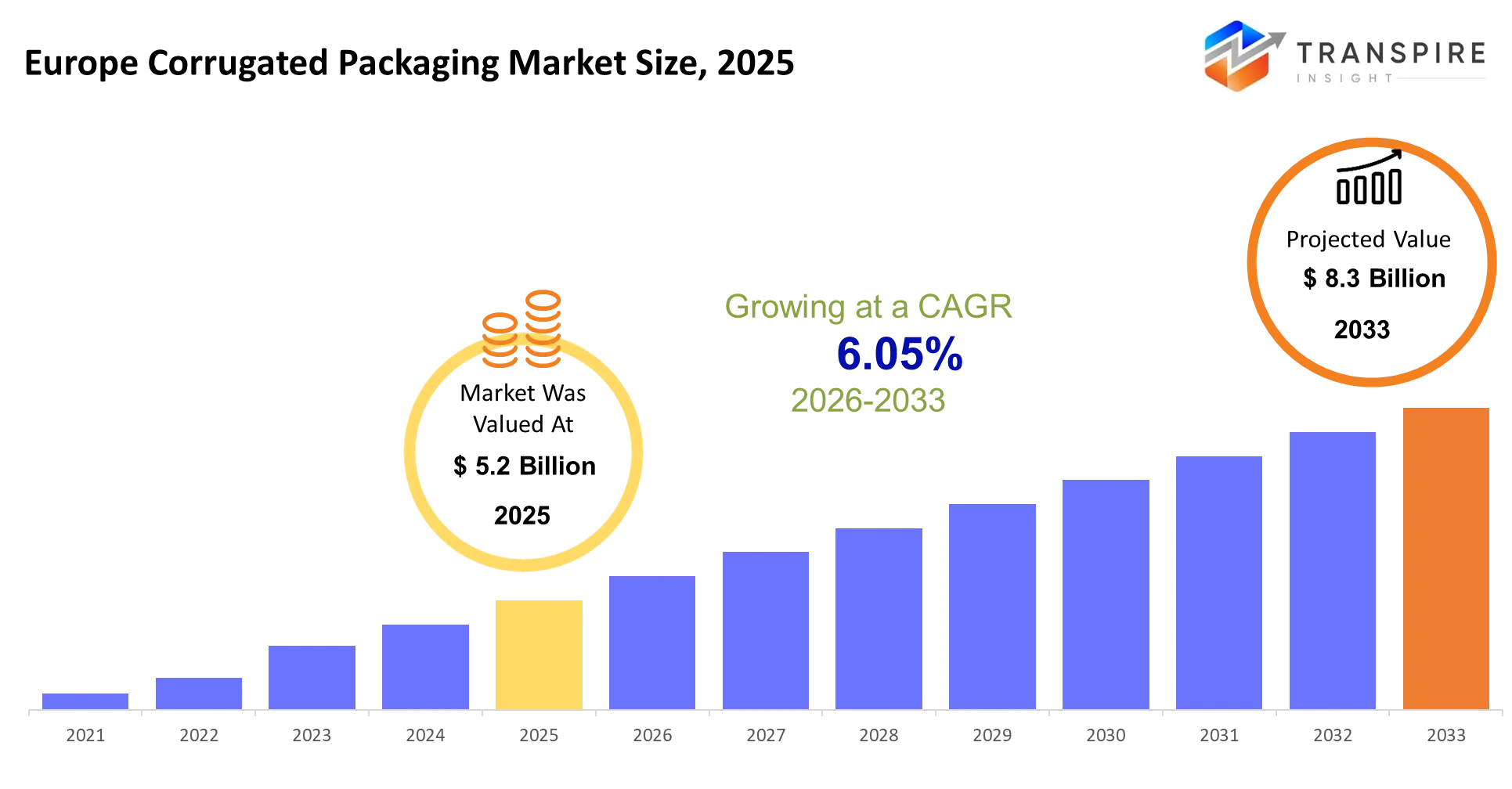
- Europe Corrugated Packaging Market Size 2025: USD 5.2 Billion
- Europe Corrugated Packaging Market Size 2033: USD 8.3 Billion
- Europe Corrugated Packaging Market CAGR: 6.05%
- Europe Corrugated Packaging Market Segments: By Type (Single Wall, Double Wall, Triple Wall, Others), By Application (Food & Beverages, E-commerce, Electronics, Industrial Goods, Consumer Goods, Others), By End-User (E-commerce Companies, FMCG Companies, Food Industry, Electronics Industry, Industrial Firms, Others), By Material (Kraft Paper, Recycled Paper, Virgin Paper, Others).
To learn more about this report,  Download Free Sample Report
Europe Corrugated Packaging Market Summary:
The Europe Corrugated Packaging Market size is estimated at USD 5.2 Billion in 2025 and is anticipated to reach USD 8.3 Billion by 2033, growing at a CAGR of 6.05% from 2026 to 2033.
The corrugated packaging system used throughout Europe enables businesses to move products between retail stores and manufacturing centers and logistics facilities because it delivers strong yet light packaging that keeps items safe during transportation from storage facilities to customers. The solution addresses a real-world challenge which requires companies to find inexpensive shipping methods that protect their products yet maintain their ability to recycle materials.
The market has experienced a fundamental transformation during the last three to five years because regulators and major retailers demand the transition to circular fiber-based solutions which should replace plastic materials. The EU packaging waste directives have become stricter which requires companies to develop new product designs and select different materials and build new recycling systems. The pandemic drove a shift toward e-commerce which created a demand for shipping solutions that need standardized shipping formats and drove development in automated box-making and right-sizing technologies.
The growth process operates according to a clear pattern because companies implement corrugated packaging solutions which decrease product damage while handling regulatory requirements and then boost their capacity to deliver premium packaging products.
Key Market Insights
- The European Corrugated Packaging Market is primarily controlled by Western Europe which holds more than 55% of the market share in 2024 with Germany France and the UK as its main market leaders.
- The manufacturing industry and logistics infrastructure investments are driving Eastern Europe as the fastest-growing region during the 2025 to 2030 period.
- The industry allocates about 60% of its total market share to single-wall corrugated boxes because they provide cost savings and multiple applications.
- The market for double-wall boards serves as the second-largest segment because customers require packaging solutions that support heavy industrial operations.
- The segment of recycled corrugated materials shows the strongest growth because it meets both regulatory requirements and sustainability trends which will increase until 2030.
- The e-commerce packaging sector controls more than 45% of the market share in 2024 because of its substantial shipping volume and requirement for secure protective packaging.
- The food and beverage packaging sector shows the fastest growth because consumers now demand packaging solutions that offer both recyclability and hygienieness.
- Retail and e-commerce remain the leading end-user segment which generates about 50% of total demand in 2024.
- The FMCG sector and food producers now use corrugated packaging formats as their main branding tool while they establish their sustainability requirements.
What are the Key Drivers, Restraints, and Opportunities in the Europe Corrugated Packaging Market?
The European corrugated packaging market develops through EU packaging and waste directive restrictions which essential EU regulations that require companies to establish recycling programs and producer responsibility systems according to their advanced packaging materials. The new regulations required retailers and manufacturers to eliminate plastic-based transport packaging materials and switch to fiber-based packaging solutions. E-commerce and FMCG companies established standardized corrugated packaging formats which helped them achieve their compliance requirements thus driving industry growth. The demand for engineered right-sized packaging solutions that minimize damage and logistics costs which used to raise average selling prices direct order volume growth to corrugated converters.
The core raw material used in production suffers from both volatility and supply constraints which create a main structural barrier to containerboard operations. European paper production facilities face energy costs that depend on unpredictable electricity and gas price changes which will take time to solve because their infrastructure needs permanent solutions. The situation creates both margin pressures and price uncertainties which prevent small buyers from making long-term contract commitments. The adoption of premium corrugated products advances at a slow pace while businesses experience uneven revenue growth across different markets and customer types.
Automation and digital box-on-demand systems represent a major opportunity for fulfillment centers which can achieve better results through their implementation. Companies invest in machine learning-powered packaging systems which enable them to create custom box sizes while decreasing material waste and shipping errors. The Netherlands and Poland serve as the first countries to adopt these technologies which help logistics centers enhance their cost control while increasing their operational capacity.
What Has the Impact of Artificial Intelligence Been on the Europe Corrugated Packaging Market?
European corrugated packaging operations now use artificial intelligence and advanced digital technologies for their converting plants and logistics networks. Manufacturers use AI-based control systems to handle all operations which include monitoring moisture levels and controlling flute formation on their corrugators. The systems achieve material waste reduction while they maintain board quality which results in increased production rates and decreased product defects. AI technology enables automated sorting and box sizing and palletization in warehouse environments which speeds up order processing while decreasing staffing requirements.
Predictive maintenance systems now use machine learning algorithms to make their decisions. Sensors on corrugating machines and die cutters produce ongoing performance data which allows algorithms to identify early indications of equipment wear or misalignment. The method decreases unexpected equipment stoppages while it increases the duration of machine operation. Operators report that their equipment runs 10 to 15 percent more and their expenses for equipment upkeep have decreased. AI technology assists converters with inventory planning and demand forecasting to match their production output with changing e-commerce order demands.
The process of adoption now encounters a major obstacle. The high cost of system integration together with the outdated systems present in European manufacturing facilities creates challenges for mid-sized manufacturers during the deployment process. The inconsistent quality of data restricts model performance because it decreases the short term financial benefits which organizations gain from their advanced analytics systems.
Key Market Trends
- The European Union packaging regulations which started their implementation in 2020 required manufacturers to create new product designs which involved using recyclable corrugated materials instead of plastic transport packaging across their retail distribution networks.
- E-commerce growth after COVID-19 required Amazon and other companies to start using perfectly sized corrugated boxes which decreased their need for filler materials and created safer delivery processes.
- Converters spent more money on automatic box-on-demand systems between 2021 and 2024 which allowed them to create customized packages at any moment while their warehouse operations reached operational gains of more than 10 percent.
- The paper mills in Europe needed to work with reduced production because of rising energy costs during 2022 to 2023 which resulted in containerboard supply shortages and unpredictable pricing agreements.
- The major companies Smurfit Kappa Group and DS Smith have developed lightweight board solutions which enable them to decrease material consumption while maintaining their ability to stack products and deliver performance.
- Manufacturers have started to create shelf-ready packaging systems which retailers want because they need products which combine branding elements with display features and delivery system efficiency.
- Europe achieved paper recovery rates beyond 65% after 2021 because of recycling system upgrades which created closed-loop supply chains and decreased need for fresh fiber materials.
- Eastern Europe has developed into a manufacturing center during 2022 because companies have started to build new facilities in Poland and Romania which help them meet their cost efficiency goals and decrease their order processing times.
- The year 2020 marked the start of digital printing development which enabled short-run companies to create high-quality customized products while allowing brands to create localized packaging designs without needing to maintain extensive inventory.
Europe Corrugated Packaging Market Segmentation
By Type
Single -wall corrugated boards maintain their market leadership because they offer cost-effective solutions which enable lightweight shipping from retail to e-commerce distribution centers. The double-wall variants rank as the second largest market segment because industries require their enhanced strength to transport heavy goods. Triple-wall boards remain niche products but they function in bulk and export packaging applications which require superior durability to protect expensive cargo.
Right -sizing trends together with automated packaging systems that focus on reducing material usage drive the growth of single-wall formats. The growing product fragility of electronics and industrial goods drives ongoing demand for double-wall packaging solutions. Future development will create engineered hybrid boards which link strength to weight because material science and performance optimization requirements compel manufacturers to invest.
By Application
The market is dominated by e-commerce because it requires frequent shipments and standardized protective packaging solutions. The food and beverage sector ranks as the second biggest market segment because it needs products to be delivered under strict hygiene and ventilation and temperature-controlled conditions. Electronics and industrial goods create consistent market demand which requires development of unique packaging solutions that provide extra strength.
Consumer goods packaging continues to develop through new branding elements and packaging solutions that enable shelf display. The packaging requirements of e-commerce have changed because businesses now prioritize preventing product damage while optimizing their package sizes. The food industry is developing new applications through recyclable materials that serve as substitutes for plastic crates and trays. The demand for packaging will increase because multi-functional designs which provide product security and branding and compliance with regulations will create design possibilities for packaging converters who need to improve their logistics operations.
By End-User
The e-commerce industry maintains its position as the leading sector in last-mile delivery, because its operational scale, shipment frequency, and usage of standardized corrugated products enable delivery to end-users. The FMCG sector and food industry follow closely behind, because they require affordable secondary packaging solutions that can handle large product volumes. The electronics industry needs custom packaging solutions that provide superior strength and protection than standard packaging options.
The industrial sector requires solutions that enable them to ship products in large quantities through their distribution networks. The rapid expansion of online retail has shifted purchasing behavior toward long-term supply contracts and integrated packaging services. FMCG companies are now developing their packaging strategies to meet both sustainability objectives and retail display standards. The future of business expansion will rely on converters and major customers working together. The industry will adopt integrated supply chain solutions and data-based packaging optimization as standard operating procedures.
By Material
Recycled paper, which dominates European markets, benefits from existing collection systems and government endorsement of circular packaging systems. Kraft paper serves as the main material for applications that demand elevated strength and durability performance in industrial and export packaging operations. Virgin paper remains restricted to particular applications which require constant performance throughout their entire operational life.
The recycled fiber market has become widely accessible yet its quality differences impact the ability to create high-strength products. Companies choose materials and develop production methods based on current energy expenses and raw material costs. The upcoming research will focus on developing advanced recycled fiber materials and blending methods which will help manufacturers achieve performance requirements while meeting both environmental regulations and budget limitations.
What are the Key Use Cases Driving the Europe Corrugated Packaging Market?
The main application of e-commerce logistics uses corrugated packaging to enable continuous parcel distribution between fulfillment centers and delivery routes. Standard box dimensions provide two advantages because they minimize shipping damages and enhance product handling processes which results in lower return expenses and online retailers' shipping costs.
The food distribution industry and the FMCG supply chain sector are developing new applications to handle fresh produce and beverages and processed goods. Food producers use corrugated trays and shelf-ready formats as retail distribution alternatives to plastic crates because these solutions help them comply with EU packaging waste regulations while preserving sanitation and air circulation needs.
The new applications of technology include the transportation of temperature-sensitive pharmaceuticals and the shipment of electronics products which need anti-static protection and durable materials. The cross-border e-commerce market is expanding while businesses face new sustainability requirements which drive the development of corrugated packaging solutions that deliver product protection and meet environmental regulations.
|
Report Metrics |
Details |
|
Market size value in 2025 |
USD 5.2 Billion |
|
Market size value in 2026 |
USD 5.5 Billion |
|
Revenue forecast in 2033 |
USD 8.3 Billion |
|
Growth rate |
CAGR of 6.05% from 2026 to 2033 |
|
Base year |
2025 |
|
Historical data |
2021 - 2024 |
|
Forecast period |
2026 - 2033 |
|
Report coverage |
Revenue forecast, competitive landscape, growth factors, and trends |
|
Regional scope |
Europe (Germany, United Kingdom, France, Italy, Spain and Rest of Europe) |
|
Key company profiled |
International Paper, WestRock, Smurfit Kappa, DS Smith, Mondi, Georgia-Pacific, Packaging Corp, Oji Holdings, Nine Dragons, Rengo, Pratt Industries, Stora Enso, Cascades, Klabin, Mayr-Melnhof |
|
Customization scope |
Free report customization (country, regional & segment scope). Avail customized purchase options to meet your exact research needs. |
|
Report Segmentation |
By Type (Single Wall, Double Wall, Triple Wall, Others), By Application (Food & Beverages, E-commerce, Electronics, Industrial Goods, Consumer Goods, Others), By End-User (E-commerce Companies, FMCG Companies, Food Industry, Electronics Industry, Industrial Firms, Others), By Material (Kraft Paper, Recycled Paper, Virgin Paper, Others) |
Which Regions are Driving the Europe Corrugated Packaging Market Growth?
Western Europe leads the market, anchored by Germany, France, and the United Kingdom. The European Union enforces strict packaging and waste management regulations which require manufacturers to use recyclable corrugated materials in their production processes. The combination of advanced logistics systems and comprehensive retail distribution networks enables businesses to meet their requirements for standardized packaging solutions. The recycling system operates effectively while integrated paper manufacturers maintain their operations which results in cost savings and accessible raw materials.
Northern Europe follows with a different strength rooted in stability and long-term industrial planning. Sweden and Finland possess extensive forest resources which provide both fresh wood and reclaimed fiber to their industries. Stora Enso and Mondi Group support sustainable packaging development through their continuous financial commitment to research and development. This region maintains predictable demand through export-oriented industries and disciplined regulatory implementation.
The manufacturing sector has expanded into Eastern Europe while the region experiences growth in logistics operations that developed after 2022. The establishment of new corrugated manufacturing facilities in Poland and Romania results from their ability to provide cost-effective operations combined with easy access to major European Union markets. The rise in packaging requirements has developed as a result of increased spending on warehousing and cross-border transportation infrastructure. The time period until 2033 will provide converters and investors with multiple chances to enter the market through production facilities and distribution networks that operate in various regions.
Who are the Key Players in the Europe Corrugated Packaging Market and How Do They Compete?
The European corrugated packaging market experiences competitive dynamics which create a situation between market consolidation and local market fragmentation. The containerboard market operates under the control of large integrated companies which manage both containerboard production and their major contracts, while mid-sized companies focus on competing within specific local markets and specialized industrial sectors. The existing market players maintain their market position through three methods which include expanding their businesses, integrating recycling operations, and establishing permanent supply contracts with retailers and online shopping companies. The main competitive aspect of our business operates through two main drivers which help us reduce operational expenses while our design team creates packaging solutions that fulfill both customer requirements and government regulations.
Smurfit Kappa Group develops business strength through its complete operational control that connects its recycled fiber collection process with its advanced box creation system. The company develops packaging optimization software which enables clients to decrease material waste together with their delivery expenses. DS Smith establishes its unique identity through its commitment to circular design and its collaborative relationships with Fast-Moving Consumer Goods companies and retail partners, which enable the company to provide packaging solutions that meet European Union environmental requirements and recycling standards. The two companies develop their business through acquisitions while they grow their operations across Eastern Europe to take advantage of manufacturing relocations to that region.
Mondi Group specializes in developing lightweight paper grades which have high strength properties, enabling better performance results without any extra production costs, because the company possesses strong market operations across Central and Eastern Europe. Stora Enso develops forest resources to establish renewable materials through its research on fiber-based products which serve as alternatives to plastic packaging solutions. International Paper improves its operational performance through two strategies which include expanding into selected markets while using its global business network to obtain necessary materials and guarantee product availability to its European client base.
Company List
- International Paper
- WestRock
- Smurfit Kappa
- DS Smith
- Mondi
- Georgia-Pacific
- Packaging Corp
- Oji Holdings
- Nine Dragons
- Rengo
- Pratt Industries
- Stora Enso
- Cascades
- Klabin
- Mayr-Melnhof
Recent Development News
In April 2026, Smurfit Westrock Q1 2026 Results Show Margin Pressure in Corrugated Packaging: Smurfit Westrock reported weaker profitability in Q1 2026 despite stable sales, as corrugated box demand faced weather disruption and cost pressure in Europe. The company highlighted ongoing restructuring in its European packaging operations.
Source: https://investors.smurfitwestrock.com
In April 2026, Dunapack Packaging Acquires Stora Enso Corrugated Plants in Germany: Dunapack Packaging, part of Prinzhorn Group, agreed to acquire Stora Enso’s German corrugated packaging facilities. The deal strengthens vertical integration and expands corrugated capacity in Western Europe.
Source: https://www.paperage.com
What Strategic Insights Define the Future of the Europe Corrugated Packaging Market?
The corrugated packaging market in Europe is developing a supply chain system which uses data to achieve peak efficiency because packaging functions as a cost management and regulatory compliance tool. The next 5 to 7 years will witness growth through automation development and right-sized packaging and stricter circular economy regulations which force manufacturers to create engineered solutions instead of using standard boxes. The companies that combine their design and production and logistics information into one unified system will gain an advantage.
The supply of fiber materials and the dependence on energy sources present hidden dangers. The increased demand for recycled fiber materials combined with unstable energy prices will reduce the ability of smaller converters to obtain consistent materials which will lead to greater market consolidation and result in fixed prices for customers.
AI-driven packaging systems create new business potential through their application in fulfillment centers across Eastern Europe which develops its logistics infrastructure. Companies that invest early in digital packaging ecosystems should prioritize partnerships with e-commerce and 3PL operators which will enable them to establish embedded solutions that secure future demand while preventing customers from switching providers.
Europe Corrugated Packaging Market Report Segmentation
By Type
- Single Wall
- Double Wall
- Triple Wall
- Others
By Application
- Food & Beverages
- E-commerce
- Electronics
- Industrial Goods
- Consumer Goods
- Others
By End-User
- E-commerce Companies
- FMCG Companies
- Food Industry
- Electronics Industry
- Industrial Firms
- Others
By Material
- Kraft Paper
- Recycled Paper
- Virgin Paper
- Others
Frequently Asked Questions
Find quick answers to common questions.
The Approximate Europe Corrugated Packaging Market size for the Market will be USD 8.3 Billion in 2033.
The key Segments of the Europe Corrugated Packaging Market are By Type (Single Wall, Double Wall, Triple Wall, Others), By Application (Food & Beverages, E-commerce, Electronics, Industrial Goods, Consumer Goods, Others), By End-User (E-commerce Companies, FMCG Companies, Food Industry, Electronics Industry, Industrial Firms, Others), By Material (Kraft Paper, Recycled Paper, Virgin Paper, Others).
Major Players in the Europe Corrugated Packaging Market are International Paper, WestRock, Smurfit Kappa, DS Smith, Mondi, Georgia-Pacific, Packaging Corp, Oji Holdings, Nine Dragons, Rengo, Pratt Industries, Stora Enso, Cascades, Klabin, Mayr-Melnhof.
The Current Market size of the Europe Corrugated Packaging Market is USD 5.2 Billion in 2025.
The Europe Corrugated Packaging Market CAGR is 6.05%.
- International Paper
- WestRock
- Smurfit Kappa
- DS Smith
- Mondi
- Georgia-Pacific
- Packaging Corp
- Oji Holdings
- Nine Dragons
- Rengo
- Pratt Industries
- Stora Enso
- Cascades
- Klabin
- Mayr-Melnhof
Recently Published Reports
-
Apr 2026
Healthcare Polymer Packaging Market
Healthcare Polymer Packaging Market Size, Share & Analysis Report By Packaging Type (Syringes, IV Bottles and Pouches, Clamshells, Blisters, Bottles & Jars, Containers, Tubes, IV Parental Packaging, Others), By Type (Regulated, Non-regulated), By Polymer Type (LDPE (Low-Density Polyethylene), HDPE (High-Density Polyethylene), Homo-polymer (Homo), Random Copolymer (Random), Block Copolymer (Block), PET, Polystyrene, Polyvinyl Chloride, Polyamide/EVOH, Others), and Geography (North America, Europe, Asia-Pacific, Middle East and Africa, South and Central America), 2021 - 2031
-
Apr 2026
Hydrophilic Tape (Waterstop) Market
Hydrophilic Tape (Waterstop) Market Size, Share & Analysis Report By Type (Bentonite-Based Hydrophilic Tape, Rubber-Based Hydrophilic Tape), By Application (Residential Buildings, Commercial Buildings, Infrastructure Projects), and Geography (North America, Europe, Asia-Pacific, Middle East and Africa, South and Central America), 2021 - 2031
-
Apr 2026
Metalens Market
Metalens Market Size, Share & Analysis Report By Type (Visible Light Metalens, and Infrared Metalens), By Application (Consumer Electronics, Automotive Electronics, Industrial, Medical, and Others), and Geography (North America, Europe, Asia-Pacific, Middle East and Africa, South and Central America), 2021 - 2031
-
Apr 2026
PBT Resin Market
PBT Resin Market Size, Share & Analysis Report By Type (Reinforced PBT Resin, Unreinforced PBT Resin), By Processing Method (Injection Molding, Extrusion, Blow Molding, Others), By End-User (Automotive, Electrical & Electronics, Consumer Appliances, Industrial Machinery, Medical Devices, Packaging, Others), and Geography (North America, Europe, Asia-Pacific, Middle East and Africa, South and Central America), 2021 - 2031