
Europe Plant-based Food Market Size & Forecast:
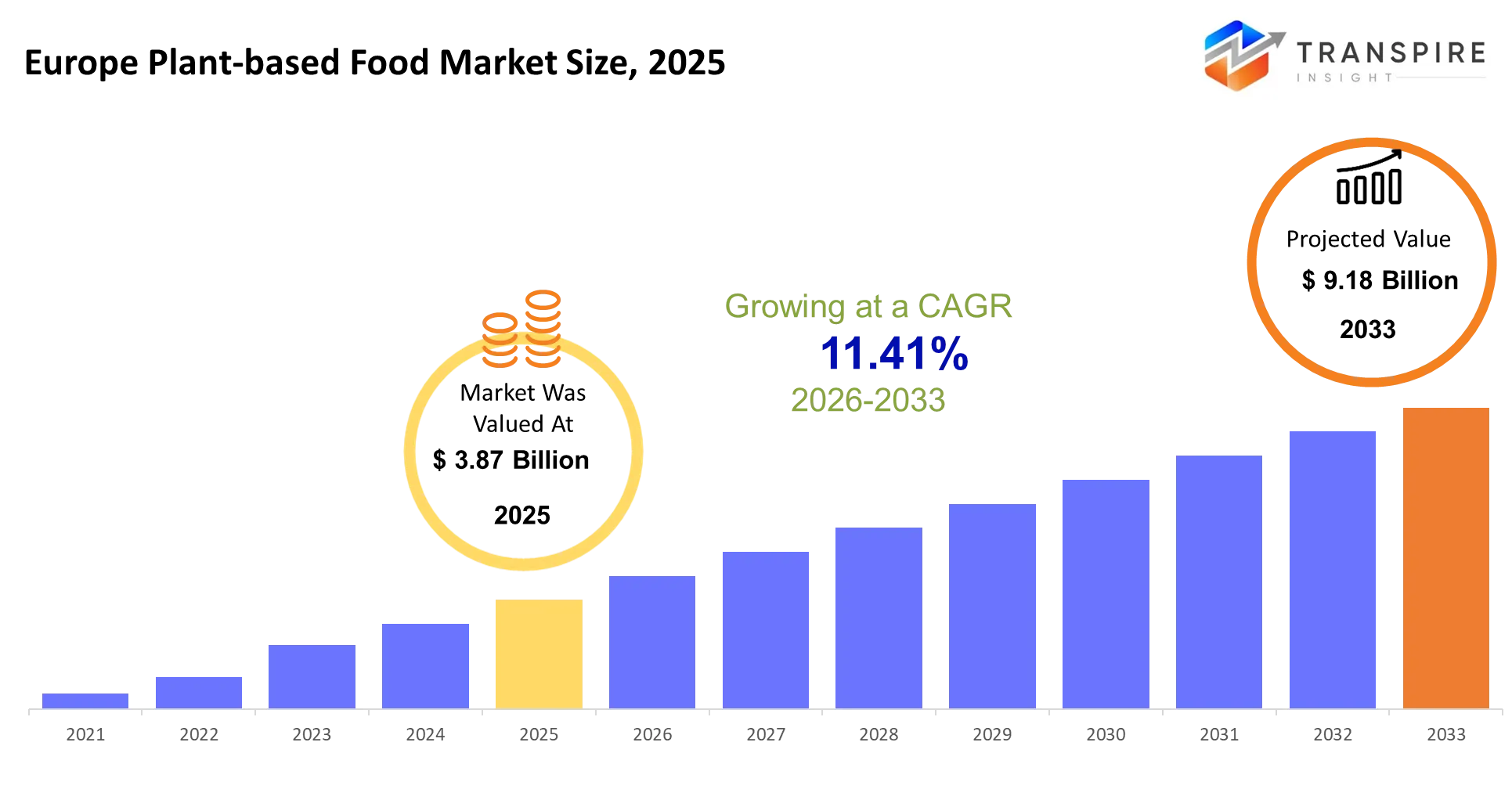
- Europe Plant-based Food Market Size 2025: USD 3.87 Billion
- Europe Plant-based Food Market Size 2033: USD 9.18 Billion
- Europe Plant-based Food Market CAGR: 11.41%
- Europe Plant-based Food Market Segments: By Type (Plant-based Meat, Dairy Alternatives, Plant-based Snacks, Ready Meals, Others); By Application (Food Service, Retail, Household Consumption, Quick Service Restaurants, Health & Wellness, Others); By End-User (Consumers, Restaurants, Retailers, Food Chains, Health-conscious Users, Others); By Distribution (Supermarkets, Online, Specialty Stores, Convenience Stores, Others)
To learn more about this report,  Download Free Sample Report
Europe Plant-based Food Market Summary
The Europe Plant-based Food Market was valued at USD 3.87 Billion 2025. It is forecast to reach USD 9.18 Billion by 2033. That is a CAGR of 11.41% over the period.
The plant-based food market in Europe provides meat and dairy alternatives to retailers and foodservice operators and food manufacturers, who use these products to create their daily meals and ready-to-eat items and their industrial ingredient combinations. The system provides companies with a practical solution to replace animal products, which enables them to control their cost fluctuations and achieve their sustainability goals while minimizing their supply chain risks. The past 3 to 5 years have created a major structural change that transformed niche health-food products into mainstream offerings found in supermarkets and quick-service restaurants and private-label product lines, which occurred after companies invested in developing better texture and flavor solutions. The Russia-Ukraine conflict created supply disruptions that affected grain and sunflower oil distribution networks which led manufacturers to search for new sources and adjust their product formulations. The market pressures have driven businesses to adopt plant-based materials because buyers now see these inputs as essential purchasing components which lead to product development partnerships and increased shelf space for retail products.
Key Market Insights
- Western Europe will control The European Plant-based Food Market through its 55% market share which results from its efficient retail distribution network that operates across Germany and the UK and France.
- The Nordic countries show the fastest growth between 2024 and 2030 because of their high sustainability adoption rates and the increasing popularity of flexitarian diets.
- Southern European countries experience slow expansion because foodservice operations become more common and urban residents change their eating habits.
- The Europe Plant-based Food Market reaches its highest point with Plant-based dairy products, which hold a 38% market share that comes from milk and yogurt alternatives.
- Plant-based meat substitutes occupy the second position because protein innovations improve their taste performance.
- The period from 2024 to 2030 will see plant-based ready meals experience their fastest growth because urban consumers who seek convenience will drive their demand.
- The European Plant-based Food Market shows retail distribution as its primary channel which accounts for about 60% of market share while supermarket private-label brands continue to grow.
- Quick-service restaurant chains expand their plant-based menu offerings to fulfill flexitarian customer needs which results in the foodservice sector experiencing its fastest growth rate.
- The primary end-user group for households reaches more than 65% market share because people use alternative foods to replace animal-based products in their meals.
- The institutional catering and hospitality sectors show the fastest growth as they expand their operations through sustainable practices and menu development.
What are the Key Drivers, Restraints, and Opportunities in the Europe Plant-based Food Market?
The Europe Plant-based Food Market observes its main growth driver because consumers who follow flexitarian diets now choose to consume less animal protein except for their complete elimination of all animal products. The food processing industry advanced through its development of high-moisture extrusion technology and its creation of fermentation-based protein solutions which enabled these products to achieve taste and texture characteristics that matched those of meat and dairy items. The restaurant industry expanded its product offerings because mainstream retailers and quick-service restaurants established new revenue channels through their private-label products and their extended menu options instead of serving only niche vegan items.
The primary obstacle which businesses face involves their need to spend more money on plant protein isolates than on traditional animal-based product inputs. The system depends on two main elements which include fragmented agricultural supply chains and the inability to achieve cost savings through bulk production of pea and soy and oat processing facilities. The cost gap restricts price competitiveness in mass-market segments which affect Southern and Eastern Europe because consumers in these areas take time to switch to new products and their purchasing patterns limit revenue growth from product sales.
Companies who work with precision fermentation and hybrid protein technologies create new market opportunities by combining cultivated proteins with plant-derived proteins to produce functional products at lower production costs. The Netherlands and Germany now experience faster growth in pilot-scale production facilities because investors start supporting business partnerships between European biotech startups and their research organizations who plan to develop scalable fermentation platforms. The Europe Plant-based Food Market will experience its next growth phase because this development will improve product scalability while satisfying both pricing demands and sensory requirements of consumers.
What Has the Impact of Artificial Intelligence Been on the Europe Plant-based Food Market?
Artificial intelligence and advanced analytics are changing how scrubber performance systems operate and how exhaust gas cleaning technology functions throughout the European maritime compliance system. AI-enabled monitoring platforms currently provide operational solutions that track scrubber parameters including sulfur emission levels and washwater quality and system load in real time while decreasing the need for manual checks and increasing the precision of reporting requirements needed for International Maritime Organization compliance.
Machine learning models use historical data about engine performance and emissions to predict when maintenance will be needed and to identify when performance will start to decline. Shipping operators use these insights to schedule predictive maintenance, which reduces unplanned downtime and can improve fleet availability by 10–15% while lowering fuel and consumables waste through optimized operating profiles.
AI-based optimization systems improve both emissions prediction accuracy and voyage efficiency planning abilities, which enables operators to modify their fuel consumption and scrubber operations according to actual route conditions. The European Union border enforcement systems now create sustainable cost-effective business operations which meet environmental requirements because high standards have been established throughout EU maritime areas.
The adoption of maritime technologies faces challenges because offshore areas lack sufficient maritime data and their sensor systems for monitoring face connectivity problems. The costs of integration into digital monitoring systems remain excessive specifically for organizations that need to upgrade their existing maritime vessels. The European Plant-based Food Market uses AI as its core element for streamlining operations in marine compliance and scrubber technology which drives progress toward sustainable decarbonization goals.
Key Market Trends
- European retailers increased their plant-based product displays by more than 30 percent since 2021 because they decided to display these products in regular supermarket sections instead of their previous niche areas.
- The market for plant-based dairy products started to grow after 2022 when supermarkets began to use oat and almond milk as their primary dairy substitute for private label products.
- Food manufacturers started to use high-moisture extrusion technology for their products after 2020 because it enabled them to create better meat alternatives which resulted in more customers buying their products again.
- European Union sustainability regulations required large foodservice chains to develop plant-based menu options which must make up 40 percent of their total menu by 2025.
- The Ukraine conflict in 2022 forced supply chains to change their operations because manufacturers needed to establish new sources for pea and soy products from Eastern European fields.
- The plant-based research and development budget from Nestlé and Unilever reached a 20 percent increase through their 2021 to 2024 investments.
- Western European urban households showed increased meat alternatives usage because flexitarian dietary patterns became more popular through meat reduction campaigns.
- Plant-based ready meals needed more temperature-controlled distribution because they required cold chain logistics which exceeded the needs of traditional shelf-stable food distribution systems.
- After 2023, fermentation-based protein startups obtained venture funding which enabled them to build production systems for scalable dairy and egg alternative products.
- Beyond Meat and Oatly expanded their European operations to create better competitive advantages through reduced import costs and improved product pricing strategies.
Europe Plant-based Food Market Segmentation
By Type:
The product range shows its highest value through plant-based dairy products which make up most of the inventory because retailers began selling them early and people now choose plant-based alternatives to replace traditional milk and yogurt products in their everyday meals. The food industry now uses plant-based meat because manufacturers developed products with better taste and texture which made them suitable for regular consumption. European urban areas which experience growing convenience eating patterns have created more demand for snacks and ready meals although these two product categories still remain smaller than other food segments.
The segment experiences growth because protein structuring and fermentation process innovation create products that match animal-based products in sensory experience. Dairy alternatives achieved market success because they faced fewer regulatory challenges and their retail presence grew more quickly than meat substitutes which needed extensive product reformulation.
The forecast period shows faster growth for plant-based meat products and ready meals because foodservice chains will begin to expand their menu offerings. The product development team will use hybrid product designs which help maintain low prices and consistent taste throughout their work while investors concentrate on protein processing methods that can be used in multiple locations.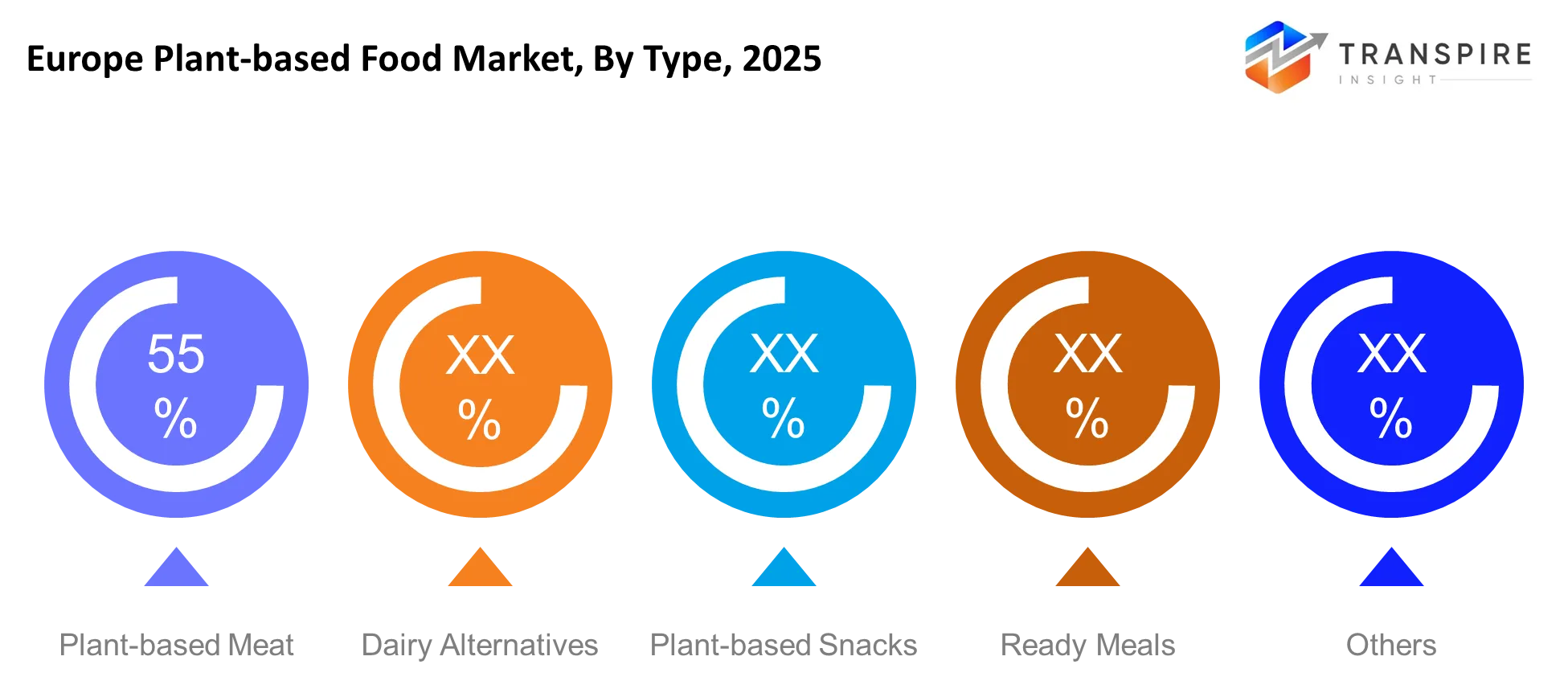
To learn more about this report, Download Free Sample Report
By Application:
The main application channel in retailing maintains its position as the most important distribution channel because supermarkets have extensive coverage and private-label products have increased their market presence throughout major European markets. The food service industry together with quick-service restaurants experiences rapid growth because restaurant chains now offer plant-based dishes as part of their regular menu items. Consumers sustain baseline demand by continuously replacing products through their repeated purchases of items for home consumption.
The industry experiences growth because restaurants adopted foodservice integration strategies which they started using in 2021 to make plant-based products available through their regular menus. Retail strength maintains its current level because grocery stores implement strong marketing campaigns and increase their product displays throughout popular shopping areas.
The industry will focus its upcoming growth efforts on quick-service restaurants because standardized plant-based menus will simplify their business operations. Foodservice operators will become the main focus of investors because they require contracts that can easily expand with their business growth while retailers will use premium product placement and cross-category bundling to enhance their market presence.
By End-User:
The first end-user group includes household consumers who maintain permanent residence for lessening their need to buy dairy and meat products. The process of menu expansion has become essential for restaurants and food chains because their competitors need to provide customers with more food choices. Premium product positioning receives strong market support from health-conscious users who establish a dedicated market segment.
The segment has experienced growth because people now choose flexitarian diets which allow them to eat less animal protein. Food chains now make plant-based food items permanent menu options instead of offering them as short-term specials which helps them achieve constant sales growth.
The institutional adoption process will lead to restaurants and food chains becoming the main business growth driver throughout the coming years. Product manufacturers will design offerings tailored for bulk foodservice use, while retailers will emphasize lifestyle-driven marketing to retain household consumers.
By Distribution:
Supermarkets control distribution channels because of their powerful private-label product growth and their ability to distribute products throughout major European retail chains. The online market experiences rapid expansion through subscription-based purchasing systems and direct-to-consumer branding methods. Specialty and convenience stores serve smaller but strategically important urban demand pockets.
Supermarkets increase their plant-based food offerings through retail modernization which allows them to display these products in their main store areas. Online platforms gain traction through targeted marketing and easier access to niche and premium products not always available in physical stores.
The upcoming distribution model will evolve toward omnichannel integration which enables supermarkets and online platforms to function as interconnected systems. Brands will invest in direct digital engagement while retailers expand refrigerated logistics to support higher-margin plant-based ready meals.
What are the Key Use Cases Driving the Europe Plant-based Food Market?
Supermarkets use plant-based dairy and meat alternatives to fulfill their primary need which exists in retail grocery substitution when customers shop for their regular products. Demand is strongest because European retail chains now provide various products which customers use to substitute their regular animal protein needs with plant-based options.
Foodservice integration and quick-service restaurant menu diversification are expanding rapidly as operators standardize plant-based options to meet flexitarian demand. The institutional catering and hospitality sectors use plant-based dishes to create sustainable menus which reduce their carbon emissions during large-scale meal preparation.
The food manufacturing industry now uses hybrid protein formulations for their production needs while health-focused nutrition products use functional plant-based ingredients as their essential components. Precision fermentation applications are experiencing initial market growth in premium dairy and egg alternatives which have received regulatory approval and are now produced at pilot-scale in advanced European food technology centers.
|
Report Metrics |
Details |
|
Market size value in 2025 |
USD 3.87 Billion |
|
Market size value in 2026 |
USD 4.31 Billion |
|
Revenue forecast in 2033 |
USD 9.18 Billion |
|
Growth rate |
CAGR of 11.41% from 2026 to 2033 |
|
Base year |
2025 |
|
Historical data |
2021 - 2024 |
|
Forecast period |
2026 - 2033 |
|
Report coverage |
Revenue forecast, competitive landscape, growth factors, and trends |
|
Regional scope |
Europe (Germany, United Kingdom, France, Italy, Spain, Rest of Europe) |
|
Key company profiled |
Beyond Meat, Impossible Foods, Nestlé, Danone, Unilever, Tyson Foods, Maple Leaf Foods, Oatly, Alpro, Vitasoy, Kellogg, General Mills, ADM, Cargill, Ingredion |
|
Customization scope |
Free report customization (country, regional & segment scope). Avail customized purchase options to meet your exact research needs. |
|
Report Segmentation |
By Type (Plant-based Meat, Dairy Alternatives, Plant-based Snacks, Ready Meals, Others); By Application (Food Service, Retail, Household Consumption, Quick Service Restaurants, Health & Wellness, Others); By End-User (Consumers, Restaurants, Retailers, Food Chains, Health-conscious Users, Others); By Distribution (Supermarkets, Online, Specialty Stores, Convenience Stores, Others) |
Which Regions are Driving the Europe Plant-based Food Market Growth?
The European Plant-based Food Market shows its strongest presence in Northern Europe since EU sustainability targets and advanced retail systems both operate in accordance with environmental regulations. The environmental labeling regulations which Germany and the Netherlands and Nordic countries enforce enable food producers to create plant-based products through mandatory product modifications. The combination of extensive supermarket networks together with high-quality cold-chain distribution systems enables swift delivery of products which permits widespread distribution of dairy and meat alternatives. The food innovation ecosystem maintains its leadership position through its established food research hubs which include agri-tech and protein research centers.
The Western European and Southern European regions function as a dependable secondary market which expands through unchanging consumer requirements instead of aggressive enforcement of policies. The French market and Italian market and Spanish market exhibit gradual market growth which results from consumers shifting their dietary preferences toward healthier food choices and restaurants introducing new menu options. This region develops through tourism that boosts food service demand while its domestic agricultural supply network enables partial dietary replacements. The global manufacturers establish revenue streams which they can predict through this structure.
Eastern Europe represents the fastest-growing region, driven by recent modernization of retail infrastructure and increasing foreign investment in food processing facilities. The multinational companies established new production facilities and plant protein sourcing operations in Poland and Hungary after they restructured their supply chains following the 2022 restructure. The expansion of supermarket chains together with rising urban consumer spending power drove the increased acceptance of plant-based products. The region will receive economic investments between 2026 and 2033.
Who are the Key Players in the Europe Plant-based Food Market and How Do They Compete?
The European Plant-based Food Market shows moderate consolidation at its highest level but maintains fragmented competition among mid-level market players. Large multinational food companies compete with specialized plant-based brands, creating a dual structure where incumbents defend retail shelf space while agile innovators push product differentiation. The primary basis of competition has shifted from price alone to technology-led differentiation, particularly in protein texturization, fermentation, and clean-label formulation. Retail access and foodservice partnerships now determine market positioning more than traditional brand strength.
Nestlé focuses on technology-driven product innovation through its Garden Gourmet and plant-based dairy lines, using advanced protein structuring to improve taste parity with meat. The company achieves a competitive edge through its extensive distribution network across Europe and its ability to produce large volumes for both private-label and branded products. The company strengthens its position through partnerships with supermarket chains and continuous R&D investment in hybrid protein formulations.
Danone builds its strategy around dairy alternative specialization, particularly oat and almond-based beverages under its Alpro brand. The company establishes its unique market position through its high nutritional content and its existing distribution systems throughout Western Europe. The company expands its business by developing new products and establishing partnerships with foodservice operators who want to use alternative dairy products in their cafés and quick-service restaurants.
Unilever and its The Vegetarian Butcher brand pursue aggressive niche specialization in meat alternatives. Quick-service restaurant partnerships enable the company to establish strong brand recognition through its high-flavor mimicry product capabilities.Beyond Meat and Oatly expand through geographic scaling and direct-to-retail penetration, with Oatly leveraging oat supply chain integration and Beyond Meat focusing on restaurant collaborations across Europe.
Company List
- Beyond Meat
- Impossible Foods
- Nestlé
- Danone
- Unilever
- Tyson Foods
- Maple Leaf Foods
- Oatly
- Alpro
- Vitasoy
- Kellogg
- General Mills
- ADM
- Cargill
- Ingredion
Recent Development News
In March 2026, Danone announced acquisition of Huel, a UK-based plant-based nutrition company, to strengthen its complete nutrition and meal replacement segment across Europe. The deal enhances Danone’s direct-to-consumer and digital distribution capabilities in high-growth health food categories. https://www.reuters.com
In 2025, Unilever reviewed strategic options for its The Vegetarian Butcher brand amid shifting consumer demand toward less processed plant-based foods. The move reflects portfolio optimization as companies rebalance exposure between niche meat alternatives and scalable dairy substitutes. https://www.reuters.com
What Strategic Insights Define the Future of the Europe Plant-based Food Market?
The Europe Plant-based Food Market is moving toward deeper industrial integration rather than consumer-led niche expansion, driven by the convergence of food technology innovation and institutional sustainability mandates. The next 5 to 7 years will experience growth because retailers and foodservice operators need to control expenses while cutting costs throughout their food supply chain operations which will lead to the adoption of hybrid products that combine plant-based elements into regular food items.
The danger of raw material concentration becomes more prominent through our reliance on specific pea and soy and oat supply centers which exist only in Northern and Eastern Europe. The combination of climate change and agricultural production uncertainty will result in price fluctuations which will affect the processing efficiency that businesses have developed through their processing advancements. Higher rates of adoption will create difficulty for this structural restriction which will maintain its effect on profit growth.
The emerging opportunity for precision fermentation-based dairy and egg proteins exists because these proteins are progressing from their pilot production stage in the Netherlands and Germany toward their first commercial production stage. The technologies need regulatory approval from the EU to transform current cost and sensory standards into new benchmarks for all industries.
The market participants need to build supply chains which operate through vertical integration to handle all processes from ingredient sourcing to processing and branded distribution because this system will strengthen their ability to operate while generating profits from protein platforms that use next-generation technology.
Europe Plant-based Food Market Report Segmentation
By Type
- Plant-based Meat
- Dairy Alternatives
- Plant-based Snacks
- Ready Meals
- Others
By Application
- Food Service
- Retail
- Household Consumption
- Quick Service Restaurants
- Health & Wellness
- Others
By End-User
- Consumers
- Restaurants
- Retailers
- Food Chains
- Health-conscious Users
- Others
By Distribution
- Supermarkets
- Online
- Specialty Stores
- Convenience Stores
- Others
Frequently Asked Questions
Find quick answers to common questions.
The Europe Plant-based Food Market size is USD 9.18 Billion in 2033.
Key Segments for the Europe Plant-based Food Market are By Type (Plant-based Meat, Dairy Alternatives, Plant-based Snacks, Ready Meals, Others); By Application (Food Service, Retail, Household Consumption, Quick Service Restaurants, Health & Wellness, Others); By End-User (Consumers, Restaurants, Retailers, Food Chains, Health-conscious Users, Others); By Distribution (Supermarkets, Online, Specialty Stores, Convenience Stores, Others).
Major Europe Plant-Based Food Market Players are Beyond Meat, Impossible Foods, Nestlé, Danone, Unilever, Tyson Foods, Maple Leaf Foods, Oatly, Alpro, Vitasoy, Kellogg, General Mills, ADM, Cargill, Ingredion.
The Europe Current Plant-based Food Market size is USD 3.87 Billion in 2025.
The Europe Plant-based Food Market CAGR is 11.41% from 2026 to 2033.
- Beyond Meat
- Impossible Foods
- Nestlé
- Danone
- Unilever
- Tyson Foods
- Maple Leaf Foods
- Oatly
- Alpro
- Vitasoy
- Kellogg
- General Mills
- ADM
- Cargill
- Ingredion
Recently Published Reports
-
Apr 2026
Baby Infant Formula Market
Baby Infant Formula Market Size, Share & Analysis Report By ype (Infant Milk, Follow On Milk, Specialty Baby Milk, Growing-Up Milk), By Ingredient (Carbohydrate, Fat, Protein, Minerals, Vitamins, and Others), By Product Form (Powder, Liquid, and Ready-to-feed), By Distribution Channels (Supermarket/Hypermarket, Specialty Store, Pharmacies, Online Retail, and Others), and Geography (North America, Europe, Asia-Pacific, Middle East and Africa, South and Central America), 2021 - 2031
-
Apr 2026
Edible Insects for Animal Feed Market
Edible Insects for Animal Feed Market Size, Share & Analysis Report By Type (Insect Powder, Insect Meal, Insect Bar, Insect Paste, Insect Oil, and Others), By Insect Type (Beetles, Cricket, Caterpillar, Hymenoptera, Orthoptera, Tree Bugs, and Others), By Application (Livestock, Pet Food, and Aquaculture), By Livestock Type (Poultry, Swine, and Others), and Geography (North America, Europe, Asia-Pacific, Middle East and Africa, South and Central America), 2021 - 2031
-
Apr 2026
Food Industry Disinfection and Bacterial Control Market
Food Industry Disinfection and Bacterial Control Market Size, Share & Analysis Report By Type (Chemical Disinfectants, Physical Disinfectants, and Biocides and Antimicrobials), By Application (Food Processing Equipment Surface Disinfection, Food Preparation Areas Surface Disinfection, Storage Areas Surface Disinfection, Anti-microbial Coatings Food Preservation, and Preservative Solutions Food Preservation), By End User (Meat and Poultry Processing, Dairy Processing, Seafood Processing, Bakery and Confectionery, Restaurants and Commercial Kitchens, and Food Service Providers), By Sales Channel (Online, Offline), and Geography (North America, Europe, Asia-Pacific, Middle East and Africa, South and Central America), 2021 - 2031
-
Apr 2026
Freeze Dried Food Market
Freeze Dried Food Market Size, Share & Analysis Report By Product Type (Fruits, Vegetables, Freeze-Dried Dairy Products, Freeze-Dried Meat and Seafood, Freeze-Dried Pet Food, and Prepared Meal), By Nature (Organic, and Conventional), By Form (Powdered, Granules, and Diced), By End Use (Breakfast Cereals, Dairy Products, Bakery & Confectionery, Nutritional Bars & Supplements, Powdered Beverages, Snacks, and Retail (Household)), and Geography (North America, Europe, Asia-Pacific, Middle East and Africa, South and Central America), 2021 - 2031